Quick Answer
Key Takeaways
- Most leadership failures don’t start with a decision to act unethically — they start with small, reasonable-sounding exceptions that accumulate.
- Ethics Intelligence™ is one of nine domains inside the Leadership Intelligence Compass™ and connects directly to Leadership Performance Intelligence™.
- Compliance sets the floor for behaviour; Ethics Intelligence™ examines the quality of judgement above it.
- Power changes how a decision is experienced — leaders must test whether someone with less authority would see it the same way.
- Ethical drift happens when repeated exceptions quietly become normal practice while stated values stay unchanged.
- Ethical judgement depends on leadership capacity — overloaded, exhausted leaders lose the time and reflection needed to exercise it well.
What Is Ethics Leadership? Building Ethics Intelligence™ Into Everyday Decisions
Most leadership failures do not begin with a leader deciding to behave unethically. They begin much earlier. A target becomes more important than the method used to achieve it. A difficult conversation is postponed. An exception is made for a high performer. Information is withheld because disclosure might complicate a decision. A senior leader receives greater tolerance than a junior colleague. A short-term commercial, political or operational pressure gradually overrides a principle that the organisation claims to protect.
Individually, these decisions can appear reasonable. Collectively, they establish the ethical architecture of an organisation.
This is why ethics leadership cannot be reduced to personal integrity, regulatory compliance or statements of organisational values. Leaders require the capacity to interpret competing interests, recognise the effects of power, anticipate consequences and remain accountable for both intended and unintended outcomes.
Featured Snippet
Burn Bright Advisory™ defines this capability through Ethics Intelligence™: the integrated judgement required to understand responsibility, fairness, consequences, power and accountability within leadership decisions. Within the wider Leadership Intelligence Compass™, Ethics Intelligence™ does not operate independently — Professionalism Intelligence™ establishes standards of conduct, Emotional Intelligence™ helps leaders recognise human impact, Reflective Practice Intelligence™ enables examination of assumptions, Constructivism Intelligence™ allows competing perspectives to be considered, and Leadership Sustainability™ asks whether decisions remain defensible and workable over time.
Ethical leadership therefore becomes more than asking: “Am I doing the right thing?”
A more demanding question is: “Have I designed a decision process capable of revealing when my definition of the right thing is incomplete?”
Good intentions can coexist with poor judgement.
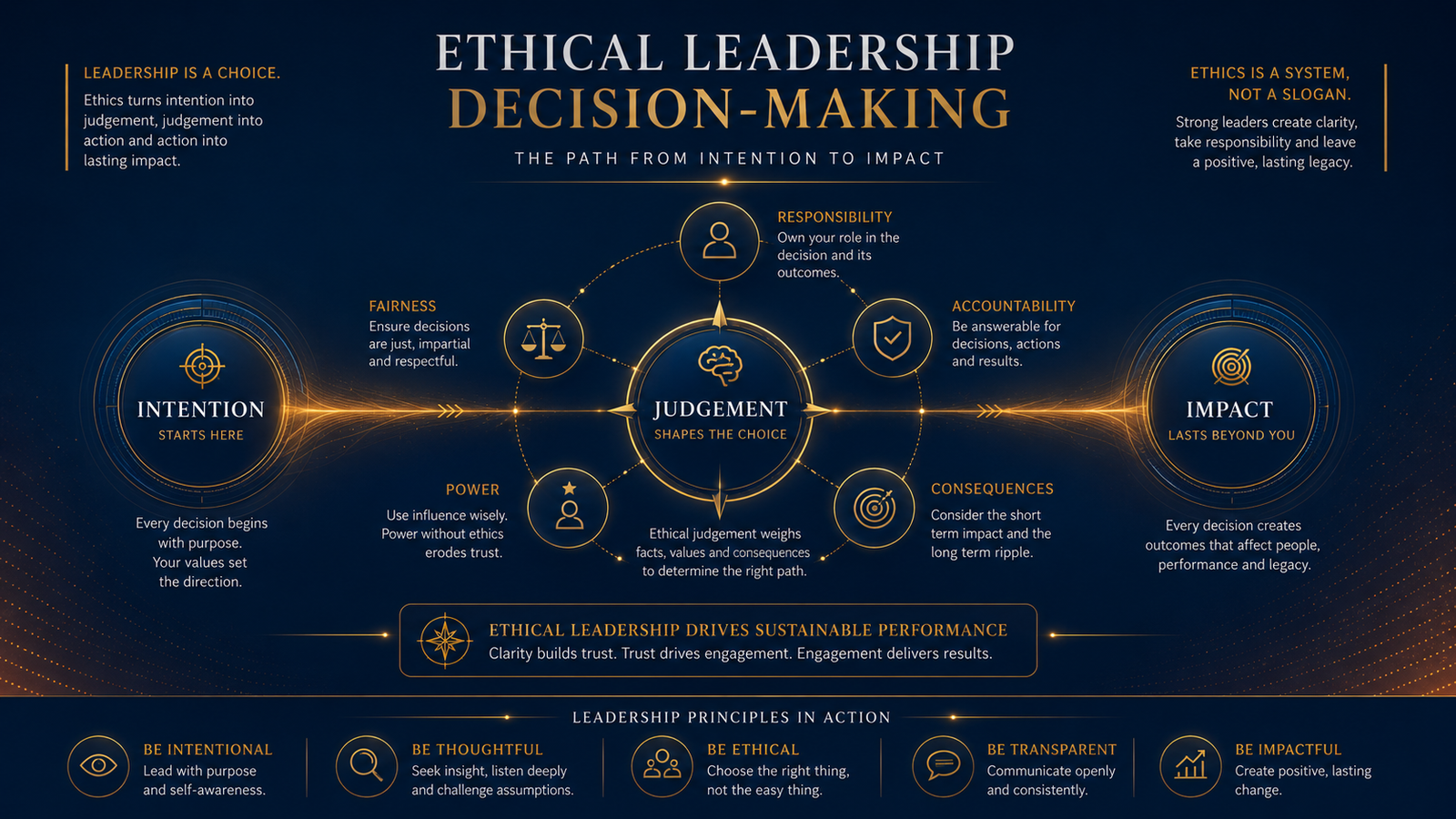
Ethics Leadership Is a Judgement System, Not a Character Claim
One of the most persistent weaknesses in discussions about ethical leadership is the tendency to frame ethics primarily as a question of character. We describe leaders as principled or unprincipled, trustworthy or untrustworthy, ethical or unethical. Character matters. But character alone is an inadequate operating system for complex leadership.
A leader can be sincere and still make a damaging decision. A manager can care deeply about employees while creating unfair workloads. A school leader can believe they are protecting standards while establishing a culture in which staff become afraid to challenge decisions. A healthcare executive can pursue efficiency for legitimate reasons while unintentionally creating conditions that weaken professional judgement at the frontline.
Ethical leadership requires leaders to move beyond what they intended and examine what their decisions actually produce — asking difficult questions about responsibility, fairness, consequences, accountability and power.
The Dangerous Gap Between Intention and Impact
Leadership decisions rarely arrive labelled “ethical dilemma.” They arrive disguised as operational problems: a budget needs reducing, a deadline must be met, performance is below expectation, a complaint has been made, a senior employee has behaved poorly, a patient-safety concern has been raised, a political commitment must be delivered, a strategic project is behind schedule.
Under pressure, leaders naturally focus on solving the visible problem. Ethics leadership requires them to examine the system surrounding it. Consider a business leader instructed to reduce costs by 10 per cent. The financial objective may be legitimate, but the ethical quality of the decision cannot be evaluated from the savings figure alone.
- Who absorbs the reduction?
- Were alternatives genuinely considered?
- Are workloads transferred to employees who already lack capacity?
- Are contractors treated differently from permanent staff simply because their interests are easier to ignore?
- Who receives the benefits of the savings, and who carries the consequences?
The spreadsheet records the financial decision. It does not automatically record the ethical one. This distinction is fundamental to Leadership Performance Intelligence™: sustained leadership performance cannot be assessed solely through whether an organisation achieves its intended outcome. A result achieved by exhausting leadership capacity, weakening trust, concealing risk or transferring unreasonable costs to others may technically represent short-term success while reducing the organisation’s capacity to perform in the future.
Why Compliance Is Necessary — and Insufficient
Organisations understandably invest heavily in policies, codes of conduct, governance procedures and regulatory compliance. These mechanisms matter — they establish boundaries and provide common expectations. But compliance answers a relatively narrow question: what are we permitted or required to do?
Ethics leadership introduces a wider question: what should responsible leadership do within the circumstances we actually face? An action can comply with policy while still damaging trust. A process can meet regulatory requirements while distributing consequences unfairly. A decision can remain technically within a leader’s authority while representing an inappropriate use of that authority.
This is where organisations become vulnerable to ethical minimalism: treating the absence of a rule violation as evidence of good leadership. It is not. Compliance establishes the floor. Ethics Intelligence™ examines the quality of judgement above that floor.
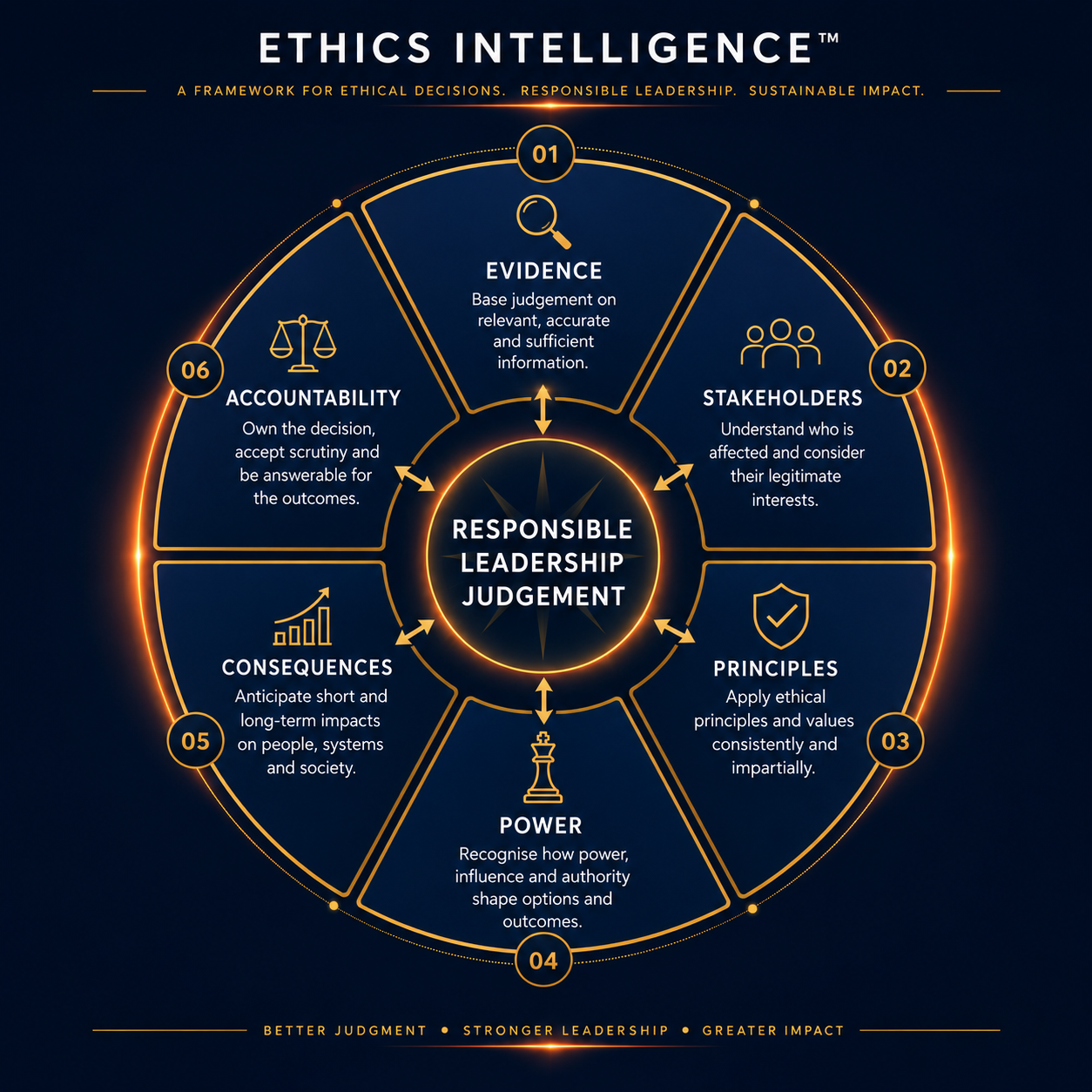
The Burn Bright Ethics Intelligence™ Framework
Burn Bright Advisory™ approaches ethical leadership through an integrated decision framework rather than a list of abstract values. Before significant decisions are finalised, leaders should examine six questions.
Question 1 What Is Actually Happening?
Separate evidence from assumption. What facts are known? What remains uncertain? Which interpretation of the situation has become dominant, and why? Poor ethical decisions frequently begin with incomplete framing.
Question 2 Who Is Affected?
Identify stakeholders beyond those represented in the meeting, including people with limited organisational power but significant exposure to the consequences of the decision.
Question 3 Which Principles Apply?
Consider organisational values, professional obligations, legal requirements, fairness, dignity, stewardship and the organisation’s stated purpose. The objective is to identify where principles compete — not simply to find one that supports the preferred option.
Question 4 What Role Is Power Playing?
Who can challenge the decision safely? Whose interests can be ignored without immediate consequence? Who controls information? Unexamined power makes ethical blind spots substantially more likely.
Question 5 What Consequences Could Follow?
Examine immediate and longer-term effects — not only financial or operational outcomes but trust, precedent, professional behaviour, workload, psychological safety, reputation and future decision quality.
Question 6 Can We Remain Accountable?
Imagine explaining the reasoning transparently to those affected. Could the decision be defended without hiding important assumptions? Accountability converts ethics from aspiration into leadership practice.
Together, these questions create a decision architecture for ethical judgement — something more useful than another statement of values.
Ethics Intelligence™ Changes the Question
The conventional leadership question is often: “Can we do this?”
The Ethics Intelligence™ question is: “What happens — to people, trust, performance and the organisation — if we do?”
That change appears small. Its implications are substantial.
It moves ethics from the margins of governance into the centre of leadership performance, and establishes the foundation for the next challenge: understanding why intelligent, experienced and fundamentally decent leaders can still make decisions that gradually normalise unfairness, silence challenge and weaken organisational trust.
Ethical Drift: How Reasonable Exceptions Become Leadership Risk
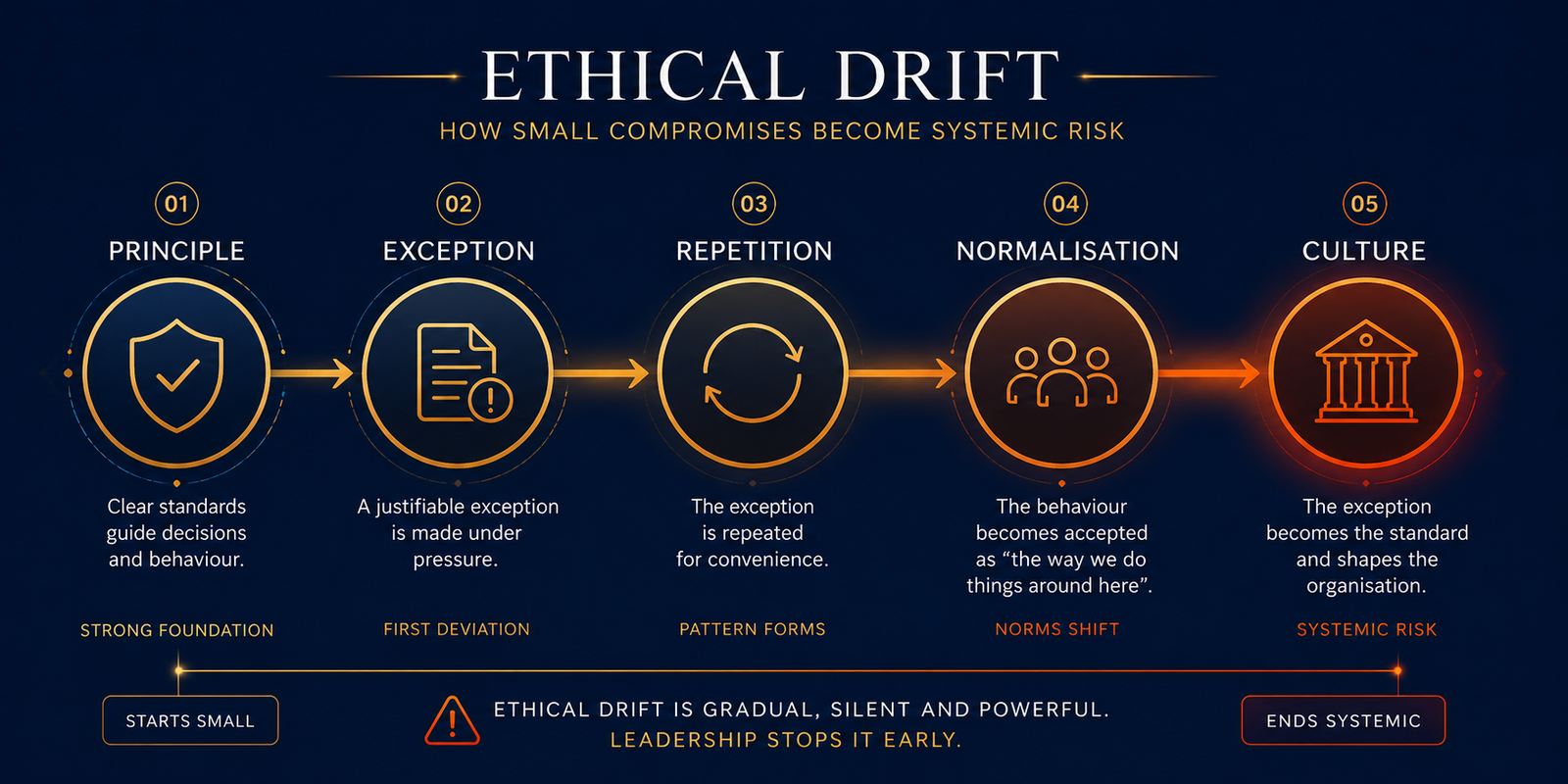
Serious ethical failures rarely begin with a dramatic decision. More often, they develop through a sequence of small accommodations: a deadline is unusually tight, so a normal consultation is skipped; a high performer behaves badly, but the issue is handled informally because their contribution is considered difficult to replace; a workload problem is tolerated because the organisation is going through an exceptional period.
Each decision can be explained. That is precisely what makes ethical drift dangerous. Ethical drift occurs when repeated exceptions gradually change what an organisation considers acceptable. The formal values may remain unchanged, policies may remain in place, and leaders may continue to describe the organisation as fair, transparent and accountable — but everyday behaviour begins telling a different story.
Leadership culture is not primarily established through values displayed on a website. It is established through what leaders repeatedly permit, reward, challenge and ignore.
The Ethical Significance of Small Decisions
Leadership ethics is often discussed through extraordinary cases: corruption, fraud, discrimination, abuse of authority or catastrophic governance failures. Those cases matter, but concentrating exclusively on major misconduct can obscure the more common leadership problem. Most leaders spend their working lives making decisions that fall into ethical grey areas rather than obvious categories of right and wrong.
Consider a manager with two employees. One consistently delivers exceptional results but regularly dismisses colleagues, dominates meetings and creates tension within the team. The second is reliable, collaborative and professionally respectful but produces less spectacular individual results. When promotion becomes available, who should receive it?
An Ethics Intelligence™ perspective asks a wider set of questions: What behaviour will the promotion legitimise? What forms of performance are being measured, and what forms are being ignored? Who carries the hidden cost of the high performer’s behaviour? A person who achieves exceptional individual results while reducing the effectiveness of everyone around them may not be a high performer when performance is measured systemically.
Power Is the Variable Leaders Cannot Afford to Ignore
Ethical leadership becomes significantly more complicated when power enters the equation — and power is present in almost every leadership decision. Leaders control or influence resources, information, opportunities, workload, recognition, promotion, access and sometimes people’s continued employment.
In schools, leaders influence teaching assignments and professional reputation. In healthcare, hierarchy can affect whether professionals feel able to question decisions affecting patient care. In public service, leaders influence how policy priorities are interpreted. In entrepreneurial organisations, founders can possess extraordinary formal and informal authority because ownership, strategy and organisational identity converge around one individual.
Power itself is not the problem — leadership requires authority. The ethical challenge is that power changes the conditions under which other people interact with leaders. A senior executive may say “my door is always open.” That does not mean employees experience the organisation as safe enough to walk through it. The ethical leader therefore does not evaluate openness solely from personal intention — they examine whether the conditions surrounding power make meaningful challenge possible.
The Power Test
Imagine a senior leader scheduling an urgent meeting at 7:00 p.m. From the leader’s perspective, the request may appear reasonable. But employees may experience it differently: can they realistically decline? Will absence signal insufficient commitment? What appears to the leader as flexibility can appear to somebody with less power as obligation. Ethics Intelligence™ requires leaders to understand both realities.
Ethical Leadership Requires Challenge, Not Agreement
One of the paradoxes of senior leadership is that increasing authority can reduce access to uncomfortable information. People become more careful, language becomes more diplomatic, problems are filtered, and bad news travels more slowly. A leader can therefore become more confident at exactly the moment when they should become more curious.
This is why ethical leadership requires designed challenge — not occasional invitations to disagree, and not a leader saying “please be honest with me,” but actual structures through which assumptions can be questioned. This is where Ethics Intelligence™ connects with Constructivism Intelligence™ and Reflective Practice Intelligence™ within the Leadership Intelligence Compass™.
The question changes from: “Does everyone agree?”
to: “Have we created sufficient challenge to discover what we may be missing?”
That is a much higher leadership standard.
When Ethical Leadership Looks Different Across Sectors
The principles of Ethics Intelligence™ are universal. Their application is contextual.
Business Growth Intelligence™
A commercial leader may face pressure to deliver quarterly performance while protecting longer-term organisational capability. Increasing workload, postponing development activity and pushing harder for short-term output may each appear commercially rational individually, but collectively create a leadership capacity deficit. The question isn’t whether to pursue performance — it’s whether today’s performance is being financed by tomorrow’s organisational capacity, connecting Ethics Intelligence™ directly with Leadership Sustainability™.
School Leadership Intelligence™
A school facing declining results may introduce new monitoring systems, more frequent data meetings and additional planning documentation. Each intervention can be defended as improving educational quality, but an ethical analysis asks: at what point does legitimate accountability become an environment of surveillance that reduces professional learning rather than improving it?
Healthcare Leadership Intelligence™
A department under severe staffing pressure may depend on professionals repeatedly accepting additional shifts. Leaders must ask how long exceptional effort can remain exceptional, when voluntary flexibility becomes implicit expectation, and whether the organisation is solving the capacity problem or transferring it to individual professionals.
Public Service Leadership Intelligence™
Public-sector leaders operate between political priorities, legal requirements, public expectations, financial constraints and professional advice. Ethics Intelligence™ requires transparency about the trade-offs involved — what evidence informed the decision, whose interests were prioritised, and who bears the cost.
HR & People Leadership Intelligence™
People decisions are among the clearest tests of organisational ethics because employees quickly notice inconsistencies between stated principles and actual treatment. If poor behaviour is tolerated from senior employees but challenged among junior staff, the organisation communicates that standards are conditional on status.
Entrepreneur Performance Intelligence™
Entrepreneurial organisations face a distinctive ethical challenge because founders often combine vision, ownership and executive authority. That concentration can accelerate decision-making but also reduce challenge. Ethical maturity for founders includes deliberately creating constraints around their own power.
The Ethics Intelligence™ Decision Check
Before making a consequential leadership decision, leaders can use the following diagnostic.
| Dimension | Leadership Question |
|---|---|
| Evidence | What do we know, and what are we assuming? |
| Stakeholders | Who benefits, who carries the cost and who has not been represented? |
| Principles | Which values or obligations apply, and where do they conflict? |
| Power | Who can challenge this decision safely? |
| Fairness | Would we apply the same reasoning to someone with less status or influence? |
| Consequences | What could happen immediately and over time? |
| Precedent | What behaviour will this decision make easier to justify next time? |
| Transparency | Could we explain our reasoning openly to those affected? |
| Accountability | Who will own the consequences if our assumptions prove wrong? |
| Sustainability | Does this decision preserve or consume future leadership capacity? |
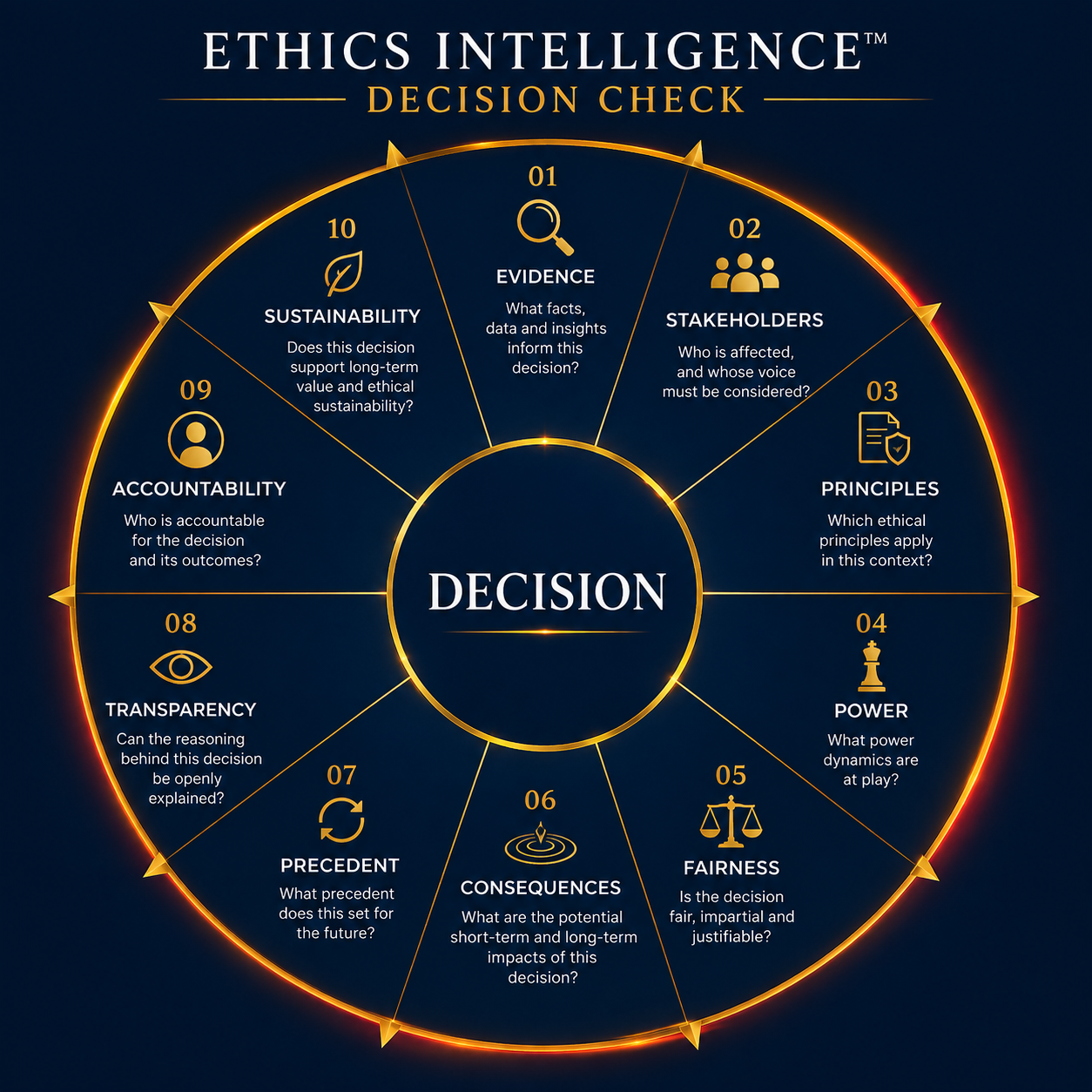
The purpose of this framework is not to make every decision slower — leadership teams that develop shared ethical reasoning become more capable of recognising risk early because they possess a common language for discussing it. It also prevents ethics from becoming the sole responsibility of a compliance department; ethics becomes part of operational judgement.
The Relationship Between Ethics and Trust
Trust is frequently discussed as though it were primarily relational. Leaders are encouraged to communicate more, demonstrate empathy and behave authentically. Those behaviours matter, but organisational trust is also structural. People watch what happens when values become inconvenient — whether leaders admit mistakes, whose behaviour receives consequences, whether bad news is welcomed or punished, whether promises survive financial pressure.
Trust accumulates through evidence. Every consequential leadership decision adds information to an organisation’s unwritten answer to one question: “What really happens here when things become difficult?” Ethical leadership determines that answer. Admitting uncertainty must lead to better inquiry. Admitting a mistake must lead to accountability. Otherwise, transparency becomes performance rather than practice.
Ethical Leadership Is Capacity, Not Perfection
Ethics Intelligence™ does not assume leaders will always make the correct decision — complex leadership rarely provides that certainty. There will be competing interests, incomplete information, and consequences that are sometimes unpredictable. A stronger test is whether leaders have developed the capacity to recognise, examine, explain and learn from ethical complexity.
That capacity becomes especially important under pressure. Exhausted leaders do not simply have less energy — their decision environment changes. Reflection becomes harder, urgency dominates, consultation feels expensive, and short-term solutions become more attractive. Ethics Intelligence™ and Leadership Sustainability™ are therefore connected: a leadership system that leaves decision-makers permanently overloaded may unintentionally weaken the conditions required for responsible judgement.
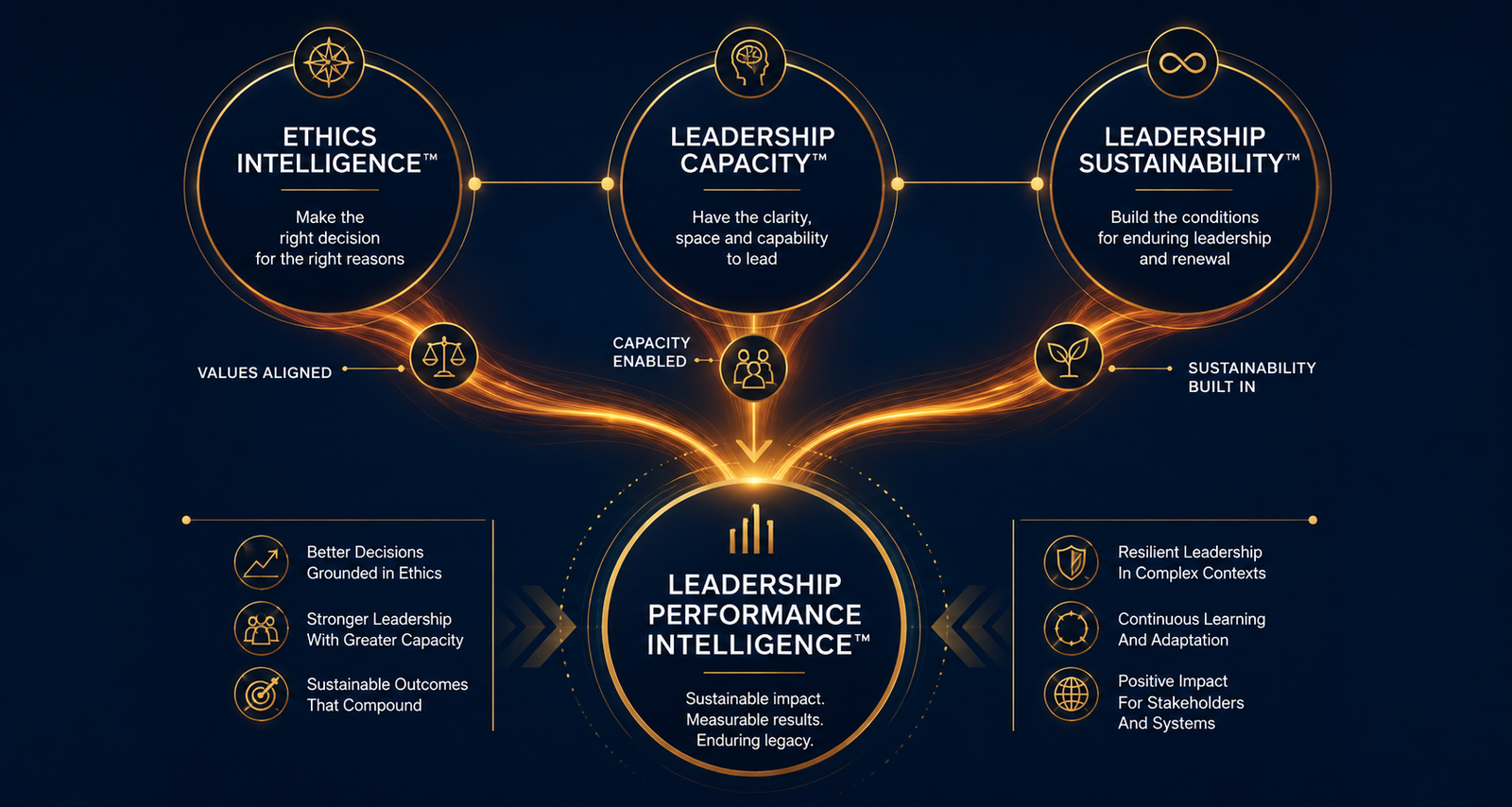
Organisations cannot demand ethical leadership while simultaneously designing leadership roles that remove the time, challenge, information and psychological capacity required to exercise ethical judgement. Ethics is not simply something leaders possess — it is something leadership systems must enable.
Building Ethics Intelligence™ Into Everyday Leadership
Ethical leadership becomes meaningful when it changes how decisions are made. That requires moving Ethics Intelligence™ beyond values statements, annual compliance training and responses to misconduct — into the everyday infrastructure of leadership: planning, recruitment, performance management, resource allocation, workload decisions, strategic reviews and executive conversations.
From Ethical Intention to Ethical Infrastructure
1. Introduce Explicit Ethical Questions
Leadership papers and project proposals should not address only cost, risk and implementation. They should identify affected stakeholders, potential inequalities, assumptions, power relationships and longer-term consequences.
2. Establish Legitimate Challenge
A leader saying “you can disagree with me” is not a challenge system. Organisations need meeting practices, escalation routes and decision processes through which dissent can influence the outcome without disproportionate personal risk.
3. Review Decisions After Implementation
Ethical responsibility does not end when approval is given. Leaders should examine whether consequences matched expectations, which groups experienced unintended effects, and what should change.
4. Measure Patterns, Not Isolated Incidents
A single exception may be justified; twenty similar exceptions may reveal the real operating culture. Leadership intelligence emerges when organisations become capable of seeing those patterns.
Leadership Reflection Questions
- Which ethical principles become hardest for me to protect when I am under pressure?
- Who has sufficient psychological and organisational safety to challenge my decisions?
- Which stakeholders are least represented in the decisions I make?
- Where might status influence how consistently I apply organisational standards?
- Which “temporary” exceptions in my organisation are becoming normal practice?
- When did I last change an important decision because somebody with less authority challenged my reasoning?
- Do I evaluate leadership decisions by intention, outcome, or both?
- Where is short-term performance being achieved by consuming longer-term Leadership Capacity™?
- Which assumptions about fairness, professionalism or performance have I not examined recently?
- If those most affected by my decisions could observe the entire decision process, would I remain comfortable defending it?
Action Steps: A 30-Day Ethics Intelligence™ Review
Week 1 — Observe
Select five consequential decisions made during the previous three months. Reconstruct them without judging them: who participated, what information was available, which stakeholders were considered, what pressure existed, what assumptions influenced the decision.
Week 2 — Examine
Apply the Ethics Intelligence™ Decision Check to each decision, looking particularly for repeated blind spots involving power, stakeholder representation, fairness, precedent and sustainability. The purpose is pattern recognition, not retrospective blame.
Week 3 — Challenge
Ask a trusted colleague or leadership team to examine one decision from an alternative perspective: “What becomes visible when we examine this decision from the perspective of the person with the least influence over it?”
Week 4 — Embed
Choose one recurring decision process — recruitment, promotion, resource allocation, restructuring, performance management, workload planning or strategic investment — and add an Ethics Intelligence™ checkpoint. Build the discipline somewhere consequential, evaluate it, and expand from there.
Conclusion: Ethical Leadership Is What Happens When Values Become Expensive
Most organisations can uphold their values when doing so is easy. The meaningful test arrives when values compete with something else the organisation wants: speed, revenue, reputation, convenience, political advantage, performance, personal loyalty or short-term stability. That is when leadership ethics becomes visible.
The central challenge is not whether leaders can describe their values. It is whether their decision systems continue to protect those values when pressure creates incentives to compromise them. Ethics Intelligence™ asks leaders to move beyond the reassuring question “did I mean well?” and confront the more demanding questions: What did my decision produce? Who benefited? Who carried the cost? Whose perspective was absent? How did power influence the process? What precedent did I create?
This is not leadership perfection. It is leadership accountability — and accountability is especially important because ethical judgement cannot be separated from leadership capacity. A leader requires capacity to perform, reflection to learn, professionalism to establish standards, Emotional Intelligence™ to understand human impact, Constructivism Intelligence™ to recognise alternative perspectives, and Ethics Intelligence™ to exercise power responsibly. That is the deeper purpose of the Leadership Intelligence Compass™: leadership capability is not one competency — it is a system.
Because ultimately, ethics leadership is not demonstrated by what leaders believe when decisions are easy. It is revealed by what they protect when the decision becomes difficult.
What is ethics leadership?
Ethics leadership is the disciplined practice of using authority, judgement and accountability responsibly. It involves examining evidence, stakeholders, principles, power, fairness, consequences and longer-term implications before and after consequential decisions.
What is Ethics Intelligence™?
Within Burn Bright Advisory’s Leadership Intelligence Compass™, Ethics Intelligence™ describes a leader’s capacity to recognise ethical dimensions within decisions and reason responsibly through competing principles, stakeholder interests, power relationships and consequences. It converts ethics from an abstract value into an applied leadership capability.
Why are good intentions insufficient in leadership?
Intentions describe what a leader hoped to achieve; they do not determine what other people experience. Well-intentioned decisions can still create unfair workloads, discourage challenge, reward inappropriate behaviour or transfer risk to people with less organisational power.
How is ethical leadership different from compliance?
Compliance asks whether behaviour satisfies laws, policies, regulations and formal requirements. Ethical leadership asks the broader question of whether the exercise of authority is responsible, fair, transparent and defensible. Something can be technically permitted without representing good leadership judgement.
What is ethical drift?
Ethical drift occurs when individually explainable exceptions gradually change what an organisation regards as normal. Because the change happens incrementally, leaders may fail to recognise that everyday practice has moved away from stated organisational principles.
Why does power matter in ethical leadership?
Leadership decisions occur within unequal power relationships. Employees may technically be able to disagree or raise concerns while believing that doing so could affect their reputation, opportunities or employment. Ethics Intelligence™ examines how authority changes the choices available to others.
Can ethical leadership improve organisational performance?
Ethics should not be treated merely as an instrument for increasing performance. However, responsible decision systems protect important conditions for sustainable performance, including trust, challenge, accountability, professional judgement and organisational learning — which is why Ethics Intelligence™ forms part of Leadership Performance Intelligence™.
How can organisations develop Ethics Intelligence™?
Organisations can incorporate ethical reasoning into leadership assessment, development, decision templates, strategic reviews, diagnostics, workshops and reflective practice. The capability becomes stronger when leaders repeatedly apply it to genuine organisational decisions rather than studying ethics only through hypothetical scenarios.
Strengthen the Intelligence Behind Your Leadership Decisions
Use the Leadership Burnout Self-Assessment to identify where pressure may already be narrowing your judgement, reducing challenge, or quietly reshaping what your organisation treats as normal.
Free Leadership Intelligence
Get Weekly Leadership Insights
Join thousands of leaders receiving practical strategies on burnout prevention, workload design, and sustainable performance every week.