Quick Answer
Key Takeaways
- Fear-based non-delegation often looks like commitment, but eventually creates leadership overload.
- Leaders frequently retain work because they fear mistakes, loss of control, reputational damage or being held accountable for someone else’s decisions.
- Every task retained by a leader consumes capacity that cannot then be used for strategic leadership.
- Delegation without clear authority and accountability creates anxiety for both the leader and the person receiving the work.
- Sustainable delegation is not about abandoning control. It is about designing better control into the system.
Fear-Based Non-Delegation: Why Leaders Hold On
Fear based non delegation is one of the quietest causes of leadership overload. It rarely begins with a conscious decision to control everything. It begins with reasonable thoughts.
I need to make sure it is right.
It will take me longer to explain it than to do it.
They are already busy.
If something goes wrong, I will be accountable anyway.
Each statement can be true. The problem starts when these exceptions become the operating model. One task remains with you. Then another. Decisions keep moving upwards. Team members learn to check before acting. Your calendar fills with work that technically belongs somewhere else. Eventually, you are approving, reviewing, correcting and deciding far more than your role was designed to carry. Then the working day expands to compensate.
This is why delegation cannot be treated simply as a personal productivity technique. It is part of Workload Architecture™. Who owns the work? Who has authority to make the decision? What genuinely requires leadership involvement? Where should accountability sit? What happens when something goes wrong?
If those questions are unclear, telling an overwhelmed leader to “delegate more” solves very little. The real objective is to create a system in which work can move away from the leader without responsibility, standards or accountability collapsing. That requires us to understand why leaders hold on in the first place.
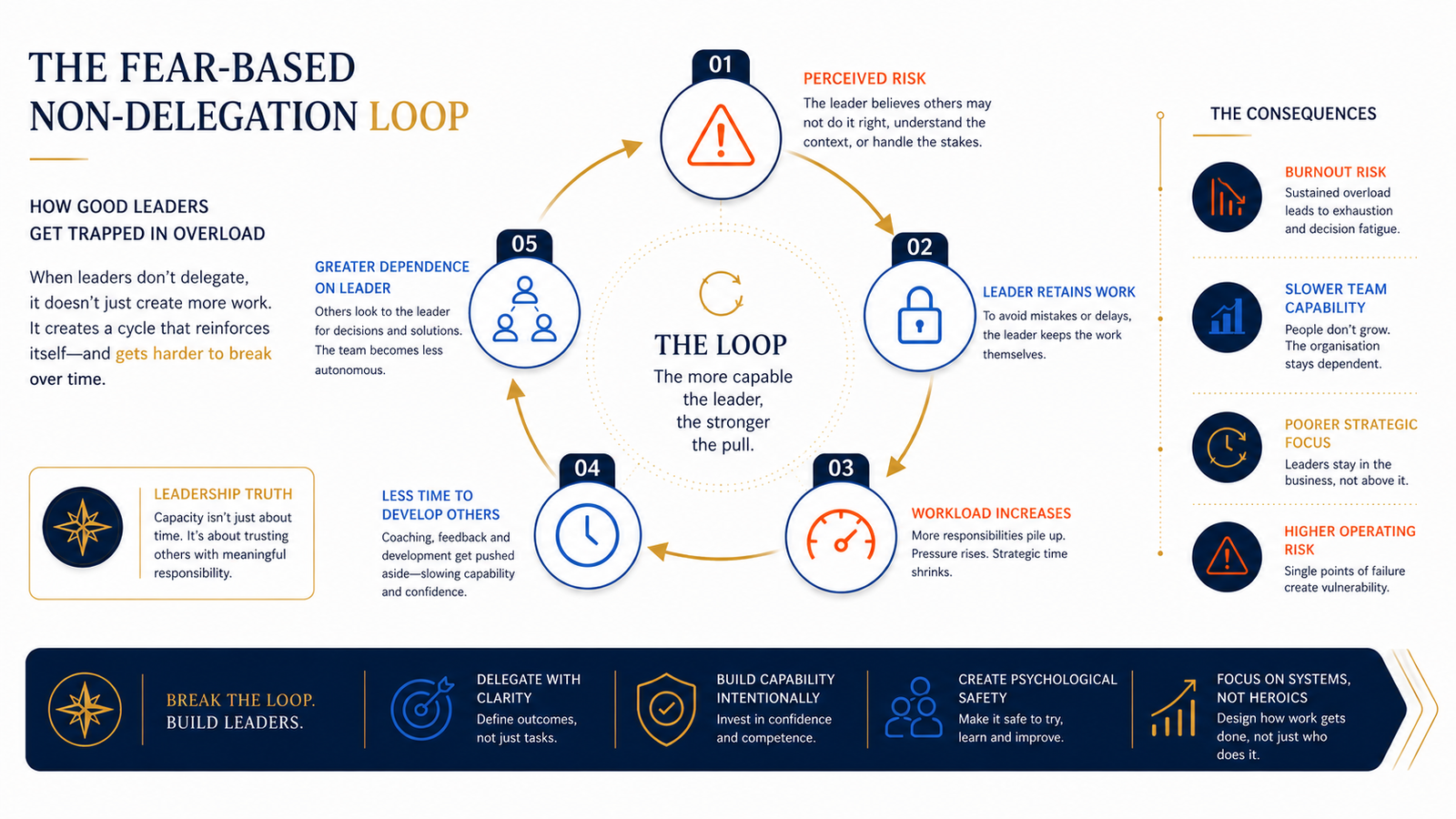
The problem is circular. A leader who is overloaded often has less time to brief, coach and develop other people. Because delegation now feels harder, the leader retains more work. That increases overload further. Breaking the cycle requires structural intervention rather than simply asking the leader to try harder.
What Is Fear-Based Non-Delegation?
Fear-based non-delegation occurs when a leader keeps responsibility, tasks or decisions that could reasonably sit elsewhere because retaining control feels safer than transferring it. That does not necessarily mean the leader is consciously afraid. Fear in leadership often sounds far more professional.
“I need visibility.”
“I want to maintain quality.”
“Send it to me before it goes out.”
“Keep me copied in.”
“I’ll make the final decision.”
“Let me fix it.”
These can all be legitimate management behaviours. The diagnostic question is not whether a leader sometimes uses them. Good leadership requires oversight. The question is whether everything keeps returning to the leader.
Consider a senior leader managing a capable team. A team member prepares a report — the leader rewrites it. A manager wants to make a supplier decision — the leader asks to approve it. A client issue emerges — the leader steps in. A presentation is being prepared — the leader adjusts every slide. A difficult conversation needs to happen — the leader decides to attend.
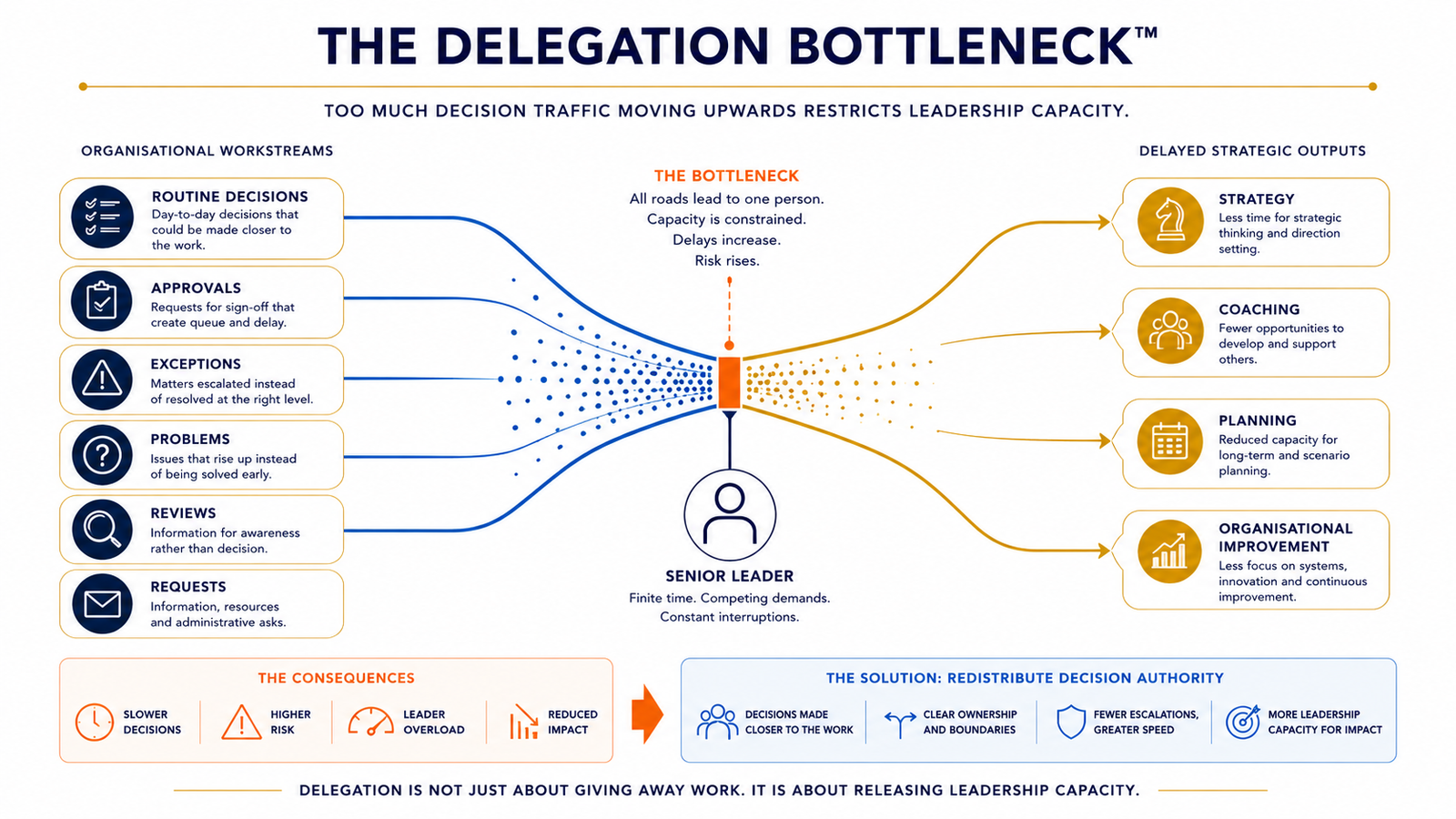
None of those interventions appears catastrophic in isolation. Together, they create an operating system. The organisation gradually learns that important work goes through the leader. That changes behaviour. People stop exercising judgement because exercising judgement carries risk while asking permission does not. Managers escalate decisions they could make themselves. Employees bring problems upward before developing solutions. Work slows because approval becomes concentrated in one place.
The leader then looks around and concludes: nobody takes enough ownership. But the system may be producing exactly the behaviour the leader dislikes.
The Difference Between Accountability and Control
This is where many leaders become trapped. Senior leaders are accountable for outcomes. They therefore assume they must personally control the activities producing those outcomes. Those are not the same thing.
A hospital leader can remain accountable for the quality of a service without personally approving every operational decision. A school leader can remain accountable for standards without rewriting every department plan. A managing director can remain accountable for financial performance without personally approving routine expenditure.
Featured Snippet
Why Competent Leaders Are Particularly Vulnerable
Fear-based non-delegation is not necessarily a sign of weak leadership. It can emerge precisely because a leader is highly competent. Competent leaders know they can complete a task quickly, know the standards required, and may have built their careers by being the person who gets difficult things done. That creates a dangerous equation:
The leader becomes the safest pair of hands in the organisation, so more work moves towards them. Success reinforces the pattern. Someone has a problem? Give it to Vincent. A deadline is slipping? Give it to the director. A client is unhappy? Escalate it. A project is struggling? Put the senior leader into the meeting.
The leader repeatedly rescues the system. Each rescue appears successful because the immediate problem gets solved. But the system learns nothing. Capability remains concentrated. Decision authority remains unclear. The team becomes increasingly dependent upon escalation. The leader becomes increasingly indispensable.
Being indispensable can feel like evidence of leadership value. Structurally, it can be evidence of leadership risk. If the organisation cannot function effectively without your constant intervention, you have not created resilience. You have created dependency.
The Hidden Connection to Burnout
This matters because non-delegation is one of the mechanisms through which leadership workload expands. Burn Bright’s structural model identifies scope creep as one of five root causes of burnout alongside meeting culture, communication chaos, decision overload and perfectionism culture. Delegation sits across several of these problems: poor delegation expands scope, poor decision authority increases decision overload, constant checking creates communication traffic, and perfectionism encourages leaders to redo work. Every responsibility retained by the leader occupies capacity that cannot be used elsewhere.
The result is not simply a longer task list. It is a different kind of leadership role. Instead of leading the system, the leader increasingly operates inside it. Strategic thinking becomes something done after hours. Planning gets pushed to Friday afternoon. Coaching becomes irregular. Development conversations disappear. Important but non-urgent work is continually displaced by operational demand.
Eventually, the leader concludes that there simply are not enough hours in the day. Sometimes that is true. But the more useful question is: why does so much work require this leader’s personal involvement? That question moves us away from personal productivity and towards organisational diagnosis, because leaders cannot outwork a system designed to send everything upwards. They have to redesign it.
Why Are Leaders Afraid to Delegate?
Leaders rarely resist delegation because they do not understand the concept. Most have attended courses on it and know the theory. Yet knowledge does not remove perceived risk. The deeper issue is that delegation requires a leader to tolerate something psychologically uncomfortable: another person may do the work differently. Not necessarily badly. Differently.
A leader may have spent 15 or 20 years developing judgement, expertise and preferred ways of working. When someone else takes responsibility, they will inevitably make different choices. The leader then has to decide whether those differences represent genuine risk or simply a loss of personal control.
The Quality Fear in Practice: Where the 10% Goes
If the output needs to reach 90% to achieve its purpose, but a leader continually intervenes to move it from 90% to their preferred 100%, that additional 10% has a capacity cost. Multiply that behaviour across reports, presentations, meetings, decisions and projects. Perfectionism becomes workload.
Risk Thresholds Instead of Universal Control
If every mistake must be prevented by senior leadership intervention, the organisation cannot scale. Senior leaders become quality-control departments, managers become approval mechanisms, and employees learn that avoiding mistakes matters more than exercising judgement. A sustainable system asks three questions: what can this person decide independently, what requires consultation before a decision, and what genuinely requires escalation? Without those distinctions, “use your judgement” is not empowerment — it is ambiguity, and ambiguity makes both leaders and employees nervous.
The RACI Delegation Framework™
This is one reason the Burn Bright framework includes the RACI Delegation Framework™ alongside Workload Architecture™ and decision fatigue management. RACI asks four useful questions: who is Responsible for completing the work, who is Accountable for the outcome, who must be Consulted, and who simply needs to be Informed.
The power of the model is not the acronym — it is the conversation it forces. Too many leadership teams operate with everyone vaguely involved and nobody genuinely empowered. Task delegation without authority delegation simply moves activity while retaining the bottleneck.
Graduated Authority Builds Trust
Think of delegation as a series of levels. At the lowest level: “research the issue and bring me the information.” Then: “research the issue and recommend an option.” Then: “develop the options, recommend one and proceed after approval.” Then: “make the decision and tell me what you decided.” Eventually: “own this area, escalate only when agreed thresholds are reached.” This is how capability grows — control changes form rather than disappearing, moving from close review to checkpoints to agreed outcomes and exception reporting.
How Does Fear-Based Non-Delegation Create Burnout?
Fear-based non-delegation creates burnout because it steadily increases the amount of work, decision-making and cognitive responsibility concentrated in one role. A leader retains one report because it is sensitive, another because the team is inexperienced, a third because the deadline is tight, continues chairing a meeting because nobody else knows the history, retains approval of expenditure because budgets are under pressure, keeps a client relationship because it is strategically important, and reviews communications because reputation matters. Every decision makes sense individually. Collectively, they create an impossible job — scope creep through retention.
That pattern sits directly inside the Burn Bright diagnosis of leadership burnout: scope creep is one of the framework’s five root causes, alongside meeting culture, communication chaos, decision overload and perfectionism culture. Fear-based non-delegation can amplify all five.
Non-Delegation Creates Decision Overload
Every responsibility retained contains decisions — small individually, but significant cumulatively. A senior leader may begin the morning making strategic decisions about budgets, staffing or organisational priorities, and by mid-afternoon be deciding whether a sentence in a presentation should change. Every switch requires attention. Every unresolved issue remains mentally open. This is why leaders can reach the end of a day feeling exhausted despite struggling to identify what they actually accomplished — they have spent the day processing organisational traffic. The more judgement the organisation concentrates at the top, the more depleted senior leaders become.
Non-Delegation Creates Communication Chaos
Retained authority also generates communication. If you own the decision, people need to update you. If you need to approve the work, they need to send it to you. Email increases, messages increase, meetings increase. This produces a paradox: the leader delegates tasks to reduce workload but retains so much involvement that delegation creates additional communication rather than additional capacity. The leader then concludes “delegating takes too much time” — within the existing system they may be right, but that does not mean delegation itself has failed. It means the delegation architecture is poor.
Why “It Is Quicker to Do It Myself” Becomes a Trap
Suppose a task takes you 30 minutes, but explaining it properly to someone else takes 45. If your only measure is today’s calendar, delegation appears inefficient — so you do it yourself. After three months, you may have spent six hours completing a task because you wanted to avoid a 45-minute delegation conversation. Doing it yourself optimises for today. Delegating develops capacity for tomorrow. Ask: will this responsibility happen again? If yes, the question is no longer whether delegation saves time today, but whether continuing to own it is the best use of leadership capacity over the next six months.
The Delegation Investment Curve
Delegation usually creates a temporary increase in workload before it produces a reduction: you explain, then demonstrate, then the other person attempts the task, then you review, give feedback, and they try again. Gradually, leadership input declines until the work no longer requires you. Leaders who are already overloaded struggle with this because they are operating in survival mode and do not have an obvious spare hour to create three future hours. This is why delegation problems cannot be separated from workload design.
How Does Non-Delegation Weaken the Team?
The cost of fear-based non-delegation is not confined to the leader. People learn how authority actually works by observing what happens when they use it. If employees make reasonable decisions and are repeatedly overruled, they stop deciding. If managers prepare work and leaders routinely rewrite it, they stop taking full ownership. If every unusual situation must be escalated, escalation becomes normal. If independent judgement creates personal risk but asking the boss transfers that risk upwards, asking the boss becomes rational behaviour — the system has trained dependence.
The Reverse Delegation Problem
A team member brings a problem to the leader. The leader immediately solves it. The team member leaves. Who now owns the problem? The leader. Work has travelled in the wrong direction. Every “leave it with me” potentially adds another responsibility to the leader’s workload. A better response may be “what do you think we should do,” “what options have you considered,” or “what decision do you need from me?” These questions keep ownership where it belongs while still providing leadership support.
When Helping Becomes Heroic Leadership
Many organisations reward leaders for rescuing difficult situations. The person who stays late gets noticed. The director who personally fixes the crisis is praised. Heroic leadership can therefore become culturally attractive, but heroics are expensive — every rescue that depends on exceptional individual effort allows the underlying system to remain unchanged, so nobody asks why a senior leader had to intervene at all. The system survives because the leader compensates for it, until the person who made the system look functional can no longer sustain the effort.
Sustainable leadership asks a different question after the crisis has passed: what needs to change so that this no longer requires me? That question turns delegation into something larger than workload reduction. It becomes organisational development.
How Can Leaders Tell Whether They Are Delegating Too Little?
Fear-based non-delegation is difficult to diagnose from inside the role. Busy leaders usually see the individual reasons for retaining work — the sensitive client, the inexperienced manager, the important deadline. What they do not always see is the accumulated pattern. That is why the first step is not “what can I get rid of,” but “what currently depends on me?”
Look at an ordinary working week. How many decisions require your approval? How many documents come to you for review? How many meetings could not proceed without you? How many people are waiting for an answer from you? How often do you redo work rather than provide feedback? How many tasks would stop if you disappeared for two weeks?
That final question is particularly revealing. Some activities should stop — certain responsibilities genuinely belong with senior leadership. But if large parts of the organisation become paralysed because one leader is unavailable, that is not evidence of strong leadership. It is evidence of concentrated dependency.
Conduct a Dependency Audit
A simple dependency audit can expose this. Review your recurring workload and place each item into one of four categories.
Category 1 Only I Can Do This
Responsibilities genuinely attached to your role, authority or expertise — board-level decisions, highly sensitive personnel matters, statutory responsibilities or major strategic choices. Keep them, but be rigorous: this should be a small category.
Category 2 Someone Else Could Do This With Development
Responsibilities you retain because another person is not quite ready. This is often where the greatest delegation opportunity sits — the solution is capability development, not immediate abandonment.
Category 3 Someone Else Can Already Do This
The uncomfortable category. If a capable person can perform the work but you continue doing it, the problem is unlikely to be capability — it may be habit, control, perfectionism, unclear authority or fear.
Category 4 Nobody Should Be Doing This
Delegation is not the only answer. A recurring report nobody uses, an approval added after a single incident, or a meeting that exists because it has always existed should simply disappear. Delegating unnecessary work does not improve the system — it moves waste to somebody else’s calendar.
Measure the Approval Burden
For one week, record every occasion when somebody requires your permission before proceeding. At the end of the week, ask why each decision required you. You will usually find four categories: decisions that genuinely require your authority, decisions that require your expertise, decisions that reach you because nobody knows who owns them, and decisions that reach you because that is simply how the organisation has always worked. The final two categories are structural opportunities — an overloaded leader may need to stop being required to make so many decisions, rather than becoming better at making them.
How Can Leaders Delegate Without Losing Control?
Fear-based non-delegation often rests on a false choice: either I control the work personally, or I lose control completely. That is not delegation. That is abdication. Effective delegation sits between those extremes — the leader retains appropriate oversight while transferring operational ownership.
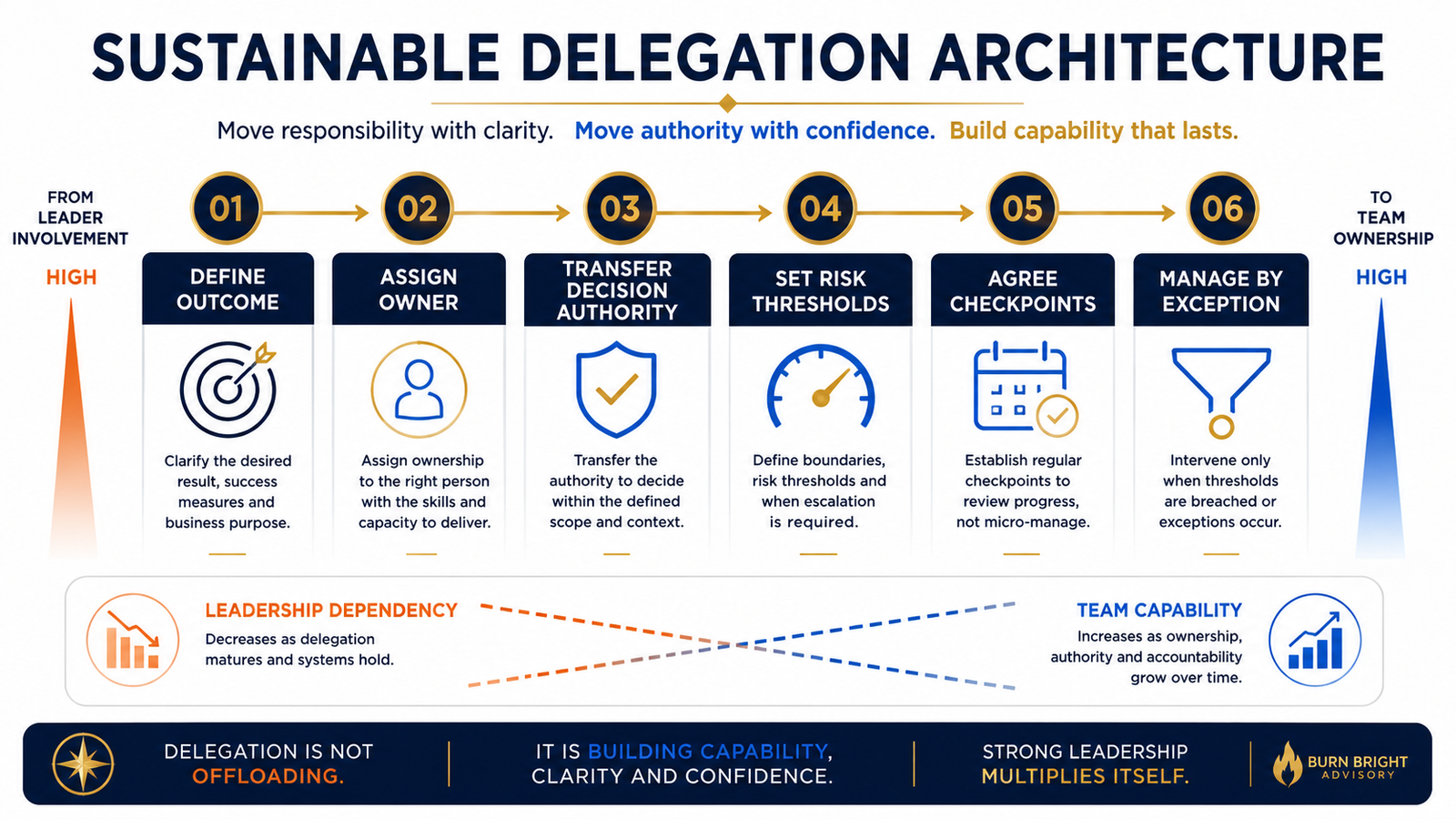
Step 1: Define the Outcome
Weak delegation transfers activity (“can you handle the report”). Strong delegation defines the required outcome — what success looks like, what standard matters, what deadline applies and what freedom the person has to decide. Otherwise the employee owns the labour while the leader still owns the thinking, which is not genuine delegation.
Step 2: Define Decision Authority
Every delegated responsibility should come with a clear answer to “what can you decide without me?” Without that clarity, the person faces a rational dilemma — act independently and risk criticism, or ask the leader and transfer the risk upwards. Most people choose the safer option, which is how organisations accidentally manufacture upward delegation.
Step 3: Establish Escalation Thresholds
Good delegation does not mean “do not bother me” — it means “bring this back to me when these conditions occur.” Explicit thresholds (financial limits, delivery tolerances, legal or reputational exposure) let the leader manage by exception rather than monitor everything continuously.
Step 4: Agree Checkpoints
The solution to fearing you’ll discover problems too late is not continuous involvement — it is scheduled visibility, agreed in advance. Structured checkpoints give the leader visibility and the employee space, replacing random checking that can signal “I don’t completely trust you.”
Step 5: Allow Different Methods
If the standard is achieved, the deadline is met and risk is controlled, a different method does not necessarily mean wrong. Sustainable delegation requires leaders to tolerate appropriate variation — otherwise every responsibility remains psychologically owned by the person at the top.
How Does RACI Reduce Fear-Based Non-Delegation?
Many delegation problems are actually role-clarity problems. Consider a senior leadership team launching a new internal development programme. Without clear roles, everyone becomes involved and nobody is certain who can make the final call. Applying RACI — for example, HR Director Accountable, Learning and Development Manager Responsible, Finance Consulted on budget, Department Heads Consulted on operational impact, CEO Informed — forces leaders to confront whether they are involved because their role requires it, or because the organisation has become accustomed to involving them.
One of the most useful disciplines within RACI is assigning a single accountable person. When accountability is shared vaguely across several people, decisions slow — everyone has influence, nobody has ownership. Clear accountability gives the organisation somewhere to place the decision without eliminating collaboration.
Many organisations use RACI for major projects but ignore it in ordinary operations. Applying the same thinking to recurring work — who owns the weekly performance meeting, who decides routine recruitment questions, who approves communications — often reveals that the answer repeatedly becomes “the senior leader,” exposing a structural concentration of authority that may simply never have been redesigned as the organisation grew.
Fear-Based Non-Delegation vs Sustainable Delegation
The difference between the two approaches is not whether leaders care about standards. Both do. The difference is where control is located.
| Fear-Based Non-Delegation | Sustainable Delegation |
|---|---|
| Leader retains work to protect quality | Leader defines quality standards before transferring ownership |
| Important decisions move upwards | Decision authority sits at the appropriate organisational level |
| Trust depends on personal confidence | Trust develops through capability, evidence and clear controls |
| Leader checks work continuously | Agreed checkpoints provide structured visibility |
| Mistakes are treated as evidence delegation failed | Appropriate mistakes are used to develop judgement |
| Accountability is confused with personal control | Accountability and operational responsibility are separated |
| Team members escalate uncertainty | Escalation thresholds define when leadership involvement is required |
| Leader corrects work personally | Leader coaches the owner to improve the work |
| Different methods create anxiety | Different methods are accepted when outcomes and standards are met |
| Leader becomes indispensable | Team capability becomes distributed |
| Short-term efficiency dominates | Long-term organisational capacity matters |
| Work accumulates at the top | Work and authority move to the appropriate level |
The sustainable model is not softer. In many ways, it requires greater discipline — it forces leaders to define standards clearly, requires difficult conversations about performance, exposes capability gaps, requires managers to coach rather than rescue, and requires senior leaders to resist the immediate satisfaction of fixing things themselves. But it produces something fear-based non-delegation cannot: capacity beyond the leader.
What Should Leaders Delegate — and What Should They Keep?
“Delegate more” is poor advice if it implies everything should move downwards. Some responsibilities belong with the leader. The objective is not maximum delegation. It is appropriate delegation. A useful filter is to assess work against four questions.
Question 1 Does This Require My Formal Authority?
Keep decisions where governance, regulation or policy requires them, but distinguish between making the final decision and completing all the surrounding work. You may need to approve a strategic investment without personally collecting every piece of information required to make that decision.
Question 2 Does This Require My Unique Expertise?
The word “currently” matters — if expertise will always remain concentrated in one person, the organisation has a succession risk. Delegation can become a form of organisational resilience, distributing institutional knowledge rather than simply reducing workload.
Question 3 Is My Involvement Adding Sufficient Value?
Treat senior leadership time as a scarce organisational resource. The real cost of non-delegation is often an opportunity cost — the strategic thinking, coaching or relationship-building that never happened because capacity was consumed elsewhere.
Question 4 Will Retaining This Work Build or Reduce Future Capacity?
Coaching a new manager or redesigning a broken process takes time now but creates future capacity. Approving the same routine decision every week merely consumes capacity repeatedly. Sustainable leadership prioritises work that improves the future system — the shift from heroic leadership to architectural leadership.
The heroic leader asks “how can I get all of this done?” The architectural leader asks “why does all of this require me?” That second question is where structural transformation begins. The goal of delegation is not to make the leader less responsible. It is to make the organisation more capable. When that happens, the leader stops being the system and starts leading it.
How Can Leaders Break the Fear-Based Non-Delegation Cycle?
Breaking fear-based non-delegation does not start by handing out more tasks. It starts by redesigning responsibility. If a leader’s task list is simply distributed across the team without addressing authority, three things often happen: the leader continues monitoring the work, the team keeps asking for approval, and the work eventually returns upwards. That is why sustainable delegation needs to address four elements together: work, authority, accountability and control.
Step 1: Map What Currently Depends on You
Take your calendar, task list, inbox and recurring responsibilities from the previous two weeks and capture reality before deciding what to delegate. For each item, ask why you are involved, what happens without you, and who the future owner should be. Patterns usually emerge: much of the workload exists because of history rather than necessity — a temporarily covered vacancy, a struggling project you stepped into, an approval retained after an incident. The circumstances changed. The responsibility remained. This is how leadership roles expand — not always through dramatic decisions, but through accumulation.
Step 2: Separate Risk From Discomfort
For each responsibility you are reluctant to transfer, get specific about the fear. Not “I don’t trust them” but “I am concerned they will commit expenditure beyond the available budget.” Specific fears can be designed around; vague fears cannot. If the concern is expenditure, establish a financial threshold. If the concern is evidence quality, create a quality standard. This is the shift from emotional control to structural control — you are no longer asking yourself to become less concerned, you are designing a system that makes the concern manageable.
Step 3: Choose the Right Level of Authority
Delegation should not be binary. Use a graduated five-level model: Level 1, Investigate (“gather the information and bring it back to me”); Level 2, Recommend (“analyse the issue and tell me what you recommend”); Level 3, Decide With Approval (“proceed once I approve it”); Level 4, Decide and Inform (“make the decision within the agreed parameters and tell me what you decided”); Level 5, Own (“this is your area — escalate only when the agreed thresholds are reached”). The objective is not to move every responsibility to Level 5, but to know which level applies, which reduces fear for everyone.
What Does Sustainable Delegation Look Like in Practice?
Imagine a director who approves every piece of departmental expenditure above £500 — a policy introduced when the department had five employees. Three years later, with 40 employees, the director receives multiple requests every day, managers complain decisions are slow and finance complains about delayed purchasing. The obvious but wrong diagnosis is that the director needs to become faster at approvals. The process was designed for an organisation that no longer exists.
A better intervention redesigns the thresholds: department managers approve expenditure up to £2,500 within existing budgets, expenditure between £2,500 and £10,000 requires director approval, anything above £10,000 follows formal procurement, unbudgeted exceptions escalate regardless of value, and a monthly report provides visibility across departmental spending. The director did not abandon financial control — control was redesigned. Routine authority moved down, exceptions remained visible, and reporting replaced constant interruption.
Stop Using Your Inbox as an Approval System
A surprising amount of organisational authority lives inside email — “can I go ahead,” “are you happy with this,” “just checking before I send it.” Each message may take only a few minutes, but the inbox gradually becomes an invisible workflow management system, so the leader’s attention becomes part of every process and nobody can easily see where decisions are getting stuck. If approval is genuinely required, create a defined process. If it is not required, remove it. If consultation is required, distinguish consultation from permission.
Replace “Keep Me Copied In” With Exception Reporting
Being copied into everything feels like visibility; usually it is information overload. Instead, define the information that actually matters — for example, tell me when a project moves more than five working days behind schedule, or when costs are forecast to exceed budget by more than 5%. The leader then receives the exceptions rather than monitoring the entire stream, which creates cognitive space — and cognitive space is a leadership resource.
What Is the 30-Day Delegation Reset?
Trying to redesign an entire leadership role in one week is unnecessary. Start with one month. The objective is not to delegate everything — it is to identify where leadership dependency is highest and remove it deliberately.
Days 1–7: Diagnose
Observe and record every approval request, every task you redo, every decision escalated to you, every meeting you attend primarily because others expect you there, and every problem you take back from somebody else. At the end of the week, identify the five recurring activities consuming the most unnecessary leadership attention and ask why each one requires you.
Days 8–14: Redesign
Choose two responsibilities — not ten. For each, define the outcome, the owner, the authority they can exercise, the constraints that cannot change, the escalation triggers, and how you will receive visibility. Then have the delegation conversation and explain the architecture explicitly rather than simply handing the task over.
Days 15–21: Resist the Rescue Reflex
When the person encounters difficulty and brings a problem, resist the instinct to solve it automatically. Ask what they recommend, what options they see, or what information would help them decide. This develops judgement rather than providing answers — intervene only when the risk threshold requires it, not simply because intervention is faster.
Days 22–30: Review the System
Review whether decisions moved faster, whether the owner became more confident, how much leadership time was released, and where unnecessary escalation continued. Ask whether interventions reflected genuine risk or personal discomfort, adjust the thresholds, and choose the next two responsibilities.
This creates progressive structural change — small enough to manage, significant enough to matter. Over several months, the leadership role begins to change, not because the leader has become more productive, but because the organisation has become less dependent on them.
What If Delegation Goes Wrong?
It will. Somebody will make a decision you would not have made, or something will take longer than expected. The presence of mistakes does not automatically mean delegation failed. The relevant question is whether this was an acceptable learning error within the agreed risk boundary, or whether the system failed to control a material risk — those require different responses.
How Does Better Delegation Protect Strategic Leadership Time?
The ultimate purpose of delegation is not a cleaner inbox or an emptier calendar. Leadership capacity should be spent on leadership work — thinking ahead, building capability, making high-consequence decisions, setting direction, identifying systemic risk, developing managers and improving organisational design. Yet these activities are often the first things displaced when operational workload grows, because operational work arrives with urgency attached while strategic work quietly disappears.
This is one reason fear-based non-delegation is so damaging. It does not simply exhaust the leader. It changes what leadership becomes — from architecture to activity, from direction to reaction, from building capability to compensating for its absence, from leadership to organisational firefighting. The answer is not to become better at firefighting. It is to reduce the number of fires that require you.
The Test of Sustainable Leadership
Ask yourself: is my team becoming more capable of operating without my constant involvement? If yes, you are building organisational capacity. If not, examine whether authority remains too concentrated, whether standards are unclear, whether you intervene too quickly, or whether your own identity has become connected to being needed. Sustainable leadership requires a different measure — not “how much depends on me,” but “how much capability have I created around me?”
The strongest leadership system is not the one where the leader solves every problem. It is the one where fewer problems need to reach the leader in the first place.
Frequently Asked Questions
What is fear-based non-delegation?
Fear-based non-delegation happens when a leader retains tasks, decisions or responsibilities because transferring them feels too risky. The leader may fear mistakes, declining standards, loss of control or accountability for another person’s decisions. Over time, this can concentrate too much work and decision authority at the top, creating organisational bottlenecks and leadership overload.
Why do senior leaders struggle to delegate?
Senior leaders often struggle because they carry significant accountability and have developed expertise over many years, so doing the work themselves can initially feel faster and safer. The problem occurs when personal control becomes the default operating model. Sustainable delegation replaces constant involvement with clear outcomes, decision authority, escalation thresholds and appropriate oversight.
Can poor delegation cause leadership burnout?
Yes. Retained work creates more than additional tasks — it also creates decisions, approvals, meetings, communication and cognitive load. When too much organisational activity requires one leader’s attention, strategic work is displaced by operational demand. The sustainable response is to redesign how work and authority are distributed.
How can I delegate without losing control?
Replace personal control with structural control. Define the required outcome, clarify what the person can decide independently, establish non-negotiable boundaries, agree escalation thresholds and schedule appropriate checkpoints. As capability increases, reduce the frequency of oversight. The objective is enough control to manage genuine risk without remaining involved in every activity.
What should a senior leader never delegate?
Responsibilities requiring the leader’s formal authority, certain high-consequence strategic decisions and specific legal, regulatory or governance obligations may need to remain with the leader. However, retaining accountability does not mean personally completing all supporting work — leaders should distinguish between what genuinely requires their authority and what has simply become attached to them through habit.
What should I do if someone makes a mistake after I delegate?
First determine whether the mistake was a reasonable learning error, a capability issue or a system failure. Do not automatically take the work back. Coach reasonable mistakes, address genuine capability problems and redesign unclear authority or escalation processes. If every mistake causes authority to return to the leader, employees quickly learn that independent judgement is unsafe.
Fear-Based Non-Delegation Is a Structural Leadership Problem
Fear based non delegation can look like responsibility. It can look like high standards. It can look like commitment. And for a while, it can even produce good results — the leader catches the mistakes, the work gets finished, standards remain high, problems get solved.
But there is a hidden cost. More work depends on one person. More decisions travel upwards. Managers develop less judgement. Employees become cautious. Strategic time disappears. The leader becomes increasingly essential to the daily functioning of the organisation, and eventually the same capability that made the leader valuable becomes the mechanism through which they become overloaded.
That is why the solution is not simply “delegate more.” The solution is structural: define ownership, clarify decision authority, set standards, create risk thresholds, develop capability, manage by exception, use frameworks such as the RACI Delegation Framework™ to distinguish responsibility, accountability, consultation and information — and continually ask why this requires me.
Burnout is a system failure. If your leadership role depends upon you personally absorbing every difficult task, important decision and operational exception, working harder will not solve the problem. Fix the system, not the person. Sustainable leadership is not about becoming less accountable. It is about building an organisation capable of carrying responsibility with you.
Identify Where Leadership Overload Is Building
If decisions, approvals and responsibilities are continually accumulating around you, start with a diagnosis rather than another productivity technique. The Leadership Burnout Self-Assessment helps you identify where workload, decision pressure and structural demands may be creating unsustainable leadership conditions.
Free Leadership Intelligence
Get Weekly Leadership Insights
Join thousands of leaders receiving practical strategies on burnout prevention, workload design, and sustainable performance every week.