Quick Answer
Key Takeaways
- Ethical leadership fails less often because of bad character and more often because of poorly designed systems, pressure and normalised drift.
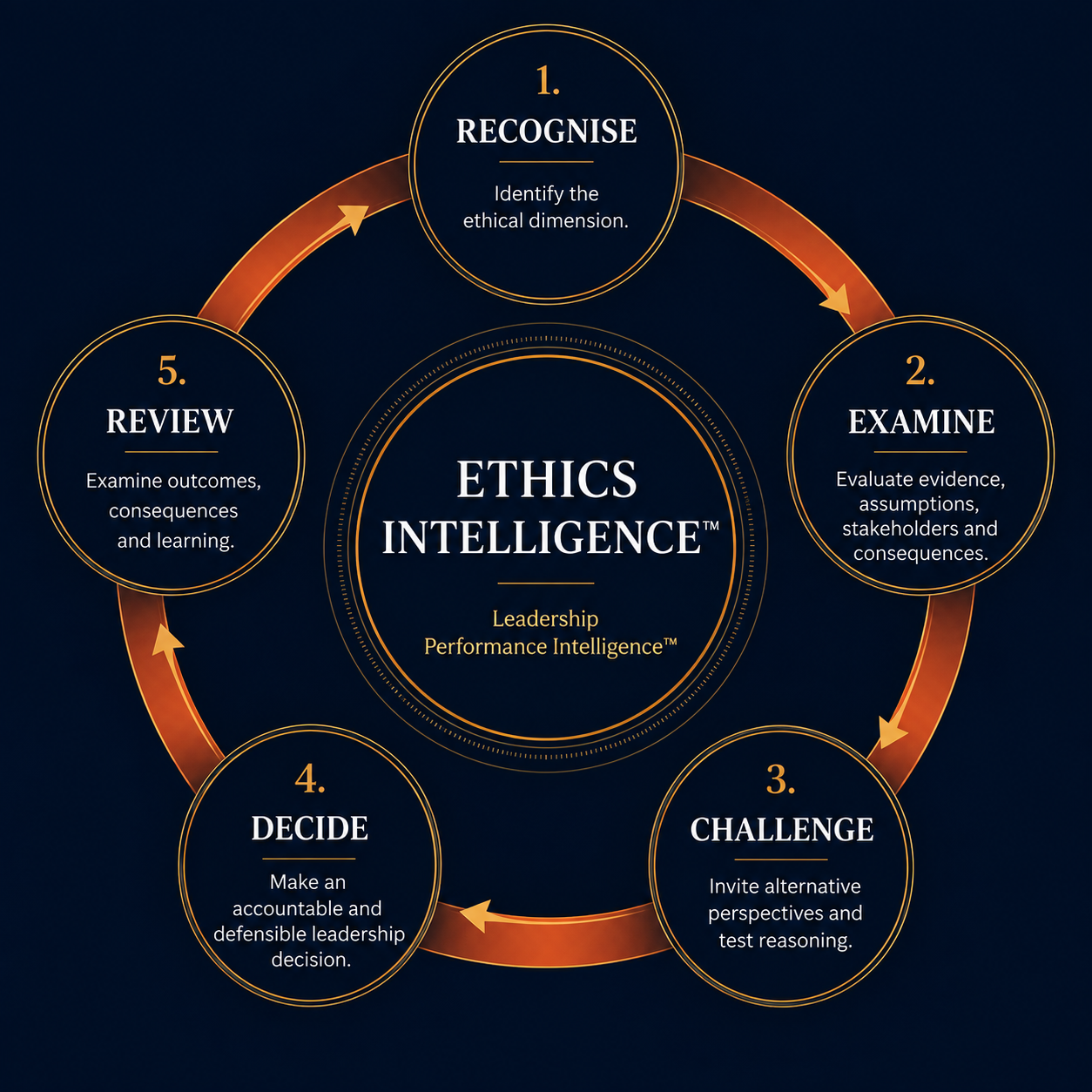
- Ethics Intelligence™ is a leadership capability — not a personality trait — built from five disciplines: Recognise, Examine, Challenge, Decide, Review.
- Ethical drift moves through a predictable pattern: exception → repetition → tolerance → expectation → normalisation.
- Seniority increases decision authority while often reducing the challenge leaders receive — a structural risk that must be deliberately counteracted.
- Organisational ethical maturity develops through five stages, from Reactive to Intelligence-Led, and can be assessed and developed like any other leadership capability.
Ethics Intelligence™: Why Ethical Leadership Is a Performance System, Not a Personality Trait
Ethics leadership is the practice of making and enabling decisions that align performance, responsibility, values and consequences. Effective ethical leadership goes beyond personal integrity. It requires systems that help leaders recognise ethical tensions, evaluate competing interests, challenge assumptions, make accountable decisions and learn from their consequences.
Ethical leadership is frequently discussed as a question of character. Is the leader honest? Do they have integrity? Can they be trusted? Do they behave according to the organisation’s values? These questions matter, but they are insufficient.
Modern leaders rarely encounter ethical challenges as simple choices between something obviously right and something obviously wrong. More often, they must choose between competing responsibilities, legitimate stakeholder interests, imperfect information and consequences that cannot be predicted with certainty.
- A hospital leader may need to reconcile patient need with workforce capacity.
- A school leader may need to balance the interests of an individual student against the needs of the wider school community.
- A business leader may face tension between commercial performance, employee security and long-term organisational resilience.
- A public-service leader may have to reconcile efficiency, fairness, political direction and public accountability.
- An HR leader may simultaneously owe responsibilities to an individual employee, a team and the organisation.
The ethical challenge is therefore rarely: “Do I know what is right?”
A more demanding question is: “How do I make a defensible decision when several important responsibilities are competing at the same time?”
This distinction matters because good intentions do not automatically produce good decisions. Neither does personal integrity guarantee an ethical organisation. An organisation can employ fundamentally decent people and still produce damaging outcomes when incentives, workload, hierarchy, decision structures or cultural norms repeatedly push those people towards poor judgement.
This is why Burn Bright Advisory™ positions Ethics Intelligence™ as an important component of Leadership Performance Intelligence™. Ethics Intelligence™ is not simply knowing organisational rules or possessing strong personal values. It is the leadership capacity to recognise the ethical dimensions of decisions, examine competing obligations, understand consequences, challenge assumptions and exercise accountable judgement under real-world conditions.
This shifts ethical leadership from a predominantly moral aspiration towards a leadership performance capability. Instead of asking organisations only to recruit ethical people, it asks them to build conditions that support ethical behaviour. Instead of relying exclusively on codes of conduct, it asks whether leaders have practical mechanisms for examining difficult decisions. Instead of measuring ethics primarily through compliance failures, it asks whether leaders can identify ethical risk before failure occurs. Instead of assuming seniority produces better judgement, it recognises that power can reduce challenge precisely when challenge is most necessary. And instead of treating ethics as separate from performance, it recognises that trust, decision quality, psychological safety, accountability and organisational sustainability are deeply interconnected.
Ethical Leadership Is a Performance System: Why Good Intentions Are Not Enough
The Problem With How Organisations Talk About Ethics
Most organisations say ethics matters. Their websites contain values statements. Their employees receive policies. Their boards establish governance arrangements. Their leaders speak about integrity, trust and accountability. Yet ethical failure continues to occur in organisations populated largely by people who would describe themselves as ethical.
That apparent contradiction deserves more attention. If unethical outcomes were produced only by obviously unethical people, organisational ethics would be comparatively straightforward. Recruitment, regulation and removal would provide much of the answer. Leadership is rarely that simple.
People make decisions inside systems. Those systems influence what leaders notice, what information reaches them, what behaviours are rewarded, what questions can safely be asked and how much time people have to think before acting. A leader can therefore enter an organisation intending to behave responsibly and gradually become part of patterns that conflict with those intentions.
Targets become dominant.
Exceptions become normal.
Challenge becomes inconvenient.
Pressure increases.
Information becomes filtered.
People learn which concerns senior leaders want to hear and which they would prefer not to hear. Eventually, behaviour that would once have generated discomfort becomes “how things are done here.” That is why ethical leadership cannot depend on character alone.
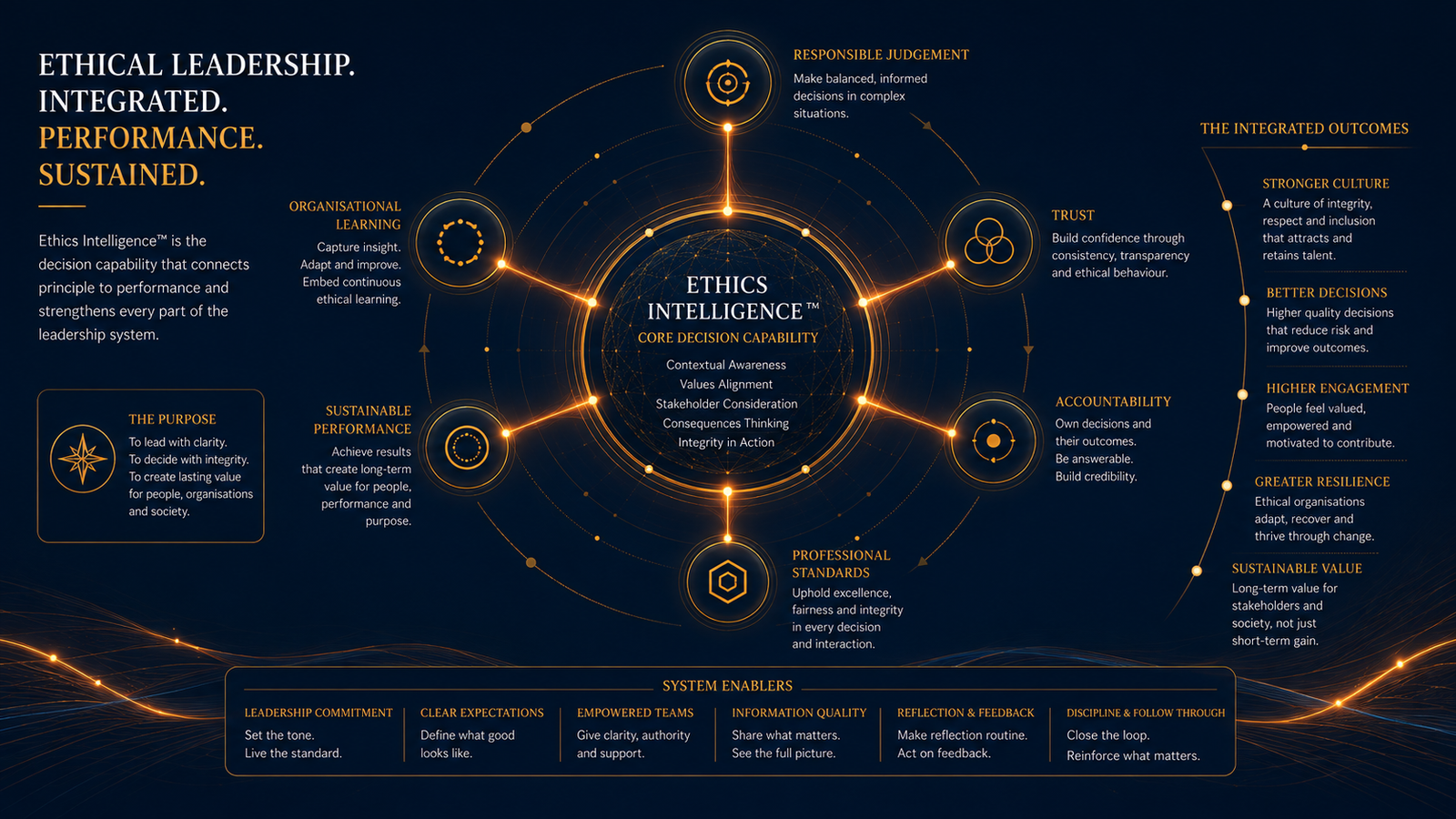
The challenge becomes particularly important when leadership is viewed through Leadership Performance Intelligence™. Leadership performance is not simply the production of results. It concerns the leader’s capacity to produce responsible, sustainable results while understanding the human and organisational consequences through which those results are achieved.
A leader who consistently reaches targets by creating fear, concealing problems, exhausting people or transferring unacceptable risks elsewhere may be producing outputs. They are not necessarily demonstrating effective leadership. The distinction is central to understanding Ethics Intelligence™.
What Is Ethics Intelligence™?
Featured Snippet
It requires leaders to ask:
- Who will be affected by this decision?
- Which interests are competing?
- What assumptions are shaping our judgement?
- Who carries the benefits, and who carries the risks?
- Which voices are absent?
- What information might we be overlooking?
- Would we defend this decision if the reasoning became public?
- What precedent does the decision create?
- What happens if this behaviour becomes normal practice?
- Can those affected challenge the decision safely?
- What will we learn from the consequences?
These are performance questions as much as ethical ones. Ethics Intelligence™ therefore connects strongly with other domains within the Leadership Intelligence Compass™. Professionalism Intelligence™ concerns standards, responsibility and conduct. Reflective Practice Intelligence™ strengthens a leader’s ability to examine their own assumptions and behaviour. Emotional Intelligence™ supports awareness of the human consequences of decisions. Adaptability Intelligence™ helps leaders respond when circumstances make established rules insufficient. Knowledge Development Intelligence™ helps leaders recognise when they do not yet possess enough information to make a sound judgement. And Leadership Sustainability™ asks whether today’s decisions preserve or consume the human and organisational capacity required for tomorrow.
From Ethical Person to Ethical System
Consider two organisations. Organisation A has a detailed code of conduct. Employees complete mandatory annual ethics training. Leaders are expected to demonstrate integrity.
Organisation B has those mechanisms too. But it also examines how decisions are actually made. Its leaders are expected to identify significant stakeholder consequences. Teams can challenge assumptions without automatically being treated as obstructive. Important decisions record not only what was decided but why. Conflicts of interest are surfaced early. Pressure indicators are monitored. Leaders review significant decisions after implementation. And senior leaders are subject to challenge rather than exempt from it.
Which organisation has the stronger ethical infrastructure? Almost certainly Organisation B. The difference is not necessarily that its people possess better values. The difference is that ethical judgement has been designed into the system.
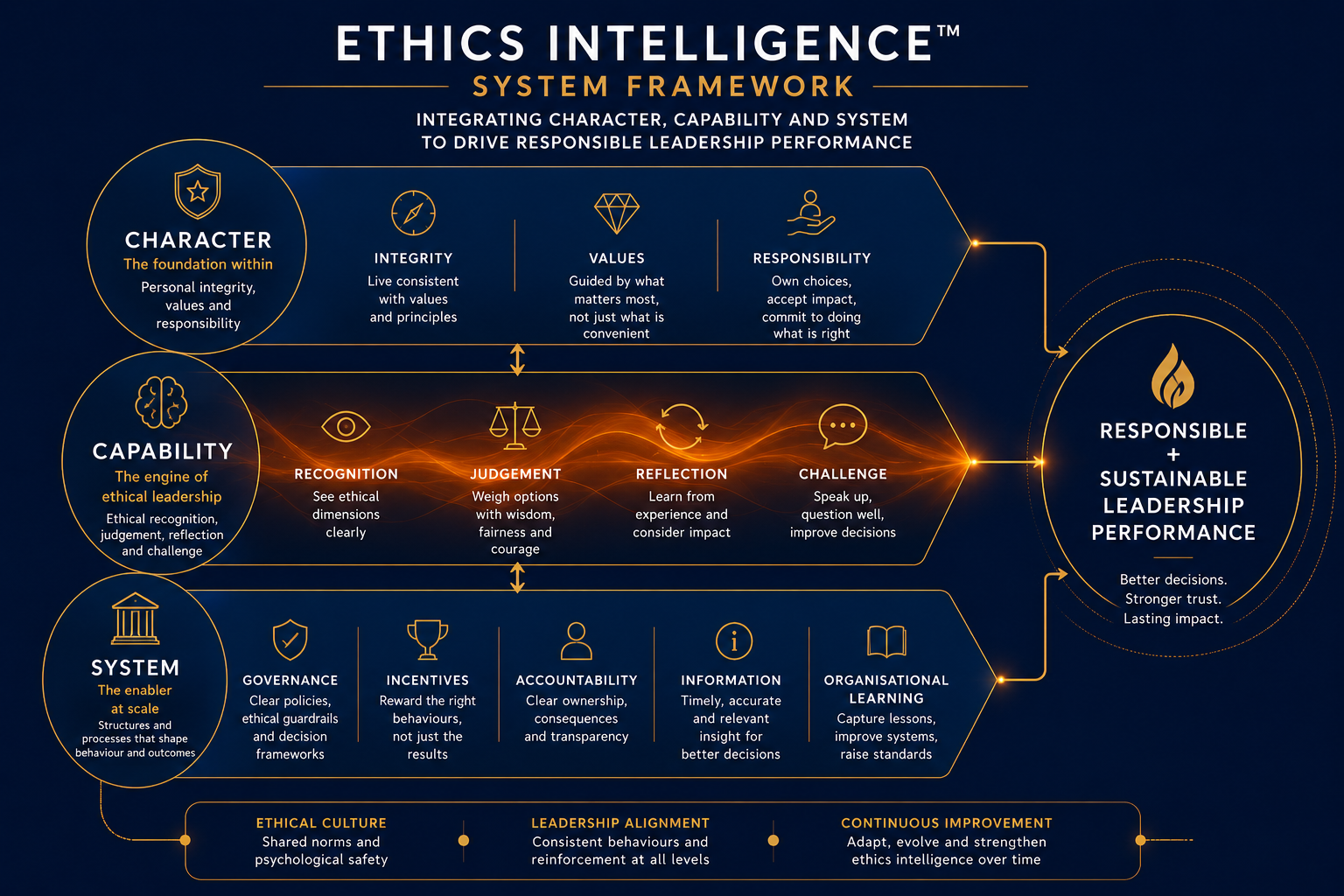
This leads to an important distinction. Ethical leadership as character asks: “What kind of person is the leader?” Ethical leadership as capability asks: “How effectively can the leader recognise and navigate ethical complexity?” Ethical leadership as a system asks: “What conditions make responsible judgement more likely across the organisation?”
Character matters.
Capability matters.
Systems matter.
But depending exclusively on any one of them creates vulnerability. A good person operating within a badly designed system can make poor decisions. A sophisticated ethical process led by someone without integrity can be manipulated. And principled leaders without the capability to navigate complexity can create unintended harm despite sincere intentions.
The objective is therefore not simply ethical leaders. It is the development of ethical leadership capacity supported by ethical organisational systems. That is a considerably more demanding standard. It is also a more useful one.
The Burn Bright Ethics Intelligence™ Performance Model
A practical way to understand ethical leadership is through five connected leadership disciplines that transform ethics from an abstract value into an observable leadership process.
Discipline 1 Recognise
What is the ethical issue beneath the operational decision? Many leadership failures occur before anyone deliberately chooses an unethical course of action — the ethical dimension simply goes unnoticed. A staffing decision is treated purely as a financial question. A performance problem becomes solely an HR process. Recognition asks leaders to look beneath the operational surface.
Discipline 2 Examine
What interests, assumptions, evidence and consequences must be considered? Leadership decisions frequently contain competing legitimate interests. Ethical leadership does not pretend these tensions disappear because an organisation has values — it makes them visible.
Discipline 3 Challenge
What might we be missing, and who can question our reasoning? The more senior a leader becomes, the easier it can become for people around them to stop disagreeing openly — seniority can increase decision authority while reducing access to corrective challenge. Effective ethics leadership deliberately counteracts this problem.
Discipline 4 Decide
What course of action can we responsibly justify? Ethics Intelligence™ does not promise comfortable outcomes. It strengthens the quality and defensibility of the reasoning through which difficult outcomes are reached.
Discipline 5 Review
What happened, what did we learn and what should change? Organisations review financial performance, projects and operational incidents — but rarely the ethical consequences of major decisions. Without review, ethical leadership remains dependent on intention. With review, it becomes capable of learning.
This is where Ethics Intelligence™ connects directly with Leadership Reflection™ and Leadership Benchmarking™. Reflection converts experience into learning. Benchmarking converts learning into evidence about capability. Together, they allow organisations to move beyond asking whether leaders believe themselves to be ethical and towards examining whether their leadership practices consistently support responsible performance.
Why Good Leaders Make Poor Ethical Decisions
One of the most dangerous assumptions in leadership is that ethical failure belongs to a particular category of person. We imagine the unethical leader as obviously dishonest, self-interested or corrupt. Sometimes that is accurate. Often it is not.
Many questionable leadership decisions emerge from something less dramatic: pressure, incomplete information, competing responsibilities, organisational norms, fatigue, misplaced loyalty and the gradual normalisation of practices that once would have caused discomfort.
This distinction matters. If organisations assume ethical failure is principally a problem of bad character, their response will concentrate on identifying bad actors. If they understand that ethical failure can also emerge from conditions that degrade judgement, they begin asking a different set of questions: What pressures are leaders operating under? What behaviours are being rewarded? Which information reaches decision-makers? Who is permitted to challenge them? What happens when someone raises a concern? How much leadership capacity exists for thoughtful judgement? And what has gradually become normal that should no longer be normal?
These questions take ethics leadership beyond compliance. They move it into the domain of Leadership Performance Intelligence™.
The Ethical Intention–Outcome Gap
Most leaders want to believe that their intentions and their impact are reasonably aligned. They intend to be fair, to listen, to act professionally, to protect standards, to make responsible decisions. Yet leadership is ultimately experienced through consequences rather than intentions.
A leader may intend to increase accountability but create fear. They may intend to improve standards but create an environment in which people conceal mistakes. They may intend to accelerate performance but create unsustainable Leadership Workload™. They may intend to maintain control during uncertainty but suppress the challenge and information needed for good decisions. They may intend to protect the organisation but silence people attempting to warn it about risk.
The gap between intention and impact is therefore an important territory for Ethics Intelligence™. This does not mean intentions are irrelevant. It means they are insufficient. Leadership Performance Intelligence™ requires leaders to examine both: What was I trying to achieve? And: What did my leadership actually produce? That second question is harder. It is also where much of leadership learning begins.
Ethical Drift: How the Unacceptable Becomes Normal
Ethical failure does not always arrive as a dramatic decision. Sometimes it develops incrementally. A deadline is missed, so a normal process is bypassed. Nothing serious happens. The exception is repeated. Pressure increases. Another safeguard becomes inconvenient. A concern is raised, but addressing it would delay an important target. The concern is therefore reframed as excessive caution. Eventually, the exceptional behaviour becomes routine.
Nobody consciously announced: “From today, our standards are lower.” Instead, the organisation drifted. This is ethical drift: the gradual movement between stated standards and normalised behaviour. It is particularly dangerous because each individual decision can appear relatively minor.
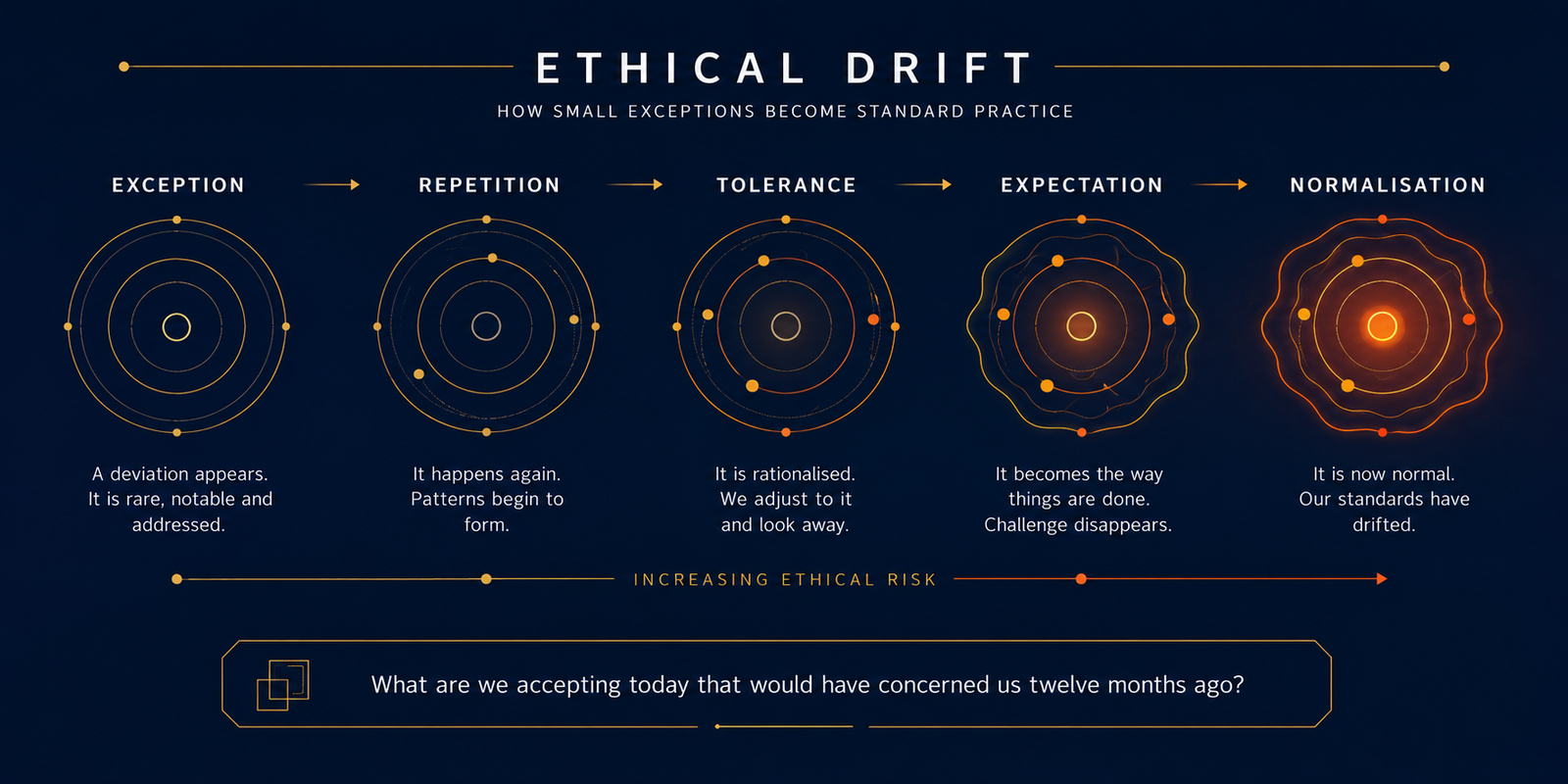
Ethics Intelligence™ therefore requires leaders to notice not only major ethical events but small changes in organisational norms. Useful questions include:
- What are we accepting today that would have concerned us twelve months ago?
- Which “temporary” workarounds have become permanent?
- Where are employees being asked to compromise standards to achieve targets?
- Which behaviours are tolerated because the person producing them is considered valuable?
- What problems have people stopped reporting because nothing happens when they do?
- Where has organisational pressure begun to override professional judgement?
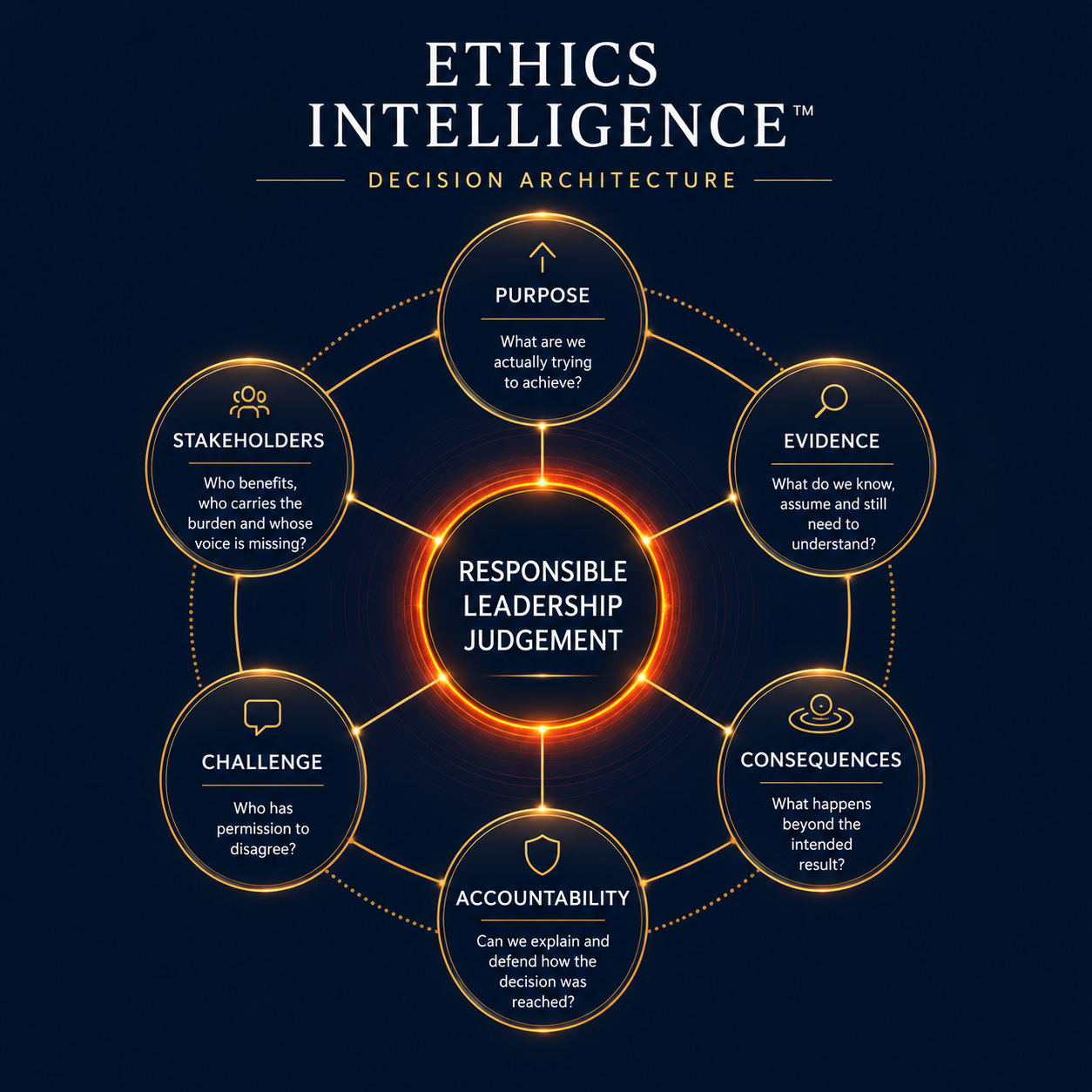
The Burn Bright Ethics Intelligence™ Decision Architecture
Ethical leadership becomes stronger when reflection is built into decision-making before problems emerge. A practical decision architecture can be organised around six lenses.
Lens 1 Purpose
What are we actually trying to achieve? Leaders should distinguish the genuine organisational objective from the immediate operational demand — is the goal to reduce expenditure, or to create a financially sustainable service? A narrowly framed objective can make damaging actions appear rational because consequences outside the target disappear from consideration.
Lens 2 Stakeholders
Who is affected, including people who are not represented in the room? Who benefits, who carries the cost, who carries the risk, and who has not been consulted? The loudest stakeholder is not automatically the most important one.
Lens 3 Evidence
What do we know, what do we think we know, and what do we not yet know? Leaders frequently have to act with incomplete information — pretending it is complete is not acceptable. Separate the known, the assumed, the unknown and the unknowable.
Lens 4 Consequences
What could this decision produce beyond the intended result? Examine immediate, secondary, cumulative and long-term consequences — this is where Ethics Intelligence™ intersects directly with Leadership Sustainability™.
Lens 5 Challenge
Who has permission to disagree? A leadership team can contain intelligent, experienced and principled people and still make poor decisions when disagreement becomes socially or professionally expensive. Leadership authority should not make leadership judgement immune from challenge.
Lens 6 Accountability
Can we explain and defend how this decision was reached? A useful test: would we be comfortable explaining our reasoning — not merely the outcome — to the people most affected by this decision?
Pressure Changes Ethical Judgement
Ethical leadership becomes most important precisely when practising it becomes difficult. Few leaders struggle to uphold values when resources are abundant, deadlines are generous, stakeholders agree and the organisation is performing comfortably. The real test appears under pressure — a missed revenue target, a regulator asking questions, a hospital department short-staffed, a school approaching inspection, a startup running out of cash.
Pressure narrows attention. The immediate problem becomes dominant. Longer-term consequences receive less attention. Leaders become more tempted by shortcuts. Challenge can begin to feel like obstruction. Reflection feels slower than action.
This is where Leadership Capacity™ becomes ethically significant. Leadership capacity is not merely about how much work someone can complete — it includes the cognitive and emotional capacity required to exercise sound judgement. An exhausted leader does not necessarily become an unethical person, but chronic overload can reduce the space available for reflection, consultation and careful consideration. This is why Leadership Workload™, Leadership Sustainability™ and Ethics Intelligence™ cannot be treated as unrelated subjects.
Power Changes the Information Leaders Receive
Leadership creates another ethical difficulty: the higher people rise, the more mediated their organisational reality can become. Information moves through layers. Bad news is softened. Complexity is compressed. Employees become more cautious. People learn which messages receive positive reactions. Senior leaders may therefore become increasingly confident while simultaneously becoming less exposed to the information that should challenge that confidence.
Yet organisations frequently do the opposite. Junior employees face multiple approvals. Senior leaders gain discretion. That discretion may be necessary for effective leadership, but it increases the importance of reflective practice and accountability. Ethical leaders therefore do not merely ask whether people can speak. They ask whether organisational conditions make speaking worthwhile and safe.
“My door is always open.”
versus
“People regularly disagree with me, and I can show you what happened when they did.”
The second provides evidence. The first provides intention. Leadership Performance Intelligence™ is interested in the difference.
Six Sectors, One Ethical Leadership Problem
The context changes across sectors. The underlying leadership challenge often does not.
Business Growth Intelligence™
When margins deteriorate, the ethical question is not simply “did the company make redundancies?” It is how responsibly leadership navigated competing obligations — accurate communication, genuinely explored alternatives, sustainable workload for those remaining — while protecting the organisation’s future.
School Leadership Intelligence™
When performance data risks falling below benchmark, Ethics Intelligence™ asks whether the school strengthens teaching and support, or narrows provision simply to improve the metric. The ethical risk appears when the indicator meant to represent quality begins controlling behaviour more strongly than the educational purpose it was designed to measure.
Healthcare Leadership Intelligence™
Patient need can exceed capacity; staff wellbeing can conflict with service demand; financial constraints can collide with clinical priorities. Ethical leadership does not eliminate these tensions — it provides a disciplined way of navigating them, asking what the patient-safety and workforce implications are before a temporary solution becomes permanent.
Public Service Leadership Intelligence™
Public-service leaders operate between political direction, professional responsibility, legislation, public expectation and resource constraint. Ethics Intelligence™ helps leaders distinguish between compliance with authority and the responsible exercise of professional judgement — both matter, and neither should automatically erase the other.
HR & People Leadership Intelligence™
When a high-performing executive’s behaviour is damaging their team, removing them may create commercial disruption — but keeping them communicates that results excuse harmful conduct. This is an ethical leadership decision about what behaviour the organisation is prepared to exchange for performance.
Entrepreneur Performance Intelligence™
Founders face a distinctive challenge because organisational identity, authority and personal identity can become intertwined, often before mature governance exists. Ethics Intelligence™ becomes important early — asking what power is being accumulated, who can challenge it, and what governance will be needed before it feels necessary.
Ethics Is Not the Opposite of Performance
A persistent misconception deserves challenging. Ethics and performance are sometimes presented as competing priorities — one side representing commercial realism, the other values. That framing is too simplistic.
Poor ethical judgement can itself become a performance risk. When people stop speaking honestly, leaders receive worse information. When accountability becomes inconsistent, trust deteriorates. When damaging behaviour is tolerated because someone delivers results, cultural standards become unstable. When workloads become unsustainable, capability disappears. When stakeholders believe decisions cannot be trusted, legitimacy weakens. When leaders hide problems, organisations lose the opportunity to respond while those problems are still manageable.
This is why Ethics Intelligence™ belongs inside the Leadership Intelligence Compass™. It helps leaders determine not merely whether they can achieve an outcome — it requires them to consider whether they should, how they should, at whose cost, with what safeguards and with what responsibility for the consequences.
The Burn Bright Ethics Intelligence™ Maturity Model
Ethical leadership capability can be understood across five levels of organisational maturity. These levels are not intended to label organisations as ethical or unethical — they provide a developmental lens.
Level 1
Reactive Ethics
Ethics becomes visible primarily when something goes wrong — a complaint, a breach, a regulator’s intervention. Success is measured largely by the absence of reported problems, which does not prove the absence of ethical problems.
Level 2
Compliance-Led Ethics
More formal infrastructure exists — training, codes of conduct, reporting routes. But the dominant question remains “are we following the rules?” Compliance establishes a floor. It should not automatically become the ceiling.
Level 3
Reflective Ethics
Leaders begin discussing the reasoning behind decisions, not merely their technical permissibility. This is where Reflective Practice Intelligence™ begins strengthening Ethics Intelligence™.
Level 4
Integrated Ethics
Ethical judgement becomes part of organisational decision architecture — strategy, performance management, workforce planning, recruitment, risk and leadership development. Ethics moves from the organisational perimeter towards the leadership operating system.
Level 5
Intelligence-Led Ethics
Organisations learn systematically from ethical decisions. Patterns are examined, diagnostics reveal emerging vulnerabilities, and governance evolves as the organisation learns. This connects Ethics Intelligence™ to Leadership Benchmarking™.
The progression can be summarised as: Reactive → Compliant → Reflective → Integrated → Intelligence-Led. Each stage changes the central organisational question, from “What went wrong?” to “What are we learning about our ethical leadership capability?”
Warning Signs That Ethics Intelligence™ Is Weakening
Ethical vulnerability often appears before a major incident. Leaders should pay particular attention when several of the following begin occurring together:
- Targets are discussed more frequently than consequences.
- People hesitate before disagreeing with senior leaders.
- Exceptions to normal standards are increasing.
- “Temporary” workarounds have become routine.
- High performers are permitted behaviours that others would not be allowed.
- Employees increasingly communicate concerns privately rather than openly.
- Difficult information reaches senior leadership late.
- Decision rationales are poorly documented.
- Responsibility becomes unclear when decisions fail.
- Workload leaves little space for reflection.
- Urgency becomes the default operating condition.
- Leaders defend decisions primarily through hierarchy: “because I said so.”
- Organisational values appear in communications but rarely in decision discussions.
- Employees believe raising concerns may damage their careers.
- People who challenge assumptions are described as negative or resistant.
- Performance is measured without examining how that performance was produced.
None of these automatically proves unethical leadership. They are signals. Ethics Intelligence™ requires leaders to investigate signals before they become evidence of larger failure.
The Ethics Intelligence™ Diagnostic Conversation
A leadership team does not need to wait for a crisis before examining its ethical capability. Consider discussing these ten questions:
- What happens here when someone disagrees with a senior leader — not what policy says, what actually happens?
- Which organisational targets create the greatest pressure to compromise?
- Which decisions receive insufficient stakeholder input?
- Where are temporary exceptions becoming permanent practices?
- What information are senior leaders least likely to hear?
- Which leadership behaviours are tolerated because the person delivers strong results?
- Where is workload reducing decision quality?
- When did we last change an important decision because someone challenged our assumptions?
- How do we know employees trust our ethical processes?
- What have we learned from the ethical consequences of previous decisions?
These questions can become part of a wider Leadership Intelligence Assessment™ rather than existing as a one-off conversation. The purpose is not to produce a simplistic ethical score — it is to reveal patterns that deserve leadership attention.
A 30-Day Ethics Intelligence™ Implementation Framework
Building ethical leadership does not require organisations to begin with a major transformation programme. A focused thirty-day cycle can establish the foundations.
Days 1–7: Observe
Begin with evidence rather than another policy. Examine several recent significant decisions: who made them, what evidence was considered, which stakeholders were affected, and what consequences emerged.
Days 8–14: Diagnose
Use the Ethics Intelligence™ questions to identify recurring patterns — pressure points, silence points, power points, capacity points, accountability points and learning points.
Days 15–21: Design
Introduce one or two mechanisms that strengthen decision quality without creating unnecessary bureaucracy — a stakeholder-impact question, a challenge stage for high-risk decisions, a short decision record, or a confidential escalation route.
Days 22–30: Review
Ask what changed, whether challenge was easier, whether decision quality improved, and what should be retained, changed or expanded. Then repeat the cycle.
That is how Ethics Intelligence™ becomes part of a Leadership Development System™ rather than another initiative that disappears after launch.
Ethics Intelligence™ and the Leadership Intelligence Compass™
No leadership capability exists entirely in isolation. Ethics Intelligence™ becomes more powerful when considered alongside the wider Leadership Intelligence Compass™.
Professionalism Intelligence™
Professionalism provides standards of conduct, responsibility and reliability. Ethics Intelligence™ asks how those standards should be interpreted when circumstances become complex.
Constructivism Intelligence™
Constructivism Intelligence™ recognises that leaders build understanding through interaction with evidence, experience and alternative perspectives — the leader’s interpretation of a situation is not automatically the only valid one.
Adaptability Intelligence™
Rules and established practices cannot anticipate every situation. Ethics Intelligence™ helps ensure that adaptation does not become justification for abandoning standards whenever they become inconvenient.
Visionary Leadership Intelligence™
Vision asks where the organisation is going. Ethics asks what kind of organisation it is becoming while getting there. A compelling destination does not justify every route.
Reflective Practice Intelligence™
Reflection creates the capacity to examine experience, assumptions and consequences. Without reflection, ethical learning is weak; without ethical consideration, reflection can become purely performance-oriented.
Knowledge Development Intelligence™
Ethical judgement depends on information. Knowledge Development Intelligence™ strengthens the informational foundation upon which ethical decisions are made.
Emotional Intelligence™
Emotional Intelligence™ helps leaders recognise the interpersonal consequences of decisions and receive disagreement without interpreting it as disloyalty — a capability essential to healthy challenge.
Leadership Sustainability™
Leadership decisions shape future capacity. A decision that repeatedly achieves results by exhausting people, degrading trust or accumulating hidden risk is not sustainable simply because the immediate metric looks positive.
Ethics Intelligence™ as Leadership Performance Intelligence™
Ethical leadership is frequently framed as a question of values. Values matter. But leadership organisations need something more operational: leaders capable of converting values into judgement, systems capable of supporting that judgement, cultures capable of challenging it, diagnostics capable of examining it, and reflective mechanisms capable of learning from its consequences.
Consider two leaders producing identical results. Leader A produces those results through clear expectations, responsible workload, honest reporting, professional challenge and sustainable capability. Leader B produces them through fear, hidden overtime, information suppression and the gradual erosion of team capacity. A conventional performance dashboard may show two successful leaders. Leadership Performance Intelligence™ should not — because the method through which performance is created tells us something important about whether that performance can continue.
The Leadership Performance Equation
A more mature model of leadership performance asks leaders to consider four dimensions:
- Results — what did we achieve?
- Responsibility — how were those results achieved?
- Relationships — what happened to trust, capability and stakeholder confidence?
- Resilience — can the performance be sustained?
A result without responsibility creates risk. Responsibility without results creates limited organisational value. Results and responsibility without relationships can destroy the social infrastructure required for future performance. And performance without resilience eventually consumes itself.
From Ethics Training to Leadership Development
An annual ethics course can explain what the policy says, what constitutes misconduct, what employees should report, and which rules apply. Useful — and necessary in many organisations. But Ethics Intelligence™ development asks different questions: Can the leader identify an ethical tension before it becomes misconduct? Can they distinguish evidence from assumption? Can they tolerate challenge? Can they explain their reasoning and reflect on unintended consequences? Can they change their mind without interpreting that change as weakness?
These are developmental capabilities. They require practice, reflection, feedback and assessment — a role for the wider Burn Bright Leadership Intelligence Library™, leadership diagnostics, workshops and the Leadership Intelligence Assessment™. The objective is not merely to teach leaders about ethics. It is to develop their capacity to lead ethically when circumstances make ethical judgement difficult.
The Leadership Question Worth Asking
Many organisations ask: “Do we have ethical leaders?” The question sounds sensible, but it encourages a binary answer. A more productive question is: “How strong is our organisation’s capacity for ethical leadership?” That question opens the door to development — allowing leaders to examine judgement, systems, culture, power, workload, challenge, reflection, accountability and learning.
Ethical leadership is not a badge awarded permanently to a person. It is a capability exercised repeatedly through decisions. Some decisions will be straightforward. Others will test everything the leader believes about responsibility. That is precisely why the capability must be developed before the difficult moment arrives.
Conclusion: Good Intentions Need Intelligent Systems
Most leaders do not begin their working day intending to make unethical decisions. They begin with objectives, problems, deadlines, people requiring answers, budgets requiring decisions, stakeholders requiring reassurance and targets requiring attention. Somewhere inside that complexity are ethical questions that may or may not be recognised.
Ethics leadership cannot depend exclusively on leaders noticing those questions by instinct. Nor can organisations assume that a values statement, code of conduct or annual compliance programme will automatically produce responsible judgement. Good intentions matter, but good intentions operating inside poorly designed systems remain vulnerable.
Ethics Intelligence™ provides a different approach. It asks leaders to recognise ethical dimensions before they become ethical failures. It encourages them to examine stakeholders, evidence and consequences. It creates space for challenge. It strengthens accountable decision-making. It connects decisions to reflection and organisational learning. And, crucially, it places ethics where it belongs: inside leadership performance rather than alongside it.
The question for leaders is therefore no longer simply “Did we achieve the result?” It is “What did our leadership create while achieving it?” That question reveals far more about the quality of leadership — and organisations prepared to answer it seriously move beyond ethical intention towards something considerably stronger: ethical leadership capability.
Burn Bright Leadership Reflection™
- What is the ethical issue beneath the operational issue?
- Whose interests are represented — and whose are missing?
- Which parts of our reasoning are evidence and which are assumptions?
- Who can challenge this decision safely?
- Who receives the benefits and who carries the consequences?
- What happens if this becomes our normal way of operating?
- Could I explain the reasoning openly to the people most affected?
- What evidence would persuade me to change my decision?
Leadership Reflection Questions
Ethics Intelligence™ develops through deliberate examination of leadership practice, not simply through knowledge of ethical principles. Use these questions individually, with a leadership team, during executive coaching, or as part of a wider Leadership Intelligence Assessment™.
Examine Your Judgement
- When making important decisions, how clearly do I distinguish between what I know, what I assume and what I still need to understand?
- Which organisational pressures are most likely to narrow my judgement?
- When did I last reconsider an important decision because someone challenged my assumptions?
- Do people around me genuinely disagree with me, or have they learned that agreement is professionally safer?
- Which stakeholder groups are least represented in the decisions I make?
Examine Your Leadership Impact
- Is there a difference between what I intend as a leader and what people actually experience?
- What behaviours might I be unintentionally normalising?
- Have I ever justified damaging behaviour because the person responsible was delivering strong results?
- Does my approach to accountability encourage people to surface problems early or conceal them until they become unavoidable?
- What does my behaviour teach others about what this organisation really values?
Examine Your Leadership System
- Where are exceptions becoming normal practice?
- Which targets create incentives that could encourage unintended or inappropriate behaviour?
- Where does excessive Leadership Workload™ create risks to judgement?
- Which important decisions depend too heavily on one individual?
- How easy is it for someone with less organisational power to challenge someone with considerably more?
Examine Sustainability
- Are we achieving today’s performance by consuming tomorrow’s Leadership Capacity™?
- What happens to people, trust and organisational capability as a consequence of how we currently produce results?
- Which decisions appear successful in the short term but may create longer-term ethical or organisational risk?
- What would happen if our current leadership behaviours became normal practice for the next five years?
- Are we building an organisation we would still be proud to lead if every major decision and its reasoning became visible?
These questions are not intended to create perfect leadership. Their purpose is to make leadership reasoning more visible. Visibility makes reflection possible. Reflection makes learning possible. And learning is fundamental to Leadership Performance Intelligence™.
Action Steps: Strengthening Ethics Intelligence™ in Practice
Ethical leadership development should translate into observable behaviour. The following actions provide a practical starting point.
- Add an ethical question to every significant decision. Before approving an important decision, ask: “What is the ethical issue contained within this decision?” Sometimes the answer will be minimal; sometimes it will fundamentally change the discussion.
- Separate evidence from assumption. For major decisions, create three headings: what we know, what we assume, and what we still need to know.
- Identify the missing stakeholder. Ask whose perspective is not represented — significant consequences should not remain invisible simply because the people experiencing them lack organisational power.
- Create permission to challenge. Do not rely on an open-door policy. Actively invite challenge, and demonstrate through your response that disagreement is legitimate.
- Monitor ethical drift. Identify one practice that began as an exception but is becoming routine, and ask why.
- Examine how performance is produced. Look beyond the output of a high-performing team to workload, turnover, psychological safety and sustainability.
- Review one difficult decision. Choose a significant decision from the previous six months and examine what was believed, assumed, and what actually happened.
- Identify your leadership pressure points. Time pressure, financial pressure, conflict, public scrutiny, fatigue, personal loyalty and fear of failure all change judgement.
- Connect ethics to leadership development. Include ethical judgement in coaching, performance conversations, succession planning and Leadership Benchmarking™.
- Build a repeatable Ethics Intelligence™ cycle. Use Recognise → Examine → Challenge → Decide → Review for significant leadership decisions until it becomes normal practice.
Frequently Asked Questions About Ethics Leadership
What is ethics leadership?
Ethics leadership is the practice of exercising leadership judgement in ways that consider values, responsibilities, evidence, stakeholder interests, consequences and accountability. Within Burn Bright Advisory’s Leadership Performance Intelligence™ framework, Ethics Intelligence™ extends this further, considering whether leaders and organisations possess the capability and systems required to make responsible decisions consistently.
Why is ethical leadership important?
Ethical leadership matters because leadership decisions affect people, resources, opportunities, organisational culture and future capability. Poor ethical judgement can weaken trust, discourage employees from raising concerns and normalise inappropriate behaviour behind short-term performance.
What are the characteristics of an ethical leader?
An ethical leader typically demonstrates integrity, accountability, fairness and professional responsibility, and can also recognise ethical complexity, examine evidence critically, tolerate disagreement, consider unintended consequences and change position when better evidence emerges.
What is Ethics Intelligence™?
Ethics Intelligence™ is the leadership capacity to recognise, examine and respond responsibly to the ethical dimensions of decisions. It connects ethical judgement with Professionalism Intelligence™, Reflective Practice Intelligence™, Emotional Intelligence™, Knowledge Development Intelligence™, Adaptability Intelligence™ and Leadership Sustainability™.
What is the difference between ethics and compliance?
Compliance asks whether behaviour follows applicable rules and requirements. Ethics asks the broader question of what the responsible course of action is. A decision can comply technically with a policy while still creating consequences that deserve ethical examination.
Can good leaders make unethical decisions?
Yes. Ethical failure does not always result from malicious intent — good leaders can make poor ethical decisions under excessive pressure, incomplete information, or within cultures where problematic practices have gradually become normal.
How can organisations improve ethical leadership?
Organisations can strengthen ethical leadership by examining stakeholder impact, distinguishing evidence from assumptions, documenting reasoning, creating safe mechanisms for challenge, reviewing unintended consequences and including ethical capability within leadership development and assessment.
How does psychological safety support ethical leadership?
Psychological safety makes it easier for people to ask questions, identify risks and challenge assumptions. If employees believe disagreement will damage their careers, important information may never reach decision-makers.
How does leadership workload affect ethical decision-making?
Responsible judgement requires cognitive and emotional capacity. When leaders operate under excessive workload and decision fatigue, the space available for reflection and consideration of consequences can become constrained.
How can ethical leadership be measured?
Ethical leadership should not be reduced to a single score. Organisations can examine indicators such as employee confidence in raising concerns, quality of decision documentation, consistency of accountability and evidence of reflective review, often as part of broader Leadership Benchmarking™.
How Strong Is Your Organisation’s Ethics Intelligence™?
Take the free Leadership Burnout Self-Assessment to understand where pressure, workload and decision-making conditions may be putting your leadership judgement at risk.
Free Leadership Intelligence
Get Weekly Leadership Insights
Join thousands of leaders receiving practical strategies on burnout prevention, workload design, and sustainable performance every week.