Quick Answer
Key Takeaways
- Delegation failure is often a symptom of poor organisational design rather than a lack of leadership confidence.
- Giving someone a task without transferring sufficient authority is not genuine delegation.
- Weak role clarity causes decisions and problems to migrate back towards senior leaders.
- Effective delegation increases leadership capacity while developing capability elsewhere in the organisation.
- Sustainable leadership depends on distributing responsibility, authority and accountability intelligently.
Delegation Failure Is a Leadership System Problem
Delegation failure in leadership is usually diagnosed too quickly. A senior leader is overwhelmed. Their calendar is full. Decisions are backing up. Their team repeatedly comes to them for answers.
The standard response is predictable: you need to delegate more. It sounds reasonable. But it often misses the real problem.
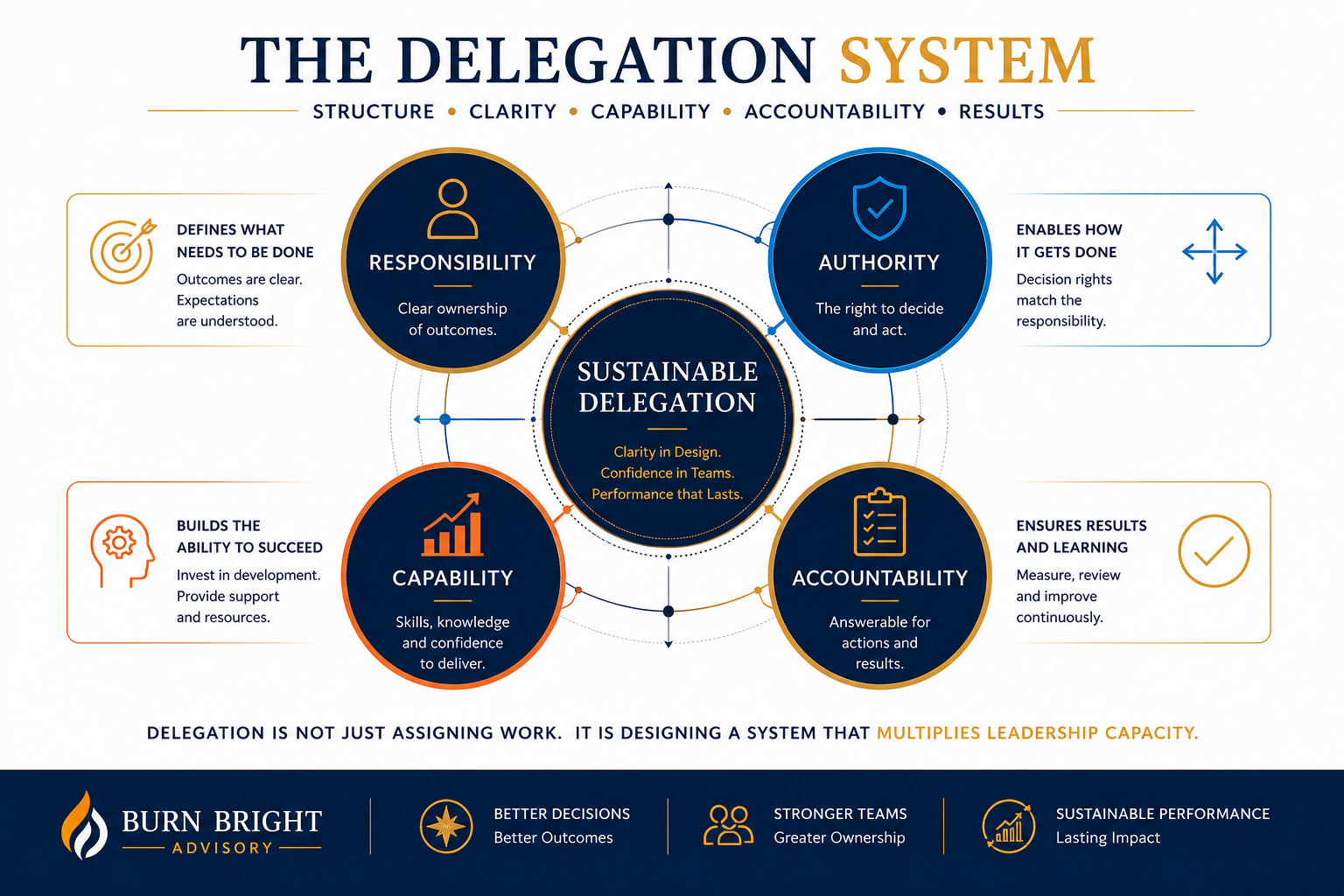
Many overloaded leaders are already delegating tasks. What they have not successfully transferred is ownership, decision authority and accountability.
The work leaves their desk.
The responsibility does not.
A manager asks somebody to prepare a report but still checks every detail. A principal appoints a department leader but continues making routine departmental decisions. An executive assigns ownership of a project but remains the unofficial approval point for every significant action.
On an organisational chart, responsibility appears distributed.
Operationally, it remains centralised.
That distinction matters because leadership overload is rarely created by the number of tasks alone. It is created by the number of tasks, decisions, approvals, escalations and unresolved responsibilities that continue to require the leader’s attention.
A useful way to understand the problem is to see delegation as an operating system rather than an isolated management technique.
Featured Snippet
Why Does Delegation Fail Even When Leaders Are Trying to Delegate?
One of the biggest misconceptions about delegation is that it begins with willingness. It does not. It begins with architecture.
Consider a senior manager responsible for a team of eight. They are told they need to delegate because they are working excessive hours. So they distribute several responsibilities among their team.
On Monday, they assign a project to a capable manager. On Tuesday, the manager asks whether they can change the project timeline. On Wednesday, they return to ask whether additional resources can be allocated. On Thursday, a stakeholder challenges part of the project and the manager escalates the issue. On Friday, the senior leader reviews the work, rewrites part of it and approves the next stage.
Technically, the project was delegated.
Operationally, very little changed.
The senior leader remained:
- the decision-maker;
- the escalation point;
- the resource authority;
- the quality controller; and
- the final source of reassurance.
This is one reason leaders can delegate more work without creating more capacity. They have transferred activity, not authority.
The Delegation Illusion
This is the delegation illusion. It occurs when an organisation believes work has been distributed because different people are completing different activities, while the cognitive responsibility for those activities remains concentrated at the top.
That distinction is critical. Physical workload matters. But so does cognitive workload. Every time a leader has to review, approve, clarify, correct or reconsider delegated work, part of that responsibility remains active in their mental workload. Ten apparently small decisions can consume more leadership capacity than one substantial piece of focused work.
The Burn Bright Not Out Framework™ identifies decision overload as one of five root causes of burnout, alongside scope creep, meeting culture, communication chaos and perfectionism culture. Poor delegation can intensify several of them simultaneously.
A leader who retains too many decisions becomes a bottleneck. That bottleneck generates meetings. Meetings generate communication. Communication generates more decisions. Meanwhile, strategic work gets pushed towards evenings and weekends because operational decisions have consumed the working day.
Delegation Must Reduce Dependency
The real test of delegation is therefore not “Did I give this task to somebody else?” The better question is “Did this delegation reduce unnecessary dependency on me?”
That changes the conversation. Successful delegation should gradually reduce the number of decisions that require senior intervention. It should increase capability elsewhere. It should clarify who owns what. And it should create more organisational capacity rather than simply moving administrative work between people.
This is why delegation belongs inside Workload Architecture™, not just management training. The Burn Bright framework treats Workload Architecture™ and Decision Authority™ as two of the structural pillars supporting sustainable leadership. They are closely connected. You cannot redesign leadership workload effectively while every meaningful decision still travels upwards. And you cannot distribute decision authority effectively when roles, capability and accountability remain unclear.
What Is the Difference Between Task Delegation and Authority Delegation?
Many leaders delegate tasks. Far fewer delegate authority. That distinction explains why delegation can look successful on paper while failing to create meaningful leadership capacity.
Task delegation says: “Please do this.”
Authority delegation says: “You own this outcome, these are the boundaries of your authority, these are the decisions you can make, and these are the circumstances in which I need to be involved.”
The first transfers activity. The second transfers ownership.
When leaders transfer activity without sufficient authority, they create what can be called delegation without release. The team member does the work, but the leader remains mentally and operationally attached to it. Every significant decision comes back. Every unusual situation requires approval. Every stakeholder challenge triggers an escalation. Every variation from the original plan creates another conversation. The leader may no longer be completing the task, but they are still carrying its cognitive weight.
That is why some leaders say: “I delegate all the time, but somehow everything still comes back to me.” That sentence should be treated as diagnostic information. It suggests that the organisation has distributed work without adequately distributing decision authority.
The Dependency Loop
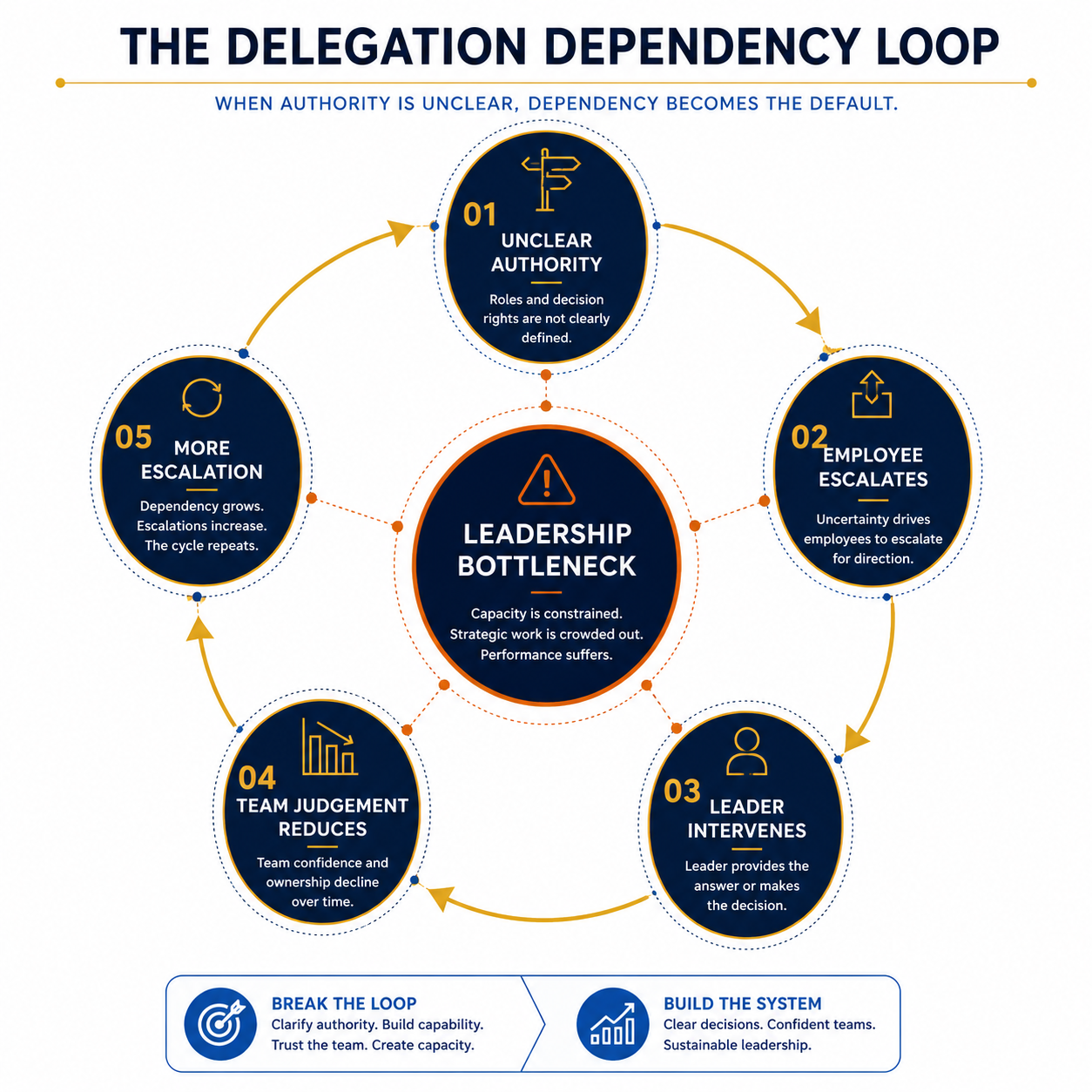
The problem can become self-reinforcing. A leader is overloaded, so they delegate. The person receiving the responsibility lacks clarity about their authority, so they ask the leader for guidance. Because the leader is under pressure, they provide the answer rather than coaching the person through the decision. The employee learns that escalation is faster and safer than independent judgement. The next time uncertainty appears, they escalate again.
The leader becomes frustrated: “Why can’t people make decisions for themselves?”
The team member becomes cautious: “I don’t want to make the wrong decision.”
Both behaviours make sense within the system. And both strengthen the dependency loop. The more decisions the leader makes, the less decision-making experience the team develops. The less experience the team develops, the more decisions are escalated. The more decisions are escalated, the more overloaded the leader becomes.
Eventually, the organisation concludes that the leader has a delegation problem. But the deeper issue is an authority architecture problem.
This fits the wider Burn Bright diagnosis of modern leadership. The Burn Bright Not Out Framework™ identifies decision overload as one of the five root causes of burnout and places Decision Authority™ alongside Workload Architecture™ as a central structural pillar. The two cannot be separated. If work moves down but authority stays up, overload stays up too.
Why Does Delegated Work Keep Coming Back to the Leader?
Reverse delegation happens when responsibility that has been assigned to somebody else gradually travels back towards the leader. Sometimes it happens explicitly: “I don’t know what to do. What do you think?” Sometimes it is more subtle: “Can you quickly check this before I send it?” “Are you happy for me to proceed?” “Could you join the meeting just in case?” “What would you do?”
Each request seems reasonable in isolation. Twenty of them across a working day create a very different leadership role. The leader becomes the organisation’s human safety net. Every ambiguity, exception and difficult judgement is pushed upwards.
This is particularly dangerous because decision work is often invisible. A calendar may show a 30-minute meeting. It does not show the six decisions created by that meeting, the three follow-up messages, the document requiring approval or the issue the leader continues thinking about while driving home. This is invisible workload, and it is one reason leaders can appear to have manageable job descriptions while experiencing completely unmanageable working lives.
Four Conditions That Cause Work to Bounce Back
Reverse delegation usually points towards one or more structural conditions.
Eventually, people stop exercising judgement. Why wouldn’t they? If every significant decision is likely to be checked, corrected or overturned, seeking approval becomes the most efficient behaviour. The leader then sees that dependency as evidence that the team cannot be trusted. A structural problem becomes a behavioural cycle.
How Can Leaders Diagnose a Delegation Problem?
Before trying to delegate more, diagnose what is already happening. Do not begin with “What can I get off my plate?” Begin with “Why is so much staying on my plate?” Those are different questions. The first encourages task redistribution. The second exposes structural causes.
The Burn Bright framework includes the RACI Delegation Framework™ as one of its nine core frameworks. RACI creates clarity around four roles:
| Role | Core Question |
|---|---|
| Responsible | Who completes the work? |
| Accountable | Who ultimately owns the outcome? |
| Consulted | Whose expertise or input is required? |
| Informed | Who needs visibility but not decision authority? |
The value of this framework is not the acronym itself. The value is the conversation it forces. Many overloaded organisations have several people who believe they are accountable, dozens who expect to be consulted and almost nobody who feels authorised to make the final decision. That produces meetings. It produces emails. It produces approval chains. And it produces exhausted leaders.
Run a Delegation Audit
Take your recurring responsibilities from the last two weeks — not just major projects. Include decisions, approvals, meetings, reviews, escalations and recurring requests. For each one, ask five questions:
- Who is doing the work? This identifies responsibility.
- Who owns the outcome? This exposes whether accountability is genuinely clear.
- Who can make the decisions? This reveals where authority actually sits rather than where the organisational chart suggests it sits.
- When does the issue have to come back to me? This creates escalation boundaries.
- What would need to change for this to operate without me? This is the most valuable question. The answer might be capability, information, trust, technology, a clearer process, access to resources — or it might reveal that your involvement is no longer necessary at all.
That final category deserves attention. Senior leaders often accumulate responsibilities because something once required their involvement. A crisis occurred. A colleague left. A new system was introduced. A project needed rescuing. A temporary gap appeared. The leader stepped in. Six months later, the crisis has passed but the responsibility remains.
This is how scope creep develops — another of the five root causes identified in the Burn Bright Not Out Framework™. Each additional responsibility may seem manageable. The cumulative architecture is not.
From “Can I Delegate This?” to “Where Should This Live?”
This requires a change in leadership language. Instead of asking “Can I delegate this?” ask “Where should this responsibility live?” That removes ego from the question. It also moves delegation away from being seen as a personal favour. You are not asking somebody to “help you out” — you are designing where work belongs.
If a department manager is closer to the information, has sufficient capability and can make the decision within agreed boundaries, there may be little reason for the decision to sit with a senior executive. If a team can resolve a recurring operational issue through a standard process, there may be no reason for the issue to require a meeting. If a decision can be governed by an agreed threshold, there may be no reason for every variation to require senior approval.
That is systems thinking. The objective is not maximum delegation. Some responsibilities should remain with senior leaders. The objective is appropriate distribution. Authority should sit as close as reasonably possible to the information required to make a good decision, while accountability remains explicit. That creates speed. It builds capability. It reduces unnecessary escalation. And it protects scarce leadership attention for work that genuinely requires leadership judgement.
Why Is Delegation a Burnout Prevention Strategy?
Delegation is usually taught as a productivity skill. That undersells it. Done properly, delegation is a capacity strategy.
Leadership burnout develops when demands repeatedly exceed sustainable capacity and recovery is insufficient. Modern management roles have expanded across strategic, operational, technological and emotional responsibilities while support structures have failed to expand at the same rate.
Simply teaching an overloaded leader to process that workload faster does not correct the underlying equation. Neither does telling them to become more resilient. If one person remains the approval point for hundreds of operational decisions, the system has a capacity problem. If one leader must personally resolve every difficult stakeholder issue, the system has a dependency problem. If the organisation cannot function when a senior manager takes a week away from work, the system has a design problem.
Heroic leadership says: “I will carry it.”
Sustainable leadership asks: “Why does this need to be carried by me?”
That question can feel uncomfortable, particularly for experienced high performers. Competence attracts work. The more reliable you are, the more likely people are to bring you difficult problems. The faster you solve them, the more attractive you become as the escalation route. Eventually, your competence can create organisational dependency. What once made you valuable begins making your role unsustainable.
The solution is not to become less capable. It is to use that capability differently. Your role increasingly becomes building a system in which good decisions can happen without your constant presence — developing people, clarifying decision rights, creating escalation thresholds, defining accountability, removing unnecessary approval stages, and resisting the temptation to reclaim work simply because you could complete it faster yourself.
How Can Leaders Build a Sustainable Delegation System?
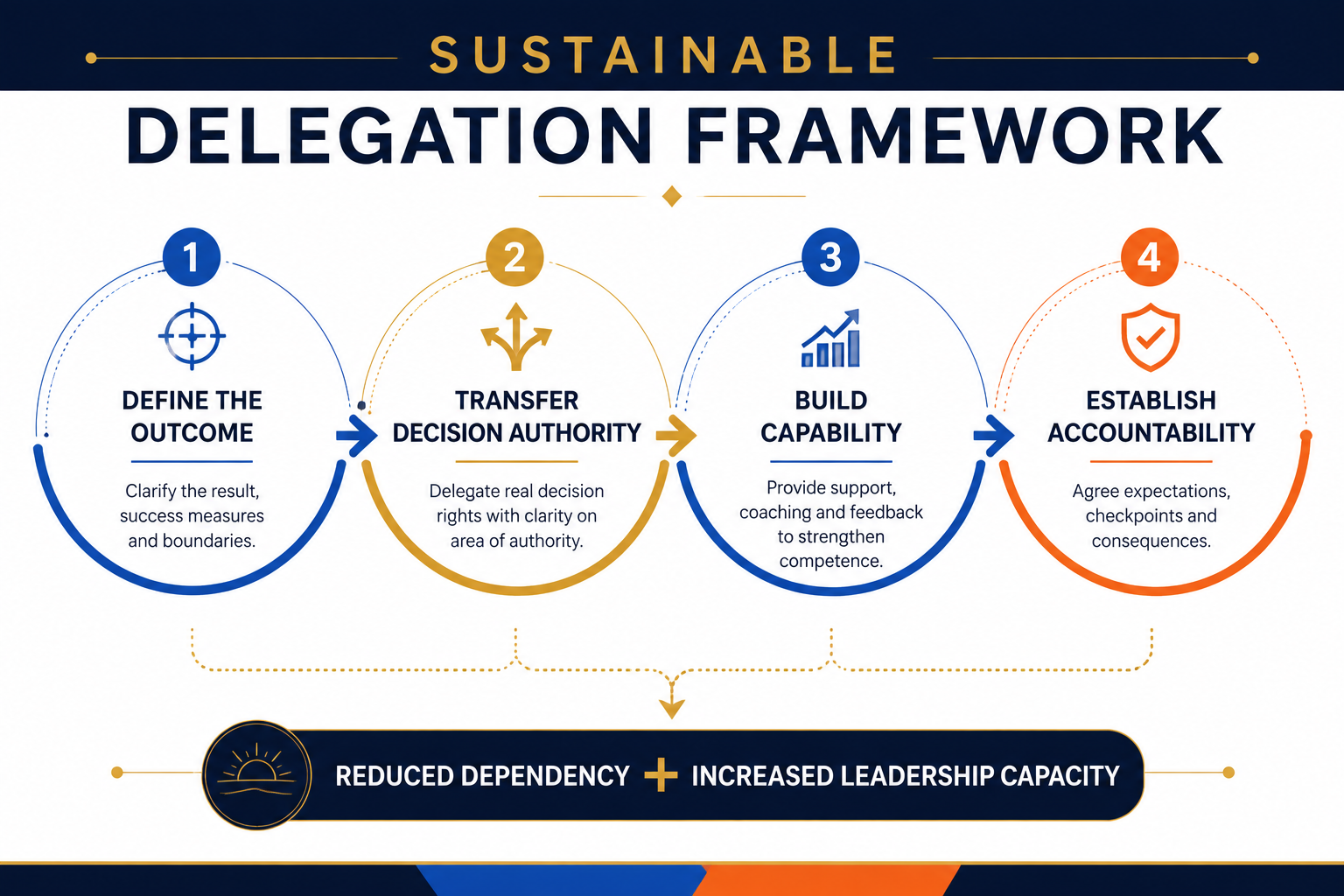
Effective delegation requires more than deciding which tasks somebody else can perform. It requires a system. The aim is not to push as much work downwards as possible, nor to remove senior leaders from decisions that genuinely require their judgement. The aim is to put responsibility and decision authority at the right level. Four questions begin that redesign.
Step 1 What Outcome Is Being Transferred?
Do not delegate vague activity — delegate an outcome. “Keep an eye on the project” is ambiguous. “Own delivery of the project by 30 September within the agreed budget and quality standards” creates far greater clarity. Without that clarity, the person will repeatedly return to the leader for interpretation.
Step 2 What Decisions Can They Make?
This is where many delegation attempts break down. Establish the boundaries — for example: decide independently within the agreed budget, timeline and operational parameters; consult when a decision materially affects another department; escalate immediately when there is a serious financial, legal, safeguarding, reputational or people risk. Now the employee does not have to guess.
Step 3 What Capability or Resources Are Required?
Delegation without capability is dumping. If somebody lacks the information, skill, authority or resources required to deliver the outcome, transferring responsibility does not solve the workload problem — it delays it. Ask: what does this person need in order to succeed without unnecessary dependence on me?
Step 4 How Will Accountability Work?
Delegation does not mean disappearing. Good delegation creates proportionate accountability — agree what will be reviewed, when it will be reviewed and what information is required. Create enough visibility to maintain accountability without recreating control.
The principle is simple: too little oversight can become abdication, too much oversight becomes micromanagement. Sustainable delegation sits between the two.
Traditional Delegation vs Sustainable Delegation
The difference between traditional and sustainable delegation is not whether work gets allocated. It is what happens to ownership after allocation.
| Traditional Delegation | Sustainable Delegation |
|---|---|
| Transfers tasks | Transfers defined outcomes |
| Leader retains most decisions | Decision authority is explicitly distributed |
| Employee seeks frequent approval | Escalation thresholds are agreed |
| Leader checks how work is completed | Leader monitors outcomes and exceptions |
| Mistakes trigger tighter control | Reasonable mistakes become capability development |
| Delegation provides temporary relief | Delegation creates permanent capacity |
| Knowledge remains concentrated | Capability spreads through the organisation |
| Leader remains essential to routine work | Team can operate without constant leader intervention |
| Success means “work left my desk” | Success means “dependency on me reduced” |
This distinction matters because sustainable leadership cannot depend on one person’s endless availability. A system that works only while the leader is constantly present is not a strong system — it is a fragile one.
The Burn Bright philosophy is structural, not motivational. Burnout is treated as a system failure, and the response is to redesign the architecture rather than simply demand more effort from the individual leader. Delegation is one part of that redesign. It changes where work lives. It changes where decisions live. And, done properly, it changes how much cognitive weight a leader carries.
Frequently Asked Questions: Delegation Failure in Leadership
What causes delegation failure in leadership?
Delegation failure in leadership commonly occurs when responsibility is transferred without sufficient authority, capability or accountability. The employee owns the task but remains dependent on the leader for decisions. Over time, work repeatedly escalates upwards and the leader becomes a bottleneck. The solution is clearer decision rights and ownership, not simply delegating more tasks.
Why do leaders struggle to let go when delegating?
Some leaders struggle because their identity has been built around competence and problem-solving. Others operate in systems where mistakes are heavily punished or accountability remains unclear. The answer is not simply “trust more” — leaders need clear standards, decision boundaries and review mechanisms that allow them to release control without abandoning accountability.
How can I delegate without losing control?
Replace constant involvement with clear governance. Define the outcome, establish decision authority, agree escalation thresholds and schedule proportionate reviews. This gives the leader visibility without requiring involvement in every decision — the objective is to move from controlling activity to governing outcomes.
What is reverse delegation?
Reverse delegation occurs when responsibility given to an employee gradually returns to the manager. It often begins with requests for advice, checking or approval. If the leader repeatedly solves the problem, the employee learns to escalate rather than decide. Clear decision rights and coaching questions can interrupt this dependency cycle.
Can poor delegation cause leadership burnout?
Poor delegation can contribute to leadership burnout because leaders remain responsible for too many tasks, decisions, approvals and escalations. The visible workload may appear distributed while the cognitive workload remains concentrated. Burn Bright therefore treats delegation and decision authority as structural components of sustainable leadership rather than merely productivity techniques.
What should a leader do when someone brings back a delegated problem?
Do not automatically solve it. Ask what has happened, what options they have considered, which option they recommend and whether the decision falls within their authority. If it does, return the decision to them. The aim is to provide enough support to develop judgement without becoming the permanent decision-maker.
Conclusion: Fix the Delegation System, Not Just the Leader
Delegation failure in leadership is easy to personalise. We tell leaders they need to trust more. Let go. Stop micromanaging. Become better delegators. Sometimes those behaviours do need to change.
But if delegation repeatedly fails across an organisation, look deeper. Examine where authority sits. Examine how decisions move. Examine what happens when somebody makes a reasonable mistake. Examine whether managers have the capability and information required to own outcomes. Examine how many decisions automatically travel upwards because nobody has explicitly decided where they should live.
That is where sustainable delegation begins. Better systems outperform more effort. A leader cannot compensate indefinitely for unclear roles, weak decision rights and organisational dependency by working longer hours. Nor should they have to.
And it begins by replacing the question “What else can I delegate?” with “Why does this organisation still need me to make this decision?”
Diagnose What Is Driving Your Leadership Overload
If work keeps returning to you despite your attempts to delegate, the problem may be bigger than delegation. Identify the structural pressures consuming your leadership capacity with the free assessment.
Free Leadership Intelligence
Get Weekly Leadership Insights
Join thousands of leaders receiving practical strategies on burnout prevention, workload design, and sustainable performance every week.