Quick Answer
Key Takeaways
- The most difficult leadership decisions rarely involve an obvious choice between right and wrong — they involve competing versions of what appears reasonable.
- Ethics Intelligence™ shifts leaders from asking “Am I an ethical person?” towards “Is the architecture of this decision ethically robust?”
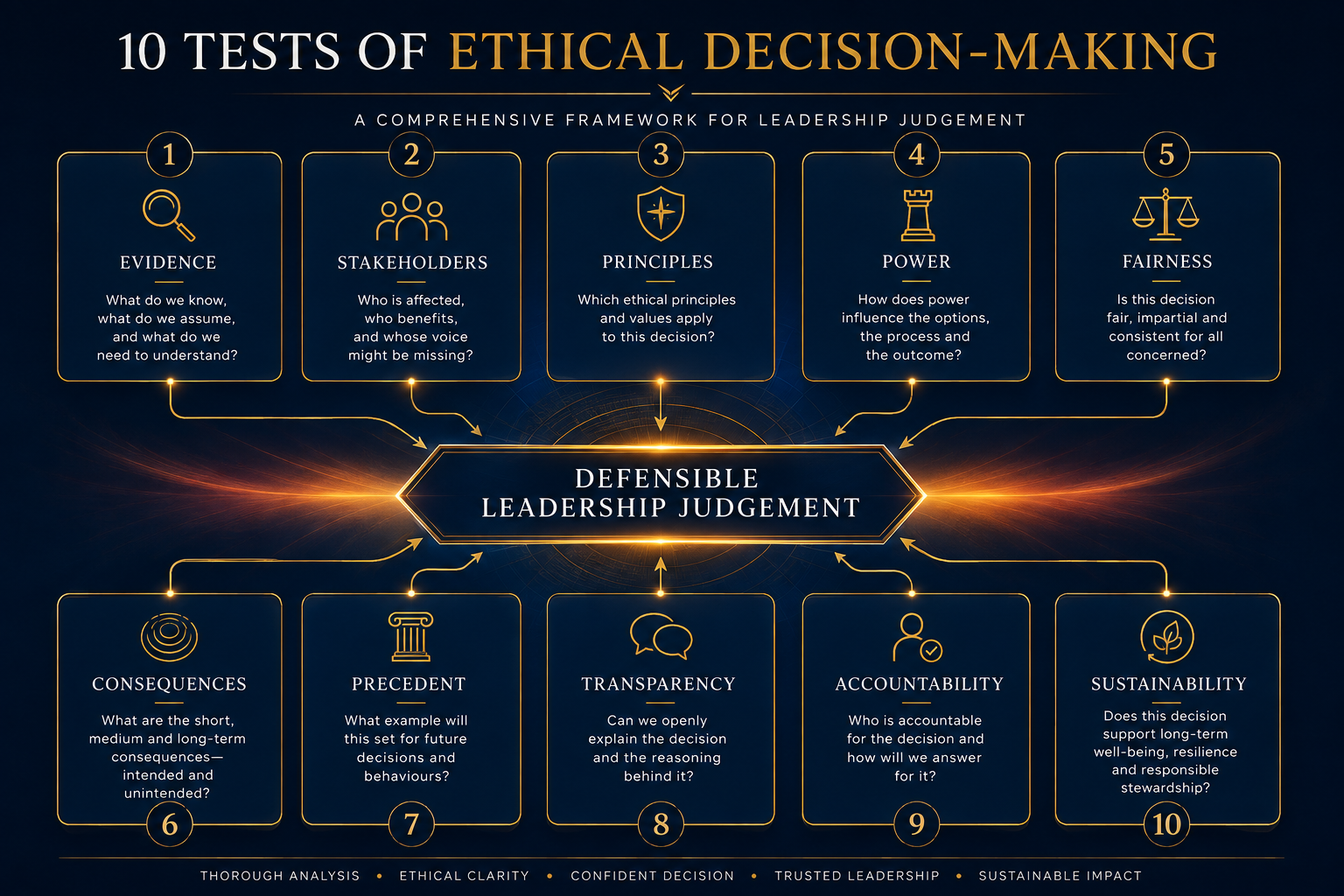
- Ten lenses — Evidence, Stakeholders, Principles, Power, Fairness, Consequences, Precedent, Transparency, Accountability and Sustainability — turn ethical intention into a repeatable decision process.
- Every consequential leadership decision resolves the immediate issue and teaches the organisation something about how it really works.
- Ethics Intelligence™ does not promise perfect decisions — it promises disciplined, reflective and accountable judgement.
Ethics Leadership: How Leaders Make Better Decisions When the Right Answer Is Not Obvious
The most difficult leadership decisions rarely involve an obvious choice between right and wrong. They involve competing versions of what appears reasonable.
- Protect the organisation or protect an individual.
- Move quickly or consult widely.
- Maintain confidentiality or increase transparency.
- Reward performance or challenge behaviour.
- Reduce expenditure or preserve capability.
- Apply a policy consistently or recognise exceptional circumstances.
These are not simply operational decisions. They are tests of Ethics Intelligence™.
Within Burn Bright Advisory’s Leadership Intelligence Compass™, Ethics Intelligence™ concerns a leader’s capacity to exercise judgement through values, principles and moral courage. It sits within the wider discipline of Leadership Performance Intelligence™ because ethical judgement is not separate from leadership performance. It is one of the conditions that determines whether performance remains trusted, legitimate and sustainable.
Ethical leadership therefore requires more than being a “good person.” It requires leaders to examine evidence, identify affected stakeholders, recognise power dynamics, test fairness, anticipate consequences, consider precedent and remain accountable for both the decision and the process used to reach it.
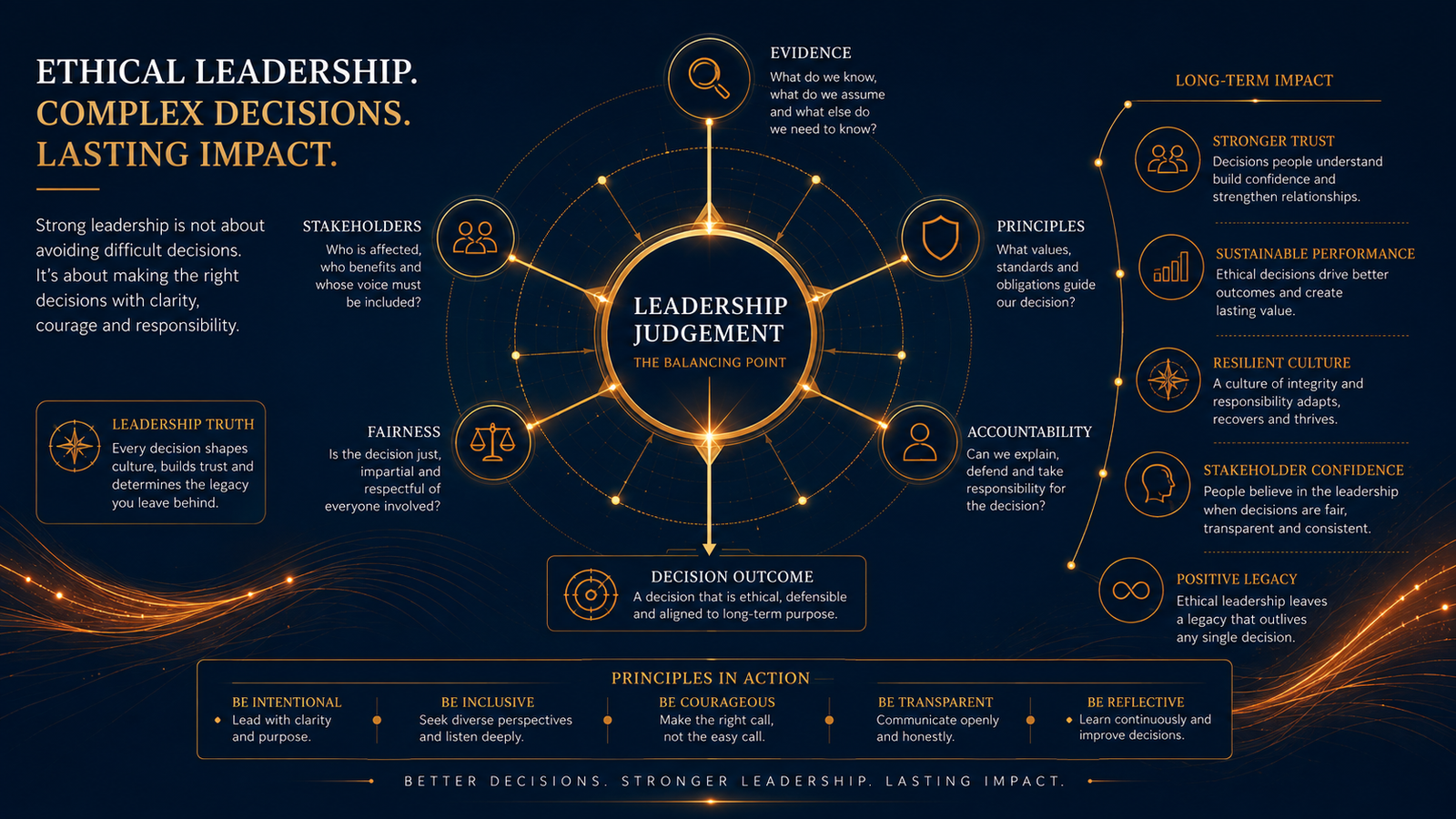
Leadership becomes ethically significant precisely when the answer is difficult. When there is a clear policy, sufficient information, aligned stakeholders and an obvious course of action, leadership judgement may be relatively straightforward. But organisations do not remain in that territory for long.
- A CEO discovers that the commercially attractive option will result in significant redundancies.
- A school principal must decide whether exceptional circumstances justify departing from an established policy.
- A healthcare leader faces competing demands involving patient care, staff capacity and financial constraints.
- A public-service executive has to balance transparency against confidentiality.
- An HR leader must determine whether the organisation should retain a high-performing executive whose behaviour repeatedly undermines colleagues.
- A founder has to decide whether rapid growth justifies demands that are becoming unsustainable for the team.
None of these situations can be resolved adequately by asking “What do I want to do?” Nor can they necessarily be resolved by asking “What does the policy say?” Policy matters. Values matter. Experience matters. But complex leadership decisions require something more sophisticated: the capacity to examine the decision from several ethical perspectives before exercising judgement. Burn Bright Advisory™ describes this capability as Ethics Intelligence™.
What Is Ethics Leadership?
Featured Snippet
That definition matters because ethical leadership is frequently reduced to personal character. We describe an ethical leader as honest, trustworthy, fair or principled. Those qualities are important. But they are insufficient.
A leader can have good intentions and still make a poor decision. A leader can believe strongly in fairness while failing to recognise that different groups are being affected unequally. A leader can follow organisational policy precisely while overlooking an ethically significant consequence. A leader can act transparently while unnecessarily exposing confidential information. And a leader can pursue an admirable organisational objective through a process that damages trust.
Ethics Intelligence™ asks leaders to move beyond the question: “Am I an ethical person?”
Towards a more demanding question: “Is the architecture of this decision ethically robust?”
That shift — from identity to disciplined judgement — is fundamental.
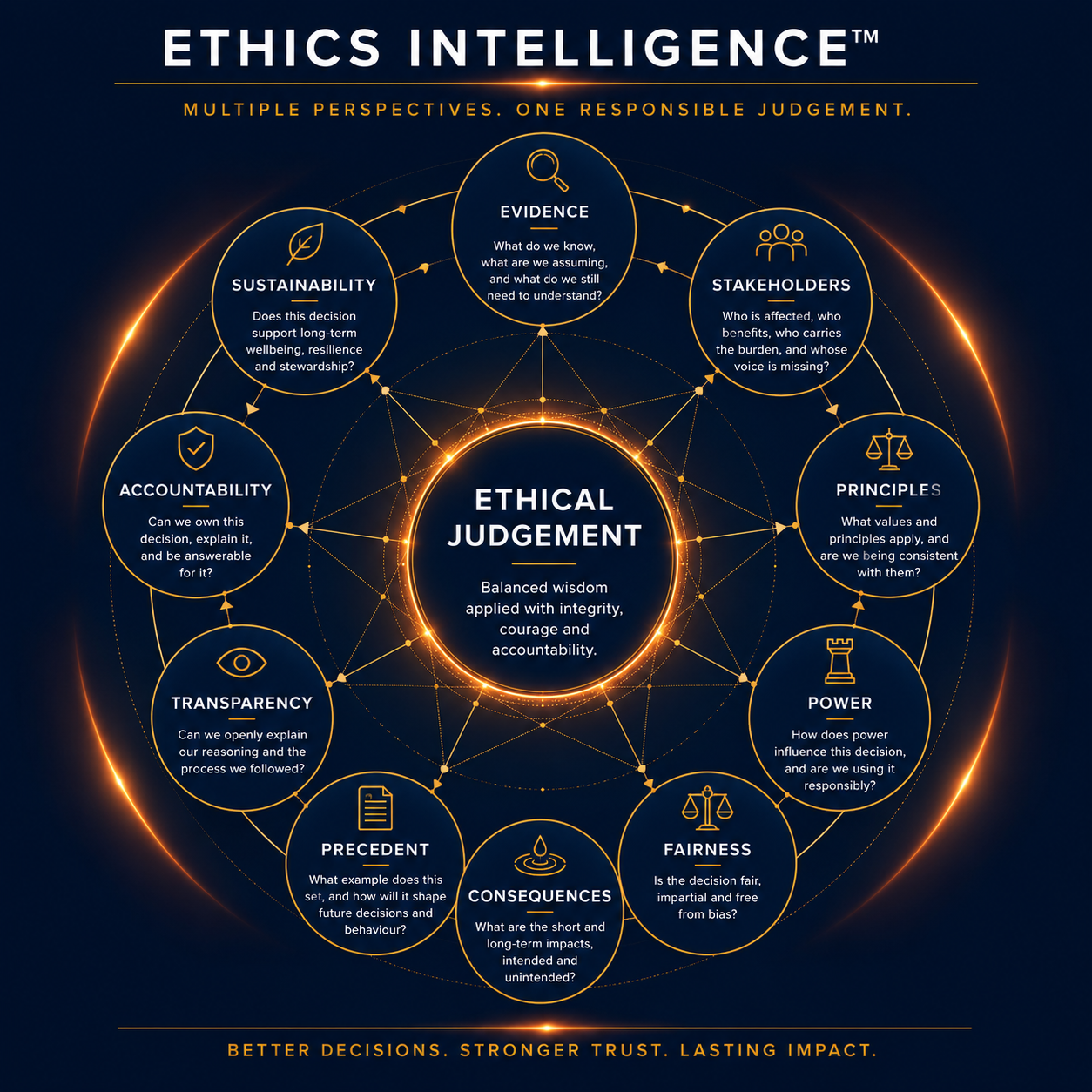
Why Ethical Leadership Is Becoming More Difficult
Leadership decisions increasingly take place inside systems characterised by speed, complexity and competing expectations. Executives are expected to make decisions quickly while consulting stakeholders. They are expected to provide transparency while protecting confidentiality. They must deliver performance while supporting wellbeing. They must innovate while controlling risk. They must use increasingly sophisticated data and artificial intelligence while remaining accountable for decisions influenced by those systems. They must treat people consistently while responding intelligently to individual circumstances.
The challenge is not simply that leaders face more decisions. It is that more decisions contain competing legitimate considerations.
This distinction is important. An ethical dilemma is not always created because one option is unethical. It may arise because several ethical obligations are simultaneously valid but cannot all be maximised.
Consider a restructuring decision. The organisation may have a legitimate responsibility to remain financially sustainable. It may also have a responsibility towards employees whose livelihoods will be affected. Leaders may owe responsibilities to customers, shareholders, communities and future employees. Maintaining every existing role could threaten organisational sustainability. Removing roles too aggressively could destroy capability and trust.
The ethical challenge therefore cannot be reduced to “Are redundancies ethical?” A better set of questions would include:
- What evidence demonstrates that restructuring is necessary?
- What alternatives have been examined?
- Who carries the greatest burden?
- Who has participated in the decision?
- How have vulnerable stakeholders been considered?
- Are the criteria fair?
- Can leaders explain the reasoning openly?
- Who is accountable for the consequences?
- What precedent will the decision establish?
These questions reveal the difference between ethical intention and ethical intelligence.
Ethics Intelligence™: From Values to Decision Architecture
Values tell leaders what matters. Ethical intelligence helps them determine what those values require in a particular situation. That distinction is easily overlooked.
An organisation may publish values such as integrity, respect, excellence, inclusion and accountability. Yet those words do not automatically tell a leader what to do when values compete.
Suppose a senior executive consistently delivers exceptional commercial results but creates fear within the team. “Excellence” might appear to support retaining the executive. “Respect” may point towards intervention. “Accountability” requires consequences. “Integrity” requires the organisation to confront the contradiction between what it publicly claims and what it privately tolerates.
The leadership challenge is not choosing which corporate value sounds best. It is converting values into decision criteria. This is where Ethics Intelligence™ becomes operational.
Within the wider Leadership Intelligence Compass™, Ethics Intelligence™ strengthens a leader’s ability to make decisions through integrity, fairness and moral judgement. But it also interacts with the other intelligence domains. Professionalism Intelligence™ asks whether standards are being maintained. Emotional Intelligence™ helps leaders understand the human consequences of decisions. Reflective Practice Intelligence™ challenges leaders to examine their assumptions. Constructivism Intelligence™ encourages leaders to test how meaning and interpretation are being formed. Adaptability Intelligence™ considers changing circumstances. Visionary Leadership Intelligence™ connects today’s choice to future direction. Knowledge Development Intelligence™ asks whether sufficient insight exists. Leadership Sustainability™ considers whether the decision can support long-term leadership and organisational health.
Ethical judgement therefore does not operate in isolation. It is strengthened by integrated leadership intelligence.
The Ten Tests of an Ethically Intelligent Decision
Burn Bright’s Ethics Intelligence™ Decision Check provides ten lenses through which leaders can examine a significant decision before committing to action:
- Evidence — What facts, data and insights inform the decision?
- Stakeholders — Who will be affected, and whose voice should be considered?
- Principles — Which ethical principles apply?
- Power — What power relationships influence the situation?
- Fairness — Is the proposed decision impartial and justifiable?
- Consequences — What could happen in the short and long term?
- Precedent — What future expectation will this decision establish?
- Transparency — Can the reasoning be explained appropriately?
- Accountability — Who owns the decision and its outcomes?
- Sustainability — Does the decision support long-term ethical and organisational value?
The purpose is not to turn leadership into a mechanical ten-step exercise. It is to prevent one-dimensional judgement.
Test 1 Evidence — What Do We Actually Know?
Ethically weak decisions often begin with untested certainty — an employee described as “difficult,” a department labelled “underperforming.” These statements may contain truth, or interpretation, bias and incomplete information. Ethics Intelligence™ begins by separating evidence from assumption: what happened, what evidence supports that conclusion, what information is missing, and what would change our interpretation? The greater the consequence of the decision, the stronger the evidence standard should become.
Test 2 Stakeholders — Who Carries the Consequences?
Leadership decisions are rarely experienced equally. A decision that appears minor from the boardroom may fundamentally alter the working conditions of frontline employees. Ethically intelligent leaders do not ask “How can we make everyone happy?” They ask “Whose interests are affected, what obligations do we have towards them, and how should those interests influence our judgement?”
Test 3 Principles — What Must Not Become Negotiable?
Evidence tells us what is happening; principles help determine what should happen. These might include dignity, safety, honesty, confidentiality, equality, professional responsibility, duty of care or procedural fairness. The difficult work begins when principles conflict — transparency can violate confidentiality, consistency can itself become unfair, and loyalty cannot justify concealing misconduct.
Test 4 Power — Who Can Speak and Who Cannot?
Every organisation contains differences in authority, status, access, expertise and security. An apparently voluntary agreement may contain significant power asymmetry. Ethics Intelligence™ asks: who feels safe enough to disagree, who depends on whom, and who might remain silent because the perceived cost of honesty is too high? A leader who ignores power can mistake silence for consent.
The Leadership Question at the Centre of Ethics Intelligence™
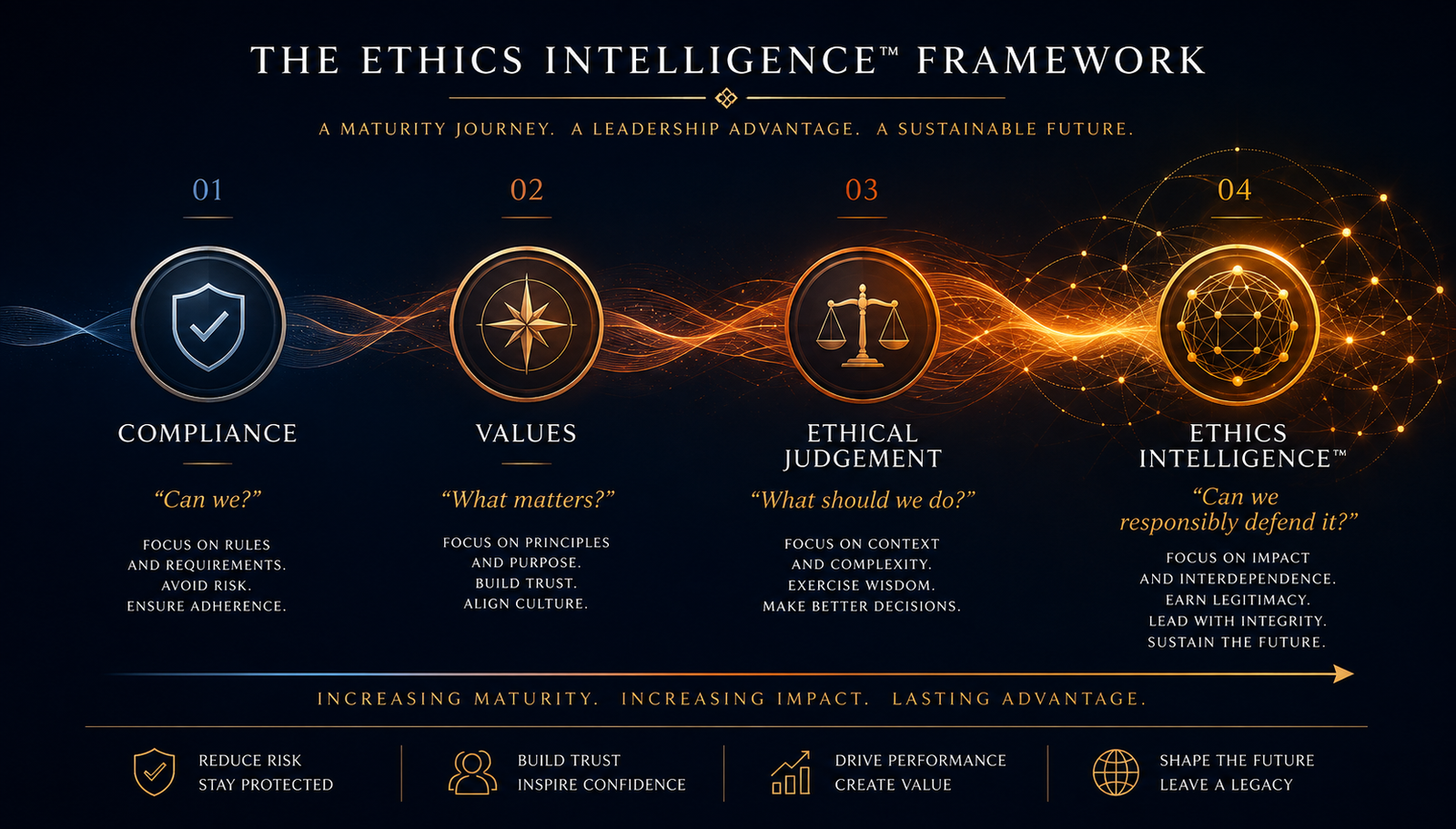
Ethical leadership is ultimately tested when authority gives a leader the ability to do something that deserves deeper examination. The crucial question is therefore not simply “Can we do this?” It is: “Given the evidence, stakeholders, principles, power dynamics and consequences involved, can we justify doing this — and would we remain comfortable explaining how we reached the decision?”
That is the transition from compliance to Ethics Intelligence™. And it is where leadership judgement becomes leadership accountability.
Test 5 Fairness — Would We Apply the Same Reasoning Elsewhere?
Fairness does not mean treating everyone the same — identical treatment can produce profoundly unequal outcomes when circumstances differ. Ethically intelligent leadership distinguishes between consistency of principle and uniformity of response: the principle should remain stable, while the application may legitimately differ according to evidence and context. Fairness becomes particularly important when leaders control scarce opportunities — promotion, workload, development, recognition, flexibility, resources or access to influential projects.
Leaders can test fairness by asking:
- Would we make the same judgement if a different person were involved?
- Are status, familiarity or personal preference influencing our decision?
- Are exceptions based on defensible circumstances?
- Who benefits from this decision, and who carries its costs?
- Could we explain the difference in treatment without embarrassment or contradiction?
An organisation’s ethical culture is not created only through major ethical decisions. It is created through thousands of smaller allocations of opportunity, attention, consequence and support.
Test 6 Consequences — What Happens After the Decision?
Leadership decisions create chains of consequences — some immediate, others slow to emerge. A decision can succeed financially and fail culturally, succeed operationally and fail ethically, improve efficiency while weakening trust. This is where Ethics Intelligence™ connects directly with Leadership Sustainability™: the question becomes not just “What are we solving now?” but “What might we be creating next?”
Test 7 Precedent — What Are We Teaching the Organisation?
Every significant leadership decision resolves the immediate issue and teaches people something about how the organisation works. An exception that appears reasonable once may become dangerous when repeated — a shortcut can become a norm, silence can become permission, tolerance can become expectation. Leaders should ask: if this became our normal response, what kind of organisation would we create?
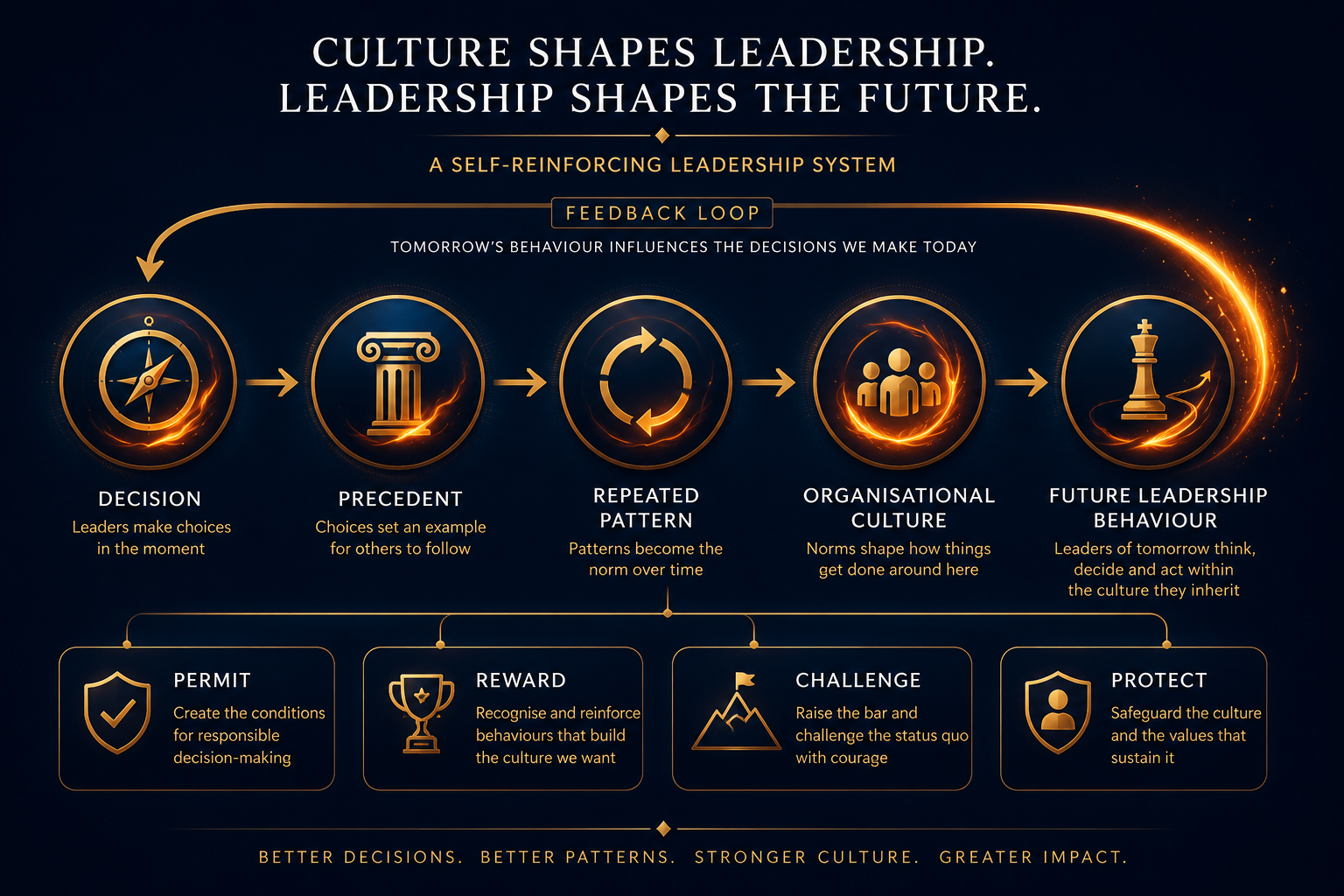
Conversely, constructive precedents can strengthen organisational culture. When leaders acknowledge mistakes openly, they establish that accountability is compatible with authority. When concerns raised by junior colleagues are taken seriously, speaking up becomes safer. When high performers remain accountable to behavioural expectations, values become credible. People learn what the organisation truly believes by observing what leaders repeatedly permit, reward, challenge and protect.
Test 8 Transparency — Could We Explain the Reasoning?
Ethical transparency does not mean disclosing everything — responsible leadership sometimes requires confidentiality. It concerns something deeper: can the logic of the decision withstand appropriate scrutiny? Could you describe the principles used, the evidence considered, why alternatives were rejected and what safeguards were introduced? Transparency is therefore a decision-quality test, not merely a communications strategy implemented afterwards.
Test 9 Accountability — Who Owns What Happens Next?
Authority without accountability creates ethical fragility. Leaders sometimes distance themselves from difficult outcomes through organisational language — “the process required it,” “the algorithm identified it.” External constraints are real, but leadership accountability cannot simply disappear inside systems, committees or technology. Someone still decided how evidence would be interpreted, and which recommendation to accept.
Test 10 Sustainability — Can This Decision Remain Defensible Over Time?
A decision may be legal, profitable, even popular — but is it sustainable? Leadership Sustainability™ concerns the preservation of human capacity, relational capacity, professional credibility, institutional trust, knowledge, culture and reputation over time. Ethics Intelligence™ asks: could we defend not only this decision, but the organisational pattern created if we continued making decisions this way?
This issue becomes increasingly important as organisations integrate artificial intelligence and automated decision-support systems. Technology may inform leadership judgement. It cannot absorb moral responsibility for it. Repeatedly solving organisational problems through excessive human effort may deliver results — it may also deplete the very people responsible for producing those results. Systems that depend upon continuous individual heroics can appear effective while gradually exhausting their leadership capacity.
Ethics Leadership Across Different Sectors
The principles of Ethics Intelligence™ are universal. Their application is contextual.
Business Growth Intelligence™
A rapidly growing business may discover its expansion strategy is creating unsustainable workloads. The commercial argument might support continuing — demand is strong, competitors are moving quickly. Ethics Intelligence™ asks whether the organisation is transferring the cost of growth onto employees, and what happens if current working practices continue for twelve months. Growth that systematically consumes Leadership Capacity™ is a leadership-performance problem, not simply a wellbeing one.
School Leadership Intelligence™
When parental pressure grows for an exception to established policy, Ethics Intelligence™ prevents the decision from collapsing into either rigid enforcement or unstructured compassion. The question becomes not “Do we make an exception?” but “What decision best honours the principles behind the policy while responding fairly to the circumstances?”
Healthcare Leadership Intelligence™
When a department faces severe capacity pressure, asking staff to absorb additional work may solve an immediate operational problem. But the ethical analysis must consider fatigue, patient safety, professional standards, fairness and sustainability — a decision that appears operationally necessary may require additional safeguards once examined through Ethics Intelligence™.
Public Service Leadership Intelligence™
Public-sector leaders operate within complex relationships involving public accountability, legislation, political priorities and finite resources. Ethics Intelligence™ helps leaders distinguish between what is politically convenient, administratively efficient and ethically defensible. Public trust is created when decision processes demonstrate it, not through declarations of integrity.
HR & People Leadership Intelligence™
People decisions — recruitment, promotion, redundancy, performance management, pay, succession — reveal organisational ethics with unusual clarity. Employees will usually believe the behaviour before they believe the values statement. Ethics Intelligence™ helps convert organisational values from words into observable decision standards.
Entrepreneur Performance Intelligence™
Entrepreneurs face a distinctive ethical challenge because authority can become concentrated — speed can make consultation feel inefficient, and personal conviction can become organisational certainty. This makes Reflective Practice Intelligence™ particularly important: what am I assuming, who disagrees with me, and would this decision survive scrutiny if somebody else made it?
A Practical Ethics Intelligence™ Decision Protocol
When facing a significant leadership decision, use the following sequence.
- Define the decision. State precisely what is being decided. Avoid beginning with your preferred solution.
- Establish the evidence. Separate verified facts from interpretations, assumptions and opinions. Identify important information gaps.
- Map stakeholders. Identify who benefits, who carries risk and who has limited influence over the outcome.
- Identify principles. Clarify the ethical, professional and organisational principles involved.
- Examine power. Ask whose voice dominates and whose perspective may be missing.
- Test fairness. Consider whether equivalent circumstances would receive equivalent reasoning.
- Examine consequences. Consider immediate, secondary and longer-term effects.
- Test precedent. Ask what would happen if this decision became the organisational norm.
- Prepare the explanation. Determine whether the reasoning can be communicated clearly and appropriately.
- Assign accountability. Identify who owns implementation, monitoring, review and correction.
This process does not eliminate difficult decisions. It improves the quality of the judgement brought to them.
Ethics Intelligence™ Is Not Ethical Perfection
Ethics Intelligence™ does not promise perfect decisions. Leadership rarely offers that luxury. Sometimes every available option carries a cost. Sometimes evidence remains incomplete. Sometimes leaders must act quickly. Sometimes stakeholders have irreconcilable interests. Sometimes the ethically preferable decision creates significant short-term difficulty.
The objective is therefore not moral perfection. It is disciplined, reflective and accountable judgement. That matters because leaders can become paralysed by the belief that ethical leadership means finding an option in which nobody loses. Often, no such option exists.
Leadership Reflection Questions
- Which decisions in my role carry the greatest ethical consequences?
- Where might organisational pressure be narrowing my judgement?
- Which stakeholders have the least influence over decisions that affect them?
- Where might consistency be creating unfairness — or exceptions be creating inconsistency?
- What behaviour does our organisation tolerate because the person responsible performs well?
- Which recent decision would be difficult to explain openly?
- Where are power differences affecting people’s willingness to challenge leadership?
- What precedent are our current decisions establishing?
- Which short-term performance decisions may be reducing long-term Leadership Capacity™?
- What evidence would cause me to change my mind about an important current decision?
Action Steps: Strengthening Ethics Intelligence™
For leaders wanting to strengthen Ethics Intelligence™ immediately:
- Identify one live decision. Choose something consequential enough to warrant deeper analysis.
- Run the ten tests. Examine evidence, stakeholders, principles, power, fairness, consequences, precedent, transparency, accountability and sustainability.
- Invite challenge before commitment. Ask someone with a different perspective to test your reasoning.
- Document the rationale. Record not only what was decided but why.
- Identify a review point. Ethical accountability continues after implementation.
- Examine patterns. One decision provides insight; repeated decisions reveal culture.
- Connect ethics with leadership development. Use the Leadership Intelligence Assessment™ and Leadership Intelligence Compass™ to examine how Ethics Intelligence™ interacts with professionalism, reflection, emotional intelligence, adaptability and sustainability.
Conclusion: Ethical Leadership Is a Performance Capability
Ethics is sometimes positioned as a constraint on leadership performance. That framing is too narrow. Ethical judgement is part of leadership performance. A leader who produces results while destroying trust has created a performance liability. A leader who makes fast decisions without sufficient evidence creates risk. A leader who demands accountability from others while avoiding it personally weakens organisational credibility. A leader who pursues short-term performance by repeatedly consuming human capacity undermines future performance.
Leadership Performance Intelligence™ provides a wider lens. Performance is not merely what a leader achieves. It concerns the quality of judgement, capability and leadership systems through which outcomes are produced — and whether those outcomes can remain credible and sustainable.
Within that system, Ethics Intelligence™ provides the moral architecture of leadership judgement. It asks leaders to look beyond “Can we?” Beyond “Will it work?” And even beyond “Is it allowed?” Towards the more consequential question: given our responsibilities, evidence, principles, stakeholders and future consequences, what decision can we responsibly defend?
There will not always be an obvious answer. That is precisely why Ethics Intelligence™ matters. The objective of ethical leadership is not to remove complexity. It is to develop leaders capable of exercising sound judgement within it.
And when organisations make that capability systematic — through the Leadership Intelligence Compass™, Leadership Intelligence Assessment™, diagnostics, planning tools, Leadership Intelligence Library™, workshops and development pathways — ethics moves beyond personal intention. It becomes part of the organisation’s Leadership Development System™. That is where ethical leadership becomes more than a value. It becomes organisational capability.
FAQ: Ethics Leadership and Ethics Intelligence™
What is ethics leadership?
Ethics leadership is the disciplined practice of exercising leadership authority and making decisions in ways that are principled, fair, evidence-informed and accountable. It extends beyond personal integrity, requiring a repeatable process for examining stakeholders, principles, power, fairness, consequences, precedent, transparency and sustainability before making significant decisions.
Why is ethics important in leadership?
Ethics matters because leadership decisions affect other people’s opportunities, resources, working conditions, wellbeing and futures. Authority increases the consequences of judgement, so ethical leadership helps ensure that performance is not achieved through decisions that unnecessarily damage trust, fairness or long-term organisational capability.
What is Ethics Intelligence™?
Ethics Intelligence™ is the leadership capacity to recognise the ethical dimensions of decisions and exercise judgement through evidence, principles, stakeholder awareness, fairness, accountability and consideration of consequences — examined through ten lenses: evidence, stakeholders, principles, power, fairness, consequences, precedent, transparency, accountability and sustainability.
What is the difference between ethics and compliance in leadership?
Compliance asks whether a decision conforms to relevant rules, policies or legal requirements. Ethics asks whether the decision is also responsible, fair and defensible. A course of action may technically comply with a policy while still creating concerns about fairness, power, transparency or foreseeable consequences.
How can leaders make better ethical decisions?
Leaders can improve ethical decision-making by defining the decision clearly, establishing available evidence, identifying affected stakeholders, clarifying relevant principles, examining power relationships, testing fairness, considering consequences, examining precedent, testing whether the reasoning can be explained, and establishing accountability for implementation and review.
Can an ethical decision still have negative consequences?
Yes. Some leadership decisions involve competing legitimate responsibilities, meaning no available option produces an entirely positive outcome. Ethical leadership does not guarantee an outcome without cost — it requires leaders to recognise those costs, consider alternatives, minimise unnecessary harm and remain accountable for the decision.
How does power affect ethical leadership?
Power influences whose opinions are heard, who can challenge decisions and who carries the consequences. Employees may remain silent because they fear career consequences. Ethics Intelligence™ requires leaders to examine whether apparent agreement genuinely represents consent or merely reflects differences in organisational power.
What is the relationship between ethical leadership and organisational culture?
Organisational culture is partly created through repeated leadership decisions. Employees observe what leaders reward, challenge, ignore and tolerate. Ethical leadership strengthens culture when organisational values become visible in actual decisions rather than remaining statements on a website or wall.
How does Ethics Intelligence™ connect with the Leadership Intelligence Compass™?
Ethics Intelligence™ is one of the interconnected domains within Burn Bright Advisory’s Leadership Intelligence Compass™. It is strengthened by Professionalism Intelligence™, Reflective Practice Intelligence™, Emotional Intelligence™, Constructivism Intelligence™, Adaptability Intelligence™, Visionary Leadership Intelligence™, Knowledge Development Intelligence™ and Leadership Sustainability™.
How can organisations develop ethical leadership?
Ethical leadership should be developed as an organisational capability rather than relying solely on individual character. Organisations can strengthen it through leadership diagnostics, structured reflection, decision protocols, leadership assessments, scenario-based workshops, planning tools and explicit accountability mechanisms.
How Robust Is the Architecture Behind Your Decisions?
Take the free Leadership Burnout Self-Assessment to understand where pressure and workload may be narrowing your judgement before it becomes a leadership risk.
Free Leadership Intelligence
Get Weekly Leadership Insights
Join thousands of leaders receiving practical strategies on burnout prevention, workload design, and sustainable performance every week.