Quick Answer
Key Takeaways
- Delegation is not abdication. You can transfer responsibility for execution while retaining appropriate oversight.
- Control should sit in the system, not the leader. Clear outcomes, decision rights and review points create visibility without micromanagement.
- Delegating tasks without authority creates dependency. People need enough authority to complete the responsibility they have been given.
- Poor delegation contributes to leadership overload. When decisions and work continually return to the leader, the leader becomes the organisational bottleneck.
- Good delegation builds capacity twice. It creates space for the leader while developing judgement and accountability across the team.
How to Delegate Without Losing Control
How to delegate without losing control is one of the most important questions for an overloaded leader.
You know you need to delegate. Your calendar is full. Decisions are stacking up. Strategic work keeps being pushed aside by operational demands. Yet handing work to someone else can create another anxiety:
What if it goes wrong?
So you hold on.
You review everything. Approve everything. Stay copied into every email. Rewrite work that is already good enough. Team members are given tasks, but the important decisions still come back to you.
That can feel like responsible leadership.
Often, it is the opposite.
It creates a system in which the organisation remains dependent on your personal capacity. As workload expands, that dependence becomes increasingly difficult to sustain.
This is one of the structural problems behind leadership burnout. The Burn Bright Not Out Framework™ identifies scope creep as a root cause of burnout and places Workload Architecture™ and Decision Authority™ among the structural changes needed to address it.
In this article, I will show you how to delegate while retaining the visibility, standards and accountability your leadership role requires — without remaining personally involved in every task and decision.
Featured Snippet
Why Does Delegation Feel Like Losing Control?
For many leaders, delegation creates an uncomfortable equation:
More delegation = less control.
That equation is wrong.
But there is a reason it feels true.
Most leaders have experienced delegation that failed. A task was handed over without sufficient context. A deadline was misunderstood. Someone made a decision outside their authority. Work came back below the expected standard. The leader then had to step in, repair the problem and explain the consequences.
The lesson becomes: “It is safer if I do it myself.”
Repeat that lesson often enough and you create a leadership role built around personal control.
That may work when the team is small and the workload manageable. It becomes dangerous as responsibilities expand.
My work on leadership burnout starts from a simple premise: burnout is a system failure. Leaders cannot indefinitely compensate for weak organisational design by supplying more personal effort.
The same principle applies to delegation. If delegation repeatedly fails, the first question should not be “Who can I trust?” Ask instead: “What is missing from the delegation system?”
The difference between personal and structural control
Personal control depends on your involvement. You attend the meeting. You approve the expenditure. You check the document. You answer the question. You solve the problem. You make the final call.
Structural control works differently. The required outcome is clear. Ownership is visible. Authority has defined limits. Standards are understood. Escalation conditions are agreed. Review points are scheduled.
You do not need to watch every action because the system tells people what they own and when you need to become involved.
Consider two leaders. The first delegates preparation of a board report but asks to see every draft, requests daily progress updates and rewrites large sections before submission. Technically, the report has been delegated. Operationally, it has not.
The second leader agrees the required outcome, audience, quality threshold and deadline. They establish which decisions the team member can make independently, identify the issues that require escalation and schedule one review before the final deadline.
Both leaders remain accountable.
Only one has actually released capacity.
This distinction matters because modern leadership roles have expanded significantly. Burn Bright Not Out™ describes leaders operating across competing demands, growing responsibilities and increasingly complex organisational environments. The answer is not simply better personal productivity. It is better workload management and more sustainable systems.
Delegation is one of those systems.
Why overloaded leaders often delegate less
There is a paradox at the centre of leadership overload. The more overwhelmed a leader becomes, the harder delegation can feel.
Good delegation requires an initial investment. You need to explain the context. Clarify the outcome. Discuss authority. Agree standards. Answer questions. Allow someone else to learn.
An overloaded leader looks at that investment and thinks: “I don’t have time for this.” So they complete the task themselves.
That may save 30 minutes today.
It can cost hundreds of hours over the following year.
The task returns next week. And next month. And next quarter. More importantly, the team learns something. They learn that the leader is where difficult work eventually goes.
This creates a dependency loop: leader holds work → team gets less experience → leader trusts team less → leader holds more work.
The leader then interprets the team’s lack of readiness as proof that delegation is impossible. But the system helped create the lack of readiness.
This is why sustainable leadership requires us to stop treating delegation as a simple productivity technique. It is part of organisational design.
The Burn Bright framework includes the RACI Delegation Framework™ alongside Workload Architecture™, Time Architecture™, Decision Fatigue Management and the wider structural transformation model. The connection matters.
Workload cannot be redesigned properly unless responsibility can move.
Responsibility cannot move effectively unless authority moves with it.
And authority cannot move safely unless accountability is clear.
The goal is not to become less accountable. The goal is to stop confusing accountability with personal involvement. That distinction is where sustainable delegation begins.
A useful way to see this shift is to compare personal control with structural control visually.
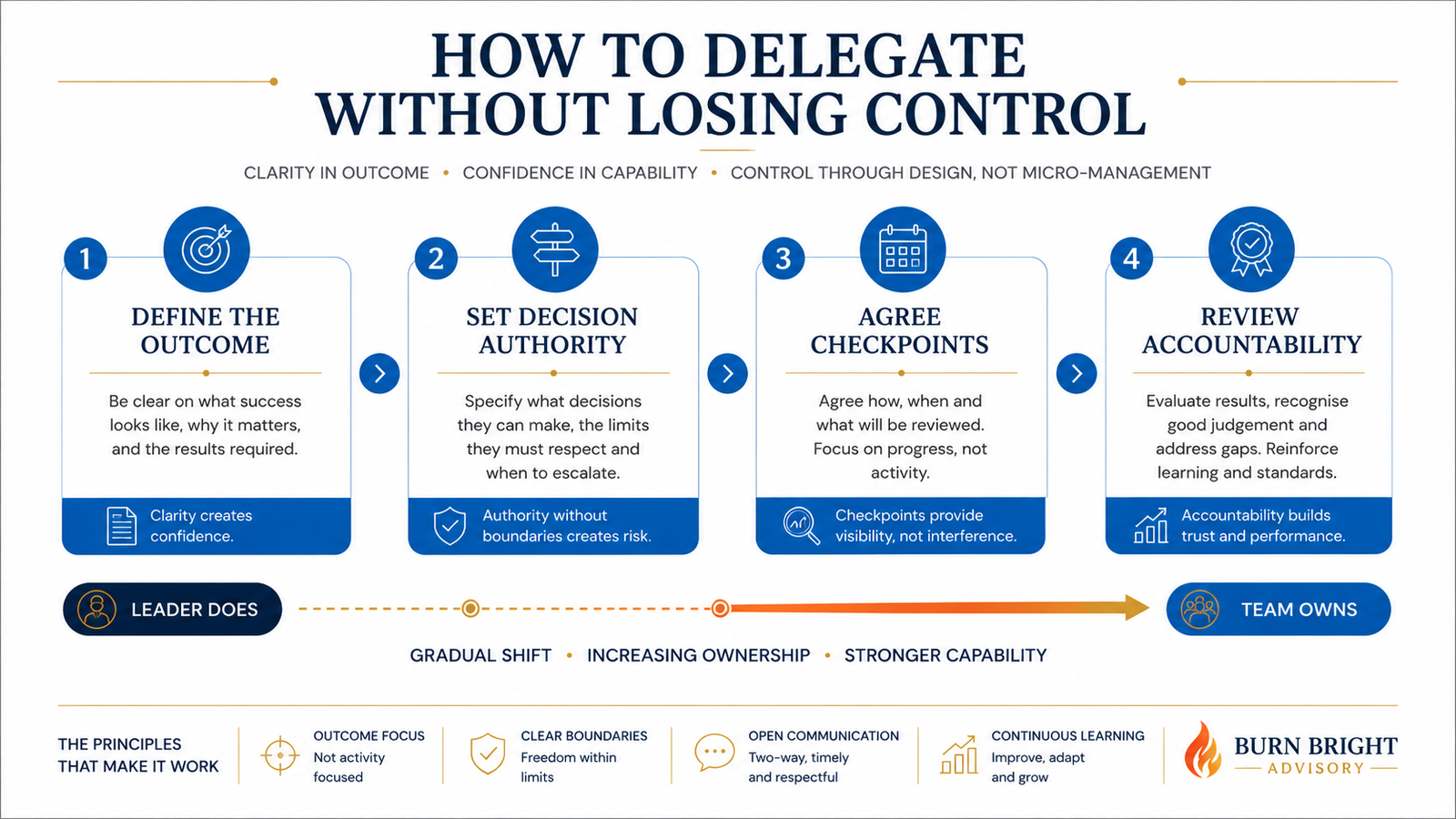
The important movement in this model is not from control to no control. It is from leader-dependent control to system-dependent control.
When everything depends on you, your capacity becomes the limit of the system. When responsibilities, decision rights and escalation points are deliberately designed, the organisation can operate without requiring your constant intervention.
That is not losing control.
That is leadership architecture.
What Should a Leader Actually Delegate?
Learning how to delegate without losing control starts with recognising that not every responsibility should be treated in the same way.
One of the biggest delegation mistakes is to ask: “What can I get off my plate?” That question is understandable when you are overloaded, but it can produce poor decisions. Leaders either dump low-value work onto already stretched team members or hold onto important responsibilities because those responsibilities feel too risky to release.
A better question is: “Where does my personal involvement genuinely add leadership value?”
That changes the conversation. Your role is not to perform the maximum amount of work personally. Your role is to make sure the right work gets done, by the right people, with the right level of authority.
Start by dividing your workload into four categories:
Category 1
Lead Personally
Work requiring your judgement, authority, relationships or accountability.
Category 2
Delegate With Review
Important work someone else can own with agreed checkpoints.
Category 3
Delegate Fully
Work another person has the capability and authority to complete independently.
Category 4
Eliminate or Redesign
Work that should not be consuming significant capacity at all.
This is Workload Architecture™ rather than task dumping.
The distinction matters because scope creep rarely arrives dramatically. It accumulates. A temporary responsibility becomes permanent. You step into a project because somebody leaves. You solve a recurring problem because doing so is quicker than fixing the process. You attend a meeting because you were invited three years ago.
Eventually, your calendar becomes an archaeological record of every problem the organisation has ever asked you to solve.
The Burn Bright Not Out Framework™ identifies scope creep as one of five root causes of burnout alongside meeting culture, communication chaos, decision overload and perfectionism culture.
Delegation therefore needs to address more than your task list. It needs to address the architecture underneath it.
Run a responsibility audit
Look at your recurring responsibilities from the last four weeks. For each one, ask: “Does this require my position, expertise or judgement?”
If the answer is no, ask why you still own it. Then ask: “What would need to be true for someone else to own this safely?”
That second question is particularly useful. It moves you away from “Nobody else can do this” towards “What capability, information, authority or safeguards are currently missing?”
Those are solvable problems. A team member may need training. They may need access to information. They may need clearer authority. The process itself may need redesigning. Or you may discover that nobody can take the work because your team genuinely lacks capacity. That is also valuable information.
The objective is not simply fewer tasks. It is better distribution of responsibility.
Why Does Delegating Tasks Without Authority Fail?
A common leadership mistake is to delegate responsibility while retaining all meaningful authority. It sounds like this:
“I want you to take ownership of this, but check with me before you do anything significant.”
That is not ownership.
It is administration.
The team member becomes responsible for moving the task forward but remains dependent on the leader for decisions.
Every exception comes upwards.
Every approval comes upwards.
Every uncertainty comes upwards.
The leader remains the bottleneck.
This is particularly damaging because the organisation can appear to have a delegation system while the leader’s cognitive workload barely changes. The task has moved. The decisions have not.
Responsibility and authority must travel together
Imagine a department head delegates responsibility for organising a professional development programme. The manager receiving the responsibility can research providers and coordinate dates. But they cannot select a provider without approval. They cannot adjust the budget. They cannot change the format. They cannot negotiate terms. They cannot resolve scheduling conflicts involving senior colleagues.
Almost every meaningful decision returns to the department head. The department head eventually thinks: “Delegation isn’t saving me any time.”
Correct.
Because only the activity was delegated.
The authority was retained.
This is where Decision Authority™ becomes central to sustainable leadership. It is one of the four structural pillars in the Burn Bright Not Out Framework™ alongside Workload Architecture™, Recovery Rhythms™ and Management Frameworks.
A useful delegation conversation therefore needs to answer three questions: What do you own? What can you decide? When do I need to become involved?
Those questions create boundaries around authority. For example:
“You own delivery of the programme within the agreed £15,000 budget. You can select suppliers, negotiate dates and make operational changes without approval. Bring the decision back to me if costs exceed the budget, the programme changes strategic objectives or a significant reputational risk emerges.”
Now there is real ownership. The leader has not disappeared. The leader has defined the boundaries of the system. That is structural control.
The goal is controlled autonomy
Delegation is sometimes presented as a binary choice. Either the leader controls the work or the employee has complete freedom. Effective delegation sits between those extremes. Call it controlled autonomy.
The person receiving responsibility has enough authority to act without repeatedly asking permission, while the organisation maintains safeguards around high-consequence decisions.
The level of autonomy should reflect several factors:
- the person’s capability and experience
- the consequence of getting the decision wrong
- the reversibility of the decision
- the financial or reputational exposure
- the clarity of the desired outcome
A new manager taking responsibility for a complex project may need more frequent review. An experienced manager handling a familiar operational area may need almost none.
The mistake is assuming that every delegated responsibility requires the same level of control. It does not. Good delegation is calibrated.
The problem becomes clearer when we look at where decisions accumulate inside an overloaded leadership system.
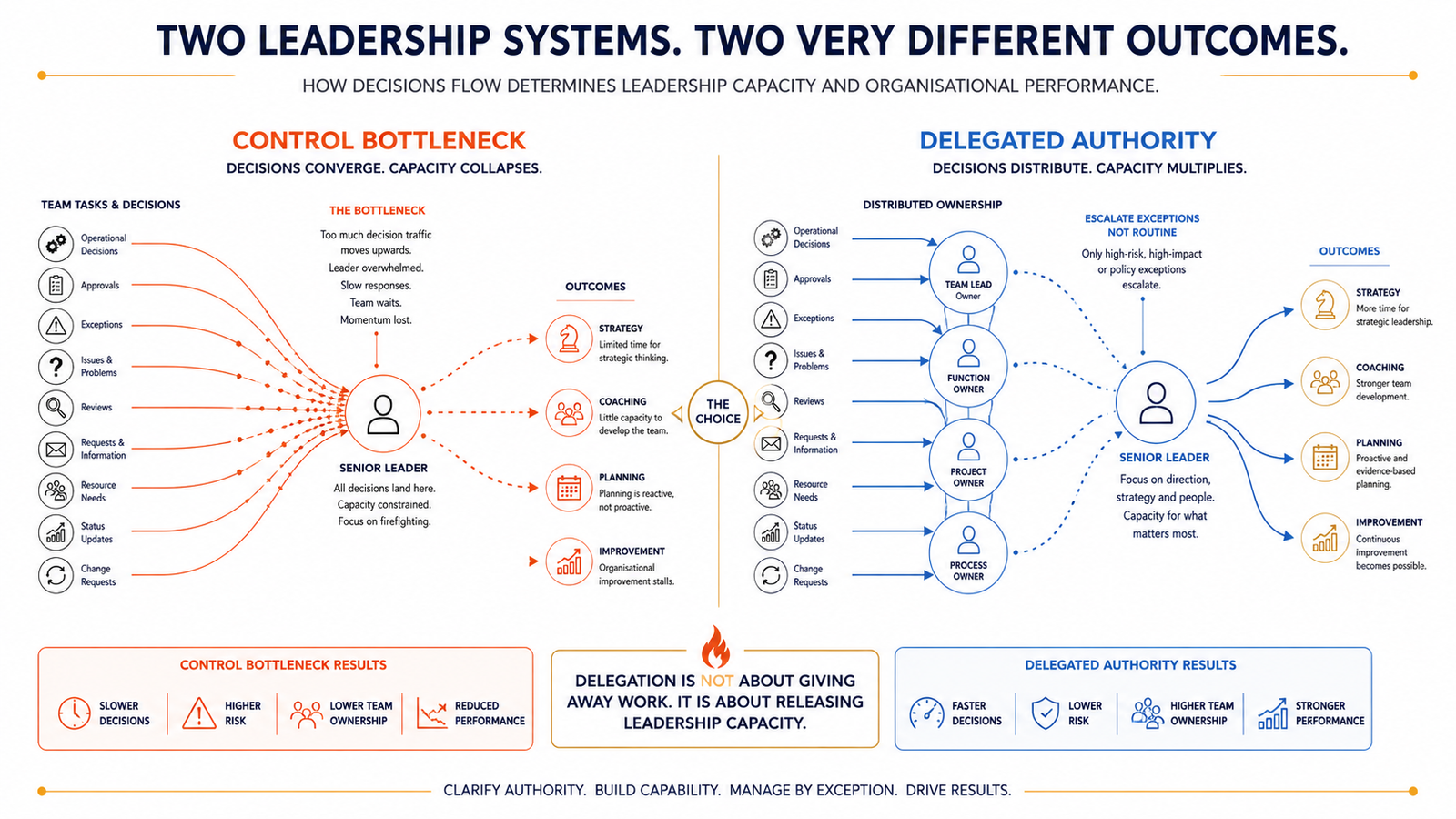
Imagine a simple data visualisation showing ten responsibilities spread across a leadership team. At first glance, workload appears distributed. Then map where the decisions go.
If eight of those ten responsibilities repeatedly require the same senior leader’s approval, the real workload has not been distributed. The visible tasks are decentralised. The cognitive load is centralised.
This distinction is crucial because decision overload is another root cause identified in the Burn Bright framework. A leader may therefore delegate more and still feel exhausted. The problem is not necessarily the number of tasks they personally complete. It is the number of decisions that still require their attention.
How Can the RACI Framework Improve Delegation?
One of the most useful ways to create clarity is to distinguish between doing the work and being accountable for the outcome. The RACI framework provides a simple structure:
- R — Responsible: Who does the work?
- A — Accountable: Who ultimately owns the outcome?
- C — Consulted: Who needs to contribute before action is taken?
- I — Informed: Who needs to know what happened?
The Burn Bright Not Out™ model includes the RACI Delegation Framework™ as one of its nine practical frameworks for structural transformation. Its value is not the acronym itself. Its value is the conversation it forces.
Consider a senior leader who is involved in a major recruitment process. Without clarity, that leader may attend candidate-screening meetings, review interview questions, approve schedules, participate in every interview, check references and approve routine communications. Why? Because nobody has explicitly decided who owns what.
A RACI conversation might establish:
- HR manager — Responsible for running the recruitment process
- Department director — Accountable for the appointment
- Relevant team leaders — Consulted on role requirements and shortlisted candidates
- Executive leader — Informed when the appointment is confirmed
Immediately, unnecessary involvement becomes visible. The executive does not need to attend every meeting simply because the recruitment matters.
If everything important requires your direct participation, you have not built organisational capacity. You have built organisational dependency.
Accountability is not the same as doing
Senior leaders often resist delegation because they remain accountable for outcomes. That concern is legitimate. You cannot delegate away every aspect of leadership accountability. But accountability does not mean performing every action yourself.
A chief financial officer remains accountable for financial reporting without personally entering every transaction. A school leader remains accountable for educational standards without teaching every lesson. A chief executive remains accountable for organisational performance without making every operational decision.
Leadership has always depended on distributed execution. The real question is whether that distribution has been designed clearly enough.
Avoid the RACI trap
RACI can also become bureaucracy if every minor activity requires a complicated chart. Do not turn delegation into paperwork. Use the framework where ambiguity is creating:
- duplicated effort
- repeated approvals
- confusion about ownership
- unnecessary escalation
- leaders being copied into everything
- work being returned upwards
- decisions sitting unresolved between functions
The objective is clarity, not documentation for its own sake. A useful test is this: ask five people involved in an important process, “Who has the authority to make the final decision?” If you receive five different answers, you have found a structural problem. No productivity technique will fix it. Clarify the architecture.
Why Micromanagement Creates Less Control, Not More
Micromanagement usually begins with a desire to reduce risk. The leader wants quality. They want consistency. They want deadlines met. They want to avoid unpleasant surprises. Those are reasonable objectives. The method is the problem.
When leaders repeatedly intervene in delegated work, several things happen. Team members stop making independent decisions because they expect the leader to alter them. They bring incomplete problems upwards because experience tells them the leader will eventually take over. They become reluctant to experiment because the safest option is to wait for instructions.
The leader then sees a team showing little initiative. That appears to confirm the original belief: “They need me involved.”
A self-reinforcing system has formed.
The more the leader controls, the less ownership the team develops.
The less ownership the team develops, the more control the leader believes is necessary.
This is not primarily a personality problem. It is a management framework problem. The leader has created a system that rewards escalation.
Replace surveillance with review points
The alternative is not to stop monitoring performance. It is to change the mechanism. Instead of asking for constant updates, establish deliberate review points before work begins.
For a four-week project, that might mean:
Day 1
Agree outcome, authority and constraints.
End of Week 1
Review direction and identify obstacles.
End of Week 3
Review near-final output.
Week 4
Complete and evaluate.
Between those points, the person responsible owns the work. This creates space for independent judgement while still allowing the leader to identify problems before they become irreversible.
It also reduces a major source of cognitive fragmentation. Every “quick update” has a cost. Every copied email asks for a small amount of attention. Every approval request requires the leader to reload context. Individually, these demands look insignificant. Collectively, they create a working day dominated by fragments.
The Burn Bright material describes modern work as increasingly matrixed and fragmented, with professionals managing simultaneous communication streams while attempting to complete their core work. The result is a shift away from deep work towards continuous availability.
Delegation should reduce that fragmentation. If it simply produces a new stream of messages, approvals and updates, redesign it.
The standard is not “Did I give the task to somebody else?” The standard is “Can this responsibility now progress successfully without requiring my continuous attention?”
That is the point at which delegation starts creating real leadership capacity.
What Framework Helps You Delegate Without Losing Control?
If delegation fails when control is either too tight or too loose, leaders need a structure between those extremes. I use seven elements: the CONTROL Delegation Framework™.
C Clarify the Outcome
Define what successful completion looks like. Do not begin delegation by explaining every step you would take. Start with the result.
O Outline Ownership
Make one person clearly responsible for moving the work forward. Not “the team will handle it” — who specifically owns it?
N Name Decision Authority
Specify what they can decide independently and what still requires approval. This is where delegation becomes real.
T Trigger Escalation Conditions
Agree the circumstances that require your involvement before the work starts, so people know when a decision genuinely needs to move upwards.
R Review at Predetermined Points
Replace continuous checking with scheduled reviews, proportionate to risk.
O Observe Outcomes, Not Activity
Measure whether the agreed result was achieved rather than how closely the person copied your method.
L Learn and Expand Authority
Use each delegation cycle to determine whether greater autonomy can be given next time.
This is how to delegate without losing control because it changes where control sits. Instead of control depending on your constant presence, it is built into the operating structure.
1. Clarify the outcome
What needs to be true when the work is finished? What does good look like? What deadline matters? What constraints cannot be crossed?
Leaders often unintentionally micromanage because they delegate their method rather than their outcome. There may be legitimate situations where the method matters — regulation, safeguarding, financial controls and safety procedures may require prescribed processes. But where the method is flexible, give people room to exercise judgement.
2. Outline ownership
Every delegated responsibility needs a recognisable owner. Shared accountability frequently becomes unclear accountability. Several people participate, but nobody feels responsible for driving the work to completion. One person should know: this is mine to move forward. Other people can contribute. Ownership still needs to be visible.
3. Name decision authority
Tell the person what they can decide without you. For example: “You can make all operational decisions within the agreed budget,” or “You can negotiate with the supplier, but any contract longer than 12 months comes back to me,” or “You own the response unless the issue creates a legal, safeguarding or significant reputational risk.”
Notice what these statements do. They do not remove boundaries. They make boundaries visible.
4. Trigger escalation conditions
One reason leaders keep checking delegated work is fear of being surprised. Solve that problem before work starts. Define the triggers that require escalation. These might include:
- expenditure exceeding an agreed threshold
- significant deviation from the deadline
- legal or regulatory risk
- reputational exposure
- conflict between strategic priorities
- consequences affecting another major function
- failure to achieve an agreed performance threshold
Now the team member does not need to ask permission about everything. They know when the decision genuinely needs to move upwards.
5. Review at predetermined points
Agree the checkpoints before the work begins. That removes the need for “just checking how this is going,” and it also prevents the opposite problem: discovering at the deadline that the work has moved significantly off course.
Review should be proportionate to risk. Low-risk, reversible decisions require less oversight. High-risk, difficult-to-reverse decisions require more. The objective is not zero oversight. It is appropriate oversight.
6. Observe outcomes, not activity
This is difficult for leaders who have been successful because of their own technical expertise. Someone else may achieve the required outcome differently. That does not automatically make their approach wrong.
Ask: did the work meet the agreed standard? Not: did they do it exactly as I would have done it? The difference is fundamental. One builds capability. The other builds imitation.
7. Learn and expand authority
Delegation should evolve. If somebody consistently makes sound decisions within an agreed boundary, widen the boundary. If problems repeatedly occur, diagnose why. Was the outcome unclear? Was the person underprepared? Was authority ambiguous? Were review points insufficient? Did the leader intervene too quickly?
Treat each delegation cycle as information about the management system.
That approach is consistent with the Burn Bright philosophy: fix the system rather than expecting individuals to compensate indefinitely for structural weakness. The wider Burn Bright Not Out Framework™ places delegation alongside Workload Architecture™ and decision-fatigue management because these problems are connected.
Why Is Better Delegation a Burnout Prevention Strategy?
Delegation is normally discussed as a productivity skill. That understates its importance. It is also a leadership sustainability mechanism.
The World Health Organization defines burnout as an occupational phenomenon resulting from chronic workplace stress that has not been successfully managed. Its three dimensions are exhaustion, increased mental distance or cynicism towards work, and reduced professional efficacy.
That definition matters because it places burnout firmly in the context of work. The question therefore cannot simply be: how do we make the leader more resilient? We also need to ask: how is the work designed?
WHO guidance on psychosocial workplace risks identifies factors including time pressure, lack of control over tasks, long working hours and lack of support. Its organisational recommendations include optimising workload and working time and increasing autonomy and participation in decision-making.
Delegation touches several of those factors simultaneously. Done properly, it distributes workload. It increases appropriate autonomy. It prevents every difficult decision from accumulating at the top. It develops additional capability inside the organisation. And it gives senior leaders more capacity for the work only they can do.
The organisational evidence matters
Deloitte surveyed 1,000 full-time US professionals and found that 77% reported experiencing burnout in their current job. It also found that 91% said unmanageable stress or frustration negatively affected the quality of their work. Among the reported drivers were lack of support or recognition, unrealistic deadlines and consistently working long hours or weekends.
A later Deloitte and Workplace Intelligence study of 3,150 executives, managers and employees across four countries found that 64% of managers were seriously considering changing jobs for one that better supported their wellbeing. Heavy workload, stressful work and long hours were among the barriers respondents identified.
There is a significant leadership lesson here. When managers are overloaded, telling them to become better at coping addresses only part of the problem. The work itself must be examined. That includes the number of responsibilities they carry, the decisions concentrated at their level, the meetings consuming their time, the communication they are expected to monitor and the work that could operate elsewhere in the organisation.
This is why delegation belongs inside Workload Architecture™. It is not merely “Who can do this task for me?” It is “Where should this responsibility and its associated decisions live in a sustainable organisation?”
That is a much more powerful question.
The Burn Bright source material makes the same distinction between traditional time management and workload management: efficiency gains cannot solve a workload that is fundamentally unsustainable.
A sustainable delegation system should gradually move the leader away from the centre of every workflow.
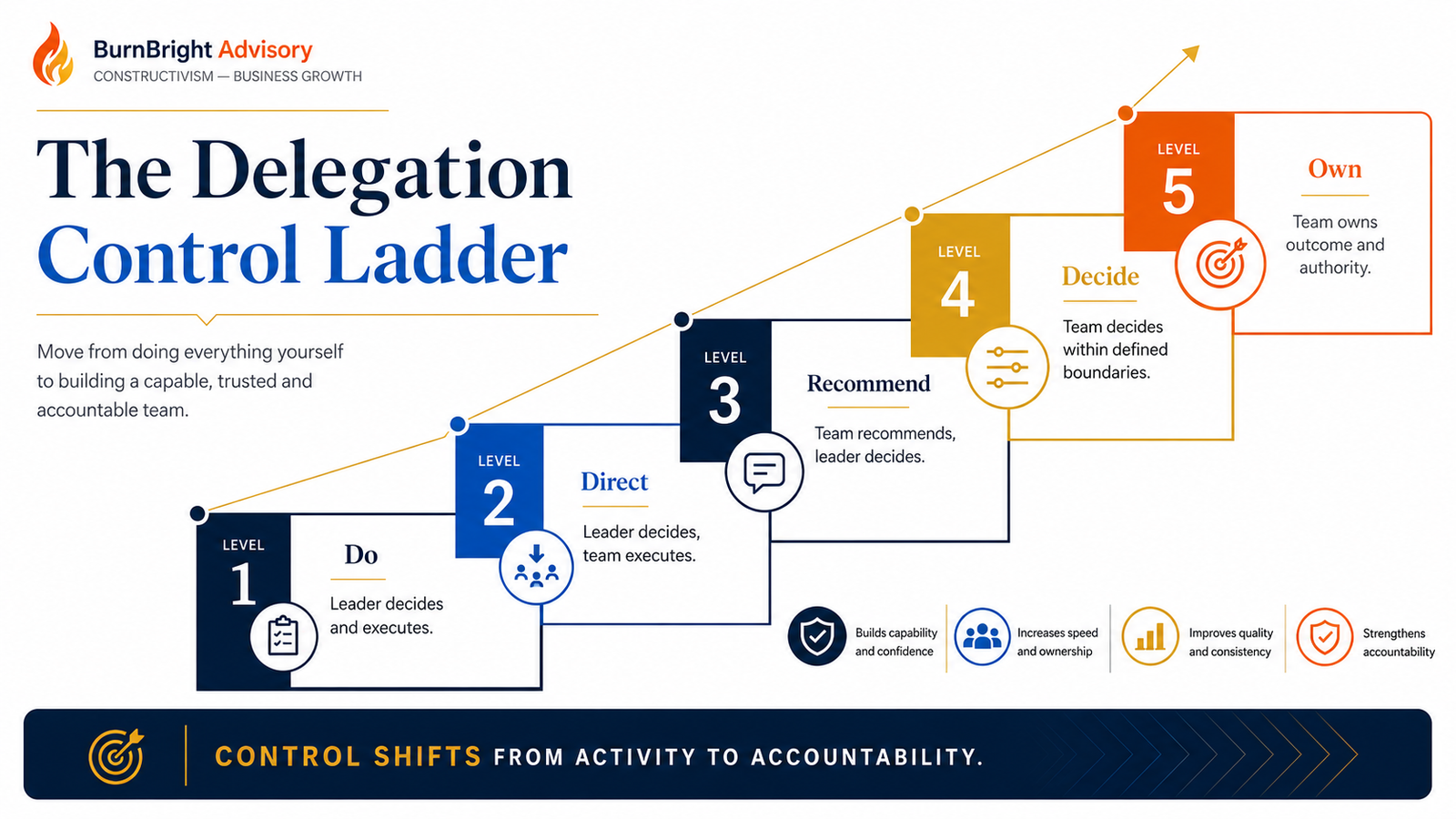
Picture the framework as a sequence: Clarify → Own → Authorise → Escalate → Review → Evaluate → Expand.
At the beginning, the leader provides clarity. In the middle, responsibility operates without constant intervention. At predetermined points, the leader reviews outcomes. Over time, demonstrated capability allows authority to expand.
This creates a positive cycle: clear delegation → greater experience → stronger judgement → increased trust → wider authority → greater leadership capacity.
Compare that with the overload cycle: leader retains control → team gains less experience → trust remains low → decisions return upwards → leader becomes overloaded → leader retains more control.
One system develops capacity.
The other consumes it.
That is why delegation is not simply about freeing several hours in your calendar. It is about designing an organisation that does not require heroic leadership to function.
Personal Control vs Structural Control
| Personal Control | Structural Control |
|---|---|
| Leader remains involved in most activity | Leader defines outcomes and boundaries |
| Tasks move but decisions return upwards | Tasks and appropriate decision authority move together |
| Frequent progress checking | Predetermined review points |
| Leader becomes the default problem solver | Clear escalation conditions determine involvement |
| Success depends on leader availability | Success depends on clear operating systems |
| Team waits for approval | Team acts within defined authority |
| Leader measures activity | Leader measures outcomes |
| Mistakes lead to tighter control | Mistakes are diagnosed and the system improved |
| Capability remains concentrated | Capability develops across the team |
| Creates dependency | Creates accountability |
The difference is not control versus freedom. It is personal control versus structural control.
Personal control may feel safer because the leader can see everything. But as the organisation grows, that model becomes fragile.
How Do You Know When Delegation Is Working?
The strongest measure is not how many tasks have disappeared from your to-do list. Look at what happens without you.
- Can decisions progress while you are unavailable?
- Do team members understand what they own?
- Are fewer routine questions being escalated?
- Can people explain their decision boundaries?
- Are you spending more time on strategic work and less time approving operational detail?
- Are delegated responsibilities being completed to an agreed standard without continuous intervention?
Those are signs that organisational capacity is increasing.
Leadership Reflection Questions
- Which responsibilities on your calendar require your judgement, and which have simply always come back to you by habit?
- Where have you delegated the task but retained all the meaningful decisions?
- What escalation triggers could you agree in advance, so people stop needing to ask permission for everything?
- Are you measuring how closely work matches your method, or whether it achieves the agreed outcome?
How to Delegate Without Losing Control: The Leadership Shift
Learning how to delegate without losing control requires a change in what you believe control should look like.
Control is not being copied into every email. It is not approving every decision. It is not attending every important meeting or correcting every piece of work until it matches exactly how you would have done it.
Sustainable leadership works differently. Define the outcome. Make ownership explicit. Transfer appropriate decision authority. Establish boundaries. Agree escalation triggers. Review at predetermined points. Then allow people to exercise judgement.
This does more than reduce your workload. It develops capability across the organisation and prevents responsibility, decisions and operational knowledge from becoming concentrated in one exhausted leader.
That distinction sits at the heart of the Burn Bright approach. Burnout is a system failure. Leaders cannot outwork broken systems, and they cannot build sustainable organisations if every important piece of work continues to depend on their personal capacity.
Better systems outperform more effort.
Delegation is one of those systems.
The question is not whether you can release control. It is whether you can build a structure strong enough that constant personal control is no longer necessary.
How do you delegate without losing control?
To learn how to delegate without losing control, define the required outcome, assign one clear owner, establish decision authority, agree escalation triggers and schedule review points. This replaces constant personal involvement with structural control. You retain appropriate accountability without becoming responsible for every action or operational decision.
What should a leader never delegate?
Leaders should be cautious about delegating responsibilities that fundamentally require their authority, including certain strategic decisions, sensitive people decisions, core leadership relationships and high-consequence accountability. However, even when final accountability stays with the leader, much of the analysis, preparation and execution surrounding that responsibility may still be delegated.
Why do managers struggle to delegate?
Managers often struggle because delegation feels slower initially, they fear declining standards, decision authority is unclear or they believe accountability requires personal involvement. Perfectionism can make the problem worse. The result is a dependency system in which the manager remains the default decision-maker even after tasks have supposedly been delegated.
What is the difference between delegation and abdication?
Delegation transfers responsibility with clarity, authority, boundaries and accountability. Abdication transfers work without adequate direction or oversight. Effective delegation means the leader remains appropriately connected to the outcome while giving another person enough authority to perform the responsibility without continuous interference.
How much control should you keep when delegating?
Keep the level of control proportionate to risk, capability and reversibility. High-consequence or difficult-to-reverse decisions need stronger review mechanisms. Experienced people handling familiar, low-risk responsibilities require less oversight. The objective is not maximum control. It is enough structural control to protect outcomes without destroying autonomy.
Can delegation help prevent leadership burnout?
Yes, when the underlying workload and decision structure are part of the problem. Delegation can redistribute responsibility, reduce decision bottlenecks and create greater organisational capacity. It should not simply transfer an impossible workload to somebody else. Sustainable delegation redesigns where work and authority sit across the system.
Ready to See What Your Leadership Workload Is Costing You?
If decisions keep returning to you, delegation feels impossible and your leadership role has become dependent on your personal capacity, start with diagnosis. The Leadership Burnout Self-Assessment helps you identify where workload, boundaries and leadership structures may be creating unsustainable pressure.
Free Leadership Intelligence
Get Weekly Leadership Insights
Join thousands of leaders receiving practical strategies on burnout prevention, workload design, and sustainable performance every week.