Quick Answer
Key Takeaways
- Ethical failure rarely begins with a leader deciding to become unethical — it begins quietly, through small justifications repeated under pressure.
- Good intentions are not sufficient evidence of ethical leadership. Ethics Intelligence™ requires leaders to examine impact, not just intent.
- Power distorts the information leaders receive. Absence of expressed concern is not proof that no concern exists.
- Leadership strengths — decisiveness, high standards, loyalty, confidence — can quietly become ethical liabilities when overused or left unexamined.
- Self-awareness alone cannot detect a blind spot. Leaders need feedback, challenge, patterns and accountability systems built around them.
Ethical Blind Spots in Leadership: Why Good Leaders Make Bad Decisions
There is a reassuring story leaders often tell themselves about ethics.
Good leaders make good decisions.
Bad leaders make bad ones.
Ethical problems therefore belong to somebody else: the dishonest executive, the abusive manager, the corrupt politician, the manipulative founder or the leader who knowingly places self-interest above responsibility.
Reality is less comfortable.
Ethically poor leadership can emerge from people who genuinely believe they are acting responsibly. They may care deeply about their organisation. They may have strong personal values. They may see themselves as fair, principled and accountable. And they may still create conditions in which other people experience fear, exclusion, unfairness or preventable harm.
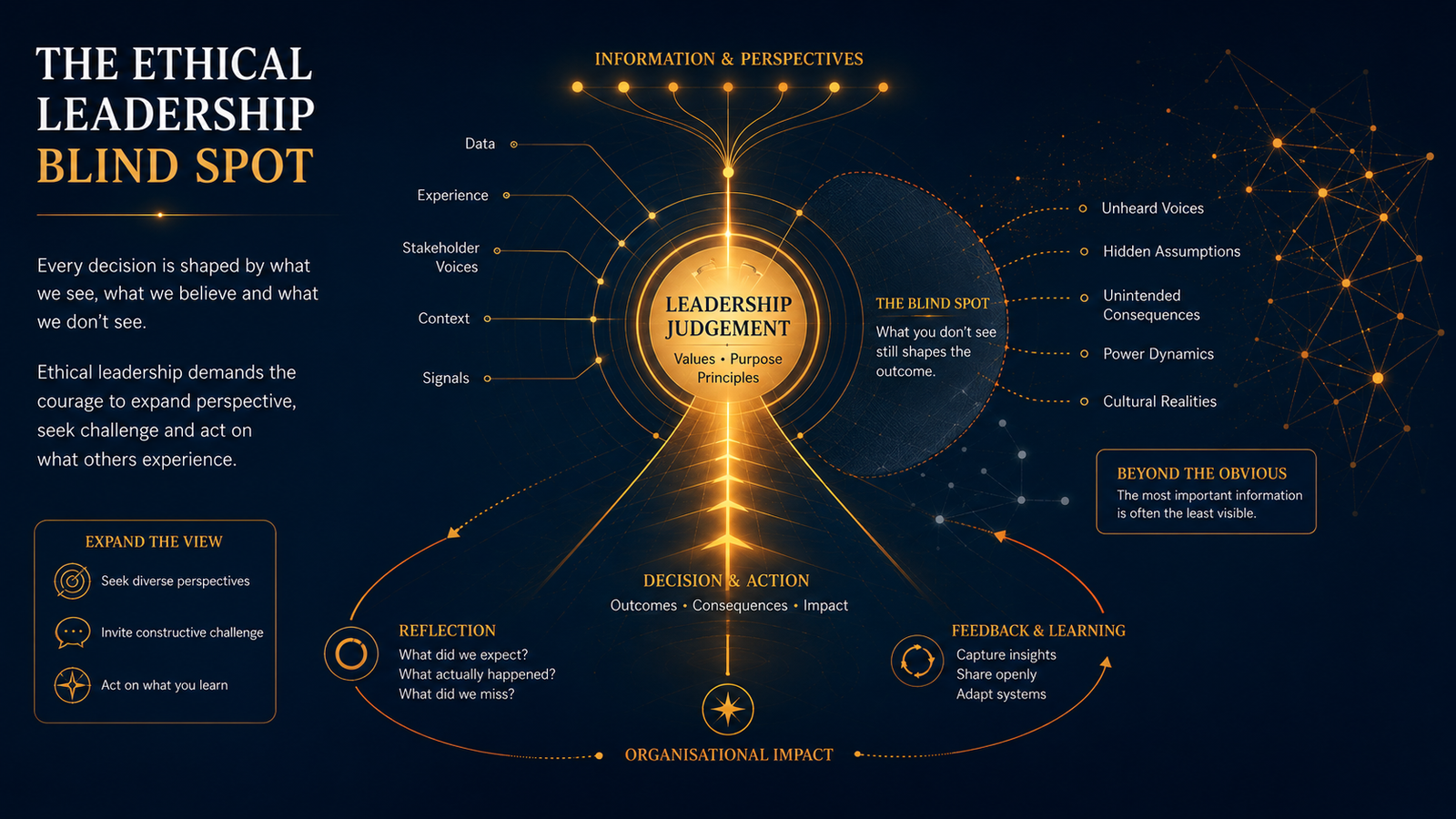
This is why Ethics Intelligence™ must extend beyond a leader’s intentions. Leadership requires the ability to examine impact. A leader who relies exclusively on intention can always explain their behaviour to themselves.
“I was only trying to maintain standards.”
“I needed to make the decision quickly.”
“They misunderstood what I meant.”
“The organisation is under enormous pressure.”
“I treat everybody the same.”
“They are resistant to accountability.”
“Someone has to make the difficult decisions.”
Some of these statements may be true. They can also become rationalisations that protect leaders from examining inconvenient evidence.
The question is therefore not simply whether the leader intended to behave ethically. The question is: what happens when their understanding of themselves becomes less reliable than the evidence around them?
What Is an Ethical Blind Spot in Leadership?
Featured Snippet
The concept is important because ethical failure does not always involve conscious misconduct. Sometimes the leader knows exactly what they are doing. Sometimes they are partially aware but continually justify it. And sometimes they genuinely cannot see the pattern.
Burn Bright’s existing work on toxic leadership makes this distinction especially important. Leadership behaviour can exist on an awareness spectrum: some leaders selectively control problematic behaviour and deflect feedback; others acknowledge problems but rationalise them; others appear genuinely confused by the impact they are having.
These situations require different responses. But they share one important feature: intention alone does not tell us whether leadership behaviour is ethically acceptable.
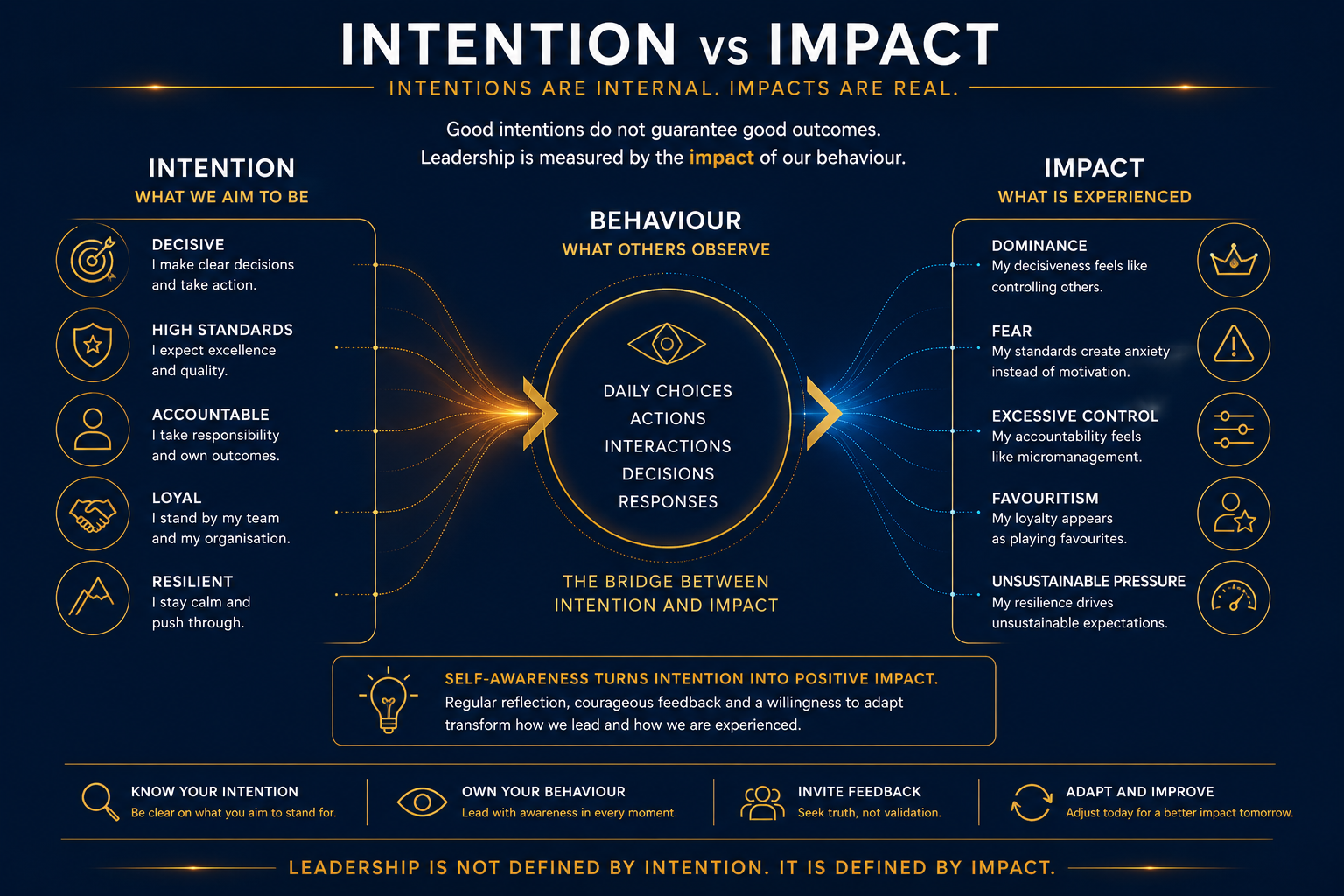
Imagine a manager who routinely interrupts colleagues. They may see themselves as energetic and decisive. The team may experience them as dismissive.
A leader may insist on approving every decision because they feel personally accountable for results. Employees may experience a lack of trust and increasing dependence.
A CEO may publicly praise transparency while senior colleagues have learned never to challenge their assumptions. A school leader may believe they are protecting standards while teachers gradually become afraid to disclose problems. A physician may believe that forceful communication creates clinical efficiency while junior colleagues become reluctant to raise patient-safety concerns.
The leader’s self-image can remain positive even as the ethical quality of the leadership environment deteriorates.
Why Good Leaders Develop Ethical Blind Spots
Ethical blind spots are not necessarily evidence of bad character. They can emerge from predictable features of leadership itself.
1. Power Changes the Information Leaders Receive
The more authority a person gains, the harder it can become to obtain unfiltered information. People adapt their communication around power. They become more selective. They soften disagreement. They delay difficult conversations. They watch how other people are treated before deciding whether it is safe to speak.
This creates a fundamental leadership problem. A senior leader may conclude: “Nobody has raised a concern.” But absence of expressed concern is not proof that no concern exists. It may indicate that the environment has stopped making honesty worthwhile.
Power therefore creates what might be called an information asymmetry of leadership. The leader believes they have access to the organisation because information flows upwards. But what reaches them may already have been filtered by hierarchy, fear, loyalty, politics or people’s assessment of what the leader wants to hear.
This is why ethical leaders cannot simply say “my door is always open.” They must examine whether people actually walk through it with difficult information.
2. Strengths Can Become Ethical Liabilities
Many leadership blind spots begin as strengths.
Decisiveness becomes dominance.
Confidence becomes certainty.
High standards become intolerance.
Empathy becomes avoidance of difficult accountability.
Loyalty becomes protection of insiders.
Ambition becomes justification for excessive demands.
Attention to detail becomes micromanagement.
Resilience becomes an expectation that everybody should absorb unreasonable pressure.
Burn Bright’s work on unguarded leadership makes this relationship explicit: every leadership strength can possess a shadow side when it is overused, applied rigidly or left unexamined.
This matters ethically because leaders are often least suspicious of the qualities for which they have historically been rewarded. The decisive executive has repeatedly been praised for making decisions quickly. The perfectionist has built a reputation for quality. The charismatic founder has convinced investors and employees to believe in a difficult vision. The analytical leader has avoided impulsive mistakes.
Success reinforces behaviour. Eventually, the leader may stop asking whether the behaviour still fits the situation.
Ethics Intelligence™ therefore requires calibration. The question is not “Is decisiveness good?” It is “When does my decisiveness stop serving the organisation and start reducing other people’s legitimate participation?”
Not “Are high standards good?” But “When do my standards begin producing fear, concealment or unsustainable work?”
Not “Is loyalty important?” But “Am I applying accountability differently to people I trust?”
This is the point at which self-awareness becomes an ethical capability rather than merely a personality-development exercise.
3. Pressure Makes Rationalisation Easier
Ethical standards are rarely tested most severely when everything is going well. They are tested when performance is threatened.
Revenue falls.
A deadline approaches.
Inspection is imminent.
Patient demand exceeds capacity.
A major client is at risk.
Political pressure increases.
Staffing collapses.
Investors want faster growth.
Under pressure, actions that previously appeared unacceptable can begin to look necessary.
“We’ll consult properly next time.”
“We just need everyone to work harder for another month.”
“We cannot deal with the behaviour issue until after the launch.”
“This is not the moment to challenge our strongest performer.”
“We need people who are committed.”
“Normal procedures are too slow for this situation.”
Sometimes exceptional action is genuinely required. Leadership must retain the ability to respond to unusual circumstances. But repeated exception creates ethical drift.
The temporary becomes normal. The emergency working pattern becomes the operating model. The high performer becomes permanently exempt. The consultation that was postponed once quietly disappears.
4. Organisational Systems Can Reward the Wrong Evidence
Leaders pay attention to what organisations measure. If executives are assessed almost entirely on financial performance, growth or operational output, ethical and behavioural consequences can remain invisible until they become severe.
A manager may deliver the numbers while exhausting the team. A department may achieve targets while employee turnover rises. A senior professional may be celebrated for performance while colleagues increasingly avoid working with them.
The visible metric says: success.
The human system says: cost.
Burn Bright’s toxic leadership work highlights the organisational conditions that enable this problem: cultures that reward individual achievement over team success, equate aggression with strength, tolerate interpersonal problems or fail to hold leaders accountable for behaviour can actively create or protect damaging patterns.
This shifts the ethical question from individual character to organisational architecture. If a system repeatedly rewards results while ignoring how those results are produced, leaders should not be surprised when people optimise for the metric.
Ethics Intelligence™ therefore asks organisations to measure not only “What did the leader achieve?” but “What happened to people, capability, trust and culture while they achieved it?”
5. Familiar Behaviour Can Become Invisible
One of the most difficult leadership patterns to recognise is behaviour that feels normal because it has been repeated for years. Leaders often reproduce the models through which they themselves learned to lead.
A manager who was developed in an aggressive performance culture may interpret intimidation as directness. A clinician trained inside a rigid hierarchy may consider public challenge an ordinary part of professional development. A school leader who experienced highly controlling supervision may reproduce it as “strong leadership.” A founder who built the organisation through personal oversight may struggle to recognise when that same behaviour becomes restrictive as the organisation grows.
The behaviour does not feel unethical because it feels familiar.
This is why reflection is not optional. Reflective Practice Intelligence™ helps leaders interrupt automatic patterns and ask:
- Where did I learn this way of leading?
- What assumptions sit underneath it?
- What evidence suggests it is working?
- What evidence suggests otherwise?
- How do people with less power experience it?
- Would I consider the behaviour acceptable if another leader used it on me?
This intersection between Ethics Intelligence™ and Reflective Practice Intelligence™ is critical. You cannot correct a blind spot you refuse to examine.
The Ethical Danger of “But My Intentions Were Good”
Intent matters. A leader who accidentally creates harm is ethically different from one who deliberately exploits others. But intention cannot become the final defence.
Leadership operates through consequences. When leaders control budgets, careers, workload, access, information, promotion, opportunities and strategic direction, their behaviour affects people regardless of what they meant.
Ethically intelligent leaders therefore develop the capacity to hold two ideas simultaneously: my intention may have been legitimate, and my impact may still require correction.
This is one of the most important maturity shifts in leadership. Immature leadership treats feedback about impact as an accusation about character. Mature leadership treats it as information.
The difference is profound. A leader who hears “People are reluctant to challenge you” and responds “But I always ask for opinions” protects their intention. A leader who responds “What am I doing that makes challenge difficult despite asking for it?” examines impact.
Ethical Self-Awareness Is Not Enough
At this point, it would be tempting to conclude that the answer is simply greater self-awareness. It is not.
Self-awareness is essential, but leadership blind spots contain a built-in paradox: the person who needs the insight may be the person least able to generate it alone.
This is why strong ethical leadership cannot rely exclusively on introspection. Leaders need systems around them capable of revealing what they cannot see themselves.
They need upward feedback.
Peer challenge.
Behavioural data.
Safe reporting mechanisms.
Leadership assessment.
Structured reflection.
Independent perspectives.
And cultures in which disagreement does not automatically become disloyalty.
The ethical leader’s objective is therefore not to become a person without blind spots. That is unrealistic. The objective is to build a Leadership Development System™ capable of detecting blind spots before they become organisational norms.
That takes Ethics Intelligence™ beyond personal morality. It turns it into organisational capability.
The Leadership Question
A useful ethical question is not “Am I a good leader?” It is “What evidence would tell me if my leadership was having an effect I could not currently see?”
The first question invites reassurance.
The second invites intelligence.
And that difference may determine whether an ethical blind spot remains a moment of learning — or becomes part of the culture.
How Leaders Detect What They Cannot See
If ethical blind spots are partly created by power, success, pressure and incomplete information, the solution cannot simply be “try harder to be ethical.” Most leaders already believe they are.
The more useful question is: what systems make it difficult for a leader to remain unaware of their impact?
This distinction is central to Leadership Performance Intelligence™. Leadership capability should not depend entirely upon an individual’s capacity to notice every weakness in their own behaviour. Strong leadership environments create mechanisms through which assumptions can be tested, consequences identified and uncomfortable information surfaced.
Burn Bright Advisory™ positions this as a movement from ethical intention towards ethical infrastructure. Six practices are particularly important.
1. Build Feedback That Can Survive Power
Leaders frequently say they welcome feedback. That statement means very little unless people believe providing feedback is safe. The true test is what happens after somebody disagrees.
Does the leader become defensive? Does the challenger lose access? Is their loyalty questioned? Does the leader explain why the feedback is wrong? Does the disagreement reappear later in a performance conversation? Or does the leader demonstrate curiosity?
Power changes the risk calculation. A chief executive asking a junior employee for “complete honesty” does not temporarily remove the hierarchy between them. A principal remains responsible for performance management. A senior physician retains professional status. A founder may still control someone’s employment. An executive may determine promotion opportunities.
The leader therefore carries a greater responsibility for creating the conditions in which challenge is possible.
Ethics Intelligence™ asks leaders to assess feedback behaviour, not simply feedback availability. Consider:
- Who disagreed with me recently?
- What happened when they did?
- Which people routinely tell me something I do not want to hear?
- Are those people still influential?
- Do colleagues challenge me before decisions — or only discuss concerns privately afterwards?
- What information reaches other people before it reaches me?
2. Separate Behaviour From Identity
One reason leaders resist ethical feedback is that criticism of behaviour can feel like criticism of character.
“You interrupted three people in that meeting” becomes “You think I am disrespectful.” “People are reluctant to raise concerns” becomes “You think I am a bad leader.” “The workload expectations are becoming unsustainable” becomes “You think I don’t care about my team.”
Once feedback is translated into an identity threat, defensiveness becomes predictable.
Ethics Intelligence™ requires a different discipline. Behaviour is data. A leader can behave inconsistently with their values without abandoning those values. Indeed, recognising the inconsistency is precisely what allows correction.
This connects Ethics Intelligence™ with Reflective Practice Intelligence™. Reflective leaders are capable of examining behaviour without immediately protecting the story they tell themselves about who they are. They can ask: what happened? What did I do? How was it interpreted? What impact followed? What assumption was operating? What should I repeat, stop or modify?
This turns reflection from introspection into a performance discipline. The objective is not shame. It is calibration.
3. Look for Patterns, Not Isolated Incidents
A single difficult interaction does not necessarily reveal an ethical leadership problem. Patterns matter.
One employee describing a leader as controlling may reflect an individual relationship problem. Repeated reports of restricted autonomy across several teams deserve different attention.
One person feeling excluded from a decision may be unavoidable. A recurring pattern in which the same voices are absent from important decisions raises a structural question.
One period of excessive workload may result from a genuine emergency. Continuous reliance on extraordinary effort suggests a leadership system that has normalised unsustainable capacity demands.
Ethical blind spots become visible when leaders stop examining events individually and start examining patterns across time. Useful indicators might include:
- employee turnover
- sickness absence
- repeated grievances
- exit-interview themes
- internal mobility
- patterns of promotion
- who receives stretch opportunities
- meeting participation
- employee survey data
- workload distribution
- decision reversals
- whistleblowing concerns
- customer or patient complaints
- recurring conflict around particular leaders
No individual metric proves unethical leadership. Together, however, patterns can challenge an overly positive leadership narrative.
This is where Leadership Benchmarking™ becomes valuable. Leaders need reference points that help distinguish “this feels normal to me” from “this pattern is actually signalling a problem.”
The Ethical Blind Spot Detection Framework™
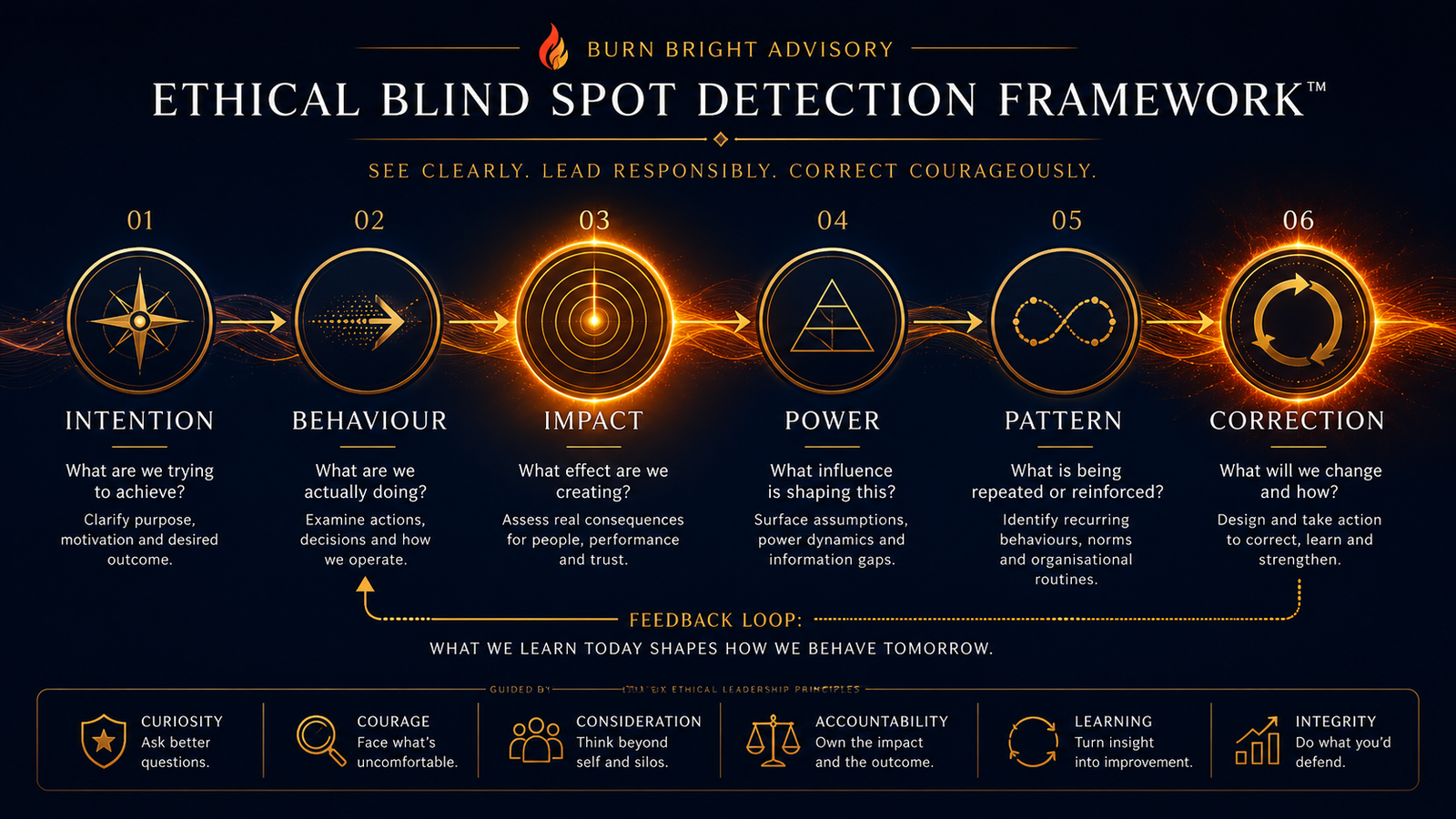
A practical Burn Bright approach can organise blind-spot detection around six questions.
1 Intention
What am I trying to achieve? Clarify the legitimate purpose behind the behaviour or decision.
2 Behaviour
What am I actually doing? Describe observable leadership behaviour rather than motives or personality.
3 Impact
What are other people experiencing? Examine consequences rather than relying exclusively on the leader’s interpretation.
4 Power
Can people challenge me safely? Identify hierarchy, dependency and consequences that might suppress honest feedback.
5 Pattern
Is this happening repeatedly? Look across incidents, teams and time rather than explaining each event separately.
6 Correction
What will change because I know this? Convert insight into behavioural or systemic action.
The framework creates a simple sequence: Intention → Behaviour → Impact → Power → Pattern → Correction.
Its value lies in forcing leaders beyond the first stage. Many ethical conversations stop at intention. Ethics Intelligence™ continues until impact is understood and correction occurs.
Ethical Blind Spots Across Leadership Sectors
The mechanism of ethical blindness may be universal. Its expression differs by context.
Business Growth Intelligence™: When Results Protect Behaviour
Consider a commercial director who consistently exceeds revenue targets. They are demanding, decisive and relentless. Their division performs.
But employees increasingly transfer away from the team. Meetings become dominated by the director. Junior colleagues rarely challenge assumptions. Several high-potential employees leave.
Senior leadership knows the director is “difficult.” But the results are exceptional. So the organisation waits.
This creates two ethical blind spots. The director may believe performance validates the leadership approach. The organisation may believe performance justifies tolerating it. Both are reinforced by the same metric.
Ethics Intelligence™ asks the organisation to examine the total cost of performance. Revenue matters. So do turnover, lost capability, psychological safety, succession risk and cultural precedent.
The ethical question is not whether performance should matter. It is whether performance has become powerful enough to purchase exemption from other leadership standards.
School Leadership Intelligence™: When High Standards Become Fear
A principal believes strongly in improving educational outcomes. Expectations rise. Performance is scrutinised. Lesson observations increase. Data is examined more frequently. The leader sees urgency and accountability.
Teachers begin to experience surveillance. They become less willing to discuss difficulties because problems may be interpreted as weakness. Innovation decreases because experimentation carries perceived risk.
The principal may genuinely believe “I am raising standards for our students.” That intention matters. But Ethics Intelligence™ asks whether the method is creating conditions that eventually undermine the objective.
When people become afraid to disclose problems, leaders receive less reliable information. When experimentation becomes unsafe, learning slows. When workload becomes unsustainable, capability leaves.
Healthcare Leadership Intelligence™: When Expertise Silences Challenge
Healthcare provides a particularly important example because leadership blind spots can intersect directly with safety.
Imagine a highly experienced senior clinician. Their judgement is respected. They make decisions quickly. In urgent situations, colleagues defer to their expertise. Over time, deference becomes habit. Junior professionals become less likely to question decisions.
The senior clinician interprets the absence of challenge as confidence in their judgement. But the team may have learned something different: challenging authority is professionally risky.
The ethical issue is no longer simply communication style. It concerns whether the leadership environment supports the flow of safety-critical information.
Expertise should improve decision quality. It should not make disagreement impossible. Ethics Intelligence™ therefore asks senior professionals to distinguish between being trusted and being unchallengeable. They are not the same.
Public Service Leadership Intelligence™: When Process Creates Moral Distance
Public-service decisions often operate through policies, committees, regulations and administrative systems. These mechanisms are essential. They can also create distance between the decision-maker and the people affected.
A leader may become highly focused on whether the correct process was followed while paying less attention to whether the process produced an unreasonable outcome.
The ethical blind spot becomes: “We followed procedure, therefore the decision was fair.” Procedure supports fairness. It does not guarantee it.
Ethics Intelligence™ encourages public-service leaders to examine both procedural integrity and lived consequence. Who experienced the decision? Was the process accessible? Could affected people understand it? Were exceptional circumstances recognised? Was there a meaningful mechanism for review?
The legitimacy of public leadership depends not only on decisions being lawful but on institutions being capable of examining how authority is experienced.
HR & People Leadership Intelligence™: When Familiarity Becomes Favouritism
People leaders regularly make decisions involving promotion, reward, development and opportunity. Ethical blind spots can emerge through familiarity.
Leaders naturally develop stronger relationships with some colleagues than others. They may trust people with whom they have worked longer. They may communicate more easily with individuals whose styles resemble their own. They may offer opportunities to the person who immediately comes to mind.
None of these actions necessarily involves deliberate discrimination. But repeated informal decisions can produce highly unequal outcomes.
One employee receives the high-profile assignment. That assignment increases visibility. Visibility strengthens their promotion case. Promotion gives access to further opportunity. A small initial preference becomes a career multiplier.
Ethics Intelligence™ therefore asks leaders to examine not only formal selection decisions but the informal distribution of access, sponsorship and opportunity. Fair systems should not depend entirely upon who is easiest for a leader to remember.
Entrepreneur Performance Intelligence™: When Founder Identity Becomes Organisational Reality
Entrepreneurs face another distinctive risk. The organisation may have grown around their judgement. Their instincts created the business. Their persistence overcame early scepticism. Their personal risk tolerance made growth possible.
Success can therefore create a powerful belief: “My judgement got us here.” It probably did.
But the capabilities required to create an organisation are not always identical to those required to scale one. The founder who once needed to control every critical decision may eventually become a bottleneck. The conviction that protected the early vision may later suppress challenge. The extraordinary working hours that were temporarily necessary during launch may become an implicit expectation imposed on everyone else.
Ethics Intelligence™ requires the founder to separate what helped build the organisation from what the organisation now needs. That requires humility without abandoning conviction. It is one of the places where Ethics Intelligence™, Adaptability Intelligence™ and Reflective Practice Intelligence™ intersect.
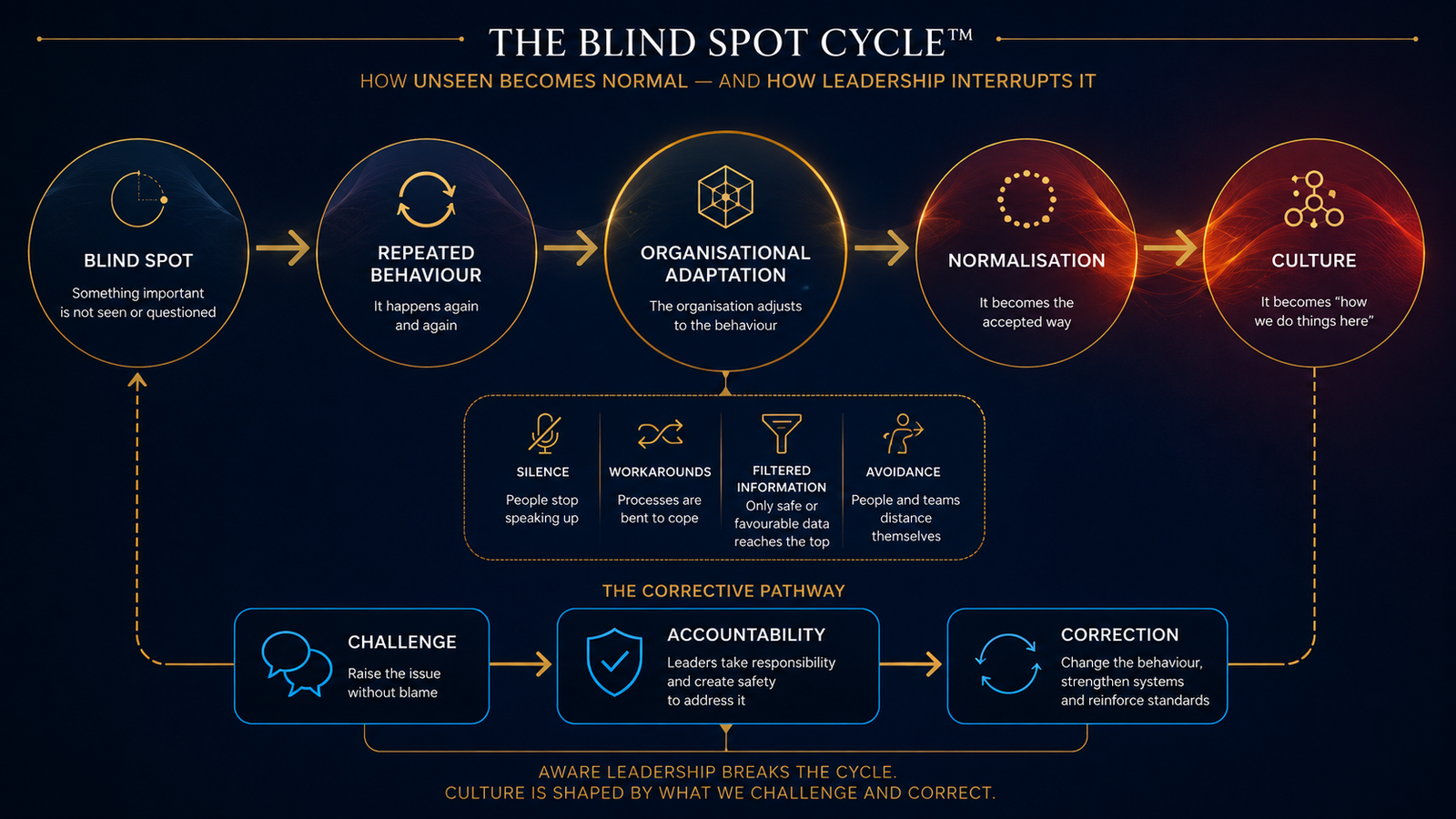
When Ethical Blind Spots Become Organisational Culture
An individual blind spot is a leadership-development issue. A protected blind spot becomes a cultural issue.
The transition occurs when organisations begin adapting around the leader rather than challenging the behaviour. Employees warn new colleagues:
“Don’t raise that in the meeting.”
“Wait until they’re in a good mood.”
“Just agree and change it later.”
“Don’t put that in writing.”
“They don’t like being challenged.”
“Everyone knows what they’re like.”
These statements are significant. They indicate that the organisation has stopped treating the behaviour as an exception and started treating it as an environmental condition.
People develop survival strategies. Workflows change. Information routes around the leader. Talented employees leave. Remaining employees become increasingly skilled at managing the person with power.
This is one reason toxic leadership can become especially powerful in small teams, where close relationships, limited escalation routes and concentrated authority amplify the impact of leadership behaviour. Burn Bright’s existing work emphasises that dysfunction in these settings can affect collaboration, psychological safety, retention and the team’s ability to function effectively.
From Ethical Awareness to Ethical Accountability
Awareness matters only if it changes something. A leader can become highly articulate about their blind spots while continuing the same behaviour.
“I know I’m impatient.”
“I know I can be intimidating.”
“I know I tend to micromanage.”
“I know I have favourites.”
Self-awareness without correction can become another form of rationalisation. Ethics Intelligence™ therefore requires accountability. The progression should be:
Recognition
Identify the behaviour or decision pattern.
Reflection
Understand the assumptions, pressures or habits driving it.
Responsibility
Accept that legitimate intention does not remove responsibility for impact.
Correction
Change behaviour, process, incentives or organisational structures.
Review
Examine whether the intervention actually improved the outcome.
This final stage matters. Leadership development should be visible in behaviour, not merely in vocabulary.
Practical Action: Run an Ethical Blind Spot Review
Choose one significant area of your leadership. It might be:
- decision-making
- workload
- promotion
- performance management
- meetings
- communication
- delegation
- conflict
- access to opportunity
Then ask:
- What do I believe about my leadership in this area?
- What observable evidence supports that belief?
- What evidence might contradict it?
- Who experiences my leadership differently from me?
- Who has enough independence to tell me the truth?
- What does my position make difficult for other people to say?
- What repeated pattern should concern me?
- What behaviour will I change?
- How will I know whether the change worked?
This is Leadership Reflection™ with accountability attached. It converts reflection into evidence-informed leadership development.
Leadership Reflection Questions
- Where am I relying most heavily on good intentions as evidence of good leadership?
- Which of my strengths is most likely to become overused?
- Who can challenge me without fearing a consequence?
- When did somebody last change my mind on an important issue?
- What feedback do I repeatedly explain rather than investigate?
- Which organisational metrics might be hiding human or cultural costs?
- Where could familiarity be influencing my allocation of opportunity?
- What behaviour has my organisation learned to work around?
- Which temporary exception may be becoming a permanent norm?
- What evidence about my leadership would I least like to discover?
Action Steps
1. Identify one possible blind spot
Do not attempt to audit your entire leadership identity. Choose one behaviour with meaningful consequences.
2. Gather behavioural evidence
Use examples, feedback, data and patterns rather than relying on self-perception.
3. Seek a genuinely independent perspective
Ask somebody capable of disagreeing with you.
4. Examine the power relationship
Consider whether your authority makes honest feedback difficult.
5. Define a behavioural change
Replace broad commitments such as “listen better” with an observable practice — for example: “In strategic meetings, I will ask for dissenting views before stating my preferred option.”
6. Establish a review point
Return to the issue after sufficient time to examine whether behaviour and impact have changed.
7. Build the learning into your Leadership Development System™
Connect the insight with the Leadership Intelligence Assessment™, relevant diagnostics, Leadership Reflection™, planning tools, workshops and ongoing development.
Conclusion: Ethical Leadership Requires Correctability
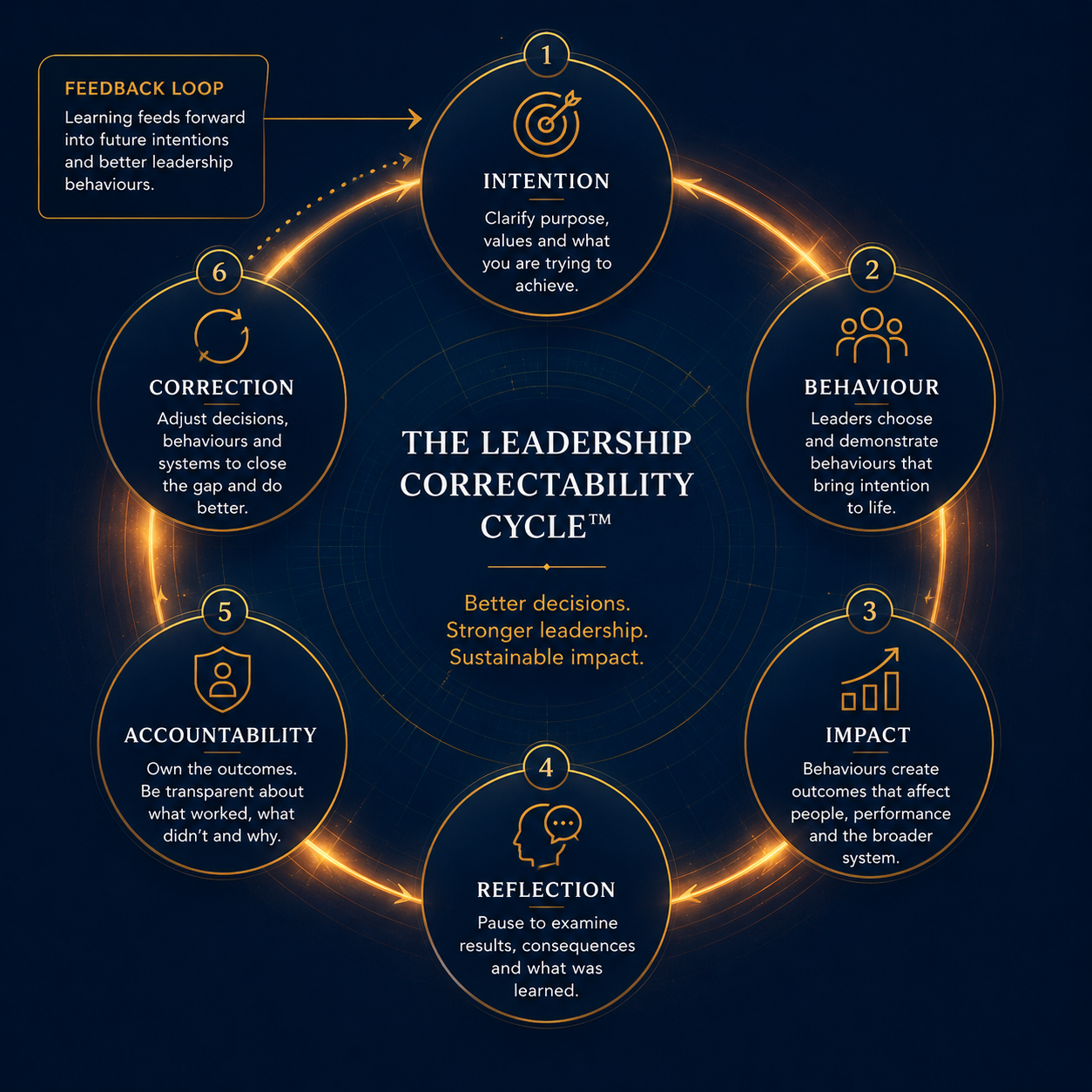
Perhaps the most useful test of ethical leadership is not whether a leader always gets things right. No leader does.
A more revealing question is: what happens when evidence suggests the leader may be wrong?
Can they hear it?
Can people say it?
Can the organisation investigate it?
Can behaviour change?
Can accountability survive hierarchy?
This is where Ethics Intelligence™ becomes more than a set of principles. It becomes the capacity for ethical correctability.
Leaders with strong Ethics Intelligence™ do not assume that good intentions make them immune to blind spots. They understand that authority can distort information. They know success can reinforce behaviour that no longer serves the organisation. They recognise that pressure makes rationalisation easier. They understand that strengths have shadow sides. And they create systems through which other people can challenge what they cannot see themselves.
This connects directly with Leadership Performance Intelligence™. Leadership performance cannot be judged only by outcomes. The methods through which those outcomes are produced matter. The capacity consumed matters. The trust created or destroyed matters. The precedent established matters. The behaviour normalised matters. And the leader’s willingness to learn when their self-perception conflicts with evidence matters.
Ethical leadership therefore requires more than integrity.
It requires humility without passivity.
Authority without defensiveness.
Confidence without certainty.
Reflection without self-protection.
Accountability without theatre.
Most importantly, it requires leaders to recognise that they will never see themselves perfectly. The objective is not to eliminate every blind spot. It is to create a leadership system in which blind spots struggle to remain hidden.
That is the relationship between Ethics Intelligence™, Reflective Practice Intelligence™, Leadership Benchmarking™ and the wider Leadership Intelligence Compass™. Together, they move leadership development away from the assumption that capable leaders should already know themselves completely. Instead, they establish a more intelligent standard: capable leaders continuously test what they think they know about themselves against evidence of how their leadership is actually experienced.
The ethical leader is therefore not the leader who can confidently declare “I know I am doing the right thing.” It is the leader capable of asking “What might I not be seeing — and have I built a system strong enough to tell me?”
What is an ethical blind spot in leadership?
An ethical blind spot is an area where a leader fails to recognise the ethical significance or impact of their own behaviour, decisions or use of authority. The leader may genuinely believe they are acting responsibly while other people experience unfairness, fear, exclusion or unnecessary pressure. Ethics Intelligence™ helps leaders examine that gap through evidence, reflection, feedback, power awareness and accountability.
Why do good leaders develop ethical blind spots?
Good leaders can develop ethical blind spots because power, pressure, success, familiarity and organisational incentives affect judgement. Authority can reduce the amount of honest feedback leaders receive, success can reinforce behaviours that were once useful but have become excessive, and pressure can make exceptions and rationalisations appear necessary. Ethical leadership requires systems that expose assumptions and reveal consequences leaders cannot see themselves.
What is the difference between intention and impact in ethical leadership?
Intention describes what a leader meant to achieve. Impact describes what their behaviour or decision actually produced. A leader may intend to maintain high standards while creating fear, or intend to increase accountability while creating excessive control. Ethics Intelligence™ requires leaders to examine both rather than treating good intentions as sufficient evidence of ethical leadership.
How does power create leadership blind spots?
Power changes the information leaders receive. Employees may soften criticism, withhold concerns or avoid disagreement because leaders influence careers, workload, opportunities, reputation or employment. Ethically intelligent leaders actively test whether challenge is genuinely safe rather than assuming an open door is enough.
Can a leadership strength become an ethical weakness?
Yes. Leadership strengths can create risks when they are overused or applied without sufficient reflection. Decisiveness can become dominance, high standards can become intolerance, and loyalty can become favouritism. The ethical question is whether the leader can recognise when the use of a strength is no longer appropriate to the context.
How can leaders identify their ethical blind spots?
Leaders can identify ethical blind spots by comparing self-perception with behavioural evidence, using a sequence such as Intention → Behaviour → Impact → Power → Pattern → Correction. Independent perspectives, leadership assessments, feedback, behavioural data and structured reflection all strengthen this process.
Why is self-awareness alone insufficient?
Self-awareness is necessary, but blind spots create a paradox: leaders cannot independently recognise everything they are currently unable to see. Strong ethical leadership requires external mechanisms including challenge, feedback, behavioural evidence, assessment and accountability, rather than relying on introspection alone.
How do ethical blind spots become organisational culture?
Ethical blind spots become cultural problems when organisations repeatedly adapt around problematic leadership instead of addressing it — employees stop challenging the leader, route information around them, or warn colleagues about behaviours they believe cannot be changed. Eventually, what began as one leader’s behaviour becomes an accepted organisational condition.
What is ethical correctability?
Ethical correctability is the capacity of a leader or leadership system to recognise evidence of a problem, accept responsibility and make meaningful corrections. It does not require ethical perfection — it asks whether leaders can receive uncomfortable evidence, reflect without excessive defensiveness, change behaviour and review whether the change improved the outcome.
How can organisations reduce ethical leadership blind spots?
Organisations can reduce ethical blind spots by creating leadership systems in which behavioural evidence and legitimate challenge can reach people with authority, including leadership assessment, structured feedback, independent challenge, behavioural expectations, diagnostics, reflection processes and accountability mechanisms.
Where Might Your Own Blind Spots Be Hiding?
If you want a clearer, evidence-based picture of how your leadership is actually experienced — not just how you intend it — start with diagnosis. The Leadership Burnout Self-Assessment helps you identify where workload, boundaries and leadership structures may be creating unsustainable pressure.
Free Leadership Intelligence
Get Weekly Leadership Insights
Join thousands of leaders receiving practical strategies on burnout prevention, workload design, and sustainable performance every week.