Quick Answer
Key Takeaways
- Ethical failure is rarely caused by an absence of values. It is often caused by an absence of ethical intelligence at the moment those values are tested.
- Compliance asks what leaders are permitted to do. Ethical leadership asks a broader question: what should we do?
- Serious ethical failures rarely begin with dramatic decisions — they emerge through incremental compromises that create ethical drift.
- Power changes ethical responsibility. Silence from people with less power should never be mistaken for agreement.
- Sustainable leadership capacity protects decision quality, not just wellbeing — exhausted leaders make narrower, more reactive judgements.
Ethical Decision-Making Under Pressure: Why Good Leaders Still Make Bad Decisions
Leadership ethics is easy to discuss when nothing significant is at stake.
Values statements can be written.
Codes of conduct can be published.
Organisations can declare commitments to integrity, transparency, fairness and accountability.
The real test arrives when those principles become inconvenient.
Imagine an executive whose division is significantly behind its annual financial target. A major contract could close the gap, protect jobs and reassure investors. During negotiations, however, concerns emerge about the prospective client’s business practices. Nothing immediately appears illegal. Walking away would nevertheless be commercially painful. What should the executive do?
Now imagine a school leader facing a serious staffing shortage. One highly effective teacher consistently achieves exceptional student outcomes but colleagues have raised concerns about the way that individual treats junior staff. Removing the teacher from responsibility could destabilise the department during an already difficult year. What should the principal do?
Or consider a hospital leader under pressure to reduce waiting times while simultaneously maintaining clinical standards with insufficient staffing. Every available option carries consequences. What should that leader prioritise?
These are leadership problems, but they are also ethical problems. And they illustrate something frequently missing from conversations about ethics:
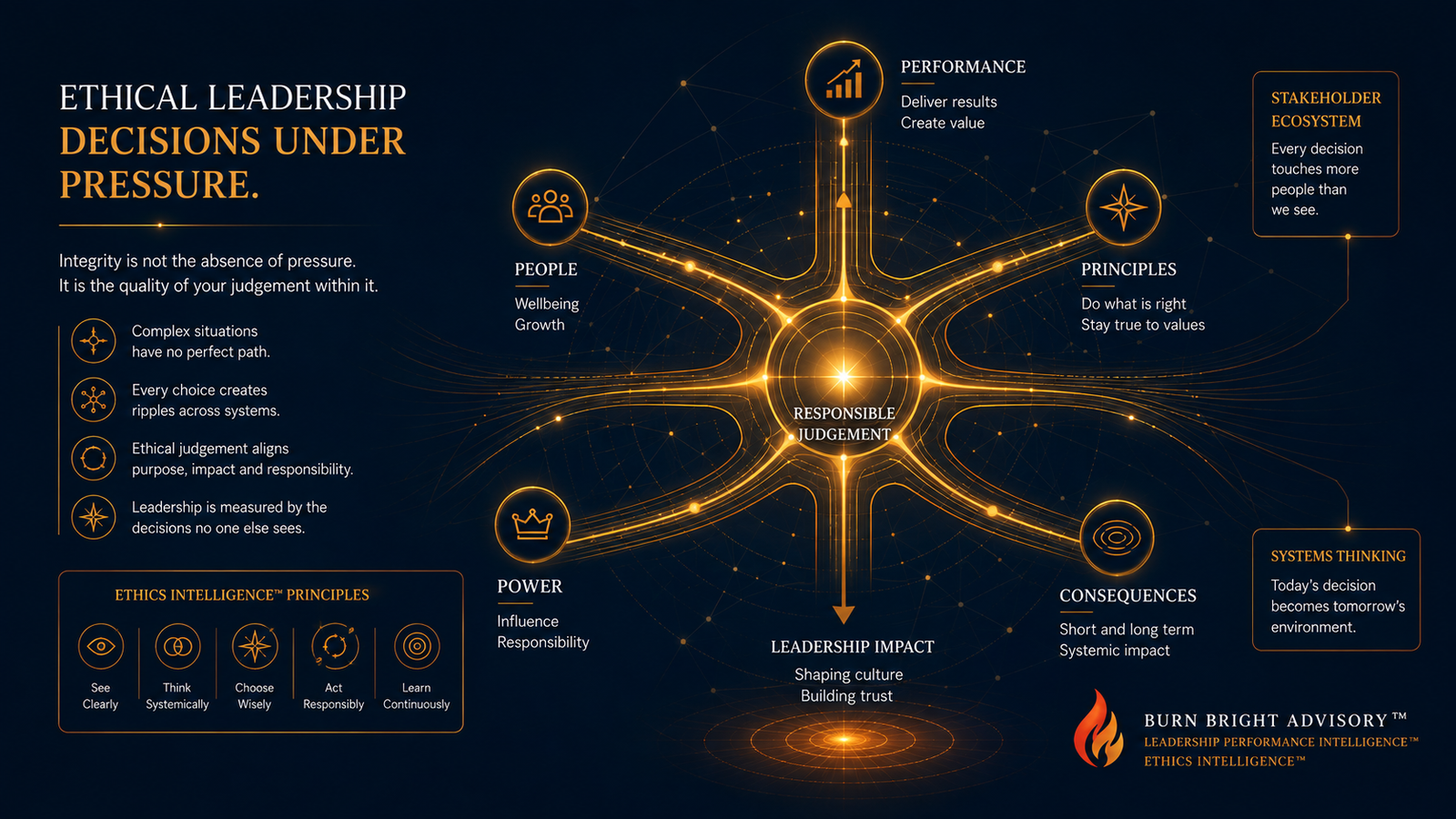
Ethics Is Not a Compliance Exercise
One of the greatest limitations in conventional approaches to organisational ethics is the tendency to treat ethics primarily as compliance.
Compliance matters. Policies, professional standards, governance structures and legal requirements provide essential boundaries around organisational behaviour. But compliance asks a relatively narrow question: what are we permitted to do?
Ethical leadership asks something broader: what should we do?
The distinction can be significant.
An organisation may technically comply with employment requirements while creating workloads that are clearly unsustainable. A business may satisfy minimum disclosure requirements while presenting information in ways that obscure important risks. A manager may follow a performance-management procedure correctly while treating an employee without dignity. A school may satisfy regulatory requirements while allowing an unhealthy leadership culture to persist. A healthcare organisation may achieve operational targets while creating conditions that professionals believe compromise quality.
Compliance establishes boundaries.
Ethics requires judgement within — and sometimes beyond — those boundaries.
This is why ethical leadership cannot be reduced to knowing organisational policies. Leaders need the capacity to interpret competing responsibilities, understand context and recognise consequences that a policy document cannot anticipate. That capability is Ethics Intelligence™.
What Is Ethics Intelligence™?
Within Burn Bright Advisory’s Leadership Intelligence Compass™, Ethics Intelligence™ concerns a leader’s ability to apply values, judgement, integrity, wisdom and courage to leadership decisions. It connects ethical intention with leadership action.
This distinction matters because knowing a principle and applying that principle are different capabilities. Most experienced leaders could identify values such as integrity, fairness, responsibility, respect, transparency and accountability.
But leadership rarely presents those values one at a time. Instead, leaders encounter situations where legitimate principles compete.
Transparency may conflict with confidentiality.
Fairness may conflict with individual circumstances.
Short-term financial protection may conflict with long-term organisational trust.
Loyalty to an individual may conflict with responsibility to the wider team.
Speed may conflict with consultation.
Performance may conflict with wellbeing.
There may be no completely consequence-free answer.
Ethics Intelligence™ therefore requires leaders to move beyond simplistic judgements of “right” and “wrong” and develop a disciplined method for examining difficult decisions.
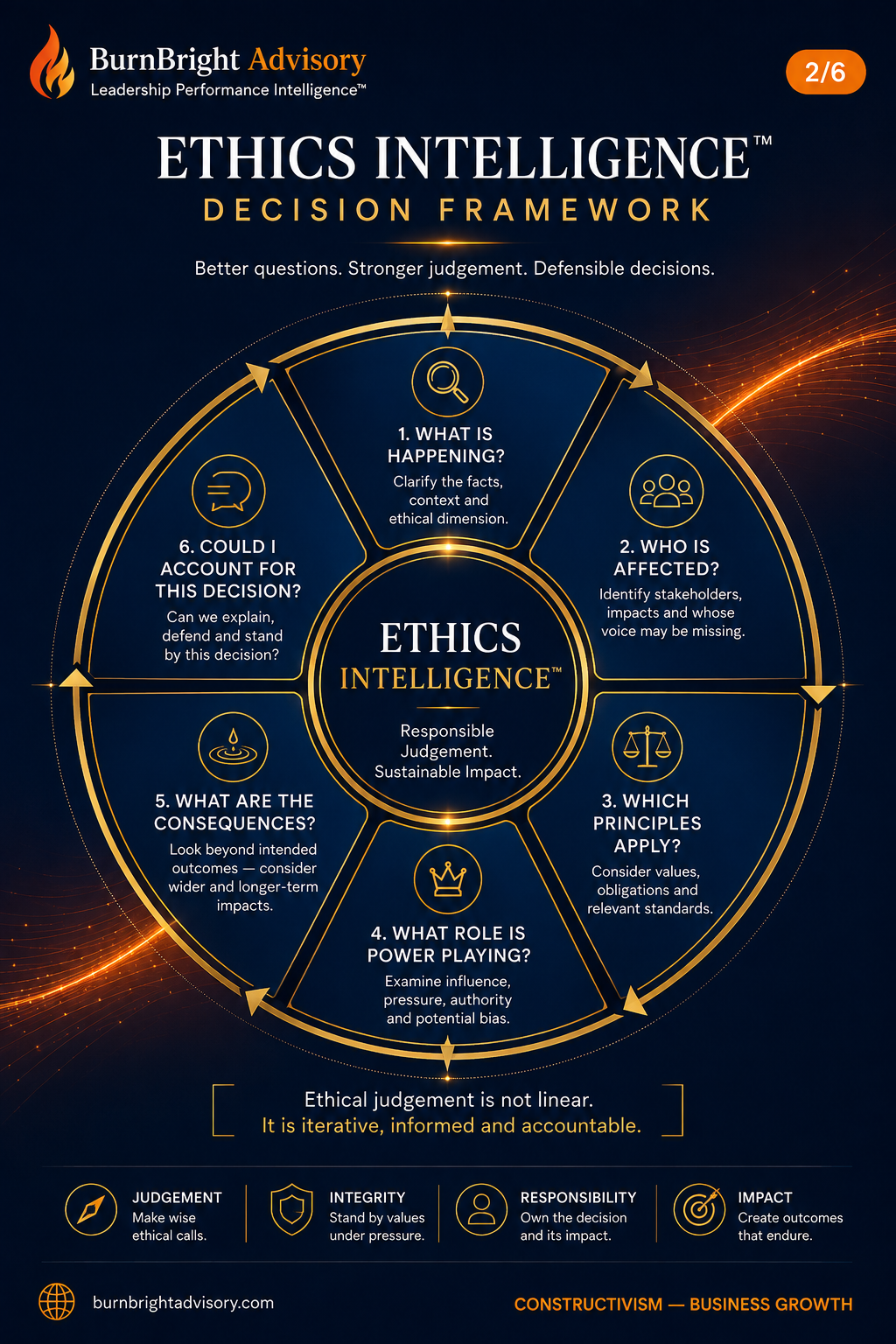
Burn Bright’s Ethics Intelligence™ Decision Framework begins with a deceptively simple question: what is actually happening? Before deciding what should happen, leaders must establish the facts. Not assumptions. Not organisational rumours. Not the most persuasive stakeholder’s interpretation. Not the version of events that makes the easiest decision possible. The facts.
This becomes particularly important under pressure because urgency changes the quality of thinking. When leaders feel threatened by deadlines, financial problems, reputational concerns or operational crises, their attention naturally narrows. The objective can quietly become: solve the immediate problem.
Why Good Leaders Can Make Bad Ethical Decisions
Ethical failure is sometimes portrayed as evidence of bad character. Occasionally, that explanation is justified. There are leaders who knowingly manipulate, deceive, exploit or abuse authority.
But that explanation is insufficient for understanding the wider problem. Many questionable decisions are made by people who genuinely regard themselves as responsible leaders. They may care deeply about their organisations and the people within them.
The problem is that ethical judgement operates inside a complex psychological and organisational environment.
Pressure changes behaviour.
Authority changes perspective.
Incentives change attention.
Culture changes what feels normal.
Repeated exposure to questionable practices can gradually shift the boundary of what people consider acceptable. A decision that would once have caused discomfort becomes routine.
This is one reason ethical leadership needs to be understood as a performance capability, rather than simply a personality characteristic.
The Ethical Drift Problem
Serious ethical failures do not always begin with dramatic decisions. They can emerge through incremental compromises.
A deadline is missed, so a figure is presented slightly more favourably. A high performer behaves poorly, but the issue is ignored because the team needs the results. A recruitment process is adjusted for a preferred candidate because leaders are convinced that person is “clearly the best choice.” An unrealistic target is imposed because senior management believes employees will somehow find a way to deliver it.
No single decision initially appears catastrophic. But each decision establishes a precedent. The next compromise becomes easier.
That is how individual decisions become organisational culture.
The Leadership Performance Intelligence™ Connection
This is where Ethics Intelligence™ connects directly to Leadership Performance Intelligence™.
Leadership performance cannot be evaluated solely through results. The method by which results are achieved matters because today’s leadership behaviour creates tomorrow’s organisational conditions.
Consider two leaders who both deliver the same financial result. Leader A achieves it through clear expectations, responsible resource allocation, transparent communication and disciplined decision-making. Leader B achieves it through chronic overwork, fear, selective information, political pressure and the quiet suppression of dissent.
A conventional performance dashboard might initially treat the two leaders as equally successful. Leadership Performance Intelligence™ asks a more sophisticated question: what organisational conditions did each leader create in producing that result?
Leader A may have increased organisational capacity.
Leader B may have consumed it.
One strengthened the system.
The other extracted performance from it.
This is why ethical intelligence and Leadership Sustainability™ are closely connected. Unethical or ethically weak leadership can sometimes produce impressive short-term numbers. But it often transfers hidden costs into the future: declining trust, employee turnover, reputational exposure, reduced psychological safety, poor decision quality and weakened institutional resilience.
Sustainable leadership requires leaders to recognise those delayed consequences before they become visible in conventional performance measures.
The Six Questions That Strengthen Ethical Judgement
Burn Bright’s Ethics Intelligence™ approach encourages leaders to slow the decision process sufficiently to examine what pressure can otherwise conceal. The framework begins with six areas of enquiry.
1 What Is Happening?
Establish the facts, context and risks. What do we know? What are we assuming? What evidence is missing? Whose interpretation is shaping our understanding? This protects leaders from making ethical decisions based on incomplete or selectively presented information.
2 Who Is Affected?
Leadership decisions create stakeholder consequences. Leaders need to identify those affected directly and indirectly — employees, customers, students, patients, suppliers, shareholders, families, communities or future leaders who inherit the consequences.
3 Which Principles Apply?
Which organisational values, professional standards, commitments or ethical principles are relevant? This is where leaders test whether a proposed action genuinely aligns with the principles the organisation claims to uphold.
4 What Role Is Power Playing?
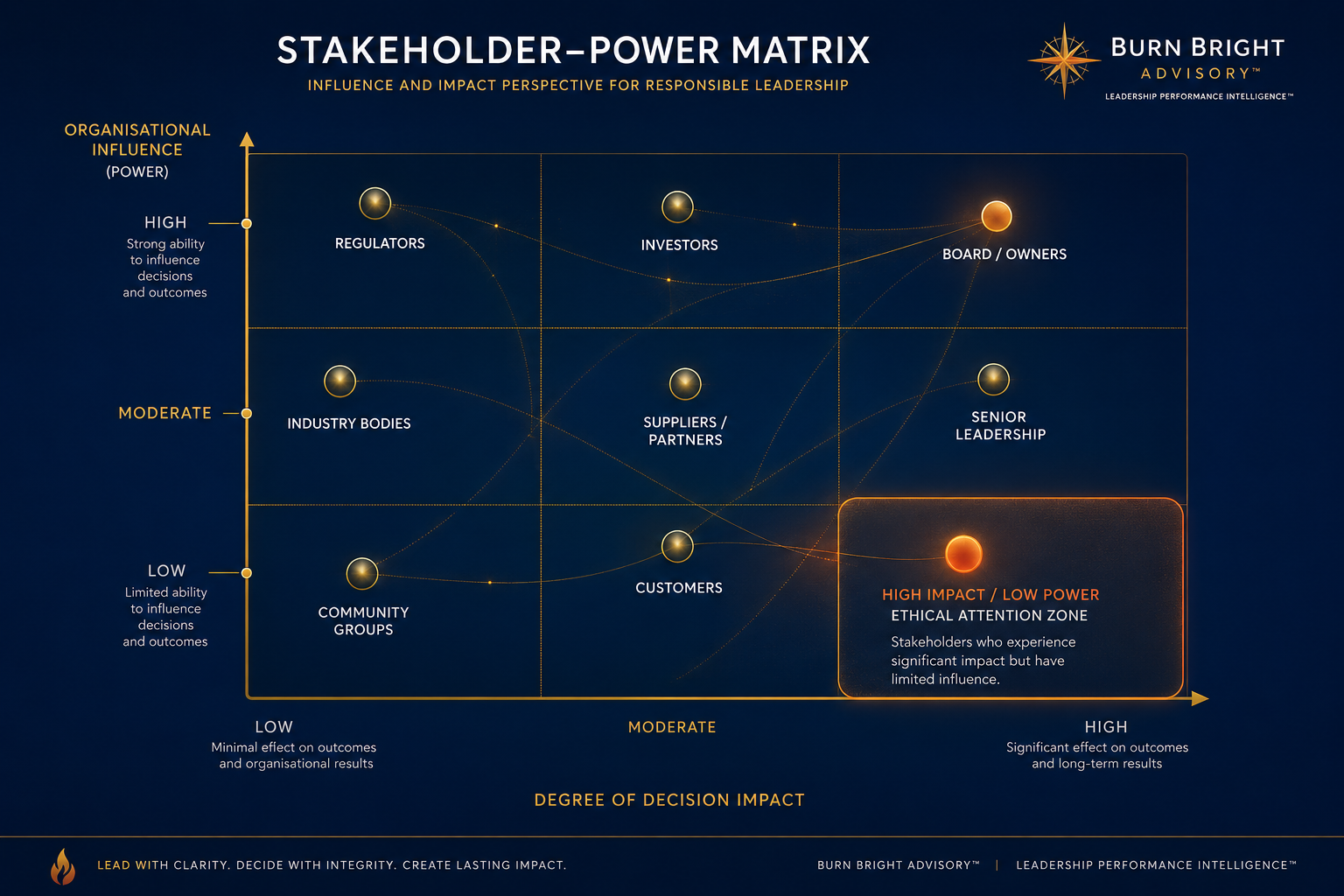
Power changes ethical responsibility. Ethical leaders examine not only what decision is being made, but who has the ability to influence, challenge or resist that decision.
5 What Are the Consequences?
Ethical decision-making requires leaders to look beyond the immediate outcome, considering immediate, secondary and longer-term effects.
6 Could I Account for This Decision?
Imagine the decision and the reasoning behind it became visible. Could you explain not merely what you decided, but why, to everyone affected?
Power becomes particularly dangerous when leaders stop noticing they possess it. The more senior the leader, the more carefully this question should be examined. Authority can cause silence to look like agreement. It can make compliance look like commitment. And it can make an absence of challenge appear to confirm that a decision is correct.
Sometimes nobody objects because everyone agrees.
Sometimes nobody objects because everyone understands who has the power.
Ethics Intelligence™ requires leaders to know the difference.
Ethical judgement also requires looking beyond the immediate outcome. This is particularly difficult when pressure is high. When an organisation faces a financial shortfall, staffing crisis, performance problem or reputational threat, attention naturally moves toward the most visible and immediate consequence.
Can we hit the target?
Can we solve the staffing problem?
Can we avoid the complaint?
Can we deliver the project?
Can we protect the organisation?
These are legitimate questions. But Ethics Intelligence™ requires another layer of enquiry: what happens after we make this decision?
A decision to tolerate the behaviour of a high-performing but destructive manager may protect short-term results while weakening psychological safety across the team. Reducing staffing may improve this year’s financial position while increasing workload, turnover and operational risk next year. Avoiding a difficult conversation may preserve a relationship temporarily while allowing a performance or conduct problem to become more serious. Suppressing uncomfortable information may protect an organisation’s reputation today while significantly increasing reputational exposure tomorrow.
The final question introduces accountability. This is not a public-relations test. A decision can be unpopular and still be ethical. The accountability test asks something more fundamental: can the reasoning withstand scrutiny?
Leaders should be able to articulate the evidence considered, the principles applied, the stakeholders affected, the alternatives examined and the rationale for the final decision. If the decision can only survive while important information remains hidden, the leader should examine it again.
The framework does not guarantee that every difficult decision will become obvious. That is not its purpose. Its purpose is to improve the quality of ethical judgement. It creates deliberate cognitive space between pressure and action. And sometimes that space is where responsible leadership begins.
Pressure Is an Ethical Risk
Leadership pressure is usually discussed as a wellbeing or productivity issue. It should also be understood as an ethical issue.
A leader operating with insufficient time, depleted emotional capacity, excessive workload or sustained organisational pressure may experience deterioration in the quality of judgement. This does not mean exhausted leaders automatically become unethical. It means the conditions surrounding leadership decisions matter.
This is one reason Ethics Intelligence™ cannot be separated from Leadership Sustainability™ and Leadership Capacity™. Burn Bright’s wider work on leadership burnout identifies a structural problem in contemporary management: organisations frequently expand leadership responsibilities without proportionately expanding the capacity, resources and systems required to carry them.
The danger is not simply exhaustion. The danger is what exhaustion can do to leadership behaviour. Under sustained pressure, leaders may become more reactive. Difficult conversations are postponed. Consultation feels inefficient. Immediate problems dominate attention. Delegation decreases. Decisions become increasingly focused on getting through the next deadline rather than understanding the longer-term consequences.
When Performance Pressure Distorts Ethics
Consider a business unit that has missed its quarterly target. The senior leader receives a clear message: the numbers need to improve.
Nothing unethical has explicitly been requested. But pressure begins moving through the hierarchy. The divisional leader pushes regional managers. Regional managers increase expectations on team leaders. Team leaders intensify scrutiny of employees. Targets that were previously challenging become non-negotiable.
Soon, conversations change. Employees begin asking: “Do they want us to do this properly, or do they just want the number?”
That question should concern every senior leader. Because this is how ethical culture can deteriorate without anybody formally deciding to lower ethical standards. The target remains. The pressure increases. The available capacity does not. And people begin improvising.
The ethical problem is therefore not necessarily the target itself. It is the system of incentives and pressures surrounding the target. Ethically intelligent leaders pay attention to what their performance expectations encourage people to do — asking, if everyone pursued this target exactly as incentivised, what behaviours might emerge?
That is a Leadership Performance Intelligence™ question. It recognises that performance systems teach behaviour.
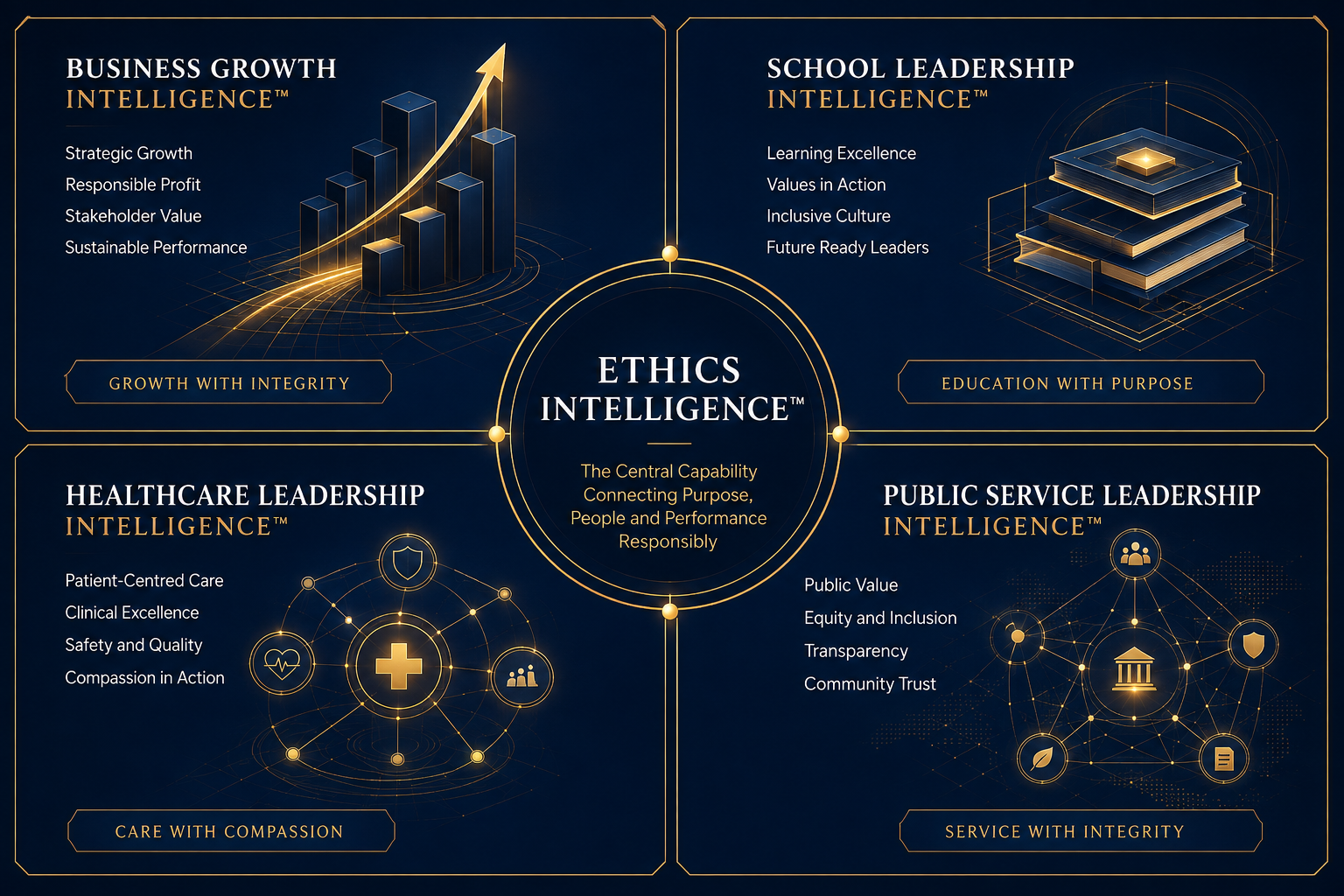
Ethics Intelligence™ Across Sectors
The underlying framework remains consistent across sectors, but the consequences of ethical judgement vary significantly.
Business Growth Intelligence™: When the Opportunity Is Too Good to Ignore
Imagine a growing consultancy offered a contract that would increase annual revenue by 20%. Commercially, the opportunity appears exceptional. During due diligence, however, concerns emerge about how the prospective client treats suppliers. There is no immediate evidence of illegality. The sales team argues that rejecting the contract would be commercially irresponsible.
Applying Ethics Intelligence™ changes the conversation. What is happening? There is a significant commercial opportunity alongside credible concerns about the prospective partner’s practices. Who is affected? Employees, shareholders, suppliers, customers and potentially the wider reputation of the organisation. Which principles apply? Commercial responsibility, integrity, responsible partnership and organisational values. What role is power playing? Financial dependence may make the organisation less willing to challenge the client once the contract begins. What are the consequences? Revenue growth must be weighed against reputational exposure, cultural signals and future dependency. Could we account for the decision? Would leaders be comfortable explaining why they entered the relationship if the client’s practices later became public?
The framework does not automatically determine that the contract should be rejected. It ensures the decision is not reduced to revenue alone. That is the difference between commercial decision-making and ethically intelligent commercial decision-making.
School Leadership Intelligence™: The Exceptional Performer Problem
Now consider a school. A highly experienced department leader consistently delivers excellent academic results. Parents respect them. Students perform well. Their subject outcomes strengthen the school’s overall performance. But several members of staff report feeling intimidated. Junior teachers describe dismissive comments, excessive criticism and an unwillingness to consider alternative approaches.
The principal faces a difficult choice. Challenging the department leader could create disruption. Ignoring the behaviour protects short-term stability.
This is where traditional performance metrics can become misleading. If the principal asks only “Are they delivering results?” the answer may be yes. If the principal asks “What leadership conditions are producing those results?” the picture changes.
Ethics Intelligence™ makes the experience of less powerful stakeholders visible. The junior teacher who fears challenging an established department leader has significantly less organisational power. Silence therefore cannot automatically be interpreted as absence of concern.
Healthcare Leadership Intelligence™: When Efficiency Meets Professional Responsibility
Healthcare leadership can make ethical tensions particularly visible because operational decisions may directly affect care. Consider a department facing significant demand alongside persistent staffing shortages. Leaders are under pressure to increase throughput. Teams are already stretched.
The operational argument for greater efficiency is understandable. But the ethically intelligent leader asks additional questions. At what point does efficiency become unsafe workload? Which professional groups are absorbing the additional pressure? Are staff able to raise concerns without being perceived as resistant? Are performance measures capturing quality as well as speed? What risks are being transferred elsewhere in the system?
The ethical question is not whether efficiency matters. It clearly does. The question is whether one performance objective is becoming so dominant that other responsibilities disappear from the decision.
Public Service Leadership Intelligence™: Stewardship Under Competing Interests
Public-service leaders frequently operate in environments where resources are finite and stakeholder expectations are extensive. A decision to prioritise one service may inevitably reduce resources available elsewhere. There may be no option that satisfies everyone.
Ethical leadership therefore cannot mean avoiding difficult trade-offs. Instead, it requires transparent reasoning. What criteria determined the priority? Whose voices were included? Who carries the greatest consequence? Were vulnerable stakeholders considered? Could the allocation process withstand public scrutiny?
Ethics Intelligence™ becomes especially important where leaders exercise authority over resources that belong not to them personally, but to the communities they serve. Leadership in this context is an act of stewardship.
Ethics Intelligence™ Does Not Operate Alone
One of the central ideas within the Leadership Intelligence Compass™ is that leadership capabilities are interconnected. Ethical judgement rarely depends upon Ethics Intelligence™ alone. Three relationships are particularly important.
Ethics Intelligence™ + Professionalism Intelligence™
Ethics asks: what should I do? Professionalism asks: how should I conduct myself while doing it?
A leader might reach an ethically defensible decision but implement it in a careless, disrespectful or inconsistent manner. Conversely, a leader can appear highly professional while avoiding the deeper ethical implications of a decision.
Strong leadership requires both. Professionalism Intelligence™ provides consistency, standards and disciplined conduct. Ethics Intelligence™ provides principled judgement. Together, they help translate values into credible leadership behaviour.
Ethics Intelligence™ + Reflective Practice Intelligence™
Reflection creates the opportunity to learn from ethical decisions after they have been made. Leaders should ask: what assumptions influenced me? Which stakeholder perspectives did I initially overlook? Where did pressure affect my thinking? What consequences emerged that I failed to anticipate? Would I make the same decision again?
This is the connection between Ethics Intelligence™ and Reflective Practice Intelligence™. Reflection turns individual decisions into leadership learning. Without reflection, leaders may repeatedly reproduce the same blind spots. With disciplined reflection, judgement can become progressively more sophisticated.
Ethics Intelligence™ + Leadership Sustainability™
The third relationship is less obvious but equally important. Ethical leadership requires capacity. A leader who is chronically overloaded may have less time to consult, investigate, reflect and challenge assumptions.
This is why Burn Bright’s concept of Leadership Sustainability™ should not be interpreted simply as helping leaders “cope” with demanding roles. The deeper objective is to create leadership conditions that preserve the capacity required for high-quality performance.
A sustainable leader has sufficient cognitive, emotional and organisational capacity to exercise judgement. A sustainable organisation does not routinely depend on leaders making significant decisions while operating beyond reasonable capacity. This links directly to Leadership Workload™: if an organisation wants consistently thoughtful, ethical leadership, it must examine whether leadership workload permits thoughtful, ethical decision-making.
Ethical Courage: Knowing Is Not Enough
There is one final difficulty. A leader can complete every stage of an ethical decision framework and still fail to act. Because ethical leadership sometimes has a cost.
The responsible decision may mean challenging a senior colleague.
It may mean rejecting revenue.
It may mean confronting a high performer.
It may require acknowledging that a previous decision was wrong.
It may delay a project.
It may produce criticism.
It may require telling powerful stakeholders something they do not want to hear.
Ethical intelligence therefore requires more than analysis. It requires ethical courage.
Courage in this context is not dramatic. Often it appears as a conversation. A question. A refusal to ignore uncomfortable evidence. A willingness to document a concern. An insistence that another perspective be heard. Or the simple statement: “Before we proceed, I think we need to examine the consequences more carefully.”
That requires psychological safety. It also requires leaders who do not interpret challenge as disloyalty.
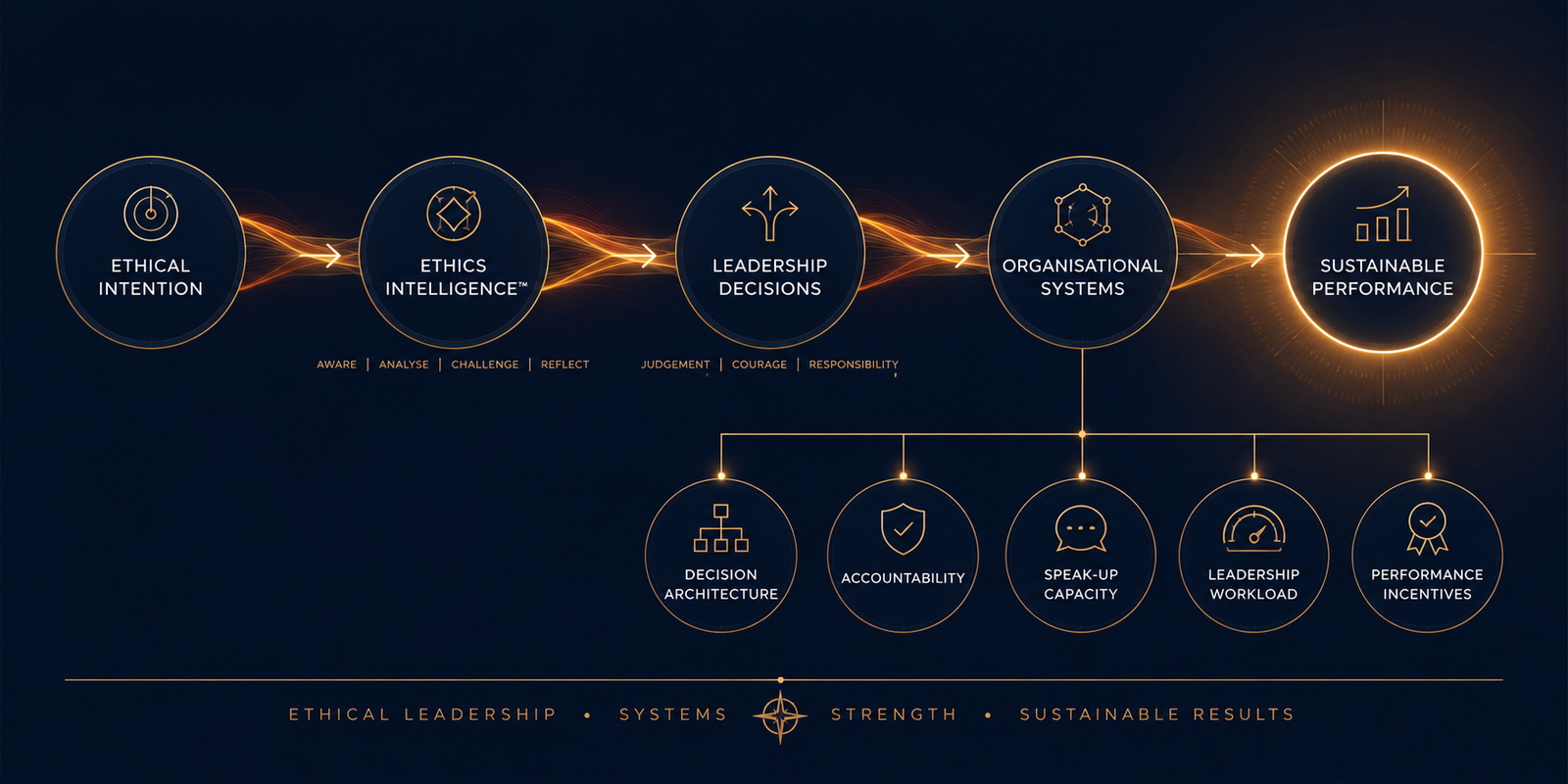
From Ethical Leader to Ethical System
There is a further implication. Organisations cannot build ethical cultures by relying exclusively on the character of individual leaders. Good people matter. But good systems matter too.
Recruitment, promotion, incentives, performance management, workload, governance, decision rights and accountability structures all influence behaviour.
If an organisation rewards results regardless of how those results are achieved, its values statement has limited power. If employees are encouraged to speak up but observe negative consequences for those who challenge senior leaders, the real culture becomes obvious. If managers are told to protect employee wellbeing while simultaneously carrying workloads that make that impossible, the system contains an ethical contradiction.
Leadership Performance Intelligence™ therefore shifts attention from “Do we have ethical leaders?” toward the more demanding question: “Does our leadership system make ethical behaviour easier or harder?”
The Ethics Intelligence™ Decision Cycle
Ethical judgement can be understood as a continuous leadership cycle rather than a single event.
1. Observe
Establish what is happening. Gather evidence, distinguish fact from interpretation and identify uncertainty.
2. Include
Identify the stakeholders affected by the decision, particularly those with less power or visibility.
3. Interpret
Examine the principles, professional standards, responsibilities and values relevant to the situation.
4. Challenge
Test assumptions, incentives, conflicts of interest and the influence of organisational power.
5. Anticipate
Consider immediate and longer-term consequences.
6. Decide
Make the decision and communicate the reasoning appropriately.
7. Review
Examine what happened after implementation and use Reflective Practice Intelligence™ to improve future judgement.
The final stage is essential. Ethical decision-making should generate learning. A decision may have been reasonable based on the information available and still produce unexpected consequences. That does not automatically mean the leader failed. The question becomes whether the leader is willing to learn.
Five Warning Signs That Ethical Leadership Is Weakening
Organisational ethics rarely deteriorates because somebody announces that values no longer matter. The warning signs are usually behavioural.
Ethics Intelligence™ turns values from organisational language into leadership criteria.
From Ethical Aspiration to Ethical Infrastructure
Individual leaders matter enormously. But organisations should not require exceptional personal courage every time someone needs to raise a legitimate concern. The stronger approach is to design ethical infrastructure — creating conditions in which responsible decisions are supported systematically.
Area 1 Decision Architecture
Significant decisions should have clear decision rights, appropriate evidence and proportionate scrutiny. Leaders should know who decides, who advises, who should be consulted, who is affected and who reviews the decision. Ambiguous decision structures increase the risk that authority becomes concentrated without appropriate challenge.
Area 2 Accountability
Accountability should apply to how results are achieved, not simply whether they are achieved. Performance conversations should include behaviour, culture, sustainability and decision quality alongside conventional outcomes. Accountability should increase with power, not decrease because of it.
Area 3 Speak-Up Capacity
People need credible ways to raise concerns. A policy alone is insufficient. Employees observe what happens to people who challenge decisions — when someone raises a legitimate concern, the first leadership task is to understand the concern, not defend the organisation.
Area 4 Leadership Capacity
Ethical infrastructure requires realistic leadership capacity. An organisation cannot continually demand reflection, consultation, strategic thinking, people development, innovation and rapid responsiveness while ignoring the finite capacity of the people expected to provide them.
Leadership Sustainability™ therefore protects more than wellbeing. It protects decision quality.
A Practical 15-Minute Ethics Intelligence™ Review
Not every leadership decision requires a committee or lengthy process. For significant but time-sensitive decisions, leaders can conduct a short Ethics Intelligence™ review.
Minutes 1–3: Establish Reality
Write down what is known. Then separately write what is assumed. The distinction is often revealing.
Minutes 4–5: Map Stakeholders
Identify everyone materially affected. Circle the stakeholder with the least influence over the decision and ask whether their perspective has been adequately considered.
Minutes 6–8: Identify Principles
Write down the two or three organisational or professional principles most relevant to the situation. Ask whether the proposed action is consistent with them.
Minutes 9–10: Examine Power
Who benefits? Who decides? Who can challenge? Who may be reluctant to speak?
Minutes 11–13: Test Consequences
Consider what happens immediately, what might happen in six months, what precedent this establishes and what behaviour this decision encourages.
Minutes 14–15: Apply the Accountability Test
Complete the sentence: “We made this decision because…” If the explanation cannot be made clearly without hiding significant information, revisit the decision.
This fifteen-minute process will not resolve every ethical dilemma. But it can interrupt automatic thinking. And in pressured leadership environments, that interruption can be extremely valuable.
Leadership Reflection: What Does Your Decision-Making Reveal?
Ethical culture is built through repeated decisions. Not annual values workshops. Not posters. Not policy statements.
Every leadership decision teaches something. When leaders tolerate destructive behaviour from high performers, people learn that performance outranks values. When leaders acknowledge mistakes, people learn that accountability is possible. When concerns are genuinely investigated, people learn that speaking up has value. When leaders ask whose perspective is missing, people learn that inclusion affects decisions. When senior leaders willingly subject their reasoning to challenge, people learn that authority does not eliminate accountability.
This is why Ethics Intelligence™ belongs inside the Leadership Intelligence Compass™. Ethical leadership is not an isolated capability. It shapes the environment within which every other leadership capability operates.
Leadership Reflection Questions
- When did I last change an important decision because new evidence or another person’s perspective challenged my initial view?
- Which stakeholders have the least power in the decisions I routinely make?
- Are high performers in my organisation held to the same behavioural expectations as everyone else?
- What happens when somebody challenges a senior leader?
- Which performance pressures could unintentionally encourage poor ethical decisions?
- Where has urgency become normal rather than exceptional?
- Can our organisational values be connected to actual recent decisions?
- Do leaders have sufficient capacity to reflect before making consequential decisions?
- What behaviour are our current incentives rewarding?
- Could I explain my most significant recent leadership decision openly, including the trade-offs involved?
Action Steps for Leaders
Ethics Intelligence™ strengthens through practice rather than declaration. Begin with five actions.
1. Introduce the Six Ethical Questions
Use the six-question Ethics Intelligence™ framework in leadership meetings when decisions have significant implications for people, performance, reputation or organisational culture.
2. Review One Recent Decision
Select an important decision made during the previous three months. Do not ask whether it was “good” or “bad.” Ask what the organisation can learn from the reasoning, stakeholder impact and consequences.
3. Identify an Ethical Pressure Point
Look for one area where targets, workload, incentives or hierarchy could be creating pressure toward undesirable behaviour. Do not wait for misconduct before examining the system.
4. Test Psychological Safety
Ask leaders what happens when employees disagree with them. Then ask employees. The difference between those answers may provide important Leadership Performance Intelligence™.
5. Connect Ethics to Performance
Include ethical behaviour, decision quality, sustainability and impact when evaluating leadership effectiveness. Stop treating ethics as separate from performance — ethical leadership is part of performance.
The Leadership Intelligence Assessment™ Perspective
Leaders interested in developing Ethics Intelligence™ should avoid assessing the capability in isolation. Ethical judgement is influenced by several domains of the Leadership Intelligence Compass™.
Professionalism Intelligence™ influences standards and conduct. Emotional Intelligence™ influences awareness of how decisions affect others. Reflective Practice Intelligence™ supports learning from previous decisions. Adaptability Intelligence™ helps leaders respond when changing circumstances invalidate previous assumptions. Visionary Leadership Intelligence™ connects immediate choices with longer-term direction. Leadership Sustainability™ protects the capacity required for sound judgement.
The Leadership Intelligence Assessment™ can therefore help leaders move beyond a single-dimensional view of leadership development. The purpose is not to produce another personality label. It is to create a clearer picture of leadership capability and identify where development could improve sustainable performance.
That assessment can then connect leaders to the wider Leadership Intelligence Library™, relevant diagnostics, planning tools, workshops and development pathways. This is the difference between consuming leadership content and building a Leadership Development System™.
Conclusion: Ethics Is What Leadership Does Under Pressure
Most organisations already know which values they want leaders to demonstrate. The challenge is not producing better lists of values. The challenge is ensuring those values remain influential when following them becomes difficult.
That is where Ethics Intelligence™ becomes visible.
It appears when a leader asks another question before approving an attractive opportunity.
It appears when somebody challenges the behaviour of a high performer rather than protecting the results they produce.
It appears when a leadership team examines who carries the consequences of a decision.
It appears when senior leaders invite challenge rather than merely tolerate it.
It appears when an organisation recognises that unsustainable leadership workload can compromise judgement as well as wellbeing.
And it appears when leaders are prepared to account for both their decisions and the systems those decisions create.
Ethical leadership is therefore not leadership without difficult choices. It is leadership capable of making difficult choices without abandoning disciplined judgement.
Within the Burn Bright Leadership Intelligence Compass™, Ethics Intelligence™ provides part of the architecture for doing that well. But it does not operate alone. Ethics connects with professionalism. It depends on reflection. It is strengthened by emotional intelligence. It is affected by workload and capacity. And ultimately, it influences whether leadership performance can be sustained without transferring unacceptable costs to people, culture or the future.
This is the wider purpose of Leadership Performance Intelligence™: to understand leadership not simply through what a leader achieves, but through the intelligence, behaviour, capacity and organisational conditions behind those achievements.
The next time an important decision appears obvious, therefore, consider resisting the temptation to act immediately. Ask:
What is actually happening?
Who is affected?
Which principles apply?
What role is power playing?
What are the consequences?
Could I account for this decision?
Those questions may take only minutes. But they can expose what urgency, authority and performance pressure make easy to miss.
What is ethical leadership?
Ethical leadership is the practice of making and influencing decisions in ways that align organisational performance with values, professional standards, stakeholder responsibilities and long-term consequences. It involves more than personal integrity — leaders must recognise ethical tensions, examine evidence, understand how power affects decisions and account for the consequences of their choices. Within the Burn Bright Leadership Intelligence Compass™, this capability is developed through Ethics Intelligence™.
What is Ethics Intelligence™?
Ethics Intelligence™ is the leadership capacity to apply principled judgement when decisions involve competing interests, uncertainty, power, consequences or organisational pressure. It moves ethics beyond knowing organisational values toward applying those values intelligently in real leadership situations, examining what is happening, who is affected, which principles apply, what role power is playing, what the consequences are, and whether the leader could account for the decision.
Why is ethics important in leadership?
Leadership decisions influence more than immediate performance — they affect trust, culture, workload, psychological safety, reputation, stakeholder relationships and future organisational capacity. Because leaders also possess organisational power, their decisions can affect people who have considerably less ability to challenge those decisions, making ethics fundamental to responsible leadership performance.
Why do good leaders sometimes make unethical decisions?
Poor ethical decisions are not always caused by deliberately unethical intentions. Leadership decisions are frequently made under conditions involving time pressure, incomplete information, competing priorities, performance expectations and unequal power, which can narrow attention toward the immediate problem while overlooking secondary consequences, less powerful stakeholders or longer-term risks.
How does pressure affect ethical decision-making?
Pressure can reduce the space available for reflection, consultation and challenge. When urgency becomes normal, leaders may increasingly rely on assumptions, established habits or the fastest available solution. Sustainable leadership preserves the cognitive and organisational capacity required for high-quality judgement, not just wellbeing.
What is ethical drift?
Ethical drift occurs when repeated small compromises gradually increase the distance between an organisation’s stated values and its everyday behaviour. A questionable decision may initially be treated as an exception; if it produces no meaningful challenge, it becomes easier to repeat, and practices that once created discomfort can become normal.
How can leaders improve ethical decision-making?
Leaders can improve ethical decision-making by separating evidence from assumptions, identifying all materially affected stakeholders, examining relevant values and professional principles, considering how power affects participation, assessing immediate and longer-term consequences, inviting credible challenge, documenting important reasoning and reviewing outcomes after implementation.
How can organisations create an ethical leadership culture?
Ethical culture requires more than values statements or compliance training. Organisations should examine the systems that shape leadership behaviour — recruitment, promotion, incentives, workload, accountability, decision rights and speak-up mechanisms — and evaluate how results are achieved, not just whether they are achieved.
What is the relationship between ethical leadership and sustainable performance?
Ethical leadership and sustainable performance are closely connected because leadership decisions create future organisational conditions. A decision may generate an immediate result while simultaneously reducing trust, increasing turnover or consuming leadership capacity. Leadership Performance Intelligence™ considers both the outcome and the conditions through which it was produced.
How does Ethics Intelligence™ connect to the Leadership Intelligence Compass™?
Ethics Intelligence™ is one interconnected domain within the Burn Bright Leadership Intelligence Compass™. Professionalism Intelligence™ supports consistent standards and conduct, Reflective Practice Intelligence™ helps leaders learn from decisions, Emotional Intelligence™ strengthens awareness of stakeholder impact, Adaptability Intelligence™ supports judgement when circumstances change, and Leadership Sustainability™ protects the capacity required to exercise those capabilities consistently.
Is Pressure Narrowing the Quality of Your Leadership Judgement?
If deadlines, workload and competing priorities are making it harder to consult, reflect and consider consequences properly, start with diagnosis. The Leadership Burnout Self-Assessment helps you identify where workload, boundaries and leadership structures may be creating unsustainable pressure.
Free Leadership Intelligence
Get Weekly Leadership Insights
Join thousands of leaders receiving practical strategies on burnout prevention, workload design, and sustainable performance every week.