Quick Answer
Key Takeaways
- Trust does not require leaders to surrender accountability. It requires clarity about who owns what.
- Delegation is a structural leadership tool, not simply a way to clear tasks from an overloaded calendar.
- Micromanagement often signals weak delegation architecture, because authority has been transferred without clear decision rights.
- Leaders build trust through appropriate autonomy, supported by agreed outcomes, boundaries and review points.
- Sustainable leaders build systems that work without their constant intervention. If everything still requires the leader, the work has not really been delegated.
Delegation and Trust: How Leaders Build Both
Delegation and trust in leadership are often treated as separate subjects. They are not.
A leader says they cannot delegate because they do not fully trust the team. The team says it cannot take ownership because the leader never truly lets go.
The result is predictable.
Work travels down the organisation and then comes straight back up.
Decisions wait for approval.
Managers become bottlenecks.
Capable people learn to seek permission.
Senior leaders spend their days answering questions that should never have reached them.
Then everyone wonders why the leader is overloaded.
I have seen this pattern repeatedly across leadership roles. Delegation problems rarely begin with a simple lack of trust. More often, the underlying problem is structural: unclear accountability, poorly defined authority, inconsistent expectations and no agreed mechanism for checking progress.
The Burn Bright framework identifies Workload Architecture™ and Decision Authority™ as two of the four structural pillars required for sustainable leadership. It also uses the RACI Delegation Framework™ as one of its practical tools for redesigning how responsibility moves through an organisation.
That matters because leaders cannot outwork a delegation problem.
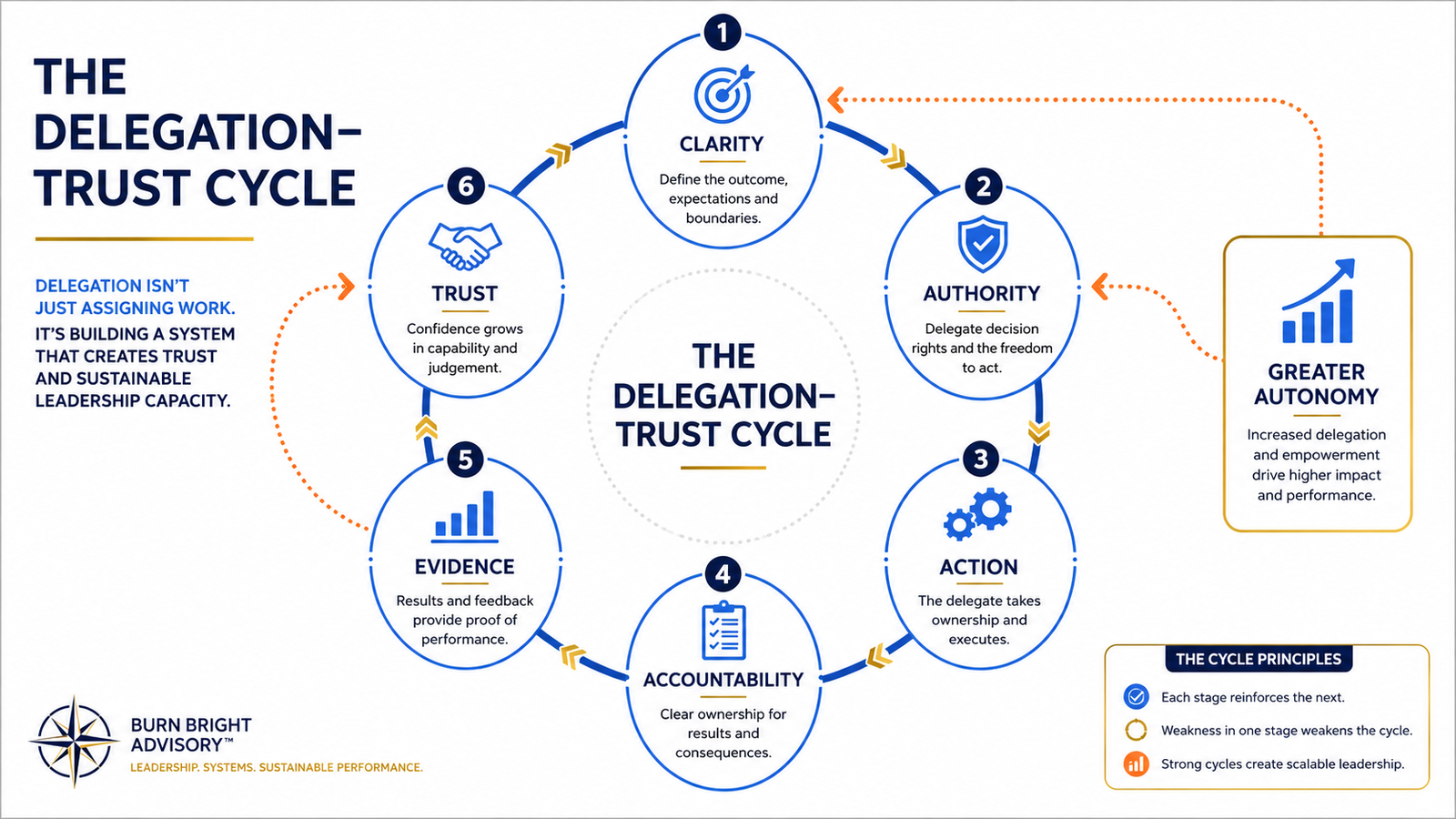
The important point is that trust does not have to appear before delegation begins. Trust can be built through well-designed delegation.
Featured Snippet
Why Are Delegation and Trust So Closely Connected?
Delegation exposes one of leadership’s most uncomfortable tensions.
You remain accountable for performance, but you cannot personally control everything that produces that performance.
For some leaders, the response is to hold on. They review every document. Approve routine decisions. Attend meetings where their presence adds little value. Ask to be copied into emails. Solve problems before their team has had the opportunity to solve them.
It can feel responsible.
It is often the opposite.
The control paradox
The more a leader tries to maintain personal control over a growing operation, the more dependent that operation becomes on the leader.
Imagine a senior manager with eight direct reports. Every significant decision comes to her. Every sensitive email is checked. Every external communication requires approval. Every emerging problem is escalated.
Initially, this may create consistency.
As the organisation grows, however, the system starts to slow. Her calendar fills. Decisions queue. Strategic work is pushed into evenings. Direct reports wait rather than act. Problems that could have been resolved in minutes take days because the person with authority is unavailable.
Eventually, the leader concludes: “I have to do everything around here.”
But look more closely. The organisation may have learned that doing anything without her is risky.
This is consistent with a wider pattern in leadership burnout. My Burn Bright Not Out™ material describes modern managers as being caught between expanding responsibilities and competing demands, while also highlighting the importance of distributed leadership and clear responsibility.
External research points in the same direction. Gallup has reported that managers face unusually heavy workloads and interruptions: managers were 67% more likely than individual contributors to strongly agree that they experience a lot of interruptions at work, while more than four in ten strongly agreed they faced multiple competing priorities.
That combination matters. When leaders respond to overload by retaining more decisions, they unintentionally make their own workload less sustainable.
Burnout changes the delegation question
This is where delegation becomes more than a management technique.
The World Health Organization’s definition of burnout describes burnout as resulting from chronic workplace stress that has not been successfully managed, characterised by exhaustion, greater mental distance or cynicism towards work, and reduced professional efficacy.
WHO guidance also identifies factors such as time pressure, lack of control, long working hours, insufficient support and poor work organisation as risks for occupational stress and burnout. Its organisational recommendations include optimising workload and working time and increasing autonomy and participation in decision-making.
That should change how we think about delegation.
Delegation is not “What can I get off my plate?”
A better question is “Where should responsibility and decision authority sit for this system to work effectively without depending on me?”
Those are very different questions.
The first starts with an exhausted leader.
The second starts with organisational design.
Trust should follow evidence, not hope
There is another mistake leaders make. They treat trust as binary.
Either: “I trust them.” Or: “I don’t trust them.”
But professional trust can be calibrated.
A new manager may initially have authority to make a decision within agreed parameters and report the outcome. As their judgement becomes more reliable, the reporting requirement can reduce. Eventually, they may own the decision completely.
That gives us a more sustainable sequence: Clarity → Authority → Action → Accountability → Evidence → Trust → Greater Autonomy.
This is why telling an overwhelmed leader to “just delegate more” is weak advice.
Without clarity, delegation creates confusion.
Without authority, it creates dependency.
Without accountability, it creates risk.
Without review, it creates anxiety.
And without genuine autonomy, it is not delegation at all.
It is task allocation with the leader still carrying the cognitive load. That distinction is fundamental to sustainable leadership.
Better delegation does not remove leadership control. It redesigns control so the organisation no longer depends on one person being involved in everything.
Why Do Leaders Struggle to Trust People With Delegated Work?
Most leaders do not resist delegation because they have never heard of it. They resist because delegation creates uncertainty.
When you do the work yourself, you know how it will be done. You know the standard. You know the risks. You know when it will be finished.
Handing ownership to somebody else removes some of that certainty.
For leaders who have built their reputation on being reliable, responsive and highly competent, that can be uncomfortable.
The internal logic sounds reasonable:
It will be quicker if I do it myself.
I know exactly what the client expects.
This is too important to get wrong.
They are already busy.
I will delegate it next time.
Individually, each decision seems harmless. Collectively, they create a leadership system dependent on one person’s capacity.
That is where the problem becomes structural.
The Burn Bright framework identifies perfectionism culture as one of five root causes of burnout, alongside scope creep, meeting culture, communication chaos and decision overload.
Perfectionism becomes particularly damaging when it shapes delegation. The leader does not merely define the required outcome. They prescribe the method, monitor every stage and intervene whenever somebody approaches the task differently.
The competence trap
High-performing leaders are particularly vulnerable to what I call the competence trap.
You become the person who solves difficult problems because you are good at solving difficult problems. That creates demand for more of your involvement.
The more problems you solve personally, the less opportunity other people have to develop the judgement required to solve them.
Their development slows.
Your workload grows.
You then look at the capability gap and conclude that you were right not to delegate.
The system reinforces itself.
This reflects a broader problem within modern management roles. Burn Bright Not Out™ describes managers facing expanding responsibilities, technology demands, stakeholder multiplication and scope creep, while still being expected to provide strategic, operational and emotional leadership.
Delegation therefore cannot be postponed until the leader finally has enough time to delegate properly. That time may never arrive.
How Does Poor Delegation Turn Into Micromanagement?
Micromanagement is often discussed as though it were simply an unpleasant personality trait. Sometimes it is. But there is another explanation worth examining: micromanagement can be the downstream consequence of poor delegation architecture.
Consider this instruction: “Can you take care of the board report?”
It sounds like delegation. But what has actually been transferred?
Does “take care of” mean gather the information? Draft the report? Approve the data? Decide the recommendations? Speak to the board? Send the final version?
What does good look like? What cannot be changed? When does the leader want to see it? Which decisions can the employee make without asking?
None of that is clear.
So the employee starts working and the leader starts worrying. Messages follow.
“How are you getting on?”
“Can you send me what you’ve done so far?”
“Have you spoken to finance?”
“Copy me into the response.”
“Let me review it before anything goes out.”
The employee experiences micromanagement. The leader experiences risk management. Both are responding rationally to an unclear system.
Replace monitoring with architecture
The solution is not simply to tell leaders to back off. Build clarity before the work starts.
A strong delegation conversation should establish five things. I call this the OABR delegation architecture.
O Outcome
What needs to be achieved?
A Ownership
Who is accountable for delivering it?
A Authority
Which decisions can they make independently?
B Boundaries
What constraints, risks or non-negotiables apply?
R Review
When will progress be examined?
It changes the leadership conversation. Instead of saying “Keep me updated,” specify: “You own this. You can make operational decisions within the agreed budget. Escalate anything that changes the delivery date or creates a regulatory risk. Bring me a progress update on Thursday.”
The leader still has visibility. The employee has genuine authority. That is a very different system from constant checking.
Autonomy needs structure
Research supports the wider principle behind this approach. The World Health Organization includes low job control among psychosocial risks at work and recommends organisational interventions that modify working conditions rather than relying solely on individual-level responses.
The implication for leadership is significant. Autonomy is not merely something organisations should discuss as a cultural value. It needs to be designed into work. That means deciding who can make which decisions, what requires consultation and what genuinely needs senior approval.
Before trying to delegate more, examine where delegated work currently returns to you.
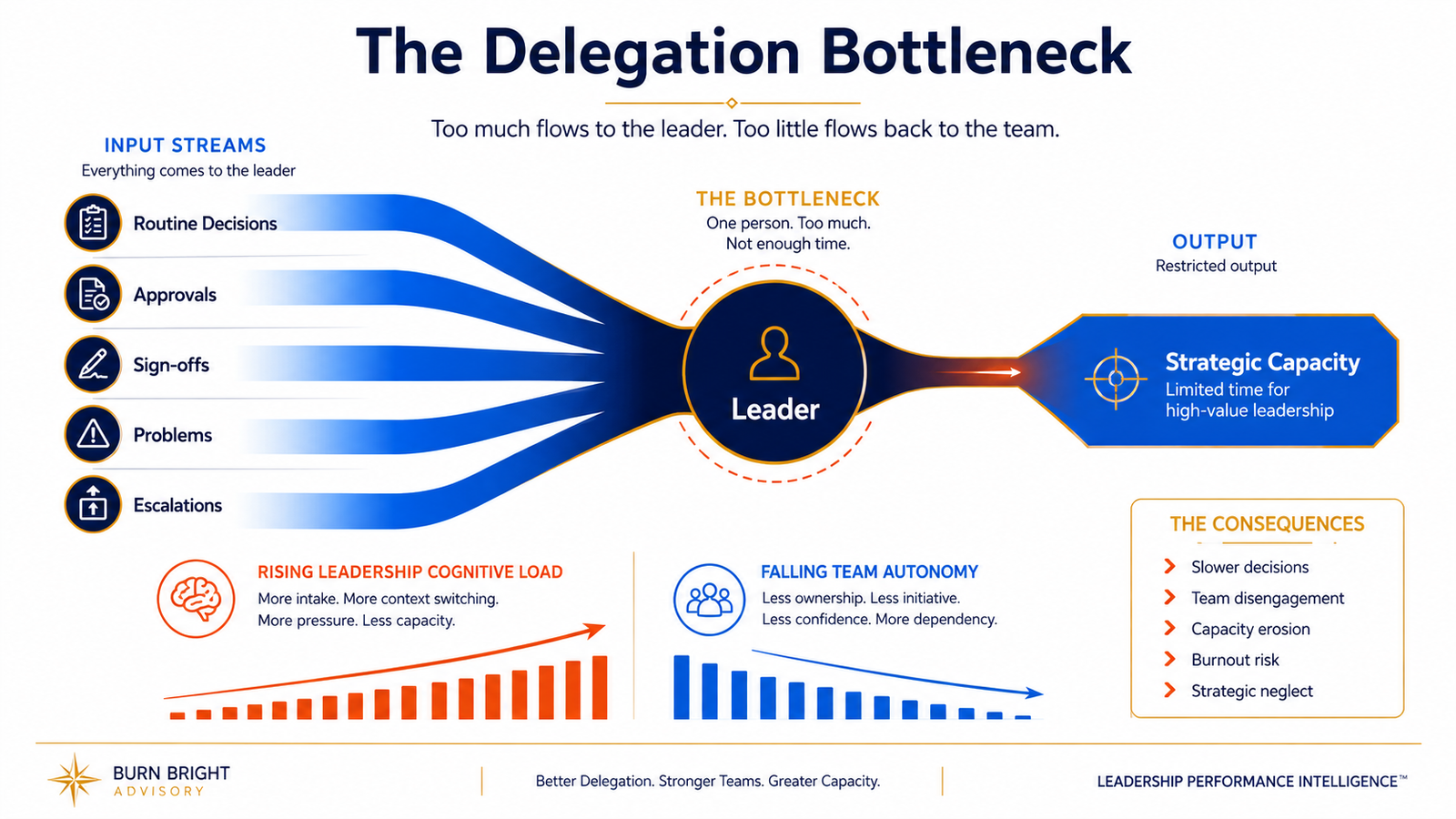
If work can travel down but decisions cannot, you have distributed tasks without distributing authority. That is one of the fastest ways to create an overloaded leader and an underdeveloped team.
What Is the Difference Between Delegation and Abdication?
There is a legitimate reason some leaders hesitate to delegate. Bad delegation exists.
Handing somebody a poorly defined responsibility, providing inadequate resources and disappearing until the deadline is not empowerment. It is abdication.
Good delegation maintains accountability while changing where the work and appropriate decisions happen.
| Traditional Control-Based Leadership | Sustainable Delegation |
|---|---|
| Leader retains most decisions | Decisions sit at the appropriate level |
| Tasks are assigned | Outcomes and ownership are transferred |
| Leader specifies how work should be done | Leader defines outcomes and critical boundaries |
| Frequent checking provides reassurance | Agreed review points provide visibility |
| Errors trigger tighter control | Errors inform capability development |
| Team escalates routine problems | Team resolves issues within defined authority |
| Leader becomes quality-control mechanism | Systems and standards protect quality |
| Trust is required before autonomy | Trust develops through evidence |
| Leader carries the cognitive load | Cognitive load is distributed |
| Success depends on leader availability | Success survives leader absence |
This distinction matters because delegation and trust in leadership require both autonomy and accountability.
Too much control creates dependency.
Too little structure creates ambiguity.
Sustainable delegation sits between them.
Use RACI when ownership becomes complicated
For work involving several people or departments, verbal delegation may not be enough.
The Burn Bright framework includes the RACI Delegation Framework™ as one of its nine core frameworks. RACI forces four distinctions:
- Responsible — Who does the work?
- Accountable — Who ultimately owns the outcome?
- Consulted — Whose expertise or input is required?
- Informed — Who needs visibility but does not need to participate in the decision?
That final distinction can transform leadership workload. Many senior leaders attend meetings, review documents and sit inside email chains because nobody has distinguished between being consulted and being informed.
They are included because the issue is important. But importance does not automatically require participation.
If you are merely informed, you may need a summary.
If you are consulted, your input is needed.
If you are accountable, you own the result.
Those are different levels of cognitive demand. Blur them and everything starts flowing upwards. Clarify them and unnecessary leadership involvement becomes visible.
How Can Leaders Delegate Without Losing Accountability?
Start by separating accountability from activity.
A senior leader may remain accountable for a function without personally performing every activity within it. That sounds obvious. In practice, many leaders behave as though accountability requires constant involvement. It does not.
A school leader can remain accountable for safeguarding without personally handling every administrative action. A hospital executive can remain accountable for operational performance without approving every rota change. A business leader can remain accountable for customer experience without resolving every customer complaint.
Leadership accountability means ensuring that the right standards, people, authority, information and escalation mechanisms exist. It does not mean becoming the operating system.
This distinction is particularly relevant to Burn Bright’s four structural transformation pillars: Workload Architecture™ asks where work should sit, Decision Authority™ determines who can act, Recovery Rhythms™ protect sustainable capacity, and Management Frameworks make the system repeatable. Delegation sits directly across those pillars.
Use progressive authority
Not every employee needs the same level of autonomy on day one. Instead, match authority to capability and risk.
Level 1 — Research
“Investigate this and bring me the options.”
Level 2 — Recommend
“Analyse the options and recommend what you think we should do.”
Level 3 — Decide With Approval
“Make the decision, but confirm it with me before acting.”
Level 4 — Decide and Report
“Make the decision and tell me what you decided.”
Level 5 — Own
“This is yours. Manage it within the agreed boundaries and escalate only the defined exceptions.”
This makes trust observable. A person does not need unlimited autonomy to begin developing ownership. The leader creates an appropriate level of decision authority, watches how judgement is exercised and expands that authority as evidence grows.
This also makes delegation safer. Higher-risk decisions can retain tighter controls. Lower-risk, reversible decisions can move much further down the organisation.
Why Does Better Delegation Reduce Leadership Burnout?
Because leaders are not only overloaded by tasks. They are overloaded by unfinished decisions, unresolved responsibility and constant cognitive switching.
A task that takes ten minutes may occupy mental space for three days. A project supposedly delegated to somebody else may still consume the leader’s attention if they expect to be consulted at every stage.
A manager can therefore remove tasks from their calendar while remaining psychologically responsible for almost everything.
One of the recurring themes in the Burn Bright material is that modern professional work has become fragmented by multiple communication streams, constant responsiveness and insufficient boundaries. The podcast material describes a shift away from deep work towards perpetually available shallow work, with workload and control mismatches contributing to exhaustion.
Poor delegation intensifies that fragmentation.
Every message becomes: “What do you think?”
Every problem becomes: “Can you decide?”
Every exception becomes: “Can you handle this?”
The leader’s day fragments into dozens of micro-decisions. Eventually there is no meaningful space left for leadership. Strategy gets pushed into the margins. Thinking happens after hours. Recovery becomes whatever time remains.
That is precisely why I do not see delegation as a productivity trick. It is workload architecture.
The test of sustainable delegation
Ask yourself one question:
Your answer identifies your dependency points. Some will be legitimate. Many will not.
Those unnecessary dependency points are not evidence of your value as a leader. They are design weaknesses.
The objective of sustainable leadership is not to make yourself indispensable to every process. It is to become highly valuable without becoming operationally essential to everything.
That is a profound difference. Because when leadership depends on permanent availability, personal memory and constant intervention, burnout risk is built into the role.
Better systems outperform more effort.
And better delegation is one of those systems.
How Can Leaders Build a Delegation System That Creates Trust?
The objective is not to delegate everything. It is to create a system in which responsibility sits at the lowest appropriate level, while leaders retain visibility over the things that genuinely require their attention.
That requires more than a conversation. It requires architecture.
The Burn Bright approach starts with a simple principle: fix the system, not the person.
If the same decisions repeatedly return to you, do not immediately assume your people lack initiative. Examine the system first.
- Do they know they have authority?
- Are the boundaries clear?
- Have you defined what requires escalation?
- Do they know what success looks like?
- Will you support a reasonable decision that differs from the decision you would have made?
That final question matters. You cannot tell people to take ownership and then punish every variation from your preferred method.
The five-part delegation reset
Use this framework to redesign one area of responsibility at a time.
1. Define the Outcome
Start with the result rather than the activity. Not “I need you to organise the leadership meeting,” but “I need the leadership team to leave Friday’s meeting with agreement on the three priorities, named owners and deadlines.” The first instruction delegates activity. The second establishes purpose.
2. Transfer Appropriate Authority
Ask what decisions this person can make without returning to you. Be specific: budget limits, staffing decisions, client communication, scheduling, procurement, operational changes. If responsibility moves but authority remains with you, you have created a messenger rather than an owner.
3. Define Escalation Thresholds
Not every problem deserves escalation. Agree what does — a financial threshold, a safeguarding concern, legal risk, missed milestone or significant change in scope. Everything else remains with the owner.
4. Agree Review Points
Replace constant checking with scheduled visibility. The level of review should reflect the level of risk and experience — a new responsibility may need weekly review, a mature one may require a monthly dashboard. Review the system. Do not hover over the person.
5. Close the Learning Loop
After significant delegated work, ask: what worked? What required escalation? Which decisions were unnecessarily referred upwards? What authority should change next time? This turns delegation into a capability-building mechanism rather than a one-off transaction.
This protects both sides. The employee knows when to involve you. You know silence does not mean loss of control.
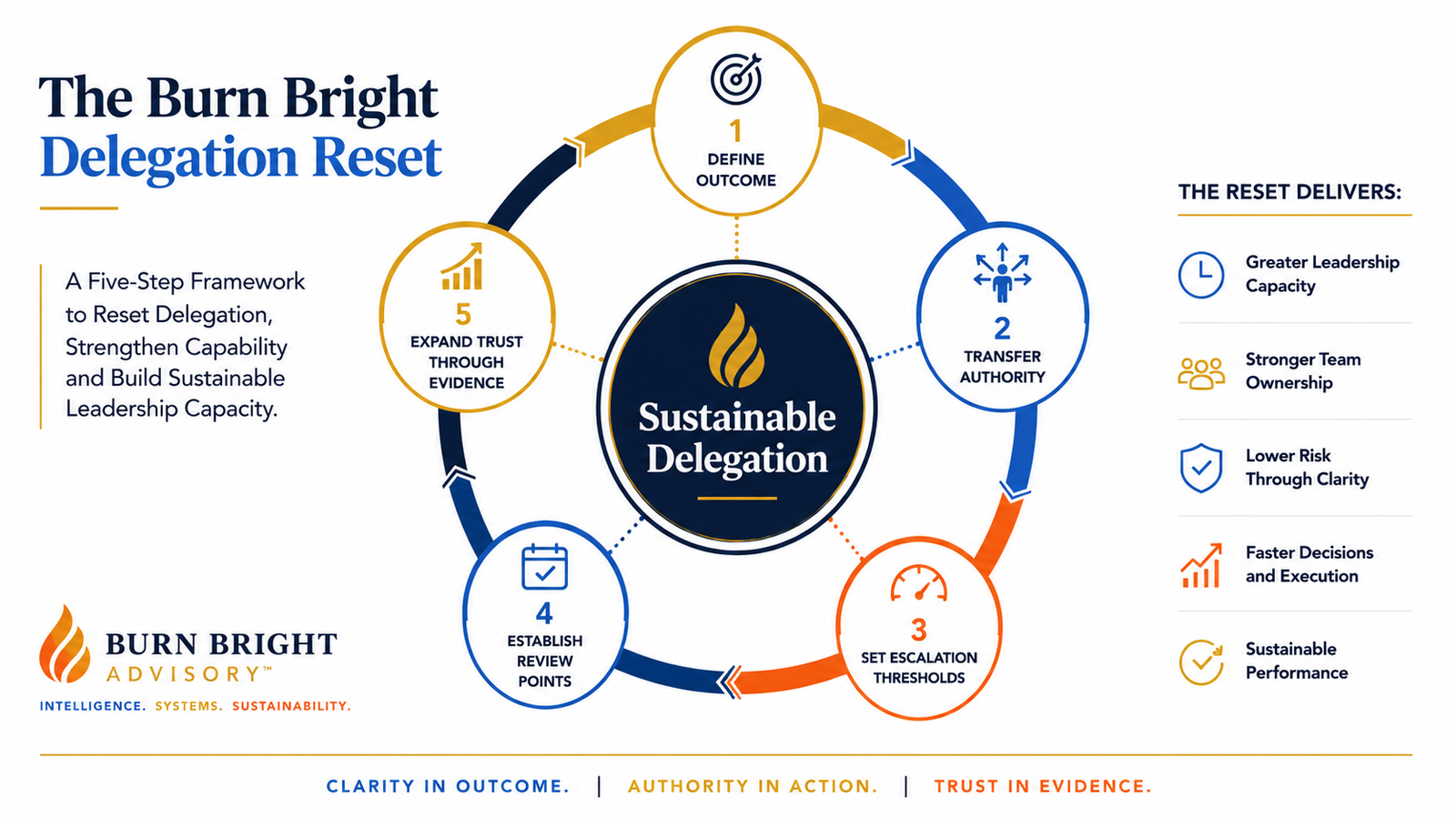
Why is this shown as a circular process rather than a straight line? Because delegation matures. Every completed cycle creates evidence. Evidence informs trust. Trust permits appropriate increases in authority. Greater authority builds stronger capability.
Eventually, decisions that once required senior intervention become routine elsewhere in the organisation. That is what leadership development looks like operationally.
What Should Leaders Do This Week to Improve Delegation and Trust?
Do not begin by trying to transform the entire organisation. Start with your own dependency points.
Open your calendar, inbox and current task list. Look for work that repeatedly requires your involvement. Then conduct a simple delegation audit.
Ask: does this genuinely require my role, authority or expertise?
If the answer is no, ask why it still reaches you. You will usually find one of several problems.
- The ownership is unclear.
- The person has responsibility but insufficient authority.
- Nobody knows the escalation boundary.
- The team has become accustomed to seeking permission.
- Or you keep taking the work back.
That last category deserves attention. Reverse delegation happens when somebody brings a problem to a leader and leaves with less responsibility for it than they had when they entered.
For example: “We have a problem with the supplier.” The leader replies: “Leave it with me.”
The employee walks away relieved. The leader acquires another problem.
Do this repeatedly and the organisation becomes exceptionally efficient at moving cognitive load upwards.
Change the conversation. Ask: “What do you recommend?” Then: “What decision do you need from me?” And finally: “What can you take forward from here?”
Protect the learning period
Delegation may initially feel slower than doing something yourself. That does not automatically make it inefficient.
If a task takes you 30 minutes but takes somebody else 60 minutes the first time, doing it yourself appears more efficient. But what happens across 50 repetitions?
If you keep doing it, you spend another 25 hours. If you transfer capability, your future involvement may fall close to zero.
Sustainable leadership evaluates efficiency over time. That is why the Burn Bright framework emphasises long-term effectiveness over individual heroics. The source material consistently argues for systems that distribute work effectively rather than depending on personal capacity to absorb unlimited demands.
Your goal is not to prove that you can carry the work. You probably can. The better question is whether you should.
How does delegation build trust in leadership?
Delegation builds trust when leaders give people meaningful responsibility, appropriate decision authority and clear accountability. Employees gain evidence that their judgement is valued, while leaders gain evidence of their capability. Over time, successful delegated decisions allow autonomy to expand. Trust therefore becomes something built through repeated evidence rather than something leaders must provide blindly.
Can you delegate to someone you do not fully trust?
Yes, provided the level of authority matches the person’s current capability and the risk involved. Start with narrower decision boundaries, explicit outcomes and agreed review points. As the person demonstrates sound judgement, increase their authority. Effective delegation allows trust to develop progressively rather than requiring complete trust at the beginning.
What is the biggest mistake leaders make when delegating?
One of the biggest mistakes is transferring responsibility without transferring authority. The employee becomes responsible for an outcome but must repeatedly return to the leader for decisions. This creates frustration, slows delivery and keeps the leader cognitively involved. Real delegation clarifies which decisions the person can make independently.
How can leaders delegate without micromanaging?
Define the outcome, authority, boundaries, escalation conditions and review points before work begins. Then allow the person to operate inside those parameters. Scheduled review creates visibility without constant intervention. If a leader needs continuous updates to feel safe, the delegation architecture may not be sufficiently clear.
Does delegation reduce leadership burnout?
Delegation can reduce leadership burnout when it genuinely redistributes responsibility and decision-making rather than merely allocating tasks. Burn Bright identifies Workload Architecture™ and Decision Authority™ as structural elements of sustainable leadership. Removing routine decisions, approvals and unnecessary escalations can reduce fragmentation and leadership dependency.
What is the difference between delegation and task allocation?
Task allocation tells somebody what to do. Delegation gives somebody responsibility for achieving an outcome and provides appropriate authority to make decisions about how that outcome is delivered. The distinction matters because task allocation can leave the leader carrying most of the planning, judgement and cognitive load.
What should a leader never delegate?
Leaders should retain decisions that genuinely require their formal authority, carry significant strategic or organisational risk, or represent responsibilities that cannot appropriately be transferred. Even then, supporting analysis and implementation may be delegated. The objective is not to delegate everything; it is to place each decision at the appropriate organisational level.
Conclusion
Delegation and trust in leadership are not soft leadership concepts. They are questions of organisational design.
When leaders retain routine decisions, personally solve recurring problems and remain involved in every important piece of work, they create dependency. That dependency eventually becomes workload.
The answer is not careless delegation.
It is structured delegation.
Define the outcome. Clarify ownership. Transfer appropriate authority. Establish boundaries. Set escalation thresholds. Agree review points. Then allow evidence to determine how trust expands.
This is sustainable leadership in practice. You stop asking one person to carry an organisation through effort and start designing an organisation capable of carrying responsibility through systems.
Because burnout is a system failure. And leaders cannot outwork broken systems.
If your workload currently depends on your permanent availability, the first step is not another productivity technique. Diagnose where the organisation has become unnecessarily dependent on you.
Diagnose Your Leadership Burnout Risk
If delegation problems, decision overload and permanent availability are consuming your leadership capacity, start with a structural diagnosis. The Leadership Burnout Self-Assessment helps you identify where workload, boundaries and leadership systems may be creating unnecessary depletion.
Free Leadership Intelligence
Get Weekly Leadership Insights
Join thousands of leaders receiving practical strategies on burnout prevention, workload design, and sustainable performance every week.