Quick Answer
Key Takeaways
- The useful leadership question is not “is this an ethical leader?” but “has this leader created conditions in which ethical decisions are consistently more likely?”
- A leader can be fundamentally decent and still preside over unethical outcomes when incentives, workload or weak governance undermine good intentions.
- Ethical failure rarely arrives through one dramatic decision. It emerges gradually as individually defensible choices accumulate into collectively indefensible outcomes.
- Psychological safety is ethical infrastructure. Leaders cannot respond responsibly to problems they never hear about.
- Ethical judgement requires capacity. Chronically overloaded leaders have less space for reflection, consultation and careful challenge.
Ethical Leadership Is Not About Being a Good Person: It Is About Building Systems That Make Good Decisions More Likely
Leadership failures are often explained retrospectively through character.
Someone lacked integrity.
Someone became too ambitious.
Someone ignored the warning signs.
Someone should have known better.
Occasionally, that explanation is correct. Some leadership failures involve deliberate deception, exploitation or misconduct.
But many ethical failures are more complicated. They emerge gradually from environments in which individually defensible decisions accumulate into collectively indefensible outcomes.
A target becomes slightly more aggressive.
A deadline becomes slightly less realistic.
An uncomfortable concern remains unspoken.
A questionable practice is tolerated because changing it would be inconvenient.
A leader approves something despite reservations because everyone else appears comfortable with it.
Nobody necessarily arrives at work intending to behave unethically. Yet the system begins producing decisions that responsible leaders would struggle to defend when viewed together.
That is why organisations need a more sophisticated understanding of ethics leadership.
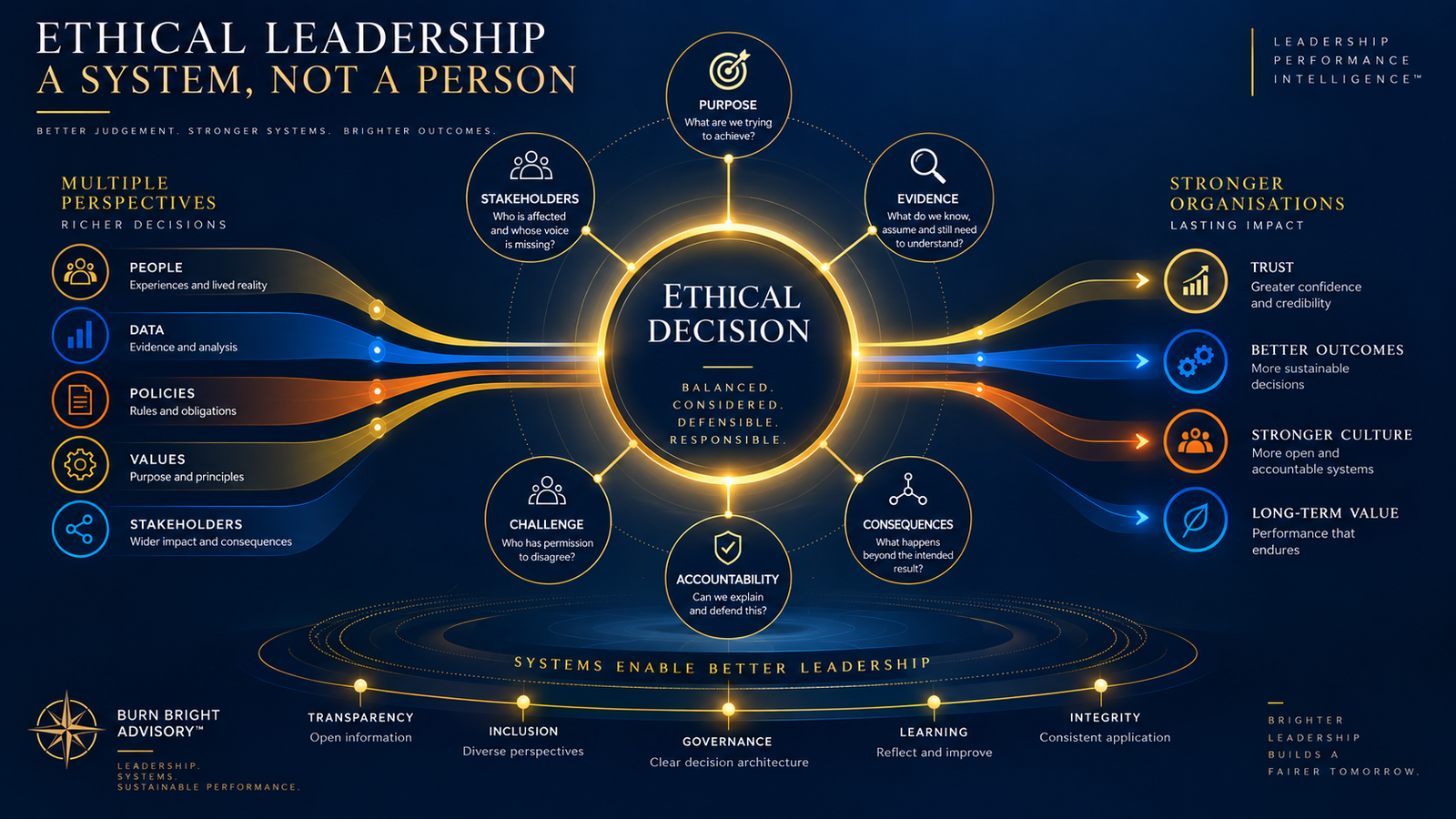
Ethical leadership cannot depend entirely upon finding exceptionally virtuous individuals and hoping their character survives every pressure placed upon them. It requires leaders capable of creating systems in which responsible judgement becomes easier to exercise, concerns become safer to raise and questionable decisions become harder to rationalise.
What Is Ethical Leadership?
Ethical leadership can be understood as the capacity to make, influence and enable decisions that are responsible, transparent, defensible and appropriately attentive to their consequences for others.
That definition deliberately extends beyond personal morality. A leader’s values matter, but leadership operates through other people and through systems. Consequently, ethical leadership must address at least four dimensions:
- Personal judgement — how the leader interprets ethical questions
- Decision architecture — how important decisions are actually made
- Organisational culture — what behaviours are encouraged, tolerated or challenged
- Accountability — what happens when actions contradict stated standards
This distinction matters because organisations frequently confuse having ethical policies with possessing ethical capability.
A code of conduct can describe expected behaviour. It cannot guarantee that an employee feels safe challenging an influential executive. A corporate value can proclaim integrity. It cannot determine what happens when meeting a commercial target requires someone to compromise that value. A compliance programme can establish rules. It cannot anticipate every ambiguous situation in which leaders must balance competing responsibilities.
The Character Trap in Ethical Leadership
There is an understandable attraction to character-based explanations of leadership. They simplify complexity.
If something goes wrong, find the person responsible.
Replace them.
Reaffirm organisational values.
Move forward.
But this approach can create what might be called the character trap: the assumption that ethical organisational outcomes primarily depend upon having good people in senior positions.
Good people certainly matter. But ethical leadership cannot rely on goodness alone.
Imagine a highly principled operational leader facing simultaneous pressures to reduce expenditure, maintain staffing levels, improve service quality and deliver an ambitious transformation programme. None of these objectives is inherently unethical. The ethical problem emerges through their interaction.
What happens when the budget cannot realistically support all four? Does the leader acknowledge the contradiction? Does the organisation revise expectations? Does the leader quietly transfer the pressure downward? Do managers begin accepting unsustainable workloads because admitting capacity constraints is interpreted as poor performance? Do employees eventually cut corners because the formal expectations and available resources no longer align?
The original leadership team may still describe itself as values-led. Yet the operating system is producing conditions in which ethical compromise becomes increasingly predictable.
This is one reason Leadership Performance Intelligence™ requires a broader understanding of leadership effectiveness. Performance cannot be judged exclusively through whether objectives were achieved. Leaders must also ask: what conditions were created in achieving them?
Ethics Intelligence™: Moving From Values to Judgement
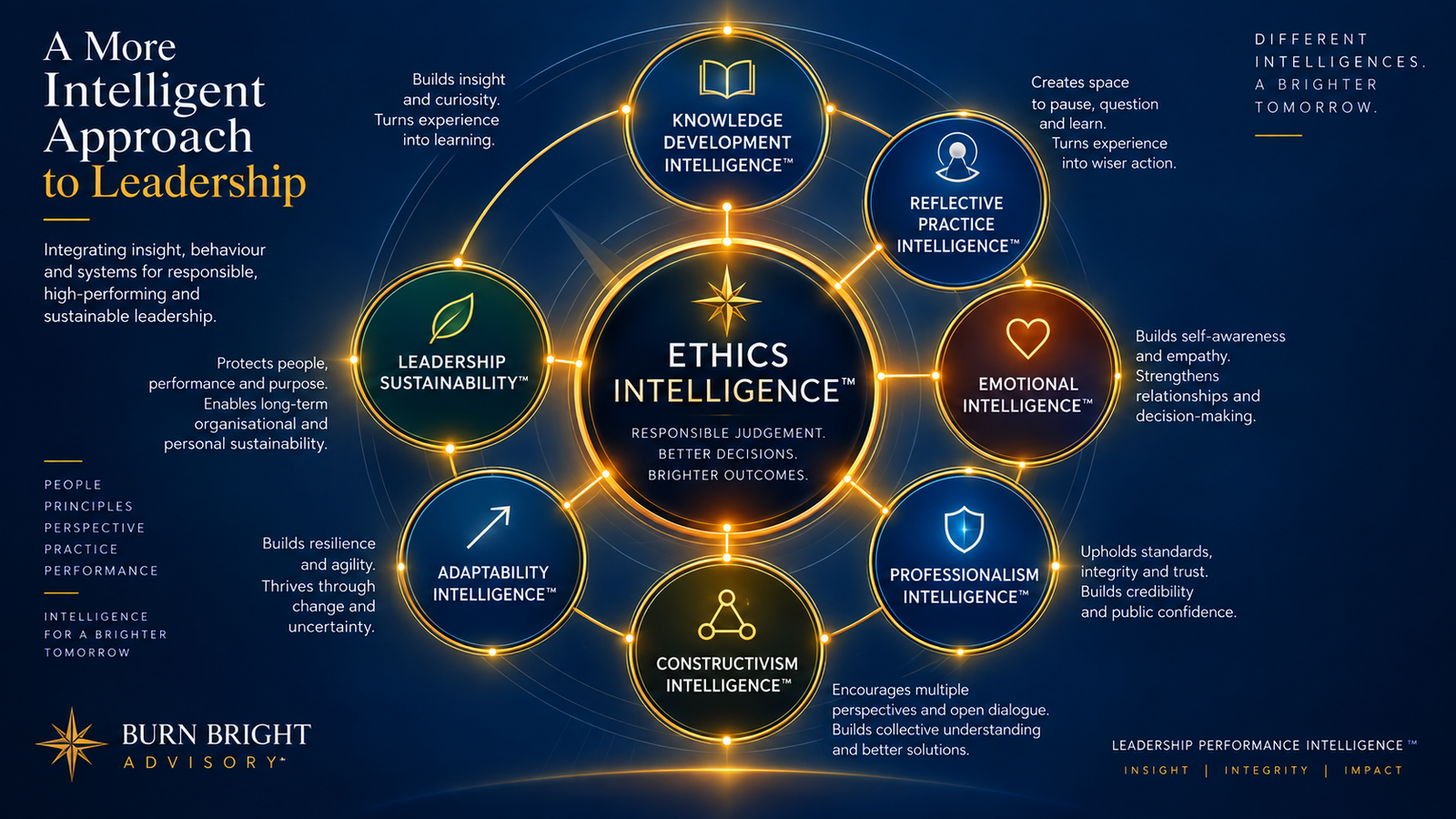
Within the Leadership Intelligence Compass™, Ethics Intelligence™ represents the capacity to recognise, examine and respond intelligently to the ethical dimensions of leadership. It asks leaders to move beyond knowing their values toward understanding how those values survive contact with complexity.
That requires several capabilities. An ethically intelligent leader must be able to notice when an apparently operational question contains an ethical dimension. They must recognise competing stakeholder interests. They must distinguish what is legally permissible from what is organisationally responsible. They must consider not only immediate outcomes but second-order consequences. They must create space for dissent. And perhaps most importantly, they must remain capable of questioning decisions that benefit themselves or their organisation.
This makes Ethics Intelligence™ closely connected to other domains of the Leadership Intelligence Compass™.
Reflective Practice Intelligence™ enables leaders to examine their own reasoning. Emotional Intelligence™ helps them recognise how fear, loyalty, status and relationships affect judgement. Professionalism Intelligence™ connects individual conduct with standards and obligations. Constructivism Intelligence™ reminds leaders that different stakeholders may interpret the same decision through very different experiences. Adaptability Intelligence™ becomes important when changing circumstances make yesterday’s assumptions inappropriate. And Leadership Sustainability™ matters because exhausted, overloaded leaders do not make decisions under the same cognitive conditions as leaders with sufficient capacity to think.
Ethical Failure Often Begins Before the Ethical Decision
One of the most important ideas in ethical leadership is also one of the easiest to overlook: the quality of an ethical decision is partly determined before the decision arrives.
Consider a leader who has spent ten hours moving between meetings, resolving operational problems, answering messages and responding to competing stakeholders. At 6:30 p.m., an urgent proposal arrives requiring approval. The proposal is commercially important. The leader has twenty minutes to review it. Several assumptions appear questionable, but challenging them would delay the project.
What happens next may eventually be described as an ethical decision. But the conditions surrounding that decision matter.
The leader is fatigued.
Time is constrained.
The organisational incentive favours approval.
The cost of questioning the proposal is immediate.
The potential cost of approving it is uncertain and distant.
This is not an excuse for poor judgement. It is an explanation of why responsible organisations cannot treat ethics solely as an individual test of character.
Burn Bright’s work on Leadership Sustainability™ starts from a related premise: leadership roles themselves can become structurally unsustainable when responsibilities expand without equivalent resources, boundaries or support. Sustainable leadership therefore requires systems thinking rather than dependence on individual heroics.
The same principle applies to ethics. If an organisation repeatedly places leaders in environments where responsible decisions require extraordinary personal resistance to systemic pressure, it has not built a strong ethical culture.
The Ethical Decision Environment
A stronger approach is to examine what Burn Bright Advisory™ describes here as the Ethical Decision Environment. Rather than asking only whether leaders know right from wrong, organisations examine the conditions surrounding important decisions. Five questions become particularly useful.
1 What Pressures Are Operating?
Every significant decision occurs within a field of pressure — commercial, political, time, performance, professional, reputational and interpersonal. The presence of pressure does not automatically make a decision unethical, but leaders must acknowledge how those pressures are influencing judgement.
2 Whose Interests Are Visible?
Some stakeholders are physically present in decision-making rooms. Others are represented through reports, data or professional obligations. Others may have no voice at all. Ethically intelligent leadership asks whose interests are structurally easier to ignore.
3 What Information Is Missing?
Has dissent been filtered out? Have frontline concerns reached senior leadership? Are assumptions being treated as facts? Has anyone actively looked for evidence that contradicts the preferred decision?
4 Can Somebody Safely Challenge the Decision?
Can a junior employee question a senior leader’s proposal without damaging their reputation? An organisation in which nobody challenges senior leaders may look aligned — it may actually be ethically fragile.
5 Can the Decision Be Explained Afterwards?
Could the leader explain what was decided, what information was considered, whose interests were affected, what alternatives were examined, what trade-offs were accepted and why the final choice was considered responsible?
Leadership environments characterised by fear, intimidation or systematic undermining can progressively reduce people’s willingness to speak, particularly in small teams where there may be few alternative reporting relationships. Burn Bright’s work on toxic leadership highlights how the deterioration of trust and psychological safety can make people increasingly reluctant to challenge problematic behaviour.
This is more demanding than asking whether a decision complied with policy. It asks whether the reasoning itself is defensible. And that is where ethical leadership begins to become a genuine organisational capability rather than a statement of aspiration.
Ethical Leadership Becomes Visible Under Pressure
It is relatively easy to behave consistently with organisational values when interests are aligned, resources are sufficient and the consequences of a decision are comfortable.
The real test of ethics leadership appears when something must be sacrificed.
Revenue or fairness.
Speed or scrutiny.
Loyalty or accountability.
Performance targets or employee capacity.
Institutional reputation or transparency.
Immediate results or longer-term sustainability.
These moments reveal the difference between stated ethics and operational ethics. Stated ethics describes what an organisation says it believes. Operational ethics describes what actually influences decisions when competing priorities collide.
This distinction matters because organisations rarely become ethically compromised through one dramatic decision. More often, standards are gradually renegotiated through a sequence of apparently reasonable exceptions.
A deadline cannot move, so the team absorbs additional work.
A high performer behaves badly, but their results make intervention inconvenient.
A senior executive bypasses a process because the situation is considered exceptional.
A concern is acknowledged but postponed until after an important milestone.
An unrealistic target remains because nobody wants to challenge the assumptions behind it.
Each decision can be rationalised independently. Together, they begin changing the organisation.
Ethical leadership therefore requires leaders to recognise not only obviously unethical behaviour, but also the normalisation of ethical drift.
The Ethics Intelligence™ Decision Model
Burn Bright Advisory™ positions Ethics Intelligence™ as more than adherence to rules. It is a leadership capability for navigating complexity while maintaining responsibility, transparency and defensible judgement.
A practical Ethics Intelligence™ decision process can be organised around five disciplines: Recognise → Examine → Challenge → Decide → Review.
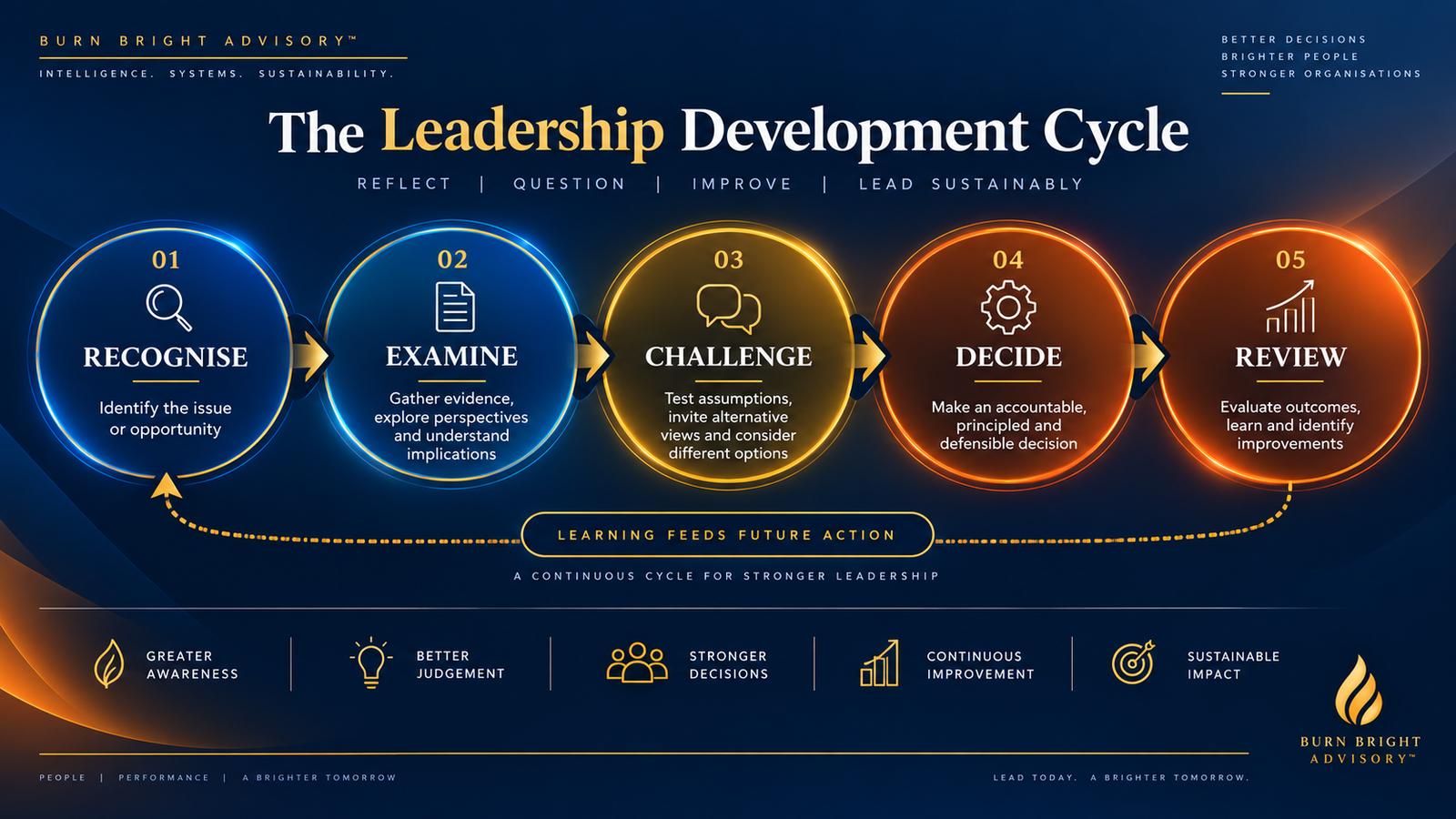
1. Recognise: Identify the Ethical Dimension
Many ethical problems arrive disguised as operational questions — “Can we meet the deadline?”, “Can we reduce the budget?”, “Can we use this customer data?” The technical answer may be yes. The ethical question is broader: what happens to people, responsibilities, standards and trust if we do?
2. Examine: Understand Stakeholders, Evidence and Consequences
Who benefits? Who carries the risk? Who has been consulted, and who has not? What assumptions are shaping the proposal, and what happens if they prove wrong? This is where Constructivism Intelligence™ matters — leadership decisions are rarely experienced identically by everyone affected by them.
3. Challenge: Test the Preferred Decision
What would make this decision wrong? What evidence would cause us to reconsider? Would we make the same decision if it became publicly visible? These questions create productive friction — and some forms of friction protect decision quality.
4. Decide: Make Responsibility Explicit
What principles influenced the decision? Which trade-offs were unavoidable? Who owns the consequences? This prevents diffused accountability, where everyone assumes somebody else owns a decision’s ethical implications.
5. Review: Learn From Consequences
Were the expected benefits realised? Did unintended consequences emerge? Would the organisation make the same decision again? Ethical maturity requires the ability to say “given what we now know, we would decide differently” — without treating that as evidence of failure.
Recognition requires leaders to resist reducing complex decisions to a single metric. A financially attractive decision can create workforce consequences. An efficient healthcare decision can affect patient experience or safety. An educational intervention can improve one performance indicator while disadvantaging particular groups of students. Ethics Intelligence™ expands the field of vision.
Organisations frequently design processes to remove friction in pursuit of speed. Yet some forms of friction protect decision quality. Governance is friction. Peer review is friction. Professional challenge is friction. Independent oversight is friction. A colleague saying “I am not comfortable with this yet” is friction. The objective should not be to eliminate such friction automatically — it should be to distinguish unnecessary bureaucracy from protective challenge.
Ethical Leadership and Psychological Safety
An ethical system depends heavily upon information. Leaders cannot respond responsibly to problems they never hear about.
That makes psychological safety more than a culture or employee-engagement issue. It is part of an organisation’s ethical infrastructure.
When people believe that raising concerns will lead to humiliation, retaliation, exclusion or damage to their careers, critical information becomes trapped lower in the organisation. The leader then faces an information paradox: senior leaders may believe everything is functioning well precisely because the environment they have created prevents people from telling them otherwise.
Burn Bright’s work on toxic leadership in small teams highlights how leadership dysfunction can progressively undermine trust, make conversations strained and cause employees to question whether it is safe to speak openly. In smaller teams, this effect can become especially pronounced because there may be few alternative reporting relationships or organisational buffers.
Ethical leadership therefore requires more than telling employees “speak up.” Leaders must examine what happens after someone speaks.
- Are they listened to?
- Are they required to defend themselves against people with substantially greater organisational power?
- Does the concern disappear into a process with no visible outcome?
- Are they subtly excluded afterwards?
- Do senior leaders become defensive?
- Or does the organisation demonstrate that responsible challenge is part of professional contribution?
Cross-Sector Application: Ethics Intelligence™ in Practice
Ethical leadership is universal, but its expression changes according to context. The Leadership Intelligence Compass™ provides a common conceptual architecture while allowing application across different sector hubs.
Business Growth Intelligence™: When Performance Creates Ethical Blind Spots
Consider a business unit consistently outperforming every other division. Revenue is growing. Customers are increasing. The executive responsible is regarded as indispensable. Then complaints begin emerging about the leader’s behaviour — intimidation, excessive workload and questionable sales practices.
The organisation now faces a revealing test. If leadership behaviour would trigger intervention in an average-performing division but becomes negotiable when the individual generates exceptional revenue, the organisation has communicated an ethical standard: performance changes the rules.
This creates significant long-term risk. Employees quickly learn which values are genuinely non-negotiable and which exist only while they remain commercially convenient.
Ethics Intelligence™ requires the organisation to examine performance more broadly — not simply what results a leader produced, but how those results were produced, what conditions they created and whether those conditions are sustainable. This is where ethics leadership becomes inseparable from Leadership Performance Intelligence™.
School Leadership Intelligence™: When Accountability Becomes Distortion
School leaders operate within complex systems of accountability. Student outcomes, attendance, safeguarding, staff performance, inspection outcomes, parent confidence and budget management all matter.
The ethical risk arises when one indicator becomes so dominant that leaders begin reorganising behaviour around the metric rather than the underlying purpose. A school leader facing intense performance pressure might be tempted to discourage the admission of students likely to affect results, interpret behaviour policies inconsistently or create unsustainable pressure on teachers to improve measurable outcomes.
Each decision may be presented as performance management. Ethics Intelligence™ asks a deeper question: does the method used to improve the measure remain consistent with the purpose education is supposed to serve?
Healthcare Leadership Intelligence™: When Hierarchy Silences Expertise
Healthcare illustrates particularly clearly why ethical leadership cannot depend exclusively upon senior expertise. A junior clinician may notice something a senior colleague has missed. A nurse may identify a patient-safety concern before a consultant. An administrator may recognise a systems failure invisible to clinical leadership.
If hierarchy determines whose information is taken seriously, the organisation creates ethical and operational risk. Burn Bright’s existing work on toxic leadership identifies this concern directly in medical settings: cultures in which nurses are afraid to question doctors or staff are humiliated for asking questions can affect more than employee satisfaction — they can undermine the quality and safety of care.
Ethics Intelligence™ therefore requires leaders to separate authority from infallibility. Expertise deserves respect. Position carries responsibility. Neither removes the need for challenge.
Public Service Leadership Intelligence™: Stewardship Beyond Immediate Results
Public-service leaders frequently operate where multiple legitimate obligations intersect: efficiency, accessibility, political priorities, public accountability, professional standards, budget constraints and community expectations.
Unlike purely transactional decisions, public-service choices may affect citizens who have little practical ability to choose an alternative provider. That creates a heightened stewardship responsibility.
Ethics Intelligence™ asks leaders to consider not only whether a decision is efficient, but whether it remains fair, explainable and proportionate. A service redesign may reduce expenditure — but who loses access? A digital transformation may improve efficiency — but who becomes excluded? A policy may improve aggregate performance — but which communities carry disproportionate consequences?
Ethical leadership does not automatically reject efficiency. It ensures efficiency is not mistaken for the whole definition of value.
The Connection Between Ethical Leadership and Leadership Sustainability™
There is another dimension organisations cannot afford to ignore. Ethical judgement requires capacity.
Leaders experiencing chronic overload may have less space for reflection, consultation and careful challenge. Under sustained pressure, leadership can become increasingly reactive: resolve the immediate problem, meet the deadline, clear the queue, move to the next decision.
Burn Bright’s work on leadership burnout argues that modern leadership roles can become structurally unsustainable when responsibilities expand without equivalent resources and support. It distinguishes sustainable leadership from reliance upon individual heroics and emphasises systems that distribute work and preserve longer-term leadership capacity.
This has ethical implications. Leadership Sustainability™ is not simply about helping leaders feel better. It helps preserve the conditions required for responsible judgement.
A leader with sufficient cognitive and emotional capacity can ask: “What are we missing?”
A depleted leader is more likely to ask: “How quickly can we close this?”
From Ethical Individuals to Ethical Systems
The central shift is simple but profound. Organisations should stop asking ethical individuals to compensate indefinitely for poorly designed systems. Instead, they should build systems that reinforce ethical behaviour.
That means creating decision processes in which:
- important assumptions can be challenged;
- dissent is professionally legitimate;
- affected stakeholders are considered;
- workload and capacity are visible;
- accountability remains clear;
- powerful people are not exempt from behavioural standards;
- decisions can be explained transparently; and
- outcomes are reviewed rather than merely implemented.
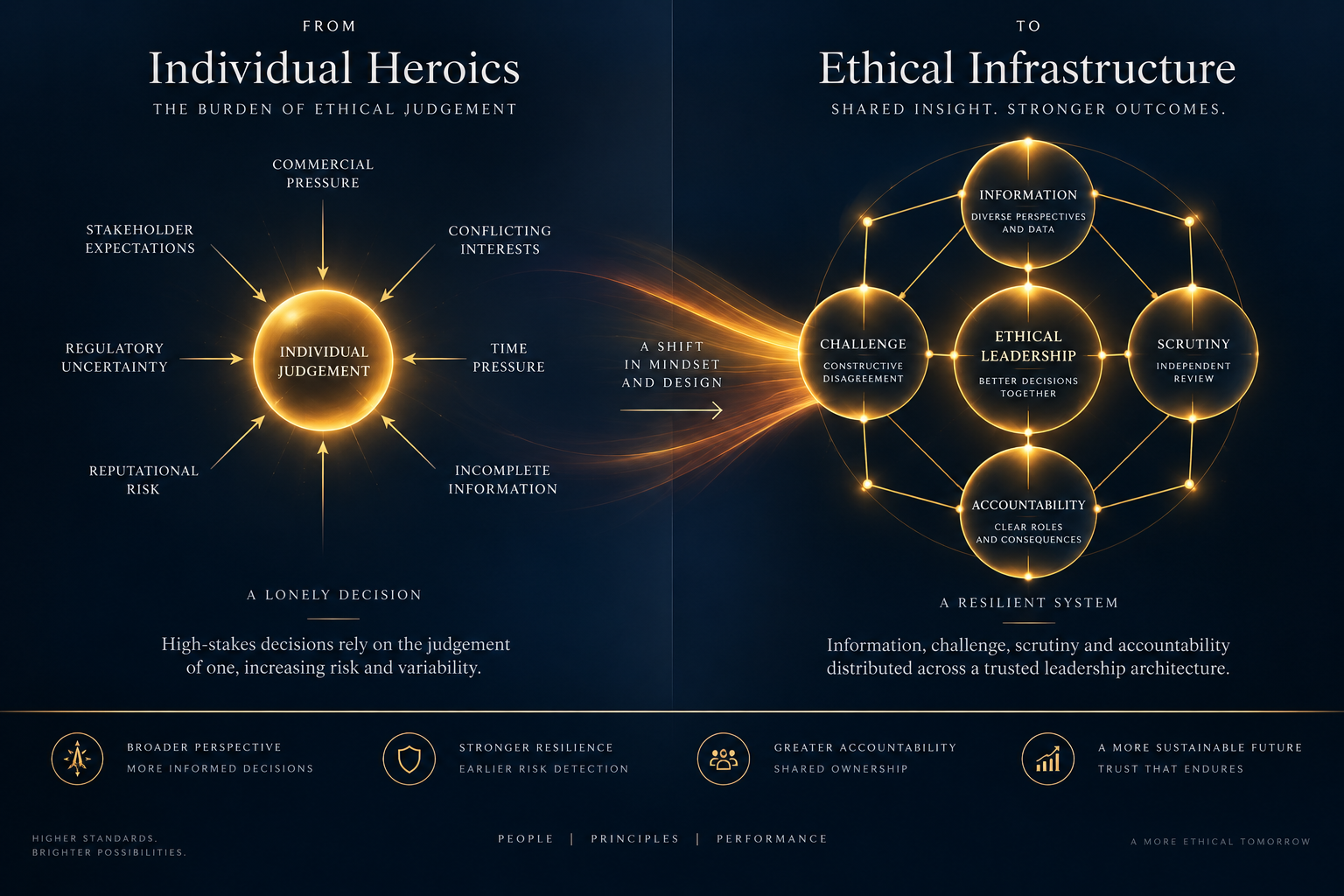
This does not remove personal responsibility. It strengthens it. Ethically intelligent systems make individual responsibility visible rather than allowing it to disappear behind hierarchy, procedure, targets or collective decision-making.
And they recognise one of the central principles of Leadership Performance Intelligence™: how leadership produces performance matters as much as whether performance is produced.
A result achieved by exhausting the workforce, silencing professional challenge, transferring unreasonable risk or compromising organisational values cannot automatically be classified as effective leadership simply because the target was reached.
Performance must be examined alongside capacity.
Results alongside consequences.
Authority alongside accountability.
And intention alongside impact.
That is the transition from ethics as organisational aspiration to Ethics Intelligence™ as leadership capability.
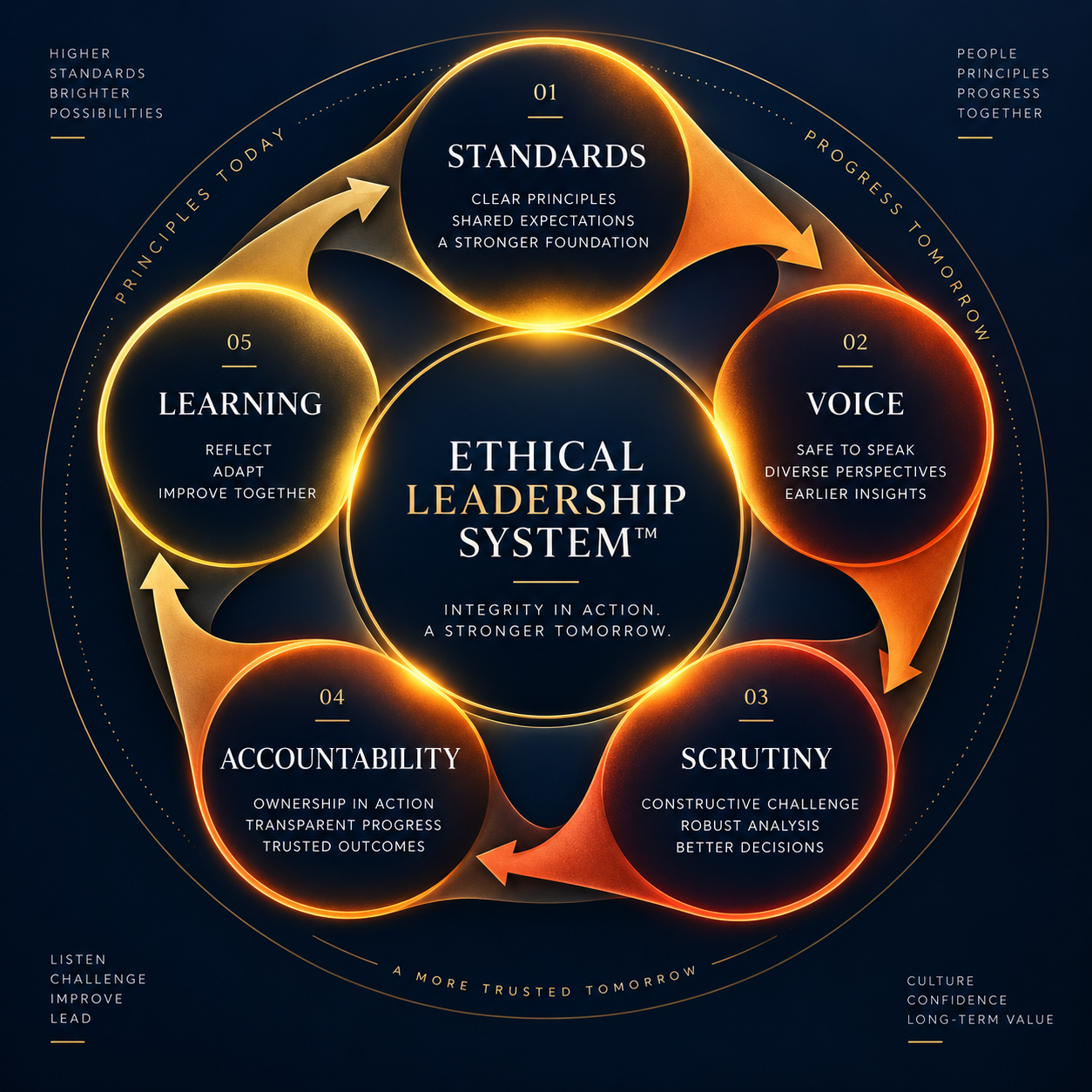
The Ethical Leadership System™
If ethical leadership is to become reliable rather than aspirational, organisations need to translate values into operating practice.
Burn Bright Advisory™ proposes thinking about this through an Ethical Leadership System™: the interconnected conditions that influence whether responsible judgement survives pressure. The system has five components: Standards → Voice → Scrutiny → Accountability → Learning.
1 Standards: Make Expectations Operational
Most organisations have values. Fewer have translated those values into meaningful decision standards. Ethics Intelligence™ asks leaders to convert abstract values into practical questions — for example, “would we regard this process as reasonable if we were the least powerful person affected by it?”
2 Voice: Make Responsible Challenge Possible
An organisation cannot use information that people are unwilling to provide. A reporting channel does not create voice if employees believe using it will damage their careers. The deeper question is what the organisation teaches people about the consequences of telling the truth upward.
3 Scrutiny: Slow Down the Decisions That Deserve It
Not every decision requires extensive ethical analysis. The challenge is identifying decisions where consequences for employees, communities or vulnerable stakeholders — or substantial financial, reputational or conflict-of-interest risk — justify greater scrutiny. The principle is proportionality.
4 Accountability: Apply Standards Consistently
Nothing weakens ethical culture faster than selective accountability. If a junior employee faces consequences for behaviour tolerated from a senior executive, the organisation has demonstrated the real hierarchy of its values — organisational power should not make fundamental behavioural expectations optional.
5 Learning: Treat Ethical Decisions as Organisational Knowledge
Difficult decisions generate valuable information. Where did the process work? Which assumptions proved inaccurate? This transforms ethical reflection from an occasional exercise into Knowledge Development Intelligence™.
Routine decisions should remain efficient. Consequential decisions should receive appropriate challenge. Accountability does not necessarily mean identical consequences in every circumstance — context matters — but it does mean that organisational power, revenue contribution, specialist expertise or seniority should not make fundamental behavioural expectations optional.
The organisation becomes better at ethical judgement because it deliberately learns from previous decisions.
Five Warning Signs of an Ethically Fragile Leadership System
Ethical fragility often becomes visible before a major failure occurs. Leaders should pay attention to five patterns.
This is where Leadership Workload™, Leadership Capacity™ and Leadership Sustainability™ become ethically significant. Burn Bright’s existing leadership sustainability work argues that modern leadership problems cannot always be solved through individual time-management techniques because workload itself may be structurally unsustainable. An organisation operating permanently beyond reasonable capacity should therefore consider not only the wellbeing implications but also the quality of the decisions being produced.
Building Ethics Intelligence™ Into Leadership Practice
Ethical leadership development should move beyond teaching leaders what the organisation believes. It should develop their capacity to reason under pressure. This can be integrated into leadership development through practical mechanisms.
Ethical Decision Reviews
Select significant decisions periodically and examine the reasoning behind them — not just whether the outcome was successful, but the evidence, assumptions, stakeholders, pressures, dissent, consequences and learning involved.
Leadership Reflection™
Leaders should routinely examine how their own position influences judgement — what am I reluctant to hear, and whose perspective have I not actively sought? This is where Leadership Reflection™ becomes a practical discipline rather than an abstract exercise.
Ethical Pre-Mortems
Before implementing a consequential decision, imagine that twelve months have passed and the decision has produced serious unintended consequences. Ask what most likely went wrong — this can reveal risks that optimism, hierarchy or momentum has suppressed.
Protected Challenge
For important decisions, explicitly assign someone responsibility for testing the preferred option. This prevents disagreement from depending entirely upon individual courage — challenge becomes part of the process rather than an act of personal opposition.
Leadership Benchmarking™
Organisations should examine whether ethical capability is visible across leadership levels. A Leadership Intelligence Assessment™ can help move development beyond self-perception by examining patterns across the wider Leadership Intelligence Compass™.
Ethics Intelligence™ should not be interpreted alone. Weak Reflective Practice Intelligence™ may make leaders less able to question their assumptions. Weak Emotional Intelligence™ may reduce awareness of interpersonal pressure. Weak Leadership Sustainability™ may compromise the capacity available for careful judgement. Weak Professionalism Intelligence™ may produce inconsistency between standards and behaviour.
Who Is Ethics Intelligence™ For?
Ethics Intelligence™ is relevant to every leader whose decisions affect other people. That includes executives and board members, but it also includes:
- department heads
- school and university leaders
- healthcare professionals
- public-service managers
- HR and people leaders
- entrepreneurs and founders
- project leaders
- team managers
- emerging leaders preparing for greater responsibility
Ethical leadership begins long before someone reaches the executive suite. Every leadership role contains decisions about resources, information, opportunity, workload, recognition, standards and consequences. Every one of those decisions can strengthen or weaken trust.
The Leadership Question That Matters
Ethical leadership is sometimes reduced to a deceptively simple instruction: do the right thing.
The difficulty is that leadership rarely presents people with choices labelled right and wrong. It presents competing obligations. Incomplete evidence. Power differences. Uncertain consequences. Limited resources. Time pressure. Human emotion. Organisational politics. And multiple stakeholders with legitimate but incompatible expectations.
That is why ethics must be treated as intelligence. Leaders need the capacity to interpret complexity rather than merely repeat principles. They need systems that expose assumptions. Cultures that permit challenge. Workloads that preserve judgement. Accountability that survives hierarchy. And reflective processes capable of converting experience into better future decisions.
This is the contribution of Ethics Intelligence™ to the wider Leadership Intelligence Compass™. And it leads to a more demanding definition of ethical leadership.
That is where ethical leadership becomes measurable. That is where values become behaviour. And that is where ethics becomes part of Leadership Performance Intelligence™.
Reflection Questions
- Where in your organisation are leaders currently experiencing the greatest pressure to compromise between competing priorities?
- Which organisational values become most difficult to maintain when performance is under pressure?
- How safe is it for someone with less authority to challenge a senior leader?
- When was the last time significant employee or stakeholder dissent materially changed a leadership decision?
- Are high performers held to the same behavioural expectations as everyone else?
- Where might permanent urgency be reducing the quality of leadership judgement?
- What important information becomes diluted as it moves upward through your organisation?
- How consistently do leaders examine the consequences of decisions after implementation?
- Which areas of the Leadership Intelligence Compass™ most strongly support or constrain Ethics Intelligence™ in your leadership context?
- Could your most consequential recent leadership decision withstand transparent explanation to every stakeholder affected by it?
Action Steps: Over the Next Seven Days
Identify one significant recent leadership decision. Do not evaluate it simply by asking whether it worked. Reconstruct the decision using the Ethics Intelligence™ model:
- Recognise: What was the ethical dimension?
- Examine: Who was affected and what evidence was considered?
- Challenge: What assumptions were questioned — and which were not?
- Decide: How was responsibility allocated?
- Review: What happened afterwards and what should be learned?
Then identify one improvement to your decision architecture. It might be creating protected challenge for major decisions, introducing an ethical pre-mortem, reviewing leadership workload, strengthening escalation processes or establishing a structured post-decision review.
What is ethical leadership?
Ethical leadership is the practice of making and enabling responsible, transparent and defensible decisions while considering organisational values, stakeholder interests, professional obligations and the consequences of leadership choices. It involves both personal conduct and the systems through which other people make decisions.
Why is ethical leadership important?
Ethical leadership influences trust, organisational culture, decision quality, accountability and long-term performance. Without effective ethical leadership, organisations can achieve short-term objectives while simultaneously accumulating workforce, cultural, professional or reputational risk.
What is Ethics Intelligence™?
Ethics Intelligence™ is a domain within Burn Bright Advisory’s Leadership Intelligence Compass™. It describes the capacity to recognise ethical dimensions within leadership situations, examine competing responsibilities, challenge assumptions, make defensible decisions and learn from their consequences.
Is ethical leadership the same as integrity?
Integrity is an important component of ethical leadership, but the concepts are not identical. Integrity primarily concerns consistency between principles and behaviour. Ethical leadership also considers decision systems, stakeholder consequences, organisational power, accountability and the conditions that influence how other people behave.
Can a good person still make an unethical leadership decision?
Yes. Personal character matters, but decisions are also influenced by incentives, workload, organisational norms, hierarchy, incomplete information, time pressure and competing responsibilities. This is why organisations need ethical systems rather than relying exclusively upon individual virtue.
How does psychological safety affect ethical leadership?
Psychological safety affects whether important information reaches decision-makers. When employees fear negative consequences for questioning authority or raising concerns, leaders may make decisions without access to critical evidence. Creating conditions for responsible challenge is therefore an important component of ethical leadership.
What is the relationship between ethical leadership and leadership performance?
Within Leadership Performance Intelligence™, leadership performance includes not only what results are achieved but how they are achieved and whether the conditions producing them are responsible and sustainable. High performance that depends upon damaging behaviour, silence, excessive risk or chronic workforce depletion should not automatically be interpreted as effective leadership.
How does leadership burnout affect ethical decision-making?
Burnout and chronic overload can reduce the time and capacity available for reflection, consultation and careful consideration. Burn Bright’s leadership sustainability work emphasises that excessive workload can be a structural leadership problem rather than simply an individual time-management failure. Sustainable leadership systems help preserve conditions for higher-quality judgement.
How can organisations improve Ethics Intelligence™?
Organisations can strengthen Ethics Intelligence™ by establishing clear decision standards, protecting responsible challenge, reviewing consequential decisions, examining leadership workload and capacity, applying accountability consistently and integrating ethics with leadership reflection, assessment and development.
How can leaders assess their ethical leadership capability?
Leaders can begin through structured reflection and decision reviews, then examine their capability more systematically through the wider Leadership Intelligence Assessment™ and Leadership Intelligence Compass™. The purpose is not simply to label a leader as ethical or unethical, but to identify patterns, strengths, risks and opportunities for development.
Conclusion
The future of ethical leadership will not be secured by publishing more values statements.
Organisations need leaders who can recognise ethical complexity before it becomes crisis. They need cultures capable of carrying uncomfortable information upward. They need accountability strong enough to survive status and performance. They need reflective practices that turn mistakes into institutional learning. And they need leadership roles designed with sufficient Leadership Capacity™ and Leadership Sustainability™ for people to exercise thoughtful judgement under pressure.
This is why Ethics Intelligence™ belongs within the Leadership Intelligence Compass™ and the wider architecture of Leadership Performance Intelligence™. Ethics is not separate from leadership performance. It determines the legitimacy and sustainability of that performance.
The question for leaders is therefore no longer simply “Am I trying to do the right thing?”
That is the question capable of moving ethics from intention to infrastructure. And it is one that every serious leadership system should be designed to answer.
What Have You Built Around You to Support Good Judgement?
If workload, pressure and unclear accountability are making it harder to exercise thoughtful leadership judgement, start with diagnosis. The Leadership Burnout Self-Assessment helps you identify where workload, boundaries and leadership structures may be creating unsustainable pressure.
Free Leadership Intelligence
Get Weekly Leadership Insights
Join thousands of leaders receiving practical strategies on burnout prevention, workload design, and sustainable performance every week.