Quick Answer
Key Takeaways
- Overwhelmed managers often have an ownership problem, not just a time problem.
- Delegating tasks without delegating authority creates more management work.
- Leaders should distinguish between work they must own, work they should oversee and work they should release.
- Clear decision rights reduce reverse delegation and repeated interruptions.
- Sustainable delegation builds organisational capacity rather than simply redistributing an overloaded manager’s task list.
Delegation for Overwhelmed Managers: A Better System
Introduction
Delegation for overwhelmed managers often begins too late.
By the time many leaders decide they need to delegate, their calendar is full, their inbox is overflowing and every important decision appears to require their personal involvement.
They know they need help.
So they start handing out tasks.
Then something frustrating happens.
People return with questions. Decisions come back for approval. Work needs correcting. Problems escalate. The manager spends almost as much time supervising the delegated work as they previously spent doing it.
The conclusion is predictable: “It would have been quicker to do it myself.”
That conclusion is understandable. It is also dangerous. The problem is rarely delegation itself. The problem is poorly designed delegation.
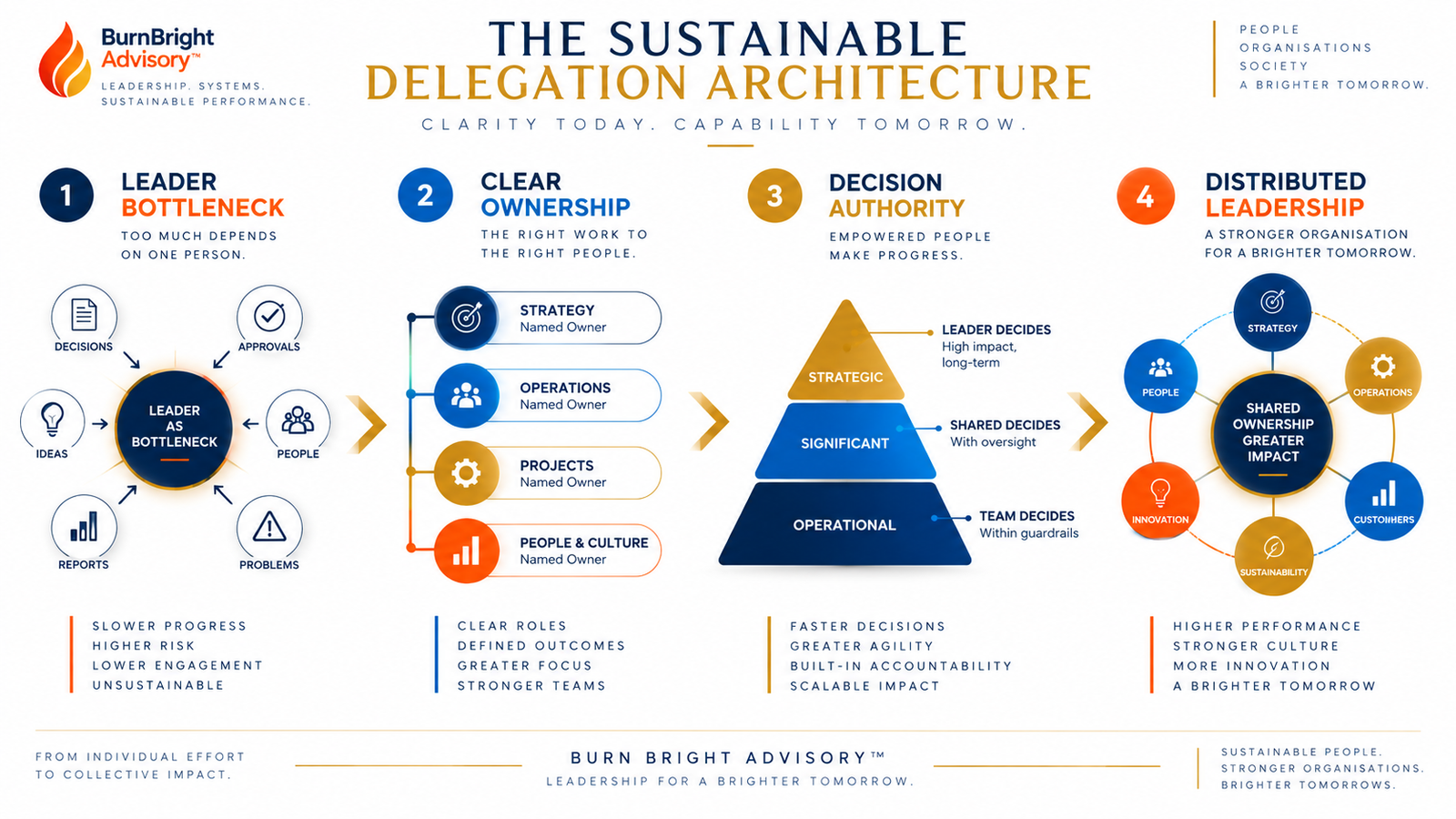
Overload is one of the recurring structural conditions behind leadership burnout. When responsibilities expand but decision authority and team capability do not expand with them, the leader becomes the organisation’s processing centre.
Everything flows upwards.
Everything waits.
Eventually, the leader becomes both overwhelmed and indispensable.
That is not sustainable leadership. It is a system design problem. This article explains how to redesign it. To understand the problem, it helps to see delegation as an operating system rather than a productivity technique.
Featured Snippet
Why Do Overwhelmed Managers Find Delegation So Difficult?
Delegation looks straightforward from the outside. Identify something another person can do. Assign it. Move on. Leadership does not work that neatly.
Overwhelmed managers often sit inside roles that have accumulated responsibilities over years. A temporary project becomes permanent. A vacancy creates additional duties. A struggling employee causes the manager to take work back. A new reporting requirement appears without an old one disappearing.
This is scope creep, one of the five root causes identified in the Burn Bright Not Out framework. Eventually, the leader is carrying responsibilities that were never deliberately designed into the role.
That matters because accumulated work develops accumulated assumptions.
“I’ve always handled that.”
“The CEO expects it from me.”
“Nobody else knows how.”
“I need to see it before it goes out.”
Some of these statements may be true. Many have simply never been tested. This is why telling an overwhelmed manager to “delegate more” is insufficient. It treats a structural problem as a behavioural weakness.
The wider evidence supports the need to look at workplace conditions. The World Health Organization defines burnout as resulting from chronic workplace stress that has not been successfully managed, with three dimensions: exhaustion, increased mental distance or cynicism towards work, and reduced professional efficacy.
That definition matters. Burnout is situated in the occupational context, so prevention cannot rely solely on making an individual leader more resilient. The work itself needs examining.
Deloitte’s research found that 70% of managers cited organisational barriers — including heavy workloads, workplace culture, policies and inadequate skills — as obstacles to supporting employee wellbeing. Only 42% said they felt completely empowered and capable of helping their organisations deliver on their wellbeing commitments.
Managers are therefore caught in an uncomfortable position. They are expected to support everybody else while operating inside systems that may be depleting their own capacity. Better delegation begins by diagnosing that system.
What Should Overwhelmed Managers Actually Delegate?
Start with a different question. Not: what can I get rid of? Ask: what genuinely requires me?
Those are very different questions. The first is driven by desperation. The second is driven by role clarity. An overwhelmed manager should divide work into four categories.
1 Own
These are responsibilities that genuinely require your role, judgement or accountability. Examples might include sensitive performance decisions, strategic direction, specific stakeholder relationships or decisions where you hold formal accountability.
2 Oversee
Someone else performs the work and may make many operational decisions, but you maintain defined checkpoints. The critical word is defined. Overseeing does not mean hovering.
3 Delegate
Another person owns the work and has sufficient authority to complete it within agreed parameters. You remain available for exceptions, not routine decisions.
4 Eliminate
Some work should not be delegated at all. It should stop. This category is frequently overlooked — overloaded organisations often move low-value activity from one busy person to another without asking whether the activity still needs to exist. That is workload redistribution, not workload redesign.
Before delegating, ask: if nobody currently did this task, would we deliberately introduce it today? If the answer is no, challenge its existence.
This connects directly to workload architecture: designing responsibilities around available capacity rather than assuming human capacity will endlessly stretch to accommodate additional work. Burn Bright’s wider approach is structural rather than motivational. Leaders cannot continually outwork expanding systems.
For leaders already struggling to distinguish temporary pressure from structural overload, the leadership burnout self-assessment can help identify where pressure is accumulating before redesign begins.
Why Does Delegation Sometimes Create More Work?
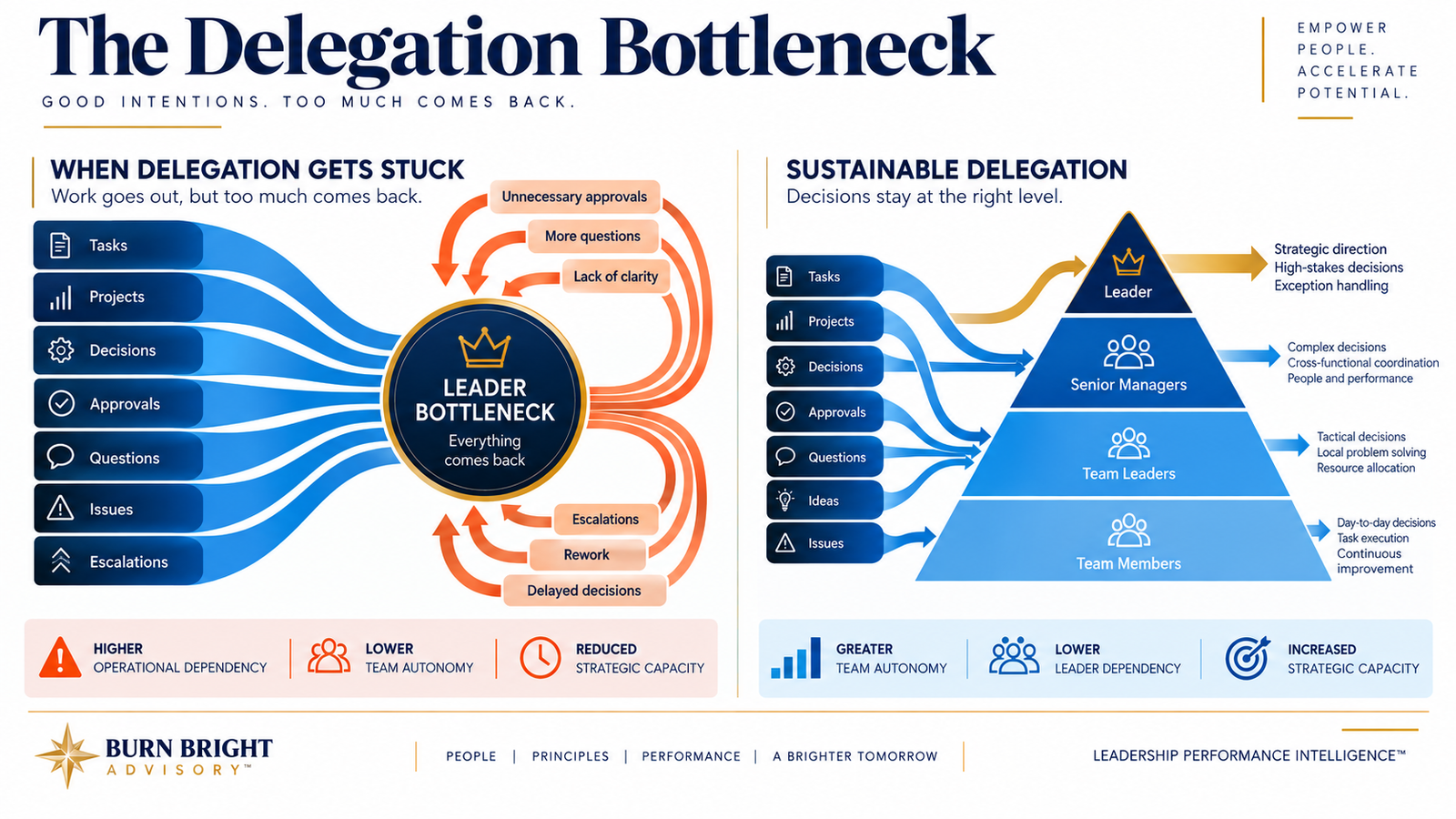
This is where many delegation attempts fail. The manager transfers activity without transferring authority.
Imagine you ask a team member to take responsibility for a monthly report. They gather the information. They analyse it. They write the report. Then they send it to you. You edit it. You question several figures. They revise it. You approve it. They distribute it.
Technically, you delegated the report. Operationally, you may still own it. Now multiply that pattern across ten responsibilities. You have created a layer of delegation administration on top of your existing leadership role.
The solution is to define decision authority at the point of delegation. For every significant delegated responsibility, establish four things:
- Outcome: What does successful completion look like?
- Authority: Which decisions can the person make without asking you?
- Boundaries: What conditions require escalation?
- Review: When will progress be reviewed?
This is where a RACI-style delegation framework becomes valuable. RACI distinguishes who is Responsible, Accountable, Consulted and Informed. The power is not in the acronym. The power is in forcing clarity.
A surprising amount of organisational overload exists because several people believe somebody else owns a decision — or because everyone believes the senior manager must approve it.
Gallup’s 2025 global workplace research found that managers experienced the largest decline in wellbeing among employee groups measured, reinforcing how much pressure is concentrated in management roles.
Deloitte also found that at least four in ten workers, managers and executives reported that they always or often felt exhausted or stressed. Among managers, 66% said they would seriously consider a job elsewhere if it offered better support for their wellbeing.
The implication is significant. Organisations cannot keep concentrating work and decisions around managers and then expect those managers to solve the resulting overload through personal resilience.
How Can Overwhelmed Managers Stop Reverse Delegation?
Reverse delegation happens when work moves down the organisation and then quietly travels back up.
You delegate a problem. The employee returns and asks, “What do you think I should do?” You answer. They return with another question. You answer again. Eventually, you are making the decisions while somebody else executes your instructions.
The task was delegated. The thinking was not.
This often happens because managers confuse support with rescue. When somebody brings you a problem, resist immediately taking ownership. Instead ask: what do you recommend?
That question changes the interaction. If they do not have a recommendation, ask them to return with two or three options. For more complex issues, ask: what decision do you believe needs to be made? Then: is this a decision you can make within your existing authority?
These questions build decision capability. They also reveal whether your delegation architecture is clear.
If capable employees continually seek approval, do not immediately assume they lack confidence. Look at the system. Have previous decisions been criticised? Does the culture punish reasonable mistakes? Do senior leaders regularly override delegated authority? Are employees told to “take ownership” but then required to obtain approval for every meaningful action?
That produces learned escalation. People discover that the safest organisational behaviour is to push decisions upwards. The result is decision overload at the top.
Sustainable leadership requires a different pattern. Create an escalation threshold. For example, a team member may make decisions independently unless the decision creates significant financial exposure, affects safeguarding or compliance, changes agreed strategy, creates substantial reputational risk, or crosses an agreed resource threshold. Everything else stays with them.
The exact boundaries depend on the role. The principle does not. Authority should sit as close as reasonably possible to the information required to make the decision. That reduces delay. It develops people. And it protects leadership capacity.
For a deeper examination of workload structures behind these patterns, the leadership burnout course explores the wider relationship between leadership systems, capacity and burnout.
Delegation vs Heroic Leadership: What Is the Difference?
Many organisations say they value delegation while quietly rewarding heroic leadership. The heroic leader is always available. They know every detail. They rescue failing projects. They answer messages late at night. They step into gaps. They solve problems personally.
For a while, this can look like exceptional leadership. Until the organisation starts depending on it.
| Heroic Leadership | Sustainable Delegation |
|---|---|
| Leader holds critical knowledge | Knowledge is distributed |
| Problems escalate upwards | Decisions sit at appropriate levels |
| Manager rescues work | Manager develops capability |
| Delegation transfers tasks | Delegation transfers ownership |
| Mistakes trigger tighter control | Mistakes trigger learning and calibration |
| Success depends on leader availability | Success depends on system capability |
| Overload is treated as commitment | Capacity is deliberately designed |
| Leader becomes indispensable | Team becomes increasingly autonomous |
The distinction matters because being indispensable can feel rewarding. People need you. Your expertise matters. You can solve problems quickly. But indispensability is not always evidence of effective leadership. Sometimes it is evidence of system dependency.
If routine work stops when you take a week’s leave, that is useful diagnostic information. If every decision waits for you, that is useful diagnostic information. If employees can perform tasks but cannot act without your approval, that is useful diagnostic information.
How Can Managers Build a Delegation System That Actually Works?
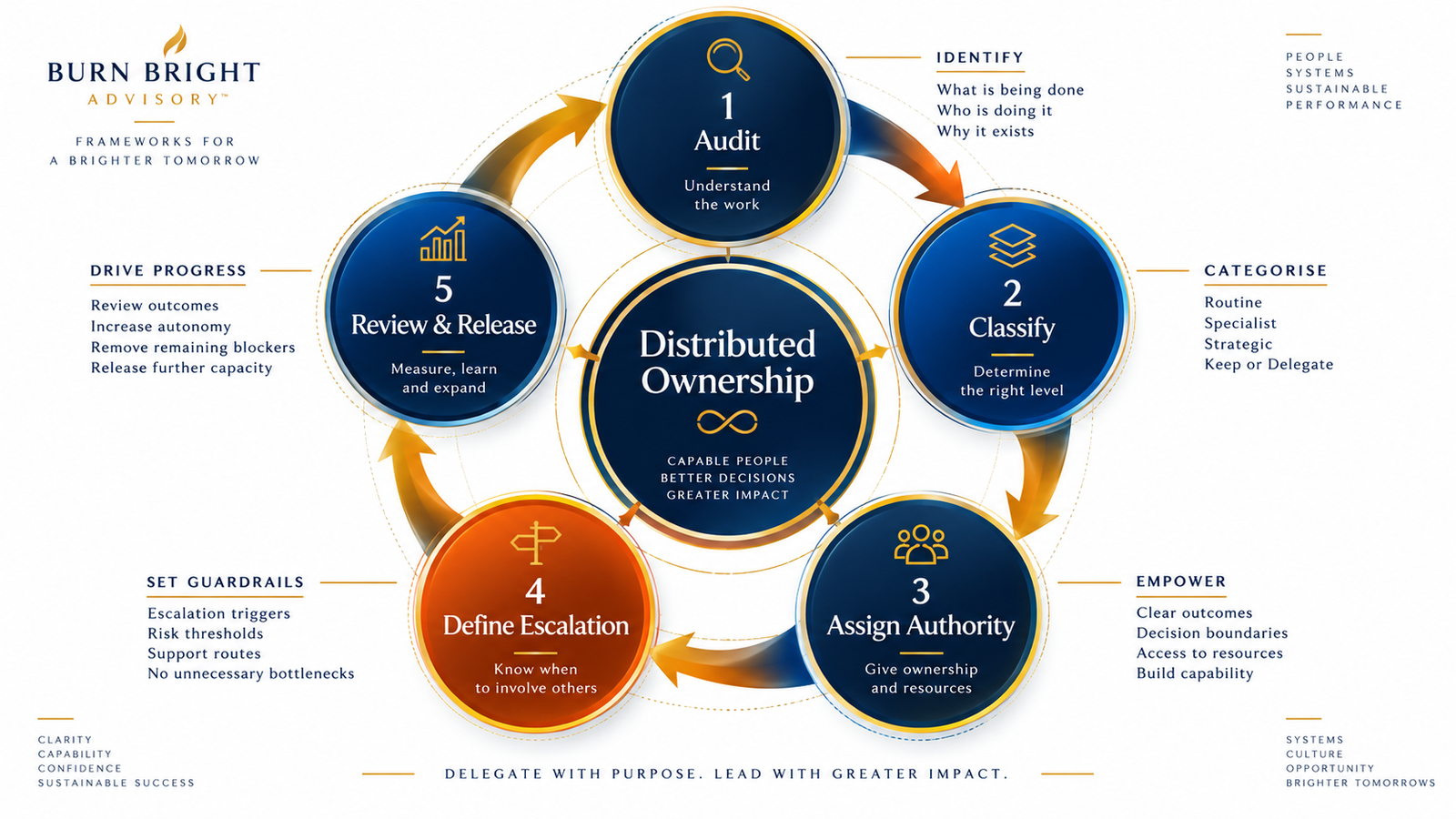
Effective delegation for overwhelmed managers needs to become architecture rather than an occasional response to pressure. A simple five-stage process can help.
1. Audit
List your recurring responsibilities. Do not use your job description — use your actual calendar, inbox, project list and recurring decisions. Reality matters more than the formal role.
2. Classify
Put each responsibility into Own, Oversee, Delegate or Eliminate. Be ruthless about the distinction.
3. Assign Authority
For delegated work, document what the person can decide independently. Do not leave authority implicit.
4. Establish Escalation Rules
Define the conditions under which work should return to you. Without escalation rules, everything can become an exception.
5. Review and Release
Early delegation may require closer review. That should reduce as capability grows. If your involvement never declines, delegation has stalled.
This is not abdication. You remain accountable for leadership. But accountability does not mean personally executing, reviewing and approving everything that happens within your area. The distinction is critical for overwhelmed leaders.
CIPD guidance on workplace stress also emphasises prevention and targeted management of excessive workplace pressures. Its 2025 reporting found that organisations investing in employee wellbeing reported benefits including higher engagement and lower sickness absence.
WHO guidance similarly identifies time pressure, lack of control, long working hours and poor work organisation as occupational stress and burnout risks, and recommends organisational interventions including workload reductions, schedule changes, improved communication and teamwork.
The pattern is consistent. Changing the conditions matters. That is why sustainable leadership strategies on the Burn Bright blog focus on structural redesign rather than simply asking exhausted leaders to tolerate more pressure.
What If You Are Already Too Overwhelmed to Delegate?
This is the paradox. Delegation requires capacity. The leaders who need it most often have the least capacity available to implement it.
Training somebody takes time.
Explaining context takes time.
Creating decision rules takes time.
Reviewing early work takes time.
So the overwhelmed leader delays delegation because doing the work personally feels quicker. Tomorrow’s capacity is sacrificed to survive today. The pattern repeats.
Breaking it requires treating delegation as an investment rather than an immediate efficiency gain.
Suppose a recurring responsibility takes you two hours each week. Properly transferring it might initially require four hours of documentation, training and review. Under pressure, four hours feels unaffordable. But keeping the responsibility costs approximately 100 leadership hours over the next year.
That is the calculation overwhelmed managers often miss. They evaluate delegation against today’s workload rather than future capacity.
There is also a second calculation. What does the organisation lose when senior people spend significant time completing work that could be owned elsewhere? Strategic thinking disappears. Coaching gets postponed. Improvement work stops. Difficult but important conversations are delayed. The leader becomes highly productive at the wrong level.
This is one reason protecting leadership capacity through a structured reset can matter when overload has already become severe.
Deloitte’s UK research provides wider context for the organisational cost of failing to address workplace conditions. Its 2024 research estimated that poor employee mental health costs UK employers £51 billion annually, while 63% of respondents reported experiencing at least one characteristic associated with burnout. It also estimated an average return of about £4.70 for every £1 employers invested in workforce mental health and wellbeing support.
The point is not that delegation alone solves burnout. It does not. The point is that organisations pay a substantial price when they ignore unsustainable work design.
What is the first thing an overwhelmed manager should delegate?
Start with recurring, relatively predictable work that does not require your unique authority or expertise. Choose something substantial enough to release meaningful capacity but clear enough for another person to own. Avoid beginning with a politically sensitive or high-risk responsibility simply because it is currently causing you stress.
How do I delegate when my team is already overloaded?
Do not simply push your overload downwards. Audit team capacity first. Delegation should redesign ownership, not transfer burnout. Some work may need to be stopped, automated, simplified, deferred or challenged upwards before responsibilities can be redistributed sustainably.
How can I delegate without losing control?
Replace constant involvement with explicit control points. Agree on the outcome, decision authority, boundaries, escalation conditions and review dates in advance. You do not need visibility into every action to maintain appropriate oversight. Good governance creates control without micromanagement.
Why does my team keep giving delegated work back to me?
Reverse delegation usually occurs when decision rights are unclear, employees lack confidence or organisational culture makes independent decisions feel risky. Ask team members to bring recommendations rather than problems alone, then examine whether your own behaviour unintentionally encourages unnecessary escalation.
Does delegation help prevent leadership burnout?
Delegation can reduce burnout risk when it genuinely redistributes workload and decision authority. Delegating tasks while retaining every approval can actually increase workload. Sustainable delegation is most effective when combined with broader workload architecture, realistic capacity and recovery.
What should a leader never delegate?
Leaders should retain responsibilities that genuinely require their formal accountability, unique judgement or specific relationship ownership. The exact responsibilities vary by role. The key is to distinguish between accountability that must remain with you and execution that can sit elsewhere.
Conclusion
Delegation for overwhelmed managers is not about becoming better at passing tasks to other people. It is about building a system that does not require the manager to remain at the centre of everything.
That means examining workload.
Clarifying ownership.
Distributing authority.
Defining escalation.
Developing team capability.
And eliminating work that no longer deserves anybody’s time.
The uncomfortable truth is that many overwhelmed managers have become organisational bottlenecks precisely because they are capable.
They solve problems.
So more problems come to them.
They rescue projects.
So people learn to wait for rescue.
They work longer.
So the organisation never has to confront the capacity problem.
Eventually, exceptional effort disguises poor design. That is where sustainable leadership has to break with heroic leadership. Burnout is a system failure. Better systems outperform more effort.
The aim is not to become a leader capable of carrying an ever-increasing load. It is to create an organisation where leadership effectiveness does not depend on one exhausted person holding everything together.
Take the Leadership Burnout Self-Assessment
If delegation feels impossible because everything depends on you, start by identifying where the structural pressure is coming from.
Free Leadership Intelligence
Get Weekly Leadership Insights
Join thousands of leaders receiving practical strategies on burnout prevention, workload design, and sustainable performance every week.