Quick Answer
Key Takeaways
- People construct meaning rather than passively receiving it — communicating a strategy clearly does not guarantee it has been understood, accepted or implemented consistently.
- Constructivism Intelligence™ is a performance capability, not simply collaborative leadership — it deliberately increases the quality of intelligence available for leadership judgement.
- Leaders who solve every problem can unintentionally become their organisation’s most expensive bottleneck; developing judgement in others builds lasting capability instead.
- Constructivism does not require consensus or abandoning authority — the strongest leaders know when to direct, inquire, facilitate, decide or create space for others to construct the answer.
- Three common traps block constructivist leadership: expert dependency, false participation, and reflection without action.
Constructivism Leadership: From Transmitting Answers to Building Understanding
Leadership has traditionally rewarded the person who appears to know.
The leader diagnoses the problem. The leader presents the strategy. The leader explains what needs to happen. Everyone else is expected to understand, align and execute.
That model can create speed. It can also create dependence.
Complex organisations operate differently. People encounter problems from different positions, hold different pieces of information and interpret the same situation through different professional experiences. A strategy communicated clearly by senior leadership may therefore be understood very differently by the people expected to implement it.
This is where constructivism leadership becomes important.
The Leadership Problem Hidden Inside “Clear Communication”
Imagine a senior leadership team announcing a major organisational change.
The presentation is excellent.
The strategy is explained.
The slides are polished.
Responsibilities are allocated.
Questions are invited.
Everyone leaves the meeting apparently clear about what happens next.
Three weeks later, however, implementation begins to fragment.
One department interprets the change as a cost-reduction programme. Another believes it is primarily about improving customer experience. A third sees it as a digital transformation initiative. Middle managers quietly reinterpret the strategy to fit existing priorities, while frontline employees continue working largely as before.
Leadership responds in a predictable way: “We need to communicate the strategy again.”
Perhaps. But communication may not be the real problem.
The organisation has received information. It has not necessarily constructed shared understanding.
That distinction matters.
Leaders frequently assume that because something has been explained, it has been understood; because it has been understood, it has been accepted; and because it has been accepted, people can translate it effectively into practice.

It recognises that every person interprets new information through existing experience, assumptions, professional knowledge and organisational context.
The finance director hears “transformation” differently from the school principal.
A clinical leader hears “efficiency” differently from a corporate operations director.
An entrepreneur hears “risk” differently from a public-service executive responsible for regulatory accountability.
Leadership therefore involves more than creating a message.
Featured Snippet
What Is Constructivism Leadership?
Constructivism is commonly associated with theories of learning in which people actively build knowledge through experience rather than simply absorbing information delivered by an authority.
Applied to leadership, the principle becomes particularly powerful.
A constructivist leader does not assume: “I have knowledge. My job is to transfer it to you.”
The stronger question is: “How do we create the conditions in which people can develop the understanding required to act intelligently?”
This changes the leader’s role. Instead of functioning only as an answer provider, the leader also becomes a:
- designer of learning conditions
- facilitator of productive dialogue
- challenger of assumptions
- connector of different perspectives
- creator of reflective space
- interpreter of evidence
- builder of collective understanding
- developer of other people’s judgement
This is the foundation of Constructivism Intelligence™ within the Burn Bright Leadership Intelligence Compass™.
Constructivism Intelligence™ is not simply collaborative leadership. Nor does it mean that every interpretation is equally useful or that leaders should avoid providing direction.
It is the capacity to understand how people develop meaning and knowledge—and to lead that process deliberately.
That makes it a performance capability. Because when people understand more deeply, they can usually make better decisions. When they can question assumptions safely, risks become easier to identify. When teams can examine different interpretations of the same problem, blind spots become more visible.
And when leaders develop thinking rather than merely prescribe actions, organisational capability becomes less dependent on individual authority.
Why Constructivism Matters to Leadership Performance
The traditional image of leadership places knowledge near the top of the hierarchy.
Senior people know.
Junior people learn.
Leaders decide.
Teams implement.
Experts explain.
Others follow.
Real organisations rarely operate so neatly.
The people closest to a problem may possess information senior leaders cannot see. Experienced employees may recognise patterns that formal reports overlook. New employees may question assumptions that long-serving colleagues have stopped noticing.
Customers, patients, students, citizens and employees each experience an organisation from a different vantage point. No single leader possesses all of those perspectives.
This creates one of the central challenges of contemporary leadership:
Constructivism Intelligence™ provides a way of responding to that tension. The objective is not to surrender leadership authority. It is to increase the quality of intelligence available to leadership.
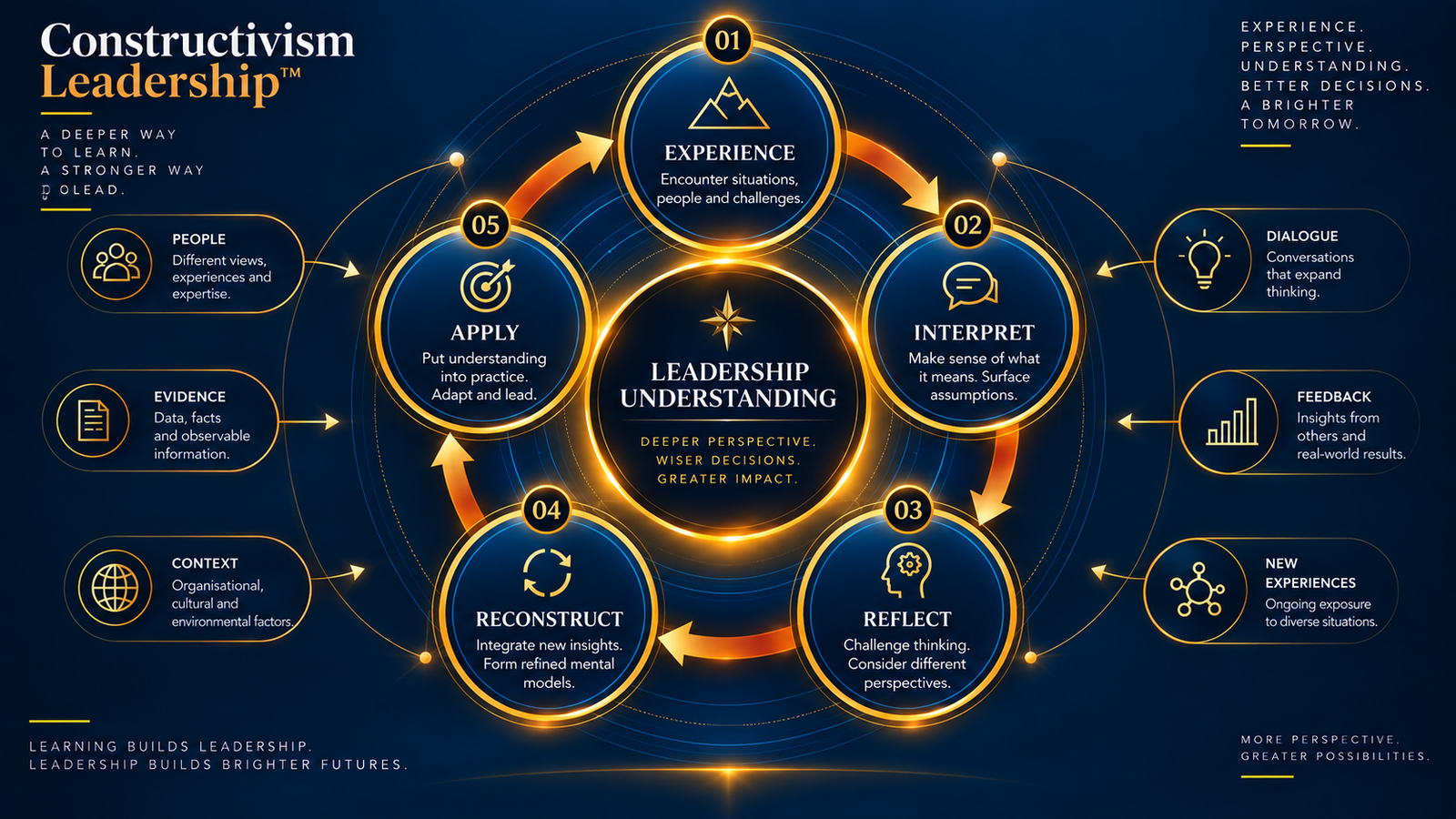
A leader with strong Constructivism Intelligence™ understands that leadership performance depends partly on the organisation’s ability to transform:
Experience → Reflection → Interpretation → Dialogue → Shared Understanding → Judgement → Action → New Experience
The final step matters. Action creates new experience. That experience generates new information. New information should influence future interpretation. Leadership learning therefore becomes a cycle rather than a one-time transfer of knowledge.
This is where Constructivism Intelligence™ connects directly with Reflective Practice Intelligence™, Knowledge Development Intelligence™ and Adaptability Intelligence™ within the Leadership Intelligence Compass™.
Constructivism helps people build meaning. Reflective Practice Intelligence™ helps them examine experience. Knowledge Development Intelligence™ helps organisations capture and extend what has been learned. Adaptability Intelligence™ helps leaders change behaviour when new understanding requires a different response.
Together, these capabilities create something considerably more valuable than a well-informed leader. They begin to create a learning leadership system.
The Difference Between Giving Answers and Developing Judgement
Consider two managers faced with the same situation. A team member approaches with a problem.
The first manager listens, identifies the solution and explains what the employee should do. The problem is resolved quickly.
The second manager listens and asks:
“What have you noticed?”
“What do you think is causing it?”
“What evidence supports that interpretation?”
“What alternatives have you considered?”
“What might we be missing?”
“What would you do if I weren’t available?”
The second conversation may take longer. But something different is being produced.
This distinction becomes increasingly important as leaders take responsibility for larger teams and more complex organisations.
A leader who solves every problem can unintentionally become the organisation’s most expensive bottleneck. Every difficult decision moves upward. Every uncertainty waits for approval. Employees become skilled at escalating problems rather than resolving them.
The leader becomes overloaded precisely because the organisation has learned to depend on the leader’s thinking.
Constructivism leadership reverses this dynamic. The question changes from “How can I solve this problem?” to “How can this problem increase our collective capacity to solve future problems?”
That is a fundamentally different conception of leadership development. And it is one of the foundations of Leadership Performance Intelligence™.
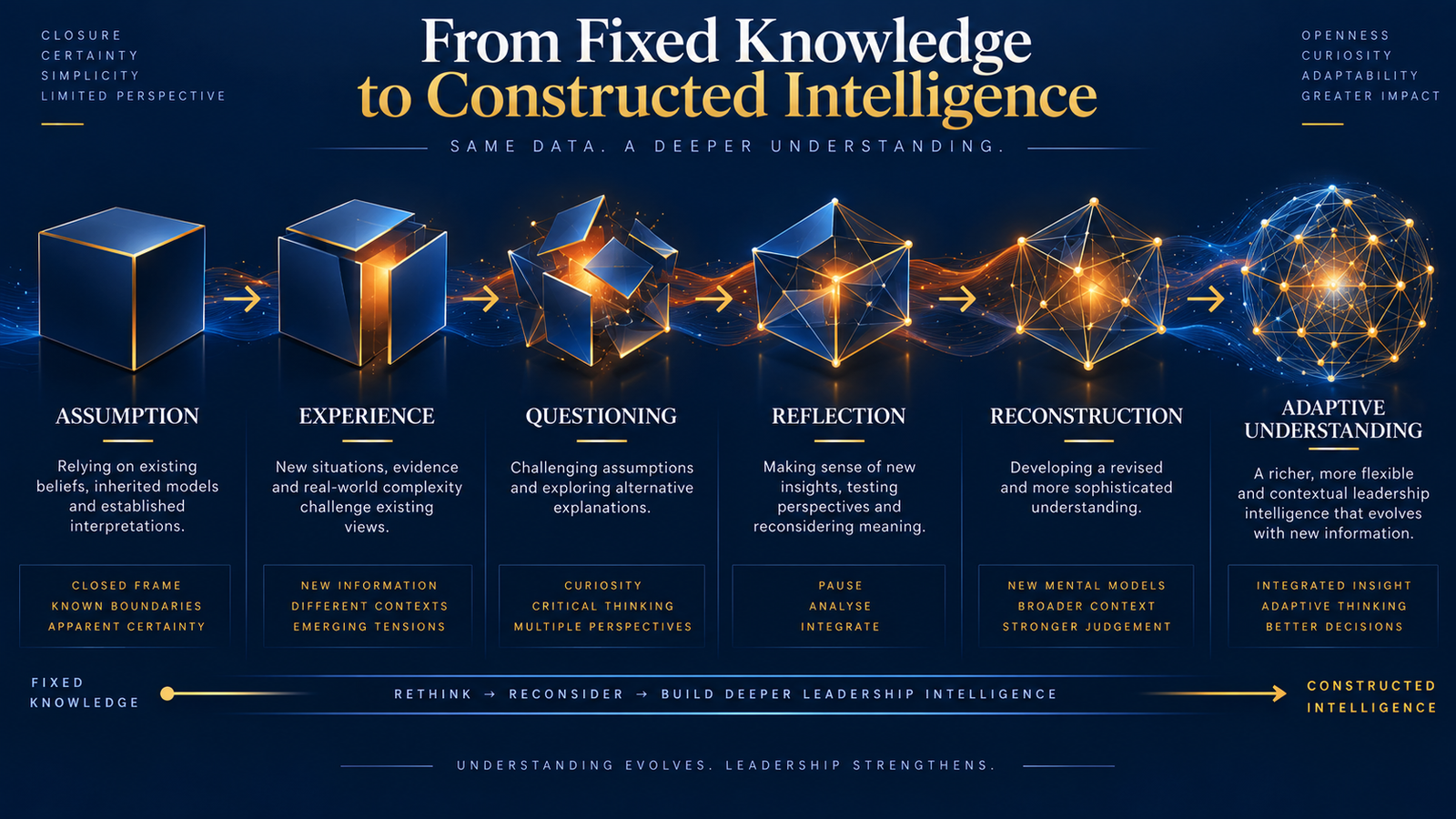
Constructivism Is Not Consensus Leadership
There is an important boundary.
Constructivism leadership does not mean every decision requires consensus.
Some decisions are urgent.
Some involve confidential information.
Some require specialist expertise.
Some sit explicitly within a leader’s accountability.
And in a crisis, prolonged collective interpretation can become dangerous.
The purpose of Constructivism Intelligence™ is therefore not endless discussion. It is better construction of understanding before action where the context allows—and intelligent learning after action where it does not.
A clinically urgent healthcare decision, for example, may require immediate professional authority. The constructivist opportunity may come afterwards through structured reflection: What happened? What did we notice? Which assumptions shaped the response? What should the team learn?
A school leader may ultimately need to make a difficult staffing decision personally. Constructivism does not remove that responsibility. It can, however, improve how the wider organisation examines the conditions, evidence and learning surrounding workforce decisions.
A chief executive may have to choose a strategic direction without unanimous agreement. The leadership challenge is not to manufacture consensus but to ensure that disagreement has generated useful intelligence before the decision is made.
Authority and constructivism are therefore not opposites.
That is leadership judgement. And it is precisely why Constructivism Intelligence™ belongs within a broader Leadership Intelligence Compass™ rather than functioning as an isolated leadership technique.
How Constructivism Intelligence™ Works in Practice
From Leadership Style to Leadership System
Constructivism leadership becomes valuable when it moves beyond a conversational technique and becomes part of how an organisation operates.
Asking better questions matters. Listening matters. Reflection matters. But isolated behaviours will have limited impact if the surrounding leadership system continues to reward certainty, discourage challenge and push every important decision upwards.
Constructivism Intelligence™ therefore requires leaders to think about the conditions under which understanding is created.
At Burn Bright Advisory™, this can be understood through five interconnected leadership practices:
- Surface existing understanding
- Introduce evidence and alternative perspectives
- Create productive dialogue
- Convert insight into judgement and action
- Reflect on outcomes and reconstruct understanding
Together, these practices create a continuous cycle of leadership learning. The objective is not discussion for its own sake. The objective is better judgement, stronger capability and more intelligent performance.
1. Surface Existing Understanding
Every leadership conversation begins before anyone speaks.
People enter meetings carrying assumptions. They have previous experiences, professional beliefs, interpretations of organisational history, relationships with colleagues and expectations about what will happen next.
Those assumptions influence how new information is interpreted.
A leader introducing organisational change, for example, may believe they are discussing future strategy. Employees may hear something entirely different. They may hear:
“jobs could disappear.”
“another initiative that will eventually be abandoned.”
“leadership has already made the decision.”
“our previous work is being criticised.”
“this will increase my workload.”
None of these interpretations necessarily appears in the strategy document. Yet they can determine whether the strategy succeeds.
Constructivism Intelligence™ therefore begins by surfacing existing understanding rather than assuming a blank page.
Leaders can ask: what do we currently believe about this issue? What experiences have shaped that belief? Where do our interpretations differ? What are we assuming to be true? What information might change our view?
These questions create a baseline. Without that baseline, leaders risk placing new information on top of old assumptions without understanding how the two interact.
2. Introduce Evidence and Alternative Perspectives
Constructivism should never become an excuse for evidence-free leadership.
People construct understanding, but that does not mean every interpretation is equally accurate. Strong constructivist leadership deliberately brings evidence into the learning process. That evidence might include:
- performance data
- employee experience
- customer or service-user feedback
- professional research
- operational observations
- financial information
- benchmarking
- stakeholder perspectives
- lessons from previous decisions
The leader’s role is partly to help people test what they believe against what the available evidence suggests.
Imagine a leadership team convinced that declining performance results from employees resisting change. A constructivist process might examine employee interviews, workflow data and implementation timelines.
A different explanation may emerge. Perhaps employees are not resistant. Perhaps the new process requires seven approvals where the previous system required three.
What initially looked like an attitude problem could actually be a system-design problem.
This illustrates an important feature of Leadership Performance Intelligence™:
3. Create Productive Dialogue
Information becomes more useful when people can interrogate it together.
But productive dialogue is different from simply giving everyone an opportunity to speak. Poorly facilitated discussion can reinforce hierarchy, amplify dominant personalities and produce superficial agreement.
The leader must create conditions in which perspectives can be examined rather than merely announced. This requires Emotional Intelligence™, Professionalism Intelligence™ and Ethics Intelligence™ alongside Constructivism Intelligence™.
People need enough psychological and professional safety to say:
“I don’t think that assumption is correct.”
“My experience suggests something different.”
“I don’t understand why we’re doing this.”
“The data appears to contradict our current strategy.”
“We tried something similar previously and it failed.”
These statements can be extraordinarily valuable. They can also feel threatening to leaders who equate authority with being right.
This is where constructivism becomes a leadership discipline. The leader must be capable of hearing information that disrupts their existing interpretation without automatically defending their position.
That does not require agreement. It requires intellectual openness.
The Constructivism Intelligence™ Cycle
A practical way to understand the process is through a repeating cycle:
Experience → Inquiry → Evidence → Dialogue → Meaning → Judgement → Action → Reflection
Each stage contributes something different. Experience provides the raw material. Inquiry prevents premature conclusions. Evidence tests assumptions. Dialogue introduces multiple perspectives. Meaning connects information to context. Judgement determines what should be done. Action tests that judgement in reality. Reflection converts the outcome into learning.
The cycle then begins again.
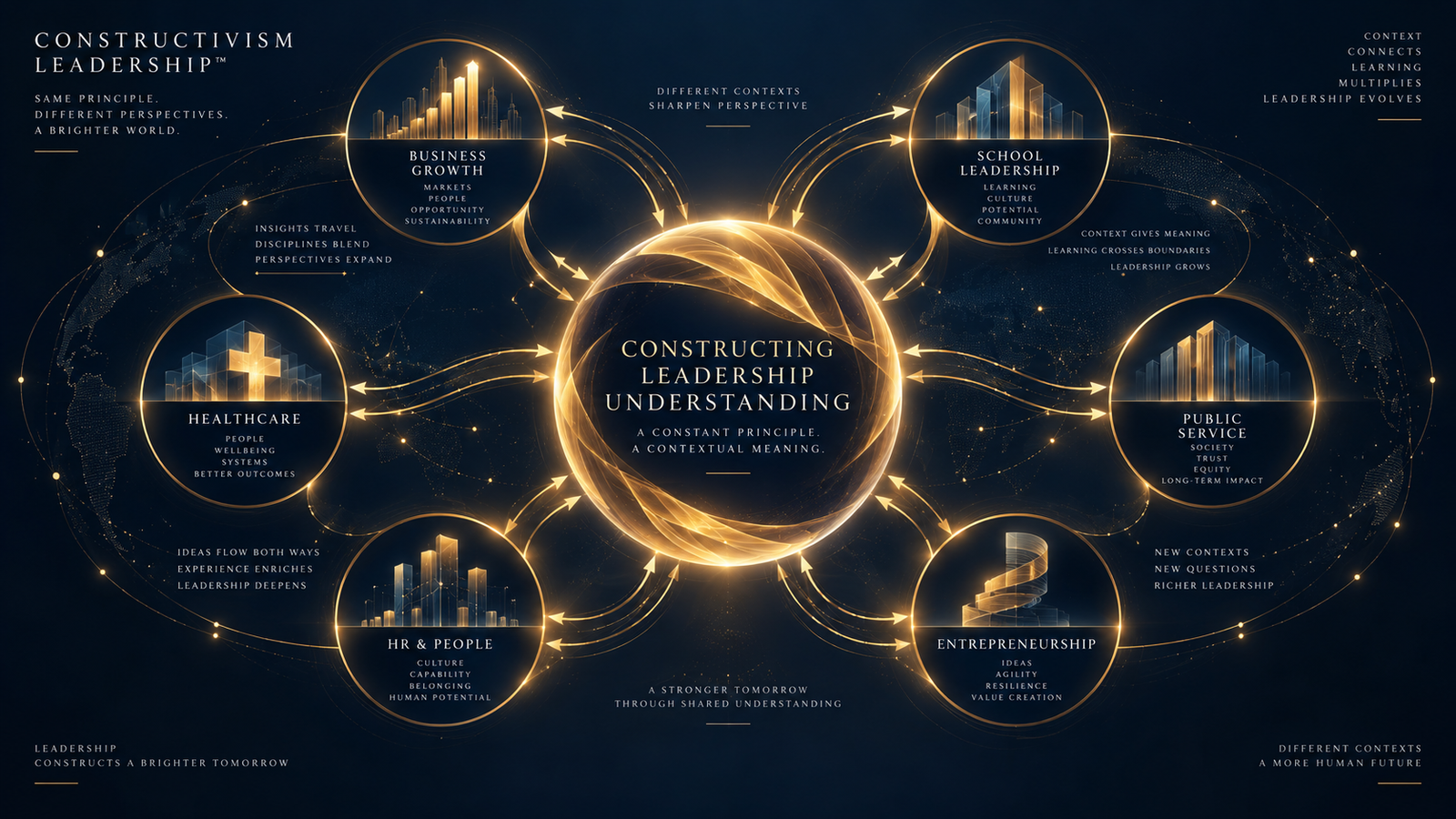
The strength of this model is that it rejects the assumption that leadership knowledge is ever completely finished.
Organisations change.
Markets change.
Technology changes.
Communities change.
Employees change.
Evidence changes.
What constituted good judgement five years ago may not constitute good judgement today.
Constructivism Intelligence™ therefore creates a disciplined form of intellectual adaptability. The leader can hold a position strongly enough to act while remaining sufficiently open to reconstruct that position when evidence changes.
The Three Leadership Traps That Block Constructivism
Several leadership habits can prevent collective understanding from developing.
Constructivism Leadership Across Sectors
One of the strengths of Constructivism Intelligence™ is its relevance across very different leadership environments. The context changes. The underlying leadership challenge remains remarkably consistent:
Business Growth Intelligence™
In business, leaders frequently operate with incomplete information. Customer behaviour changes. Competitors emerge. Technologies disrupt established models. Strategic assumptions can become outdated quickly.
A traditional leadership team may respond by concentrating decision-making at the top. A constructivist leadership team deliberately expands its sources of intelligence: sales teams contribute what they are hearing from customers, operations identifies implementation constraints, finance tests economic assumptions, frontline employees identify friction invisible in executive dashboards, and customers provide evidence about actual rather than assumed value.
The chief executive remains accountable for strategy, but strategy is constructed from a richer intelligence base. For Business Growth Intelligence™, this matters because sustainable growth rarely comes from senior leaders simply having more ideas — it comes from organisations becoming better at recognising, interpreting and acting upon useful information.
School Leadership Intelligence™
Constructivism has particular relevance in education because learning sits at the centre of the institution itself. Yet schools can still operate through highly transmissive leadership models: senior leaders identify the improvement priority, middle leaders receive instructions, teachers implement programmes, data is collected, and when outcomes disappoint, another initiative begins.
Constructivist school leadership asks different questions. What are teachers noticing in classrooms? What does student work tell us? How are different teachers interpreting the same instructional challenge? What assumptions are shaping current practice? What happens when professional knowledge is tested against classroom evidence?
Instead of professional development functioning primarily as information delivery, it becomes structured professional inquiry. Teachers become contributors to organisational knowledge rather than simply recipients of leadership direction — strengthening instructional leadership rather than weakening it.
Healthcare Leadership Intelligence™
Healthcare demonstrates why constructivism must be balanced carefully with expertise and accountability. Clinical standards cannot become matters of personal interpretation — evidence, regulation and professional competence remain essential.
Yet complex healthcare environments also depend heavily on distributed knowledge. A physician sees one part of the patient journey. A nurse may see another. Pharmacists, therapists, administrators and patients each hold information that can affect understanding. A leader who creates conditions where those perspectives can be integrated improves the team’s collective intelligence.
This is particularly important when reviewing incidents or near misses. A punitive question asks “Who made the mistake?” A constructivist question asks “What combination of decisions, assumptions, conditions and system factors produced this outcome, and what must we learn from it?” Individual accountability may still be necessary, but accountability alone does not create organisational learning. Constructivism Intelligence™ helps transform experience into safer future practice.
Public Service Leadership Intelligence™
Public-service leaders operate within environments containing competing legitimate perspectives. Policy makers, professionals, communities, elected representatives and service users may understand the same problem differently.
Constructivism does not require pretending those differences can always be resolved. Instead, it creates a disciplined process for understanding them: what does the evidence show, how is the issue experienced by different groups, which assumptions are shaping policy, where do interpretations conflict, and which trade-offs cannot be eliminated?
This improves the quality of public leadership because complex social problems rarely have purely technical answers — they require judgement informed by evidence, context and multiple perspectives.
HR & People Leadership Intelligence™
People leaders often encounter organisational problems first as labels: “low engagement,” “resistance,” “poor performance,” “culture problem,” “communication issue.”
Constructivism Intelligence™ encourages HR leaders to interrogate those labels before designing solutions. What does “resistance” mean in this context? What are employees actually resisting? What experiences shaped that response? Is the problem motivational, structural, relational or procedural?
Different constructions of the problem produce different interventions. A leader who misdiagnoses workload overload as poor engagement may introduce recognition initiatives when the actual requirement is workload redesign. Understanding therefore comes before intervention.
Entrepreneur Performance Intelligence™
Entrepreneurs face a distinctive constructivist challenge because their original interpretation of the opportunity can become emotionally attached to their identity. The business began with their idea. They understood the problem. They developed the solution.
That conviction may have been essential during the company’s early stages. Growth eventually requires a different capability: customers challenge assumptions, employees bring expertise the founder does not possess, and evidence may contradict the original business model.
The entrepreneur must become capable of reconstructing their understanding without interpreting every change as a rejection of the original vision. Constructivism Intelligence™ therefore becomes part of Entrepreneur Performance Intelligence™. The question shifts from “How do I make everyone understand my vision?” to “How do we keep learning what this organisation needs to become?” That shift can mark the difference between founder-dependent growth and sustainable organisational development.
Constructivism Intelligence™ and Leadership Capacity™
There is another important consequence. Constructivist leadership can increase Leadership Capacity™.
When leaders habitually provide answers, organisational thinking becomes concentrated around them. Questions accumulate. Approvals accumulate. Decisions accumulate. The leader’s workload expands.
This pattern is closely related to the wider leadership sustainability problem: organisations can unintentionally design roles that depend on individual heroics rather than sustainable systems.
Constructivism offers part of the alternative. Developing other people’s judgement distributes cognitive capability. A manager who teaches ten people how to think through recurring problems reduces future dependency. A leader who builds reflective practice into team routines creates learning without personally facilitating every insight. A senior team that makes assumptions visible can identify risks before they become executive crises.
Constructivism Intelligence™ therefore connects directly with Leadership Sustainability™ and Leadership Workload™.
A Practical Constructivism Intelligence™ Conversation
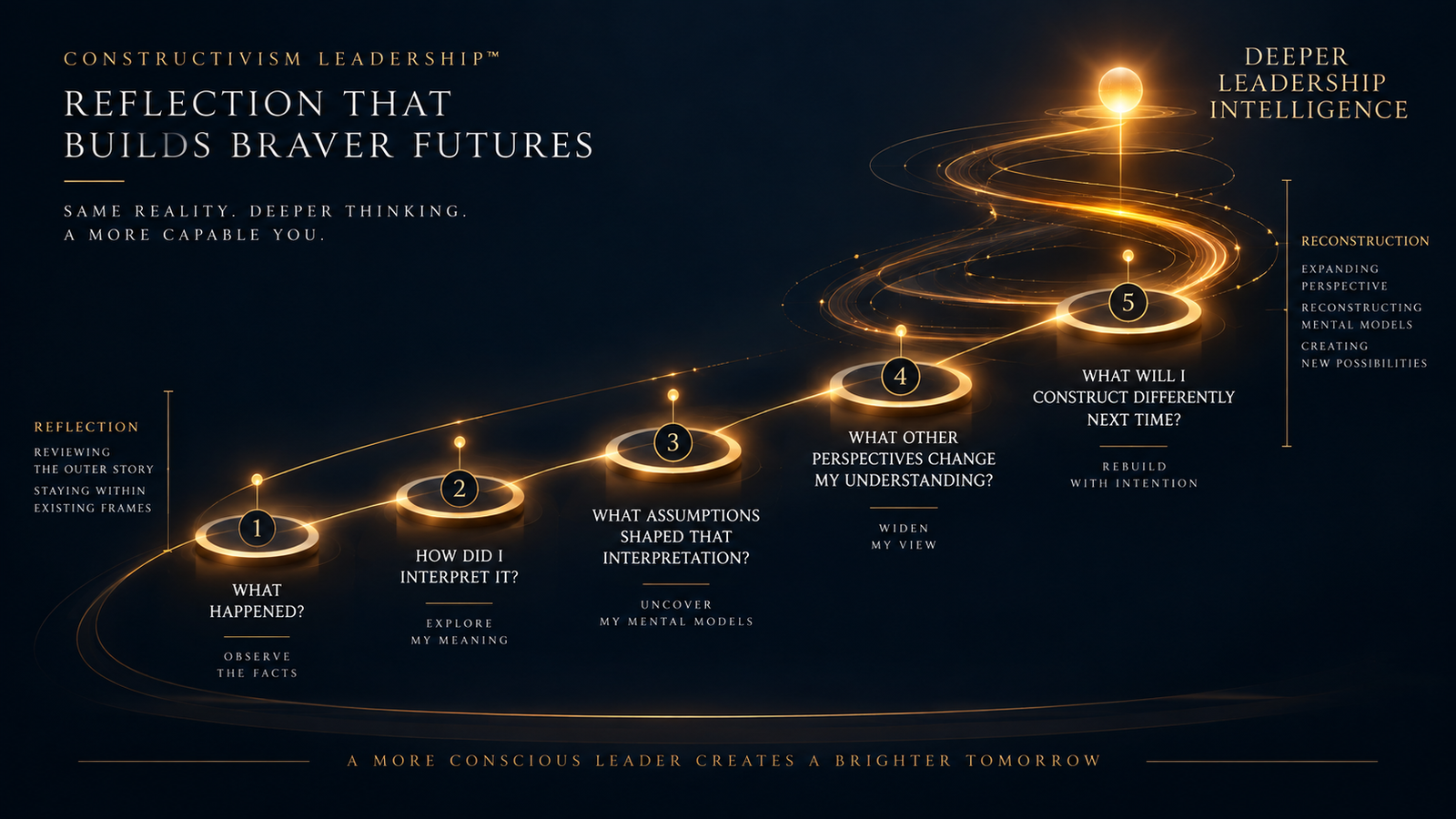
Leaders can begin with a simple five-question sequence. When someone brings you a significant problem, resist the immediate urge to solve it. Ask:
- What are you seeing? Begin with observation.
- How are you interpreting it? Separate events from the meaning attached to them.
- What evidence supports or challenges that interpretation? Test the emerging explanation.
- What other explanations or perspectives should we consider? Introduce cognitive flexibility.
- Based on what we now understand, what do you think we should do? Convert learning into judgement.
These questions are deceptively simple. Used consistently, however, they change the relationship between leader and employee.
The leader stops being merely the destination for difficult problems. They become a developer of thinking.
And that is the deeper purpose of Constructivism Intelligence™. Leadership should not simply increase the number of people who know what the leader thinks. It should increase the number of people capable of thinking intelligently for themselves while contributing to shared organisational purpose.
That is how individual leadership begins to become collective capability.
Turning Constructivism Intelligence™ Into Leadership Practice
Constructivism Intelligence™ becomes meaningful when leaders turn the framework back on themselves.
It is relatively easy to agree that people should think independently, challenge assumptions and contribute their knowledge. It is harder to examine whether our own leadership behaviour actually allows that to happen.
Consider what occurs when somebody disagrees with you. Do you become curious—or begin constructing your rebuttal? When an employee brings you a problem, do you develop their thinking—or solve it because doing so is faster? When a project fails, do you investigate the assumptions and conditions that produced the outcome—or look immediately for the person responsible? When evidence contradicts a decision you previously championed, can you reconstruct your position without experiencing the change as a loss of authority?
These are not simply questions about communication style. They reveal something deeper about how a leader relates to knowledge. And that relationship matters because leaders teach organisations how knowledge should be handled.
If leaders reward certainty, people learn to hide uncertainty.
If leaders punish disagreement, people learn to manufacture agreement.
If leaders solve every difficult problem, people learn to escalate rather than think.
If leaders demonstrate curiosity, disciplined reflection and willingness to revise their interpretation, they create permission for others to do the same.
This is why Constructivism Intelligence™ is not primarily about asking more questions. It is about creating an environment in which learning can influence leadership.
A Constructivism Intelligence™ Self-Reflection Framework
Leaders can begin assessing their current practice across five dimensions.
Dimension 1 Inquiry
Do I seek to understand before reaching conclusions? Strong inquiry means resisting premature certainty. It involves distinguishing what you know from what you assume, and asking questions that genuinely have the possibility of changing your interpretation.
A leader may appear curious while only asking questions designed to confirm an existing conclusion — that is not inquiry. Constructive inquiry contains intellectual risk: the answer might require the leader to reconsider what they currently believe.
Dimension 2 Perspective
Whose interpretation is influencing the decision—and whose is absent? Leadership teams can easily become echo chambers. Similar professional backgrounds, organisational histories and positions of authority can produce similar interpretations.
Constructivism Intelligence™ deliberately seeks relevant perspectives without assuming that more perspectives automatically create better decisions. The question is not “how many people have we consulted?” It is “which perspectives could materially improve our understanding?”
Dimension 3 Evidence
What evidence would cause us to reconsider our current view? This is one of the most powerful questions available to a leadership team. If the answer is “nothing,” the organisation may no longer be examining a proposition — it may be defending a belief.
Evidence-informed leadership requires leaders to establish what they would expect to observe if their interpretation were correct—and what evidence might indicate that it is wrong.
Dimension 4 Reflection
How systematically do we learn from experience? Many organisations move quickly from one project, crisis or strategic cycle to another. Experience accumulates. Learning does not necessarily accumulate with it.
Reflective Practice Intelligence™ converts experience into insight by creating structured opportunities to examine what happened and why. Without reflection, organisations can repeat the same mistakes under different project names.
Dimension 5 Reconstruction
Can we change our understanding when circumstances change? This may be the most important test. Leadership maturity is not demonstrated by never changing your mind — it is demonstrated by knowing when your mind should change and why.
Reconstruction means integrating new evidence without abandoning standards, purpose or accountability. It is the point where Constructivism Intelligence™ meets Adaptability Intelligence™.
The Benefits of Strong Constructivism Intelligence™
When embedded carefully, constructivist leadership can strengthen several dimensions of organisational performance.
Better Decision Quality
Complex decisions improve when relevant knowledge can travel across hierarchy. Senior leaders may possess strategic context, frontline employees may possess operational reality, specialists may possess technical knowledge, and customers or service users may possess experiential knowledge. Constructivism Intelligence™ creates mechanisms through which these different forms of knowledge can inform judgement. The leader still decides where accountability requires it, but the decision is less likely to be based on an unnecessarily narrow picture of reality.
Stronger Leadership Capacity™
When people repeatedly participate in disciplined problem-solving, they develop greater confidence and competence in exercising judgement. This expands Leadership Capacity™: capability begins to exist throughout the organisation rather than only inside formal leadership positions — which matters for succession, resilience and organisational growth.
Greater Adaptability
Adaptive organisations must be able to notice when reality no longer matches their assumptions. Constructivism Intelligence™ makes assumptions discussable, allowing teams to reconstruct their understanding before outdated thinking becomes embedded failure.
Deeper Ownership
People are generally better positioned to implement decisions when they understand the reasoning, evidence and trade-offs behind them. This is not because participation guarantees agreement — it does not, and people can understand a decision and still dislike it. But understanding reduces the gap between receiving an instruction and knowing how to interpret that instruction when circumstances change.
More Sustainable Leadership
Distributed judgement also has workload implications. Leadership sustainability is difficult when every ambiguity, decision and problem requires senior intervention. Developing the thinking capacity of others can reduce unnecessary dependency. This connects Constructivism Intelligence™ with Leadership Sustainability™, Leadership Capacity™ and Leadership Workload™.
The Risks Leaders Must Manage
Constructivism leadership also carries risks when poorly applied.
The first is decision paralysis. If leaders interpret inclusion as a requirement to consult everyone about everything, organisations slow down. People become frustrated and accountability becomes unclear.
The second is false equivalence. Different perspectives deserve consideration, but expertise still matters. Evidence still matters. Professional standards still matter. A constructivist process should improve judgement—not replace expertise with opinion.
The third is leadership avoidance. Some difficult decisions belong to the leader. Inviting endless discussion can become a sophisticated way of avoiding responsibility.
The fourth is consultation fatigue. Employees quickly become cynical when organisations repeatedly ask for input without explaining what happened to it.
The fifth is psychological unsafety. A leader may ask for challenge while behaving defensively when challenge arrives. Teams learn from behaviour faster than they learn from leadership statements.
The practical principle is therefore:
Seven Actions Leaders Can Take Now
Leaders do not need to redesign the entire organisation to begin developing Constructivism Intelligence™. Start with everyday leadership behaviour.
1. Ask before answering
When somebody brings you a non-urgent problem, ask for their interpretation before offering yours.
2. Separate observation from interpretation
Encourage teams to distinguish “what happened” from “what we think it means.”
3. Make assumptions visible
During important decisions, explicitly ask: “What are we assuming?”
4. Search for disconfirming evidence
Ask what evidence would suggest that the preferred strategy is wrong.
5. Clarify decision rights
Tell people whether they are being informed, consulted, involved in co-construction or given authority to decide.
6. Build reflection into work
Do not reserve reflection for annual reviews. Use short structured reviews after significant decisions, projects and incidents.
7. Track what changes
If reflection identifies a lesson, assign ownership for converting that lesson into changed behaviour, process or policy.
These actions appear modest. Their cumulative effect can be significant. They move the organisation from a culture in which knowledge is transmitted downward towards one in which intelligence can move in multiple directions.
Reflection Questions
- When people bring me problems, do I usually provide answers or develop their judgement?
- How comfortable am I when someone presents evidence that contradicts my position?
- Which voices influence important decisions in my organisation?
- Which relevant voices are routinely absent?
- Do employees know when their input can genuinely influence a decision?
- What assumptions currently underpin our most important strategic priorities?
- When did we last change an important decision because new evidence emerged?
- How effectively do we convert experience into organisational learning?
- Where has dependence on senior leadership become a constraint on performance?
- What could I stop answering personally so that somebody else can develop the capacity to answer it?
Constructivism Intelligence™ as Part of the Leadership Intelligence Compass™
No leadership capability operates independently.
Constructivism Intelligence™ becomes significantly more powerful when understood alongside the other domains of the Leadership Intelligence Compass™.
It needs Professionalism Intelligence™ because productive inquiry requires standards, role clarity and responsible behaviour. It needs Ethics Intelligence™ because leaders influence whose knowledge is heard, whose experience is valued and how power operates within dialogue. It needs Emotional Intelligence™ because disagreement, uncertainty and challenge carry emotional as well as intellectual consequences.
It needs Reflective Practice Intelligence™ because experience does not automatically become learning. It needs Knowledge Development Intelligence™ because useful learning must be captured, transferred and extended. It needs Adaptability Intelligence™ because reconstructed understanding eventually has to produce changed action.
And it connects to Leadership Sustainability™ because leaders who build capability around themselves reduce unnecessary organisational dependence on their own finite capacity.
This interconnectedness is central to Leadership Performance Intelligence™. Leadership performance is rarely determined by one isolated competence. It emerges from the interaction between multiple forms of intelligence, the context in which leadership occurs and the leader’s capacity to recognise which capability the situation requires.
Conclusion: The Leader’s Job Is Not to Be the Final Source of Intelligence
For much of the history of management, authority and knowledge have been closely connected. The leader was expected to know.
That expectation has not disappeared. Leaders still require expertise, judgement and the courage to make decisions. But complexity changes what leadership knowledge must look like.
No individual can see every part of a modern organisation.
No executive possesses every form of expertise required by their strategy.
No school leader experiences the classroom exactly as every teacher or student does.
No healthcare executive sees patient care from every professional perspective.
No entrepreneur can indefinitely remain the organisation’s only meaningful source of judgement.
Leadership therefore needs a more sophisticated relationship with knowing.
That is the significance of Constructivism Intelligence™. It transforms leadership from the transmission of certainty into the disciplined construction of understanding.
It asks leaders to remain decisive without becoming intellectually closed. To possess expertise without creating dependency. To invite challenge without surrendering accountability. To learn without becoming directionless. And to build organisations in which knowledge becomes collective capability.
The question for leaders is therefore not simply “Do my people understand what I have told them?”
A more powerful question is: “What are we becoming capable of understanding together?”
That question changes the purpose of leadership development, and it moves leadership closer to the central ambition of Leadership Performance Intelligence™: creating leaders and leadership systems capable of sustaining intelligent performance as circumstances change.
When leaders become the default destination for every difficult question, something predictable happens: people escalate rather than think, decisions move upwards, leadership workload increases, organisational capability remains concentrated, and eventually the leader becomes the bottleneck.
Constructivism Intelligence™ offers a different model. It starts from the principle that people do not simply receive organisational knowledge. They construct understanding through experience, evidence, dialogue, reflection and interaction with others.
For leaders, this changes the question. Instead of “How do I give my team the answer?” ask “How do I help them develop the judgement required to reach stronger answers?”
That does not mean abandoning authority. It does not mean every decision becomes democratic. And it certainly does not mean expertise stops mattering. It means knowing when to direct, when to inquire, when to challenge, when to facilitate and when to decide.
A useful question for your next leadership meeting: what are we currently assuming to be true—and what evidence would cause us to reconsider it? The quality of that conversation may tell you more about your leadership culture than another engagement survey ever could.
Frequently Asked Questions
What is constructivism leadership?
Constructivism leadership is an approach that recognises that people actively construct understanding through experience, evidence, dialogue and reflection. Rather than relying exclusively on leaders to provide answers, it develops conditions in which individuals and teams can build shared understanding and stronger judgement.
What is Constructivism Intelligence™?
Within Burn Bright Advisory’s Leadership Intelligence Compass™, Constructivism Intelligence™ describes a leader’s capacity to create environments where people question assumptions, interpret evidence, exchange perspectives and construct knowledge that improves judgement and performance.
How is constructivist leadership different from collaborative leadership?
Collaboration focuses primarily on people working together. Constructivism focuses specifically on how understanding and knowledge are developed. Collaboration can support constructivism, but a team can collaborate extensively while never questioning its shared assumptions.
Does constructivism mean leaders should stop giving answers?
No. Leaders should provide direction or answers when expertise, urgency or accountability requires them. The capability lies in recognising when providing an answer is appropriate and when developing somebody else’s thinking creates greater long-term value.
Does constructivism leadership require consensus?
No. Shared understanding and unanimous agreement are different things. Leaders can deliberately explore different perspectives and still make a decision that some stakeholders oppose.
How does Constructivism Intelligence™ improve decision-making?
It helps leaders expose assumptions, incorporate relevant perspectives, test interpretations against evidence and learn from previous decisions. This can provide a stronger intelligence base for leadership judgement.
What is the relationship between constructivism and reflective leadership?
Constructivism concerns how understanding is constructed. Reflective Practice Intelligence™ helps leaders examine experience so that it can contribute to that construction. Reflection therefore forms an important part of the constructivist learning cycle.
Can constructivism leadership reduce leadership workload?
Potentially. Leaders who consistently develop other people’s judgement can reduce unnecessary dependency on senior authority. Over time, more decisions can be handled effectively at the appropriate level, strengthening both Leadership Capacity™ and Leadership Sustainability™.
How can I develop Constructivism Intelligence™?
Begin by examining how you respond to questions, disagreement and uncertainty. Ask before answering, make assumptions explicit, seek relevant evidence, clarify decision rights and establish regular reflection processes that convert experience into changed practice.
Assess Where Leadership Overload Is Building
If your team still relies on you for every difficult answer, start with diagnosis rather than another productivity technique. The Leadership Burnout Self-Assessment can help you identify where workload, control and leadership pressure may be becoming unsustainable.
Free Leadership Intelligence
Get Weekly Leadership Insights
Join thousands of leaders receiving practical strategies on burnout prevention, workload design, and sustainable performance every week.