Quick Answer
Key Takeaways
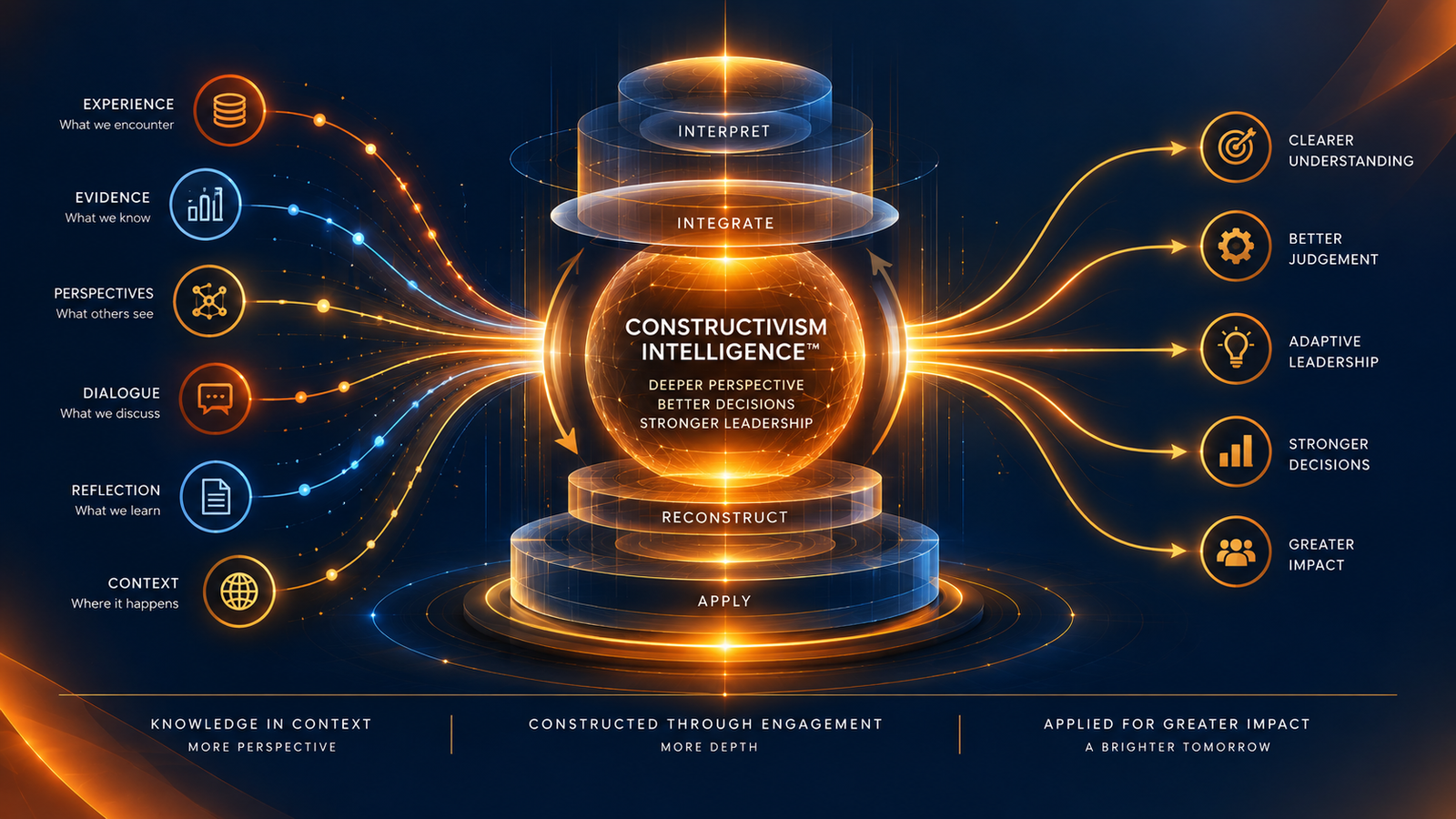
- Constructivism Intelligence™ is the capacity to build shared understanding by surfacing assumptions, gathering perspectives, testing evidence and constructing better explanations before acting.
- It does not replace expertise or authority — it improves the quality of thinking that precedes a decision.
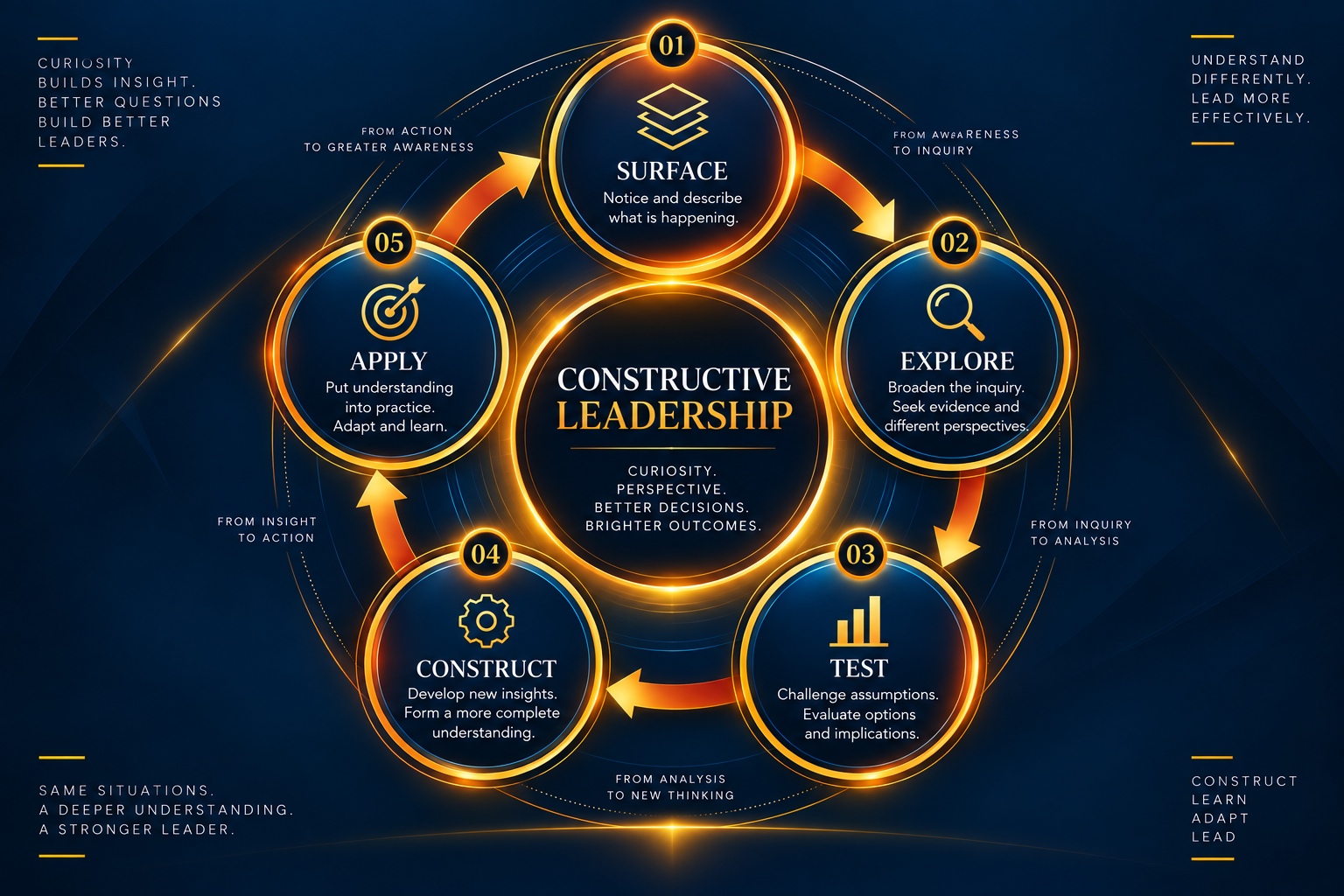
- The Burn Bright Constructive Leadership Cycle™ moves through five disciplines: Surface, Explore, Test, Construct, Apply.
- Shared understanding is not the same as consensus — people can understand a decision’s reasoning and still disagree with it.
- Psychological safety is a precondition for constructivist leadership: without it, leaders lose access to knowledge the organisation already holds.
- Overused without judgement, constructivism can slide into consultation without consequence, consensus dependency, or leadership abdication.
What Is Constructivism in Leadership? Building Understanding, Not Just Answers
Leadership has traditionally rewarded the person who knows. The leader is expected to provide direction, interpret complexity, answer questions and resolve uncertainty. Expertise matters, and leaders cannot outsource responsibility for judgement. Yet modern organisations increasingly face situations in which no individual — regardless of experience — possesses enough information to understand the entire problem.
This changes the leadership challenge. The question is no longer simply does the leader know the answer? A more important question is: can the leader create the conditions in which better understanding can be constructed? This is where Constructivism Intelligence™ becomes an important component of Leadership Performance Intelligence™.
Featured Snippet
The Leadership Problem Is Not Always a Lack of Information
Organisations have never had greater access to information. Dashboards display performance in real time. Artificial intelligence can analyse enormous datasets. Employees can access research, benchmarks and professional knowledge within seconds. Leaders receive reports, forecasts, surveys, risk assessments and recommendations from almost every direction.
Yet access to more information has not eliminated poor decisions.
In some environments, it has made leadership harder.
The difficulty is increasingly not obtaining information. It is determining what that information means.
Imagine a senior leadership team examining declining employee performance. The finance director sees inefficient resource allocation. The HR director sees burnout. The operations director sees weak processes. The department manager sees unrealistic targets. Employees see decisions being made without understanding their workload.
Each may be looking at legitimate evidence. The leadership challenge is therefore not simply deciding which person is correct — it is constructing a sufficiently rich understanding of the problem before deciding how to respond.
What Is Constructivism in Leadership, Really?
Constructivism originates from theories of learning and knowledge which propose that human beings actively construct meaning from their experiences rather than passively absorbing information. Applied to leadership, the principle becomes highly practical: people enter organisations carrying different experiences, professional knowledge, assumptions, expectations and interpretations, and they use those existing mental frameworks to make sense of what happens around them.
Leadership therefore involves more than communicating facts — it involves shaping the conditions in which people interpret those facts. Consider a leader announcing, “We need to become more agile.” The executive team may hear faster strategic adaptation. Middle managers may hear another restructuring is coming. Employees may hear we will be expected to do more with fewer resources.
The leader has delivered one sentence. The organisation has constructed several meanings. Traditional communication thinking may conclude that the message needs to be repeated more clearly. Constructivist thinking asks something different: what experiences and assumptions are causing different groups to interpret the message differently? That is a much more powerful leadership question.
Constructivism Intelligence™: From Delivering Answers to Building Understanding
Within Burn Bright Advisory’s Leadership Performance Intelligence™ framework, Constructivism Intelligence™ should not be confused with endless consultation or consensus leadership. Leaders still need to decide. They still need expertise. They still need accountability. They still need the courage to act when agreement is impossible.
Constructivism Intelligence™ concerns what happens before and around those decisions — the capacity to improve the organisation’s understanding of reality by bringing together evidence, experience, interpretation, reflection and dialogue. This is expressed through the Burn Bright Constructive Leadership Cycle™:
SURFACE → EXPLORE → TEST → CONSTRUCT → APPLY
The cycle then repeats, because action generates new experience, and new experience creates new knowledge. This is one of the reasons constructivist leadership is particularly relevant in uncertain environments. When conditions are stable, leaders can rely heavily on established knowledge. When conditions change rapidly, yesterday’s assumptions become less reliable, and leaders must be able not only to use knowledge, but to help their organisations create new knowledge.
Why Experienced Leaders Can Become Vulnerable to Fixed Thinking
Experience is one of leadership’s greatest assets. It can also become a constraint. A leader who has solved the same type of problem repeatedly develops mental shortcuts that make decision-making faster because the leader recognises patterns and draws on previous experience. Usually, this is valuable.
The danger appears when the environment changes but the mental model does not. The leader begins interpreting new problems through old explanations. Past success becomes evidence that their existing approach remains correct. Questions start to feel like challenges. Alternative interpretations appear inefficient. Eventually, expertise can become rigidity.
This connects Constructivism Intelligence™ directly with Reflective Practice Intelligence™. Constructivism asks: how are we creating our understanding of this situation? Reflective Practice asks: how might my own assumptions be influencing that understanding? The two capabilities reinforce one another.
Leadership Performance Intelligence™ Requires More Than Individual Intelligence
One of the central propositions of Burn Bright Advisory™ is that leadership performance cannot be understood purely through the characteristics of an individual leader. Leadership exists within a system. Performance is shaped by the interaction between the leader, other people, organisational structures, workload, knowledge, culture, context and changing external conditions.
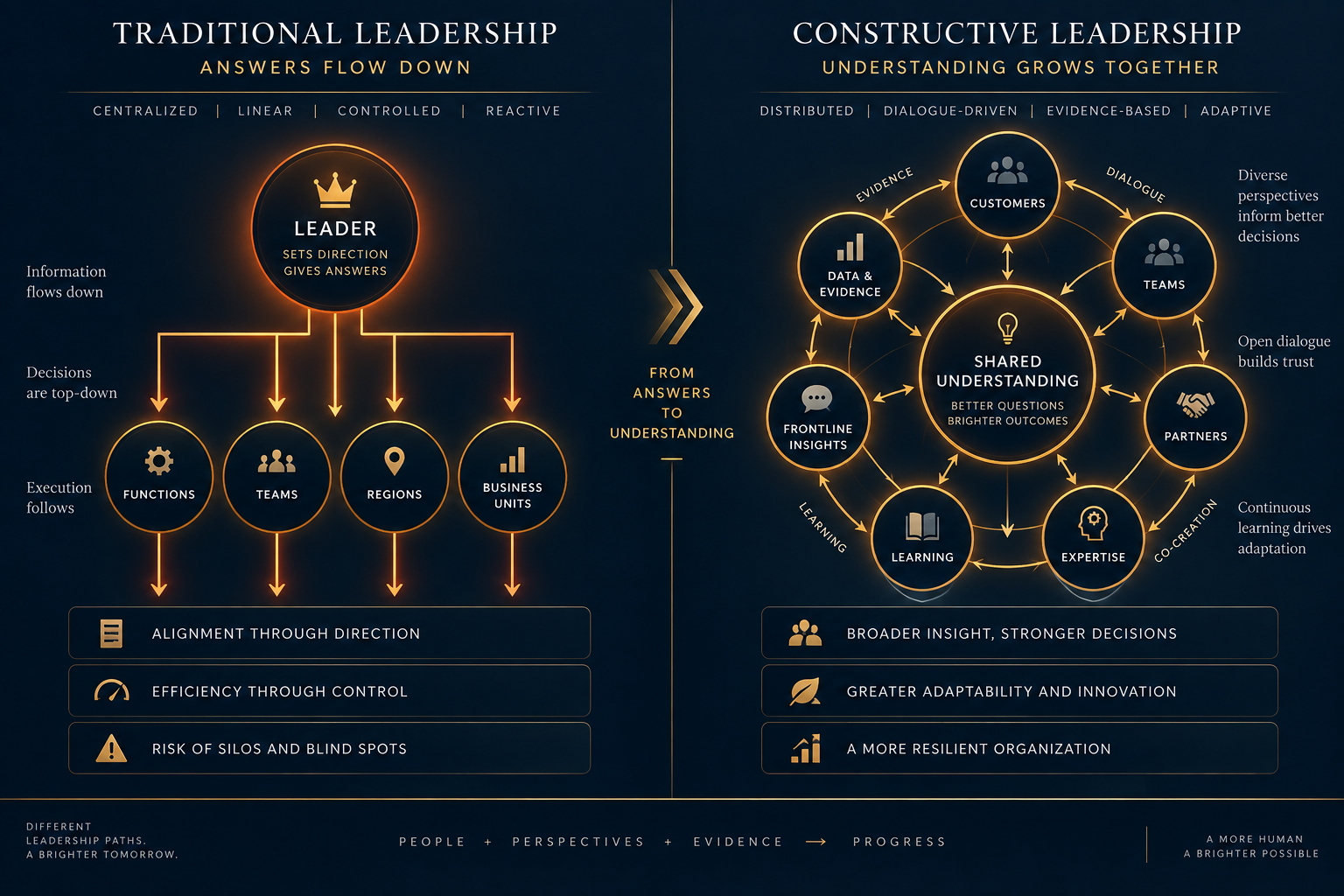
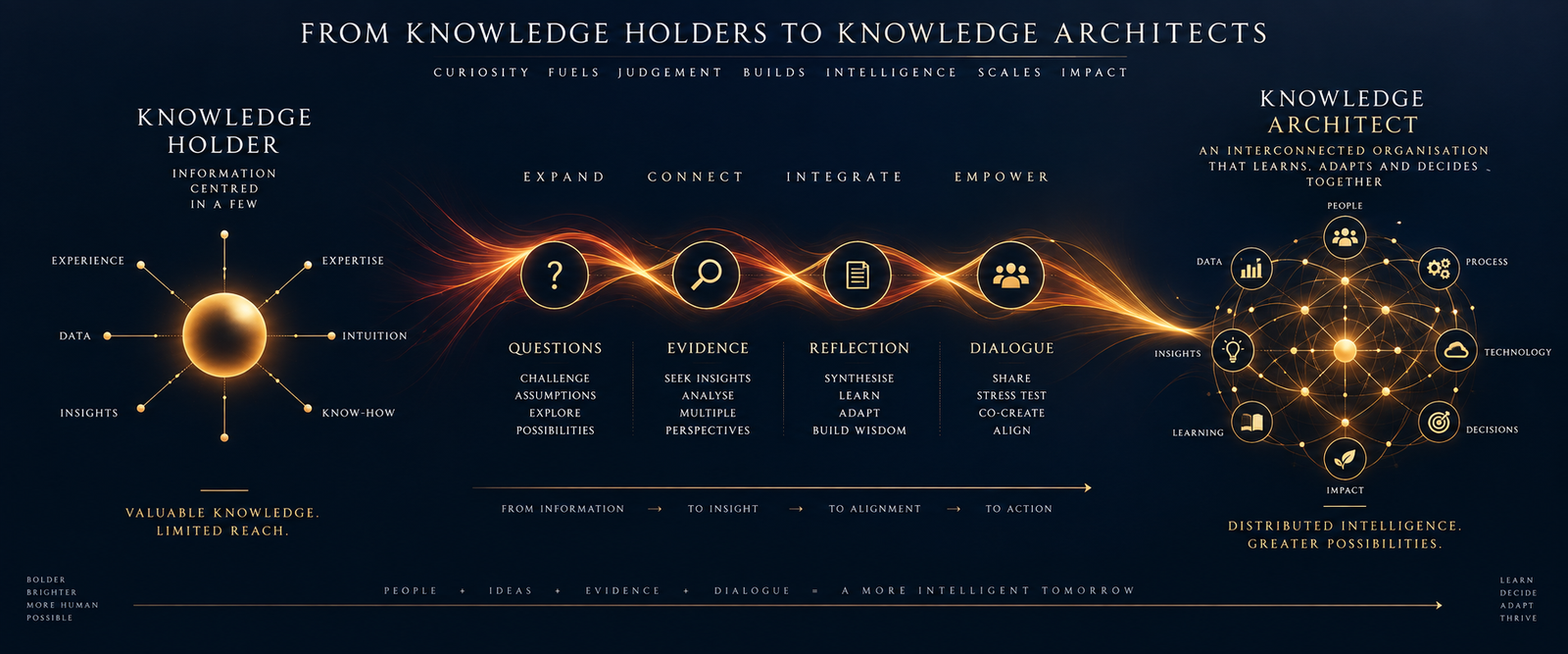
Constructivism Intelligence™ strengthens this system because it changes where leaders believe useful knowledge resides. Instead of assuming knowledge flows primarily from the leader downward, the organisation begins recognising knowledge distributed throughout the system:
- The frontline employee knows things the executive cannot see.
- The customer sees things the operations team may overlook.
- The finance team understands constraints that innovators may underestimate.
- The new employee notices assumptions that long-serving employees no longer question.
- The experienced professional possesses contextual knowledge that cannot always be captured in a dashboard.
The leader’s role is therefore not diminished — it becomes more sophisticated. The leader becomes responsible for creating the architecture through which those different forms of knowledge can interact productively. That is the shift from being the primary source of answers to becoming the architect of organisational understanding.
Why Constructivism Intelligence™ Matters for Decision Quality
Leadership decisions are often described as rational processes: gather information, evaluate alternatives, select an option and implement it. Real organisational decision-making is rarely that clean. Information is incomplete. Different stakeholders hold different pieces of the picture. Experience influences interpretation. Organisational politics affect what people are willing to say. Time pressure encourages leaders to rely on familiar assumptions. Hierarchy can make people reluctant to challenge senior opinions.
The result is a significant leadership risk: a group can possess the knowledge required to make a better decision without that knowledge ever reaching the decision itself. Constructivism Intelligence™ helps address this because it treats decision quality as partly dependent on the quality of the meaning-making process preceding the decision.
Example: Rising Patient Waiting Times
A purely top-down response might analyse performance data and introduce new efficiency targets. A constructivist approach widens the inquiry first: what are clinicians experiencing? Where are administrative bottlenecks occurring? What assumptions underpin the existing patient pathway? What do patients experience that internal performance measures do not reveal? The purpose is not consultation for its own sake — it is to construct a more accurate representation of reality.
This is an important distinction within Leadership Performance Intelligence™: leadership effectiveness should not be measured simply by the speed with which a leader produces an answer. Sometimes leadership intelligence is demonstrated by recognising that the organisation has not yet understood the question.
Psychological Safety Is an Intelligence Infrastructure
Constructivism also has an important relationship with psychological safety. Leaders cannot construct a reliable understanding of organisational reality if people are afraid to tell them what they actually see. A team may appear aligned while privately holding serious reservations. Professionals may recognise a developing risk but remain silent because challenging authority has historically carried consequences. Middle managers may soften difficult information before passing it upwards.
When this happens, the leader’s picture of reality becomes progressively distorted. This is why psychological safety should not be viewed simply as an employee-experience issue — it is also part of an organisation’s intelligence infrastructure. If people cannot question, challenge, report mistakes or introduce conflicting evidence, the organisation loses access to information it already possesses. Constructivist leaders therefore create environments where respectful disagreement has legitimate status, asking questions such as:
- “What are we assuming here?”
- “What would someone who disagrees with this proposal say?”
- “What information would cause us to change our minds?”
- “What are we not seeing from where we sit?”
- “Whose experience is missing from this discussion?”
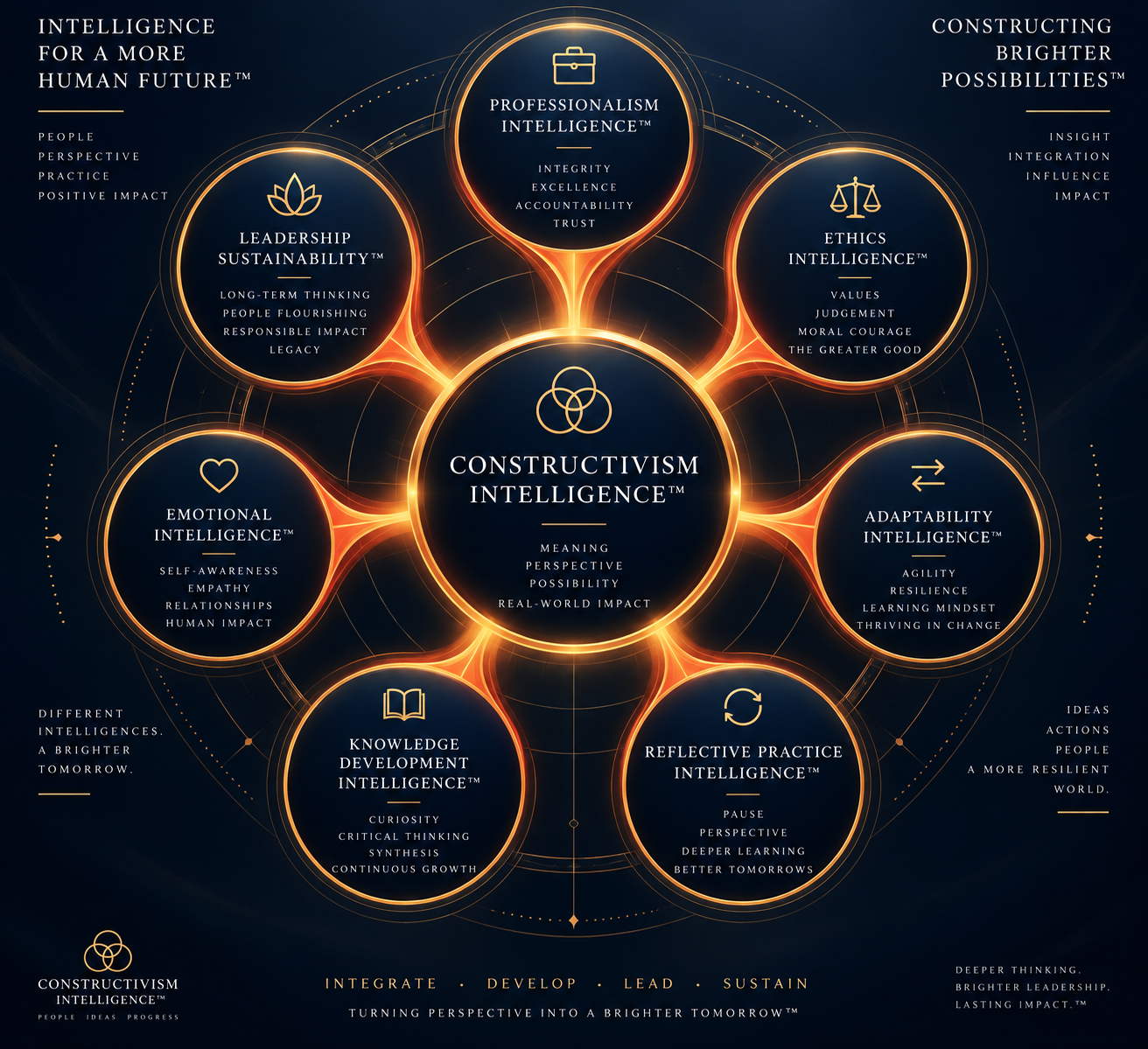
This connects Constructivism Intelligence™ with Professionalism Intelligence™, Ethics Intelligence™ and Emotional Intelligence™ within the Leadership Intelligence Compass™. Professionalism establishes the standards through which disagreement remains constructive. Ethics Intelligence™ asks whose interests, voices and consequences are being considered. Emotional Intelligence™ helps leaders recognise the interpersonal dynamics that determine whether people feel able to contribute honestly. Constructivism Intelligence™ then turns those contributions into learning.
The Critical Difference Between Shared Understanding and False Consensus
Constructivist leadership does not mean everyone must agree. In fact, attempting to manufacture agreement can undermine the entire process. Teams sometimes confuse consensus with understanding — they hold workshops, gather views, produce shared statements and leave the room believing alignment has been achieved, when difficult differences have merely been suppressed. This creates false consensus.
A stronger leadership objective is shared understanding. Shared understanding means people can accurately explain the problem being addressed, the evidence being considered, the important differences in interpretation, the constraints affecting the decision, the reasoning behind the eventual choice, and what will happen next. People may still disagree with the decision — that is not necessarily leadership failure.
This protects constructivist leadership from becoming indecisive leadership. A chief executive, principal, clinical leader, public official or entrepreneur may ultimately need to choose between competing options — the difference is that the decision emerges from a richer understanding of the system rather than from an assumption that positional authority automatically provides superior knowledge.
The Burn Bright Constructive Leadership Framework™
Leaders can translate Constructivism Intelligence™ into everyday practice through five disciplines. Each stage serves a distinct leadership purpose.
Discipline 1 Surface — Make Assumptions Visible
Every leadership problem arrives surrounded by assumptions (“we have a motivation problem,” “customers want lower prices”). Statements like these often sound factual when they are actually interpretations. A leader might ask: what evidence supports this interpretation? What have we inferred rather than established? How might our previous experience be shaping the way we define the problem?
Discipline 2 Explore — Bring Different Perspectives Into the Room
Who experiences this problem differently? Who works closest to it? Who will implement the eventual decision? Who bears its consequences? The objective is not simply diversity of opinion — it is diversity of information and interpretation, which intentionally reduces the information distance hierarchy can create.
Discipline 3 Test — Challenge the Emerging Explanation
What evidence contradicts our preferred explanation? What alternative explanation could fit the same facts? Where has a similar approach failed? Testing protects constructivism from becoming a collection of opinions — evidence still matters.
Discipline 4 Construct — Build a Better Working Model
The objective is to create the best available explanation of the situation — not a perfect or permanent one, a working model. An organisation that believes it has a motivation problem may discover the deeper issue combines workload, unclear priorities and inconsistent decision rights, which changes the intervention entirely.
Discipline 5 Apply — Act, Observe and Learn Again
Constructivism does not end in discussion. Leaders act, and action is treated as another source of information: what happened, what did we expect, where were we wrong, and what should change next time? Application feeds directly back into reflection: Action → Evidence → Reflection → Revised Understanding → Better Action.
| Answer-Giving Leadership | Constructivist Leadership |
|---|---|
| Asks “what decision should I make?” | Asks “what do we need to understand before we decide?” |
| Assumes knowledge flows from the leader downward | Recognises knowledge distributed throughout the system |
| Treats a repeated message as a clarity problem | Asks what assumptions are causing different interpretations |
| Measures effectiveness by speed of the answer | Recognises when the organisation hasn’t yet understood the question |
| Manufactures agreement to close discussion | Builds shared understanding while accepting continued disagreement |
What Constructivism Intelligence™ Looks Like Across Sectors
The principles remain consistent, but their application changes according to context.
Business Growth Intelligence™
A growing business discovers declining customer retention. Rather than simply instructing sales to improve follow-up, a constructivist leader examines the wider system — pricing, onboarding, product usability and the mismatch between what was sold and what was delivered — before intervening.
School Leadership Intelligence™
A school leader notices declining student outcomes. Rather than defaulting to teacher performance as the explanation, a wider inquiry involving teachers, curriculum leaders, students and families may reveal curriculum sequencing problems, attendance patterns, workload pressures or assessment inconsistency.
Healthcare Leadership Intelligence™
Clinical environments contain specialised expertise and significant interdependence. No senior leader can personally observe every interaction through which quality and safety are produced — the most senior person in the room is not automatically the person holding the most relevant information.
Public Service Leadership Intelligence™
A policy can appear rational at the organisational level yet create unintended consequences when it meets citizens’ lived realities. Constructivist leaders treat implementation itself as a source of knowledge about the assumptions behind the original policy.
HR & People Leadership Intelligence™
People strategies are particularly vulnerable to assumptions — prescribing resilience training when the real problem is workload, or recognition programmes when employees actually need clearer progression. Constructivism Intelligence™ helps HR leaders move from prescribing solutions to understanding systems.
Entrepreneur Performance Intelligence™
Early success can strengthen attachment to a founder’s original assumptions precisely when the organisation needs those assumptions questioned. Constructivist entrepreneurs stay committed to purpose while remaining capable of revising their interpretation of markets, customers and organisational needs.
Constructivism and the Leadership Intelligence Compass™
Constructivism Intelligence™ becomes more powerful when understood as part of a wider leadership system. It interacts with Professionalism Intelligence™ by ensuring dialogue operates within clear behavioural standards; Ethics Intelligence™ by asking whose perspective and interests are represented; Adaptability Intelligence™ by enabling leaders to revise assumptions as circumstances change; Visionary Leadership Intelligence™ by connecting collective understanding to future direction; Reflective Practice Intelligence™ by helping leaders examine how their own thinking influences judgement; Knowledge Development Intelligence™ by turning experience into organisational learning; Emotional Intelligence™ by enabling leaders to read the interpersonal conditions affecting contribution; and Leadership Sustainability™ by identifying when performance problems originate in workload or system design rather than individual effort.
This interconnectedness is central to Leadership Performance Intelligence™. Leadership capability is rarely produced by one competency operating independently — it emerges through relationships between different forms of intelligence.
From Knowledge Holder to Knowledge Architect
Perhaps the most important shift created by Constructivism Intelligence™ concerns leadership identity. Many leaders have spent years being rewarded for knowing — gaining credibility because they could solve problems, being promoted because they demonstrated expertise. Moving towards constructivist leadership can therefore feel uncomfortable because it challenges a deeply established professional identity.
But the transition does not require leaders to become less knowledgeable. It requires them to use knowledge differently. The question changes from “how do I demonstrate that I know?” to “how do I help this organisation know more?” The first centres leadership intelligence in the individual. The second builds intelligence throughout the system.
When Constructivist Leadership Goes Wrong
Constructivism Intelligence™ is powerful precisely because it expands the quality of organisational thinking. But every leadership capability can become dysfunctional when applied without judgement — and constructivism is no exception. The greatest risk is confusing participation with leadership: meetings multiply, questions generate more questions, and employees are repeatedly asked for input without seeing corresponding action.
Constructivism Intelligence™ therefore requires boundaries. Not every decision requires extensive collective exploration — a routine operational decision may require expertise and speed, an emergency may require immediate authority, and an ethical decision may require consultation while still being governed by principles that should not be negotiated away.
Five Failure Modes Leaders Should Recognise
A Constructivism Intelligence™ Leadership Diagnostic
Leaders can begin evaluating their own practice by examining how knowledge actually moves through their organisation. The more valuable question is not a score, but where organisational understanding currently becomes constrained.
| Leadership Practice | Reflection |
|---|---|
| I actively distinguish evidence from assumptions. | Rarely / Sometimes / Consistently |
| People can challenge my interpretation without fearing negative consequences. | Rarely / Sometimes / Consistently |
| I seek information from people closest to the work. | Rarely / Sometimes / Consistently |
| Important decisions include perspectives beyond the senior leadership group. | Rarely / Sometimes / Consistently |
| I deliberately look for evidence that contradicts my preferred explanation. | Rarely / Sometimes / Consistently |
| I can revise my judgement publicly when new evidence emerges. | Rarely / Sometimes / Consistently |
| Meetings create understanding rather than simply distribute information. | Rarely / Sometimes / Consistently |
| Lessons from implementation influence future decisions. | Rarely / Sometimes / Consistently |
| People understand why significant decisions have been made. | Rarely / Sometimes / Consistently |
| My organisation becomes better at thinking rather than increasingly dependent on me for answers. | Rarely / Sometimes / Consistently |
Leadership Reflection Questions
- When people disagree with me, do I become more curious or more certain?
- Which assumptions currently underpin my most important leadership decisions?
- What evidence would cause me to reconsider those assumptions?
- Whose knowledge is easiest for me to access — and whose knowledge rarely reaches me?
- Do people in my organisation feel able to say, “I think we may be looking at this incorrectly”?
- Where might hierarchy be filtering information before it reaches senior leadership?
- When did I last change an important decision because another person’s perspective improved my understanding?
- Does my team understand the reasoning behind decisions, or merely the instructions that follow them?
- What did our most recent failure teach us, and what actually changed because of that learning?
- Am I developing people who can think independently, or people who have become increasingly dependent on my judgement?
Action Steps: Building Constructivism Intelligence™ Into Leadership Practice
Constructivist leadership does not require another large organisational initiative. Leaders can begin by changing the architecture of everyday conversations and decisions.
- Introduce an assumption check. Before major decisions, explicitly identify what the team knows, what it believes and what remains uncertain.
- Create a missing-perspective question. Ask, “Who experiences this issue differently from the people currently discussing it?”
- Introduce constructive challenge. Before approving a significant proposal, ask someone to develop the strongest evidence-based argument against it.
- Shorten the distance to frontline knowledge. Establish regular mechanisms through which senior leaders encounter people doing the work rather than relying exclusively on information filtered through management layers.
- Close the learning loop. After implementation, compare expected outcomes with actual outcomes and document what should change next time.
These practices turn Constructivism Intelligence™ from a leadership philosophy into an organisational capability.
Conclusion: The Leader Is Not Required to Know Everything
The mythology surrounding leadership has long encouraged an impossible expectation — that the leader should know everything, always. Knowledge and expertise remain important. But leadership in complex organisations requires something beyond possessing answers. It requires the ability to construct understanding.
Listening without surrendering judgement.
Questioning without becoming paralysed.
Using expertise without becoming imprisoned by it.
Inviting challenge without abandoning authority.
Acting decisively while remaining willing to learn.
The strongest leader is not necessarily the person who can answer every question in the room. It may be the person who notices that the room is asking the wrong question — the leader who surfaces an assumption everyone else has accepted, or the executive who asks the frontline what the dashboard cannot explain.
Constructivism changes leadership from an exercise in possessing knowledge into the discipline of developing knowledge. This creates an important test of leadership performance: when you leave the room, is the organisation better able to think without you? If the answer increasingly becomes yes, leadership has achieved something more valuable than simply providing answers — it has built capacity. That is the movement from knowledge holder to knowledge architect.
Frequently Asked Questions
What is constructivism leadership?
Constructivism leadership is an approach in which leaders recognise that understanding develops through experience, dialogue, evidence, reflection and interaction. Rather than assuming knowledge resides solely with the leader, constructivist leadership brings together distributed knowledge to build stronger shared understanding before action.
Is constructivist leadership the same as collaborative leadership?
They overlap but are not identical. Collaborative leadership emphasises working with others. Constructivism focuses specifically on how understanding and knowledge are developed. Collaboration can support constructivism, but collaboration without reflection, evidence or learning does not automatically create better understanding.
Does constructivism mean leaders should stop giving answers?
No. Leaders still provide expertise, direction and decisions. Constructivism Intelligence™ helps them recognise when giving an immediate answer is appropriate and when the organisation would benefit from deeper exploration first.
Does everyone need to agree before a constructivist leader makes a decision?
No. Shared understanding is different from consensus. People can understand the evidence, constraints and reasoning behind a decision while continuing to disagree with the final choice.
How does Constructivism Intelligence™ improve decision-making?
It can improve decision quality by exposing assumptions, incorporating distributed knowledge, testing interpretations against evidence and identifying information that may otherwise be filtered by organisational hierarchy.
How does constructivism relate to psychological safety?
People need sufficient psychological safety to question assumptions, introduce contradictory evidence and acknowledge uncertainty. Without those conditions, leaders may receive agreement while losing access to important organisational knowledge.
What is the relationship between constructivism and reflective leadership?
Reflective leadership examines one’s experience, assumptions and actions. Constructivism extends that process by considering how individuals and groups develop meaning together. Within the Leadership Intelligence Compass™, Reflective Practice Intelligence™ and Constructivism Intelligence™ therefore reinforce one another.
Can constructivist leadership work in a crisis?
Yes, but the degree of participation must reflect the situation. A crisis may require rapid decisions and clear authority. Constructivist practice becomes particularly valuable before and after critical events — developing shared situational awareness beforehand and learning systematically afterwards.
How can organisations develop Constructivism Intelligence™?
They can strengthen mechanisms for constructive challenge, reflection, frontline feedback, cross-functional learning, after-action review and evidence-based decision-making. Leadership development should also help leaders recognise assumptions and become more comfortable revising their interpretations.
Why does Constructivism Intelligence™ matter for Leadership Performance Intelligence™?
Because leadership performance depends partly on how accurately leaders understand the systems they are attempting to influence. Constructivism Intelligence™ strengthens the processes through which leaders and organisations build, test and revise that understanding.
How Well Does Your Leadership System Build Understanding?
Take the free Leadership Burnout Self-Assessment to see how your organisation turns experience, evidence and different perspectives into better decisions — and where the system may be quietly breaking down.
Free Leadership Intelligence
Get Weekly Leadership Insights
Join thousands of leaders receiving practical strategies on burnout prevention, workload design, and sustainable performance every week.