Quick Answer
Key Takeaways
- People do not receive leadership messages as empty containers — they interpret them through prior experience, professional identity and assumptions.
- Constructivism Intelligence™ is the capacity to recognise, examine and deliberately influence how understanding is constructed.
- The Constructivist Leadership Cycle™ moves through five stages: Experience, Interpretation, Dialogue, Reflection and Reconstruction.
- Constructivist leadership is not relativism — evidence, expertise and professional standards still matter.
- Distributing the capacity to think, not just tasks, is what makes leadership sustainable at scale.
What Is Constructivism Leadership?
Constructivism leadership is an approach in which leaders recognise that understanding is not simply transferred from one person to another. It is constructed through experience, dialogue, reflection and interpretation. Rather than assuming leadership means supplying every answer, constructivist leaders create the conditions in which people can examine assumptions, make sense of complex situations, learn from experience and develop shared understanding.
Executive Summary
One of the most persistent assumptions about leadership is that leaders are supposed to know. They are expected to enter difficult situations with answers, provide certainty when others are uncertain and quickly explain what should happen next.
That expectation is understandable. Organisations need direction. But direction and certainty are not the same thing.
In increasingly complex organisations, some of the most consequential leadership challenges cannot be solved simply by transferring an answer from the person at the top to everyone else. They require people to interpret information, reconcile competing perspectives, test assumptions and construct a shared understanding of what is actually happening.
This is where Constructivism Intelligence™, one of the domains within the Leadership Intelligence Compass™, becomes important.
Constructivism Intelligence™ is the capacity to recognise that people interpret situations through previous experience, existing knowledge, professional identity, assumptions and context. Effective leaders therefore do more than communicate information. They deliberately shape the conditions through which meaning is formed.
That distinction changes leadership.
Instead of asking only, “How do I get people to understand my decision?”
the leader begins asking, “How are people making sense of this situation?”
Instead of, “Why are they resisting?”
the question becomes, “What experience or interpretation makes their response reasonable from where they stand?”
And instead of, “How do I give them the answer?”
the leader considers, “What process will help us develop a stronger answer together?”
This is not leadership by consensus. Nor does it mean surrendering authority.
It means understanding that sustainable organisational capability develops when people learn how to think, interpret and act—not merely when they learn how to comply.
That makes constructivism a significant component of Leadership Performance Intelligence™.
Introduction: The Leadership Problem Hidden Inside “I Already Told Them”
There is a familiar moment in organisational life.
A leader explains a new strategy. The presentation is clear. The slides are polished. Responsibilities have been allocated. Questions have been invited.
Everyone leaves the room apparently understanding what has been agreed.
Three weeks later, different departments are implementing different interpretations of the same strategy. The executive team becomes frustrated: “We explained this.” Managers respond: “We understood it differently.”
Both statements can be true.
The problem may not be communication in the conventional sense. The message may have been delivered accurately. The problem is meaning.
People do not receive leadership messages as empty containers waiting to be filled with information. They interpret them through what they already know.
A finance director may hear “transformation” and think about investment and financial risk. An operations leader may hear the same word and think about processes, capacity and disruption. An HR leader may interpret it through capability, culture and workforce implications. A school principal may hear “improvement” through the experience of previous inspection cycles. A clinician may interpret “efficiency” through its potential effect on patient care. A public-service leader may hear “reform” while remembering three previous initiatives that disappeared following leadership changes.
The words may be identical. The meanings are not.
This is one of the central challenges of constructivism leadership.

Leadership Is Not Simply the Transfer of Knowledge
Traditional models of organisational communication can encourage a relatively simple assumption: leader knows → leader communicates → employee understands → employee acts.
Real organisations rarely function so neatly.
Human beings interpret. We compare new information with previous experience. We notice what confirms our assumptions. We question what contradicts them. We connect new ideas with existing mental models. We interpret what is said alongside what has happened before.
This is why two experienced people can attend the same meeting and leave with different conclusions. Neither necessarily failed to listen. They constructed meaning differently.
Constructivism has long influenced thinking about learning because it challenges the idea that knowledge can simply be deposited into another person’s mind. Learners actively connect new information with what they already understand.
Leadership operates through the same human process. A leader can issue an instruction. A leader cannot completely control the meaning another person constructs around that instruction.
Recognising this changes the leadership task. Communication remains essential, but communication alone is insufficient. The leader must also become interested in interpretation.
What Is Constructivism Intelligence™?
Featured Snippet
It involves several interconnected capabilities:
- Recognising that different people may interpret the same situation differently
- Surfacing assumptions rather than allowing them to remain invisible
- Connecting new knowledge with existing experience
- Creating meaningful opportunities for dialogue
- Using questions to deepen thinking rather than simply verify compliance
- Enabling teams to learn from experience
- Testing interpretations against evidence
- Revising understanding when circumstances change
Constructivism Intelligence™ therefore moves leadership beyond knowledge possession toward knowledge development.
A knowledgeable leader may know a great deal. A constructivist leader also understands how other people come to know. That is a significant difference. It affects meetings, strategy, organisational change, professional development, problem-solving, innovation and even conflict.
Consider a leader introducing a new organisational model. A conventional implementation approach might involve presenting the model, explaining the benefits, distributing guidance and monitoring compliance.
A constructivist approach asks additional questions: What do people currently believe about the problem this model is intended to solve? What previous experiences will influence their response? Which assumptions need to be examined? Where might different professional groups interpret the change differently? What opportunities will people have to test the model against their actual work? How will experience from implementation feed back into organisational learning?
From Answer-Giving to Sense-Making
Many leaders develop their careers because they are good at answering questions. Someone identifies a problem. They solve it. Someone becomes stuck. They intervene. A decision is required. They make it.
This pattern can produce rapid early career progression because expertise is valuable. But leadership eventually introduces a paradox.
The more senior you become, the less sustainable it is to remain the principal source of answers. Your responsibility expands faster than your individual cognitive capacity. The organisation therefore needs something more valuable than access to your knowledge. It needs distributed thinking capacity.
This connects closely with a recurring principle in Burn Bright’s wider leadership work: sustainable leadership cannot depend indefinitely upon individual heroics. Leadership roles become fragile when organisational performance relies excessively upon one person’s personal capacity.
Constructivism Intelligence™ offers another way of thinking about that problem. Instead of becoming the organisational answer machine, the leader becomes an architect of better thinking. That means creating environments where people can interpret complexity, challenge assumptions, connect experience with evidence, learn from mistakes, examine competing explanations, and construct increasingly sophisticated understandings of their work.
This also resonates with unguarded leadership. Leadership expertise can become restrictive when leaders feel compelled to protect the identity of being the person who knows. Curiosity becomes difficult because questions can feel like admissions of weakness. The Burn Bright source material on unguarded leadership instead emphasises the shift from being the person with all the answers toward creating conditions in which better answers can emerge.
Constructivism Intelligence™ gives that shift an intellectual architecture.
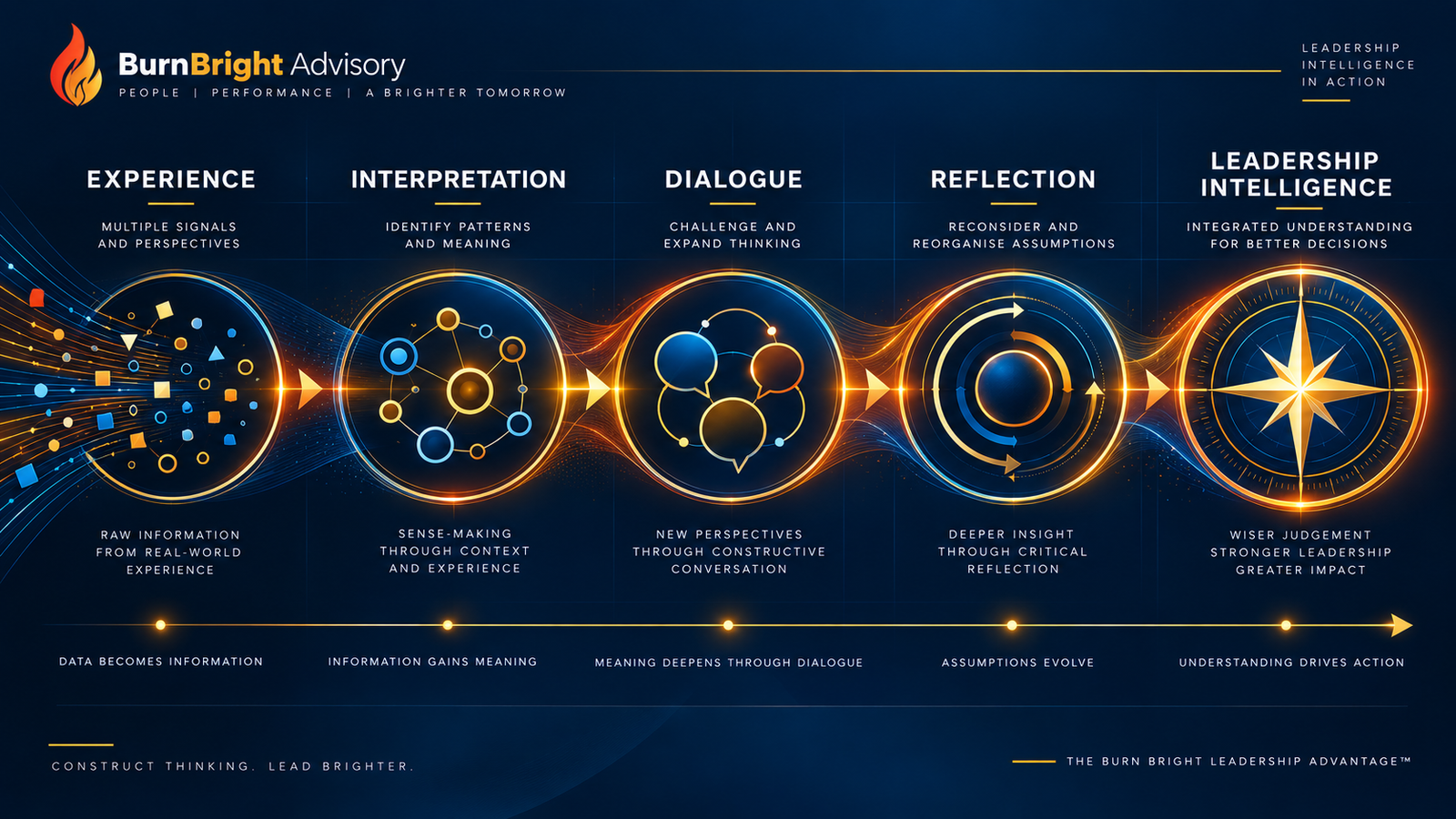
The Constructivist Leadership Cycle™
A practical way to understand this capability is through a five-stage cycle: Experience → Interpretation → Dialogue → Reflection → Reconstruction.
Stage 1 Experience
Something happens — a project succeeds, a customer complains, a patient-safety incident occurs, examination results change, a strategic initiative stalls, an employee leaves. Experience supplies the raw material for learning. But experience alone does not guarantee learning.
Stage 2 Interpretation
People decide what they think the experience means, remarkably quickly: “The strategy was wrong.” “The team resisted.” “The market changed.” These interpretations can rapidly become organisational truths despite being only one possible explanation. Constructivist leaders slow this process down and distinguish what happened from what we think it means.
Stage 3 Dialogue
Different interpretations are brought into conversation, not for argument’s sake but to expose information that individual perspectives may be missing. A frontline employee, a customer, a teacher or a nurse may each see something the executive team cannot. Dialogue expands the evidence available to the group.
Stage 4 Reflection
The leader and team examine their thinking: What assumptions did we make? What evidence supports our interpretation? What contradicts it? What did we overlook? Reflection converts activity into learning.
Stage 5 Reconstruction
Understanding changes. The team develops a more sophisticated interpretation and uses it to shape future action. Constructivism is not endless discussion — its purpose is better-informed action. The organisation returns to experience with a stronger mental model, tests it through action, and begins the cycle again. That is how leadership learning compounds.
Why Constructivism Intelligence™ Matters for Leadership Performance
Leadership performance is often evaluated through visible outcomes: targets achieved, strategies implemented, problems resolved and decisions made. But beneath those outcomes sits a less visible capability — the quality of the thinking that produced them.
Two organisations can experience the same problem and reach very different conclusions about what it means. One organisation experiences a failed project and concludes, “The team needs tighter control.” Another examines the same kind of failure and asks, “What assumptions shaped the project, what did we learn, and what should we understand differently before trying again?”
The first response may produce additional procedures. The second can produce additional intelligence.
This distinction sits at the heart of Leadership Performance Intelligence™, which is not simply concerned with whether leaders perform. It considers the capabilities, conditions and patterns of thinking that make effective performance repeatable and sustainable.
Constructivism Intelligence™ contributes to that system by strengthening the leader’s ability to convert experience into understanding and understanding into improved action.
Without that capability, organisations can accumulate enormous amounts of experience without becoming meaningfully wiser. They repeat meetings. They repeat initiatives. They repeat mistakes. They collect data but fail to reconsider assumptions. They conduct reviews without changing mental models. They describe themselves as learning organisations while continuing to interpret new problems through old explanations.
The problem is not necessarily lack of intelligence. It is lack of organisational learning intelligence.
The Danger of Imposed Certainty
Leadership naturally involves uncertainty. Markets change. Technology develops. Employees behave unpredictably. Communities evolve. Strategies encounter conditions nobody anticipated.
Yet many organisational cultures reward leaders for appearing certain. The leader is expected to know. The executive presentation needs a recommendation. The board wants an answer. The team wants direction. The client wants reassurance.
Consequently, leaders can begin treating uncertainty as something that must be hidden rather than investigated. This creates what we might call imposed certainty: a leadership condition in which one interpretation is presented as settled before sufficient collective sense-making has occurred.
Imposed certainty can initially feel efficient. Discussion becomes shorter. Decisions happen faster. Disagreement disappears. But the absence of disagreement does not necessarily indicate the presence of understanding. Sometimes people simply stop contributing alternative interpretations.
That becomes particularly dangerous when authority and expertise become inseparable. A senior leader says, “This is what is happening.” The organisation gradually hears, “This is the only acceptable interpretation of what is happening.”
This is why curiosity and the willingness to acknowledge incomplete knowledge are important leadership capabilities. Burn Bright’s work on unguarded leadership similarly challenges the assumption that leadership credibility depends upon always possessing the answer. It argues for creating conditions where questions, learning and alternative perspectives can emerge rather than allowing expertise to become a cognitive prison.
Constructivism Intelligence™ extends this principle from individual leadership behaviour into organisational learning. The question becomes: can people safely construct and test alternative interpretations before the organisation commits itself to one version of reality?
The Constructivist Leader Framework™
Constructivist leadership can be translated into five practical disciplines.
Discipline 1
Surface Assumptions
Every important decision contains assumptions. Some are explicit. Most are not. A leadership team considering a restructure might assume existing problems are caused by unclear accountability — but what if the real problem is workload, capability, information flow, or conflicting objectives? If the underlying assumption is wrong, an elegantly designed solution may solve the wrong problem.
Constructivist leaders ask: what would need to be true for our interpretation to be correct? That question moves teams away from defending positions and toward examining the foundations beneath those positions.
Discipline 2
Invite Multiple Interpretations
Different perspectives are not merely interpersonal complications to manage — they are potential sources of intelligence. In a healthcare pathway producing delays, executives see performance data, clinicians experience workflow, administrative staff see scheduling constraints, and patients experience the whole journey differently. Each group possesses only part of the picture.
This is also where psychological safety becomes operationally important — people must be able to say “I interpret this differently” without senior leaders becoming increasingly confident while simultaneously disconnected from operational reality.
Discipline 3
Connect New Knowledge to Existing Experience
People rarely change their understanding because they received another presentation — they need to connect new ideas with what they already know. When introducing AI into established workflows, employees arrive with different experiences: opportunity, threat, memories of past implementations, or prior experimentation.
A constructivist leader begins with “What experience do we already have?” rather than “Here is the new system,” so new knowledge has somewhere to connect and learning becomes contextual rather than abstract.
Discipline 4
Create Reflection Before Reaction
Organisations frequently confuse speed with intelligence. A complaint triggers a policy, a mistake triggers another approval process, a poor quarter triggers restructuring. Repeated reaction without reflection creates organisational clutter: policies accumulate, processes expand, leadership workload increases.
Constructivism Intelligence™ introduces a complementary discipline: before adding another solution, examine the meaning being assigned to the problem. Reflection is not inactivity — it is an intervention against poorly constructed action.
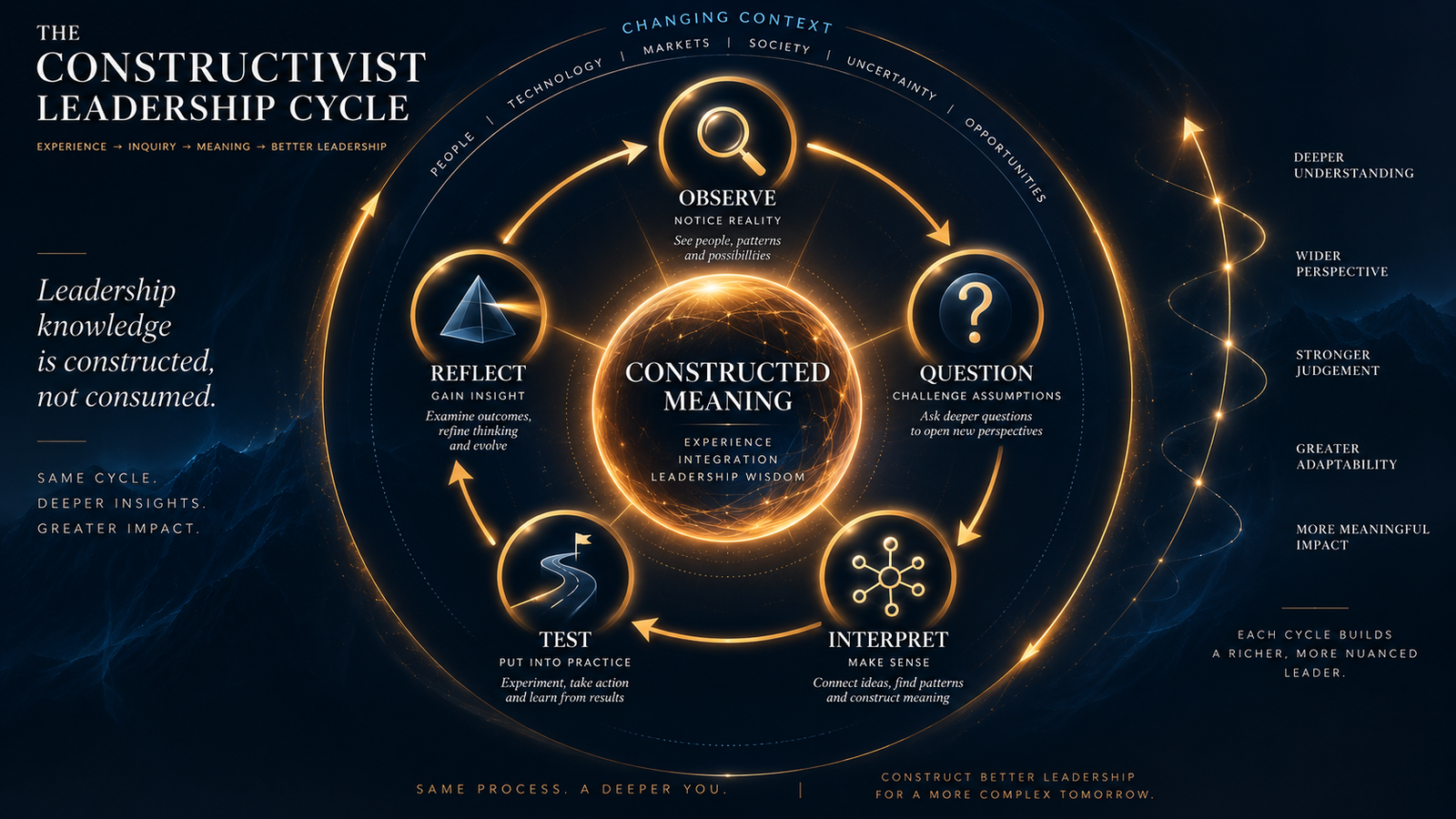
Discipline 5
Reconstruct and Test
Constructivist leadership cannot end with discussion. A team develops a hypothesis, acts, observes, reflects and adjusts. Instead of “We have decided, therefore we are right,” the organisation learns to think, “Based on what we currently understand, this is our strongest course of action. Now we will test what reality teaches us.” That is not indecisiveness — it is disciplined intellectual humility.
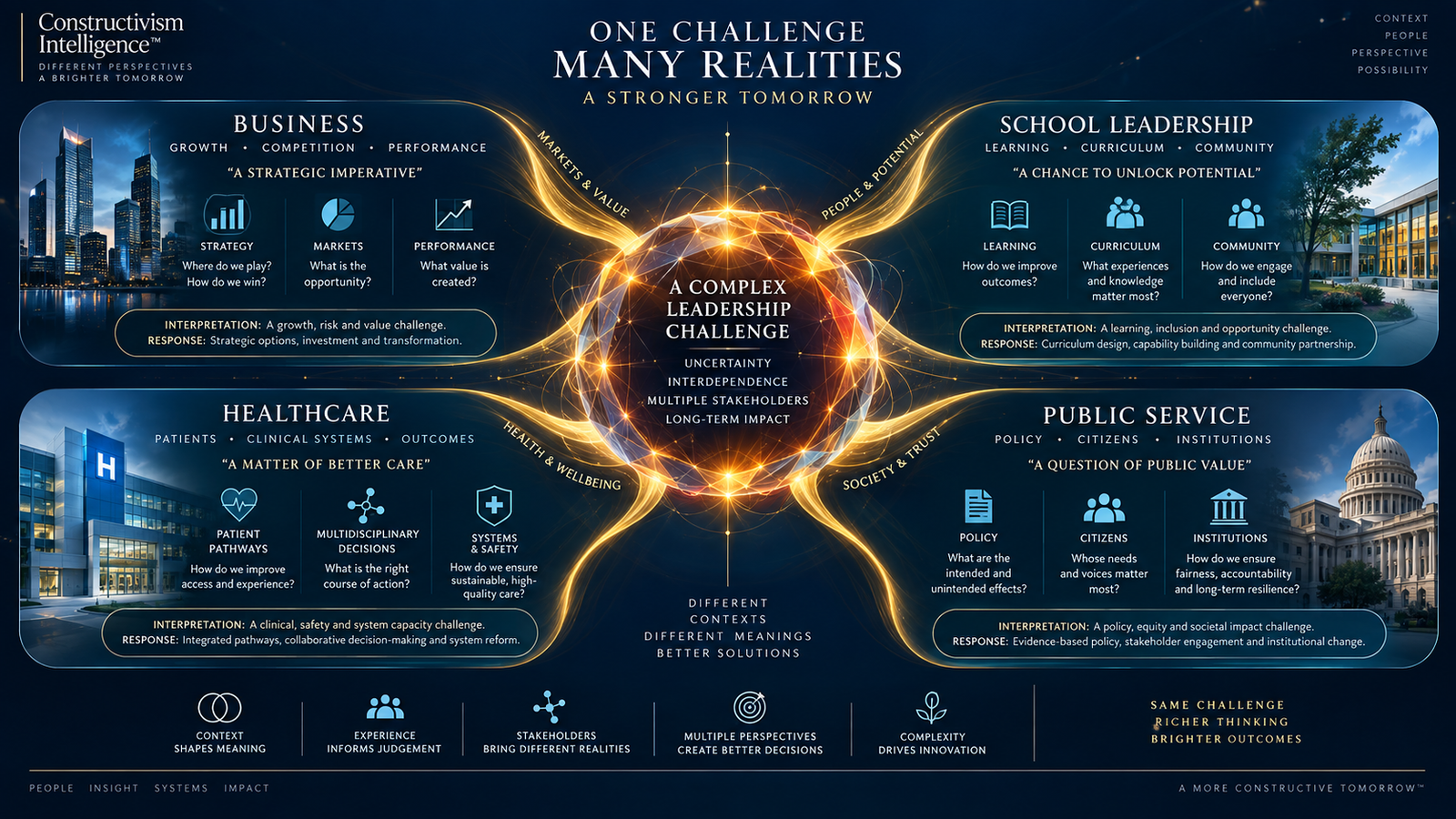
Constructivism Intelligence™ Across Sectors
The underlying principle is universal, but its expression changes according to context.
Business Growth Intelligence™
A growing business sees declining customer retention. The obvious explanation might be price, but a constructivist process investigates further: sales reports price resistance, customer service identifies onboarding frustration, product teams recognise usability problems. The interpretation may shift from “customers are leaving because we are too expensive” to “customers are leaving because perceived value arrives too slowly” — and those two interpretations produce completely different strategies.
School Leadership Intelligence™
When student outcomes decline, a simplistic interpretation — “teaching quality has fallen” — immediately shapes leadership behaviour toward more monitoring. But investigation may reveal changed curriculum sequencing, a specific conceptual gap, or timetable changes that reduced collaborative planning time. Constructivist school leadership recognises teachers as professional knowledge-builders, not passive recipients of instructions.
Healthcare Leadership Intelligence™
A recurring medication error prompts a weak response — “who made the mistake?” — versus a stronger one: “how did the system make this mistake possible?” That shift opens inquiry into unclear information, excessive workload, failed handovers, confusing technology and reluctance to challenge senior colleagues, while accountability still matters throughout.
Public Service Leadership Intelligence™
Redesigning a community service involves officials, finance teams, frontline workers, community members and political leaders — each understanding only part of the system. Constructivist leadership creates mechanisms through which these forms of knowledge inform one another without pretending disagreement will disappear, aiming for a more accurate shared understanding rather than universal agreement.
HR & People Leadership Intelligence™
Declining employee engagement could reflect benefits, communication, workload, progression or trust — an engagement score alone cannot determine which. Constructivist HR leadership combines quantitative evidence with dialogue, employee experience and organisational context so intervention becomes intelligently targeted rather than merely measuring sentiment.
Entrepreneur Performance Intelligence™
Founders can be vulnerable to an invisible equation: past success equals current interpretive accuracy. As customers change, employees develop expertise the founder lacks, and markets grow unfamiliar, the developmental challenge is moving from “I built this, so I understand it best” toward “I built the conditions from which something larger than my individual knowledge is now emerging.”
Constructivism Does Not Mean Every Opinion Is Correct
An important distinction is necessary. If knowledge is constructed through experience and interpretation, it does not follow that every interpretation is equally valid.
Evidence matters. Expertise matters. Professional standards matter. Facts matter.
Constructivist leadership is not relativism. A leader should not respond to conflicting views by saying, “Everyone has their own truth, so all answers are acceptable.” Instead, the leader asks: which interpretation best fits the available evidence?
Multiple perspectives are valuable because they expand inquiry. They do not eliminate standards of judgement. This is particularly important in healthcare, finance, engineering, education and other environments where professional evidence and regulatory requirements place legitimate boundaries around decision-making.
The Connection to the Leadership Intelligence Compass™
Constructivism Intelligence™ becomes more powerful when understood alongside the other domains of the Leadership Intelligence Compass™. It does not operate alone.
Professionalism Intelligence™ provides standards and disciplined conduct. Ethics Intelligence™ asks whether decisions and processes are responsible, fair and defensible. Constructivism Intelligence™ examines how understanding itself is being formed. Adaptability Intelligence™ enables leaders to change when new understanding demands a different response. Visionary Leadership Intelligence™ connects learning with future direction. Reflective Practice Intelligence™ converts experience into deliberate learning. Knowledge Development Intelligence™ helps capture, strengthen and distribute what the organisation learns. Emotional Intelligence™ enables leaders to navigate the human responses involved when assumptions are questioned. Leadership Sustainability™ ensures the resulting leadership system does not depend upon permanently exhausting the people inside it.
The relationship matters. Constructivism without Ethics could produce sophisticated thinking without sufficient consideration of consequences. Constructivism without Adaptability could create insight that never changes behaviour. Constructivism without Reflection could generate discussion without learning. Constructivism without Knowledge Development could leave valuable insights trapped inside individual conversations. And Constructivism without Leadership Sustainability™ could create learning processes that simply add more meetings and cognitive demand to already overloaded leaders.
The Compass therefore encourages leaders to think systemically. Leadership intelligence is not one capability. It is the interaction between capabilities.
A Practical Leadership Test: What Happens When Someone Says “I See It Differently”?
Perhaps one of the simplest tests of Constructivism Intelligence™ occurs in an ordinary meeting. A leader presents an interpretation. Someone responds, “I see it differently.”
What happens next? Does the room become tense? Does the leader immediately explain why the employee is wrong? Does seniority settle the issue? Does the person learn not to challenge the interpretation again?
Or does the leader become curious? “Talk me through what you’re seeing.”
That sentence does not surrender authority. It creates information. The leader may ultimately retain the original position — but now the decision has survived examination. That is a stronger form of confidence.
Leadership Performance Intelligence™ does not require leaders to abandon conviction. It requires them to know the difference between conviction that has been tested and certainty that has merely been protected. Constructivism Intelligence™ helps create that distinction.
And in organisations facing accelerating technological, economic and social complexity, the ability to reconstruct understanding may become as important as the ability to construct strategy in the first place.
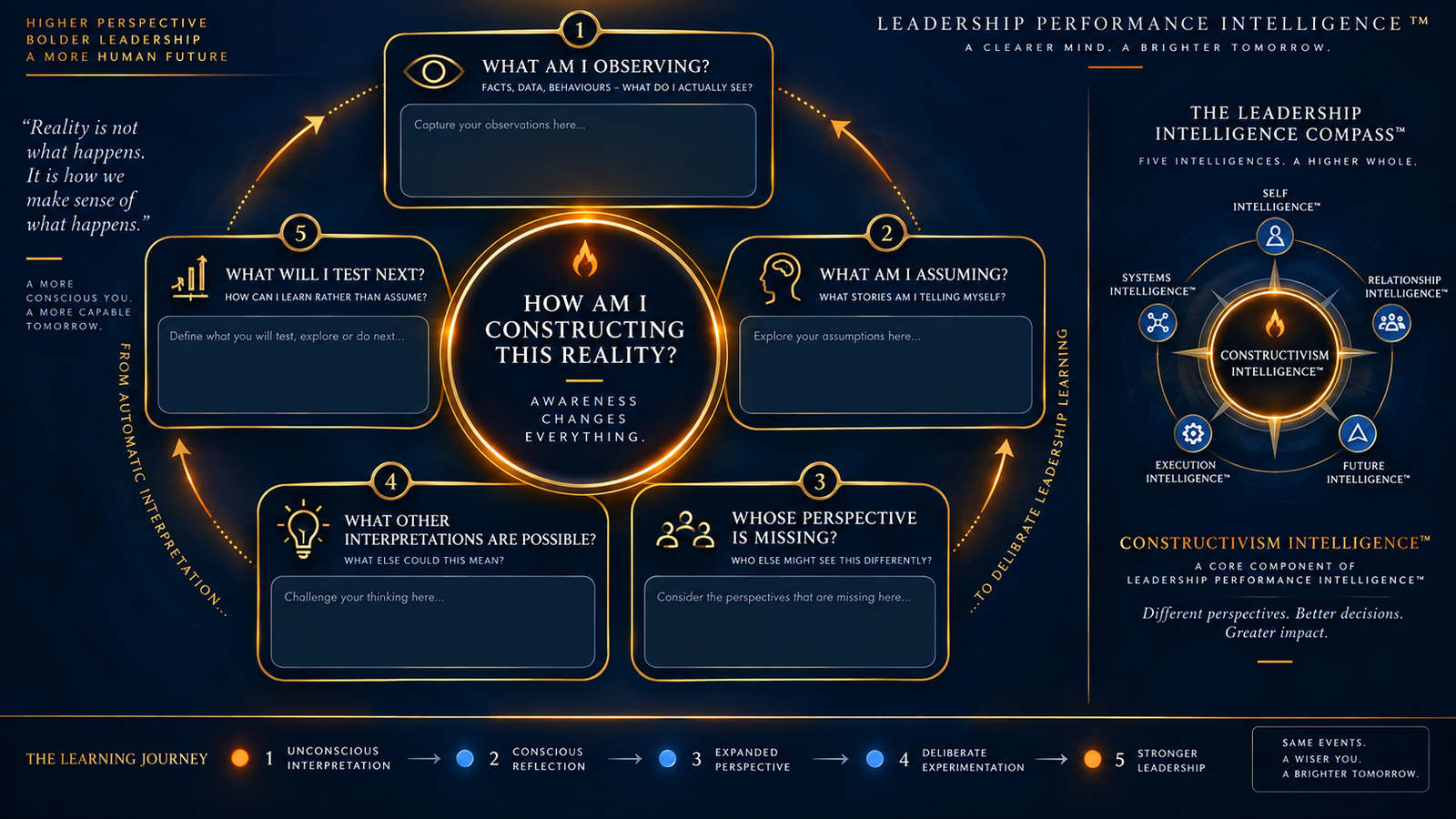
From Leadership Concept to Leadership Practice
The value of Constructivism Intelligence™ is not demonstrated by how well leaders can describe it. It is demonstrated by what changes in the way they lead.
Constructivist leadership becomes visible in ordinary organisational moments: how meetings are conducted, how failures are reviewed, how strategy is developed, how disagreement is handled and how leaders respond when evidence challenges what they previously believed.
The transition does not require organisations to replace every existing leadership process. It requires leaders to change the quality of thinking inside those processes. A performance review can become an exercise in judgement or an opportunity for learning. A strategy meeting can reinforce executive assumptions or test them. A project review can search for someone to blame or investigate what the organisation needs to understand differently. A consultation can become a ritual designed to validate a predetermined answer or a genuine opportunity to improve the answer.
The structure may look similar. The intelligence behind it is different.
The Constructivism Intelligence™ Practice Model
Leaders can begin applying Constructivism Intelligence™ through five recurring practices.
Ask Before You Explain
Leadership pressure encourages explanation. Someone raises a concern and the leader explains; someone disagrees and the leader clarifies. Try replacing the first explanation with a question: “What are you seeing that leads you to that conclusion?” This treats disagreement as potential data rather than a communication problem.
Separate Observation From Interpretation
Teams frequently move directly from events to conclusions. A useful discipline is to divide discussion into three questions: What do we know? What do we think it means? What else could explain it? This reduces the risk of building strategies on assumptions that have quietly acquired the status of facts.
Build Reflection Into Work
Reflection should not be reserved for annual retreats — it belongs inside operational leadership. After a significant project, decision or incident, ask what was expected, what actually happened, where interpretation was accurate, where the team was surprised, and what will change next time.
Make It Safe to Revise an Opinion
Senior leaders may privately realise their original interpretation was incomplete but feel unable to change position for fear of appearing inconsistent. Changing an opinion without evidence may indicate inconsistency; changing an opinion because of better evidence indicates learning. The distinction is fundamental.
Turn Learning Into Organisational Memory
Organisations repeatedly lose valuable knowledge when people leave, projects end or leadership teams change. Constructivist leadership needs a relationship with the wider Leadership Intelligence Library™, capturing decision rationales, post-project reflections, case studies, implementation lessons and recurring patterns so knowledge becomes organisational capability rather than something vulnerable, held only inside individual leaders.
Benefits of Constructivism Intelligence™
When developed carefully, Constructivism Intelligence™ can strengthen several dimensions of leadership performance. It can improve decision quality because assumptions are examined before they become embedded in action. It can strengthen adaptability because leaders become more willing to reconstruct their understanding when circumstances change. It can improve innovation because alternative interpretations are more likely to surface. It can strengthen professional learning because experience becomes material for reflection rather than something merely endured. It can support psychological safety because disagreement becomes a legitimate contribution to thinking rather than an automatic challenge to authority.
And it can strengthen Leadership Sustainability™ because organisational intelligence becomes less dependent upon one leader personally solving every problem.
That final benefit deserves particular attention. Burn Bright’s wider work on leadership burnout argues that sustainable leadership requires systems rather than continual individual heroics. When leaders become the central decision-maker, problem-solver and source of knowledge for every significant issue, both the leader and the organisation become vulnerable.
Risks: When Constructivist Leadership Goes Wrong
Constructivism is not automatically effective simply because leaders involve more people. Poorly implemented, it can create its own problems.
Leadership Reflection Questions
- When someone challenges my interpretation, do I become curious or defensive?
- Which organisational assumptions have become accepted without recently being tested?
- Where are we confusing seniority with interpretive accuracy?
- Do our meetings create genuine opportunities for alternative perspectives?
- How effectively do we distinguish evidence from interpretation?
- What have we experienced repeatedly without learning from?
- Can people safely tell senior leaders, “I see this differently”?
- When did I last change an important leadership view because new evidence emerged?
- How effectively does our organisation capture learning after projects, failures and major decisions?
- Is organisational knowledge distributed, or does too much of it remain concentrated in individual leaders?
Action Steps: Developing Constructivism Intelligence™
Begin with one recurring leadership meeting. Do not redesign the entire organisation.
For the next significant issue, introduce three questions: What do we know? What are we assuming? What else could explain this?
Then identify one assumption worth testing. Invite one perspective that would normally be absent from the discussion.
After action has been taken, schedule a short reflection: what did reality teach us? Capture the resulting insight somewhere accessible so that future teams do not need to rediscover it.
Finally, assess the wider leadership environment. If people are reluctant to question assumptions, the challenge may extend beyond Constructivism Intelligence™ into Emotional Intelligence™, Professionalism Intelligence™, Ethics Intelligence™ or psychological safety. The Leadership Intelligence Compass™ is useful precisely because leadership problems rarely belong entirely to one domain.
Conclusion: Leadership Is the Capacity to Keep Learning
The traditional image of leadership places enormous emphasis on knowing. Know the strategy. Know the market. Know the answer. Know what everyone should do next.
Knowledge remains important. But complex leadership demands another capability: the capacity to reconstruct what you know.
Constructivism Intelligence™ recognises that leaders and organisations operate through interpretations shaped by experience, assumptions, professional identity and context. The intelligent leader therefore does more than communicate conclusions. They investigate how conclusions are being formed. They surface assumptions. They invite competing perspectives. They distinguish evidence from interpretation. They reflect on experience. They revise understanding. And they build organisational systems through which learning can survive beyond the individual leader.
This is not leadership without authority. It is authority strengthened by inquiry. It is not uncertainty replacing confidence. It is confidence capable of surviving examination. And it is not discussion replacing action. It is better understanding producing better action.
Within Leadership Performance Intelligence™, Constructivism Intelligence™ therefore represents a fundamental leadership capability: the ability to turn experience into learning, learning into knowledge and knowledge into stronger future judgement.
What is constructivism leadership?
Constructivism leadership recognises that people develop understanding through experience, interpretation, dialogue and reflection. Leaders therefore create conditions in which people can examine assumptions, integrate different perspectives and construct stronger shared understanding rather than simply receiving answers.
What is Constructivism Intelligence™?
Within Burn Bright Advisory’s Leadership Intelligence Compass™, Constructivism Intelligence™ describes a leader’s capacity to understand and improve how meaning, knowledge and interpretations are constructed through experience, interaction and reflection.
Why is constructivism important in leadership?
Leaders operate in environments where different stakeholders can interpret the same situation differently. Constructivist leadership helps expose those differences, test assumptions and develop better-informed decisions.
Does constructivist leadership mean leaders should avoid making decisions?
No. Constructivism improves the thinking that precedes decisions. Leaders remain responsible for exercising judgement, establishing boundaries and acting when necessary.
Is constructivist leadership the same as collaborative leadership?
They overlap but are not identical. Collaboration describes people working together. Constructivism focuses specifically on how understanding and knowledge develop through experience, dialogue and reflection. Collaboration can support that process.
Can constructivism improve organisational learning?
Yes. When leaders deliberately examine experience, surface assumptions, test interpretations and capture resulting knowledge, organisations are better positioned to convert experience into reusable learning.
How does constructivism support psychological safety?
Constructivist leadership treats alternative interpretations and thoughtful questions as useful contributions rather than automatic threats to authority. This can support environments in which people are more willing to speak up, although psychological safety also depends on wider leadership behaviours and organisational conditions.
How does Constructivism Intelligence™ connect with reflective practice?
Constructivism concerns how understanding develops. Reflective Practice Intelligence™ helps leaders deliberately examine experience. Reflection therefore becomes one mechanism through which leaders reconstruct understanding.
How can leaders develop Constructivism Intelligence™?
Begin by separating observations from interpretations, identifying assumptions, inviting alternative perspectives, reflecting after significant decisions and testing revised understanding through action.
Understand How You Lead Under Pressure
Discover how you construct meaning, handle uncertainty and lead through complexity with the free Leadership Burnout Self-Assessment.
Free Leadership Intelligence
Get Weekly Leadership Insights
Join thousands of leaders receiving practical strategies on burnout prevention, workload design, and sustainable performance every week.