Quick Answer
Key Takeaways
- Accountability starts with clear ownership, not increased supervision.
- Leaders create dependency when they delegate tasks but retain every meaningful decision.
- Effective delegation defines the outcome, authority, resources, timeline and review points.
- RACI helps distinguish who is Responsible, Accountable, Consulted and Informed.
- Building accountable teams reduces decision overload and creates more sustainable leadership capacity.
Building Accountable Teams Without Micromanaging
Building accountable teams is not about finding people who need less management. It is about designing a management system in which people know what they own, what they can decide and what successful delivery looks like.
That distinction matters.
Many overwhelmed leaders believe they have delegated. They have distributed tasks, assigned projects and asked other people to help.
Yet the work keeps coming back.
A team member asks for approval.
A manager escalates a routine decision.
Someone sends a draft and waits for detailed corrections.
A problem reaches the leader that could have been resolved two levels below.
Eventually, the leader concludes that delegation does not work. So they take back control.
In the Burn Bright framework, sustainable delegation means gradually moving ownership away from the leader while building capability and defining decision rights. The aim is not simply to remove tasks from your calendar. It is to create a team capable of carrying responsibility without requiring your continuous involvement.
That matters for performance. It also matters for burnout.
The World Health Organization defines burnout as an occupational phenomenon resulting from chronic workplace stress that has not been successfully managed.
If every important task, decision and problem eventually returns to one leader, chronic overload is not surprising.
It has been designed into the system.
Featured Snippet
Why Do Leaders Struggle to Build Accountable Teams?
Most accountability problems are diagnosed too quickly as people problems. Someone is described as lacking initiative. Another person is said to need too much reassurance. A manager supposedly needs to become “more confident”.
Sometimes individual capability genuinely is the problem. But leaders should examine the architecture before blaming the individual.
Ask a more useful question: what does our management system teach people to do when they encounter uncertainty?
If every meaningful decision requires senior approval, people learn to escalate. If mistakes are punished but good judgement is rarely recognised, people learn to protect themselves. If expectations change after work has been completed, people learn to seek reassurance before acting. If the leader routinely takes work back because completing it personally is faster, people learn that ownership is temporary.
The Accountability Paradox
This creates a common leadership paradox. The more overloaded a leader becomes, the more tempting control becomes.
You check more frequently because there is no capacity for something to go wrong.
You correct work yourself because coaching takes longer.
You retain decisions because explaining the decision framework feels inefficient.
You attend meetings because you cannot risk missing information.
Each choice appears rational in isolation. Collectively, they create dependency.
Your team gets less opportunity to exercise judgement. You become involved in more operational decisions. Your workload expands further. Eventually, your inability to step away becomes evidence that you are “indispensable”.
This is particularly important because managers themselves are already operating under substantial pressure. Deloitte’s 2025 Well-Being at Work research surveyed 3,150 workers, managers and C-suite leaders across the US, UK, Australia and Canada. Only 28% of managers surveyed said they felt completely empowered and capable of supporting employee wellbeing with all the tools and support they needed. Meanwhile, 66% reported at least one organisational barrier preventing them from doing more.
CIPD research tells a similar story. Its 2025 Good Work Index found that only 59% of managers said they had enough time to manage their staff well.
Adding more supervision to an already overloaded management role is not a sustainable solution. We need better architecture.
Accountability Requires Authority
One of the biggest structural mistakes is separating responsibility from authority.
Imagine telling a department head, “You are accountable for improving performance.” Then consider what happens when they try.
Can they change the workflow? No.
Can they redistribute responsibilities? Not without approval.
Can they change meeting structures? No.
Can they approve expenditure? Only after escalation.
Can they challenge an unrealistic deadline? Not really.
An accountable team therefore requires more than a list of responsibilities. People need clearly defined decision rights. They need to know: What can I decide myself? What requires consultation? What genuinely requires approval? What simply needs to be communicated afterwards?
Until those questions are answered, leaders should expect escalation. The solution is structural, not motivational.
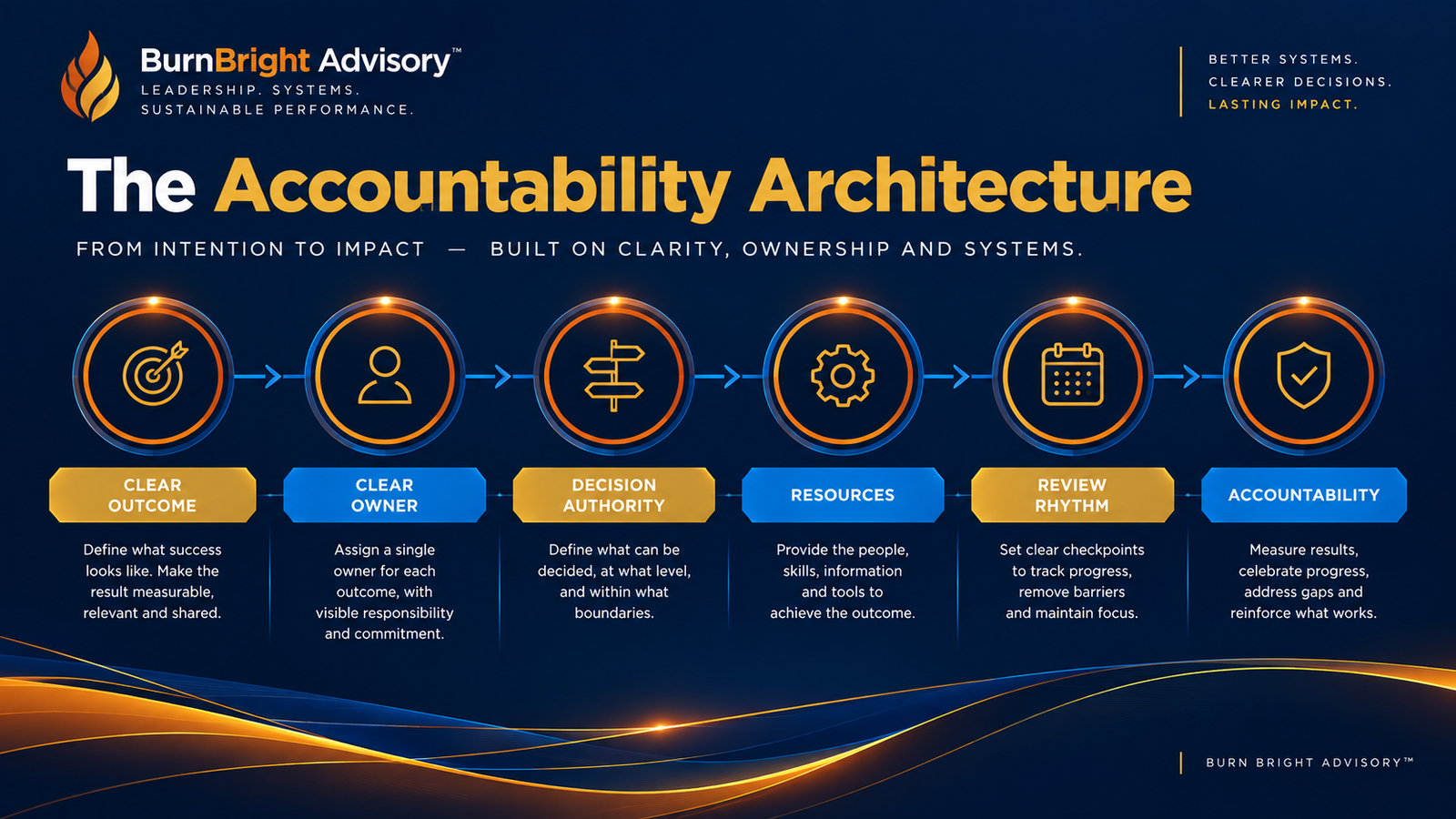
The important point is that accountability sits at the end of this sequence. You cannot reasonably hold someone accountable for an outcome they did not understand, did not have the authority to influence or did not have the resources to deliver.
That is why building accountable teams begins with architecture rather than pressure.
Why Doesn’t Telling People to “Take Ownership” Work?
“Take ownership.” It sounds decisive. But it is one of the least useful instructions a leader can give without further clarification.
Ownership of what?
Within what boundaries?
With what authority?
Measured against which outcome?
By when?
What happens if circumstances change?
When should the person escalate?
When should they act independently?
Without those answers, “take ownership” transfers psychological pressure without transferring operational clarity.
This means moving beyond the traditional task-based model of delegation. Consider two approaches.
A leader using task delegation might say: “Prepare the monthly performance report. Use last month’s template. Update these figures. Send it to me before you circulate it.” The employee owns activity. The leader still owns thinking.
Now consider outcome delegation: “By Friday, I need the leadership team to understand our three biggest performance risks, what has changed since last month and where intervention is required. You own the report and can determine the format. Speak directly with the department heads if you need clarification. Send me the final version Thursday afternoon if there is anything that requires executive escalation.”
Now the employee owns an outcome. There is context. There is authority. There is a deadline. There is an escalation boundary. There is room for judgement.
That is a very different leadership system.
The Cost of Poor Accountability
Poor accountability does more than frustrate leaders. It consumes capacity.
Every unnecessary escalation creates another decision. Every ambiguous responsibility creates another conversation. Every task returned for avoidable correction creates rework. Every unclear approval pathway slows delivery. And every time the leader becomes the default answer to operational uncertainty, the organisation concentrates more cognitive load at the top.
That pattern matters because excessive workload remains strongly associated with unhealthy work. CIPD’s 2025 research found that 25% of UK workers said their job negatively affected their mental health, with excessive workload, pressure, workplace relationships and line-management quality among the strongest associated factors.
Its employee wellbeing research also found high workload among the leading reported drivers when work negatively affects mental health.
The lesson for leaders is straightforward. You cannot keep absorbing organisational ambiguity personally.
How Can RACI Help Build Accountable Teams?
One of the fastest ways to expose an accountability problem is to ask a team a simple question: who owns this?
If three people answer, “We all do,” there is probably a problem. Shared contribution can be valuable. Shared accountability is often much less effective.
When responsibility is vague, decisions slow down. People duplicate work. Problems move sideways through meetings and email chains. Eventually, somebody escalates to the leader because nobody is certain who has the authority to act.
This is where the RACI Delegation Framework becomes useful. RACI separates four roles:
- Responsible — the person doing the work.
- Accountable — the person ultimately answerable for the outcome.
- Consulted — people whose expertise or input is required.
- Informed — people who need visibility but do not need to participate in the decision.
The distinction sounds simple. Its implications are significant.
Many overloaded leaders sit in the Responsible or Accountable column for far too much work. They chair the meeting. Review the document. Approve the expenditure. Resolve the problem. Check the final output. Communicate the decision. Then monitor implementation.
Delegation happens around them, but accountability never really moves. That creates what I call leadership gravity. Everything important is eventually pulled back towards the leader.
The objective of RACI is not to remove leaders from important work. It is to place them at the correct level of involvement. For some responsibilities, you should remain Accountable. For others, you should be Consulted. And for a surprisingly large amount of operational work, you may only need to be Informed.
That final transition can be difficult. It is also where significant leadership capacity is recovered.
Ask Four Questions Before Accepting Another Responsibility
When new work appears, stop automatically asking, “How am I going to fit this in?”
Ask instead: who should be Responsible? Who genuinely needs to be Accountable? Who needs to be Consulted? Who only needs to be Informed?
This changes the conversation from personal capacity to organisational design. That is precisely the shift sustainable leadership requires.
How Do You Delegate Without Losing Control?
The fear behind weak delegation is rarely delegation itself. It is uncertainty.
What if the standard drops?
What if the person makes the wrong decision?
What if I discover the problem too late?
What if I am still held accountable?
Those are reasonable concerns. But the answer is not permanent control. The answer is scaffolded delegation.
Instead of treating delegation as a binary choice between “I do it” and “you do it”, leaders can progressively transfer authority as capability and confidence increase. Think of it as five levels.
Level 1
Investigate
The team member gathers information and brings it back. The leader decides. This is useful when somebody is learning an unfamiliar area or when the consequences of a poor decision are substantial.
Level 2
Recommend
The team member investigates the issue and proposes a course of action. The leader reviews the reasoning and makes the final decision. Now you are developing judgement, not simply collecting information.
Level 3
Decide With Approval
The team member determines what should happen but seeks approval before implementation. The leader remains a control point, but most of the cognitive work has moved.
Level 4
Decide and Inform
The team member has authority to make the decision. They tell the leader what they decided and why. The leader has visibility without becoming a bottleneck.
Level 5
Own
The team member owns the outcome within agreed boundaries. They make routine decisions independently and escalate only when predefined thresholds are crossed. The leader moves towards being Informed, rather than remaining Responsible for execution.
This is sustainable delegation. The goal is not to push every responsibility immediately to Level 5. The goal is to stop keeping capable people at Level 1 because that feels safer.
Control Should Come From the System
There is another important distinction here. Leaders often confuse control with involvement. They are not the same.
You do not need to attend every meeting to maintain control. You need appropriate information.
You do not need to approve every decision. You need clear decision boundaries.
You do not need to check progress every day. You need agreed review points.
You do not need to rewrite somebody’s work. You need a clearly defined quality standard.
Strong management systems allow leaders to retain strategic control while reducing operational involvement. Weak systems require leaders to compensate through constant attention.
That is exhausting.
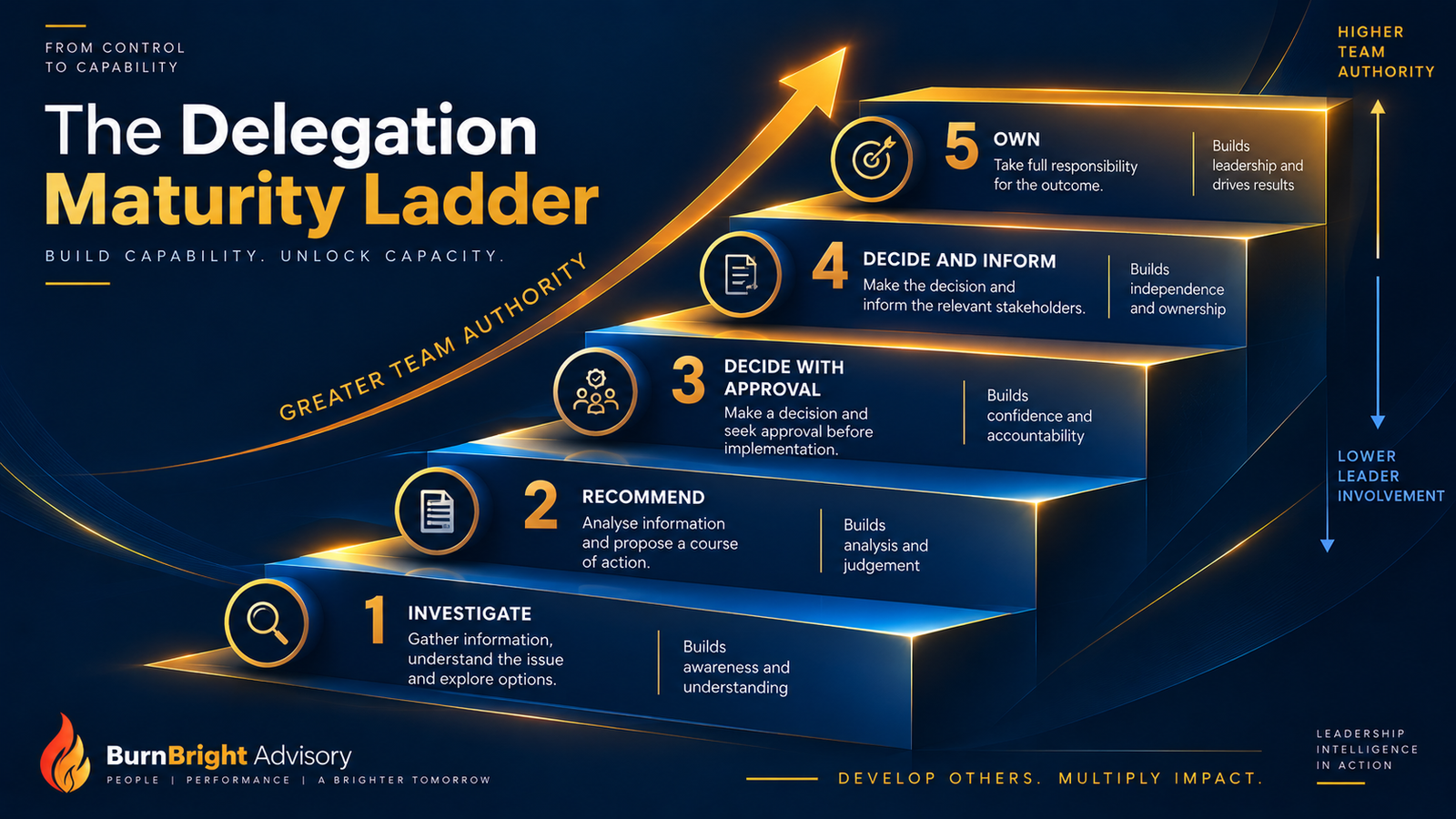
The key movement is not simply from leader does more to team does more. It is from permission dependency to decision capability. As capability increases, leader involvement should decrease. If it does not, delegation has stalled.
What Does Accountable Delegation Look Like in Practice?
Imagine a senior leader who receives a weekly performance report covering six operational teams. Historically, the leader has created much of the report personally. Department heads send information. The leader checks the figures, challenges inconsistencies, rewrites commentary, identifies emerging risks, formats the document and circulates it.
The report takes four hours every week. That is more than 200 hours a year.
The obvious response might be, “Delegate the report.” But handing the document to somebody else is not enough. If the leader still checks every figure, rewrites every paragraph and approves every judgement, the task has moved while the cognitive workload has not.
Instead, redesign the responsibility. A capable operations manager becomes Responsible for producing the report. The senior leader initially remains Accountable for its usefulness to the executive team. Department heads are Consulted where their operational knowledge is required. Other stakeholders are Informed through the final report.
Then define the outcome: the executive team should be able to understand current performance, identify material changes, see the three largest risks and know where intervention is required.
Now establish decision authority. The operations manager can:
- Determine the report format
- Request information directly from department heads
- Challenge inconsistent data
- Determine which routine issues require inclusion
- Make recommendations based on the evidence
The leader does not need to approve routine formatting, wording or data requests.
Finally, establish escalation thresholds. For example, escalation may be required where:
- Performance falls outside an agreed tolerance
- There is significant financial exposure
- A serious people or safeguarding issue emerges
- Two departments cannot resolve a cross-functional problem
- The proposed response requires executive authority
Now accountability has architecture. The manager is not simply completing the leader’s administrative work. They are exercising judgement inside defined boundaries.
Over time, the leader may move from Accountable to Consulted or even Informed for parts of the process. That is how leadership capacity grows.
The Test of Successful Delegation
There is a simple question I use when examining delegated work: if you disappeared for two weeks, would the work continue?
If the answer is no because nobody else can approve routine decisions, you have created dependency. If the answer is no because nobody understands the complete process, you have created dependency. If the answer is no because information exists only in your head, you have created dependency.
And if the answer is, “Yes, but I would return to 200 messages asking me to confirm what everybody already did,” you still have dependency.
Building accountable teams means creating enough clarity that normal work continues without continuous leadership intervention. That does not make the leader irrelevant. It makes the organisation stronger.
Why Is Accountability Different From Micromanagement?
Accountability and micromanagement are sometimes confused because both involve standards. The difference is where control sits.
Micromanagement places control in the leader’s continuous involvement. Accountability places control in the architecture of the work.
| Micromanagement | Accountable Leadership |
|---|---|
| Leader specifies every step | Leader defines the required outcome |
| Frequent approval required | Decision authority is explicit |
| Mistakes trigger tighter control | Mistakes become information for capability development |
| Leader monitors activity | Leader reviews outcomes and agreed indicators |
| Team waits for permission | Team acts within defined boundaries |
| Knowledge stays concentrated | Knowledge and capability are distributed |
| Leader becomes bottleneck | Leader focuses on exceptions and strategic issues |
| Dependency increases | Ownership increases |
This distinction matters. A leader who asks for a clear outcome by Friday is not necessarily micromanaging. A leader who specifies the font, attends every working meeting, requests daily updates, changes minor wording and requires approval before every routine decision probably is.
The question is not, “Am I checking the work?” The better question is, “Does my involvement increase capability, or preserve dependency?”
Sometimes close supervision is appropriate. A new manager may need it. A high-risk project may require it. A significant capability problem may justify it.
But increased supervision should have a reason and, where possible, an exit point. Otherwise temporary support becomes permanent architecture.
How Does Team Accountability Reduce Leadership Burnout?
Delegation is often discussed as a productivity technique. That undersells it.
The Burn Bright framework identifies five structural root causes of burnout:
- Scope creep
- Meeting culture
- Communication chaos
- Decision overload
- Perfectionism culture
Poor delegation can intensify almost every one of them. Scope creep increases because leaders continue accumulating responsibilities. Meeting load increases because the leader believes they must remain involved. Communication expands because everybody copies the leader into everything. Decision overload grows because authority remains concentrated at the top. Perfectionism makes the problem worse because the leader struggles to accept work completed differently from how they would have done it.
The result is predictable. The leader becomes the organisation’s human routing system.
Questions arrive.
Decisions arrive.
Documents arrive.
Problems arrive.
Approvals arrive.
Eventually, even relatively small decisions begin consuming cognitive capacity.
The structural response is to distribute both work and authority. Not recklessly. Not instantly. Deliberately.
This aligns with one of the central principles of the Burn Bright framework: systems thinking over individual heroics.
A heroic leader asks, “How can I handle all of this?” A sustainable leader asks, “Why does all of this require me?”
And that is the deeper purpose of building accountable teams. You are not merely trying to clear your calendar. You are building an organisation that does not depend on your exhaustion to function.
How Can Leaders Build Accountability Without Adding More Pressure?
Accountability fails when it becomes another word for pressure.
“Be more accountable.”
“Take greater ownership.”
“Step up.”
These statements demand a behavioural change without necessarily changing the conditions surrounding the behaviour. That is not enough.
Building accountable teams requires a repeatable management framework. I use five elements.
Element 1 Define the Outcome
Start with the result rather than the activity. Do not simply say, “Run the weekly meeting.” Define why the meeting exists — for example, “Your outcome is to ensure operational risks are identified, assigned and resolved before they affect delivery.”
That gives the person something meaningful to own. It also gives them permission to question whether the existing meeting is even the best mechanism for achieving it.
Element 2 Name One Accountable Owner
Collaboration does not require ambiguous accountability. A project may involve ten people. One person should still know: I own the outcome. This does not mean they personally complete every task — it means they are responsible for ensuring the pieces come together.
Where everybody owns an outcome, nobody can easily determine who should act when it begins to drift.
Element 3 Define Decision Authority
This is where many delegation attempts fail. Tell the person explicitly what they can decide without you — for example, “You can make operational decisions within the agreed budget,” or “Consult me if the issue creates legal, financial or reputational exposure.”
These boundaries reduce uncertainty. More importantly, they prevent the leader from becoming the default approval mechanism.
Element 4 Agree Review Rhythms
Accountability does not mean disappearing. Create predictable review points. A complex new responsibility might require a weekly review initially, moving to fortnightly and eventually monthly as confidence increases.
The important word is predictable. Constant “just checking” messages teach people that you do not trust the system. Scheduled review points allow autonomy between checkpoints while preserving visibility.
Element 5 Review the System, Not Just the Person
When delivery fails, avoid immediately asking, “Who messed up?” Start with, “Where did the system break down?” Was ownership unclear? Did the person lack authority? Was information missing? Was the workload unrealistic? Was the standard poorly defined?
Personal accountability still matters, but individual performance should not become a convenient explanation for structural failure.
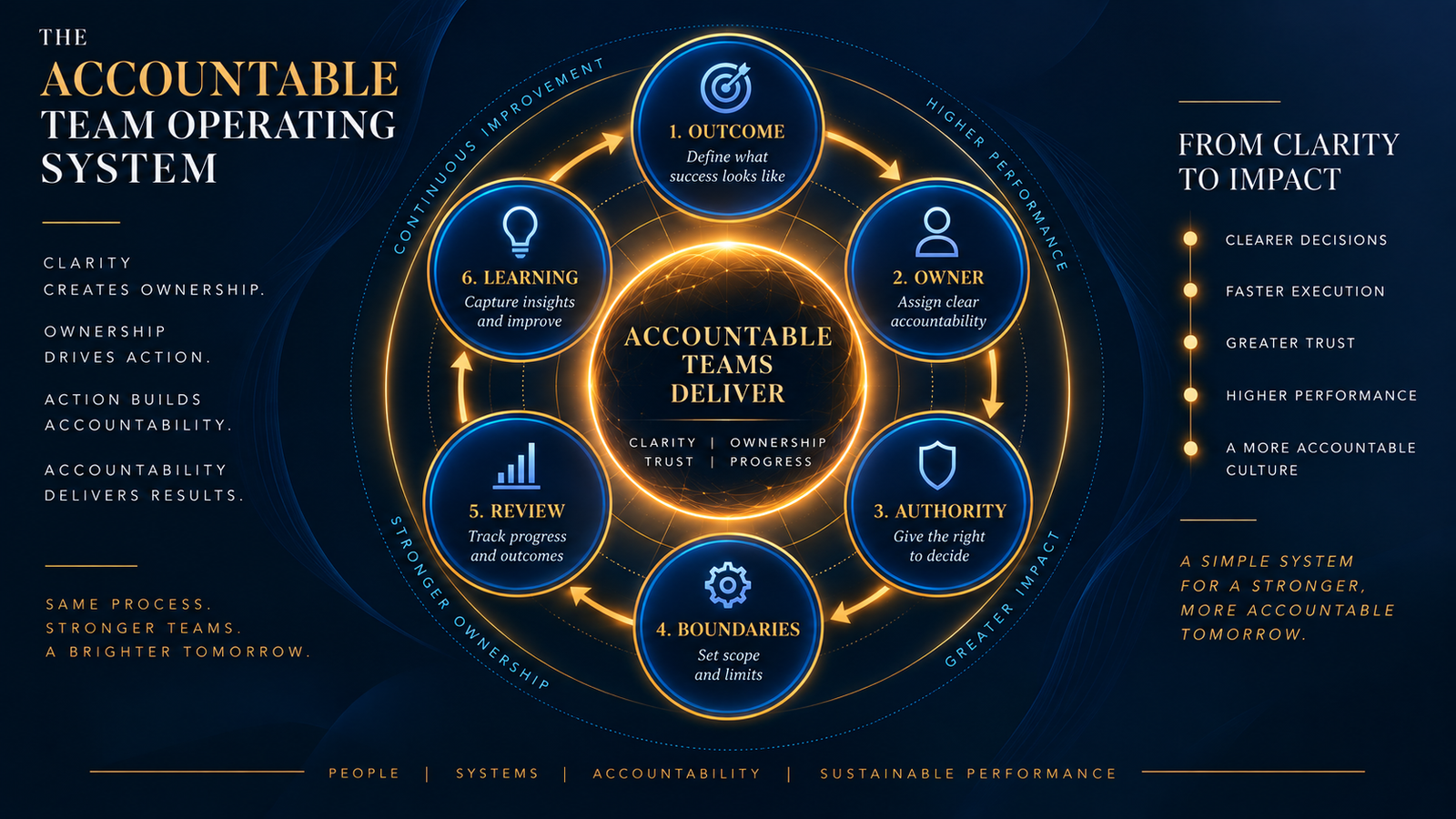
Read the model from left to right. First, establish what needs to happen. Then identify who owns it. Give that person sufficient authority. Define the boundaries around that authority. Establish a review rhythm. Finally, use results — including mistakes — to improve both capability and the system.
That final stage matters. Accountability without learning becomes blame. Accountability with learning builds capability.
What Is the Difference Between Dependency and Accountability?
The distinction becomes clearer when we compare the two systems directly.
| Leader-Dependent Team | Accountable Team |
|---|---|
| Leader is the default problem solver | Problems are resolved at the appropriate level |
| Tasks are delegated | Outcomes and authority are delegated |
| Decisions move upwards | Decision rights are distributed |
| Leader attends most important meetings | Leader attends where their contribution is required |
| Team seeks frequent permission | Team acts within agreed boundaries |
| Information is copied to everyone | Information follows defined communication pathways |
| Mistakes cause tighter control | Mistakes trigger review and learning |
| Leader carries organisational knowledge | Knowledge is documented and distributed |
| Progress depends on leader availability | Work continues without constant intervention |
| Leader becomes increasingly overloaded | Leadership capacity is protected |
| Heroic effort sustains performance | Systems sustain performance |
The difference is not whether leaders care about standards. Both systems may have demanding standards. The difference is how those standards are maintained.
In a dependent system, the leader personally holds everything together. In an accountable system, the architecture holds the work together.
What Should Leaders Do This Week?
Do not try to redesign your entire organisation tomorrow. Start with diagnosis.
Look at the next seven days in your calendar and workload. Identify three recurring responsibilities that consume your time. For each one, ask: why am I involved?
Then classify your current role using RACI: Responsible? Accountable? Consulted? Informed?
Now ask a harder question: what is the lowest appropriate level of involvement for me?
Perhaps you genuinely need to remain Accountable. Fine. But do you also need to be Responsible? Perhaps you need to be Consulted. Fine. But why are you attending every operational meeting? Perhaps you only need to be Informed. If so, why are six people waiting for your approval?
This exercise exposes unnecessary leadership involvement quickly.
Then choose one responsibility to redesign. Do not simply hand it to somebody. Define the outcome. Choose the owner. Clarify authority. Set boundaries. Agree review points. Then allow the system to work.
There may be mistakes. That does not automatically mean delegation failed. The relevant question is whether those mistakes reveal a capability gap, an unclear boundary or a flaw in the system.
Fix what the evidence tells you to fix. Then continue.
What does building accountable teams mean?
Building accountable teams means creating a working environment where people understand the outcomes they own, the decisions they can make and the standards they are expected to meet. Leaders provide clarity and appropriate oversight without remaining involved in every operational step. Effective accountability distributes ownership while maintaining clear responsibility for results.
How do you create accountability without micromanaging?
Define outcomes, decision rights, boundaries and scheduled review points. Then allow the person responsible to determine how the work gets done within those parameters. Micromanagement controls activity continuously. Accountability establishes expectations and reviews results. The stronger the management architecture, the less continuous supervision should be necessary.
What is the RACI framework?
RACI defines four roles around work: Responsible, Accountable, Consulted and Informed. Responsible identifies who completes the work. Accountable identifies who ultimately owns the outcome. Consulted identifies people whose input is required. Informed identifies people who need visibility. It helps prevent unclear ownership and unnecessary leadership involvement.
Why do employees keep escalating decisions to managers?
Repeated escalation can indicate unclear decision authority rather than unwillingness to take responsibility. Employees may have learned that acting independently creates risk, while asking permission is safer. Leaders can reduce unnecessary escalation by defining which decisions employees can make, when consultation is required and which exceptions genuinely require senior approval.
Does delegation reduce leadership burnout?
Well-designed delegation can reduce structural contributors to leadership burnout by distributing workload, decisions and operational responsibility. Delegating tasks while retaining every decision provides much less relief. Sustainable delegation transfers appropriate authority alongside responsibility, reducing the leader’s role as the organisation’s default problem solver and approval point.
What should a leader never delegate?
Some responsibilities should remain with the leader because of their role, governance obligations or strategic importance. These may include certain high-impact people decisions, confidential matters, statutory responsibilities and decisions that genuinely require the leader’s authority. However, retaining accountability does not mean the leader must personally complete every supporting task.
Building Accountable Teams Is a Leadership System
Building accountable teams requires more than telling people to take responsibility.
People need to understand the outcome. They need clear ownership. They need enough authority to make appropriate decisions. They need boundaries. They need predictable review points. And they need leaders who can distinguish oversight from constant involvement.
This matters because the alternative carries a substantial leadership cost. When every question, approval, decision and problem travels upwards, the leader becomes a bottleneck. More effort may keep that system functioning temporarily, but it does not make the system sustainable.
Leaders cannot outwork broken systems.
The better question is not, “How can I personally keep control of everything?” It is, “What structure would allow good work to happen without everything depending on me?”
That is the shift from heroic leadership to sustainable leadership.
Better systems outperform more effort. And when accountability is properly designed, both the team and the leader become stronger.
Ready to Diagnose Where Leadership Overload Is Building?
If delegation still leaves you overloaded, the problem may sit deeper in the architecture of your role. Use the free assessment to identify where workload, decision pressure and unsustainable leadership patterns may be accumulating.
Free Leadership Intelligence
Get Weekly Leadership Insights
Join thousands of leaders receiving practical strategies on burnout prevention, workload design, and sustainable performance every week.