Quick Answer
Key Takeaways
- No single leader possesses all the knowledge required to understand complex organisational problems.
- Constructivism Intelligence™ treats leadership as the disciplined construction of understanding, not the transmission of answers.
- The core leadership shift is from “What is the answer?” to “What do we need to understand before deciding?”
- Shared understanding is not the same as consensus — people can understand a decision fully while still disagreeing with it.
- Applied without judgement, constructivism can produce analysis paralysis, false equivalence or performative consultation.
- Constructivist leadership builds Leadership Capacity™ and Leadership Sustainability™ by reducing organisational dependence on any one individual.
Constructivism Leadership: Why the Strongest Leaders Build Understanding Instead of Supplying Answers
Leadership has traditionally rewarded the person who knows. The leader is expected to interpret the situation, identify the answer, communicate the direction and ensure that others execute it. That model can work when problems are familiar, information is concentrated at the top and the environment is relatively predictable.
It becomes considerably less reliable when organisations operate in conditions of complexity. A senior executive may understand strategy but not what customers are experiencing on the frontline. A school principal may understand institutional priorities but not everything occurring inside individual classrooms. A healthcare leader may understand performance data without possessing the clinical observations distributed across multidisciplinary teams.
The problem is not necessarily that leaders lack knowledge. It is that no individual possesses all the knowledge required to understand increasingly complex leadership problems.
Constructivism leadership offers a different way of thinking. Rather than treating leadership as the transmission of answers, it treats leadership as the disciplined construction of understanding. People bring experience, professional knowledge, evidence, assumptions and perspectives into a shared process. Through inquiry, dialogue and reflection, those fragments can become a more coherent picture of what is actually happening.
Within Burn Bright Advisory’s Leadership Performance Intelligence™ framework, this capability is expressed through Constructivism Intelligence™: the capacity to create stronger leadership understanding by actively examining how knowledge is formed, interpreted, challenged and reconstructed.
This does not mean abandoning expertise. It means recognising its limits. The constructivist leader still makes decisions, establishes standards and accepts accountability. But instead of assuming that authority automatically provides superior understanding, the leader deliberately creates conditions in which organisational intelligence can surface.

What Is Constructivism Leadership?
Featured Snippet
Leadership encounters this phenomenon every day. Consider a declining performance indicator. The finance director may interpret it as a cost problem. The operations leader may see a process problem. HR may identify a capability issue. Employees may describe an unrealistic workload. Customers may experience the problem as declining service quality.
Each perspective contains information.
None necessarily contains the whole explanation.
A conventional leadership response may be to decide which interpretation is correct. A constructivist leadership response begins differently: what is each perspective revealing that the others cannot see?
That question changes the leadership process. Instead of immediately collapsing complexity into one explanation, the leader creates space to examine how different interpretations have been constructed. This is the foundation of Constructivism Intelligence™.
It requires leaders to recognise that organisational knowledge is distributed. People closest to customers possess knowledge senior executives may not have. Employees performing operational work understand friction that dashboards may conceal. Different professions notice different risks. New employees sometimes see assumptions that long-serving colleagues no longer question.
Leadership intelligence therefore depends partly on the ability to connect these fragments. The objective is not endless discussion. It is better understanding in service of better action.
The Leadership Risk of Becoming the Person Who Always Knows
Expertise is essential to leadership. But expertise can create an unexpected vulnerability. The more senior a leader becomes, the more likely other people are to assume that the leader should know the answer. Eventually, leaders may begin making the same assumption about themselves.
Questions become statements.
Exploration becomes explanation.
Meetings become opportunities to confirm a direction rather than investigate a problem.
People learn that challenging the prevailing interpretation creates friction, so they become increasingly selective about what they raise. The leader may still receive enormous quantities of information while simultaneously becoming less exposed to alternative interpretations.
This creates an important distinction between information volume and understanding quality. A leader can receive hundreds of reports, attend dozens of meetings and monitor sophisticated dashboards while still misunderstanding what is happening. Why? Because data does not interpret itself. People interpret data. And interpretation is shaped by assumptions.
Constructivism Intelligence™ therefore asks leaders to become interested not only in what they know, but also in how they came to know it:
- What evidence shaped this conclusion?
- Whose experience contributed to it?
- Which voices are missing?
- What assumptions are being treated as facts?
- What alternative explanation could also fit the evidence?
- What might someone closer to the issue notice that senior leadership cannot?
These are not signs of indecision. They are mechanisms for improving the quality of leadership judgement. The strongest leaders are not necessarily those who enter every conversation with the clearest answer. Sometimes they are the leaders capable of creating the clearest collective understanding.
From Knowledge Transmission to Knowledge Construction
Traditional organisational communication often follows a transmission model. Leadership develops the strategy. Managers receive it. Teams implement it. Information moves downward through the organisation.
Constructivist leadership introduces another direction of movement. Knowledge also travels upward, sideways and across professional boundaries. The organisation becomes less like a broadcast system and more like an intelligence network.
| Transmission Model | Constructivist Model |
|---|---|
| Leader → Answer → Team → Execution | Experience → Inquiry → Dialogue → Reflection → Shared Understanding → Decision → Action |
| Knowledge moves downward only | Knowledge travels upward, sideways and across professional boundaries |
| The leader possesses or determines the knowledge | The organisation constructs understanding together before deciding |
| Speed comes from certainty | Speed comes from shared understanding |
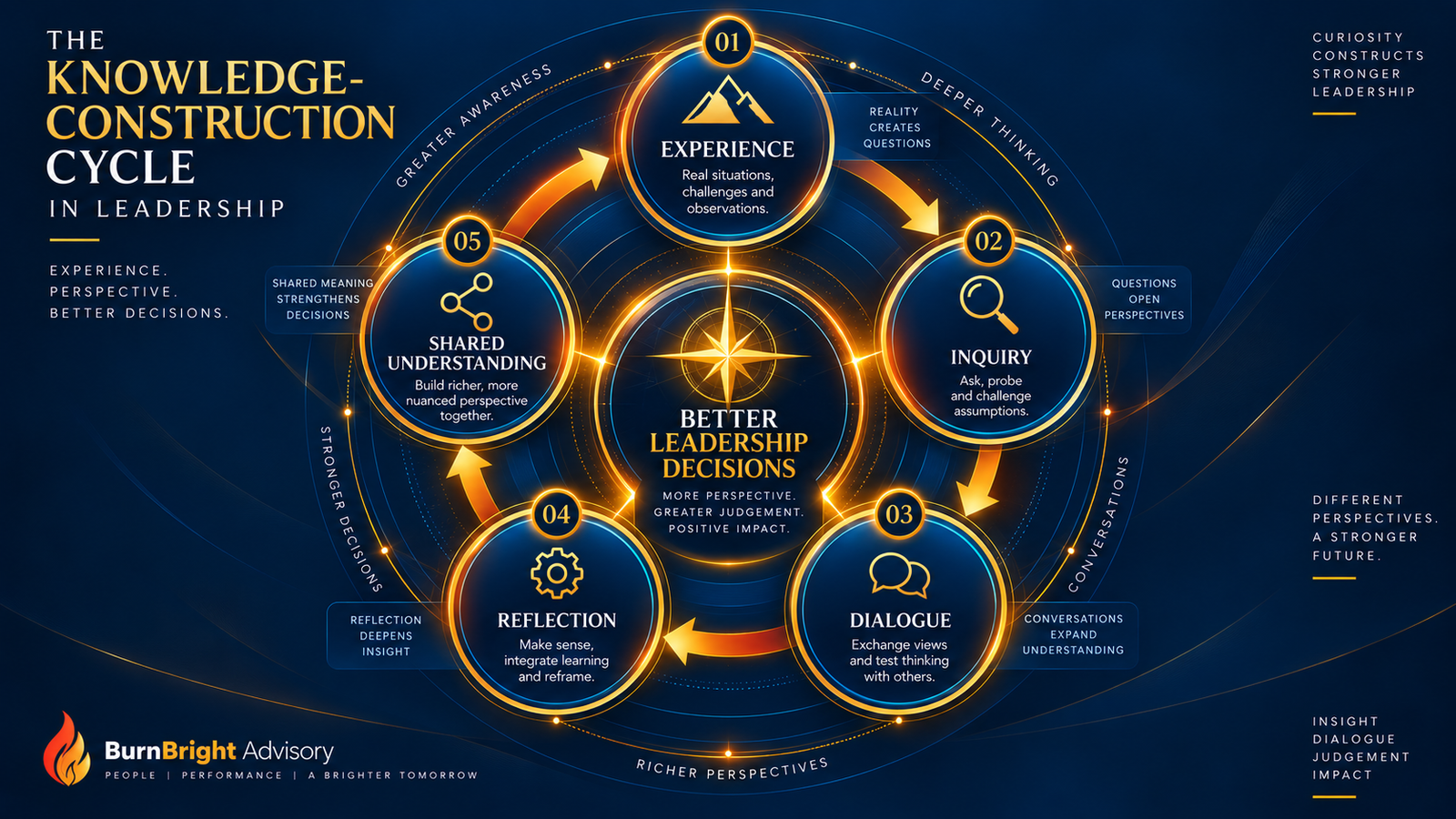
The difference becomes particularly important when dealing with complex problems. If a machine has stopped because one component has failed, expert diagnosis may quickly identify the answer. If employee turnover is increasing across several departments, however, there may be no single cause. Compensation could matter. Management behaviour could matter. Workload could matter. Career development could matter. Organisational change could matter. Different factors may interact.
Immediately selecting one explanation can produce an efficient response to the wrong problem. Constructivist leadership slows down one part of leadership in order to improve another. It slows premature certainty. It does not necessarily slow action. In fact, when teams develop a stronger shared understanding of a problem, implementation can become faster because people understand not only what is being done, but why.
The Five Elements of Constructivism Intelligence™
Burn Bright Advisory™ frames Constructivism Intelligence™ as a practical leadership capability rather than an abstract educational theory. Five elements are particularly important.
Element 1
Experience
Every organisation contains a vast reservoir of lived experience. Employees know where processes break. Customers know where services frustrate them. Managers know where policies collide with operational reality. Constructivist leaders treat experience as evidence to investigate rather than anecdote to dismiss. Experience is partial, but it can reveal questions that formal data has not yet captured.
Element 2
Inquiry
Constructivist leaders ask questions designed to expand understanding. Instead of “What went wrong?” they might ask “What were people experiencing before the problem became visible?” Instead of “Why didn’t the team follow the process?” they might ask “What made the process difficult to follow in practice?” Inquiry shifts leadership from judgement toward investigation.
Element 3
Dialogue
Dialogue is more than allowing people to speak. Its purpose is to expose different interpretations to one another. A finance perspective may challenge an operational assumption. A frontline perspective may expose a flaw in executive reasoning. The value lies in the interaction — understanding develops because perspectives meet.
Element 4
Reflection
Without reflection, organisations can repeat experience without learning from it. Reflective leadership creates deliberate space to examine what happened, why it happened, what assumptions influenced decisions and what should change next time. Experience provides material; reflection converts that material into learning.
Element 5
Shared Understanding
The objective is not universal agreement. Shared understanding means that people have developed sufficient clarity about the problem, evidence, constraints and competing perspectives to act intelligently together. Consensus asks “Do we all agree?” Constructivism asks “Do we understand the situation well enough to move forward?” Leadership frequently requires the second without achieving the first.
Why Constructivism Leadership Matters More in Complex Organisations
Complexity changes the nature of leadership. When cause and effect are obvious, expertise can often provide rapid answers. When multiple systems interact, certainty becomes more difficult.
Consider a hospital trying to reduce patient waiting times. The apparent solution may be to increase clinical capacity. But deeper inquiry could reveal delays in discharge processes, diagnostic bottlenecks, scheduling patterns, administrative duplication or communication failures between departments. A leader looking only at the headline metric sees waiting time. A constructivist leader asks how the system is producing that outcome.
The same principle applies in education. Declining student outcomes may initially appear to be an instructional problem. Dialogue with teachers, students, families and support teams may reveal a more complicated interaction involving attendance, curriculum design, workload, assessment practices or student wellbeing.
In business, falling customer retention may look like a sales problem while the deeper causes sit across product design, service delivery, pricing and customer expectations. Complex problems frequently cross organisational boundaries. Yet organisations tend to divide knowledge into departments. Constructivism Intelligence™ helps reconnect what organisational structures separate.
Leadership performance is not simply the ability to act. It is the ability to understand sufficiently well before, during and after action. That requires leaders who can combine expertise with curiosity, authority with inquiry and decision-making with reflection. The result is not weaker leadership — it is leadership operating with a larger field of intelligence.
The Constructivism Intelligence™ Leadership Cycle
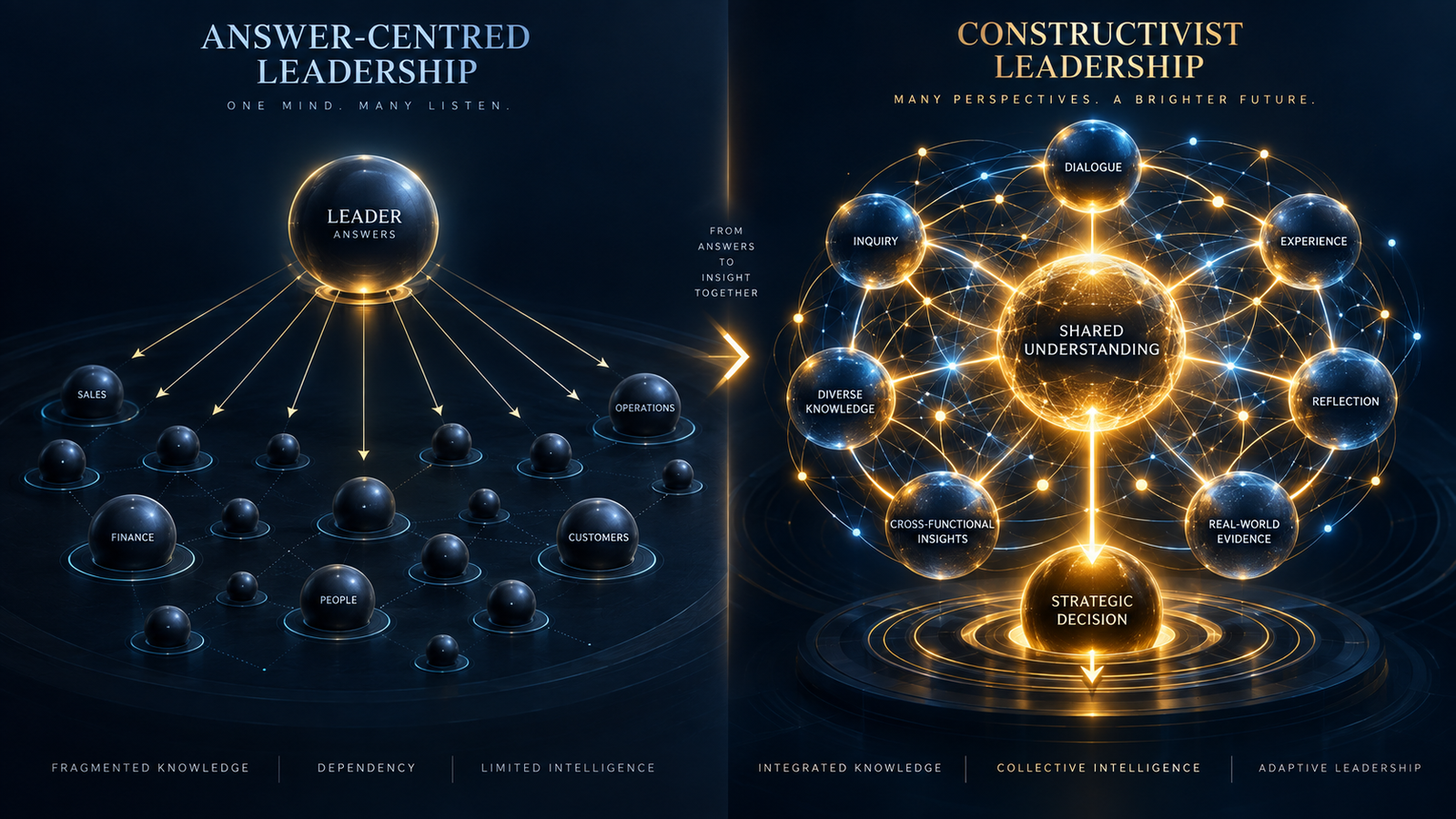
Constructivist leadership becomes useful when it moves beyond philosophy and changes how leaders actually work. The practical challenge is straightforward: leaders cannot investigate everything indefinitely. Organisations still require decisions, priorities, accountability and action. Constructivism Intelligence™ therefore needs discipline.
Action produces new information. A decision that appeared sensible in a meeting may behave differently when it encounters operational reality. Constructivist leadership therefore treats implementation not as the end of thinking, but as the beginning of another learning cycle.
Instead of: We decided, therefore we were right.
The mindset becomes: We decided based on our best current understanding. Now we must observe what the decision teaches us.
Stage 1 — Surface Experience
Begin with what people are actually experiencing. Before analysing dashboards or proposing solutions, leaders need access to the lived reality of the system: where is friction occurring, what has changed, and where does formal policy differ from actual practice?
Stage 2 — Investigate Through Inquiry
Resist premature explanation. Good inquiry separates observation from interpretation — for example, “turnover has increased” is an observation; “employees are leaving because compensation is inadequate” is an interpretation. Constructivist leaders make that distinction visible.
Stage 3 — Create Meaning Through Dialogue
Different perspectives now need to encounter one another. A productive leadership conversation compares evidence, questions assumptions and identifies where interpretations converge or diverge. The leader’s role is to make difference useful, not to eliminate it prematurely.
Stage 4 — Reflect
Reflection asks what the conversation has changed: what do we understand now that we did not before, which assumption has weakened, and what remains uncertain? Reflection converts discussion into leadership learning.
Stage 5 — Construct Shared Understanding
The organisation develops a working interpretation — not perfect knowledge, not permanent certainty, but a sufficiently robust understanding from which responsible action can follow.
Stage 6 — Decide and Act
Authority remains necessary. Constructivist leadership does not require every decision to become democratic; it requires the decision-making process to make intelligent use of relevant knowledge, with assumptions named openly.
Stage 7 — Learn From What Happens Next
Once action begins, reality becomes another source of evidence. Did the intervention produce the expected result? What should be retained, adapted or abandoned? Leadership becomes a continuous process of construction, action and reconstruction.
Constructivism Leadership Does Not Mean Consensus Leadership
One of the easiest ways to misunderstand constructivism leadership is to assume that every perspective must carry equal weight or every decision requires consensus. Neither is true.
Different perspectives can be valuable without being equally supported by evidence. A subject-matter expert may possess knowledge that others do not. Legal, clinical, financial or safety requirements may sharply constrain available choices. Constructivism Intelligence™ does not erase these realities — instead, it asks leaders to understand the knowledge architecture surrounding a decision: who possesses relevant expertise, who possesses relevant experience, who will experience the consequences, and who ultimately holds accountability.
This prevents collaboration from becoming performative. Inviting twenty people into a room is not automatically constructivist leadership. Neither is running a workshop, collecting sticky notes or asking employees for ideas when the decision has already been made. Genuine knowledge construction requires the possibility that what leaders hear could change what they understand. Without that possibility, participation becomes theatre.
From Expert Leader to Constructivist Leader
The transition does not require leaders to become less knowledgeable. It requires them to use expertise differently. The traditional expert leader can become the gravitational centre of organisational thinking — questions travel upward, answers travel downward — and over time, employees learn that leadership value comes from providing certainty. This creates dependency.
Constructivist leaders attempt to build capability instead. Rather than answering every question immediately, they may ask:
- What are you noticing?
- What evidence is shaping your interpretation?
- What alternatives have you considered?
- Who else sees part of this problem?
- What would change your conclusion?
These questions move thinking back into the organisation. The leader is no longer merely solving the immediate problem — the leader is strengthening the organisation’s ability to understand future problems. That is the difference between providing an answer and developing Leadership Capacity™.
Constructivism Intelligence™ Across Leadership Sectors
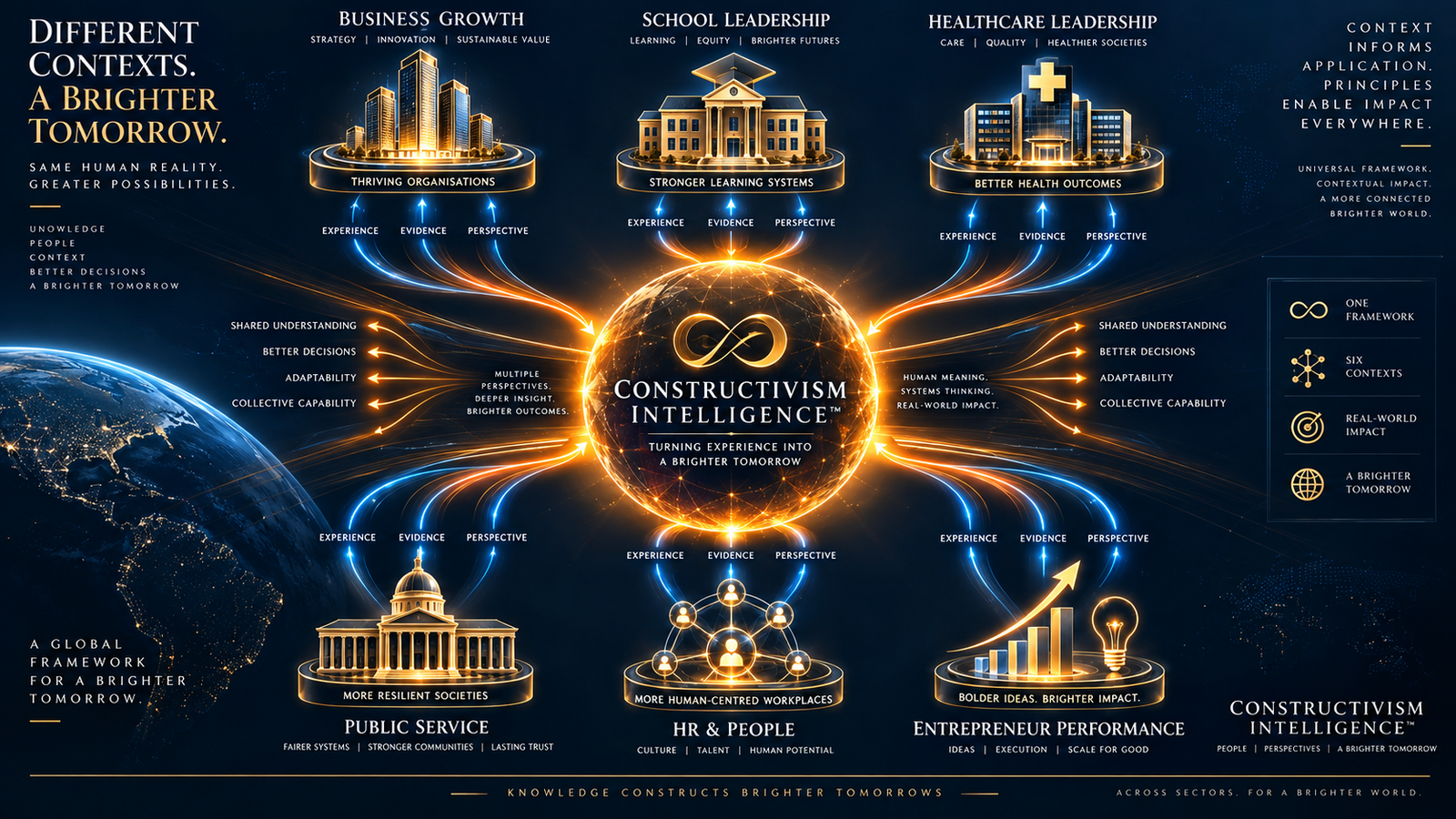
Because knowledge is distributed differently across organisations, constructivist leadership takes different forms in different environments. The underlying principle remains consistent: leadership understanding improves when relevant experience, evidence and perspective are deliberately connected.
Business Growth Intelligence™
When customer retention declines, sales, marketing, operations, product and finance often blame different causes. A constructivist leader examines customer data alongside frontline experience rather than selecting the most persuasive single explanation, often finding that retention is emerging from an interaction between onboarding, product complexity and service responsiveness.
School Leadership Intelligence™
Declining attendance might initially look like weak family engagement. Inquiry with students, teachers, families and pastoral teams can reveal curriculum disengagement, timetable issues, transport difficulties or anxiety patterns that attendance data alone cannot explain.
Healthcare Leadership Intelligence™
A patient journey crosses clinical, administrative and operational boundaries. A delay that appears operational from one perspective may have clinical consequences from another, so constructivist healthcare leadership depends on disciplined interdisciplinary dialogue.
Public Service Leadership Intelligence™
Citizens, frontline employees, policy teams and finance teams often hold competing legitimate perspectives. Constructivist leadership examines these without pretending every stakeholder wants the same outcome — shared understanding does not require shared preference.
HR & People Leadership Intelligence™
An employee described as “disengaged” may be experiencing workload overload, unclear role expectations or unresolved team conflict. Constructivist people leadership investigates the interaction between person, role, manager, team and system rather than settling on a single label.
Entrepreneur Performance Intelligence™
Founder intuition, trusted because it helped create the organisation, can become orthodoxy as the business grows. Constructivist entrepreneurship requires a shift from being the primary source of organisational knowledge to becoming an architect of organisational learning.
Where Constructivism Leadership Can Fail
Every leadership capability becomes dysfunctional when applied without judgement. Constructivism is no exception.
Constructivism and the Leadership Intelligence Compass™
Constructivism Intelligence™ becomes more powerful when understood as part of a wider leadership system. It interacts particularly closely with several other domains of the Leadership Intelligence Compass™.
- Reflective Practice Intelligence™ enables leaders to examine experience and convert it into learning.
- Knowledge Development Intelligence™ strengthens the acquisition, testing and development of organisational knowledge.
- Emotional Intelligence™ helps leaders create conversations in which disagreement can occur without unnecessary defensiveness.
- Adaptability Intelligence™ enables leaders to revise strategies when new understanding changes the situation.
- Ethics Intelligence™ asks whose perspectives, interests and consequences are being considered.
- Professionalism Intelligence™ provides the standards and disciplined judgement necessary to prevent openness from becoming ambiguity.
Effective leadership cannot be reduced to possessing individual competencies. A leader may be highly reflective but unwilling to change, highly knowledgeable but unable to hear alternative perspectives, or highly adaptive but insufficiently anchored by professional or ethical standards. Leadership intelligence emerges through the relationships between these capabilities.
A Practical Constructivism Intelligence™ Framework for Leaders
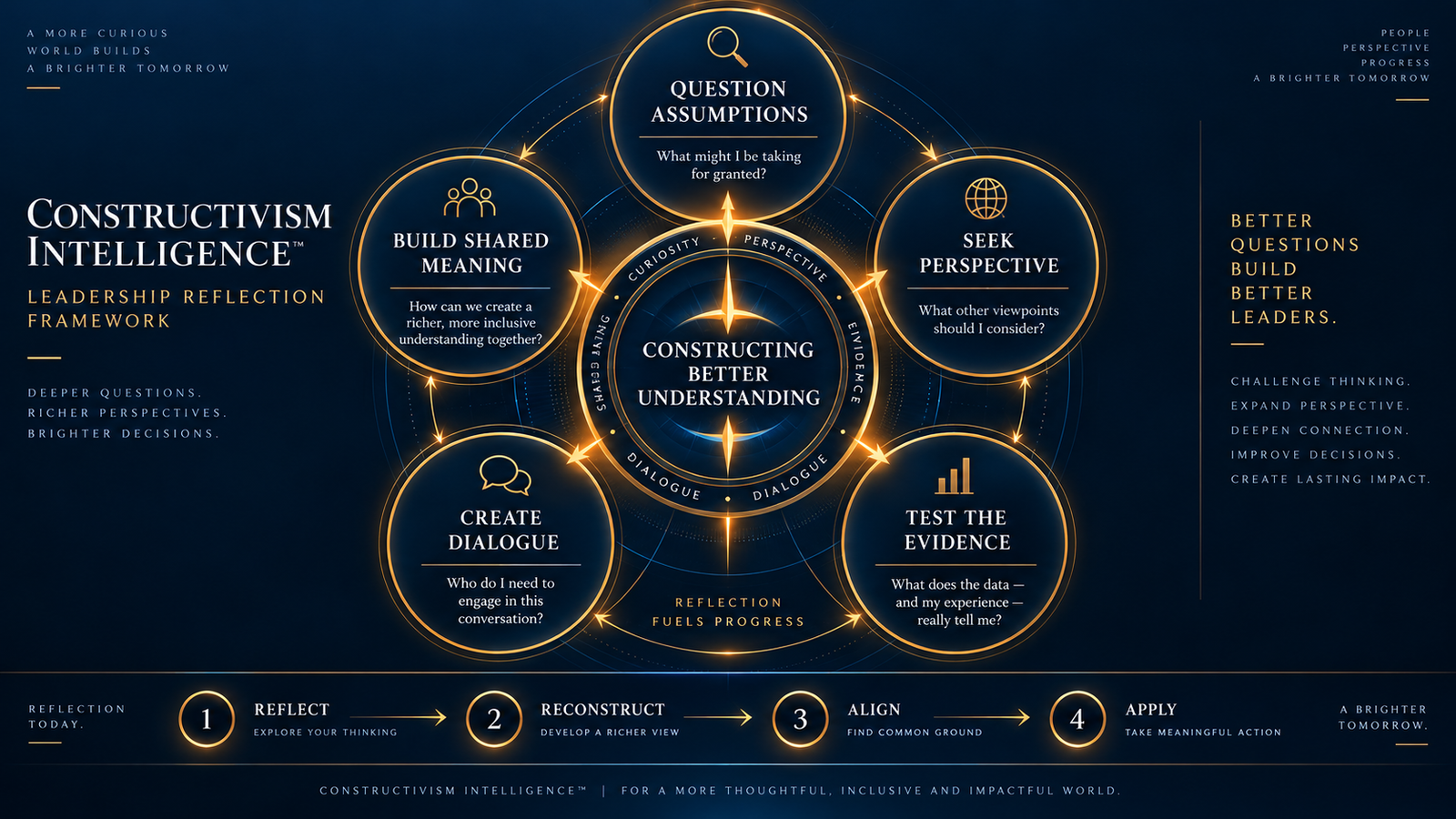
Before your next significant decision, use five questions.
Question 1 What do we currently believe?
State the prevailing interpretation clearly. Do not hide assumptions inside vague language.
Question 2 How did we construct that belief?
Identify the evidence, experience and assumptions supporting it.
Question 3 What perspective is missing?
Look beyond hierarchy. Ask who possesses knowledge because they are closer to the work, customer, patient, student, system or consequence.
Question 4 What could challenge our interpretation?
Actively search for contradictory evidence rather than merely confirming the current view.
Question 5 What will we monitor after acting?
Identify the signals that would suggest the decision or underlying assumptions need reconsideration.
These five questions turn constructivism from an intellectual concept into a repeatable leadership discipline. When leaders learn to mobilise intelligence distributed across the organisation, leadership capacity expands and the organisation becomes less dependent on individual heroics. That connects Constructivism Intelligence™ directly with Leadership Sustainability™.
From Constructivist Leadership to a Learning Organisation
The deeper value of Constructivism Intelligence™ appears when it stops being something an individual leader practises and becomes something the organisation routinely does. A constructivist organisation does not assume that seniority automatically produces the best interpretation, does not confuse previous success with permanent knowledge, and does not treat mistakes only as failures to be corrected.
Instead, it develops mechanisms through which experience can become evidence, evidence can be examined through dialogue, assumptions can be challenged and new understanding can influence action. Meetings become places where assumptions can be tested rather than simply updates delivered. Reviews examine why outcomes occurred rather than merely whether targets were achieved.
This matters because organisations do not automatically learn simply because their people accumulate experience. Experience can reinforce poor assumptions just as easily as it can challenge them. Learning requires reflection, and meaningful reflection requires leaders who are willing to discover that their original interpretation was incomplete.
The Leadership Advantage of Saying “We Need to Understand This Better”
Leadership culture often rewards certainty. Senior people are expected to know. Questions can feel less impressive than answers. Changing one’s position can be interpreted as inconsistency rather than learning. Yet complex environments make permanent certainty increasingly difficult to sustain.
A leader who says “we need to understand this better before deciding” is not necessarily avoiding responsibility — the statement can represent disciplined judgement. The important distinction is what happens next. If uncertainty produces inactivity, leadership performance suffers. If uncertainty produces structured inquiry, better evidence, broader perspective and clearer decision-making, it becomes productive.
We must act.
And our current understanding may be incomplete.
Together, they describe intelligent leadership under uncertainty.
Building Leadership Capacity™ Rather Than Leadership Dependency
If an organisation depends on one person to interpret every problem, approve every judgement and provide every answer, apparent leadership strength may conceal organisational weakness. The leader becomes a bottleneck: people escalate rather than think, managers wait rather than decide, and teams become skilled at interpreting what the leader wants rather than what the situation requires.
Constructivist leadership attempts to reverse that dependency. People are expected to investigate. Managers learn to distinguish evidence from assumption. Decision-making capability spreads. Sustainable leadership is not created merely by helping an individual leader tolerate more pressure — it is created partly by reducing unnecessary dependence on that individual.
Conclusion: Leadership Is Not About Knowing Everything
The enduring image of leadership is often the person at the front of the room with the answer. Complex organisations require something more sophisticated: leaders capable of recognising that knowledge is distributed, interpretations are constructed and even experienced professionals can mistake assumptions for facts.
Constructivism leadership does not ask leaders to abandon expertise, authority or accountability. It asks them to use those things more intelligently. Expertise becomes a contribution to understanding rather than proof of infallibility. Authority creates conditions for inquiry rather than closing inquiry prematurely. Dialogue becomes a mechanism for improving judgement. Reflection converts experience into learning. And decisions become hypotheses that reality will continue to test.
From telling to investigating.
From certainty to disciplined curiosity.
From individual expertise to distributed intelligence.
From answers to understanding.
The strongest leadership system is not one in which the leader always knows what to think. It is one in which people throughout the organisation become increasingly capable of thinking well together. That is not leadership surrendering authority — it is leadership expanding intelligence.
Leadership Reflection Questions
- Where in my leadership do people expect me to provide answers that they could help construct?
- Which of my current leadership assumptions have I treated as facts?
- Whose experience is currently underrepresented in our decision-making?
- When someone challenges my interpretation, do I become curious or defensive?
- Where does valuable frontline knowledge struggle to reach senior decision-makers?
- Do our meetings genuinely change understanding, or mainly communicate decisions and reinforce existing positions?
- How effectively do we distinguish evidence, experience, interpretation and assumption?
- What recent decision has produced new information that should cause us to reconsider our original thinking?
- Where have we created dependency on individual expertise rather than developing collective capability?
- What could I do this month to strengthen Constructivism Intelligence™ within my leadership practice?
What is constructivism leadership?
Constructivism leadership is an approach in which leaders recognise that understanding develops through experience, inquiry, dialogue, reflection and interaction between different perspectives. Instead of assuming that leadership knowledge resides primarily at the top of an organisation, constructivist leaders deliberately connect distributed knowledge to create stronger shared understanding and improve decision-making.
What is Constructivism Intelligence™?
Within Burn Bright Advisory’s Leadership Intelligence Compass™, Constructivism Intelligence™ describes a leader’s capacity to examine how understanding is created, surface different perspectives, question assumptions and construct more robust interpretations before and after action. It forms part of the broader Leadership Performance Intelligence™ system.
Does constructivist leadership mean leaders should stop giving answers?
No. Some situations require immediate direction, specialist expertise or decisive authority. The issue is not whether leaders should provide answers, but whether the leader is providing an answer to a problem that has been sufficiently understood. Constructivism Intelligence™ helps leaders distinguish situations requiring direct expertise from those requiring broader inquiry.
Is constructivism leadership the same as collaborative leadership?
They overlap, but they are not identical. Collaboration concerns people working together. Constructivism focuses more specifically on how understanding and knowledge are created through experience, inquiry, interaction and reflection. A team can collaborate operationally without critically examining how it has constructed its interpretation of a problem.
Does everyone need to agree before a constructivist leader makes a decision?
No. Shared understanding is different from consensus. People can understand the evidence, competing perspectives, constraints and reasoning surrounding a decision while continuing to disagree about the preferred course of action. Leadership accountability still matters.
How does constructivism improve leadership decision-making?
It can improve decision-making by widening the information available to leaders, exposing hidden assumptions, connecting knowledge from different parts of an organisation and reducing the risk of acting on a single incomplete interpretation. Its value is especially relevant when problems are complex and knowledge is distributed across different people or professional groups.
What are the risks of constructivist leadership?
Poorly applied constructivism can produce excessive consultation, analysis paralysis, false equivalence between strong and weak evidence, unclear accountability or performative participation. Effective constructivist leadership therefore combines openness with disciplined judgement.
How does Constructivism Intelligence™ connect with reflective leadership?
Constructivism and reflection are closely related. Experience provides information, but reflection helps leaders interpret that experience and reconsider previous assumptions. For this reason, Constructivism Intelligence™ and Reflective Practice Intelligence™ reinforce one another within the Leadership Intelligence Compass™.
Can constructivism leadership reduce leadership dependency?
Potentially. When leaders repeatedly help people investigate problems, evaluate evidence and construct their own informed judgements, thinking capability becomes more distributed. This strengthens Leadership Capacity™ and can contribute to Leadership Sustainability™ by reducing unnecessary dependence on one individual for every answer.
Where Does Your Leadership Rely on Answers Instead of Understanding?
Take the free Leadership Burnout Self-Assessment to see where dependency on individual expertise may be quietly building unsustainable pressure into your leadership.
Free Leadership Intelligence
Get Weekly Leadership Insights
Join thousands of leaders receiving practical strategies on burnout prevention, workload design, and sustainable performance every week.