Quick Answer
Key Takeaways
- Two capable leaders can see the same situation and construct entirely different explanations of it — the data doesn’t change, but the meaning attached to it does.
- Constructivism Intelligence™ is the capacity to recognise how understanding is built, question assumptions, incorporate other perspectives, reflect on experience, and revise thinking when new evidence appears.
- Interpretations can quietly become “facts.” Once that happens, a leader’s behaviour can start generating the very evidence that appears to confirm the original belief.
- Expertise and experience are assets, but a model built in one context can mislead when applied automatically to another.
- The discipline runs on a five-stage cycle: Experience → Reflect → Expand Perspective → Experiment → Integrate.
- Psychological safety determines whether a leader ever hears the perspectives their interpretation needs.
Constructivism Leadership: Why How Leaders Interpret Reality Shapes Everything They Decide
Leadership decisions are rarely made from facts alone.
Leaders interpret what they see through previous experience, professional knowledge, organisational culture, assumptions, relationships and expectations. Two capable leaders can therefore encounter exactly the same situation and construct very different explanations of what is happening.
That matters because leaders do not respond directly to reality. They frequently respond to their interpretation of reality.
Constructivism leadership provides a way of understanding this process. Within Burn Bright Advisory™, Constructivism Intelligence™ describes a leader’s capacity to recognise how understanding is constructed, question assumptions, incorporate alternative perspectives, reflect on experience and revise thinking when new evidence emerges.
It is an important dimension of Leadership Performance Intelligence™ because leadership performance depends not only on what a leader knows, but on how effectively that leader builds, tests and updates knowledge.

A leader with strong technical expertise can still make poor decisions if their interpretation of a situation is incomplete. A leader with significant experience can still misunderstand an emerging problem if previous experience becomes the only lens through which new evidence is considered.
Constructivism Intelligence™ therefore asks leaders to move beyond What do I know? towards a more demanding set of questions: How did I come to know this? What assumptions are shaping my interpretation? What might another person see that I cannot currently see? What evidence would cause me to reconsider my position?
For leaders operating in increasingly complex organisations, the ability to construct better understanding may be becoming as important as the ability to make decisions themselves.
Leadership Begins With Interpretation
Imagine a senior leader receives a report showing that a team’s performance has declined for the third consecutive month. The data appears straightforward. Performance is down. But what happens next depends almost entirely on how the leader interprets that information.
One leader might conclude: the team has become complacent.
Another might think: our expectations are unrealistic.
A third may ask: has something changed in the operating environment?
Another could wonder: are we measuring the right things?
Someone else may identify workload, capability, unclear priorities, leadership behaviour, resource constraints or a change in customer demand.
That distinction sits at the heart of constructivism leadership. Leadership is often presented as though leaders observe situations objectively, analyse the available information and then make rational decisions. In practice, leadership is considerably more complicated.
Every observation passes through an interpretive system shaped by experience, beliefs, professional knowledge, previous successes and failures, organisational norms and expectations. That interpretive system can be extraordinarily valuable. Experience allows leaders to recognise patterns quickly. Professional knowledge enables them to understand complexity. Organisational knowledge provides context that an outsider may miss.
But the same mechanisms can also restrict thinking.
Past experience can become an assumption.
Expertise can become certainty.
Organisational knowledge can become institutional blindness.
A familiar explanation can become the explanation.
Constructivism Intelligence™ helps leaders recognise this tension. The objective is not to abandon experience or expertise. It is to use both intelligently while remaining capable of reconstructing understanding when circumstances require it.
What Is Constructivism Leadership?
Featured Snippet
In practical leadership terms, this means knowledge does not simply arrive fully formed. Leaders build understanding by connecting new information with existing knowledge, interpreting experience, engaging with other perspectives, questioning assumptions and reflecting on outcomes.
This creates an ongoing process: Experience → Interpretation → Dialogue → Reflection → Constructed Meaning → Action → New Experience.
Leadership learning therefore becomes cyclical rather than static. A decision produces an outcome. The outcome creates new evidence. That evidence can confirm, challenge or complicate the leader’s previous understanding. Reflection then allows the leader to integrate what has been learned into a stronger interpretation. The cycle begins again.
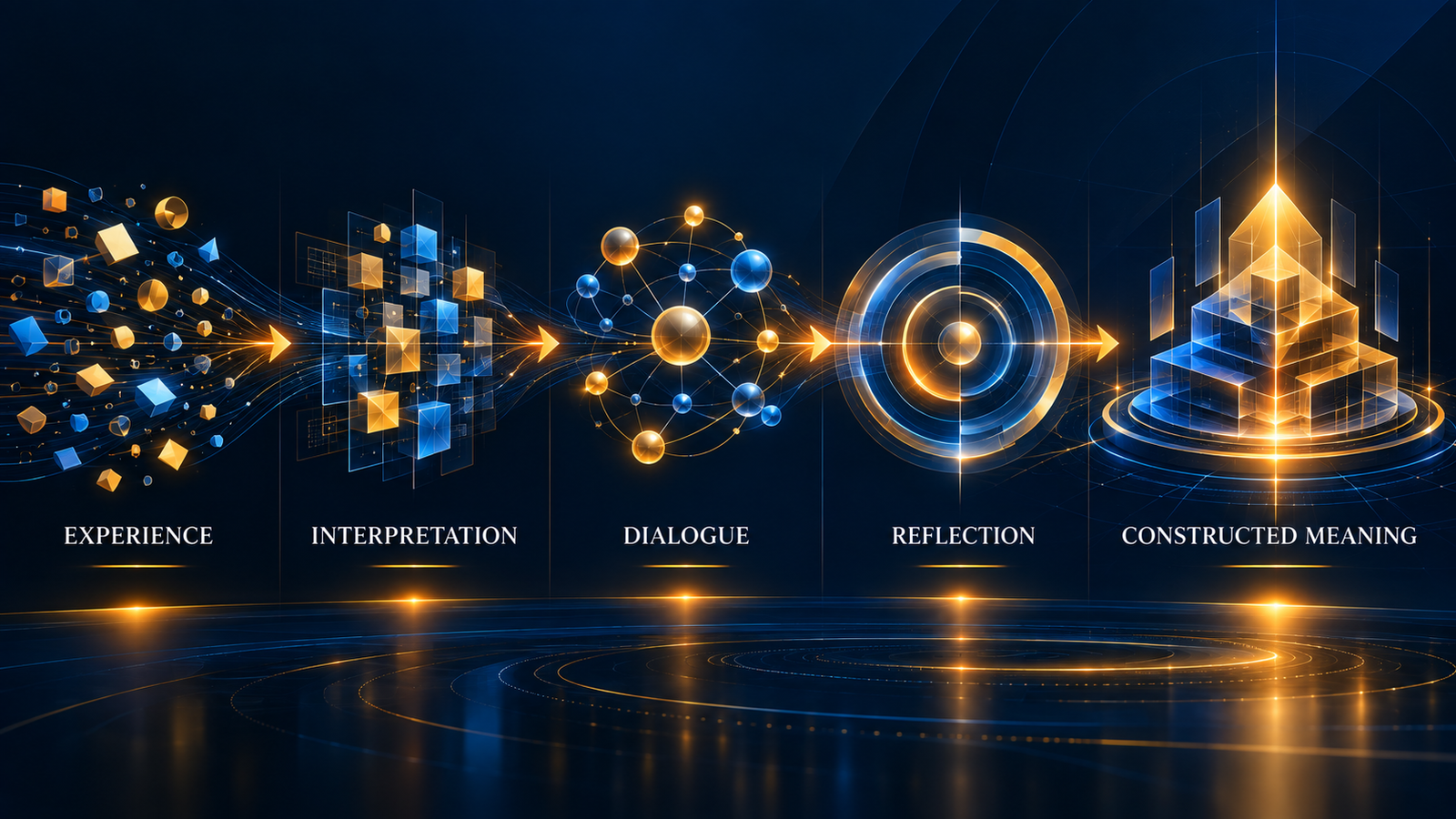
This is why Constructivism Intelligence™ is more than being open-minded. Openness is valuable, but constructivist leadership requires something more disciplined. It requires leaders to examine how meaning is being created.
For example, when a colleague challenges a proposal, a leader might initially interpret the behaviour as resistance. But resistance is already an interpretation. The observable event may simply be that the colleague raised three objections. Why they raised them remains open to investigation. They may disagree with the strategy. They may possess information the leader does not have. They may be protecting their team from an implementation problem. They may not understand the proposal. They may have experienced a similar initiative previously and recognise a risk. Or they may indeed be resistant to change.
Constructivism Intelligence™ creates space between the event and the explanation. That space is strategically important. It allows leaders to investigate before concluding.
The Leadership Risk of Treating Interpretation as Fact
One of the most consequential mistakes in leadership occurs when an interpretation becomes indistinguishable from an observable fact.
Consider statements such as: “They don’t care.” “She isn’t strategic.” “This team hates change.” “He isn’t committed.” “They aren’t ready.” “The organisation will never accept this.”
Each statement may eventually prove accurate. But none begins as a neutral observation. Each contains an interpretation.
Once leaders treat interpretations as established facts, those interpretations can begin influencing behaviour. A leader who believes a team is resistant may communicate more forcefully. The team may respond defensively. That defensiveness then appears to confirm the leader’s original belief. The interpretation has helped create the evidence used to support it.
This is one reason reflective leadership matters. Without reflection, leaders can become trapped inside explanations that continually reinforce themselves.
Constructivism Intelligence™ interrupts that process by asking: What actually happened? What meaning have I attached to what happened? What evidence supports that interpretation? What alternative explanations are plausible? Whose perspective is absent from my understanding?
These questions create a more rigorous foundation for leadership judgement. They also reveal an important distinction within Leadership Performance Intelligence™: information is not the same as understanding. A leader can possess enormous amounts of information and still construct an inaccurate picture of what is happening. The leadership challenge is therefore not simply to acquire more information — it is to transform information into better understanding. That transformation is where Constructivism Intelligence™ becomes a leadership capability.
From Information to Leadership Intelligence
Modern leaders have access to more information than almost any previous generation of decision-makers. Dashboards provide performance data. Employee surveys provide sentiment data. Customer systems provide behavioural data. AI tools can summarise documents, identify patterns and generate analysis within seconds. Meetings, reports, emails, messages and digital platforms create an almost continuous flow of information.
Yet information abundance does not automatically create leadership intelligence. In some circumstances, it can make interpretation harder. Leaders must determine what matters, what is noise, what requires context, what contradicts existing assumptions, what evidence is missing, and what different stakeholders understand about the situation.
Constructivism Intelligence™ provides a bridge between information and Leadership Performance Intelligence™. That bridge is built through four capabilities:
Capability Inquiry
The leader investigates rather than immediately concludes.
Capability Reflection
The leader examines how their own thinking may be influencing interpretation.
Capability Perspective
The leader deliberately seeks viewpoints capable of expanding or challenging the existing picture.
Capability Synthesis
The leader integrates evidence, experience and perspective into a more useful understanding.

These capabilities change the leader’s relationship with knowledge. Instead of asking only “What information do I have?”, the leader begins asking: “What does this information mean? What context is necessary to understand it? What assumptions am I bringing to it? What doesn’t fit my current explanation? What would I need to learn before deciding?”
That shift is subtle. Its implications are substantial. Because in complex leadership environments, the quality of a decision is often constrained by the quality of the understanding from which that decision emerges.
Why Constructivism Intelligence™ Matters in Complex Leadership
The need for Constructivism Intelligence™ increases as leadership environments become more complex. In relatively predictable situations, experience can provide a reliable guide. Leaders recognise familiar patterns, apply established knowledge and make decisions based on approaches that have worked previously.
Complex environments behave differently. The information may be incomplete. Stakeholders may interpret the same problem differently. Causes and effects may be difficult to separate. Conditions may change while decisions are being implemented. Under these circumstances, certainty can become dangerous.
The challenge is not simply that leaders do not have enough information. It is that several interpretations of the available information may be plausible simultaneously.
Consider an organisation experiencing unusually high employee turnover. A finance leader might see a compensation problem. An HR leader may identify weaknesses in career development. An operational leader may see excessive workload. A team manager may point to poor systems. Employees may describe a lack of trust. Senior executives may believe competitors are recruiting aggressively.
These explanations do not necessarily cancel each other out. Several may be true. Constructivism leadership helps leaders resist the pressure to reduce a complex situation prematurely to one convenient explanation. Instead, they construct a more complete picture.
This requires intellectual discipline because leadership cultures frequently reward certainty. Senior leaders are expected to know. Managers are expected to provide answers. Executives are expected to make decisions. But decisive leadership and intellectual certainty are not the same thing.
Indeed, knowing where uncertainty exists can improve the decision. This is an important expression of Leadership Performance Intelligence™: the capacity to act without pretending that complexity has disappeared.
When Expertise Becomes a Constraint
Expertise is one of leadership’s greatest assets. It can also become one of its most subtle limitations.
Experienced leaders develop mental models that help them recognise patterns quickly. These models reduce cognitive effort and allow leaders to respond efficiently to familiar situations. The problem emerges when a model developed in one context is automatically applied to another.
A leader may think: “I have seen this before.” Sometimes they have. Sometimes they have seen something that merely resembles it. That distinction matters.
Imagine a senior executive who successfully led an organisation through a previous downturn. When performance begins declining several years later, the executive immediately applies the same recovery strategy. Costs are reduced. Decision-making is centralised. Targets are tightened. Performance monitoring increases. The previous strategy becomes the template for the present response.
But what if the new problem has a different cause? Perhaps customers’ expectations have changed. Perhaps the organisation’s technology is outdated. Perhaps employees lack critical capabilities. Perhaps competitors have changed the market. Perhaps the organisation’s own operating model is preventing innovation.
Experience has provided an answer before the problem has been fully understood.
Constructivism Intelligence™ does not reject expertise. It makes expertise more adaptive. Instead of asking “What does my experience tell me to do?”, the constructivist leader also asks: “Which parts of my experience are relevant here, and which might be misleading me?”
That additional question creates an important distinction between experience as evidence and experience as authority. Experienced leaders should use what they know. But what they know should remain open to examination.
This is especially important when previous success is involved. Success creates powerful stories about causality. A leader introduces a strategy. Performance improves. The strategy is therefore remembered as the cause. But organisational outcomes rarely emerge from one variable. Market conditions, team capability, timing, resources, competitor behaviour, culture and dozens of other factors may have contributed.
Constructivism Intelligence™ encourages leaders to examine these stories rather than simply inherit them. The objective is not self-doubt. It is better calibration.
The Constructivism Intelligence™ Framework
Burn Bright Advisory™ approaches Constructivism Intelligence™ as an active leadership capability rather than an abstract intellectual concept. A practical way to understand the capability is through five interconnected movements.
Movement 1
Experience
Leadership learning begins with experience. A conversation happens. A strategy succeeds. A project fails. A conflict emerges. A customer complains. A team performs unexpectedly well. An organisational change produces an unintended consequence. These experiences provide raw material for learning — but experience by itself does not guarantee learning. Experience becomes developmental when it is examined.
Movement 2
Reflect
Reflection creates distance between an event and the leader’s immediate explanation of it: What happened? What did I expect? What surprised me? How did I respond? What assumptions influenced that response? What evidence supports my interpretation? This connects Constructivism Intelligence™ closely with Reflective Practice Intelligence™ within the Leadership Intelligence Compass™. Constructivism asks how understanding is being built; Reflective Practice Intelligence™ provides the discipline through which it can be examined.
Movement 3
Expand Perspective
The leader deliberately introduces perspectives beyond their own — colleagues, employees, customers, professional experts, stakeholders, data or people who disagree with the current interpretation. The purpose is not to manufacture consensus. Different perspectives are valuable precisely because they may reveal different parts of the system.
Movement 4
Experiment
Better understanding does not emerge from reflection alone. A small change can provide new evidence. A pilot programme can test an assumption. A different meeting structure can reveal whether participation changes. Experimentation turns assumptions into questions that reality can answer — this is where Constructivism Intelligence™ intersects with Adaptability Intelligence™.
Movement 5
Integrate
The leader combines experience, reflection, evidence, alternative perspectives and the results of experimentation into a revised mental model. Constructivist leadership does not assume that learning eventually produces a perfect understanding of reality. It produces progressively more useful understanding.
The resulting cycle becomes: EXPERIENCE → REFLECT → EXPAND PERSPECTIVE → EXPERIMENT → INTEGRATE → NEW EXPERIENCE. Leadership development therefore becomes continuous construction rather than periodic knowledge acquisition.
Perspective Is Leadership Data
One of the most practical implications of constructivism leadership is that perspective itself becomes a source of data.
Leaders often seek objective information when making decisions. That is appropriate. Financial figures, performance metrics, operational measures, research and other forms of evidence are essential. But leadership problems also involve human interpretation.
Consider a major organisational transformation. The executive team may understand the change as necessary modernisation. Middle managers may experience it as another initiative added to an already overloaded system. Employees may interpret it as a threat to established roles. Customers may see an opportunity for improved service. The technology team may view it as an infrastructure challenge. The finance team may see an investment requiring measurable returns.
Which perspective is correct? The more useful question may be: what does each perspective reveal?
Constructivism Intelligence™ does not require leaders to treat every opinion as equally accurate. Evidence still matters. Expertise still matters. Facts still matter. But perspectives can expose assumptions, risks and consequences that would otherwise remain hidden.
This gives leaders a more sophisticated approach to disagreement. Instead of asking “Who is right?”, they can initially ask: “What information becomes visible when I examine the problem from each position?” That question changes the function of dialogue. Dialogue is no longer simply a mechanism for persuading people to accept a decision. It becomes part of the intelligence system through which the decision is constructed.

Constructivism Leadership Across Sectors
The principle becomes clearer when applied across different leadership environments.
Business Growth Intelligence™
A company experiences declining customer retention. A constructivist approach broadens the inquiry beyond “the sales team is underperforming” to ask what customers are experiencing, what has changed in the market, and where employee and data perspectives agree or conflict. The resulting understanding may reveal that the problem involves product design, pricing or a fragmented customer journey — not employee performance at all.
School Leadership Intelligence™
A school leader sees declining student outcomes. Teachers may describe curriculum overload, students may identify disengagement, families may raise communication problems, and data may reveal difficulties concentrated within particular groups or subjects. Constructivism leadership strengthens diagnosis before accountability mechanisms are applied.
Healthcare Leadership Intelligence™
A healthcare leader investigating repeated delays may initially see an efficiency problem. Clinicians describe staffing pressures, administrative colleagues identify scheduling design, patients experience communication failures, and data reveals bottlenecks at a particular point in the pathway. The leadership task becomes one of synthesis.
Public Service Leadership Intelligence™
Public-service leaders frequently operate within environments where stakeholders hold legitimately different priorities. Constructivism Intelligence™ helps leaders distinguish between disagreement that should be resolved and difference that should be understood.
HR & People Leadership Intelligence™
An employee survey identifies low trust — but “low trust” describes an outcome, not necessarily its cause. Teams may associate trust with transparency, consistency, psychological safety or communication. Constructivist inquiry asks what people mean when they use the same words, preventing generic solutions to poorly understood problems.
Entrepreneur Performance Intelligence™
Early success strengthens founders’ confidence in their instincts. As the organisation grows, direct experience becomes a smaller proportion of everything occurring inside the system. Constructivism Intelligence™ helps the entrepreneur evolve from “I know this organisation because I created it” towards “I need systems that continually update my understanding of the organisation it has become.”
Explore how these applications differ further across the Leadership Sector Hubs.
The Difference Between Listening and Reconstructing Understanding
Many leaders already listen. Constructivism leadership asks whether listening actually changes anything.
A leader can conduct consultations, hold employee forums, commission surveys and invite challenge while leaving their original interpretation untouched. In that situation, listening has occurred. Learning may not have.
Constructivism Intelligence™ requires the possibility of reconstruction. New evidence must be capable of changing the leader’s mental model. This does not mean changing direction every time someone disagrees. It means remaining intellectually available to information that challenges the existing explanation.
That distinction is particularly important for senior leaders because organisational hierarchy can gradually reduce the amount of contradiction they encounter. People learn what the leader prefers. Meetings become more predictable. Challenges become softer. Information becomes filtered. Eventually, the leader may possess substantial authority while receiving increasingly limited information about the organisation they lead.
Constructivism Intelligence™ counters that risk by treating challenge, inquiry and perspective not as threats to authority, but as inputs into leadership intelligence. The result is not indecisive leadership. It is leadership capable of updating itself.
The Constructivist Leadership Cycle in Practice
Constructivism leadership becomes valuable when it changes what leaders actually do. The practical challenge is to create a repeatable discipline that prevents interpretation from becoming premature certainty.
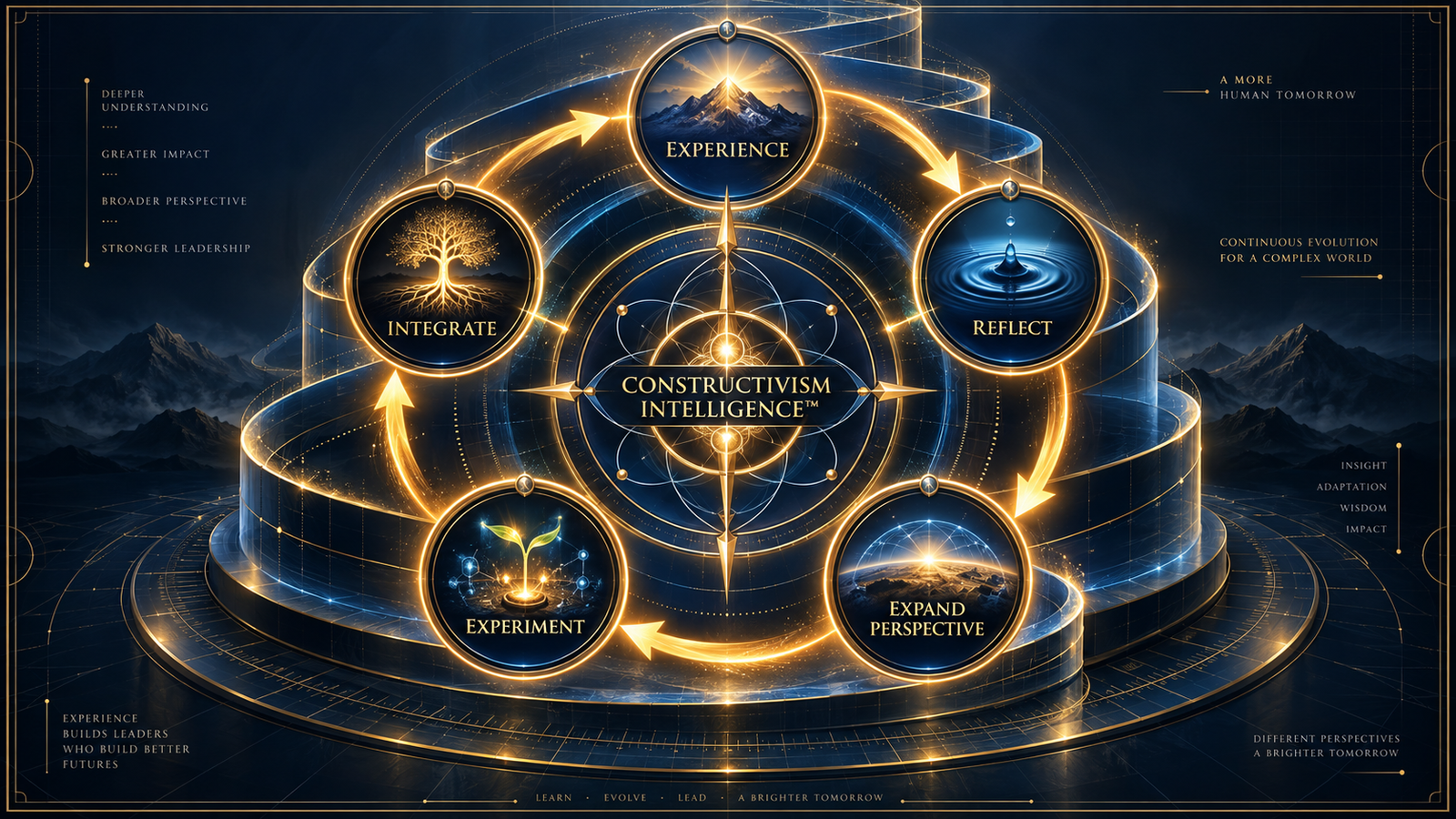
Consider a leader implementing a new organisational process. The first implementation produces resistance. The leader’s initial interpretation might be: “People do not want to change.” The constructivist cycle interrupts that conclusion.
Experience
What actually happened? Adoption was slower than expected. Several managers questioned the process. Employees continued using elements of the previous system. Those are observations — “resistance to change” is an interpretation of them.
Reflect
Was the implementation timetable realistic? Did employees understand why the change was necessary? Were the people affected involved in designing the process? Reflection turns attention back towards the leadership system rather than automatically locating the problem elsewhere.
Expand Perspective
Employees explain the new system duplicates existing work. Managers report training was insufficient. Customers experience unintended delays. Suddenly, “resistance” becomes a much less complete explanation.
Experiment
One department pilots a simplified workflow. Training is redesigned. A duplicated approval stage is removed. The purpose is not merely to improve the process — it is also to test the leadership team’s emerging understanding of the problem.
Integrate
Adoption improves significantly. The interpretation changes from “people resist change” to “adoption falls when operational friction exceeds the perceived value of the change” — a more useful insight that can influence future transformation, communication and resource allocation.
The leader has not merely solved a problem. The organisation has developed intelligence.
Assumption Testing as a Leadership Discipline
One of the most useful applications of Constructivism Intelligence™ is deliberate assumption testing.
Every strategy contains assumptions. Every forecast contains assumptions. Every judgement about another person contains assumptions. Every organisational plan contains assumptions about how people, markets, systems or stakeholders will behave. The difficulty is that assumptions often remain invisible until they fail.
A leader preparing a major initiative might assume that employees understand the rationale, managers have enough capacity to implement it, customers will value the outcome, technology will perform as expected and existing processes can accommodate the change. Each assumption may be reasonable. None should automatically be treated as fact.
That question exposes the hidden architecture beneath a strategy. The leader can then ask: What evidence supports this assumption? What evidence challenges it? How confident are we? Whose knowledge could test it? What could we test before committing significant resources?
This moves leadership away from certainty theatre and towards disciplined inquiry. It also creates a healthier relationship with being wrong. If assumptions are explicitly identified as assumptions, discovering that one is incorrect becomes useful information. When assumptions are disguised as certainty, contradictory evidence becomes more threatening because acknowledging it can feel like admitting leadership failure.
Constructivism Intelligence™ reframes the situation. Updating an interpretation in response to stronger evidence is not evidence that leadership intelligence has failed. It is evidence that leadership intelligence is functioning.
Dialogue Is Part of the Intelligence System
Constructivism leadership also changes the purpose of leadership dialogue.
Meetings are often treated primarily as coordination mechanisms. Information is distributed. Progress is reported. Tasks are allocated. Decisions are communicated. Those functions are necessary. But dialogue can perform another function: it can improve the organisation’s capacity to construct meaning.
Imagine a leadership meeting discussing declining performance. A conventional discussion may quickly move towards solutions: “We need stronger accountability.” “We need better training.” “We need clearer targets.” “We need to restructure.” Each proposal may have merit. But the group may be attempting to solve a problem before establishing whether members share an adequate understanding of it.
A constructivist conversation begins differently: What are we observing? What do we think it means? Where does our evidence come from? Which assumptions are we making? Where do our interpretations differ? What information are we missing? Who sees this problem differently? Only then does the conversation move towards intervention.
This distinction can significantly improve leadership dialogue because disagreement stops being treated automatically as an obstacle. Different interpretations can become diagnostic. If six capable leaders examine the same problem and reach six different conclusions, that disagreement contains information. It suggests the situation may be more complex than any single explanation captures.
Constructivism Intelligence™ Requires Psychological Safety
There is, however, an important condition. Leaders cannot benefit from multiple perspectives if people do not feel able to express them.
Constructivism Intelligence™ therefore connects directly with the quality of the leadership environment. If employees believe disagreement will damage their careers, they will learn to agree. If managers are punished for delivering uncomfortable information, information will become filtered. If senior leaders respond defensively to challenge, challenge will gradually disappear.
The organisation may still hold meetings. People may still be invited to contribute. But the leadership intelligence system becomes weaker because the range of available perspectives contracts.
Psychological safety matters here not because every discussion must be comfortable, but because leaders need access to information that may contradict their preferred interpretation. A constructivist leader therefore pays attention not only to what people say, but to the conditions determining what can be said: What views are difficult to express here? Who speaks most often? Who rarely contributes? What happens when someone disagrees with a senior person? Do people bring problems early, or wait until the evidence becomes impossible to ignore? Are mistakes examined for learning or primarily allocated to individuals?
A Practical Case: When a Performance Problem Is Not a People Problem
Consider a fictional but representative organisation experiencing declining output in one operational team. For three months, productivity has fallen below target. Senior leaders are concerned. The team’s manager believes performance expectations have become too relaxed and recommends tighter monitoring.
At first glance, the explanation appears credible. The data clearly shows lower output. A conventional response might therefore introduce additional targets, closer supervision and stronger accountability.
A constructivist leadership approach delays the intervention long enough to examine the interpretation. The leadership team separates observation from explanation.
Observation: output has declined by approximately 15 per cent. Initial interpretation: employees are becoming less productive.
The leaders then expand the evidence base. Employees explain that a recently introduced digital process requires information to be entered twice. The team manager reports spending increasing amounts of time resolving exceptions. Another department reveals that incomplete requests are being passed into the team’s workflow. Customer-service colleagues report that cases have become more complex. The technology team confirms that automation originally planned for the new system has not yet been implemented.
The original data was accurate. Output really had declined. The original interpretation, however, was incomplete. The problem was not simply employee productivity — the system surrounding employees had changed.
This leads to a different intervention. Instead of increasing surveillance, leaders remove duplicate data entry, improve the quality of incoming requests, introduce the delayed automation and revise performance measures to account for case complexity. Performance begins to recover.
But something more important has happened. The organisation has learned that its original performance metric was describing an outcome without adequately explaining its cause. That lesson can now inform future leadership decisions.
How Constructivism Intelligence™ Connects to the Leadership Intelligence Compass™
Constructivism Intelligence™ does not operate independently. Its value becomes stronger when connected with the wider Leadership Intelligence Compass™.
Reflective Practice Intelligence™
Reflection allows leaders to examine how their own experiences, assumptions and behaviour influence the meaning they construct. Without reflective practice, experience can simply reinforce existing beliefs.
Knowledge Development Intelligence™
Constructivism Intelligence™ concerns how understanding is constructed. Knowledge Development Intelligence™ strengthens the leader’s capacity to deliberately expand the knowledge available for that construction. Together, they move leaders from passive experience towards active learning.
Emotional Intelligence™
Different perspectives can create discomfort. Challenge can feel personal. Contradictory evidence can threaten confidence. Emotional Intelligence™ helps leaders manage those responses so that disagreement remains a source of information rather than becoming a trigger for defensiveness.
Adaptability Intelligence™
Once a leader’s understanding changes, behaviour may also need to change. Adaptability Intelligence™ enables the transition from revised interpretation to revised action. Learning without adaptation produces insight without impact.
Ethics Intelligence™
Constructed interpretations influence how leaders treat people. If a leader labels someone “difficult,” “uncommitted” or “not leadership material,” that interpretation can influence opportunities, decisions and relationships. Ethics Intelligence™ encourages leaders to examine whether their judgements are sufficiently grounded, fair and open to challenge.
Visionary Leadership Intelligence™
Vision requires leaders to imagine a future that does not yet exist. Constructivism Intelligence™ strengthens that process by helping leaders examine the assumptions embedded within their vision and integrate perspectives capable of making it more robust.
Professionalism Intelligence™
Professional judgement requires more than confidence. It requires disciplined reasoning, evidence, accountability and an ability to distinguish what is known from what is assumed. Constructivism Intelligence™ strengthens that professional discipline.
Leadership Sustainability™
Constructivist leadership can contribute to Leadership Sustainability™. Leaders who believe they must personally possess every answer carry an enormous cognitive burden. A leadership system that distributes inquiry, knowledge and perspective creates a different model. The leader remains accountable, but intelligence becomes collective rather than exclusively individual.
The Risks of Constructivism Leadership
Like any leadership capability, constructivism can be poorly applied.
From Knowing Leader to Learning Leader
Traditional images of leadership often place knowledge at the centre of authority. The leader knows. The leader explains. The leader decides. The leader provides certainty.
Constructivism leadership offers a more sophisticated model. The leader still develops expertise, still exercises judgement, still makes decisions. But leadership authority is no longer dependent on pretending that understanding is complete. Instead, the leader becomes responsible for creating the conditions through which stronger understanding can emerge.
| The Knowing Leader | The Learning Leader |
|---|---|
| Authority depends on having the answer | Authority depends on building the strongest available understanding |
| Experience is treated as proof | Experience is treated as evidence, open to examination |
| Disagreement is a threat to be managed | Disagreement is information to be investigated |
| Certainty is projected to appear decisive | Uncertainty is made visible, and decisions still get made |
| The first plausible explanation becomes the explanation | The first plausible explanation is tested before it is trusted |
That means knowing when to answer, knowing when to ask, knowing when experience is useful and knowing when experience may be creating a blind spot. Knowing when disagreement should be resolved, and knowing when disagreement contains information the organisation needs.
Leadership Reflection Questions
- What leadership assumption am I currently treating as a fact?
- Which of my current beliefs about my organisation are based primarily on previous experience rather than current evidence?
- When I encounter a performance problem, how quickly do I move from observation to explanation?
- Whose perspective is currently missing from an important decision I am making?
- Which people in my organisation are most likely to challenge my interpretation — and how easy have I made it for them to do so?
- When did I last substantially change my mind because someone presented better evidence or a perspective I had not considered?
- What would I need to discover for me to reconsider one of my current strategic assumptions?
- Do our leadership meetings create genuine inquiry, or primarily reinforce conclusions already reached?
- Where might my professional expertise be helping me recognise patterns — and where might it be preventing me from seeing something new?
- What have I learned during the past six months that should change how I lead during the next six?
Action Steps: Strengthening Your Constructivism Intelligence™
Constructivism Intelligence™ is developed through practice. Leaders can begin with five actions.
1. Separate Observation From Interpretation
Choose one current leadership problem. Write down only what you can directly observe. Then separately record your interpretation of what those observations mean. For example — Observation: three project milestones were missed. Interpretation: the team lacks accountability. Once the distinction is visible, ask what alternative explanations could also account for the observation.
2. Identify the Assumptions Beneath an Important Decision
Take one significant decision currently under consideration and ask: what must be true for this decision to succeed? List the assumptions, then classify each according to the strength of the available evidence. Some may be well supported; a few may reveal themselves as beliefs never examined. Those are valuable discoveries.
3. Add a Deliberate Perspective
Identify someone who experiences the issue differently from you. Do not ask them whether they agree with your proposed solution. Ask: “What am I not seeing?” Then listen specifically for information that complicates your existing interpretation. The objective is expanded understanding, not agreement.
4. Turn One Assumption Into an Experiment
Rather than debating whether an assumption is correct, identify a small way to test it. Pilot the proposed change. Change one part of the process. Ask a different question. Collect another form of evidence. Compare two approaches.
5. Create an Integration Routine
At the end of a project, decision cycle or significant leadership event, ask: What did we expect? What actually happened? What did we learn? Which assumption changed? What will we do differently because of that learning? Integration converts reflection into leadership capability.
The Constructivist Leader’s Decision Check
Before making a significant decision, use this short diagnostic:
- What do I know? Identify the strongest available evidence.
- What do I think I know? Identify interpretations that may have become accepted without sufficient examination.
- What am I assuming? Surface the conditions you expect to be true.
- What don’t I know? Make uncertainty visible.
- Who sees this differently? Introduce perspectives capable of expanding the picture.
- What could change my mind? Define the evidence that would require reconsideration.
- What can we test? Reduce unnecessary uncertainty through experimentation where possible.
- When will we review the decision? Create a deliberate point at which new evidence can be integrated.
This approach does not remove leadership judgement. It improves the conditions under which judgement is exercised.
Conclusion: Strong Leadership Is Capable of Changing Its Mind
Leadership has traditionally placed significant value on knowing. Knowledge matters. Experience matters. Expertise matters. Decisiveness matters. But complex leadership environments require another capability alongside them: the ability to reconstruct understanding.
Constructivism leadership recognises that leaders do not simply receive an objective picture of their organisations. They build interpretations from information, experience, assumptions, relationships, evidence and perspective. Those interpretations influence decisions. Decisions influence behaviour. Behaviour influences organisations. The quality of the construction therefore matters.
Constructivism Intelligence™ strengthens the leader’s ability to participate consciously in that process. It asks leaders to distinguish observation from interpretation, to recognise assumptions before they become organisational truths, to seek perspectives capable of revealing what their own experience cannot, to test rather than merely defend ideas, to reflect on outcomes, and to integrate learning into the next decision.
This creates an important shift in leadership identity. The effective leader does not need to be the person who permanently possesses the correct answer. The leader becomes responsible for creating the conditions in which better answers can emerge. That does not diminish authority. It makes authority more intelligent.
Within Burn Bright Advisory’s Leadership Performance Intelligence™ framework, this is why Constructivism Intelligence™ matters. Leadership performance is not determined only by how much a leader knows. It is also shaped by how that knowledge was constructed, how rigorously it is tested and how readily it can evolve.
The question for leaders is therefore no longer simply “What do I know?” It becomes: “How have I constructed what I believe I know — and what might help me understand it better?”
That question creates space for reflection.
Reflection creates space for learning.
Learning creates space for adaptation.
And adaptation allows leadership intelligence to remain relevant as the environment changes.
The strongest leaders are therefore not those whose thinking never changes. They are those who know when evidence requires it to change — and have developed the intelligence to do so.
What is constructivism leadership?
Constructivism leadership is an approach in which leaders recognise that understanding is actively constructed through experience, evidence, dialogue, reflection and different perspectives. Rather than assuming their first interpretation of a situation represents the complete reality, leaders investigate how that interpretation was formed and remain willing to revise it as new evidence emerges.
What is Constructivism Intelligence™?
Within Burn Bright Advisory’s Leadership Intelligence Compass™, Constructivism Intelligence™ is the capacity to examine how leadership understanding is constructed, identify assumptions, integrate different perspectives, learn through reflection and experimentation, and revise mental models when stronger evidence becomes available. It forms part of the wider Leadership Performance Intelligence™ approach to developing more intelligent and sustainable leadership performance.
Why is constructivism important in leadership?
Leadership decisions depend on interpretation. Performance data, employee behaviour, customer feedback and organisational events require leaders to decide what those signals mean. If the interpretation is incomplete, even a well-executed decision can address the wrong problem. Constructivism helps leaders improve the quality of understanding that precedes action.
Does constructivist leadership mean leaders should question everything?
No. The objective is not permanent uncertainty. Leaders still need to make decisions and provide direction. Constructivism encourages leaders to distinguish strong evidence from assumptions and remain appropriately open to information capable of changing their interpretation — holding conclusions firmly enough to act, but lightly enough to revise.
How is Constructivism Intelligence™ different from Reflective Practice Intelligence™?
The two capabilities are closely connected but perform different functions. Constructivism Intelligence™ focuses on how leaders construct meaning and understanding. Reflective Practice Intelligence™ strengthens the disciplined examination of experience, behaviour, decisions and outcomes. Reflection is one of the mechanisms through which leaders can strengthen Constructivism Intelligence™.
How does constructivism improve leadership decision-making?
Constructivism improves decision-making by encouraging leaders to examine assumptions, seek missing perspectives, distinguish observations from interpretations, test uncertain beliefs and integrate new evidence. This can reduce the risk of solving a problem based on an incomplete diagnosis.
Can experienced leaders benefit from Constructivism Intelligence™?
Yes. Experience provides valuable pattern recognition and professional judgement. However, previous experience can also encourage leaders to interpret new situations through old models. Constructivism Intelligence™ helps leaders use experience as an important source of evidence without automatically treating it as proof that the present situation is identical to the past.
How can organisations develop Constructivism Intelligence™?
Organisations can strengthen the capability by building reflection into leadership routines, encouraging constructive challenge, testing strategic assumptions, reviewing decisions against outcomes, creating psychologically safe dialogue and deliberately including multiple perspectives in complex decisions. The capability can also be explored through the Leadership Intelligence Assessment™, diagnostics, planning tools and structured leadership-development programmes.
Where Does Your Leadership Intelligence Stand Today?
Constructivism Intelligence™ is one dimension of sustainable leadership performance. Take the free self-assessment to see how your leadership capacity holds up under real-world pressure.
Free Leadership Intelligence
Get Weekly Leadership Insights
Join thousands of leaders receiving practical strategies on burnout prevention, workload design, and sustainable performance every week.