Early Signs of Leadership Burnout
Not Sure Where You Stand?
Before you read further, find out whether what you’re noticing is ordinary pressure or the early architecture of leadership burnout.
Quick Answer
Key Takeaways
- Persistent exhaustion that does not disappear after normal rest deserves attention.
- Decision fatigue, irritability and reduced strategic thinking can emerge before obvious performance failure.
- Burnout is different from temporary stress because recovery becomes increasingly difficult.
- Team behaviour can reveal leadership burnout before the leader recognises it themselves.
- Early intervention should examine workload, meetings, communication, decision authority and recovery — not simply personal resilience.
The early signs of leadership burnout are remarkably easy to miss.
Not because they are invisible.
Because they often look like leadership.
Answering emails late at night looks committed. Taking another responsibility looks dependable. Making every important decision looks accountable. Working through lunch looks productive. Staying available during leave looks dedicated.
Until it isn’t.
The World Health Organization defines burnout as an occupational phenomenon resulting from chronic workplace stress that has not been successfully managed. It identifies three dimensions: exhaustion, increased mental distance or cynicism towards work, and reduced professional efficacy.
For leaders, the warning signs can develop quietly because many of the behaviours creating the problem are rewarded.
You become the person who always responds.
Always fixes.
Always decides.
Always absorbs the pressure.
The problem is not simply that leaders need to become better at coping.
Recognising the warning signs gives you an opportunity to diagnose that system before exhaustion becomes collapse. To see how these signs connect, it helps to view burnout as a progression rather than a sudden event.
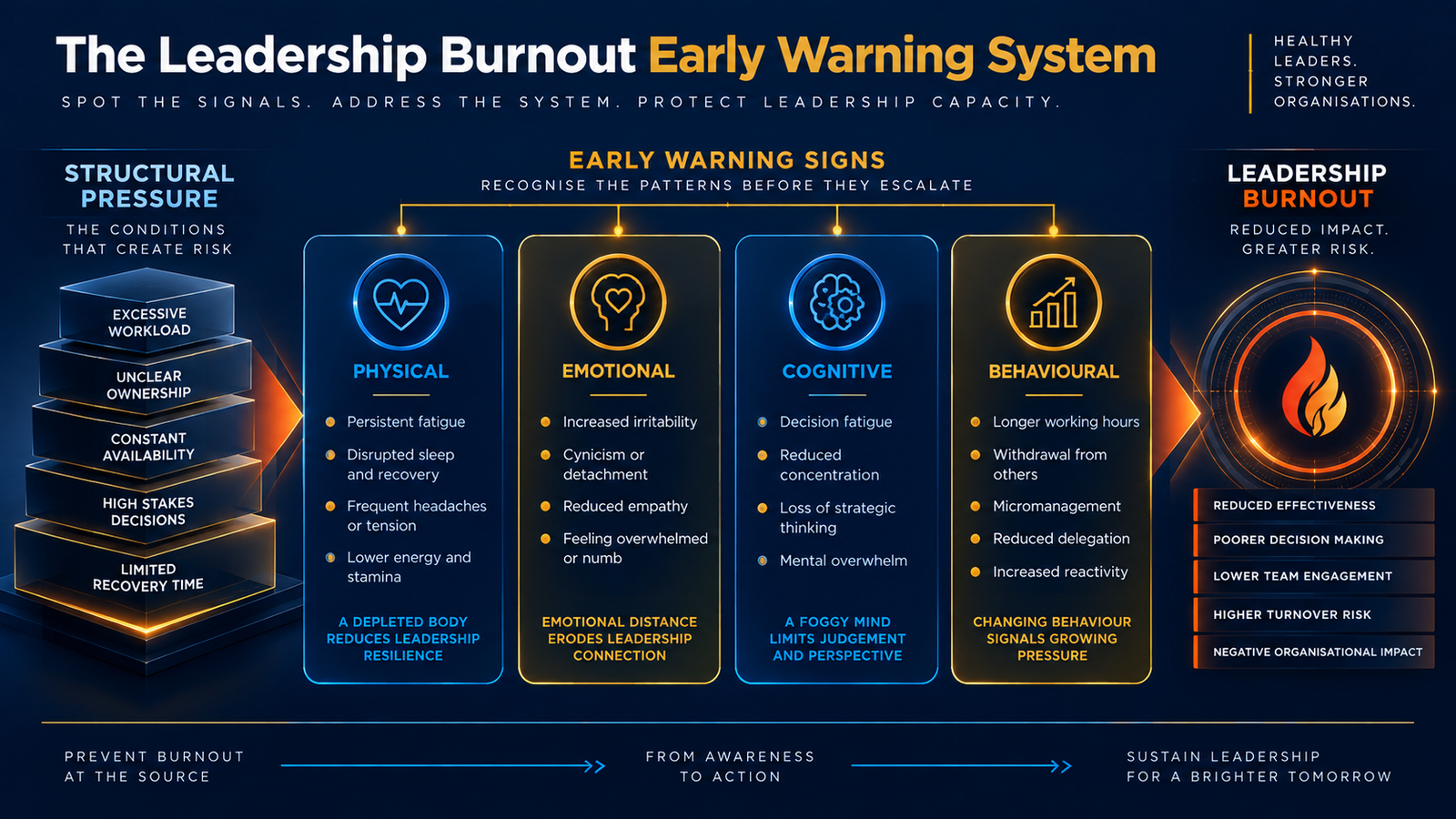
The key point is simple: the symptom may appear in the leader, but the cause may sit in the architecture of the work.
Featured Snippet
What Are the Earliest Signs of Leadership Burnout?
Leadership burnout rarely begins with somebody announcing, “I am burnt out.”
It begins with small changes.
A leader who previously made decisions quickly starts revisiting them repeatedly. Someone who was patient becomes unusually irritated by routine questions. A strategic thinker spends most of the week reacting to operational problems. A leader who once protected evenings starts checking messages at 10pm.
None of these behaviours proves burnout in isolation. Patterns matter more than individual incidents.
One of the most useful distinctions is between temporary pressure and persistent change. A demanding week can leave anyone tired. A product launch, inspection, restructuring programme or organisational crisis may require temporarily increased effort.
Burnout behaves differently. You take the weekend off but return tired. You complete one major project, but another immediately replaces it. You take leave but spend the first half recovering and the second half anticipating your return.
The WHO’s definition is useful precisely because it focuses on chronic workplace stress that has not been successfully managed, rather than ordinary tiredness.
Burn Bright’s framework identifies five structural conditions worth examining when these warning signs begin appearing:
- Scope creep — responsibilities keep expanding without old responsibilities being removed.
- Meeting culture — calendars become fragmented, leaving little space to think or lead.
- Communication chaos — messages, emails and notifications create constant context switching.
- Decision overload — too many decisions remain concentrated with the leader.
- Perfectionism culture — unrealistically high standards make delegation and completion difficult.
These conditions matter because leadership burnout does not develop in a vacuum. Gallup reported that managers were especially affected by workplace disruption: 64% said employees had been given additional responsibilities, 51% reported team restructuring and 42% reported budget cuts in 2023. Gallup also found managers were more likely than non-managers to report burnout and difficulties with work-life balance.
That is why diagnosis needs to move beyond “What is wrong with me?” towards “What has changed in the system around me?”
How Does Leadership Burnout Affect Your Thinking?
One of the most dangerous early signs of leadership burnout is cognitive rather than physical.
Small decisions feel disproportionately difficult. You reread information without absorbing it. You postpone decisions you would normally make quickly. You move between tasks constantly but finish fewer of them.
This is where leadership burnout becomes an organisational issue. Leadership depends on cognitive capacity. You need space to distinguish signal from noise, challenge assumptions, anticipate consequences and make decisions without knowing everything.
When cognitive capacity is depleted, leadership becomes increasingly reactive. Instead of asking “What will matter six months from now?” you ask “What needs dealing with before 5pm?”
That shift is significant. Strategic leadership slowly becomes operational firefighting.
Another warning sign is decision compression. Decisions are postponed because the leader lacks the bandwidth to address them. Eventually, several become urgent simultaneously.
That creates more pressure.
More pressure reduces thinking capacity.
Reduced capacity creates more delayed decisions.
The cycle reinforces itself.
This is why the solution cannot simply be “make better decisions.” The more useful question is: why are so many decisions reaching you in the first place?
Decision authority may be poorly designed. Teams may lack clarity about what they can decide independently. Senior leaders may have created approval cultures in which relatively minor choices travel upwards. The result is a leadership bottleneck.
Gallup’s latest global data underline the wider strain on managers. Manager engagement fell from 27% in 2024 to 22% in 2025, while Gallup notes that managers are increasingly being asked to reconcile executive demands, restructuring, technology change and employee expectations.
The warning sign is not simply feeling busy. It is when your role no longer leaves enough cognitive space to perform the work that only you can perform. This is the difference between having a full calendar and having a structurally unsustainable role.
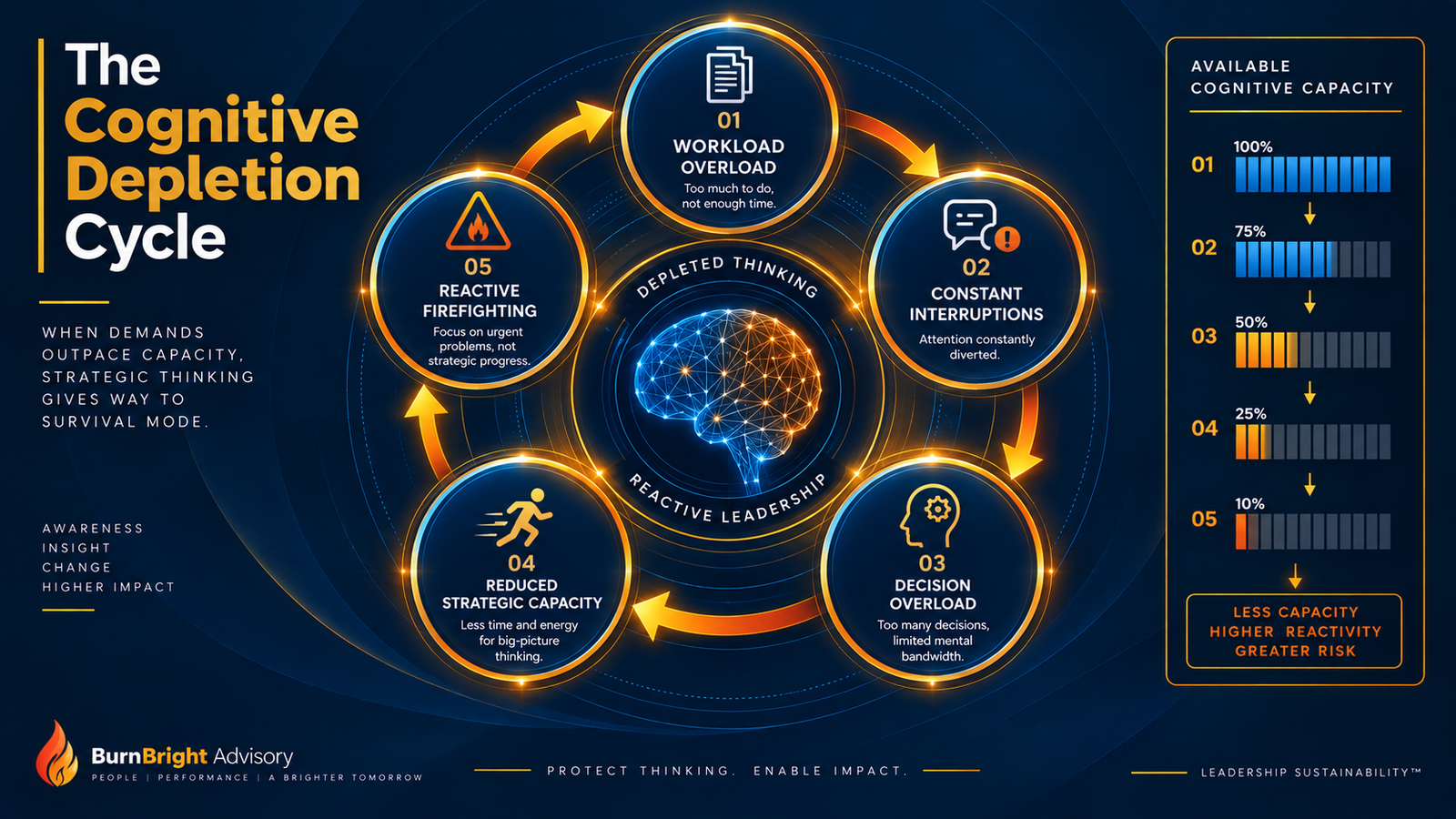
This matters beyond the individual leader. Gallup’s research has repeatedly found that managers account for around 70% of the variance in team engagement. When leadership capacity declines, teams feel it.
What Physical and Emotional Warning Signs Should Leaders Notice?
Leadership burnout does not remain neatly inside your calendar. The body keeps score of sustained workload.
Early physical signs can include persistent tiredness, disrupted sleep, muscle tension, headaches and difficulty switching off after work. But context matters.
One bad night’s sleep is not burnout. Repeatedly waking at 3am thinking about staffing, budgets, deadlines or tomorrow’s meetings is different. So is needing progressively more time to recover from normal working weeks.
Deloitte’s 2024 Well-being at Work research surveyed 3,150 workers, managers and executives across the US, UK, Canada and Australia. At least four in ten workers, managers and executives reported that they always or often felt exhausted or stressed. The same research found 66% of managers would seriously consider moving to another employer that better supported their wellbeing.
Emotional changes can be equally revealing. You may become less patient. Minor problems create disproportionate frustration. Requests that once felt reasonable begin to feel intrusive. A new initiative generates irritation before you have even examined it.
Then detachment begins. That detachment can be mistaken for experience. You tell yourself you have simply become more pragmatic. But there is a difference between professional objectivity and emotional depletion. The exhausted leader starts withdrawing emotional investment because investment costs energy they no longer have.
Cynicism can become a defence mechanism.
“Nothing ever changes.”
“Nobody listens.”
“I’ll just do it myself.”
“There is no point explaining.”
Those statements matter because cynicism is one of the dimensions included in the WHO description of burnout.
Another warning sign is loss of satisfaction. You may still be achieving. Targets may still be met. People may still describe you as successful. But achievement stops registering internally. You finish one difficult task and immediately move to the next.
There is no sense of completion.
No recovery.
Only continuation.
That is particularly dangerous for high-performing leaders because external performance can disguise internal depletion for months.
How Can You Tell the Difference Between Stress and Burnout?
Stress and burnout overlap, but they are not identical. A useful distinction is recovery.
| Temporary Leadership Stress | Developing Leadership Burnout |
|---|---|
| Pressure has a recognisable endpoint | Pressure feels continuous |
| Rest restores energy | Rest provides limited recovery |
| You remain connected to purpose | Work feels increasingly meaningless |
| Decisions remain manageable | Routine decisions feel heavy |
| Irritation is situational | Irritability becomes a pattern |
| You can mentally leave work | Work follows you everywhere |
| Extra effort solves a short-term problem | Extra effort creates more depletion |
| Performance generally returns after pressure | Effectiveness gradually deteriorates |
This distinction matters because organisations frequently prescribe a stress solution for a structural burnout problem. Take some leave. Attend a resilience workshop. Use a meditation app. Improve your morning routine. These things may help someone recover from ordinary pressure. But they cannot compensate indefinitely for an overloaded role.
CIPD’s 2025 UK workplace research found heavy workloads were the most commonly identified cause of stress-related absence among organisations reporting stress-related absence, at 41%. The same report found average sickness absence had risen to 9.4 days per employee per year, from 5.8 days in 2022.
The workload question therefore matters. Imagine a senior leader responsible for twelve major priorities. They attend 25 hours of meetings each week, manage a large team, approve routine expenditure, respond across several communication platforms and remain the escalation point for operational problems.
Giving that person a breathing exercise without changing their workload is not organisational transformation. It is symptom management.
McKinsey has similarly argued for greater attention to job and team-level conditions. Its research notes that organisations in the top quartile for organisational health have burnout rates around half those of the rest of its organisational-health database.
The diagnostic question is therefore not simply “How stressed am I?” Ask: “Does my current work architecture allow genuine recovery?” If the answer is consistently no, the problem deserves structural attention.
What Team Warning Signs Reveal Leadership Burnout?
Sometimes your team notices your burnout before you do. Not because they know how tired you feel. Because they experience changes in your leadership.
One of the first is reduced accessibility. One-to-one meetings get postponed. Feedback becomes shorter. Informal conversations disappear. You communicate only when something requires action.
Then delegation changes. Some depleted leaders delegate everything without enough context. Others move in the opposite direction and delegate almost nothing.
“I’ll do it myself” becomes the default. That feels faster. Initially, it often is. But it creates a dependency system around the leader. More work travels upwards. The leader becomes busier. The team becomes less autonomous. And the workload becomes even less sustainable.
Communication quality may also deteriorate. Instructions become less precise because the leader is moving too quickly. Priorities change without explanation. Team members begin checking decisions because they are uncertain whether yesterday’s priority remains today’s priority.
Psychological safety can suffer. When a normally measured leader becomes unpredictable or irritable, people adapt. They stop bringing small problems forward. Unfortunately, small problems do not disappear. They mature into large ones. Teams may also stop challenging decisions because challenge feels risky.
This matters because the impact of leadership depletion can spread well beyond the leader. Gallup’s finding that managers account for approximately 70% of variation in team engagement demonstrates how significant the manager’s working environment can be for the people around them.
CIPD’s 2025 employee research also found that high workload was cited by 69% of employees identifying negative impacts on mental health, while 63% cited line managers not helping staff perform effectively.
That does not mean a burnt-out manager is automatically a poor manager. It means leadership capacity is part of organisational capacity. When the system depletes managers, the consequences can travel through the organisation.
A useful diagnostic question is: “What has changed in my team’s behaviour around me?” Are people taking less initiative? Are more decisions being escalated? Are difficult conversations being avoided? Are you cancelling development conversations because operational work always wins?
Those are not merely people-management issues. They may be early warning signals that your own leadership capacity is narrowing.
Why Do High-Performing Leaders Miss the Warning Signs?
Because high performers are often exceptionally good at compensation.
When workload increases, they work longer.
When someone leaves, they absorb the gap.
When a project struggles, they become more involved.
When delegation fails, they take the work back.
When priorities conflict, they try to satisfy all of them.
Their capability hides the structural problem. This is where competence becomes dangerous.
A less experienced leader may hit the system’s limit quickly. A highly capable leader can keep an unsustainable system functioning for months or years. The organisation sees performance. The leader experiences depletion. Eventually, the gap becomes impossible to maintain.
This is also why burnout should not automatically be interpreted as a resilience failure. The Burn Bright model treats five common drivers — scope creep, meetings, communication chaos, decision overload and perfectionism — as structural signals to investigate.
Consider scope creep. Your role starts with eight major responsibilities. A colleague leaves. You temporarily take two more. A transformation programme begins. You join its steering group. A reporting requirement appears. Nobody removes anything. Two years later, the role has changed substantially, but the organisation still behaves as though the original job description describes the workload.
Or consider meeting culture. A leader may technically work 40 hours but spend 28 of them in meetings. The remaining strategic work does not disappear. It moves. Early mornings. Evenings. Weekends.
The organisation then interprets those extended hours as evidence that the role requires exceptional dedication rather than evidence that the working system is badly designed.
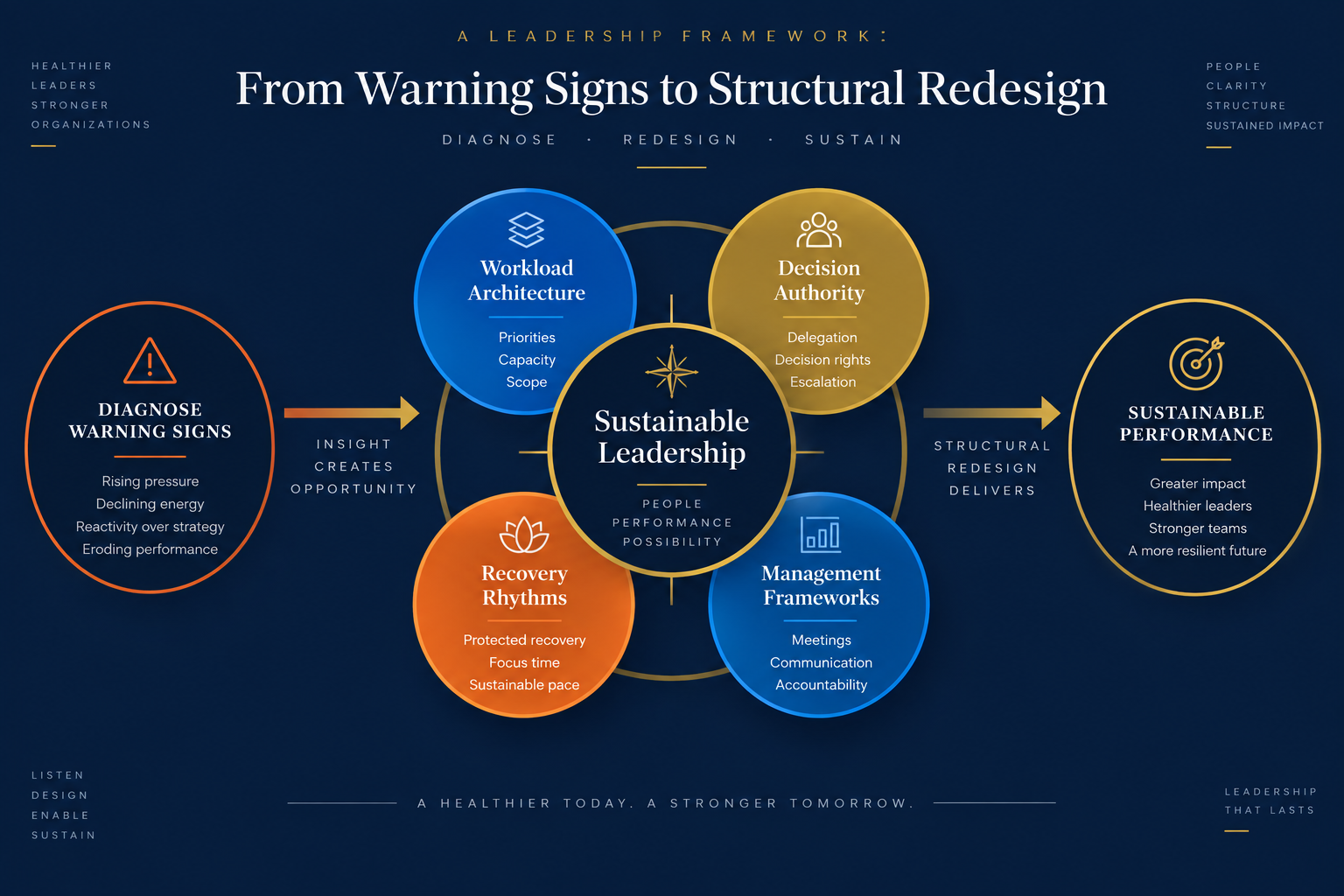
Recognising burnout early therefore requires something harder than monitoring tiredness. It requires examining the architecture that produces the tiredness.
What Should You Do When You Notice the Early Signs of Leadership Burnout?
Do not begin by trying to become more efficient. Begin with diagnosis.
For one working week, observe the system around your leadership role. Track where your time goes. Notice which meetings produce decisions and which simply consume attention. Record how many decisions reach you that someone else could reasonably make. Identify recurring interruptions. Notice what work consistently moves into evenings or weekends.
Then examine your responsibilities. Which tasks genuinely require your authority, expertise or judgement? Which could be delegated? Which exist because “we have always done it this way”? Which were added temporarily but never removed?
This creates the foundation for structural redesign. At Burn Bright, I organise this work around four pillars:
Pillar 1
Workload Architecture™
Clarify priorities, remove low-value responsibilities and make capacity visible.
Pillar 2
Decision Authority™
Move appropriate decisions closer to the people with the information and expertise to make them.
Pillar 3
Recovery Rhythms™
Design recovery into the operating system rather than hoping exhausted leaders find time for it.
Pillar 4
Management Frameworks
Create clear delegation, communication, meeting and escalation systems so that leadership does not depend on constant individual intervention.
The aim is not to eliminate pressure. Leadership contains pressure. The aim is to prevent normal pressure becoming chronic depletion. That distinction changes the intervention.
Instead of asking a depleted leader to become tougher, the organisation asks why toughness is required simply to survive an ordinary working week. Instead of telling managers to set boundaries, leaders examine whether organisational expectations make those boundaries possible. Instead of adding another wellbeing initiative, they remove unnecessary workload.
Structural, not motivational.
Framework, not feelings.
Fix the system, not just the person.
What are the first signs of leadership burnout?
The first signs often include persistent tiredness, difficulty switching off, increased irritability, reduced patience, slower decision-making and a shift from strategic work towards constant firefighting. The key is persistence. A difficult week is normal; a repeated pattern that does not improve with ordinary recovery deserves closer attention.
Can you be burnt out and still perform well?
Yes. High-performing leaders can compensate for declining capacity by working longer hours, becoming more controlling or sacrificing recovery. External performance may remain strong while internal capacity deteriorates. This is one reason leadership burnout can remain hidden until the problem has become severe.
How do I know whether I am stressed or burnt out?
Look at recovery. Temporary stress usually improves when the pressure ends and you have sufficient rest. Burnout is associated with chronic workplace stress and can involve persistent exhaustion, greater mental distance or cynicism towards work, and reduced professional efficacy. If symptoms concern you, seek appropriate professional medical or psychological advice.
Can workload cause leadership burnout?
Chronic excessive workload can be a major contributor. The problem may involve not only the amount of work but also fragmented calendars, unclear priorities, excessive decisions, poor delegation and constant communication. Burnout prevention therefore requires examining how the leadership role itself has been designed.
Does leadership burnout affect the team?
It can. Depleted leaders may communicate less clearly, delay decisions, cancel one-to-one meetings, become less patient or delegate less effectively. Because managers have substantial influence on employee engagement, protecting leadership capacity can also protect team performance and organisational culture.
Why do successful leaders miss burnout signs?
Successful leaders often compensate for overloaded systems through greater personal effort. They work longer, absorb vacancies, retain decisions and rescue failing processes. Because results continue, the underlying system problem remains hidden. Capability can therefore delay recognition rather than prevent burnout.
Conclusion
The early signs of leadership burnout rarely arrive as a dramatic collapse. They appear in patterns.
You become tired but keep going.
You lose patience but blame the pressure.
You stop thinking strategically because operational problems consume the day.
You retain more decisions because delegation feels slower.
You work longer because the calendar leaves no space for the work the calendar was supposed to support.
Individually, each change can look manageable. Together, they tell you something about the system.
That is why recognising leadership burnout early matters. It creates an opportunity to intervene before exhaustion becomes detachment, declining effectiveness or departure. But intervention must go beyond telling leaders to become more resilient.
Examine the workload. Examine the meetings. Examine communication. Examine decision authority. Examine whether recovery actually exists inside the design of the role.
Sustainable leadership begins when we stop asking how much pressure a leader can tolerate and start asking whether the organisation has designed leadership to remain effective over time.
Ready for a Full Structural Diagnosis?
The Burn Bright Full Diagnostic™ goes beyond self-assessment — a complete review of your workload, decision authority, meeting culture and recovery architecture.
Start With Diagnosis, Not Guesswork
If several of these warning signs feel familiar, the next step is understanding exactly where the pressure in your leadership role is coming from.
Free Leadership Intelligence
Get Weekly Leadership Insights
Join thousands of leaders receiving practical strategies on burnout prevention, workload design, and sustainable performance every week.