Quick Answer
Key Takeaways
- Delegation maturity is measured by ownership and decision authority, not the number of tasks handed out.
- Leaders create dependency when they delegate execution but retain every meaningful decision.
- Different people and responsibilities can sit at different levels of delegation maturity.
- Clear guardrails make delegation safer than constant approval.
- Mature delegation reduces leadership overload because decisions are made closer to the work.
Delegation Maturity Model: How Leaders Let Go
A delegation maturity model helps explain why some leaders delegate constantly yet remain completely overloaded.
They are handing out work.
They are not transferring ownership.
A manager assigns the presentation but rewrites it before the meeting. A director asks someone to lead a project but requires approval for every significant decision. A senior leader tells the team to take ownership but remains copied into every email.
The work moved.
The responsibility did not.
That distinction matters because poor delegation is one of the mechanisms through which leadership burnout becomes structural. The Burn Bright framework identifies scope creep, decision overload and perfectionism culture among the root causes that keep work accumulating around leaders.
Gallup has also found that managers face heavier workloads and more interruptions than individual contributors.
Delegation should create capacity. Poor delegation merely creates another layer of supervision.
The answer is not to suddenly hand everything over. It is to develop delegation progressively. That requires a model.
Is Your Delegation System Actually Working?
Before you rebuild how work moves through your team, find out where the pressure in your own leadership is really coming from.
What is a delegation maturity model?
Featured Snippet
The visual below shows that progression.
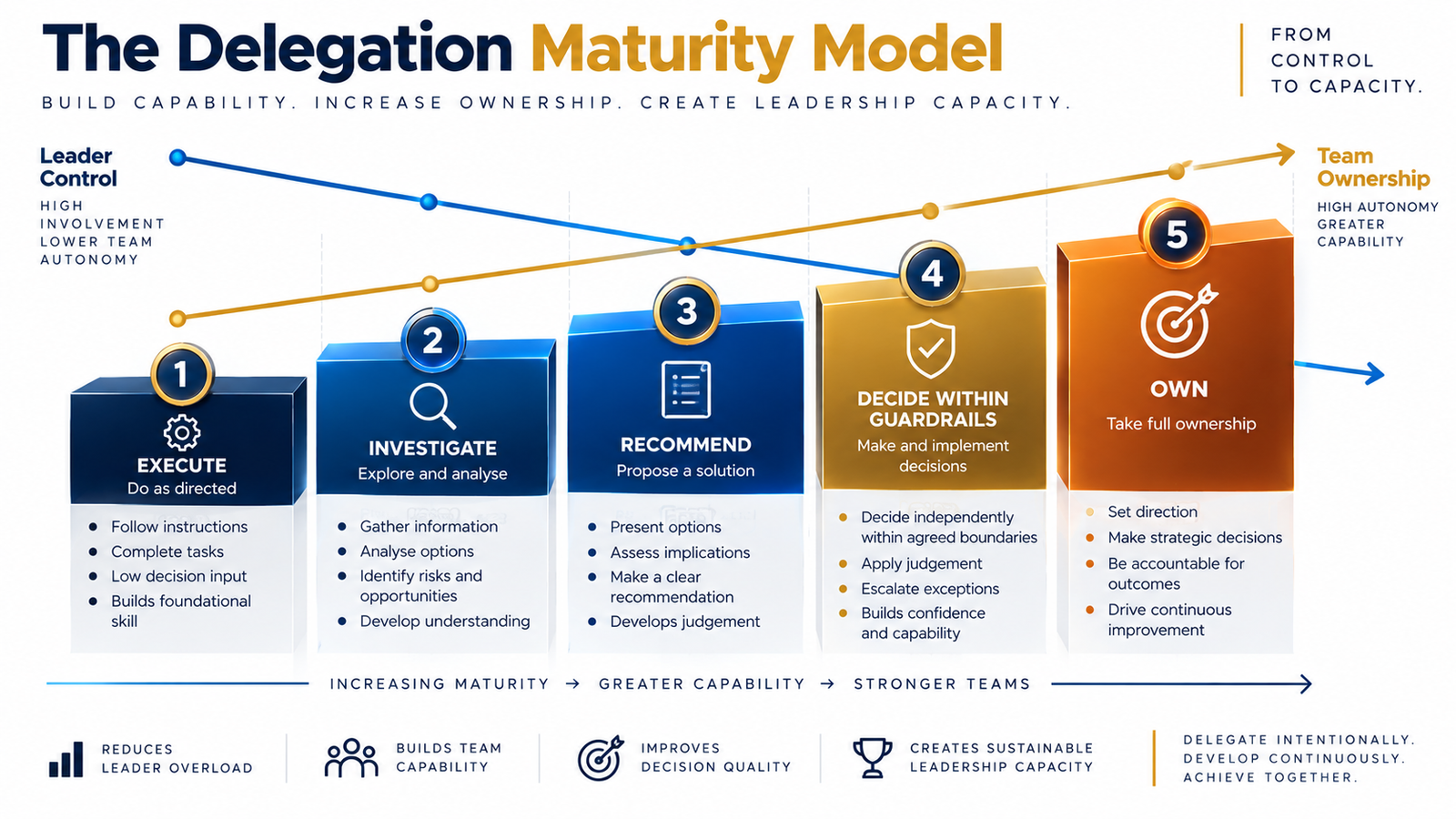
The important point is that maturity does not mean the leader disappears. Their role changes from controller to architect.
Why Does Delegation Fail Even When Leaders Delegate?
Many leaders think delegation is binary.
Either I do the work or somebody else does it.
Real delegation is more complicated. There are at least four separate things that can be transferred:
- Task. Who performs the work?
- Judgement. Who determines how the work should be approached?
- Decision authority. Who can make decisions without asking permission?
- Accountability. Who owns the outcome?
Immature delegation often transfers only the first.
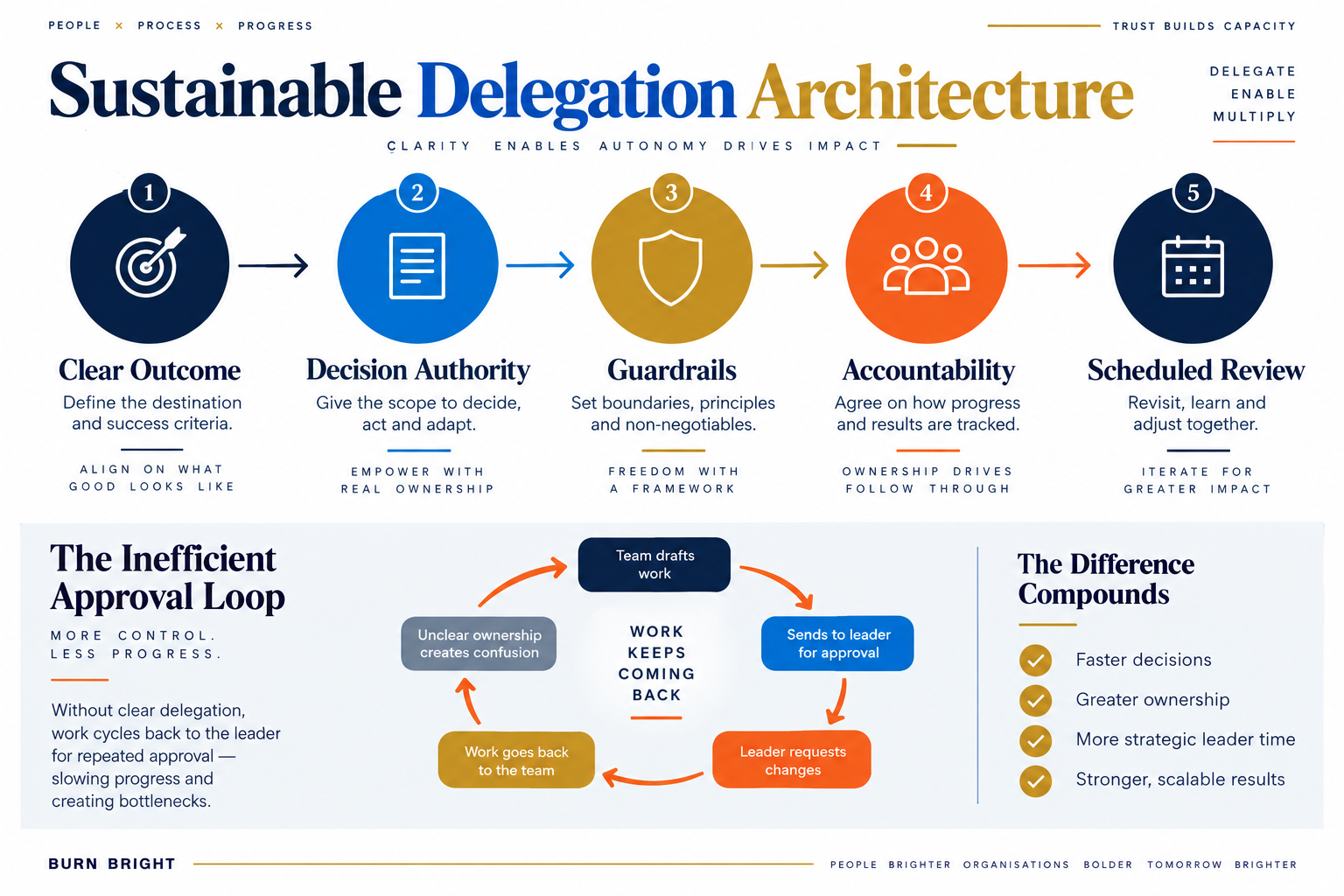
Consider a department head who asks a manager to organise a major event. The manager selects suppliers but needs approval. They prepare the programme but need approval. They draft communications but need approval. They solve problems but need approval before implementing the solution.
Technically, the event has been delegated.
Operationally, the department head remains the bottleneck.
This is one reason delegation can fail to reduce leadership workload. Instead of doing the work, the leader becomes an approval system for the work.
Notice the combination.
Authority plus support.
Not abandonment.
Not control.
This matters because leaders frequently oscillate between two extremes. At one end is micromanagement: “Don’t do anything until you’ve checked with me.” At the other is abdication: “It’s yours now. Let me know when it’s finished.” Neither represents mature delegation.
Effective delegation provides sufficient clarity and support while progressively increasing autonomy. That is why delegation maturity needs to be understood as a continuum rather than a switch.
What Are the Five Levels of the Delegation Maturity Model?
I use five practical levels for thinking about delegation.
Level 1
Execute
“I decide. You execute.” The leader retains decision authority and provides detailed direction. This is appropriate when someone is learning, the risk is high or the task requires precise compliance. There is nothing inherently wrong with Level 1 delegation — the problem occurs when capable people remain there permanently.
Level 2
Investigate
“Investigate the situation and bring me your findings.” The team member begins contributing judgement, but the leader still makes the decision. This develops analytical capability without transferring significant risk.
Level 3
Recommend
“Assess the options and recommend what you think we should do.” Judgement moves further away from the leader. The leader still holds final authority, but the team member must develop a position rather than simply provide information.
Level 4
Decide Within Guardrails
“Make the decision within agreed boundaries and keep me informed.” This is the critical transition. Authority has moved. The leader establishes constraints — budget, risk tolerance, policy, strategic priorities or escalation thresholds — but does not approve every action.
Level 5
Own
“You own the outcome.” The person has appropriate authority and accountability. They decide. They execute. They monitor. They escalate only when agreed thresholds are reached.
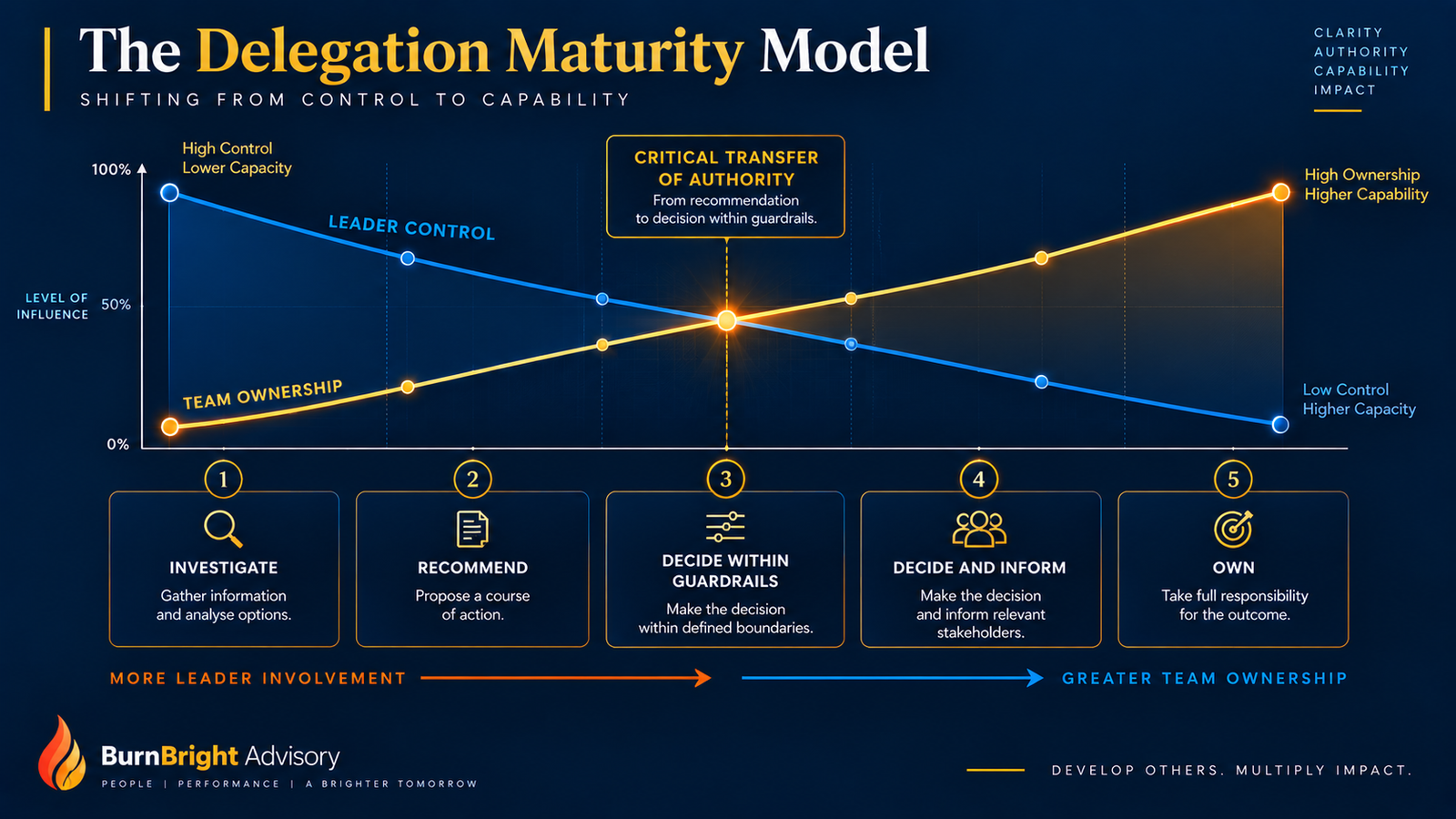
The model is not a judgement of the employee. Someone may operate at Level 5 for an area they have managed for ten years and Level 2 when taking responsibility for something new.
Likewise, not every responsibility should reach Level 5. High-risk, legally sensitive or strategically irreversible decisions may legitimately remain with senior leadership. Maturity means deliberately selecting the right level. It does not mean delegating everything.
How Does Delegation Maturity Reduce Leadership Burnout?
The connection between delegation and burnout is not simply about saving time. It is about reducing cognitive load.
A leader can delegate 20 tasks and remain mentally responsible for all 20. That is not meaningful workload reduction.
They may no longer produce the spreadsheet, but they still need to remember it.
They may not organise the meeting, but they still monitor it.
They may not prepare the proposal, but they still make every significant decision within it.
The physical work has moved.
The cognitive workload has not.
This distinction fits the wider Burn Bright principle that leaders cannot outwork broken systems. Sustainable leadership requires redesigning how work, decisions and accountability move through an organisation.
The scale of the problem is visible in wider workplace research. Deloitte reported that 53% of managers said they were burned out at work, and its workplace research also found that at least four in ten workers, managers and executives said they often or always felt exhausted or stressed. CIPD’s 2025 Good Work Index found that 25% of UK workers said their work negatively affected their mental health, with excessive workloads, pressure, workplace relationships and line-management quality among the strongest associated factors.
Featured Snippet
Delegation therefore becomes more than a productivity technique. It becomes part of Workload Architecture™. When appropriate decisions can be made without constantly returning to the senior leader, the organisation gains capacity without requiring that leader to personally work faster. That is sustainable leadership.
What Is the Difference Between Immature and Mature Delegation?
The easiest way to diagnose delegation maturity is to look at what happens when the leader is unavailable.
| Immature Delegation | Mature Delegation |
|---|---|
| Tasks are delegated | Outcomes are delegated |
| Leader retains most decisions | Decision authority moves appropriately |
| Frequent permission seeking | Agreed decision guardrails |
| Leader fixes mistakes | Leader coaches learning |
| Updates happen constantly | Updates happen at agreed points |
| Accountability is ambiguous | Ownership is explicit |
| Leader remains the bottleneck | Work continues without the leader |
| Trust depends on visibility | Trust depends on agreed outcomes |
| Delegation reduces activity | Delegation reduces cognitive load |
There is a simple test. What stops when you disappear for a week?
If routine decisions accumulate in your inbox, your delegation system is probably less mature than it appears. If people repeatedly say, “We were waiting for you,” examine why. Sometimes the team genuinely lacks capability. But sometimes they have learned that apparent authority can be withdrawn without warning.
McKinsey describes a version of this problem in which decisions are supposedly delegated but senior leaders later intervene or reopen them. Employees quickly learn that delegation is conditional, so they escalate decisions rather than risk making the “wrong” one.
That behaviour can look like a confidence problem.
Often it is a system problem.
If you want people to own decisions, the architecture around those decisions must make ownership safe and clear.
How Can Leaders Move Teams Up the Delegation Maturity Model?
The mistake is trying to leap directly from control to complete autonomy. Delegation capability is built. Start with one recurring responsibility rather than redesigning the entire team overnight. Ask five questions:
- What outcome am I actually delegating? “Help with recruitment” is vague. “Own the first-stage recruitment process and provide a shortlist of three appointable candidates by Friday” is much clearer.
- What authority comes with it? Can the person make decisions? Which ones? A responsibility without authority creates frustration rather than ownership.
- What are the guardrails? Define what must not happen. This might include spending limits, legal requirements, quality standards or situations that require escalation.
- What does success look like? Agree on outcomes rather than prescribing every action. This moves accountability towards results.
- When do we review? Create scheduled checkpoints. Do not replace micromanagement with continuous digital surveillance.
McKinsey recommends clarity around the boundaries of delegated decisions, capability development, accountability and escalation. Its work also emphasises that successful empowerment remains hands-on through coaching without taking the decision back from the person who owns it.
This is where the Burn Bright RACI Delegation Framework™ becomes particularly useful. RACI clarifies who is Responsible, Accountable, Consulted and Informed.
But RACI alone is not enough. A box on a chart does not create psychological permission to act. Recent HBR analysis similarly argues that assigning decision roles on paper does not automatically remove confusion around decision rights.
Structure must be reinforced through behaviour. If you delegate authority and then repeatedly override it, you teach people not to use it.
What Prevents Leaders From Reaching Mature Delegation?
Usually, the obstacle is not knowledge. Most experienced leaders understand delegation intellectually. The harder issue is what delegation asks them to surrender.
Control.
Certainty.
Speed.
And sometimes identity.
A highly capable leader can usually complete a familiar task faster than someone learning it. So they take it back. That feels efficient today. It creates dependency tomorrow.
This becomes particularly dangerous when perfectionism enters the system. The leader does not simply require an acceptable outcome. They require the outcome to resemble exactly what they would have produced themselves.
The standard quietly changes from “Is this good enough to achieve the required outcome?” to “Is this exactly how I would have done it?”
That is not quality control.
It is replication.
Instead, change the conversation. Ask: “What do you think we should do?” Then: “What decision do you need from me that you cannot make yourself?” Those two questions expose whether escalation is genuinely necessary.
The goal is not to stop supporting people. The goal is to stop confusing support with taking responsibility back.
How Do You Assess Your Current Delegation Maturity?
Do not begin by asking whether you are “good at delegation”. That is too broad to be useful. Audit your actual work. Take ten recurring responsibilities currently occupying your attention. For each one, record:
- Current owner. Who actually carries the work?
- Decision owner. Who makes the meaningful decisions?
- Escalation frequency. How often does it return to you?
- Risk. What would happen if the person made a poor decision?
- Capability. Does that person currently have the skill and context to operate independently?
- Target maturity level. Where should this responsibility sit in 90 days?
You may discover that you have delegated activity without delegating authority. That diagnosis matters.
That is a structural warning. We cannot keep adding leadership responsibilities while leaving leaders buried in work that could be owned elsewhere.
The Burn Bright approach is structural, not motivational. Do not simply tell managers to delegate more. Give them a framework for deciding what, to whom, with what authority, within which boundaries, and with what accountability. That is how delegation becomes organisational design rather than management advice.
What is a delegation maturity model?
A delegation maturity model describes progressive levels of responsibility and authority between a leader and team member. It helps leaders determine how much direction, decision authority and accountability should be transferred based on the responsibility, risk and person’s capability.
What are the five levels of delegation maturity?
A practical five-level model is: Execute, Investigate, Recommend, Decide Within Guardrails and Own. The progression moves from leader-controlled decisions towards genuine team ownership. People do not need to operate at the same level for every responsibility.
Does delegation mean giving up control?
No. Mature delegation replaces direct control with structural control. Instead of approving every action, leaders establish outcomes, guardrails, escalation thresholds and review points. The leader retains appropriate oversight without becoming the operational bottleneck.
How does delegation help prevent leadership burnout?
Effective delegation removes both work and decision load from leaders. This matters because simply transferring tasks while retaining every approval can leave cognitive workload unchanged. Mature delegation distributes responsibility and increases organisational capacity.
What should a leader not delegate?
Leaders should be cautious about delegating responsibilities where they personally hold legal accountability, highly sensitive people matters, critical strategic choices or decisions outside another person’s competence. The objective is appropriate distribution of authority, not maximum delegation.
Why do employees keep bringing delegated work back?
Reverse delegation often occurs because decision authority is unclear, employees fear consequences for making mistakes, or leaders have previously overridden delegated decisions. Clarify the person’s authority, define escalation thresholds and coach them through decisions without automatically taking ownership back.
Sustainable Leadership Requires Mature Delegation
A delegation maturity model changes the question leaders ask. Instead of “What can I give someone else to do?” ask “Where does ownership of this responsibility belong?” That is a fundamentally different leadership question.
Burnout is a system failure. If every meaningful task, judgement and decision eventually travels upward to one leader, overload is not surprising. It has been designed into the organisation.
The answer is not indiscriminate delegation.
It is deliberate distribution of responsibility.
Build capability. Define outcomes. Establish decision rights. Set guardrails. Agree escalation thresholds. Then allow people to own what you have genuinely asked them to own.
Better systems outperform more effort.
The mature leader is not the person who can personally carry the most. It is the person who builds a system in which responsibility can be carried well without everything depending on them.
Find Out Exactly Where Your Delegation System Is Breaking
If delegation is failing because too much responsibility still depends on you, a full diagnostic maps the structural pressures across your leadership so you know precisely what to redesign.
Take the Leadership Burnout Self-Assessment
If delegation is failing because too much responsibility still depends on you, the first step is diagnosing where the pressure is coming from. Take the free assessment to identify the structural pressures affecting your leadership capacity.
Free Leadership Intelligence
Get Weekly Leadership Insights
Join thousands of leaders receiving practical strategies on burnout prevention, workload design, and sustainable performance every week.