Quick Answer
Key Takeaways
- Leaders act on their interpretation of facts, not on the facts themselves — and different leaders can construct very different meanings from identical evidence.
- Many leadership failures begin when an interpretation is prematurely accepted as reality rather than tested.
- Experience and expertise sharpen judgement, but can also narrow it by making alternative explanations easier to dismiss.
- The Burn Bright Constructivism Intelligence™ Cycle moves leaders from unconscious interpretation through reflection, expanded perspective and experimentation to stronger leadership.
- Constructivism Intelligence™ supports Leadership Sustainability™ by reducing the wasted effort that comes from solving the wrong problem well.
Constructivism Intelligence™: How Leaders Separate Fact From Interpretation
Leadership decisions rarely begin with facts alone.
They begin with an interpretation of facts.
Two executives can receive the same performance report and identify different problems. Two school leaders can observe the same classroom and reach different conclusions. Two healthcare leaders can examine the same incident and recommend different interventions.
The information may be identical.
The meaning constructed from it is not.
This distinction sits at the heart of Constructivism Intelligence™, a domain within Burn Bright Advisory’s Leadership Intelligence Compass™.
Featured Snippet
This matters because many leadership failures are not failures of intelligence, commitment or effort. They begin when an interpretation becomes prematurely accepted as reality.
The stronger leadership question is therefore not simply “What happened?” It is: “How have I constructed my understanding of what happened — and what might I be missing?” That question creates the space for stronger learning, better judgement and more intelligent leadership performance.
Where Are Your Own Assumptions Shaping Your Leadership?
Before you can question your interpretations, it helps to see where pressure and habit are already shaping your leadership decisions.
Leadership Is an Act of Interpretation
Leadership is often presented as an exercise in decision-making. Assess the situation. Identify the problem. Select an intervention. Execute.
The difficulty is that this apparently rational sequence hides an important stage.
Before leaders decide, they interpret.
- A declining performance indicator becomes evidence of poor execution.
- Resistance to a new strategy becomes evidence of disengagement.
- Silence in a meeting becomes agreement.
- A missed deadline becomes evidence of weak accountability.
- A difficult employee becomes the source of a team problem.
Perhaps.
But perhaps not.
The observable event and the meaning assigned to that event are not necessarily the same thing.
Every leader interprets organisational reality through previous experience, professional knowledge, expectations, assumptions, values and existing mental models. Those frameworks are necessary. Without them, leaders could not process complexity quickly enough to function. But they also create risk.
Experience can sharpen judgement while simultaneously narrowing it.
Expertise can improve interpretation while making alternative explanations easier to dismiss.
Confidence can accelerate decisions while reducing curiosity.
This creates one of the less visible risks in leadership performance: leaders can become highly effective at solving the problem they believe exists without adequately testing whether they have constructed the problem correctly.
Constructivism Intelligence™ addresses that risk.
What Is Constructivism Leadership?
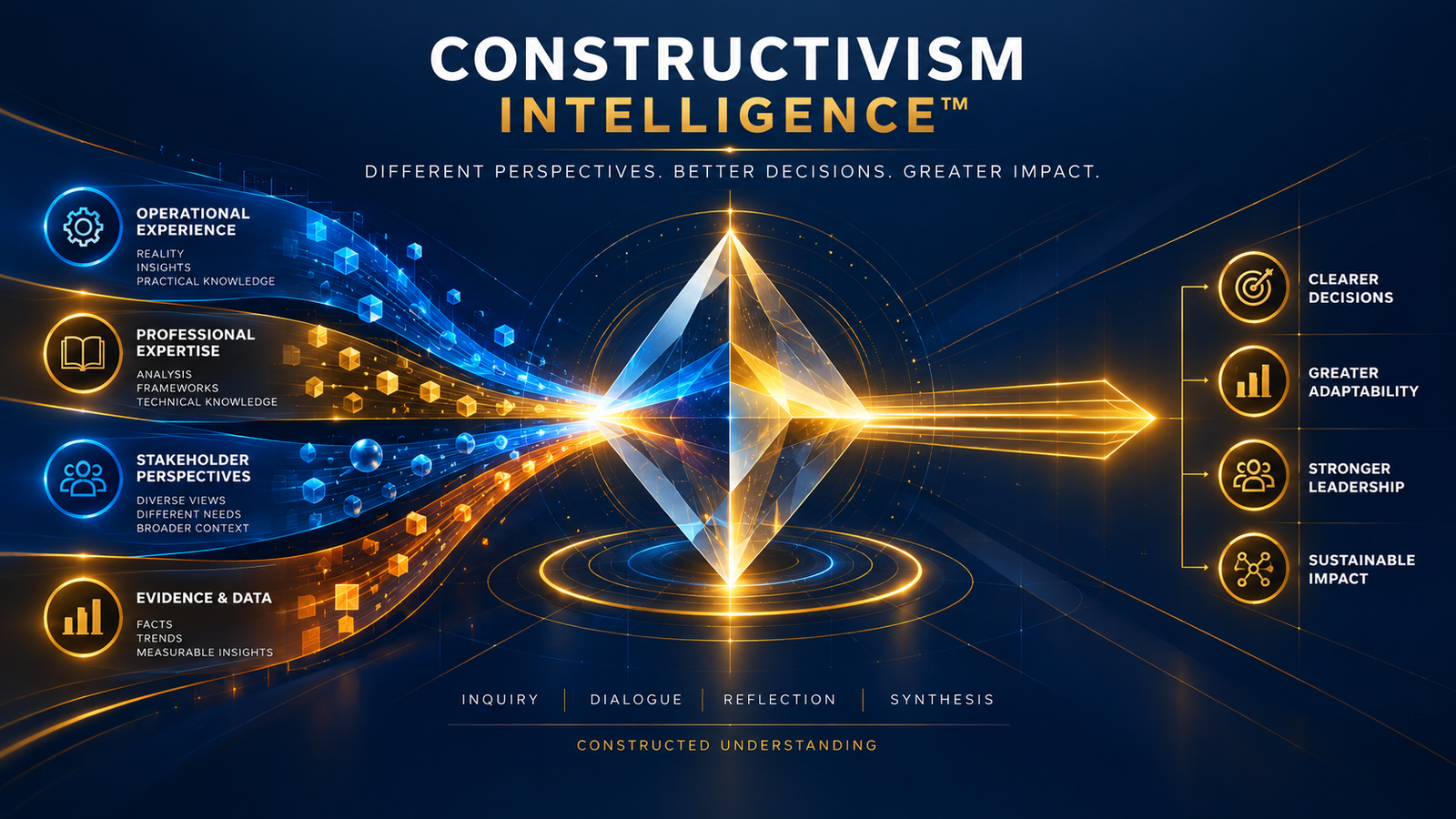
Constructivism leadership recognises that individuals do not simply receive organisational reality objectively. They interpret events and construct meaning through the interaction of evidence, experience, context and perspective.
For leaders, this does not mean that facts are irrelevant or that every interpretation is equally valid. It means distinguishing between what is observable, what is interpreted, and what is concluded. That distinction is strategically important.
Consider a senior leadership team discussing falling employee participation in an organisational development programme. One dataset generates four different constructions of the problem:
- “Employees are not committed to development.”
- “Managers are not giving employees enough time to participate.”
- “The programme does not address the problems employees currently face.”
- “Employees may not believe participation will influence their career progression.”
If the organisation accepts the first explanation without examination, it might introduce stronger participation targets. If the second is accurate, workload redesign may be necessary. If the third is correct, the programme itself requires redesign. If the fourth is driving behaviour, the organisation may have a trust or career architecture problem.
The quality of the eventual intervention therefore depends partly upon the quality of the meaning constructed around the evidence. This is why Constructivism Intelligence™ matters to Leadership Performance Intelligence™. Performance is not simply the result of doing things efficiently. It depends upon leaders understanding situations accurately enough to act intelligently.
The Hidden Leadership Risk: Confusing Interpretation With Reality
The most dangerous leadership assumptions are often the ones leaders no longer recognise as assumptions. They sound like facts:
- “The team lacks accountability.”
- “People resist change.”
- “Middle management is the problem.”
- “We need better communication.”
- “The strategy is clear.”
- “They aren’t ready.”
- “That approach won’t work here.”
Each statement might eventually prove reasonable. But each is also a construction requiring examination.
When assumptions harden into organisational truths without sufficient testing, they begin influencing recruitment, performance management, investment, restructuring, communication and culture. The result can be significant: leaders may spend considerable resources solving symptoms created by an inaccurate diagnosis.
This is where constructivist leadership differs from indecisiveness. Constructivism Intelligence™ does not require endless discussion or avoidance of judgement. It requires leaders to improve the quality of interpretation before certainty becomes action.
The Burn Bright Constructivism Intelligence™ Cycle
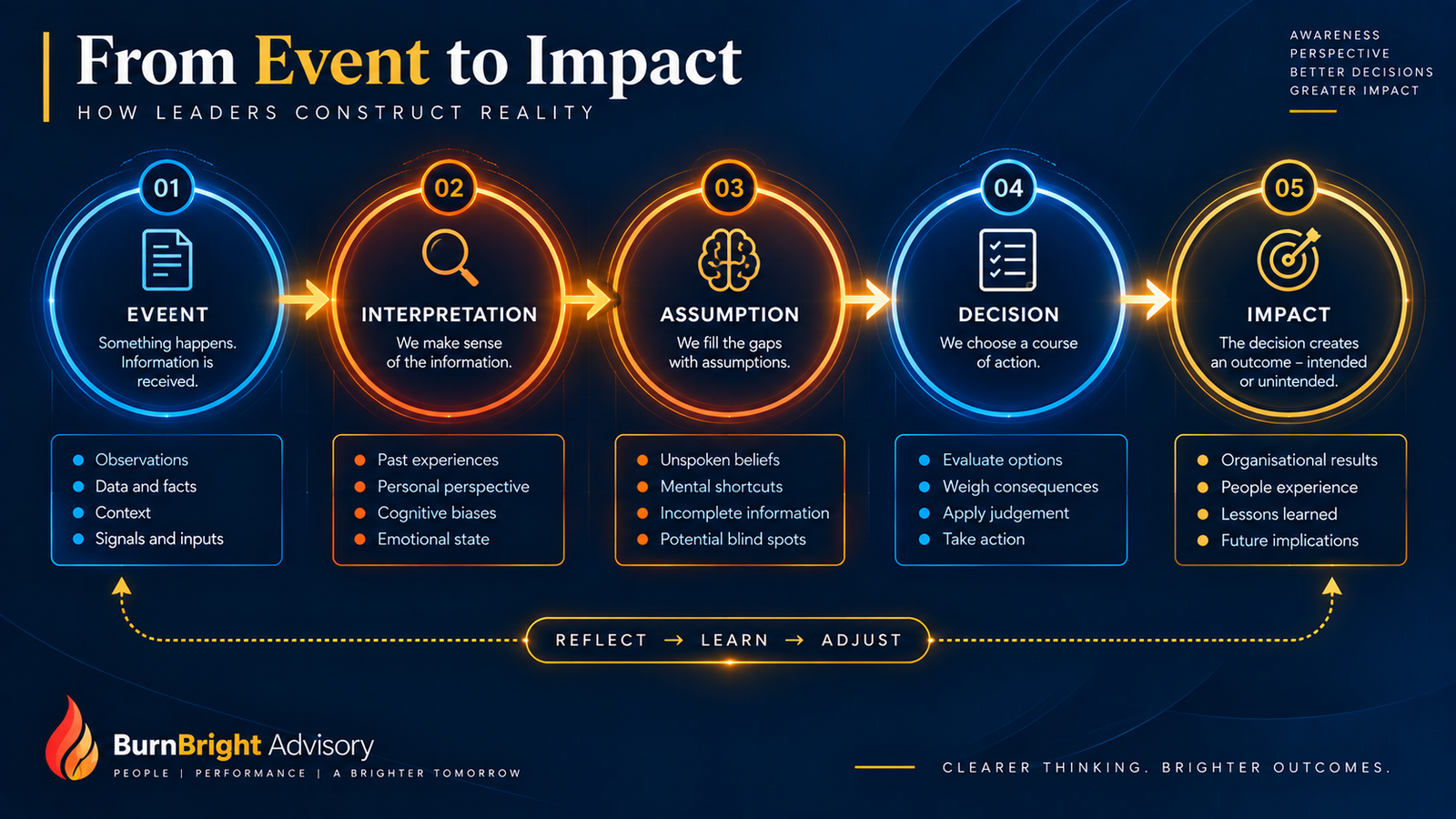
A practical way to strengthen this capability is to move leadership thinking through five stages.
Stage 1
Unconscious Interpretation
Something happens and meaning is assigned almost automatically. A colleague challenges a proposal and the leader thinks, “They are being difficult.” The interpretation feels immediate and obvious, but an event has already been transformed into a story. Constructivist leaders learn to notice this transition.
Stage 2
Conscious Reflection
The leader creates distance between the event and the interpretation. What actually happened? What did I observe directly? What did I infer? Which assumptions am I making? This is where Reflective Practice Intelligence™ becomes closely connected to Constructivism Intelligence™.
Stage 3
Expanded Perspective
The leader deliberately introduces alternative viewpoints. How might the colleague describe the interaction? What information might they possess that I do not? What would another function, customer, employee, regulator, patient, parent or citizen conclude? The purpose is not consensus — it is increased informational range.
Stage 4
Deliberate Experimentation
Instead of treating the first explanation as settled truth, the leader tests competing hypotheses. If resistance is caused by poor communication, one intervention should change behaviour. If workload is the real constraint, communication alone will have little effect. Leadership becomes a disciplined learning process rather than a sequence of increasingly confident assumptions.
Stage 5
Stronger Leadership
Evidence from reflection and experimentation updates the leader’s mental model. The leader has not simply solved one problem — they have improved the way they understand similar problems in the future.
Unconscious Interpretation → Conscious Reflection → Expanded Perspective → Deliberate Experimentation → Stronger Leadership
That is constructivism translated into leadership practice.
Constructivism Intelligence™ and the Leadership Intelligence Compass™
Leadership capabilities rarely operate independently. Constructivism Intelligence™ becomes particularly powerful when connected with other domains of the Leadership Intelligence Compass™.
- Reflective Practice Intelligence™ helps leaders examine their own assumptions.
- Emotional Intelligence™ helps them understand how emotion affects interpretation and how others may experience the same situation differently.
- Knowledge Development Intelligence™ strengthens the evidence and expertise available for constructing meaning.
- Adaptability Intelligence™ enables leaders to revise approaches when new evidence invalidates previous assumptions.
- Ethics Intelligence™ encourages leaders to consider whose perspective is included, whose is missing and who may experience the consequences of a decision.
- Professionalism Intelligence™ turns insight into disciplined, accountable leadership behaviour.
Together, these capabilities support the wider architecture of Leadership Performance Intelligence™: the ability to understand, decide, act, learn and sustain performance under real organisational conditions.
Why Expertise Can Become a Constraint
Organisations rightly value experience. Experienced leaders recognise patterns quickly. They understand context. They can identify risks that inexperienced colleagues miss.
Yet experience produces an important paradox. The better leaders become at recognising familiar patterns, the greater the temptation to interpret new situations through old explanations.
- “This is exactly what happened at my previous organisation.”
- “I’ve seen this before.”
- “We tried that five years ago.”
Sometimes those statements provide valuable institutional intelligence. Sometimes they close inquiry prematurely.
Constructivism Intelligence™ asks leaders to treat experience as evidence rather than destiny. The question changes from “What does my experience tell me this is?” to “What does my experience suggest — and what evidence would tell me this situation is different?”
From Being Right to Building Understanding
Traditional leadership cultures often reward certainty. Senior people are expected to know. Meetings move rapidly toward answers. Confidence can become associated with competence. Questions can be interpreted as hesitation.
Yet complex environments rarely reward premature certainty for long. Leadership Performance Intelligence™ requires a different standard. The objective is not to demonstrate that the leader already understands everything — it is to build sufficient understanding for effective action.
That requires leaders to become comfortable saying:
- “I have an initial interpretation, but I want to test it.”
- “What are we assuming here?”
- “Which perspective is absent from this discussion?”
- “What evidence would cause us to change our conclusion?”
- “What else could explain this result?”
These are not weak leadership questions. They are mechanisms for improving decision quality.
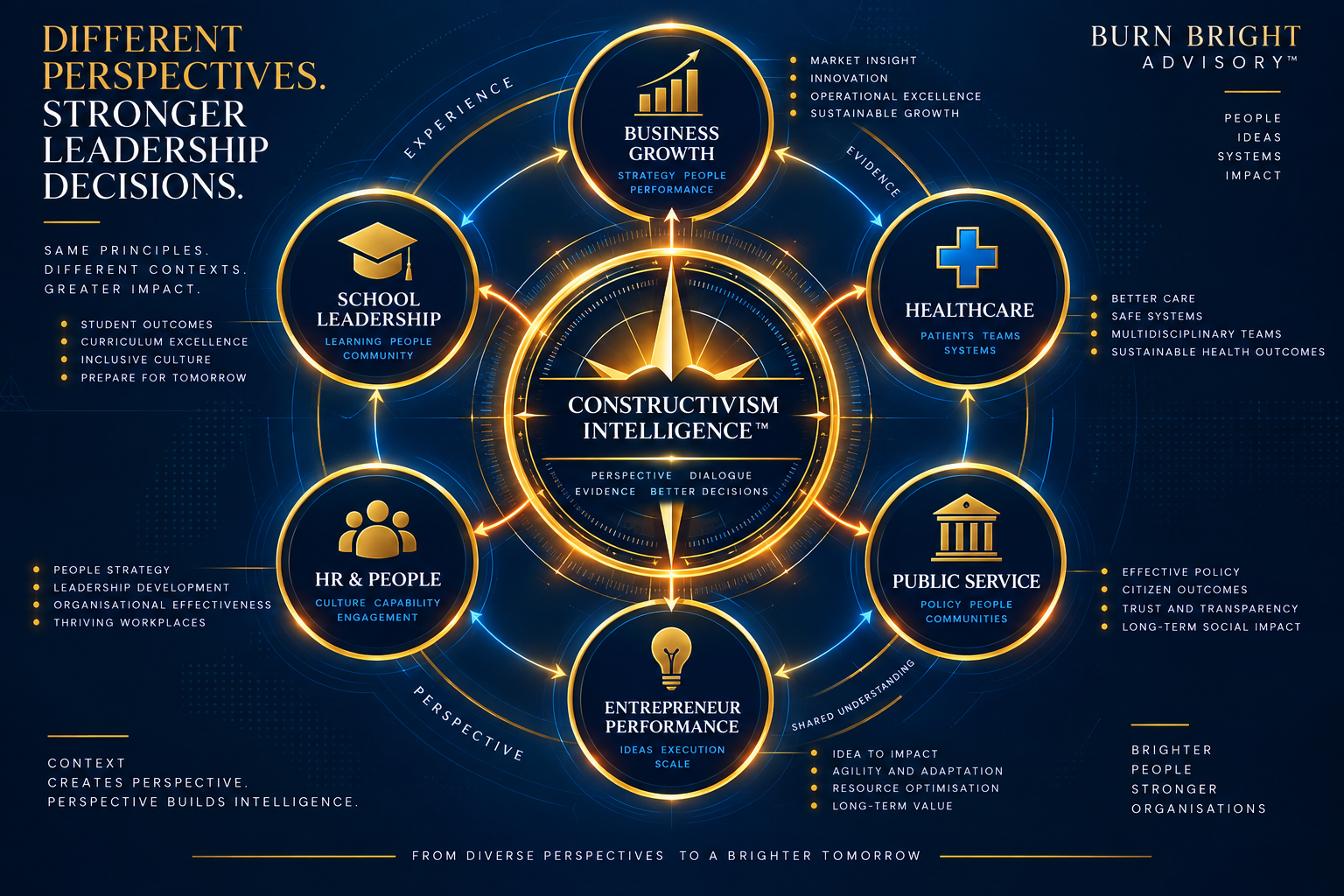
Constructivism Leadership Across Sectors
📈 Business Growth Intelligence™
A business experiencing declining customer retention could focus immediately on sales, service or pricing. A constructivist approach widens the frame — asking whether different customer groups behave differently, whether the value proposition has changed, and whether customers are leaving because of service quality, competitor innovation, product complexity or changing expectations, before investing heavily in a solution.
🏫 School Leadership Intelligence™
A school leader sees declining assessment performance. One interpretation is weak teaching, but alternative constructions might include curriculum sequencing, attendance, student wellbeing, assessment design, staffing instability, transition difficulties or differences between student cohorts. Constructivist leadership does not lower accountability — it improves diagnosis.
🏥 Healthcare Leadership Intelligence™
A healthcare team experiences repeated operational delays. A leader might attribute them to individual performance, while frontline clinicians see staffing constraints, administrators identify scheduling design, and patients experience communication failures. Patient safety can depend on whether leaders create conditions in which these perspectives can be surfaced rather than suppressed.
🏛️ Public Service Leadership Intelligence™
Public-service problems often involve multiple legitimate perspectives simultaneously. Constructivism Intelligence™ helps leaders distinguish disagreement about evidence from disagreement arising from different experiences, assumptions or definitions of the problem.
👥 HR & People Leadership Intelligence™
Calling something an “engagement problem” can itself constrain thinking. Employees may be responding to workload, management behaviour, limited progression, organisational uncertainty, poor role design or declining trust. A survey score identifies a signal — it does not automatically provide the explanation.
🚀 Entrepreneur Performance Intelligence™
Founders are particularly vulnerable to the strengths and risks of their own conviction. The vision necessary to build something new can eventually make contradictory evidence difficult to absorb. Constructivism Intelligence™ allows entrepreneurs to retain conviction while continually updating the assumptions underneath it.
The Perspective Portfolio
Practical Tool Building a Perspective Portfolio
Before making a significant decision, identify five forms of perspective. This does not mean giving every opinion equal weight — evidence, expertise and accountability still matter. The objective is to avoid mistaking limited perspective for complete understanding.
- Your perspective: What do I currently believe is happening?
- Operational perspective: What do people closest to the work see?
- Stakeholder perspective: How is the situation experienced by those affected?
- Contrarian perspective: What would someone who disagrees with my interpretation argue?
- Evidence perspective: What do reliable data actually establish — and what remains uncertain?
The Constructivism Intelligence™ Decision Audit
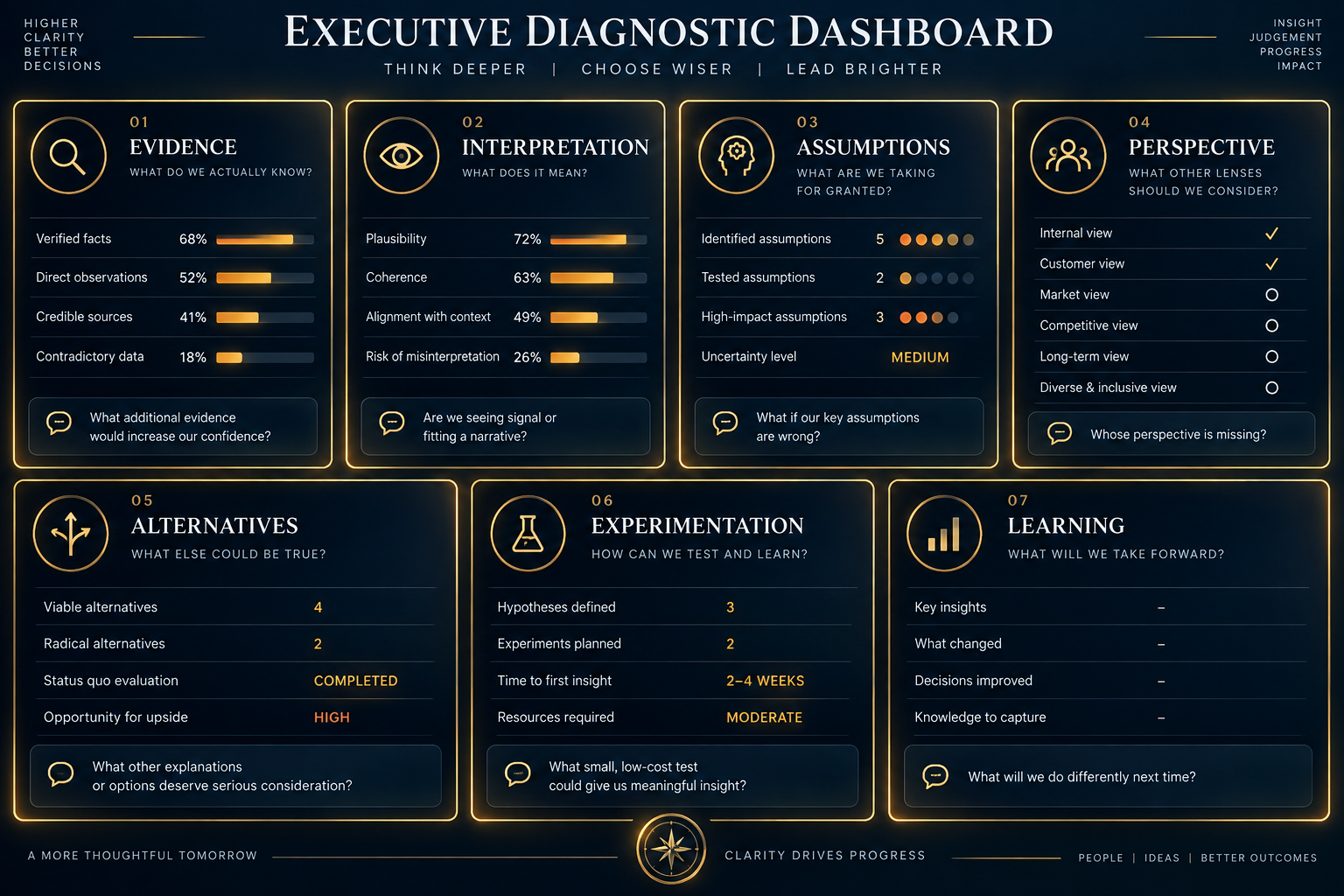
Before a strategically important decision, leaders can work through seven dimensions. This audit can be completed individually, by an executive team or during strategic review — its value comes from making invisible thinking visible.
| Dimension | Leadership Question |
|---|---|
| Evidence | What do we actually know? |
| Interpretation | What meaning have we assigned to that evidence? |
| Assumptions | What must be true for our interpretation to be correct? |
| Perspective | Whose interpretation have we not considered? |
| Alternatives | What else could explain what we are seeing? |
| Experimentation | What could we test before committing fully? |
| Learning | What would cause us to revise our position? |
Psychological Safety Is Part of the Architecture
Perspective diversity is useless if people do not feel able to express it. A leadership team can contain extraordinary experience and still produce weak decisions if everybody learns that challenging the dominant interpretation carries interpersonal or professional risk.
This connects Constructivism Intelligence™ to leadership culture. Leaders need environments where people can distinguish between challenging an idea and challenging authority.
The leader’s response to disagreement becomes critical. When someone offers contradictory evidence, does the leader become defensive? When a junior colleague questions an assumption, is curiosity rewarded? When an experiment fails, is the organisation interested in what was learned or primarily concerned with allocating blame?
These behaviours determine whether an organisation genuinely learns or merely confirms what its most powerful people already believe. This is also where constructivist leadership intersects with the principles of unguarded leadership: expertise remains valuable, but leaders stop treating the appearance of certainty as a prerequisite for authority.
Constructivism and Leadership Sustainability™
Poorly examined assumptions create unnecessary work. When leaders misdiagnose problems, organisations launch programmes, restructure teams, add meetings, introduce controls and create initiatives that may never address the underlying issue. The organisation becomes busier without becoming more intelligent. Leaders then absorb the consequences.
More escalations.
More interventions.
More reporting.
More decisions.
More cognitive load.
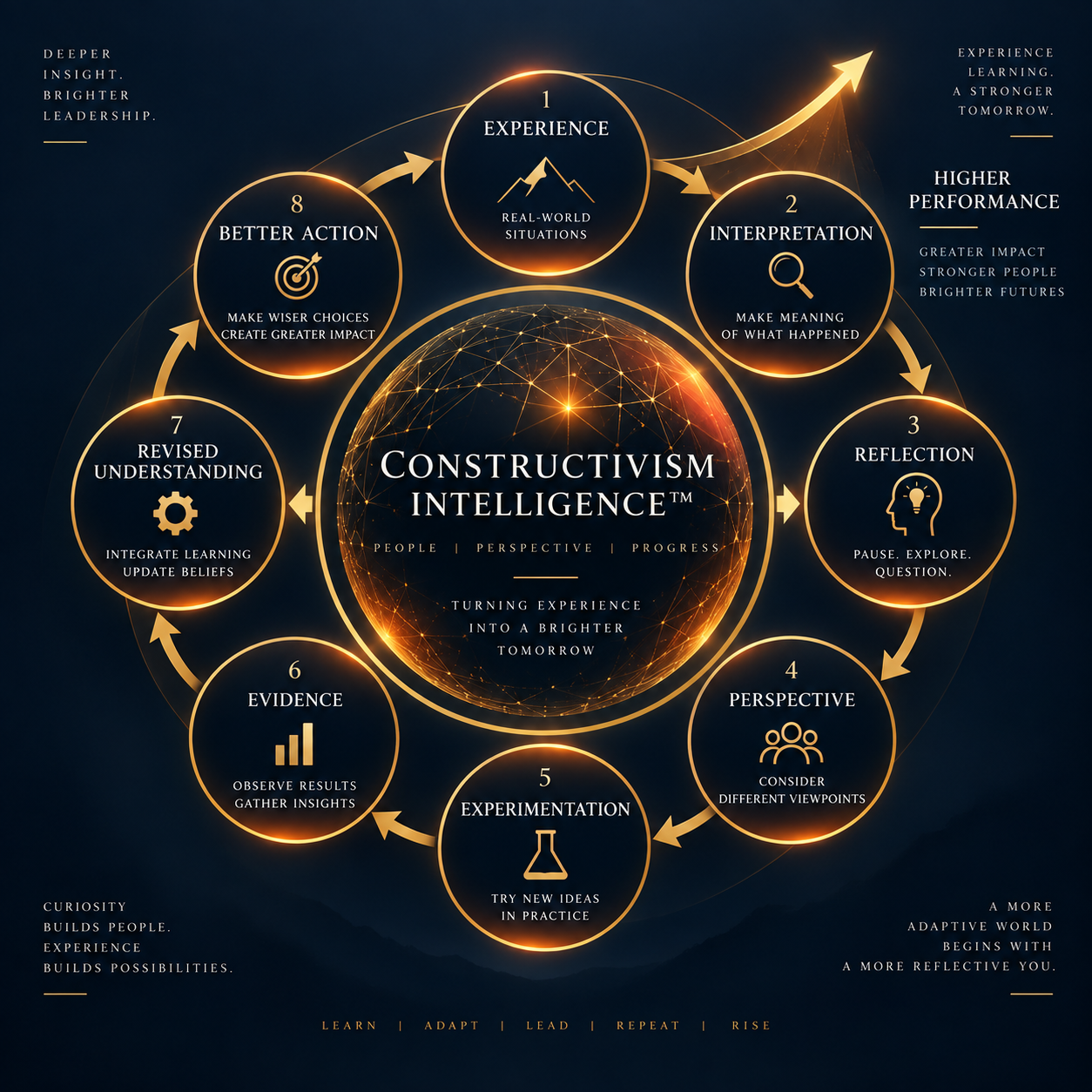
The Leadership Learning Loop
Constructivist leaders treat leadership itself as an evolving learning system. They do not simply ask, “Did the decision work?” They ask, “What did the outcome teach us about the assumptions behind the decision?”
Experience → Interpretation → Reflection → Perspective → Experimentation → Evidence → Revised Understanding → Better Action
Every significant leadership experience becomes potential data for development. This is fundamentally different from collecting experience. A leader can accumulate twenty years of experience while repeatedly reinforcing the same mental models. Leadership development occurs when experience changes understanding. That distinction is central to the Leadership Development System™.
When Constructivism Becomes Organisational Capability
The greatest opportunity is not merely creating constructivist leaders. It is creating constructivist organisations that embed learning into operating systems.
- Strategy reviews examine assumptions as well as results.
- Project reviews ask what changed in the team’s understanding.
- Performance discussions distinguish observation from interpretation.
- Executive meetings actively surface alternative explanations.
- Diagnostics become learning mechanisms rather than judgement mechanisms.
- Data informs inquiry rather than merely confirming existing narratives.
Over time, the organisation develops greater capacity to update itself. That capability matters in environments characterised by uncertainty because yesterday’s successful interpretation may not explain tomorrow’s conditions.
Leadership Performance Intelligence™ therefore requires more than knowledge. It requires the ability to reconstruct knowledge when reality changes.
Leadership Reflection Questions
- Which leadership assumptions have become so familiar that you rarely question them?
- Where might you currently be confusing interpretation with observable fact?
- Whose perspective is systematically missing from your important decisions?
- When did you last substantially change your mind because of new evidence?
- Does your leadership team reward thoughtful disagreement or quiet compliance?
- Which current organisational problem may have been framed too narrowly?
- What evidence would cause you to revise one of your strongest current conclusions?
- Are you accumulating leadership experience — or actively learning from it?
Action Steps
For one significant leadership issue this week:
- Write down the facts before writing your interpretation.
- Identify the assumptions connecting those facts to your conclusion.
- Seek at least two perspectives from people who experience the issue differently.
- Develop one credible alternative explanation.
- Decide what evidence could distinguish between the competing explanations.
- Run the smallest useful experiment before committing substantial organisational resources.
- Record what the process changed in your understanding.
That final step matters. Constructivism Intelligence™ is strengthened not simply by experiencing more, but by becoming increasingly deliberate about how experience changes the way you think.
What is constructivism leadership?
Constructivism leadership recognises that leaders and stakeholders interpret situations through existing experience, knowledge and assumptions. Effective leaders therefore examine how understanding has been constructed before acting upon it.
What is Constructivism Intelligence™?
Constructivism Intelligence™ is Burn Bright Advisory’s leadership capability concerned with examining assumptions, integrating different perspectives, learning from experience and deliberately reconstructing understanding to improve leadership decisions and performance.
Why is constructivism important in leadership?
Because leaders rarely act directly upon facts. They act upon their interpretation of facts. Improving interpretation can therefore improve diagnosis, decisions, organisational learning and subsequent action.
Does constructivist leadership mean every perspective is equally correct?
No. Different perspectives should inform inquiry, but evidence, expertise, ethics and professional judgement remain essential. Constructivism broadens understanding; it does not eliminate standards of evidence.
How does constructivism improve decision-making?
It encourages leaders to separate observations from interpretations, expose assumptions, consider alternative explanations and test hypotheses before making large commitments.
What is the relationship between reflection and constructivism?
Reflective Practice Intelligence™ helps leaders examine their thinking. Constructivism Intelligence™ extends that process by incorporating other perspectives, evidence and experimentation to reconstruct understanding.
Can experienced leaders benefit from constructivist thinking?
Especially so. Experience improves pattern recognition but can also strengthen assumptions. Constructivist thinking allows leaders to use experience without becoming trapped by it.
How does constructivism support Leadership Sustainability™?
Better problem diagnosis can reduce unnecessary interventions, repeated crises and wasted leadership effort, helping preserve Leadership Capacity™ for work that creates greater strategic value.
How can organisations develop Constructivism Intelligence™?
Organisations can embed assumption testing, perspective seeking, reflection, experimentation and learning reviews into executive meetings, strategy processes, diagnostics, performance discussions and leadership development.
Leadership Intelligence Begins With Better Understanding
The leadership challenge is not simply making more decisions. It is constructing better understanding before those decisions are made.
Every leader operates through mental models. Every executive interprets. Every organisation develops stories about why performance is improving or declining. The question is whether those interpretations remain open to evidence, reflection and reconstruction.
Constructivism Intelligence™ gives leaders a disciplined way to accomplish this. It moves leadership from unconscious interpretation to conscious reflection, from narrow perspective to expanded understanding, and from assumption-driven action to deliberate experimentation.
The result is not endless uncertainty.
It is better-founded confidence.
Within Burn Bright Advisory’s wider Leadership Performance Intelligence™ architecture, this capability is critical because leadership performance depends upon more than executing effectively. Leaders must first understand intelligently.
The strongest leaders are therefore not those who never revise their view. They are those capable of learning fast enough, deeply enough and deliberately enough to construct a better one.
See How Your Own Assumptions Are Shaping Your Leadership
A full diagnostic maps the structural pressures, patterns and blind spots across your leadership so you can see exactly where interpretation may be outrunning evidence.
Take the Leadership Burnout Self-Assessment
If your leadership feels busier than it is effective, the first step is diagnosing where the structural pressure is actually coming from. Take the free assessment to identify the pressures affecting your leadership capacity.
Free Leadership Intelligence
Get Weekly Leadership Insights
Join thousands of leaders receiving practical strategies on burnout prevention, workload design, and sustainable performance every week.