Quick Answer
Key Takeaways
- Information can be transmitted, but understanding has to be constructed — telling people the priorities is not the same as them understanding how those priorities should shape decisions.
- Leaders who constantly supply answers can unintentionally make themselves the organisation’s cognitive bottleneck.
- The Burn Bright Constructivist Leadership Cycle moves teams through experience, interpretation, dialogue, reconstruction and application.
- Constructive sense-making depends on four conditions: psychological safety, cognitive diversity, reflective space and permission to revise.
- Constructivism Intelligence™ becomes more valuable, not less, as AI makes information and analysis more abundant.
Constructivism Intelligence™: From Instruction to Inquiry
Many organisational problems initially appear to be performance problems.
- A team repeatedly misses deadlines.
- A strategy is announced but implementation stalls.
- Employees attend training but behaviour barely changes.
- Departments disagree about priorities.
- A transformation programme produces compliance rather than commitment.
The instinctive leadership response is often to increase communication. Another presentation is delivered. Another email is written. Another meeting is scheduled. Another procedure is created.
Yet information continues to move while understanding remains stubbornly uneven.
This distinction matters.
Information can be transmitted.
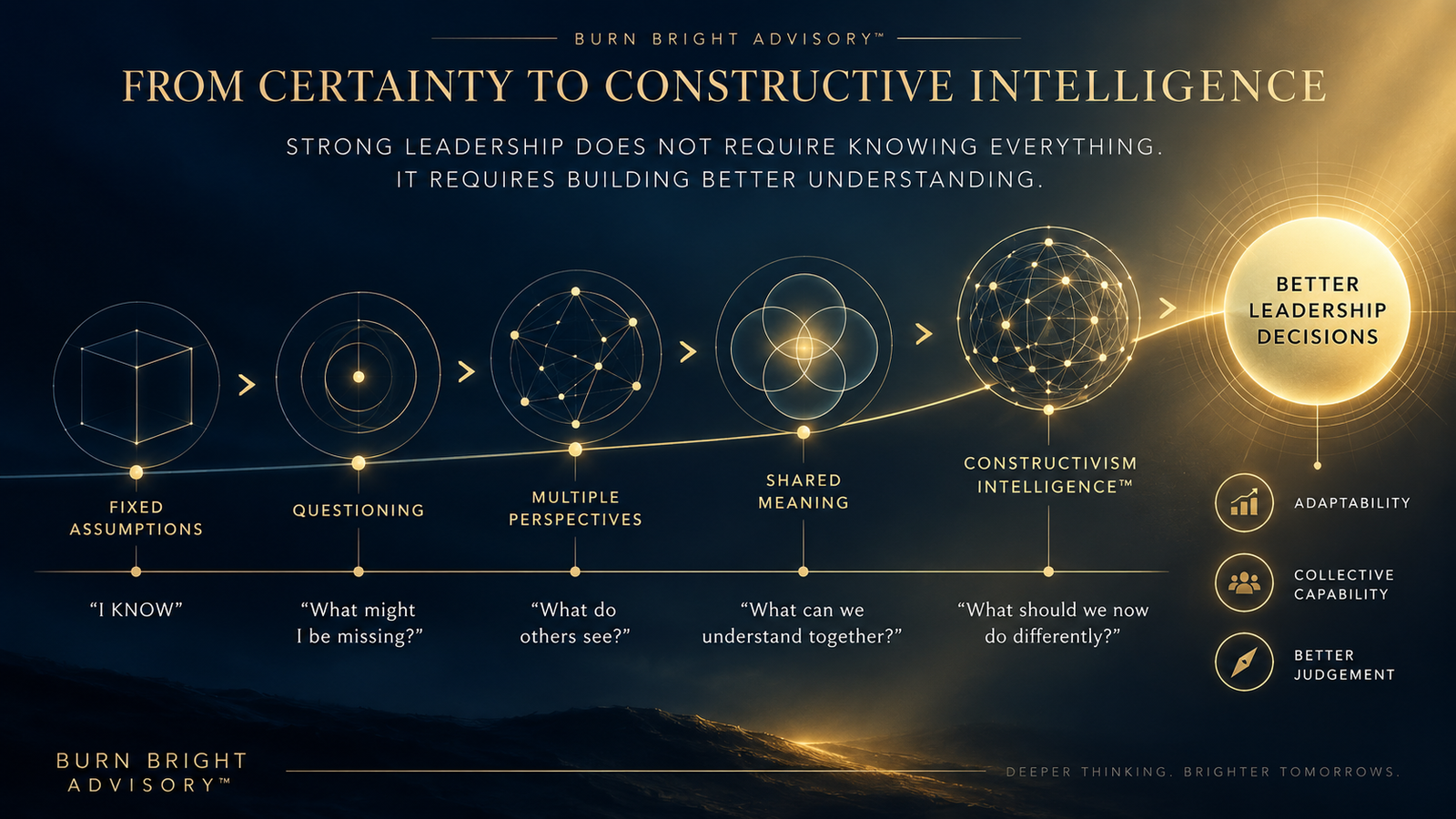
Understanding must be constructed.
A leader can tell someone the organisation’s priorities. That does not mean the person understands how those priorities should influence competing decisions. A manager can explain a new process. That does not mean employees understand why the process exists or how to respond when reality does not fit the procedure.
A school leader can introduce a pedagogical framework. A healthcare executive can publish a new clinical strategy. A CEO can announce a transformation programme. None of these activities guarantees shared meaning.
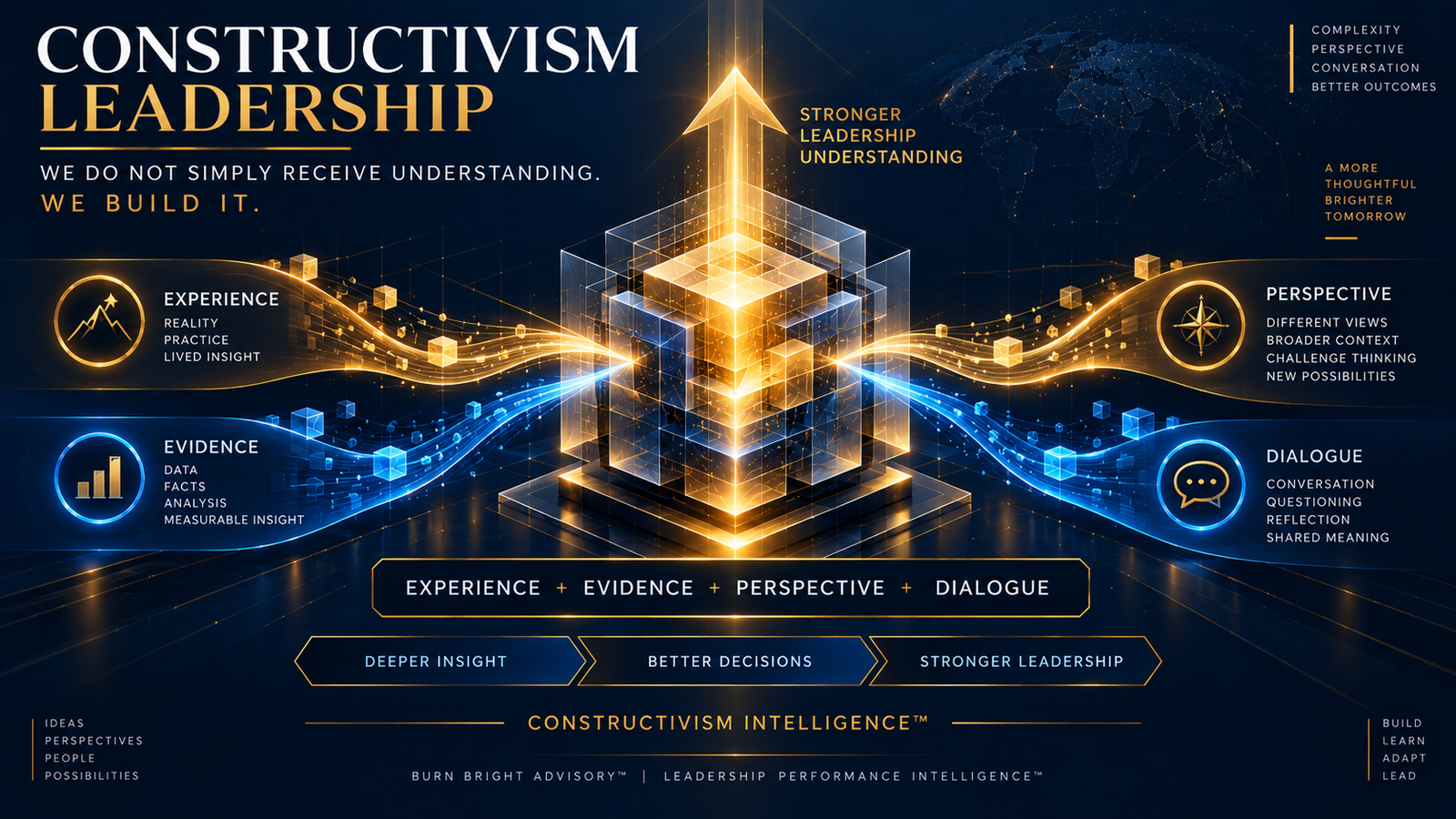
Constructivism leadership begins with this gap.
Is Constant Instruction Quietly Overloading You?
If every decision still migrates upward to you, the pressure that creates is worth naming before you try to fix it.
What Is Constructivism Leadership?
Featured Snippet
People are continuously interpreting leadership messages. They compare them with previous experience. They test them against what they observe. They discuss them with colleagues. They reconcile them with existing beliefs. They notice inconsistencies. And eventually they construct their own interpretation of what something means.
This is why two people can leave the same leadership meeting with entirely different understandings of what has just been decided.
From the perspective of Leadership Performance Intelligence™, that is not simply a communication problem.
It is a sense-making problem.
Constructivism Intelligence™ gives leaders a framework for recognising and managing that reality.
The Leader as an Architect of Understanding
Traditional leadership can unintentionally create dependency.
The organisation encounters a problem.
The team escalates it.
The leader interprets it.
The leader decides.
The leader provides the answer.
The team implements it.
Repeated often enough, the organisation learns something dangerous: when uncertainty appears, look upward.
The leader becomes the organisation’s cognitive bottleneck.
More decisions migrate upward. Employees become increasingly hesitant to exercise judgement. Senior leaders become overloaded while capable people further down the organisation wait for direction.
This dynamic connects directly with Leadership Capacity™ and Leadership Sustainability™. Sustainable leadership is not achieved merely by teaching leaders to tolerate more pressure. It requires organisations to distribute thinking, judgement and decision-making more intelligently.
Constructivist leadership contributes to that distribution.
Rather than solving every problem, leaders develop people’s ability to interpret problems.
Rather than supplying every answer, they improve the questions through which answers emerge.
Rather than becoming indispensable, they deliberately expand capability around them.
That is not an abdication of leadership. It is leadership development occurring through everyday work.
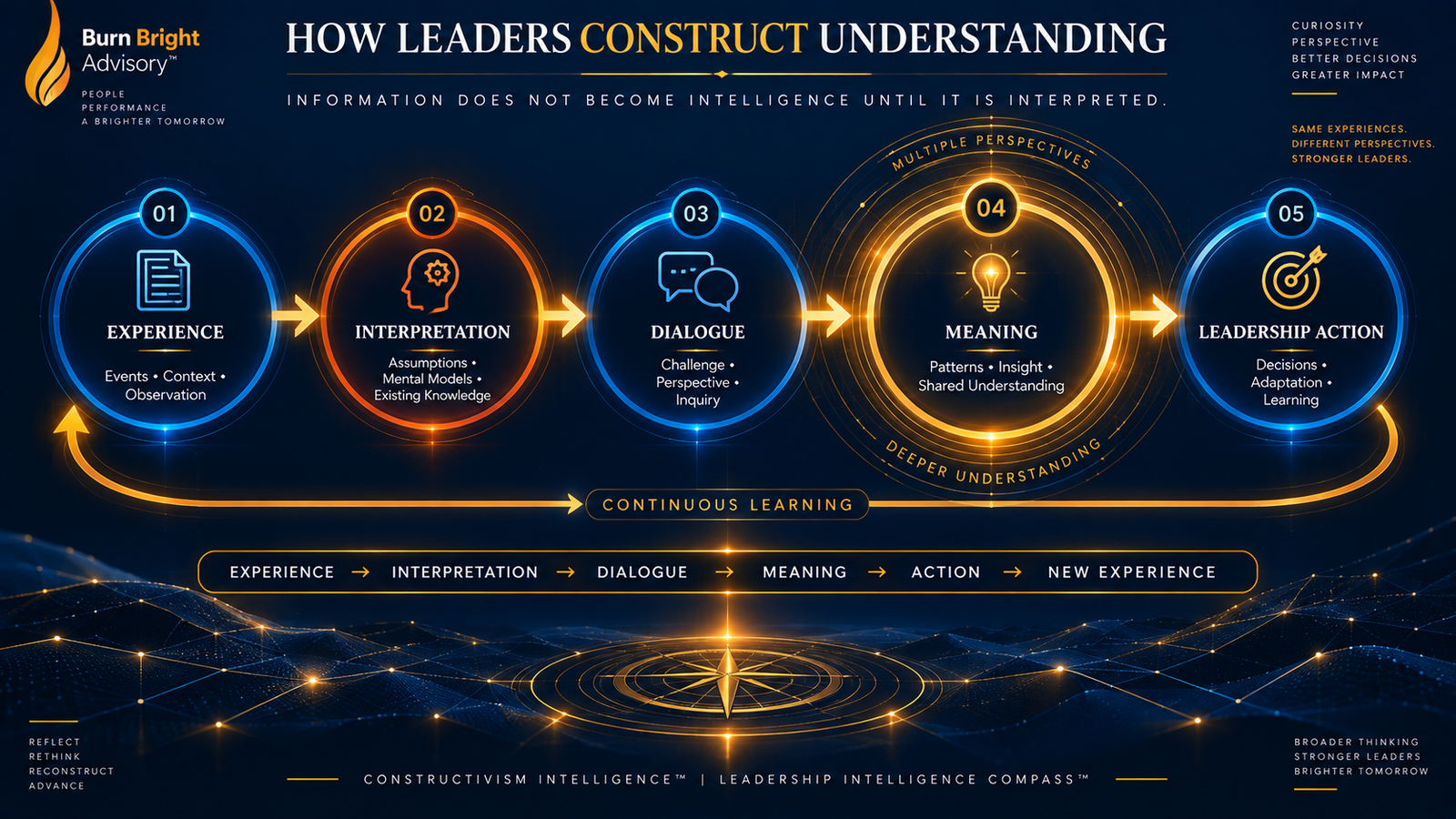
The Burn Bright Constructivist Leadership Cycle
Burn Bright Advisory™ frames constructivist leadership through five connected stages.
Stage 1
Experience
People encounter a situation, challenge, decision or result. Experience creates the raw material for learning, but experience alone does not guarantee learning — organisations can repeat the same mistakes for years while accumulating enormous amounts of experience. The difference lies in what happens next.
Stage 2
Interpretation
People naturally interpret what happened: what caused the result, what mattered, what assumptions were operating, whose perspective shaped the decision, what information was missing. Different people may construct radically different explanations from exactly the same event. Constructivist leaders make those interpretations visible rather than allowing them to remain hidden.
Stage 3
Dialogue
Interpretations are tested through structured conversation. Healthy dialogue is not a meeting in which everyone politely agrees with the most senior person — it creates sufficient psychological and professional safety for people to say “I interpreted that differently” or “What evidence supports that conclusion?” Learning requires disagreement without degradation.
Stage 4
Reconstruction
Through reflection and dialogue, people revise their understanding. Perhaps an assumption changes, the problem is reframed, or a previously invisible relationship becomes obvious. This is where genuine development occurs — learning is not merely acquiring another piece of information, it is changing the mental model through which future information will be interpreted.
Stage 5
Application
The revised understanding is tested through action. A different decision is made. A process changes. A conversation happens differently. A team experiments. The results then create new experience — and the cycle begins again.
Experience → Interpretation → Dialogue → Reconstruction → Application
This is how organisations turn activity into intelligence.
Why Constructivism Matters in Complex Organisations
Complex organisations rarely suffer from a shortage of information. They suffer from difficulty converting information into usable judgement.
Dashboards multiply. Reports expand. Meetings increase. AI systems accelerate access to analysis. Yet leaders can still struggle to answer fundamental questions:
- What does this mean?
- Why is this happening?
- What should we pay attention to?
- Which assumptions are no longer valid?
- What should we do differently?
The more information becomes abundant, the more valuable interpretation becomes.
This has profound implications in the age of artificial intelligence. AI can increasingly generate summaries, scenarios, recommendations and analysis. But leadership still requires contextual judgement.
A technically plausible recommendation may be culturally impossible. A financially efficient decision may create unacceptable ethical consequences. A strategy that worked elsewhere may fail because local conditions differ.
Constructivism Intelligence™ therefore becomes more — not less — important as analytical technology improves. Leaders need the capacity to interrogate information rather than merely consume it.
From Instruction to Inquiry
One of the simplest ways leaders can develop Constructivism Intelligence™ is by examining the ratio between telling and questioning in their leadership practice.
Imagine an employee approaches with a difficult operational problem. The conventional response might be: “Here’s what you need to do.”
A constructivist response might begin differently:
- “What do you think is happening?”
- “What evidence is shaping that view?”
- “What alternatives have you considered?”
- “What might we be missing?”
- “What would change your interpretation?”
- “What do you think the consequences of each option would be?”
The purpose is not to turn every conversation into an interrogation. Nor should leaders withhold expertise when it is genuinely needed. The objective is to avoid unnecessarily replacing another person’s thinking with the leader’s own.
The Four Conditions for Constructive Sense-Making
For constructivist leadership to work, four organisational conditions matter.
Condition 1 Psychological Safety
People need sufficient safety to expose incomplete thinking. If uncertainty is punished, employees learn to conceal it. If disagreement damages careers, consensus becomes performative. This does not mean eliminating accountability — constructive challenge requires both safety and standards.
Condition 2 Cognitive Diversity
Shared understanding does not require identical perspectives. In fact, excessive agreement can reduce learning. Different professional backgrounds, experiences and viewpoints reveal assumptions that homogeneous groups may never notice. The objective is not diversity for its own sake but better interpretation through multiple legitimate perspectives.
Condition 3 Reflective Space
Teams cannot construct sophisticated understanding when every moment is consumed by immediate execution. Reflection requires capacity. This creates a direct relationship between Constructivism Intelligence™, Reflective Practice Intelligence™ and Leadership Sustainability™ — a permanently overloaded organisation gradually loses its ability to learn from itself.
Condition 4 Permission to Revise
Perhaps the most overlooked condition is permission to change one’s mind. In low-learning cultures, changing position can be interpreted as weakness or inconsistency. In learning cultures, leaders distinguish between careless indecision and evidence-informed revision. The ability to say, “The evidence has changed my understanding,” is an intellectual strength.
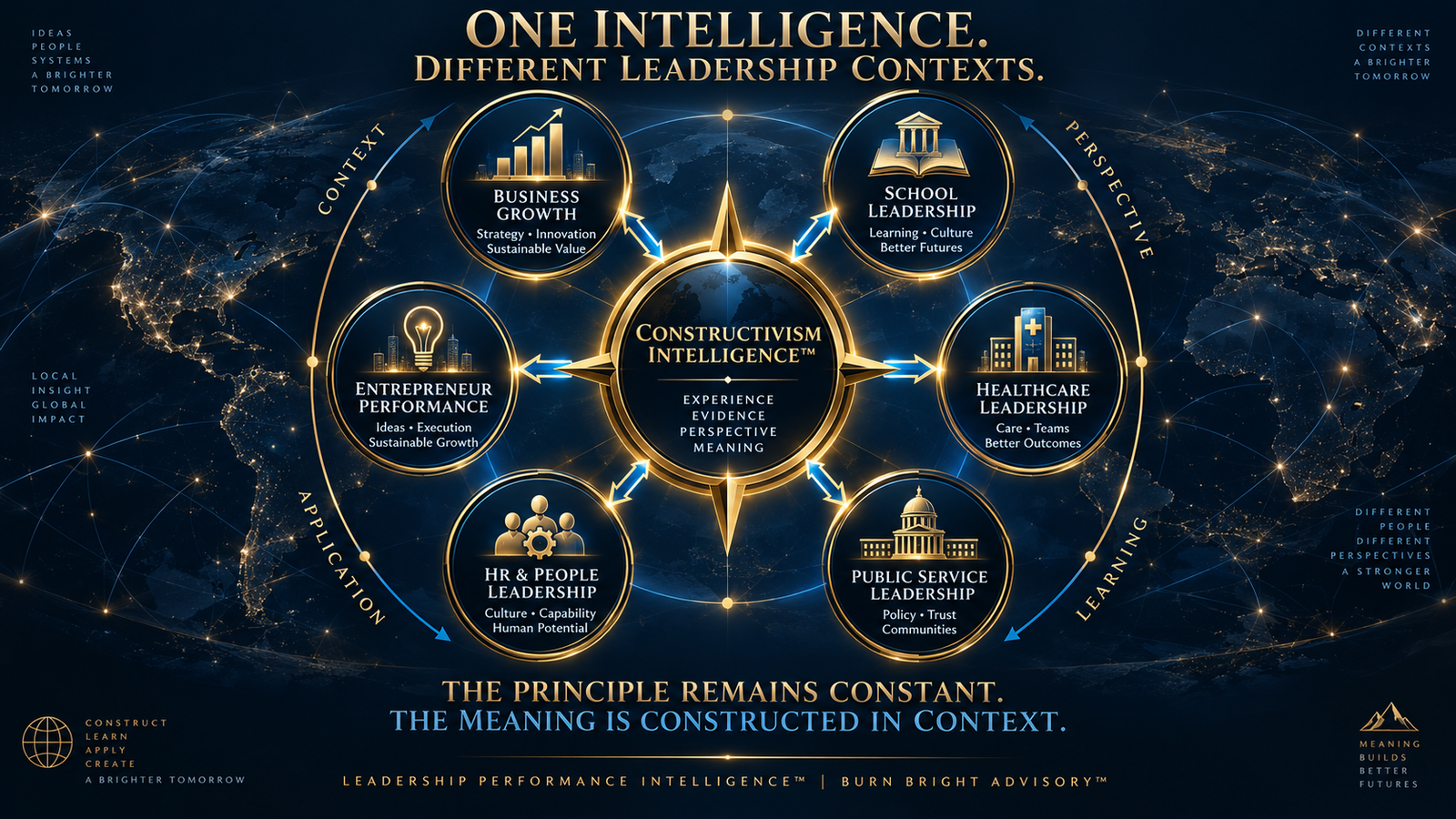
Constructivism Leadership Across Sectors
The principle applies differently across environments, but the underlying leadership challenge remains remarkably consistent.
📈 Business Growth Intelligence™
A growing company discovers customer retention is declining. Sales may attribute churn to product limitations, product teams may see expectation-setting problems, customer service may identify onboarding weaknesses, and finance may reveal that apparently similar customer segments have fundamentally different economics. Leadership’s role is to bring these interpretations together before prematurely defining the solution.
🏫 School Leadership Intelligence™
A school identifies inconsistent student outcomes. Constructivist school leadership invites teachers, middle leaders and specialists to interrogate evidence collectively rather than assuming the data already explains the cause. The goal is professional learning that strengthens teachers’ ability to interpret evidence and adjust practice.
🏥 Healthcare Leadership Intelligence™
Clinical environments contain significant expertise and legitimate hierarchy, but hierarchy must not prevent information from moving upward. A team member noticing a risk needs both the confidence and the professional mechanisms to question an emerging interpretation.
🏛️ Public Service Leadership Intelligence™
Citizens, operational staff, policymakers, community organisations and technical specialists may each see different dimensions of the same problem. Constructivist leadership creates processes through which evidence, experience and competing interpretations can be examined before action is determined.
👥 HR & People Leadership Intelligence™
Employee surveys provide data — they do not automatically provide understanding. If engagement falls, the score is evidence of a condition, not necessarily an explanation of its cause. Constructivist people leadership moves beyond dashboards toward structured inquiry into what sits behind the numbers.
🚀 Entrepreneur Performance Intelligence™
Founders face a particular constructivist challenge because early success can strengthen attachment to personal intuition. As organisations grow, founders need mechanisms that expose their thinking to challenge without destroying entrepreneurial speed. The objective is informed conviction rather than unexamined certainty.
The Risk of False Constructivism
Constructivist leadership should not be confused with endless consultation. Not every decision requires a workshop. Not every fact is a matter of interpretation. Not every opinion deserves equal weight. And leaders remain accountable for decisions that sit within their authority.
Poorly applied constructivism can create three problems.
Effective Constructivism Intelligence™ avoids all three. The leader remains clear about what is fixed, what is genuinely open for exploration and who ultimately owns the decision.
Constructivism and Leadership Performance Intelligence™
Constructivism Intelligence™ should not operate in isolation. It is one component of the broader Leadership Intelligence Compass™ and contributes to Leadership Performance Intelligence™: understanding the conditions that enable leaders and organisations to sustain effective performance.
Its relationship with other domains is particularly important.
- Professionalism Intelligence™ creates standards for productive dialogue.
- Ethics Intelligence™ ensures interpretation considers consequences, fairness and responsibility.
- Emotional Intelligence™ helps leaders recognise how identity, fear and relationships influence sense-making.
- Reflective Practice Intelligence™ converts experience into deliberate learning.
- Knowledge Development Intelligence™ turns insight into capability that can travel through the organisation.
- Adaptability Intelligence™ enables reconstructed understanding to become changed behaviour.
- Leadership Sustainability™ ensures leaders preserve enough cognitive and emotional capacity to think rather than merely react.
Together, these domains create something much more powerful than individual leadership techniques. They create a leadership development system.
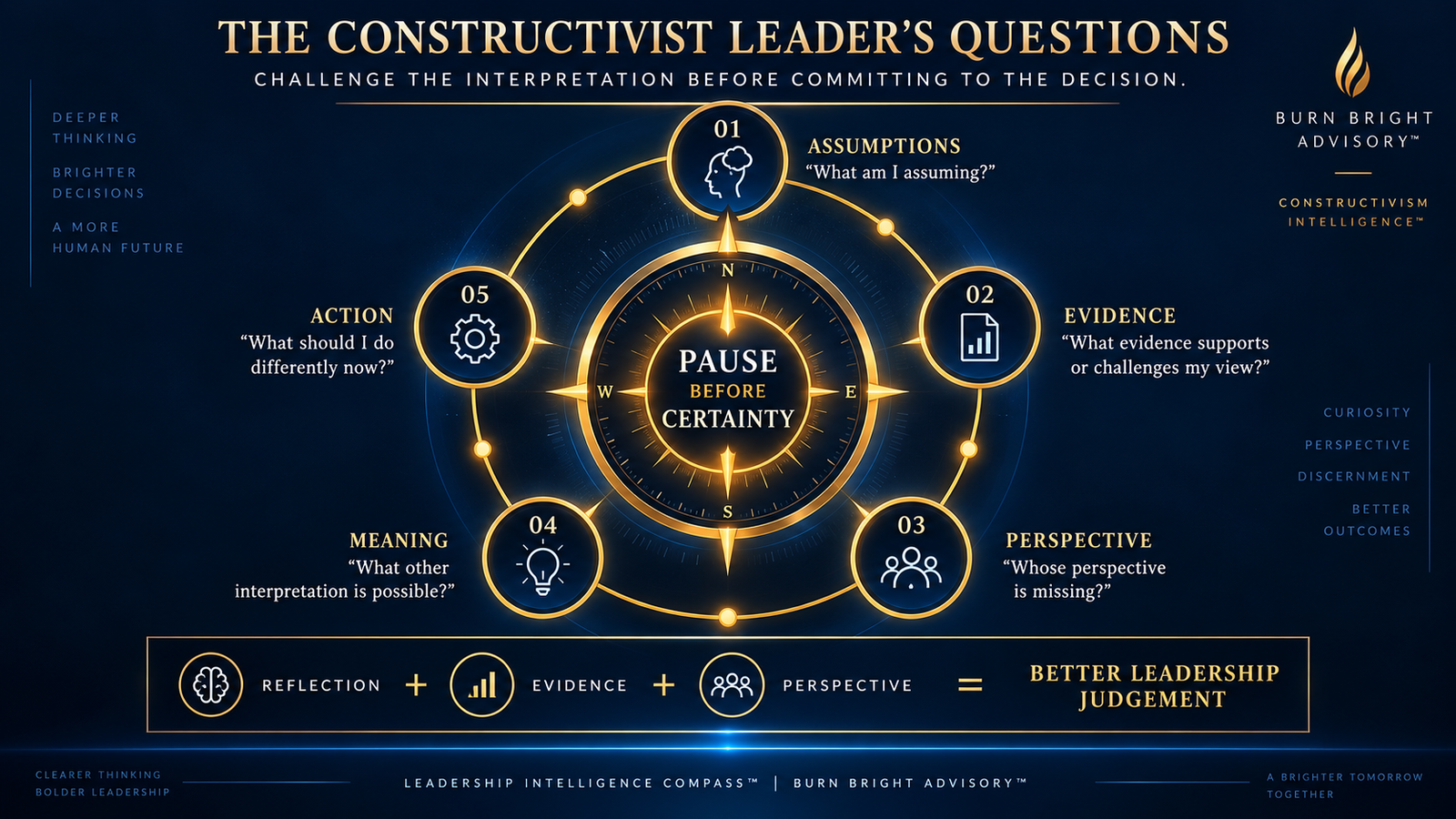
Five Questions That Change Leadership Conversations
Leaders can begin applying Constructivism Intelligence™ immediately by introducing five questions into decision-making conversations.
- What are we observing? Separate evidence from interpretation.
- What meaning are we giving it? Make assumptions visible.
- What else could explain this? Create alternative interpretations.
- Whose perspective is missing? Expose blind spots.
- What could we test next? Convert discussion into learning through action.
These questions appear simple. Their organisational impact can be substantial. They slow premature certainty without creating unnecessary bureaucracy, they make reasoning visible, and they gradually teach teams how to think together.
From Knowledge Hoarding to Organisational Intelligence
The ultimate test of leadership is not how much knowledge remains inside the leader.
It is how much capability exists throughout the system.
A leader who personally resolves every difficult situation may appear highly effective. But if the organisation becomes incapable whenever that person is absent, leadership capacity has not truly been built.
This is where Constructivism Intelligence™ connects to Leadership Benchmarking™ and the Leadership Development System™. Organisations should examine not only whether leaders deliver results but whether their leadership increases the thinking capability around them.
- Do team members become more capable of diagnosing problems?
- Does decision quality improve closer to the work?
- Can people challenge assumptions professionally?
- Do teams learn from setbacks?
- Does knowledge move across organisational boundaries?
- Can the organisation operate intelligently without constant senior intervention?
Those are indicators of leadership maturity.
The future of leadership will not belong simply to people who know the most.
Knowledge changes too quickly.
Complexity is too distributed.
The future belongs to leaders who can build environments in which people continuously develop better understanding together. That is the strategic value of Constructivism Intelligence™.
Leadership Reflection Questions
- When people bring problems to me, do I automatically provide answers or develop their thinking?
- Where has my organisation confused communication with understanding?
- Which assumptions within my team have become so familiar that nobody questions them?
- How safe is it for someone to challenge my interpretation of a situation?
- Where does decision-making unnecessarily depend on senior leaders?
- Does my team deliberately reflect on experience, or simply move from one task to another?
- What evidence would cause me to change my mind about a current priority?
- Am I developing followers of instructions or independent organisational thinkers?
Action Steps
- Audit one recurring meeting. Identify how much time is devoted to reporting information versus interpreting what that information means.
- Replace one answer with inquiry. When a capable colleague brings you a problem this week, ask them to explain their interpretation and options before giving your view.
- Separate evidence from assumptions. During your next significant decision, create two columns: What We Know and What We Think It Means.
- Invite one missing perspective. Identify whose knowledge is currently absent from an important conversation.
- Create reflective capacity. Protect time after a significant project, decision or incident to examine what happened and what should change.
- Assess organisational dependency. Identify decisions that repeatedly escalate upward and determine whether capability, authority or confidence can be developed closer to the work.
What is constructivism leadership?
Constructivism leadership recognises that people actively build understanding through experience, interpretation, reflection and dialogue. Leaders therefore create conditions for effective sense-making rather than relying solely on instruction.
What is Constructivism Intelligence™?
Constructivism Intelligence™ is a Burn Bright Advisory™ Leadership Intelligence Compass™ domain focused on a leader’s capacity to enable people to examine assumptions, interpret experience, develop shared understanding and convert learning into better judgement and action.
Is constructivist leadership the same as collaborative leadership?
They overlap, but they are not identical. Collaboration describes people working together. Constructivism focuses specifically on how people develop and reconstruct understanding through experience and interaction.
Does constructivist leadership mean leaders should stop giving answers?
No. Expertise and clear direction remain essential. The principle is that leaders should avoid replacing other people’s thinking unnecessarily when developing their judgement would create greater long-term capability.
How does constructivism improve decision-making?
It makes assumptions and interpretations visible, introduces alternative perspectives and encourages evidence to be examined before conclusions become fixed.
Can constructivist leadership slow decisions?
Poorly designed consultation can. Effective constructivism distinguishes situations requiring rapid direction from those where inquiry will improve decision quality or develop capability.
What is the relationship between constructivism and psychological safety?
People are unlikely to expose uncertainty, challenge assumptions or revise their thinking when doing so creates interpersonal or professional risk. Psychological safety therefore supports productive organisational learning.
How does constructivism relate to leadership development?
Instead of separating leadership development from everyday work, constructivist leadership turns problems, decisions, reflection and dialogue into continuous development opportunities.
Why is constructivism increasingly important in an AI-enabled workplace?
As AI increases access to information and analysis, human leadership increasingly depends on contextual interpretation, ethical judgement, questioning assumptions and determining what information means within a specific organisational environment.
See Where Instruction Is Standing In For Understanding
A full diagnostic maps where decisions, dependency and unexamined assumptions are quietly overloading your leadership — so you know exactly what to redesign.
Take the Leadership Burnout Self-Assessment
If too many decisions still depend on you personally, the first step is diagnosing where that structural pressure is coming from. Take the free assessment to identify the pressures affecting your leadership capacity.
Free Leadership Intelligence
Get Weekly Leadership Insights
Join thousands of leaders receiving practical strategies on burnout prevention, workload design, and sustainable performance every week.