Quick Answer
Key Takeaways
- Poor delegation concentrates workload, decisions and accountability around one leader.
- Delegation fails when leaders transfer tasks but retain every decision.
- Perfectionism and fear of losing control often disguise structural delegation problems.
- Sustainable delegation requires clear outcomes, authority, boundaries and accountability.
- Leaders should redesign work before trying to become more efficient at carrying it.
Delegation and Burnout: Why Leaders Must Let Go
Delegation and burnout are more closely connected than many leadership teams realise.
When a leader becomes overloaded, the usual response is to look at time management. Can they organise their diary better? Could they prioritise more effectively? Do they need another productivity tool?
Sometimes those interventions help. But they miss a more fundamental question:
Why is so much work sitting with the leader in the first place?
Burnout is not simply the consequence of working long hours. The World Health Organization defines it as an occupational phenomenon resulting from chronic workplace stress that has not been successfully managed, characterised by exhaustion, greater mental distance or cynicism towards work, and reduced professional efficacy.
That definition matters because it moves the conversation away from personal weakness and towards the design of work. Delegation is part of that design.
A leader who remains the decision-maker, problem-solver, reviewer and final safety net for everything eventually becomes the organisation’s bottleneck.
The answer is not to become a more efficient bottleneck.
It is to redesign the system.
The following framework shows how workload, authority and accountability need to move together if delegation is going to reduce leadership pressure.
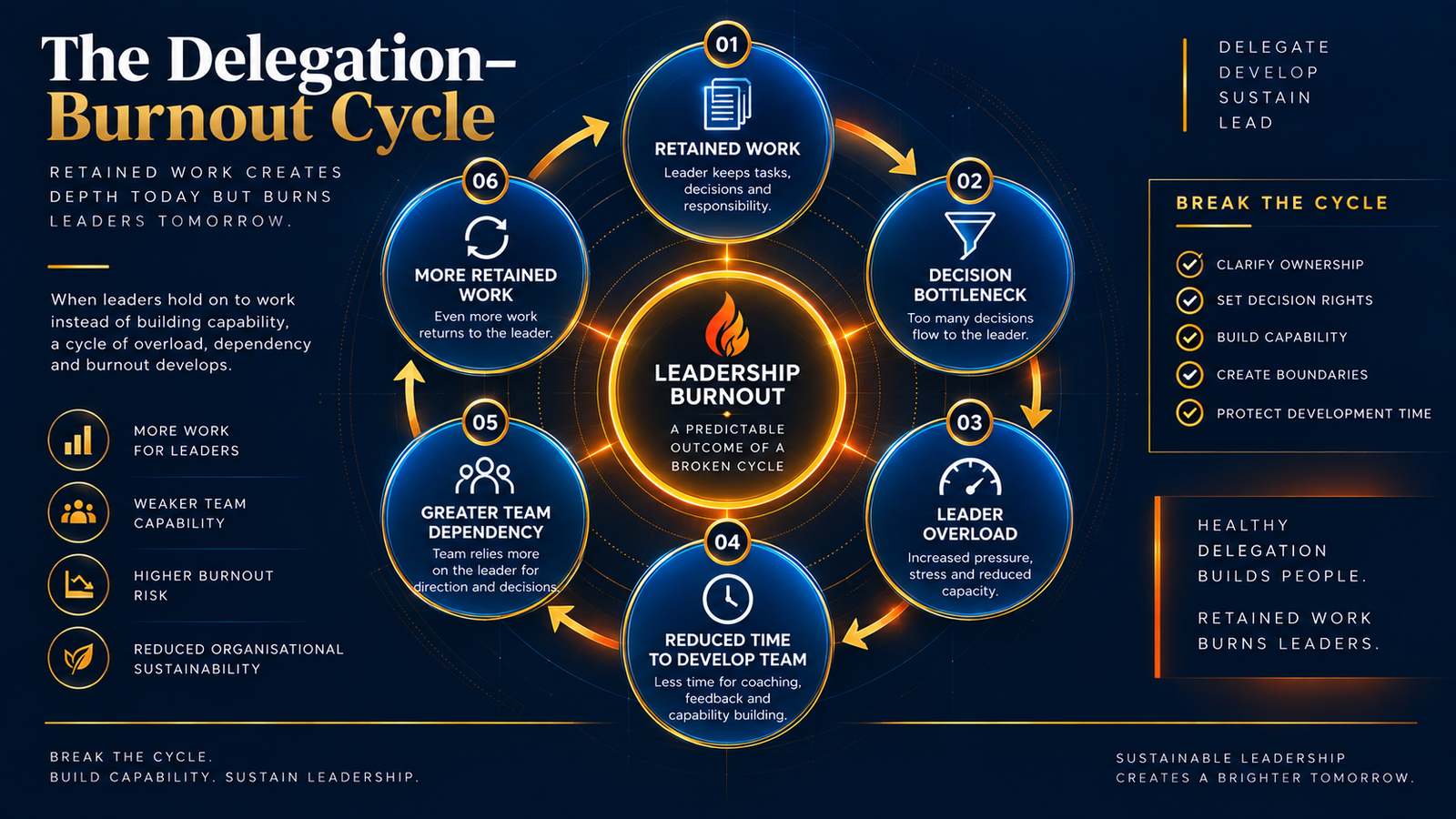
The critical point is that delegation problems rarely begin with laziness or incompetence. They emerge because responsibilities accumulate while authority remains concentrated.
Featured Snippet
Is Your Workload Actually a Delegation Problem?
Before redesigning who owns what, it helps to see clearly where the pressure in your own leadership is coming from.
How Does Poor Delegation Cause Burnout?
Delegation is usually discussed as a leadership skill.
I think that description is too narrow.
It is better understood as workload architecture.
Every organisation has a finite amount of work and a finite amount of human capacity. The question is how that work is distributed. When too much flows towards one person, pressure increases.
This often happens gradually. A leader steps in because someone is inexperienced. They take responsibility during a crisis. They personally manage an important client because the relationship feels sensitive. They review a report because the previous version contained errors. They approve expenditure because something once went wrong.
Every individual decision appears reasonable.
Collectively, they create scope creep.
The Burn Bright framework identifies scope creep as one of five structural root causes of burnout alongside meeting culture, communication chaos, decision overload and perfectionism culture. Delegation problems can feed several of these simultaneously.
The leader takes on more tasks.
More people need access to the leader.
More decisions reach the top.
The diary fills.
Communication increases.
Strategic work gets pushed into evenings.
Recovery disappears.
Eventually, the leader appears to have a time-management problem.
They do not.
They have a work-distribution problem.
This is consistent with broader workplace evidence. WHO guidance on occupational psychosocial risks identifies time pressure, lack of control, long hours, insufficient support and poor work organisation as important contributors to occupational stress, burnout and fatigue. WHO specifically points towards organisational interventions including workload reduction, schedule changes, communication and teamwork improvements.
That distinction changes the intervention. If the problem is poor personal discipline, fix the diary. If the problem is workload architecture, redesign who owns the work.
For example, imagine a department head personally approving every external communication. At first, this may provide quality control. As the organisation grows, however, ten approvals become 30. Thirty become 60. Soon the leader spends several hours each week checking work that competent colleagues could approve themselves.
The solution is not faster approval. It is a different approval system.
Why Do Overwhelmed Leaders Struggle to Delegate?
Leaders rarely say, “I want to become a bottleneck.” They usually arrive there through reasonable decisions repeated for too long.
One common cause is competence. High-performing leaders are often good at solving problems. When something goes wrong, stepping in works. That creates a dangerous feedback loop.
Problem appears.
Leader intervenes.
Problem disappears.
Leader concludes that intervention was necessary.
Team learns that difficult problems ultimately belong to the leader.
The next problem travels upwards even faster. This is how dependency becomes normalised.
Another cause is perfectionism. A leader may say, “It will take longer to explain it than to do it myself.” Occasionally, that is true. But it confuses today’s transaction with tomorrow’s capacity.
Doing a 30-minute task yourself may indeed be faster than spending 45 minutes teaching someone else. Do it every week for two years and the mathematics changes completely. You have saved 15 minutes once and purchased dozens of hours of future work.
Perfectionism creates a similar problem. The question quietly shifts from “Is this work good enough to achieve the required outcome?” to “Is this exactly how I would have done it?” Those are different standards.
This is why telling managers simply to “delegate more” is inadequate. They need authority. Their teams need capacity. Responsibilities need clarity. Standards need definition. And senior leaders must tolerate competent work being completed differently from the way they personally would have completed it.
Delegation requires letting go of unnecessary control without abandoning accountability. That is a structural leadership discipline.
What Does the Data Tell Us About Leadership Overload?
The scale of the problem makes delegation more than a personal productivity issue.
That should concern organisations because managers influence conditions far beyond their own roles. Gallup reports that managers account for 70% of the variance in team engagement. It also reported global employee engagement at 20% in 2025 and connected much of the recent decline to falling manager engagement.
An exhausted manager therefore represents more than one exhausted employee.
Leadership pressure can become team pressure.
The organisation starts paying what I call the Culture Tax™: the hidden cost of burnout, disengagement, turnover and performance loss created when organisations repeatedly treat symptoms without repairing structures.
These statistics should change the leadership conversation. We cannot keep treating overloaded managers as isolated cases.
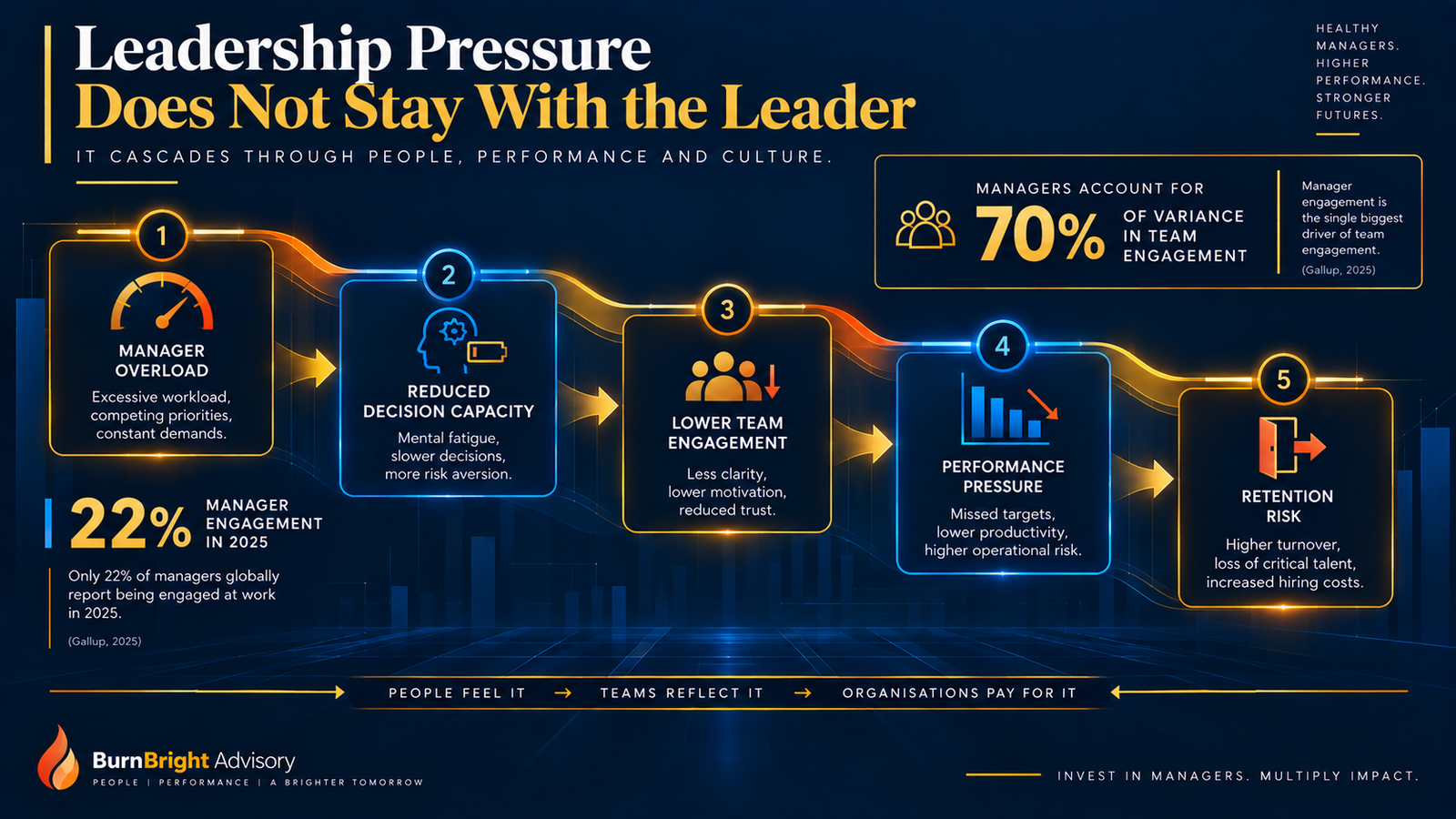
The data visualisation should not be interpreted as evidence that delegation alone will solve burnout. It will not. Burnout is multi-causal. But where workload and decision concentration are major drivers, delegation is one of the structural levers leaders can actually change. That makes it significantly more powerful than another instruction to “manage your time better”.
What Should Leaders Delegate to Reduce Burnout?
The wrong question is “What can I get rid of?” That makes delegation sound like dumping unwanted work. A better question is “Where should this responsibility sit for the system to operate effectively?” I use four tests.
Test 1 Does This Genuinely Require My Authority?
Some decisions belong with senior leaders because of legal responsibility, strategic significance, confidentiality or organisational risk — keep them. But many tasks remain at senior level simply because they have always been there. Challenge inherited ownership.
Test 2 Am I Adding Unique Value?
If you disappeared for two weeks, who would perform the task? If the answer is an obvious team member, ask why that person cannot develop permanent ownership.
Test 3 Is This Recurring?
Recurring work creates the greatest delegation return. Delegating something that occurs once saves time once. Moving a weekly responsibility creates continuing capacity.
Test 4 Am I the Decision-Maker or Merely the Habit?
Organisations accumulate historical patterns. A director approves something because a previous director did. A headteacher attends a meeting because their predecessor attended. A manager receives a report nobody remembers requesting. Habit becomes architecture. Audit it.
The Burn Bright framework also uses RACI Delegation™ because delegation becomes clearer when people understand who is Responsible, Accountable, Consulted and Informed. Confusion is expensive. If two people think they own something, work gets duplicated. If nobody thinks they own it, work stalls. If everyone believes the leader must approve it, everything travels upwards. Good delegation therefore removes ambiguity as well as workload.
Why Is Delegating Tasks Not Enough?
This is where many organisations get delegation wrong. They delegate activity while retaining authority.
Imagine telling a manager, “You own the project.” Then requiring them to seek permission for every budget decision, deadline adjustment, stakeholder communication and change in scope.
They do not own the project.
They administer it.
The senior leader still carries the decisions. The manager carries the frustration. And both remain overloaded.
Sustainable delegation requires four elements:
Outcome
What needs to be achieved? Without an outcome, people lack direction.
Authority
What can the person decide independently? Without authority, they become messengers.
Boundaries
What requires escalation? Without boundaries, risk increases.
Accountability
How will progress and results be reviewed? Without accountability, ownership becomes vague.
This is why decision authority forms one of the four pillars of the Burn Bright structural transformation framework alongside Workload Architecture™, Recovery Rhythms™ and management frameworks.
Effective delegation redistributes thinking, not just doing. That matters because decision load consumes leadership capacity. A leader who delegates 20 tasks but still makes every judgement connected to those tasks has not released the cognitive workload — they have merely changed who moves the pieces.
The goal is controlled autonomy. Give people sufficient authority to perform the role while establishing explicit escalation thresholds. For example:
- A department manager might approve spending up to an agreed limit without referral.
- A project lead might change timelines within a defined tolerance.
- A team leader might resolve routine customer complaints independently but escalate cases involving legal or reputational risk.
Clear decision rights reduce unnecessary traffic. They also build capability. The leader stops being the answer to every question. The organisation becomes stronger because more people learn to think, decide and take responsibility. That is sustainable leadership.
How Can Leaders Build Delegation Without Losing Control?
The fear behind poor delegation is often straightforward: “If I let go, standards will fall.” Sometimes they will, particularly at the beginning. Someone learning a responsibility may take longer or make different choices.
The answer is not permanent centralisation. It is designed delegation.
- Define the required result. Not every step — the result.
- Define decision boundaries. What can the person decide? What cannot they decide? What needs consultation? What requires immediate escalation?
- Agree review points. This replaces continuous supervision with structured accountability. A 12-week project does not require the leader hovering over every email for 12 weeks — it may need agreed checkpoints at weeks two, four, eight and twelve, with exceptions escalated as necessary.
- Review the system rather than automatically taking work back when something goes wrong. Was the outcome unclear? Was authority insufficient? Did the person lack capability? Was the escalation threshold poorly defined? Was the workload itself unrealistic?
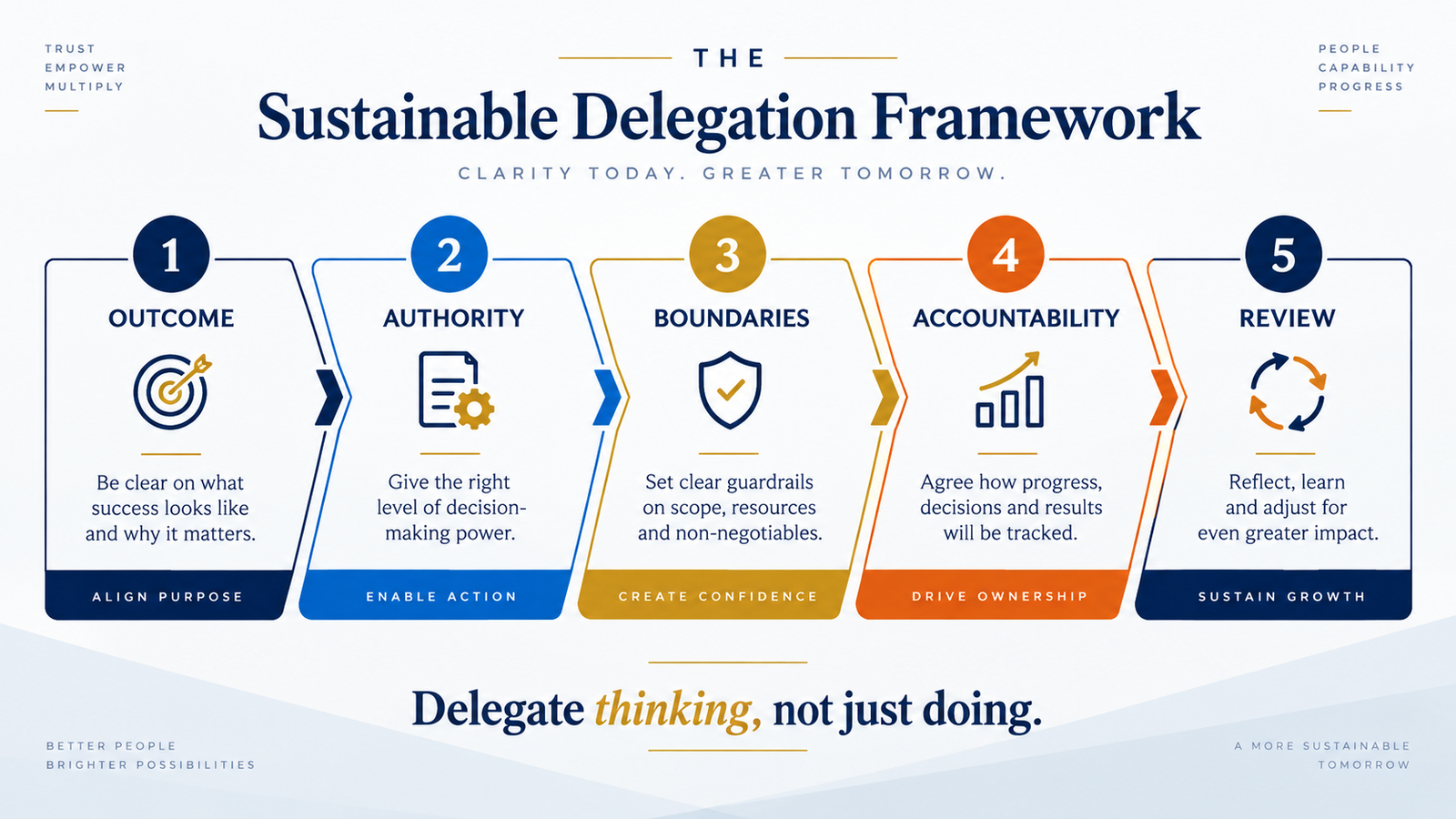
This framework protects control differently. Instead of controlling every action, the leader controls the architecture within which decisions happen. That is a more scalable form of leadership.
It also creates space for recovery. Recovery is not something leaders should attempt to squeeze into whatever fragments remain after work has consumed the week. Within the Burn Bright model, recovery needs to be designed into leadership capacity. Delegation contributes to that design because it removes work and decisions that never needed to depend on the leader.
The objective is not absence. It is organisational capability without constant leadership intervention.
Delegation and Burnout: Two Different Leadership Models
| Traditional Heroic Leadership | Sustainable Leadership |
|---|---|
| Leader solves the hardest problems | Problems sit at the appropriate level |
| Delegates tasks | Delegates outcomes and authority |
| Retains final approval by default | Defines explicit decision rights |
| Measures commitment through availability | Measures leadership through outcomes |
| Steps in when standards differ | Coaches against agreed standards |
| Becomes the team’s safety net | Builds systems and capability |
| Recovery happens when work allows | Recovery is designed into capacity |
| Success depends on the leader | Success survives without constant leader intervention |
The difference is not whether the leader remains accountable. They do. The difference is how accountability is exercised.
Heroic leadership concentrates capacity.
Sustainable leadership distributes it.
One makes the organisation increasingly dependent on the leader. The other makes the organisation progressively more capable.
How Can Organisations Make Delegation Part of Burnout Prevention?
Individual leaders can improve their delegation. But organisations need to examine why leaders become overloaded in the first place.
Start with role design. When new responsibilities are added, what comes out? Usually, nothing. That is how scope creep becomes normal.
Next, audit decision rights. Map recurring decisions and ask where they currently sit versus where they should sit. If routine operational choices continually reach directors or executives, the problem may not be individual reluctance to delegate — governance may actively require escalation.
Then examine capability. You cannot responsibly transfer authority to people who have never been trained, supported or given the information required to exercise it.
Delegation without development is abandonment.
Development without authority is frustration.
You need both.
Organisations should also examine what they reward. If leaders are praised for personally rescuing every crisis, being available at all hours and knowing every operational detail, heroic leadership will continue. Culture follows reinforcement.
- Reward leaders who build capable teams.
- Reward prevention, not only rescue.
- Reward good decisions made at lower organisational levels.
- Reward systems that continue to function when the leader is away.
Efficiency gains do not automatically create capacity. Organisations often fill the space. That is why leaders cannot outwork broken systems.
The structural question must always be: what workload is sustainable, who should own it, and what authority do they need to deliver it?
Can poor delegation cause burnout?
Yes. Poor delegation can contribute to burnout when leaders retain excessive workload, decisions and responsibility. The resulting pressure can create long hours, constant interruptions and insufficient recovery. Delegation will not solve every cause of burnout, but it can address structural overload when too much work is concentrated around one person.
How does delegation help prevent leadership burnout?
Delegation can reduce both workload and cognitive pressure. Effective delegation transfers appropriate responsibility and decision authority to capable people rather than merely reallocating tasks. This reduces bottlenecks while building team capability and creating more leadership capacity for strategic work and recovery.
Why do burned-out leaders struggle to delegate?
Overloaded leaders often feel they lack time to explain work, train people or tolerate mistakes. They therefore keep completing tasks themselves. This provides short-term relief but creates long-term dependency. Burnout can consequently reinforce the very behaviours that maintain excessive workload.
What should a leader not delegate?
Leaders should retain responsibilities that genuinely require their authority because of strategic significance, legal accountability, confidentiality or material organisational risk. Even then, supporting analysis and implementation can often be distributed. The goal is not maximum delegation. It is placing work and authority at the correct level.
How do you delegate without micromanaging?
Define the required outcome, give explicit decision authority, establish boundaries and agree review points. This allows leaders to maintain accountability without supervising every action. Structured checkpoints are usually more effective than continuous intervention because they create autonomy while preserving visibility.
Is delegation just giving work to someone else?
No. Good delegation transfers appropriate ownership, authority and accountability. Giving someone a task while retaining every decision is task allocation, not meaningful delegation. Sustainable delegation enables another person to think, decide and act within clearly defined boundaries.
Fix the System, Not the Person
Delegation and burnout are connected because leadership capacity is finite.
No leader can remain the organisation’s strategist, troubleshooter, approver, quality controller, escalation point and safety net indefinitely. Eventually, the architecture fails.
The warning sign is not always collapse. Sometimes it looks like an executive answering emails at midnight. A manager reviewing work their team should own. A department head attending every meeting. A leader returning from leave to 200 decisions nobody was willing to make.
These are not simply diary problems.
They are structural clues.
Burnout is a system failure.
Fix the system, not the person.
That means redesigning workload, clarifying decision authority, building capability and creating genuine ownership throughout the organisation.
Delegation is therefore not about doing less because you cannot cope. It is about leading differently because no healthy organisation should depend upon one person’s unlimited capacity.
Sustainable leadership beats heroic leadership.
And the strongest test of your leadership may not be how much you can personally carry. It may be how effectively the organisation operates when you stop carrying what was never yours to hold.
Find Out Exactly What Should Not Be Yours to Carry
If your workload keeps expanding despite better planning and longer hours, a full diagnostic maps the structural pressures across your leadership so you know precisely what to redesign.
Take the Leadership Burnout Self-Assessment
If your workload keeps expanding despite better planning and longer hours, diagnose the structure before demanding more from yourself. Take the free assessment to identify the pressures affecting your leadership capacity.
Free Leadership Intelligence
Get Weekly Leadership Insights
Join thousands of leaders receiving practical strategies on burnout prevention, workload design, and sustainable performance every week.