Quick Answer
Key Takeaways
- Most organisations don’t suffer from a shortage of knowledge — they suffer from an inability to move knowledge to where it is needed.
- Knowledge is not the same as information: information tells us something, knowledge helps us understand it, and intelligence helps us decide what to do with it.
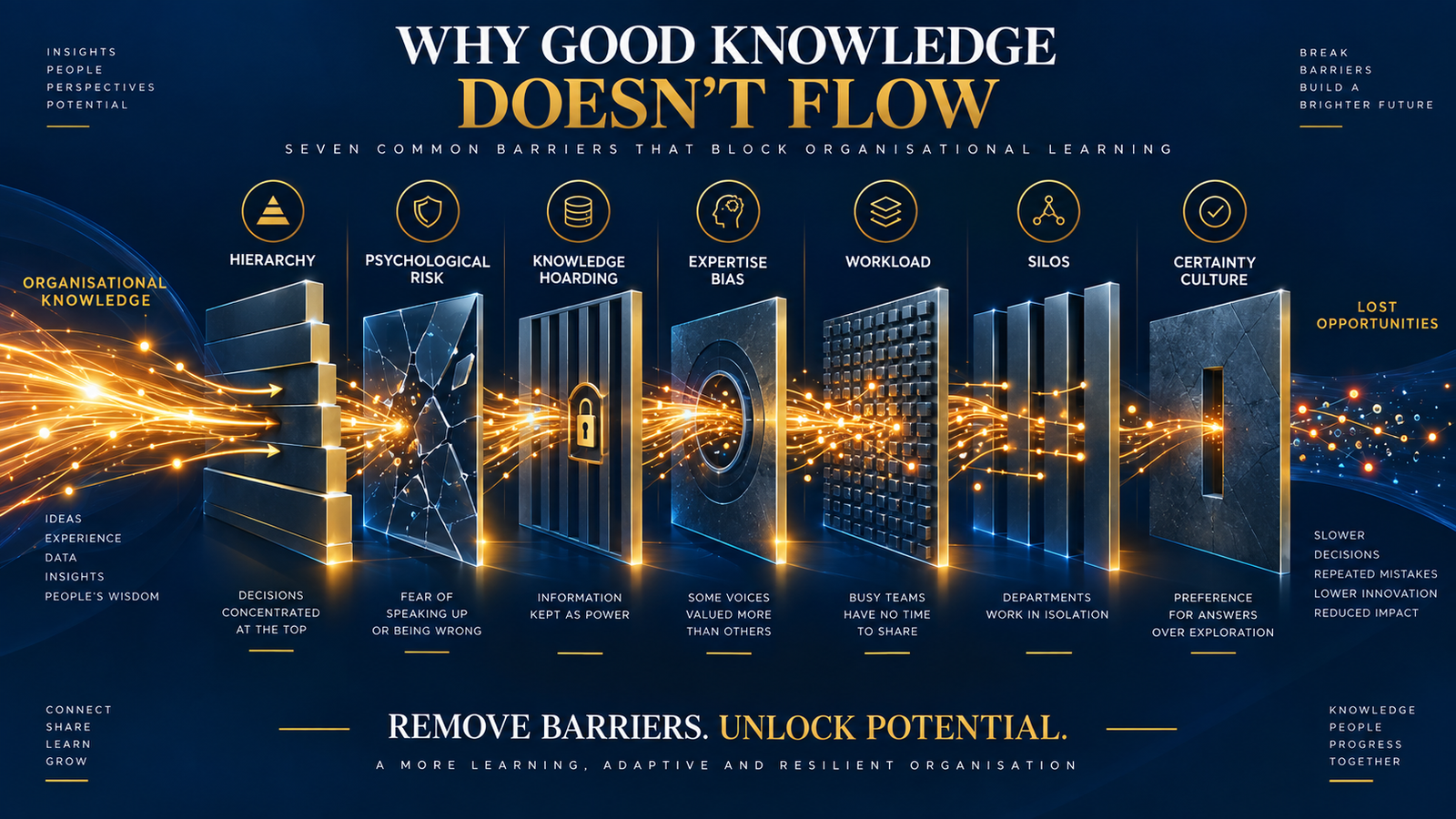
- Knowledge gets blocked by seven common conditions: hierarchy, psychological risk, hoarding, expertise bias, workload, silos and certainty cultures.
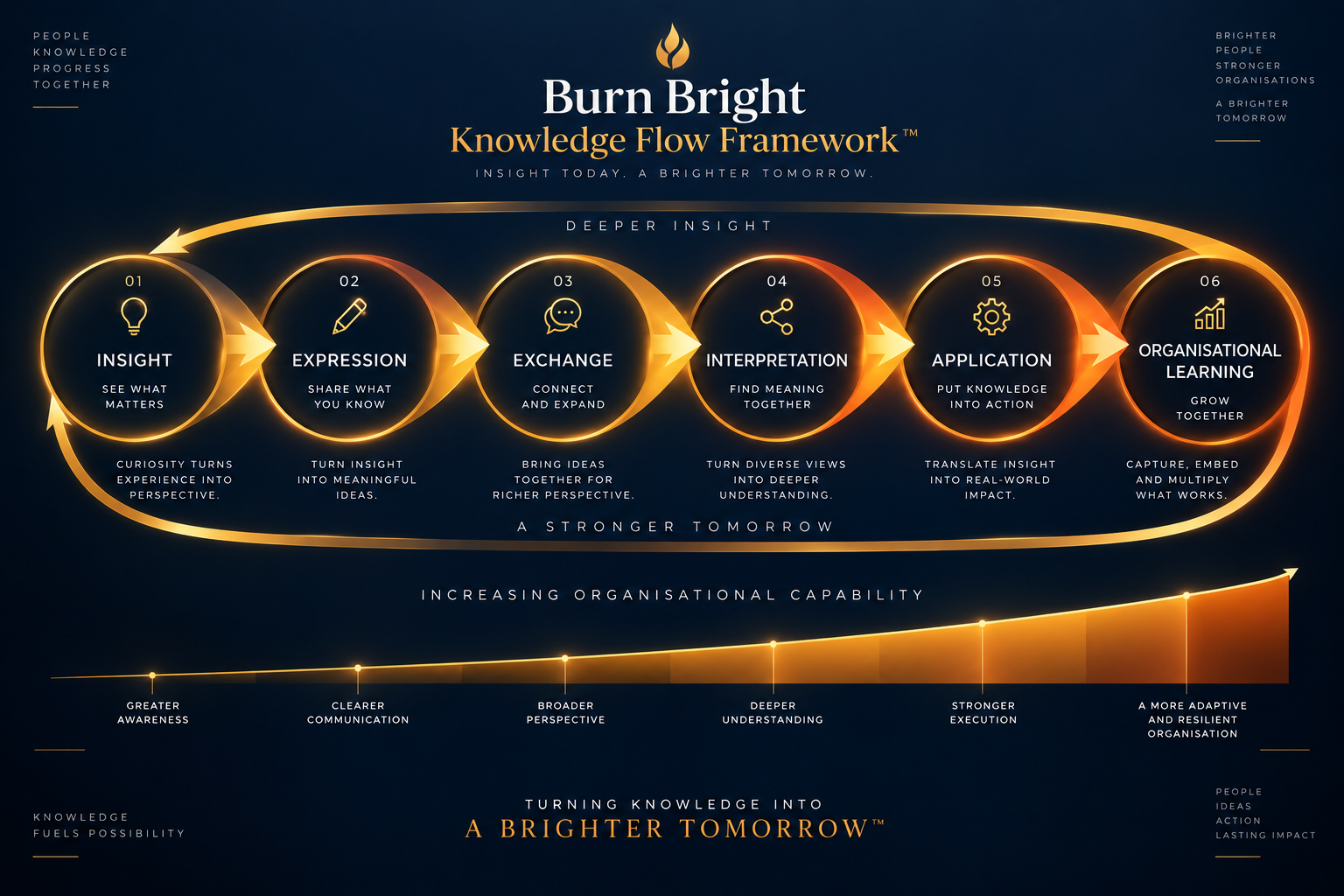
- The Burn Bright Knowledge Flow Framework™ treats learning as six connected stages: Insight → Expression → Exchange → Interpretation → Application → Organisational Learning.
- When knowledge moves well, leadership becomes more sustainable because the organisation stops depending on any one person’s cognitive capacity.
Knowledge Flow: Why Your Organisation Knows More Than It Uses
Most organisations do not suffer from an absolute shortage of knowledge.
They suffer from an inability to move knowledge to where it is needed.
Someone knows why a process repeatedly fails. Someone has noticed the emerging customer problem. Someone understands why employees are leaving. Someone has discovered a more effective method. Someone on the frontline can see a risk that senior leadership cannot.
Yet knowing something and enabling an organisation to learn from it are very different things.
Knowledge becomes organisationally valuable only when it can move.
That movement depends heavily on leadership. Leaders influence whether people ask questions, admit uncertainty, share incomplete ideas, challenge established thinking, transfer expertise, reflect on mistakes and learn across professional boundaries. They also determine whether knowledge is treated as collective infrastructure or personal territory.
Within Burn Bright Advisory’s concept of Leadership Performance Intelligence™, effective leadership is not simply the ability to possess knowledge. It is the capacity to create conditions in which useful knowledge can continually enter, move through and improve the system. That requires more than databases, intranets, training programmes or knowledge-management platforms — it requires a culture that wants to grow.
The central leadership question therefore changes. Instead of asking “How do we give our people more knowledge?” leaders need to ask “What is preventing the knowledge we already possess from moving?”
Is Knowledge Actually Reaching You?
Before redesigning how your organisation learns, it helps to see clearly where pressure and bottlenecks already sit in your own leadership.
The Knowledge Problem Hiding Inside Modern Organisations
Imagine a leadership meeting in which twelve experienced people are discussing a persistent organisational problem. The conversation sounds intelligent. There are reports, metrics, presentations, opinions. Eventually, a decision is made.
Yet three floors below, someone already knows why the proposed solution is unlikely to work. They have seen the problem repeatedly. They understand the operational reality. They may even have attempted to raise it before. But their knowledge never reaches the room.
The organisation technically possesses the knowledge.
Operationally, however, it cannot access it.
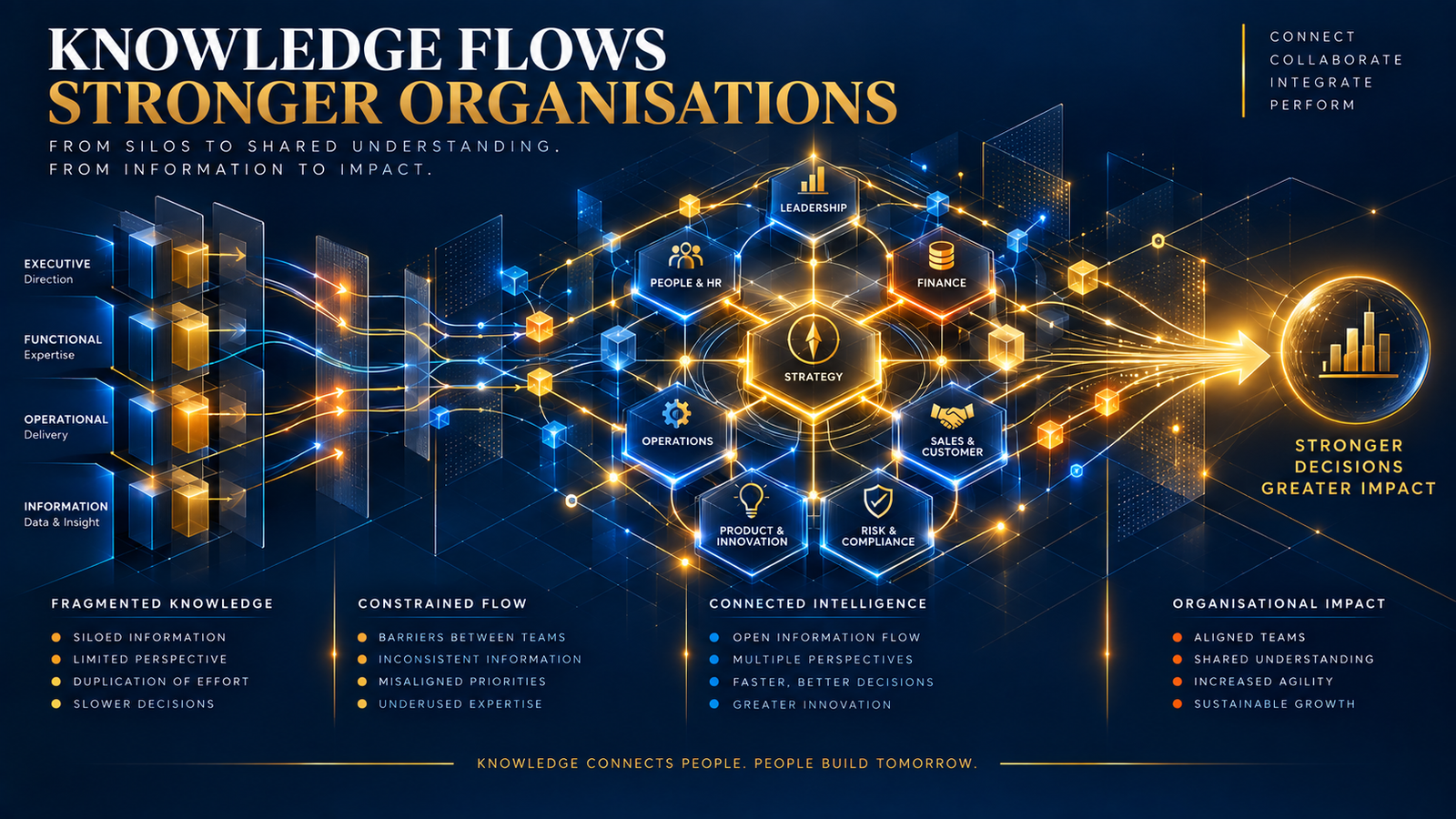
Knowledge frequently becomes trapped at boundaries: between frontline employees and executives, between departments, between experienced and emerging professionals, between specialists and generalists, between people who generate information and people authorised to make decisions, and increasingly between human expertise and the technological systems designed to capture organisational information.
These boundaries are often described as communication problems, but communication is only part of the issue. Communication asks whether information was transmitted. Knowledge flow asks whether useful understanding travelled far enough through the system to influence thinking, decisions and action.
An organisation can communicate constantly and still learn very little. None of the emails, meetings, dashboards, reports or training programmes guarantees that the right insight reaches the right person at the right moment — or that anyone changes what they do because of it.
Knowledge Is Not the Same as Information
Featured Snippet
Consider a hospital. A dashboard may reveal an increase in patient waiting times — that is information. An experienced nurse may recognise that the real cause is not patient volume but a change in the way admissions are being processed — that is knowledge. A leadership team that connects the data with frontline expertise, investigates the process and redesigns the workflow is demonstrating organisational intelligence.
The same pattern appears everywhere: in a school, attendance data may reveal a pattern while teachers understand the human circumstances behind it. In a growing business, customer analytics may show declining retention while account managers already understand why customers are frustrated. In public service, performance metrics may indicate delays while frontline staff know which procedural requirement is creating the bottleneck.
In each case, the organisation’s intelligence depends upon its ability to connect different forms of knowing. That connection cannot be assumed. It must be led.
The Leadership Paradox: The More Expertise We Build, the More Easily We Can Trap It
Organisations spend considerable resources developing expertise — recruiting specialists, training professionals, developing leaders, purchasing research, commissioning consultants, collecting data, building digital knowledge systems. Then something curious happens.
The knowledge becomes territorial.
Departments develop their own language. Experts become known as the people who “own” particular subjects. Professional status becomes associated with knowing things other people do not. Over time, knowledge can shift from being an organisational resource to becoming a source of personal authority.
The problem is rarely deliberate secrecy. More often, organisations unintentionally reward knowledge possession more strongly than knowledge circulation.
The person who solves every problem becomes indispensable.
The person who teaches five other people to solve it may become less visibly important.
These incentives matter because culture is shaped not simply by what organisations say they value but by what people observe being rewarded. A genuine learning culture therefore requires a different leadership assumption.
From Knowledge Ownership to Knowledge Stewardship
Traditional expertise can encourage leaders to think: “I am responsible for knowing.” Knowledge stewardship asks leaders to think: “I am responsible for helping the organisation know.” Those are not the same responsibility — the first concentrates capability, the second distributes it.
A leader operating as a knowledge steward still develops expertise, but expertise is not treated as something to defend. It becomes something to connect, translate, challenge and expand. That leader asks different questions:
- Who knows something about this that we have not heard?
- Where is relevant experience sitting?
- Whose perspective is missing?
- What have we learned previously that we are failing to use?
- What does the frontline see that leadership cannot?
These are questions of Knowledge Development Intelligence™, and they reveal why knowledge flow intersects with other domains of the Leadership Intelligence Compass™: Constructivism Intelligence™ (people build understanding through interaction and interpretation), Reflective Practice Intelligence™ (experience does not automatically become learning), Adaptability Intelligence™ (knowledge that never alters behaviour has limited value), and Emotional Intelligence™ (sharing knowledge is fundamentally social).
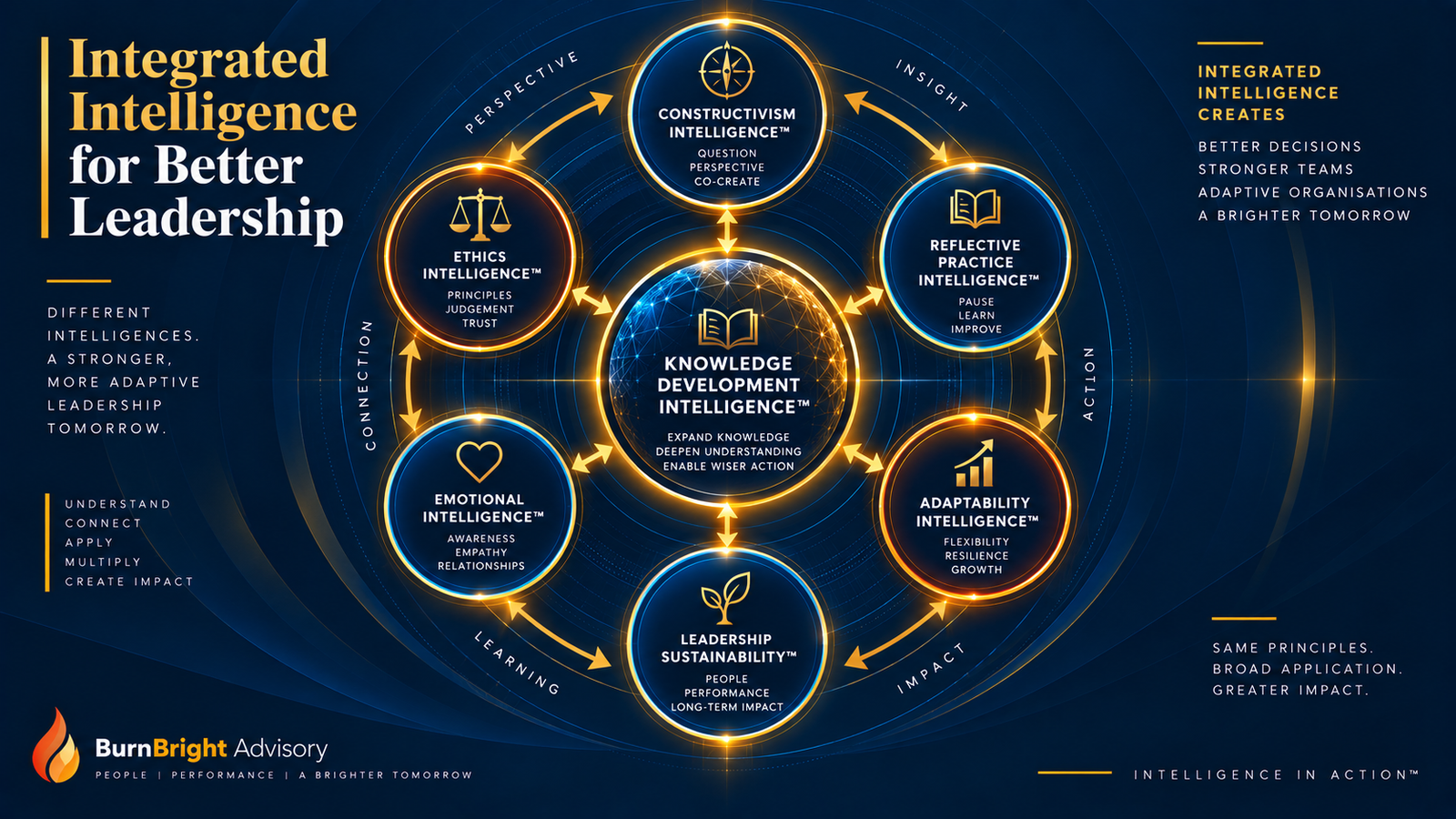
Knowledge flow is therefore not a technical process operating separately from leadership culture. It is an expression of that culture.
The Invisible Decision People Make Before They Share What They Know
Before somebody contributes knowledge, they make a calculation, usually almost instantly: is saying this worth the risk?
Imagine a junior employee notices a flaw in a senior leader’s proposal. Before sharing it, other questions appear: Will I sound inexperienced? Will my manager think I am being difficult? Will anybody listen? What happened to the last person who challenged this?
If the perceived interpersonal cost of contributing is higher than the expected value of contributing, silence becomes rational. The organisation then loses access to knowledge it technically employs.
This helps explain why psychological safety matters so deeply to knowledge flow. But it should not be reduced to making people comfortable — a learning culture still requires challenge, accountability, standards and disagreement. The objective is to reduce unnecessary interpersonal risk around learning, not to remove intellectual tension. People need to be able to say “I don’t understand,” “I think we may be wrong,” “I made a mistake” and “Could there be another explanation?”
Why Knowledge Gets Blocked
Organisations rarely announce that they are going to suppress knowledge — no executive team develops a strategy to prevent useful information from reaching decision-makers. Yet organisations achieve this remarkably effectively, through hierarchy, incentives, workload, professional boundaries, leadership behaviour and everyday signals about who is permitted to know, question and contribute.
The result is what we might call knowledge friction: the organisational conditions that make useful knowledge harder to express, exchange, interpret or apply. A useful way for leaders to diagnose this is to examine seven common knowledge-flow blockers.
The Knowledge-Flow Cascade
These seven blockers rarely operate independently — they reinforce one another. Frontline employees know something senior leaders do not, but do not feel safe enough to raise it. Nobody has time to create a forum where the issue might surface. Another department has relevant information, but there is no mechanism connecting the two. Senior leaders interpret the limited information they receive through assumptions built from previous experience. Nobody wants to admit that the organisation does not fully understand the problem.
From Knowledge Pipelines to Knowledge Ecosystems
Traditional knowledge management often imagines knowledge moving through a pipeline: someone creates it, it is documented, someone else accesses it, they use it. Real organisational learning is more complex — knowledge is questioned, combined, reinterpreted, tested, challenged, applied, modified and shared again. The better metaphor is an ecosystem. Healthy ecosystems depend upon movement and exchange. So do healthy learning cultures.
Knowledge exists → Knowledge is expressed → Knowledge is exchanged → Knowledge is interpreted → Knowledge is applied → Results are reflected upon → New knowledge emerges.
Break any connection and learning weakens.
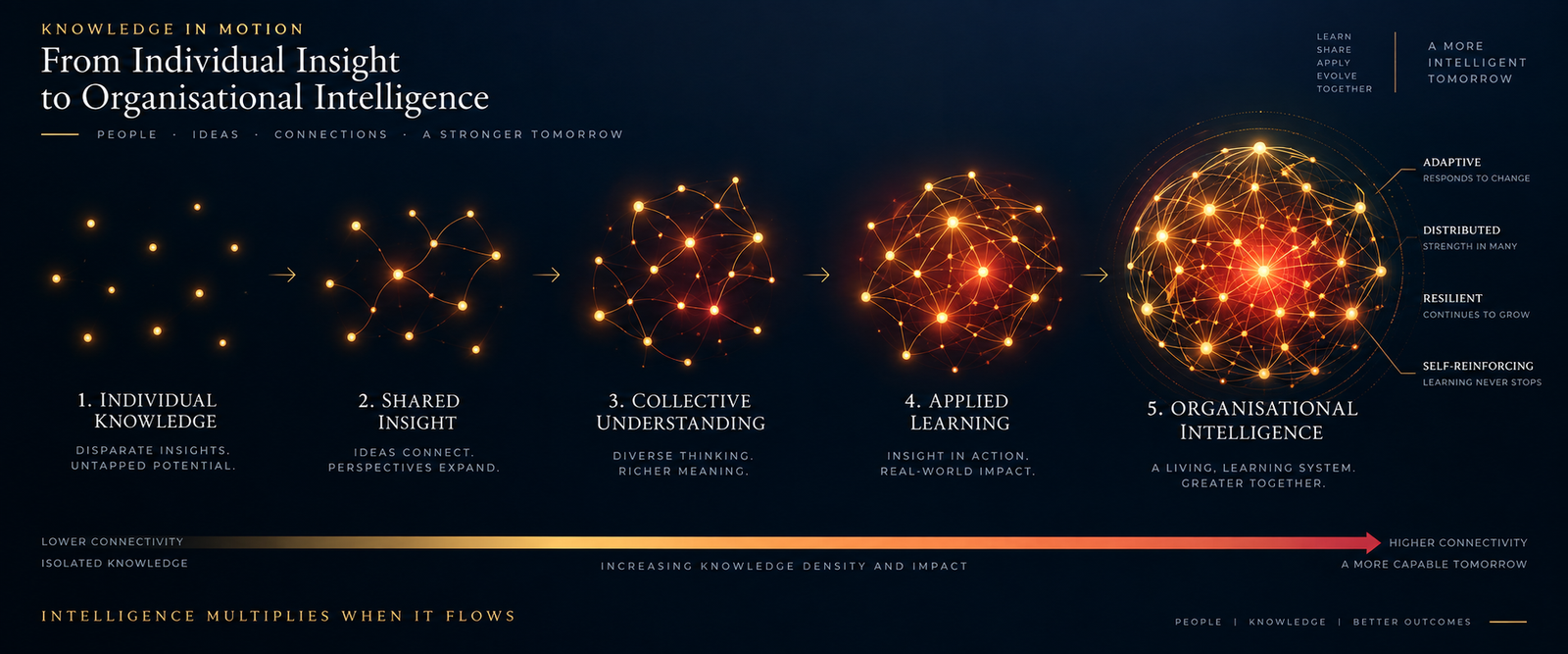
This creates an important distinction between organisations that provide learning and organisations that are capable of learning. A company can have an extensive learning platform and still suppress challenge. A healthcare organisation can collect enormous quantities of clinical data while failing to hear frontline concerns. Learning infrastructure matters, but learning culture determines whether that infrastructure becomes intelligence.
The Burn Bright Knowledge Flow Framework™
If knowledge flow is a leadership capability, leaders need a way to see it. The framework treats organisational learning as a six-stage movement: Insight → Expression → Exchange → Interpretation → Application → Organisational Learning. A lesson can be identified without being expressed, expressed without being exchanged, exchanged without being understood, understood without being applied, and applied once without becoming part of organisational capability. Knowledge creates sustained value only when it completes the journey.
Stage 1
Insight
Every cycle begins with someone noticing something — a signal, not yet a conclusion. It may be formal research, professional expertise, a frontline observation or simply a question: “Why do we keep doing it this way?” A learning culture makes observations available for examination rather than demanding certainty from them immediately.
Stage 2
Expression
Insight has no organisational value if it remains inside someone’s head. The important leadership question is not “Did I give people an opportunity to speak?” but “Did I create conditions in which people believed speaking honestly was worthwhile?” That is a much higher standard, and it is set by leadership behaviour, not by policy.
Stage 3
Exchange
Expression makes knowledge visible. Exchange makes it social — one person’s understanding meets another’s experience, evidence or perspective. This is where Constructivism Intelligence™ becomes central: different interpretations are not always obstacles to overcome, they can be resources, if the conversation doesn’t become a competition for intellectual dominance.
Stage 4
Interpretation
More information does not necessarily create more understanding. Dashboards can show that something happened without explaining why. This is where Reflective Practice Intelligence™ becomes essential — asking not merely “What happened?” but “What does what happened teach us?” Reflection should not be reserved for failure; success also requires interpretation.
Stage 5
Application
This is the stage at which many learning cultures fail: insight is generated, thoughtful conversations are held, lessons-learned documents are produced — then nothing changes. Application asks the decisive question: what will we do differently because of what we now know? This is where Adaptability Intelligence™ enters — the ability to change intelligently because learning has occurred inside the system.
Stage 6
Organisational Learning
A team can learn without the organisation learning. Organisational learning occurs when useful knowledge becomes less dependent on the individuals who originally discovered it — entering processes, induction, professional development, decision frameworks and organisational memory, so capability survives when people move on.
Featured Snippet
| Stage | Diagnostic Question |
|---|---|
| Insight | What do our people know, notice or experience that the organisation needs to understand? |
| Expression | Do they feel able and motivated to say it? |
| Exchange | Does that knowledge reach the people and perspectives that could enrich it? |
| Interpretation | Do we create time and processes to make sense of it? |
| Application | Does learning influence decisions and behaviour? |
| Organisational Learning | Does useful knowledge become embedded so capability survives beyond individuals? |
From Knowledge Flow to Leadership Capacity
Effective knowledge flow reduces unnecessary leadership dependency. In low-flow cultures, knowledge repeatedly travels toward the leader, who becomes an information bottleneck. This may initially feel like strong leadership, but the system has become dependent on their cognitive capacity — and as complexity grows, that model becomes increasingly unsustainable.
| Low-Flow Culture | High-Flow Culture |
|---|---|
| People ask for answers and wait for direction | Knowledge moves laterally as well as vertically |
| Decisions constantly escalate to the leader | Problems are solved closer to where they occur |
| The leader becomes an information bottleneck | People know who possesses relevant expertise |
| Teams work in isolation from one another | Teams learn from one another |
| Experience is not captured or reused | Reflection creates reusable knowledge |
| The leader personally carries collective intelligence | Decision-making is better distributed |
This strengthens Leadership Capacity™ and Leadership Sustainability™ because the organisation is no longer asking individual leaders to personally carry its collective intelligence. When leaders create conditions in which expertise multiplies, their leadership makes the organisation stronger.
What This Looks Like Across Sectors
📈 Business Growth Intelligence™
A growing company notices customer churn increasing. Rather than immediately commissioning another report, leaders bring together customer-service insight, sales experience, product data and customer feedback. Knowledge becomes growth intelligence.
🏫 School Leadership Intelligence™
Teachers notice a group of students becoming increasingly disengaged. Instead of treating each classroom as isolated, leaders create structured inquiry across departments — comparing observations, testing interventions and sharing successful practice. Individual teacher insight becomes institutional learning.
🏥 Healthcare Leadership Intelligence™
Frontline clinicians identify recurring friction in a patient pathway. Leaders create a psychologically safe mechanism for surfacing concerns, bring different professional groups together, test a redesigned process and incorporate successful changes into standard practice. Experience becomes system capability.
🏛️ Public Service Leadership Intelligence™
Frontline staff observe that citizens repeatedly struggle with a particular administrative requirement. Rather than interpreting non-compliance solely through policy data, leaders bring lived service experience into policy interpretation.
👥 HR & People Leadership Intelligence™
Exit interviews reveal recurring concerns about management behaviour. Instead of storing the findings within HR, leaders connect them with engagement data, manager development and workload patterns. Employee experience becomes leadership-development intelligence.
🚀 Entrepreneur Performance Intelligence™
A founder realises that every significant decision still reaches them. Instead of simply working longer, they examine where knowledge and decision authority are concentrated, document and distribute expertise, and turn knowledge flow into a mechanism for scaling leadership itself.
How Leaders Create Cultures That Want to Grow
A culture that wants to grow cannot be created through a statement of values or installed through a learning platform. It emerges from repeated experiences — people watch what leaders ask, notice what leaders reward, and remember how leaders react when challenged.
Practice 1 Lead With Questions Before Answers
A leader who enters every discussion with an immediate solution reduces thinking around them. Before contributing an answer, create space for knowledge to emerge: “What are we seeing? What are we assuming? Who sees this differently?”
Practice 2 Make Reflection Part of the Work
A ten-minute reflective conversation after a meeting, milestone or decision can produce valuable learning: What happened? What helped? What should we change next time? Then add the question that turns reflection into knowledge flow — “Who else needs to know this?”
Practice 3 Reward People Who Multiply Knowledge
Who receives status — the person who rescues the project, or the person who redesigned the process so rescue is no longer necessary? Knowledge multipliers teach, mentor, document, connect teams and deliberately reduce unnecessary dependency on themselves. That should be visible in what gets recognised.
Practice 4 Design Meetings for Knowledge Flow
Separate information, interpretation, challenge, decision and learning as distinct activities rather than compressing them into one presentation. Ask participants to contribute observations before the most senior person gives their interpretation.
Practice 5 Build Bridges Between Silos
Start from organisational problems rather than organisational charts. Do not connect teams simply so they can exchange updates — connect them around questions they need one another to answer.
Practice 6 Create a Healthier Relationship With Failure
Distinguish between a thoughtful experiment, incomplete information, a flawed process and deliberate misconduct. If every failure is punished identically, people learn concealment. If every failure is excused, accountability deteriorates. Ask what happened and what needs to change, not simply who is to blame.
Practice 7 Close the Feedback Loop
Explain what was heard, what was learned, what is changing, what is not changing, and why. People do not expect every suggestion to be adopted — they expect evidence that contributing was meaningful.
A Practical 30-Day Knowledge Flow Reset
Week One: Listen
Identify where useful knowledge may currently be trapped. Ask employees where information repeatedly gets lost, what people here know that others need, and what lessons keep getting relearned. The purpose is diagnosis, not immediate correction.
Week Two: Connect
Choose one important organisational challenge and bring together people with different knowledge of it. Begin by constructing the fullest possible understanding of the problem: “What can you see from your position that the rest of us may not?”
Week Three: Reflect
Introduce a short reflective routine into one meeting, project or operational process: What happened? What did we learn? What will we do differently? Who else needs this knowledge? Keep it light enough to survive beyond the first month.
Week Four: Embed
Take one useful piece of learning and ensure the organisation remembers it — update a process, create a resource, change induction, or build it into leadership development.
One completed cycle of the full framework — Insight → Expression → Exchange → Interpretation → Application → Organisational Learning — teaches more about organisational learning than dozens of disconnected learning activities.
What Leaders Should Measure
Knowledge flow is difficult to capture with a single metric, but leaders can monitor useful indicators. Consider whether:
- Employees raise problems early.
- Lessons from projects are reused elsewhere.
- Teams know where relevant expertise exists.
- Critical processes depend excessively on particular individuals.
- Decisions incorporate frontline knowledge.
- Employees can question assumptions safely.
- Reflection produces observable changes.
- Repeated mistakes decline over time.
The goal is to develop Leadership Benchmarking™ around the conditions that enable organisational intelligence. Leaders should be able to ask: are we becoming better at learning — not simply, are we doing more learning activities?
Leadership Reflection Questions
- Where does valuable knowledge currently become trapped in your organisation?
- Which people or roles hold expertise that would create greater value if it were distributed?
- How easy is it for someone with less organisational status to challenge someone with more?
- When employees identify problems, what typically happens next?
- Are your meetings primarily designed to exchange updates, or do they enable collective interpretation and learning?
- Where are different departments solving similar problems independently?
- What important organisational knowledge would disappear if key people left tomorrow?
- How much protected capacity exists for reflection, learning and knowledge transfer?
- When something goes wrong, does your leadership culture first search for understanding or blame?
- What has your organisation learned during the past year that has genuinely changed how it operates?
Action Steps for Leaders
- Map one knowledge journey. Choose one recurring organisational problem and trace what happens to knowledge about it — who first sees it, where it travels, who interprets it, who can act, and where flow stops.
- Ask one knowledge-opening question. At your next significant meeting, resist beginning with your interpretation. Ask, “What can you see from your position that the rest of us may not?” and listen before contributing your own conclusion.
- Identify one knowledge dependency. Find one process, relationship or capability that depends excessively on one individual and begin transferring that knowledge before it becomes a crisis.
- Introduce a ten-minute reflection. After an important activity, ask what happened, what was learned, what should change, and who else needs to know.
- Close one feedback loop. Choose a recent survey, consultation or workshop and tell participants what was heard, what was learned, what will change, what will not, and why.
- Connect two organisational silos. Identify two teams holding different knowledge about the same challenge and bring them together around the problem rather than departmental updates.
- Embed one lesson. Take one valuable insight and move it into organisational memory — the process, induction material, leadership routine or resource library.
What is knowledge flow in leadership?
Knowledge flow is the movement of useful insight, experience, evidence and expertise through an organisation so that it can influence understanding, decisions and action. Leadership affects whether knowledge is expressed, exchanged, interpreted, applied and retained.
Why is knowledge flow important for organisational performance?
Organisations frequently possess relevant knowledge without using it effectively. Better knowledge flow helps leaders connect frontline experience, specialist expertise, organisational data and different professional perspectives, improving the information available for decision-making and organisational learning.
What blocks knowledge sharing in organisations?
Common barriers include hierarchy, psychological risk, knowledge hoarding, professional silos, excessive workload, expertise bias and leadership cultures that expect certainty. These conditions can make people reluctant or unable to contribute what they know.
How can leaders improve knowledge flow?
Leaders can ask questions before providing answers, create psychologically safer opportunities for challenge, establish reflective routines, connect teams across silos, reward knowledge transfer, close feedback loops and ensure useful learning becomes embedded in organisational systems.
What is the difference between knowledge sharing and knowledge flow?
Knowledge sharing usually describes the act of communicating information or expertise. Knowledge flow goes further — it considers whether knowledge reaches relevant people, encounters other perspectives, is interpreted, influences action and becomes part of organisational capability.
How does psychological safety affect organisational learning?
People are less likely to reveal concerns, mistakes, questions or alternative interpretations when doing so carries significant interpersonal risk. Psychological safety supports knowledge flow by making honest contribution more possible while remaining compatible with appropriate accountability and performance expectations.
How can leaders prevent knowledge hoarding?
Leaders can reduce dependence on individual experts by rewarding teaching and mentoring, documenting critical knowledge, developing successors, creating peer-learning structures and recognising leaders who increase capability in other people rather than simply becoming indispensable themselves.
What is the Burn Bright Knowledge Flow Framework™?
The Burn Bright Knowledge Flow Framework™ describes organisational learning through six connected stages: Insight → Expression → Exchange → Interpretation → Application → Organisational Learning. It helps leaders identify where useful knowledge becomes blocked or lost before it can improve organisational performance.
How does knowledge flow support leadership sustainability?
When knowledge and problem-solving remain concentrated around individual leaders, those leaders can become decision and information bottlenecks. Distributing knowledge and developing capability in others can reduce unnecessary dependency, strengthen Leadership Capacity™ and support Leadership Sustainability™.
How do you know whether an organisation has a genuine learning culture?
Look beyond training participation. Examine whether people raise problems early, question assumptions, share expertise, learn across departments, reflect on outcomes, apply lessons and retain valuable knowledge when people change roles or leave. A strong learning culture produces observable changes in organisational capability.
Build an Organisation That Can Keep Learning
The future of leadership will not belong to the organisations that simply possess the most information. Information is becoming abundant. The more significant advantage will belong to organisations capable of converting information, experience, expertise and reflection into better collective judgement.
That requires knowledge to move — from the frontline to decision-makers, between departments, across professional boundaries, from experienced people to emerging talent, from mistakes into improved practice, and from reflection into action.
This is why knowledge flow should be understood as a leadership-performance capability rather than simply a knowledge-management concern. Instead of asking “How can I become the person with the answers?” ask “How can I build an organisation capable of discovering better answers?” Instead of “How can we give people more information?” ask “What prevents useful knowledge from reaching the people who need it?”
These questions move leadership away from knowledge ownership and towards knowledge stewardship. It means designing environments where people can question assumptions without unnecessary interpersonal risk, creating time to reflect, connecting professional perspectives, rewarding people who develop capability in others, and building organisational memory so valuable knowledge does not disappear when individuals leave.
When knowledge moves, capability grows.
When capability grows, dependency reduces.
When dependency reduces, leadership becomes more sustainable.
A culture that wants to grow does not need leaders who pretend to know everything. It needs leaders sufficiently secure to remain curious — leaders who can listen before concluding, who recognise expertise without becoming captive to it, and who understand that organisational intelligence is not located at the top of the hierarchy. It is distributed throughout the system. The leadership task is to help it move.
See Where Knowledge Is Getting Stuck in Your Leadership
A full diagnostic maps where decisions, dependency and unheard frontline knowledge are quietly overloading your leadership — so you know exactly what to redesign.
Take the Leadership Burnout Self-Assessment
If too much still depends on you knowing everything, the first step is diagnosing where that structural pressure is coming from. Take the free assessment to identify the pressures affecting your leadership capacity.
Free Leadership Intelligence
Get Weekly Leadership Insights
Join thousands of leaders receiving practical strategies on burnout prevention, workload design, and sustainable performance every week.