Quick Answer
Key Takeaways
- Leaders who continually provide answers can achieve short-term efficiency while weakening long-term capability.
- Constructivism Intelligence™ moves the leadership question from “How can I give people better answers?” to “How can I create the conditions in which people become better at finding answers?”
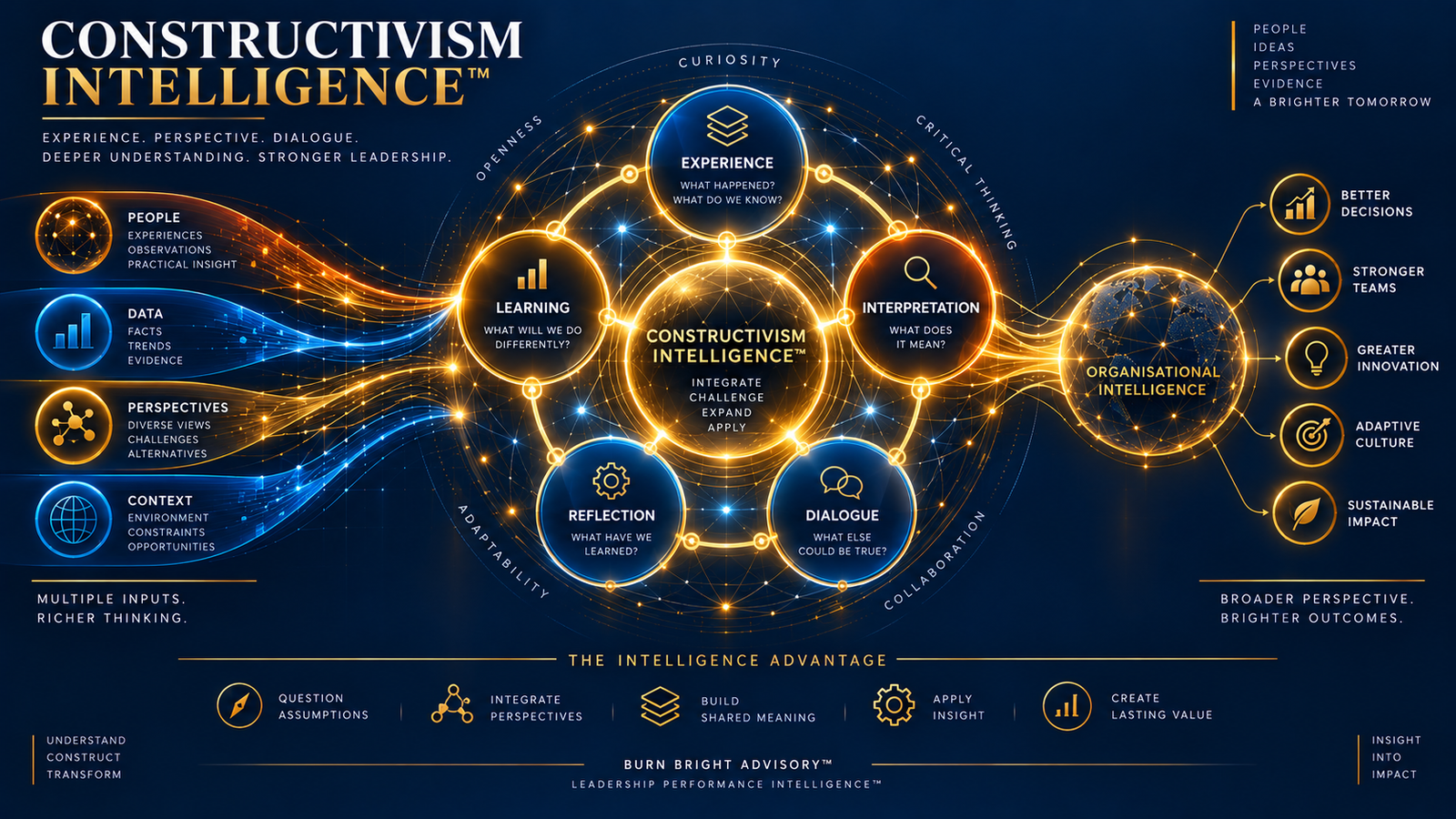
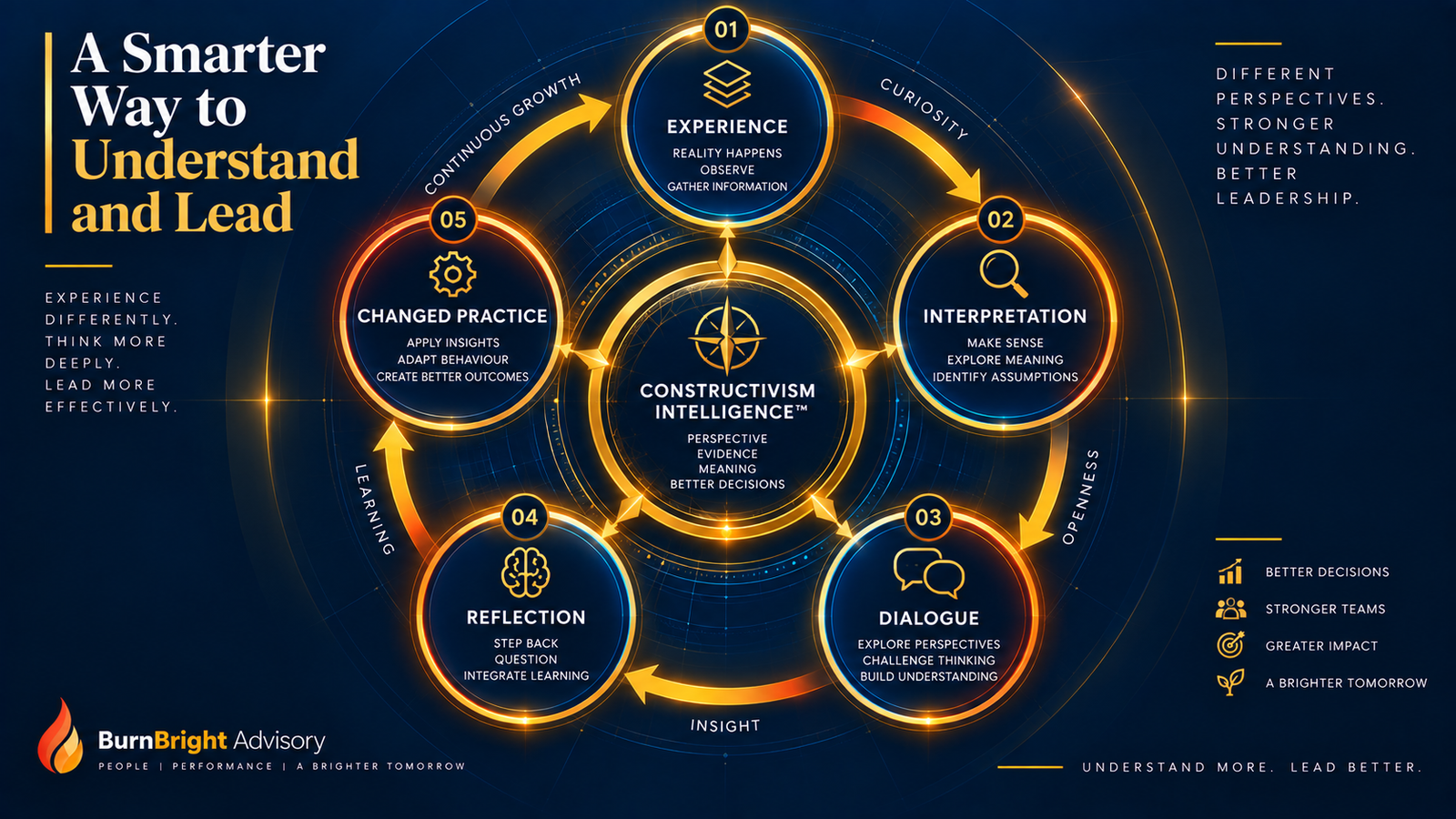
- A constructivist approach moves through four interconnected processes: Experience, Interpretation, Dialogue and Reflection.
- Constructivist leadership is not passive — leaders still set boundaries, make decisions and intervene when risk requires it.
- Developing other people’s judgement is a capacity strategy: every decision made closer to the relevant knowledge reduces unnecessary cognitive demand on senior leadership.
Constructivism Leadership: Why Great Leaders Build Understanding Rather Than Simply Give Answers
Leadership has traditionally been associated with knowing.
The leader understands the problem.
The leader determines the solution.
The leader communicates the decision.
Others implement it.
That model can work when environments are predictable, expertise is concentrated and problems have relatively stable answers. Modern organisations rarely enjoy those conditions. Leaders increasingly operate amid incomplete information, technological disruption, competing stakeholder expectations, distributed expertise and problems whose consequences cannot be fully understood in advance.
Under these conditions, leadership cannot depend exclusively on one person’s ability to know.
It must also depend on the organisation’s ability to learn.
Constructivism is commonly associated with theories of learning. At its core is a straightforward proposition: people do not simply receive knowledge. They interpret information through what they already know, what they have experienced and the meaning they construct through interaction with their environment and other people.
Constructivism leadership is not about withholding expertise or abandoning authority. It is about recognising that telling somebody an answer and developing their ability to think are not the same thing. The strongest leaders increasingly need to do both.
Are You the Organisation’s Answer-Giver by Default?
Before you change how you lead, it helps to see clearly where the pressure of always having the answer is landing on you.
What Is Constructivism Leadership?
Featured Snippet
People encounter challenges. They develop interpretations. They test assumptions. They compare perspectives. They receive feedback. They reflect. And gradually, their capacity for judgement increases.
This sits within the wider discipline of Leadership Performance Intelligence™ because organisational performance depends not only on what leaders know today, but on how effectively leadership systems expand the organisation’s ability to think tomorrow. That makes constructivism a performance issue rather than simply a learning philosophy.
The Answer-Giving Trap
One of the easiest ways for experienced leaders to become organisational bottlenecks is also one of the most socially rewarded: becoming exceptionally good at answering questions.
A team member brings a problem. The leader immediately solves it.
A colleague requests direction. The leader provides it.
A difficult decision emerges. Everyone waits for the leader.
The leader may feel useful, responsive and competent. The team may initially appreciate the speed. But something less visible can happen over time: the organisation begins transferring thinking upward. Employees learn that difficult judgement belongs to somebody else. Managers become reluctant to act without approval. Meetings revolve around obtaining decisions rather than developing understanding.
Constructivism leadership attempts to reverse that pattern. Instead of immediately asking “What answer should I give?”, leaders learn to ask “What thinking needs to happen here?” That is a very different leadership intervention.
From Knowledge Transfer to Knowledge Construction
Traditional development often operates according to a transfer model: the expert possesses knowledge, the learner lacks it, the expert transfers it, the learner applies it. Sometimes that is entirely appropriate — compliance procedures, technical instructions and emergency protocols may require precise knowledge transmission.
But leadership development involves something more complicated. Leaders routinely face situations in which there is no perfect script. They must interpret competing evidence, understand context, anticipate consequences and exercise judgement. Those capabilities cannot be developed through information transfer alone — they require experience.
Stage 1
Experience
Experience provides the raw material for learning — the situation, decision or challenge that a person actually encounters.
Stage 2
Interpretation
Interpretation asks what the experience might mean — separating what was observed from what was assumed.
Stage 3
Dialogue
Dialogue exposes the interpretation to alternative perspectives, testing it against evidence and experience the person does not hold alone.
Stage 4
Reflection
Reflection converts the experience into learning that can influence future action, rather than simply reinforcing existing habits.
Consider a newly promoted manager dealing with their first significant team conflict. A conventional leader might tell them exactly what to do. A constructivist leader could instead explore: What have you observed? What do you think is driving the disagreement? What options have you considered? What support do you need before acting?
The senior leader has not abandoned the manager. They have transformed the conversation from instruction into capability development.
Constructivism Intelligence™ and Leadership Performance Intelligence™
Constructivism Intelligence™ becomes especially powerful when connected with the broader Burn Bright leadership system. It also connects naturally with other domains of the Leadership Intelligence Compass™.
- Reflective Practice Intelligence™ helps leaders convert experience into insight.
- Knowledge Development Intelligence™ ensures learning becomes increasingly sophisticated rather than remaining anecdotal.
- Emotional Intelligence™ enables constructive dialogue, particularly when perspectives conflict.
- Adaptability Intelligence™ allows new understanding to translate into changed behaviour.
- Ethics Intelligence™ ensures interpretation remains connected with responsibility, fairness and consequence.
- Professionalism Intelligence™ provides the standards and discipline within which learning occurs.
These are not isolated leadership competencies. A leader may reflect without changing, learn without sharing, or encourage experimentation without ethical boundaries. Leadership intelligence emerges from the relationships between these capacities.
Why Constructivism Matters in Complex Organisations
Complex organisations contain knowledge that no single executive can possess.
- The frontline employee understands aspects of the customer experience that the executive team may never see.
- A teacher understands classroom dynamics that cannot be completely represented through performance data.
- A clinician sees patient-care realities that may disappear inside operational dashboards.
- A public servant encounters implementation consequences that were invisible when policy was designed.
- An entrepreneur hears objections from customers that challenge assumptions embedded in the original business model.
Constructivism leadership creates mechanisms through which those different realities can contribute to organisational understanding. The leader therefore becomes less of an information gatekeeper and more of an architect of collective sense-making. That does not reduce leadership authority — it changes how authority creates value.
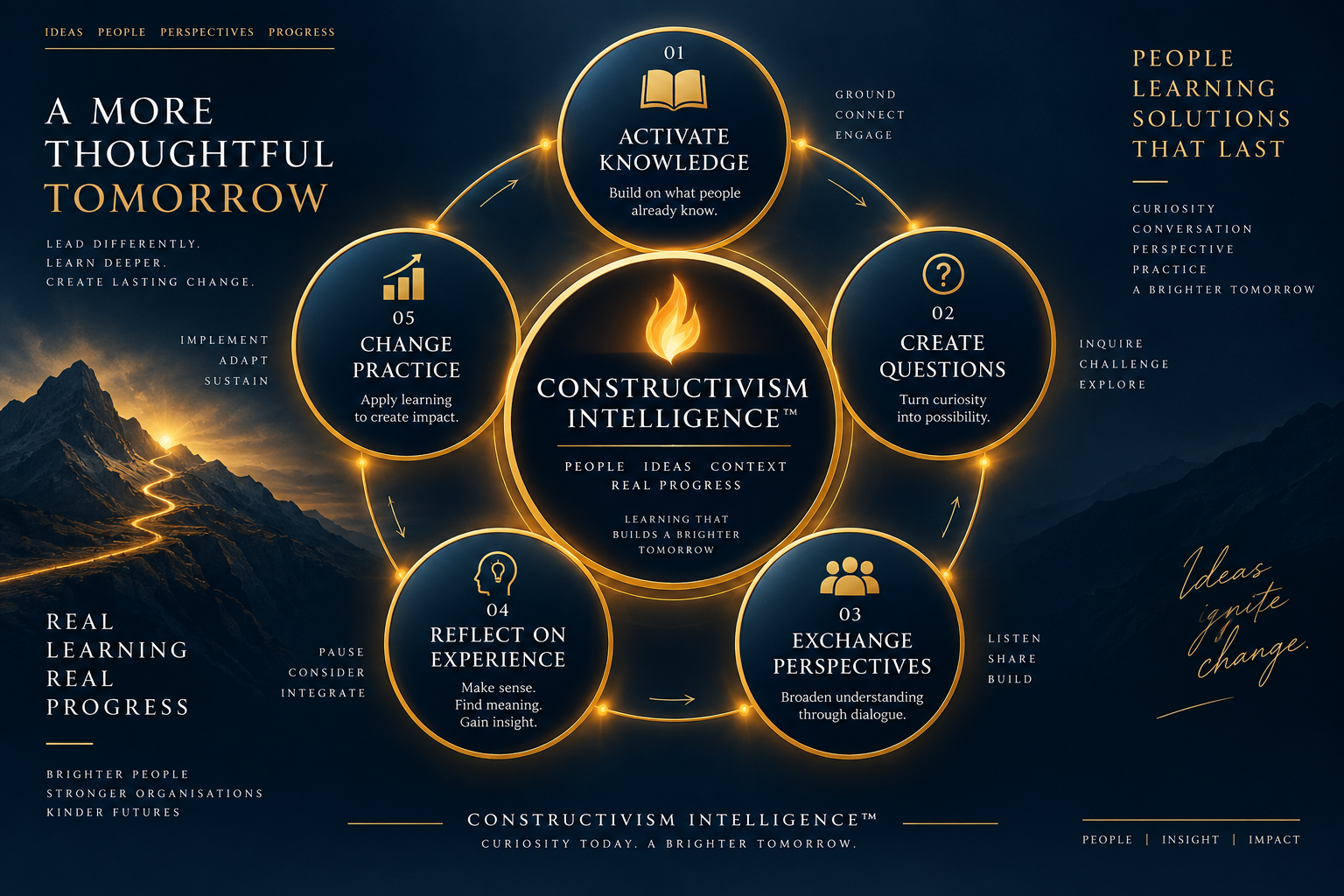
The Five Practices of Constructivism Leadership
Practice 1 Activate Existing Knowledge
People rarely approach situations without previous experience. Effective leaders discover what people already understand before adding more information: What have we seen before? Where might our existing assumptions be misleading us?
Practice 2 Create Productive Questions
The quality of leadership thinking is heavily influenced by the quality of leadership questions. Weak questions seek confirmation; strong questions expose assumptions. Instead of “Do you agree with this approach?” ask “What could make this approach fail?”
Practice 3 Enable Perspective Exchange
Constructivism becomes more powerful when individual interpretations encounter alternative perspectives. This requires environments in which disagreement can occur without automatically becoming conflict. The objective is not conversational comfort — it is better understanding.
Practice 4 Turn Experience Into Reflection
Experience does not automatically create expertise. Repeated experience without reflection can simply reinforce existing habits. Constructivist leaders deliberately create reflective loops after significant projects, decisions, successes and failures.
Practice 5 Convert Learning Into Changed Practice
Reflection without changed behaviour has limited organisational value. A powerful final question closes the learning loop: What will we do differently because of what we now understand?
What Constructivism Leadership Is Not
Constructivist leadership can be misunderstood as passive leadership. It is not. Leaders still establish boundaries. They still make decisions. They still hold people accountable. They still provide expertise. They still intervene when risk requires intervention.
Imagine a clinical emergency — that is not the moment for an extended philosophical dialogue about competing interpretations. Likewise, safeguarding, regulatory compliance, financial controls and serious ethical concerns may require explicit direction.
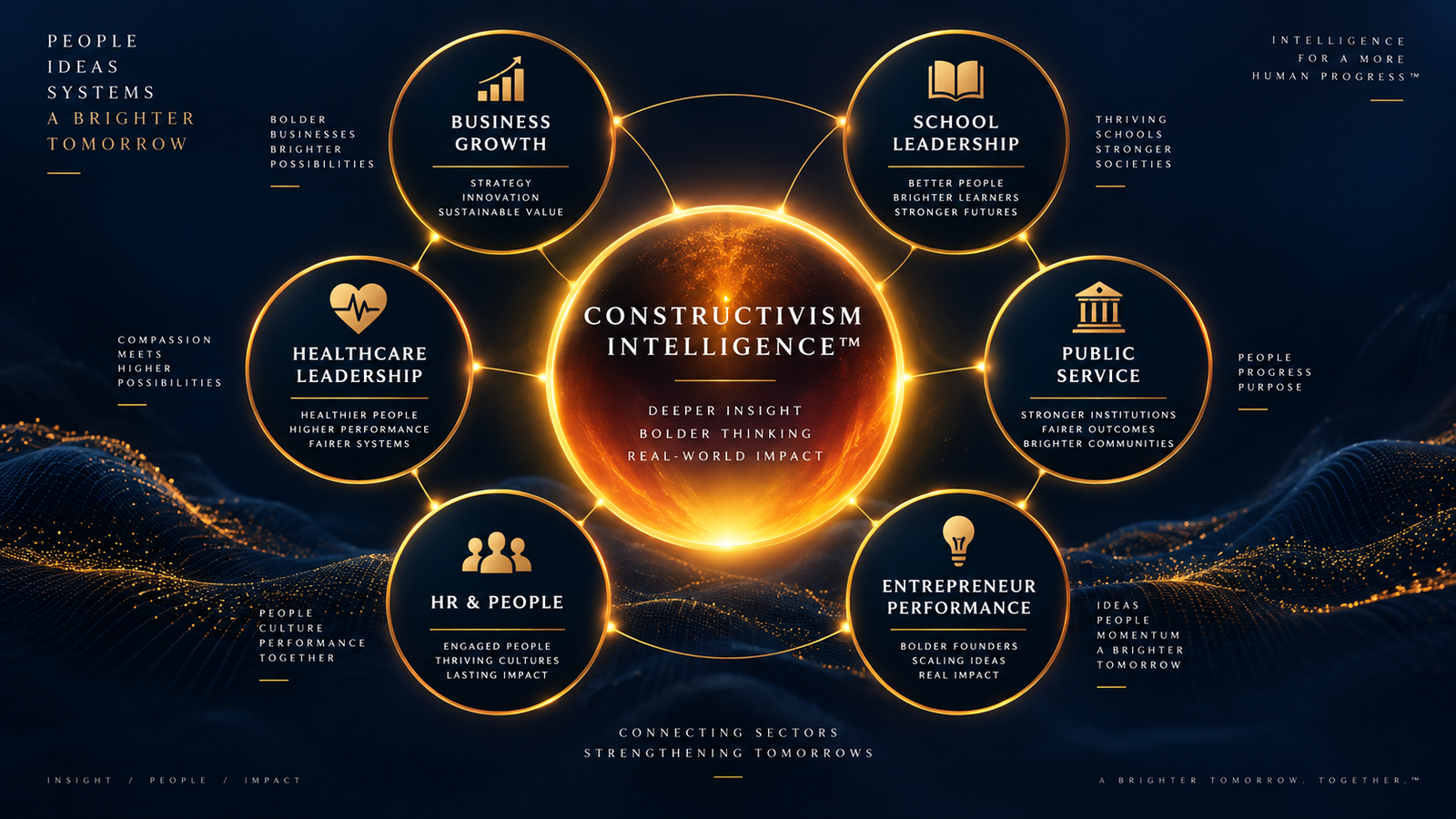
Sector Applications
📈 Business Growth Intelligence™
A growing business discovers that customer retention is declining. Rather than a conventional executive team studying the numbers and announcing a solution, a constructivist approach brings together sales, operations, customer service, product teams and potentially customers themselves before committing resources to a response.
🏫 School Leadership Intelligence™
A school identifies declining student engagement. Rather than immediately launching another initiative, leaders involve teachers, students, families and pastoral teams in understanding the pattern, moving from “What programme should we implement?” towards “What is happening here, and what evidence would help us understand it?”
🏥 Healthcare Leadership Intelligence™
Constructivist leadership can strengthen multidisciplinary learning by creating structured opportunities for different professionals to contribute their interpretation of patient pathways, operational challenges and quality issues — without blurring professional accountability.
🏛️ Public Service Leadership Intelligence™
Constructivist public leadership deliberately creates feedback loops between policy designers, frontline professionals, communities and service users, so implementation becomes a source of intelligence rather than simply a compliance exercise.
👥 HR & People Leadership Intelligence™
People teams can use constructivist approaches to move leadership development beyond courses — stretch assignments, peer dialogue, facilitated reflection, coaching, action learning and post-project reviews allow leadership capability to be constructed through real organisational experience.
🚀 Entrepreneur Performance Intelligence™
Entrepreneurs frequently begin with strong assumptions about customers, markets and products. Constructivist thinking treats those assumptions as hypotheses rather than truths — customer feedback, experimentation, failure and iteration become mechanisms through which understanding develops.
The Risk of Leaders Becoming the Organisation’s Cognitive Bottleneck
Leadership dependency has another consequence: workload. When every difficult question travels upward, senior leaders become overloaded. Their calendars fill with approvals. Teams wait. Decision queues expand. Strategic thinking gets displaced by operational problem-solving.
The leader concludes that employees need more support. Employees conclude that the leader wants greater control. Both sides become frustrated.
This is where Constructivism Intelligence™ connects unexpectedly with Leadership Capacity™, Leadership Workload™ and Leadership Sustainability™. Developing other people’s judgement is not merely developmental generosity — it is a capacity strategy. Every decision that can responsibly be made closer to the relevant knowledge reduces unnecessary cognitive demand on senior leadership.
A Practical Constructivism Intelligence™ Framework
Leaders can use a simple six-question framework when a colleague brings them a complex problem.
- What are you seeing? Separate observation from interpretation.
- What do you think it means? Surface the person’s current mental model.
- What assumptions are you making? Identify beliefs that may require testing.
- What other interpretations are possible? Expand perspective.
- What would you do? Require judgement rather than dependency.
- What will we learn from the result? Turn action into future intelligence.
This does not need to become a twenty-minute coaching conversation every time somebody asks a question. Sometimes it takes sixty seconds. The important shift is that the leader stops automatically completing the thinking on behalf of everyone else.
Measuring Constructivism Intelligence™
Organisations should examine whether their leadership environment actually develops independent thinking. Useful indicators might include:
- Percentage of operational decisions made at the appropriate organisational level.
- Frequency and quality of reflective reviews.
- Employee confidence in challenging assumptions.
- Evidence that lessons from projects influence future decisions.
- Cross-functional knowledge exchange.
- Manager dependency rates.
- Internal leadership pipeline strength.
- Repeated versus genuinely new organisational problems.
This introduces the possibility of Leadership Benchmarking™: instead of measuring leadership purely through output, organisations can evaluate whether leadership behaviour is increasing or decreasing organisational capability.
From Smart Leaders to Intelligent Organisations
The future of leadership will not be secured simply by creating increasingly knowledgeable executives.
Knowledge changes too quickly.
Problems cross too many boundaries.
Expertise is too distributed.
Organisations need something more valuable: the capacity to continuously construct new understanding. That requires leaders who can tolerate questions they cannot immediately answer, who can listen without prematurely concluding, who can expose assumptions without humiliating people, and who understand that developing someone’s thinking may sometimes be more valuable than solving their problem.
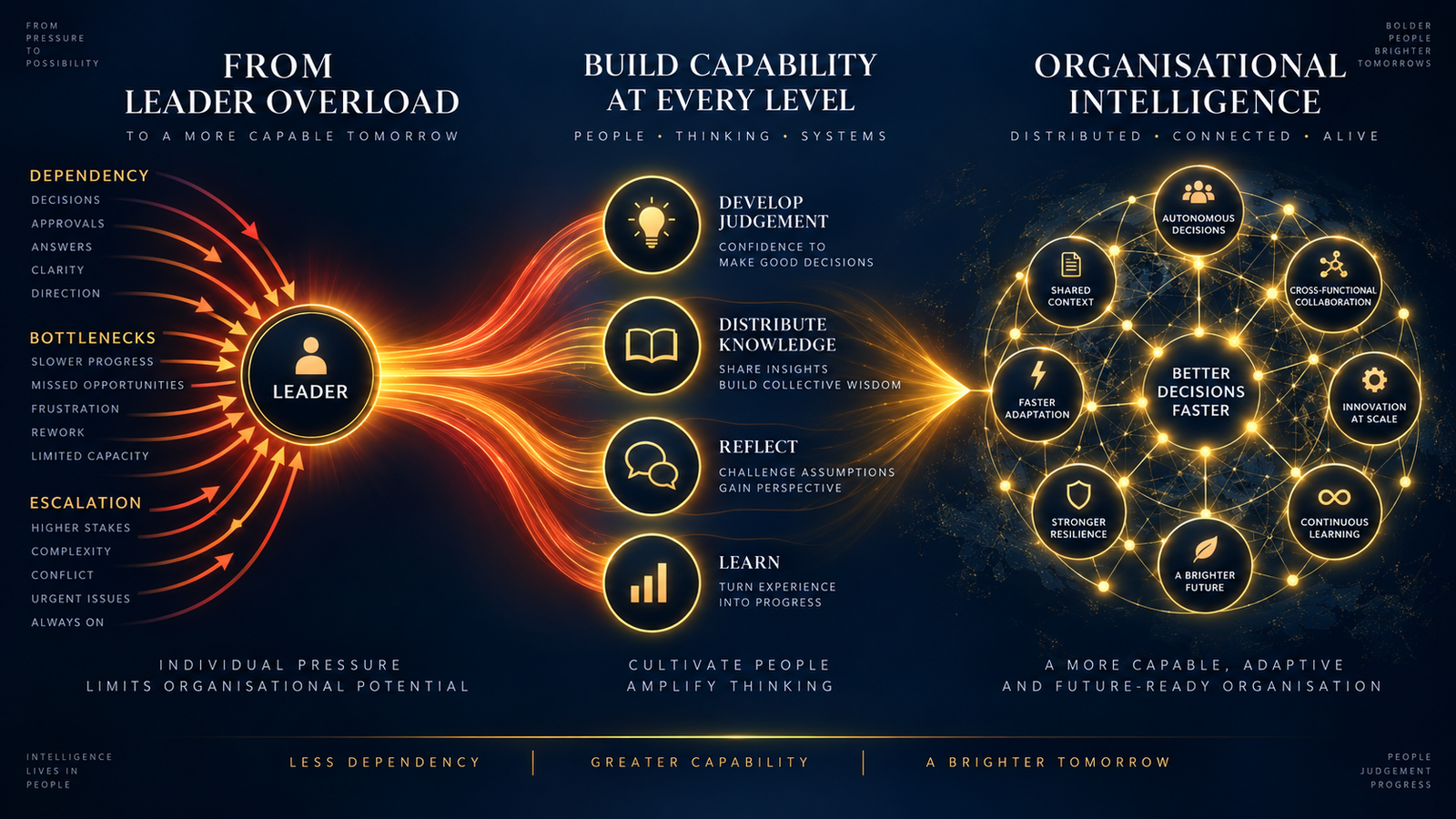
Leadership is no longer simply the application of what the leader knows. It becomes the deliberate expansion of what the organisation is capable of learning.
Leadership Reflection Questions
- When team members bring problems to you, how quickly do you provide the answer?
- Where has your expertise unintentionally created dependency?
- Which decisions repeatedly travel upward that could eventually be made elsewhere?
- How deliberately does your organisation convert experience into learning?
- Can people challenge assumptions without damaging relationships or status?
- What organisational knowledge currently remains trapped within individual teams?
- Where are repeated problems indicating that experience is occurring without sufficient reflection?
- What would change if leadership success included the capability created in others?
Action Steps
This Week
Identify one recurring situation in which colleagues routinely ask you for answers. Replace the immediate answer with two or three questions that help them develop their own interpretation.
This Month
Introduce a structured reflective review after one important project or decision. Capture assumptions, outcomes, surprises and lessons.
This Quarter
Map decisions that repeatedly escalate upward. Determine which could move closer to frontline knowledge if capability, information or authority were strengthened.
At Organisational Level
Examine whether your leadership environment develops independent judgement or reinforces dependency, using relevant Constructivism Intelligence™ diagnostics.
What is constructivism leadership?
Constructivism leadership is an approach in which leaders develop understanding through experience, inquiry, dialogue and reflection rather than relying exclusively on instruction.
What is Constructivism Intelligence™?
Constructivism Intelligence™ is a Burn Bright Advisory™ Leadership Intelligence Compass™ domain describing a leader’s capacity to create conditions in which people construct stronger knowledge, understanding and judgement.
Why is constructivism important for leaders?
Complex organisations face problems that cannot always be solved through existing knowledge. Constructivist leadership increases the organisation’s ability to learn, interpret evidence and develop new responses.
Does constructivist leadership mean leaders should stop giving answers?
No. Direct instruction remains appropriate when expertise, safety, regulation or urgency requires it. Constructivism Intelligence™ helps leaders judge when providing an answer is necessary and when developing another person’s thinking creates greater long-term value.
How does constructivism improve leadership development?
It moves development beyond knowledge consumption. Leaders learn through experience, reflection, dialogue, experimentation and feedback, allowing judgement to develop alongside technical knowledge.
How does constructivism support innovation?
Innovation requires organisations to challenge assumptions and construct new interpretations. Constructivist environments make alternative perspectives and experimentation legitimate parts of organisational learning.
How is constructivism connected to reflective leadership?
Experience provides material for learning, while reflection helps leaders interpret that experience. Constructivism Intelligence™ and Reflective Practice Intelligence™ therefore reinforce each other.
Can constructivism reduce leadership workload?
Potentially. When leaders systematically develop judgement throughout their teams, fewer routine decisions need to escalate upward, increasing Leadership Capacity™ and supporting Leadership Sustainability™.
How can organisations assess Constructivism Intelligence™?
They can examine decision dependency, reflective practices, knowledge-sharing, employee confidence in questioning assumptions, learning transfer and evidence that experience changes future organisational behaviour.
Conclusion
The strongest organisations are not those in which the leader always has the answer. They are organisations in which people have learned how to investigate questions, challenge assumptions, combine perspectives, reflect on experience and make increasingly sophisticated judgements.
That capability does not emerge accidentally.
Leaders create it.
Constructivism leadership therefore asks leaders to reconsider one of the deepest assumptions of traditional authority: that leadership value comes primarily from providing answers. Sometimes it does. But sustainable leadership creates something more powerful. It develops people who can think when the leader is absent. It creates teams that can learn when established knowledge becomes obsolete. It creates organisations capable of adapting because learning is embedded into how work happens.
The defining question is therefore no longer: how many answers does the leader possess? It is: how much greater has the organisation’s capacity to think become because of their leadership?
That is a different measure of leadership.
And potentially, a far more consequential one.
See Where Answer-Giving Has Become a Bottleneck
A full diagnostic maps where decisions, dependency and unexamined assumptions are quietly concentrating around you — so you know exactly what to redesign.
Take the Leadership Burnout Self-Assessment
If too many decisions still depend on you personally, the first step is diagnosing where that structural pressure is coming from. Take the free assessment to identify the pressures affecting your leadership capacity.
Free Leadership Intelligence
Get Weekly Leadership Insights
Join thousands of leaders receiving practical strategies on burnout prevention, workload design, and sustainable performance every week.