Quick Answer
Key Takeaways
- Teach decision-making, not task allocation. Effective delegation transfers appropriate authority alongside responsibility.
- Address structural barriers. Unclear roles, competing priorities and excessive approval requirements undermine delegation.
- Introduce a consistent framework. Managers need practical systems for selecting, assigning and monitoring responsibilities.
- Measure outcomes rather than activity. Successful delegation creates accountability without constant supervision.
- Protect leadership capacity. Delegation should release time for strategic leadership while developing employees’ capabilities.
Teaching Managers to Delegate: A Practical Framework
By Vincent Walters, Burn Bright Advisory. Published Friday, 25 September 2026.
Introduction
Teaching managers to delegate is one of the most important investments an organisation can make in sustainable leadership.
Yet many organisations approach delegation incorrectly.
They send managers on training courses, introduce new productivity techniques and encourage leaders to distribute more responsibilities. Then they return those managers to organisational structures that make effective delegation almost impossible.
Decision-making remains centralised.
Accountability is unclear.
Managers remain responsible for outcomes they cannot fully control.
Eventually, delegated responsibilities return to the manager’s desk.
The result is predictable. Managers become operational bottlenecks. Employees lose confidence in their authority. Senior leaders experience increasing workloads despite having teams capable of carrying greater responsibility.
Having worked in leadership across education, business and the public sector for more than three decades, I have repeatedly observed the consequences of organisations depending on individual managers rather than effective management systems.
The solution is to treat delegation as a structural leadership capability.
In this article, we will examine why conventional delegation training often fails, how organisations can develop managers systematically and how to build a practical framework that supports accountability, employee development and sustainable leadership.
The objective is straightforward: develop managers who build organisational capability rather than organisational dependency.
Understanding the Delegation System
Effective delegation depends on four interconnected elements: responsibility, authority, accountability and organisational support.
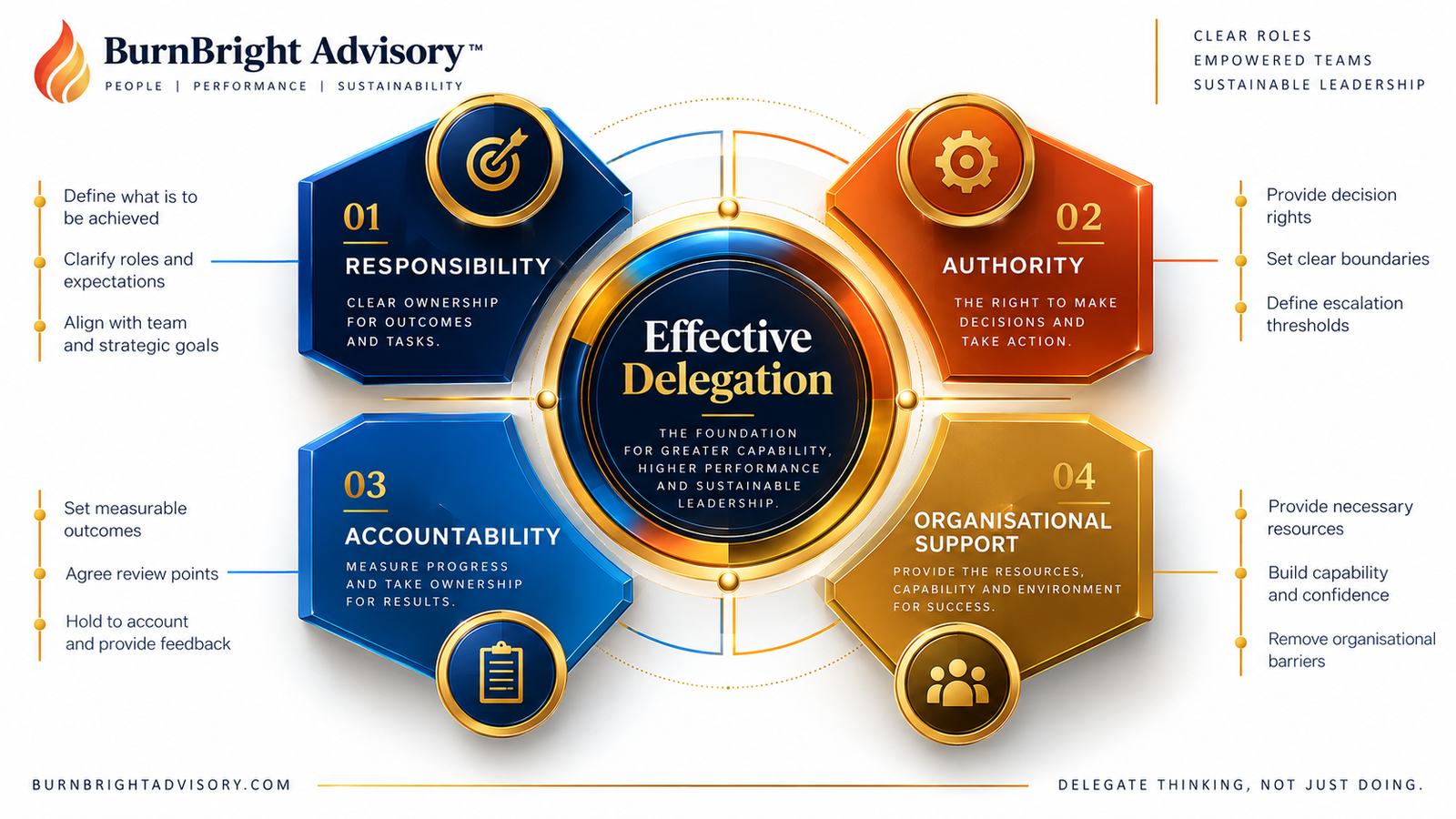
These elements must operate together. Transferring responsibility without decision-making authority creates dependency rather than genuine delegation.
What Does Teaching Managers to Delegate Actually Involve?
Delegation is frequently misunderstood.
Many managers believe they are delegating when they assign tasks to employees. However, assigning work and delegating responsibility are fundamentally different activities.
Featured Snippet
This distinction changes how organisations should approach management development.
Consider a department manager responsible for producing a monthly performance report.
The manager asks a team member to collect information, prepare charts and draft the report. However, the manager retains responsibility for interpreting the information, deciding which findings matter and determining what recommendations should be included.
The employee performs the administrative work.
The manager retains the cognitive workload.
Although some time has been saved, the underlying decision-making structure remains unchanged.
Now consider an alternative.
The manager delegates responsibility for producing the complete report, including analysis and recommendations. The employee receives clearly defined objectives, access to relevant information and authority to make decisions within agreed boundaries. The manager reviews the completed work against established standards.
This arrangement develops the employee’s capabilities while reducing the manager’s operational involvement.
Effective delegation requires managers to develop five capabilities:
- Identifying responsibilities that can be transferred.
- Matching responsibilities with employee capabilities.
- Establishing appropriate decision-making authority.
- Communicating expectations and performance standards.
- Monitoring outcomes without reclaiming ownership.
These capabilities cannot develop through theoretical instruction alone. Managers need opportunities to practise delegation, receive feedback and progressively transfer greater responsibility.
Organisations must also examine whether their internal policies support the behaviours they are teaching. A manager cannot meaningfully delegate decisions when organisational procedures require personal approval for every operational adjustment.
This is where delegation training must connect with organisational design.
The objective is not simply to create managers who delegate more tasks. It is to develop management systems that distribute responsibility intelligently.
Why Do Traditional Delegation Training Programmes Fail?
Most delegation training concentrates on individual management behaviour. Participants learn how to identify suitable tasks, communicate instructions and monitor progress.
These are useful capabilities. However, training frequently overlooks the organisational conditions that determine whether managers can apply what they have learned.
The result is a familiar pattern. Managers attend training, return to their existing responsibilities and discover that nothing within their working environment has changed.
Their workload remains excessive.
Decision-making authority remains unclear.
Senior leaders continue to expect personal involvement in operational details.
Eventually, managers return to established behaviours.
This is not necessarily evidence that the training was ineffective. It may indicate that the organisational system prevents managers from implementing their new capabilities.
The five structural barriers
Within the Burn Bright Not Out Framework™, I identify five recurring organisational conditions that contribute to leadership burnout. Each can also undermine delegation.
These barriers require organisational intervention.
The World Health Organization defines burnout as an occupational phenomenon associated with chronic workplace stress that has not been successfully managed. Its three dimensions are exhaustion, increased mental distance from work and reduced professional efficacy.
This definition reinforces the need to examine working conditions rather than concentrating exclusively on individual coping strategies.
Delegation training should therefore be connected to workload redesign, decision authority and organisational accountability. Otherwise, organisations risk teaching managers techniques they cannot realistically implement.
How Does Poor Delegation Contribute to Leadership Burnout?
Poor delegation concentrates operational responsibility within individual management positions.
Over time, managers become responsible for an increasing number of decisions, problems and administrative activities. Their working days become fragmented. Strategic responsibilities are postponed because immediate operational demands consume available capacity.
This creates a dangerous management cycle:
The more overwhelmed managers become, the less time they have to develop employees.
The less employees develop, the more dependent they become on management intervention.
Eventually, the organisation relies on managers working beyond sustainable capacity.
What does the research reveal?
The scale of management pressure is becoming increasingly visible.
According to Gallup’s 2026 State of the Global Workplace report, global manager engagement declined from 31% in 2022 to 22% in 2025. This represents a nine-percentage-point decline.
Although this research does not establish poor delegation as the cause, it highlights the importance of examining management roles and organisational support.
Gallup’s 2026 research also reported that global employee engagement stood at just 20% in 2025. Managers influence how organisational expectations translate into employees’ daily working experiences. Their capacity matters.
Research from the CIPD’s 2025 Health and Wellbeing at Work report provides further context. Among employees who reported that work negatively affected their mental health, 69% identified high workload as a contributing factor. Additionally, 63% identified insufficient management support for performing their jobs effectively.
These findings demonstrate why workload design and management capability should be examined together.
They do not establish that delegation training alone prevents burnout. However, they support a broader organisational approach that addresses workload, authority and management effectiveness.
The hidden operational cost
Consider a manager responsible for twelve employees.
Every significant decision requires management approval. Employees regularly interrupt the manager to resolve problems they could reasonably handle independently. The manager responds by extending their working hours to complete responsibilities that require concentrated attention.
The immediate problem appears to be insufficient time.
The underlying problem is excessive management dependency.
Teaching that manager to organise their calendar more efficiently will produce limited improvement.
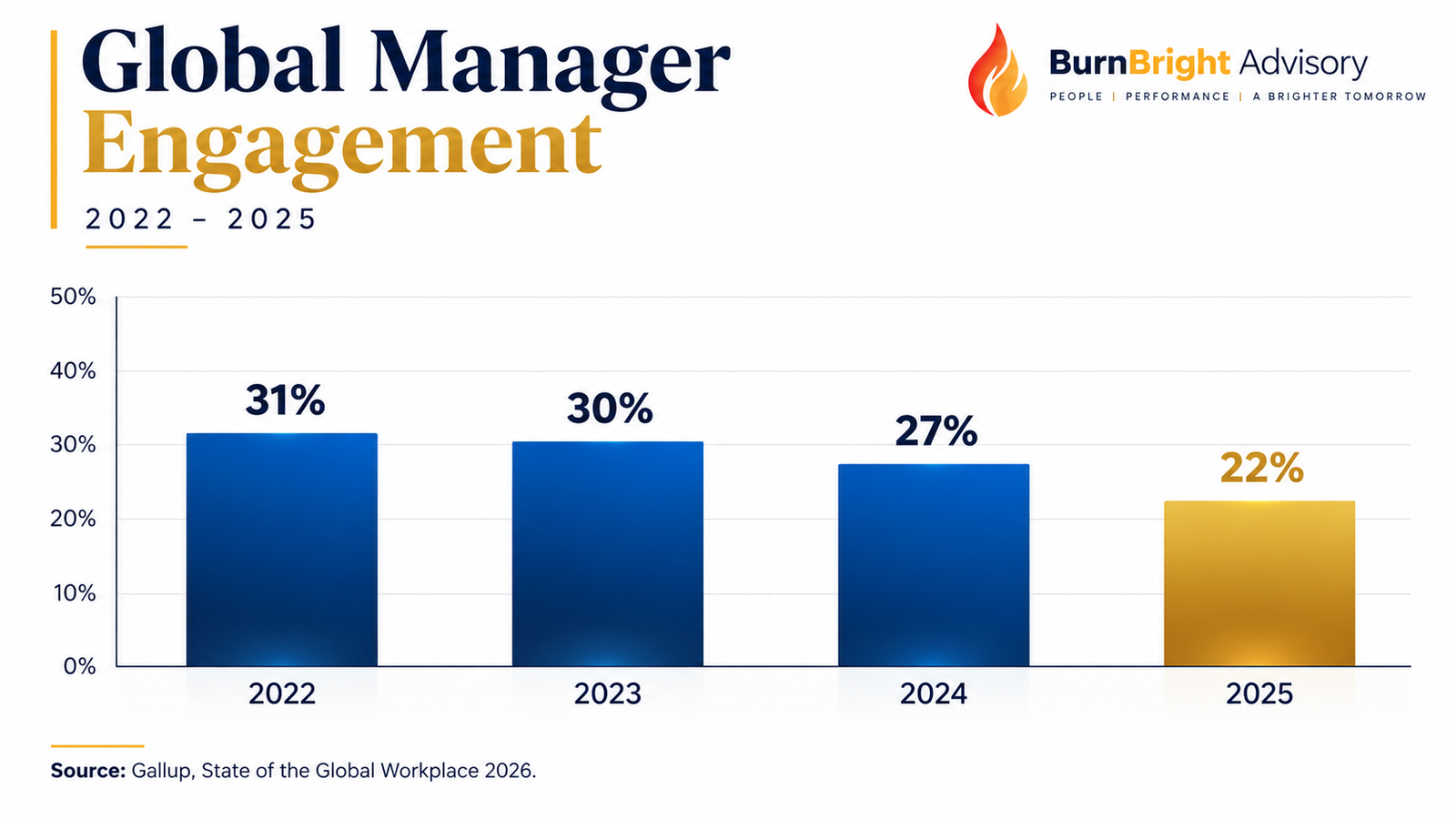
The data illustrates increasing pressure on management engagement. It should encourage organisations to examine how management responsibilities, resources and authority are structured.
How Can Organisations Teach Managers to Delegate Effectively?
Effective management development requires a consistent framework.
Managers should not be expected to invent their own delegation systems while simultaneously managing demanding operational responsibilities.
Within Burn Bright Advisory, I recommend connecting delegation development to four structural pillars.
Pillar 1
Workload Architecture™
Begin by examining the manager’s existing responsibilities. Identify which activities require management expertise and which could be transferred, simplified or eliminated.
Managers should distinguish between strategic leadership responsibilities and operational activities. A practical workload audit should examine recurring responsibilities, decision requirements, time commitments and organisational value.
Importantly, delegation must not simply transfer excessive workloads to employees. Team capacity must be considered.
Pillar 2
Decision Authority™
Responsibility and authority must be aligned. Managers should establish which decisions employees can make independently, which require consultation and which must remain with senior leadership.
The RACI framework provides a useful starting point. It identifies who is:
- Responsible for completing the work.
- Accountable for the outcome.
- Consulted before decisions.
- Informed about progress.
RACI is particularly useful when responsibilities cross departments or involve several stakeholders. However, it should be supplemented with explicit decision boundaries.
Being responsible for completing an activity does not automatically establish authority to approve expenditure, change deadlines or alter organisational priorities. These distinctions must be documented.
Pillar 3
Recovery Rhythms™
Delegation should create genuine leadership capacity. If managers immediately fill their newly available time with additional operational responsibilities, the underlying problem remains unresolved.
Organisations should protect time for strategic planning, employee development and recovery between demanding activities.
Recovery is a leadership discipline. It should be incorporated into workload design rather than treated as something managers must arrange outside working hours.
Pillar 4
Management Frameworks
Managers need repeatable processes for assigning responsibility and reviewing performance. These should include:
- Clear outcomes and success criteria.
- Appropriate resources.
- Documented decision boundaries.
- Agreed review points.
- Defined escalation procedures.
Consistency reduces uncertainty. It also makes delegation easier to evaluate and improve.
These four pillars connect delegation training with the broader structural changes required for sustainable leadership.
What Practical Framework Should Managers Use?
Teaching managers to delegate becomes easier when organisations introduce a simple, repeatable process. I recommend a four-stage delegation model.
Stage 1 Diagnose
Identify responsibilities that should no longer require the manager’s direct involvement. Examine the time consumed, decisions required and consequences of transferring ownership.
Do not assume every responsibility should be delegated. Some activities involve statutory accountability, confidential information or strategic decisions that must remain with designated leaders.
Stage 2 Design
Establish the intended outcome. Select an appropriate employee and determine what support they require. Agree on decision-making boundaries, available resources and completion standards.
The objective is to remove ambiguity before work begins.
Stage 3 Transfer
Communicate responsibility and authority together. Managers should explain what success looks like without prescribing every step.
Employees need sufficient independence to exercise judgement. They also need clarity about when consultation is required.
Stage 4 Review
Establish proportionate review arrangements. Managers should monitor progress, provide coaching and evaluate outcomes.
Review does not mean reclaiming responsibility whenever difficulties emerge. Instead, managers should help employees develop the capability to resolve problems independently.
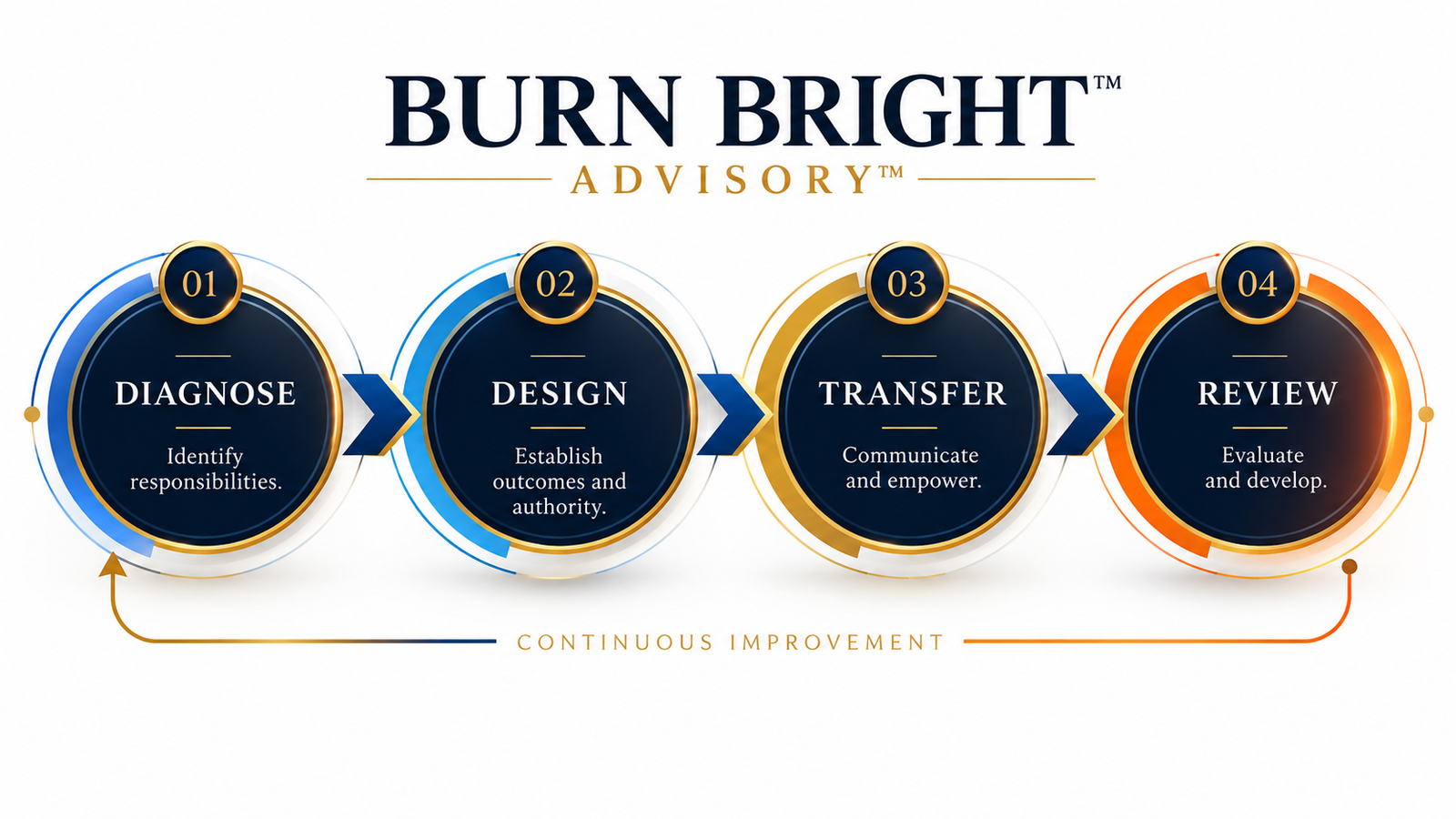
The framework provides managers with a repeatable process. It also allows organisations to evaluate whether delegation is developing capability or merely redistributing administrative work.
How Should Organisations Measure Delegation Success?
Delegation success should not be measured simply by counting the number of tasks managers assign. This approach encourages activity rather than meaningful organisational improvement.
Instead, organisations should examine four indicators.
1. Management capacity
Has delegation reduced unnecessary operational involvement? Are managers spending more time on strategic priorities and employee development?
2. Decision efficiency
Can employees resolve appropriate operational issues without unnecessary approval? Have avoidable management bottlenecks decreased?
3. Employee capability
Are employees developing the confidence, knowledge and authority required to manage increasingly complex responsibilities?
4. Workload sustainability
Has responsibility been distributed appropriately, or has excessive workload simply moved from managers to employees?
These measures should be reviewed together. An increase in employee independence means little if it is accompanied by excessive workload or inadequate support. Similarly, reducing management involvement is not successful when accountability becomes unclear.
A practical 30-60-90 day approach
Days 1–30: Audit and clarify
Conduct workload audits, clarify decision authority and identify suitable responsibilities for delegation.
Days 31–60: Implement and support
Managers implement structured delegation arrangements, provide employees with appropriate support and establish review procedures.
Days 61–90: Evaluate and adjust
Evaluate results, identify remaining bottlenecks and adjust management structures.
This timetable is an implementation framework, not a guaranteed period for achieving measurable performance improvements. Different organisations will require different approaches depending on their size, operating environment and existing management capabilities.
The essential principle remains consistent:
Comparison: Traditional vs Structural Delegation
| Traditional Delegation | Structural Delegation |
|---|---|
| Concentrates on assigning tasks | Concentrates on transferring appropriate responsibility |
| Relies heavily on individual management behaviour | Aligns management behaviour with organisational systems |
| Managers retain most decision-making authority | Decision authority is distributed within defined boundaries |
| Progress is monitored through frequent supervision | Progress is monitored through agreed outcomes |
| Employees complete assigned activities | Employees develop ownership and judgement |
| Training is delivered as an isolated activity | Training is integrated with workload and organisational design |
| Success is measured through tasks completed | Success is measured through capability, accountability and sustainable capacity |
Neither approach removes the need for managerial judgement. However, structural delegation provides a broader framework for addressing the organisational conditions that determine whether delegation succeeds.
Frequently Asked Questions
What is the most effective way to teach managers to delegate?
Managers need practical training combined with clear organisational structures. Begin with workload analysis, identify responsibilities suitable for delegation and establish decision-making boundaries. Introduce a consistent delegation framework and provide opportunities for supported practice. Evaluate progress through employee capability, decision efficiency and management capacity rather than the number of tasks assigned.
Why do experienced managers struggle with delegation?
Experienced managers may have developed their careers through technical expertise, personal responsibility and maintaining high standards. These strengths can become obstacles when leadership responsibilities expand. Unclear organisational authority, limited employee development and cultures that penalise mistakes can reinforce excessive management control. Effective intervention must address both management behaviour and organisational expectations.
Can delegation help prevent leadership burnout?
Effective delegation can reduce unnecessary management involvement and distribute appropriate responsibilities across teams. However, delegation alone cannot prevent burnout when overall workloads remain excessive or organisational resources are inadequate. Sustainable prevention requires workload management, clear decision authority, appropriate staffing and protected recovery opportunities alongside effective management development.
How can managers delegate without losing accountability?
Managers should establish clear outcomes, decision boundaries and review arrangements before transferring responsibility. Employees need sufficient authority to complete their work independently, while managers retain appropriate oversight. Accountability does not require continuous supervision. Effective delegation creates transparent expectations and proportionate monitoring arrangements that support employee independence.
How long does it take to develop effective delegation skills?
Development depends on management experience, employee capability and organisational conditions. A structured 30-60-90 day programme can establish initial practices, introduce decision-making frameworks and identify operational improvements. However, developing consistent delegation behaviours requires ongoing coaching, performance feedback and organisational support. Delegation should be treated as a continuing management capability rather than a one-off training outcome.
Conclusion: Build Capability, Not Dependency
Teaching managers to delegate should be a central component of organisational leadership development.
However, organisations must recognise that delegation cannot succeed through management training alone.
Managers need clearly defined responsibilities, appropriate decision-making authority and organisational systems that support the transfer of ownership.
Employees need development opportunities, clear expectations and sufficient resources to exercise their responsibilities effectively.
Senior leaders must also examine their own behaviour. Organisations cannot encourage delegation while simultaneously demanding unnecessary approvals, rewarding excessive management involvement or treating every employee mistake as evidence of inadequate supervision.
Sustainable leadership requires a different approach. It requires organisations to build management systems that distribute responsibility, develop employee capability and protect leadership capacity.
The objective is not to make managers less involved.
It is to ensure their involvement creates genuine organisational value.
When delegation becomes part of organisational design, managers can concentrate on the responsibilities that genuinely require their expertise.
Find Out Where Delegation Is Breaking Down
The Burn Bright Full Diagnostic™ examines workload, decision authority and the structural conditions around your leadership role, so you can fix the system rather than work harder inside it.
Take the Free Leadership Burnout Self-Assessment
If delegation remains difficult because your responsibilities continue expanding, begin by examining the structural conditions surrounding your leadership role. The free assessment is a starting point for identifying patterns that may be undermining your leadership capacity.
Free Leadership Intelligence
Get Weekly Leadership Insights
Join thousands of leaders receiving practical strategies on burnout prevention, workload design, and sustainable performance every week.