Quick Answer
Key Takeaways
- Organisational complexity creates problems no single leader has the knowledge to fully understand.
- Organisational knowledge is what an organisation knows; organisational intelligence is its capacity to interpret, integrate and apply that knowledge.
- Constructivist leadership changes how authority is exercised — it does not remove executive accountability.
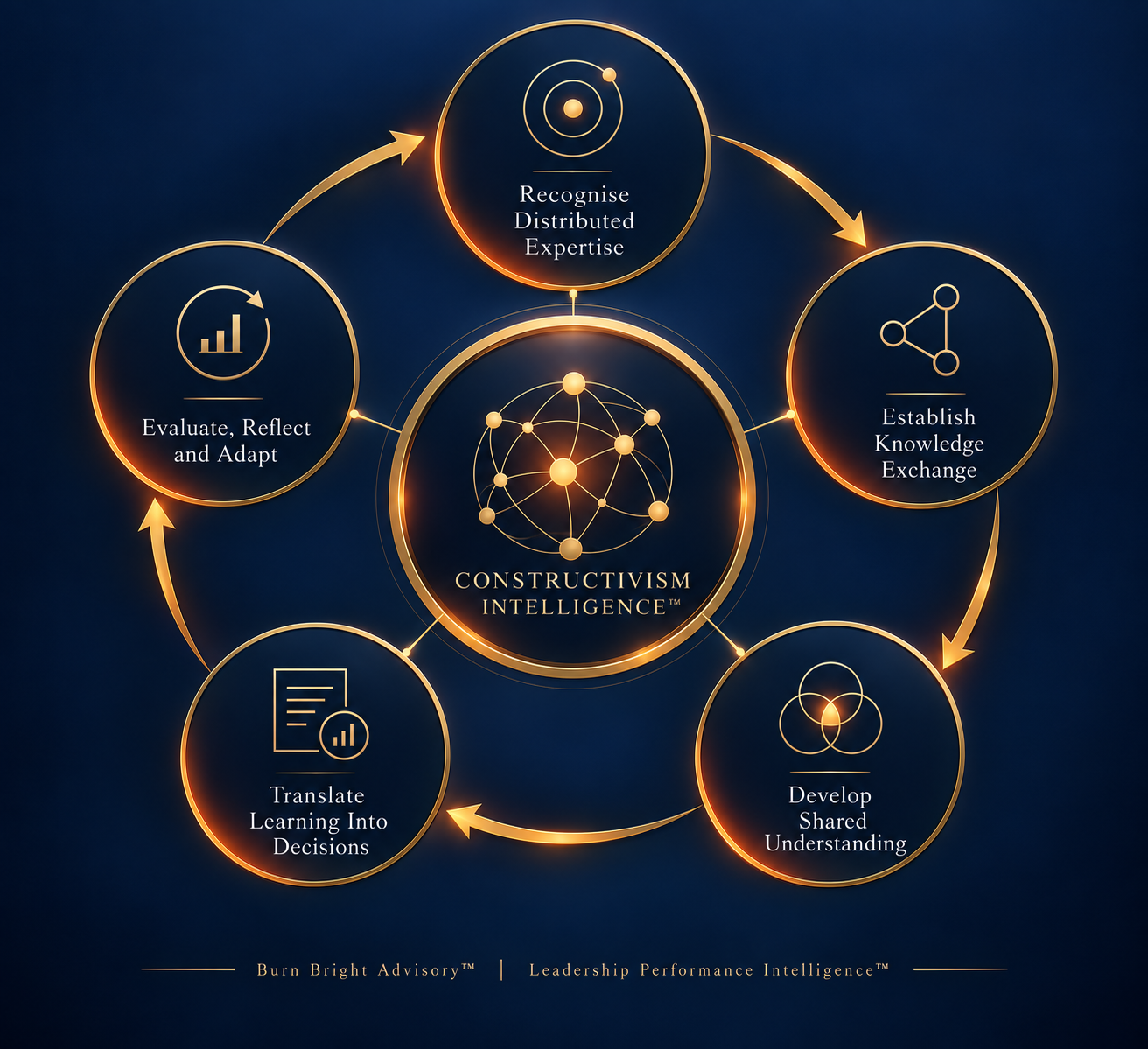
- The five-stage framework: recognise distributed expertise, establish conditions for knowledge exchange, develop shared understanding, translate learning into decisions, and evaluate, reflect and adapt.
- Collaborative learning must strengthen organisational capability without creating additional, unmanaged workloads — connecting Constructivism Intelligence™ with Leadership Sustainability™.
Constructivist Leadership: How Leaders Develop Organisational Intelligence Through Collective Learning
The Limits of Individual Leadership Knowledge
One of the most persistent assumptions in organisational leadership is that seniority should be accompanied by superior knowledge.
Executives are expected to provide strategic answers.
Managers are expected to resolve operational problems.
Department heads are expected to interpret complexity and communicate solutions.
These expectations are understandable. Leadership involves responsibility, and responsibility requires judgement.
However, organisational complexity creates situations in which no individual possesses sufficient knowledge to understand every dimension of a problem.
- A healthcare executive may understand organisational strategy without possessing the clinical knowledge required to evaluate every operational decision.
- A school principal may understand educational improvement while depending on teachers to interpret the realities of classroom practice.
- A business leader may recognise emerging market opportunities while relying on employees to identify operational constraints that determine whether those opportunities are achievable.
In each situation, the organisation possesses knowledge that extends beyond the expertise of its formal leader.
The leadership challenge is therefore not simply acquiring additional personal knowledge. It is developing the organisational capacity to identify, combine, challenge and apply knowledge effectively.
Constructivist leadership provides a framework for examining this question. Rather than treating knowledge as something transferred exclusively from leaders to followers, it recognises that organisational understanding develops through interaction between individuals, experiences and perspectives.
The implications extend beyond collaborative decision-making. Constructivist leadership challenges organisations to reconsider how expertise is recognised, how assumptions are tested, how professional learning occurs and how leadership capacity develops.
For Burn Bright Advisory, these questions connect directly with Leadership Performance Intelligence™ and the development of Constructivism Intelligence™ within the Leadership Intelligence Compass™.
Is your leadership system carrying more than it can sustain? Find out in a few minutes.

What Is Constructivist Leadership?
Featured Snippet
Constructivist leadership applies principles associated with constructivist learning theory to leadership practice and organisational development.
Constructivist perspectives emphasise that people actively develop understanding by interpreting experiences, connecting new information with existing knowledge and interacting with their environments. Rather than assuming that knowledge can always be transferred unchanged from one person to another, constructivism examines how individuals develop meaning.
This distinction has significant implications for leadership. Traditional approaches may emphasise the communication of established knowledge, direction and expectations. Constructivist leadership places additional emphasis on the processes through which people develop understanding together.
The leader’s responsibility consequently expands. Beyond communicating decisions, leaders must establish conditions in which people can examine evidence, exchange perspectives, challenge assumptions and develop informed responses to organisational problems.
A constructivist leader remains accountable for organisational direction, ethical standards and performance expectations while recognising that valuable knowledge exists throughout the organisation.
The objective is not consensus on every issue. It is to improve the quality of organisational understanding and decision-making by drawing on relevant knowledge.
From Individual Expertise to Collective Intelligence
Individual expertise remains essential to effective leadership. However, expertise can become a limitation when leaders assume that previous experience provides sufficient understanding of unfamiliar situations.
Organisational environments change. Professional knowledge evolves. Emerging challenges frequently require perspectives that extend beyond established leadership experience.
Constructivist leadership addresses this limitation by creating opportunities for collective knowledge development. Consider a leadership team responding to declining organisational performance. One approach involves senior executives examining performance indicators and communicating a corrective strategy. A constructivist approach introduces additional questions:
- What are employees observing that existing performance indicators fail to capture?
- Which assumptions underpin the organisation’s current strategy?
- How do different departments interpret the causes of declining performance?
- What knowledge could emerge from examining these interpretations together?
These questions do not guarantee improved decisions. They create opportunities to identify information, assumptions and relationships that might otherwise remain invisible.
This is where Constructivism Intelligence™ becomes particularly relevant. Within the Burn Bright approach, it provides a conceptual connection between collaborative learning, reflective practice, knowledge development and organisational performance. The objective is to strengthen the organisation’s capacity to learn rather than increase its dependence on any single individual.
Why Constructivist Leadership Matters for Organisational Intelligence
The relationship between leadership and organisational intelligence deserves greater attention.
Organisations invest extensively in recruiting expertise, developing professional capabilities and implementing knowledge management systems. Yet possessing knowledge and using knowledge effectively are fundamentally different organisational capabilities.
- An organisation may employ highly qualified professionals while consistently making decisions that fail to incorporate their expertise.
- It may collect extensive performance data without developing a shared understanding of what those data reveal.
- It may conduct regular professional development activities without systematically translating learning into improved organisational practice.
These situations illustrate an important distinction between organisational knowledge and organisational intelligence.
Constructivist leadership contributes to this process by establishing conditions in which knowledge can move beyond individuals and become a collective organisational resource. However, achieving this requires more than encouraging collaboration. Leaders must address three interconnected challenges.
Overcoming Knowledge Fragmentation
Knowledge fragmentation occurs when valuable information remains isolated within individuals, departments or professional groups.
This fragmentation frequently develops unintentionally. Organisational structures establish reporting relationships, departmental responsibilities and professional boundaries. Although these arrangements support accountability, they can also restrict opportunities for knowledge exchange.
A healthcare organisation provides a useful illustration. Clinical professionals, administrative managers, financial specialists and patient experience teams may interpret the same operational problem differently. Each perspective contains potentially valuable information. However, when decisions are developed exclusively within senior management structures, important operational knowledge may remain disconnected from strategic decision-making.
Constructivist leadership creates opportunities to integrate these perspectives. Structured interdisciplinary discussions, collaborative problem-solving and reflective reviews allow professionals to examine how their individual experiences contribute to a broader organisational understanding.
The objective is not to eliminate professional specialisation. It is to ensure that specialist knowledge contributes appropriately to collective decisions.
Challenging Established Assumptions
Organisations develop established ways of interpreting their environments. Over time, these interpretations become embedded within policies, procedures, professional expectations and organisational culture.
Although established practices provide consistency, they can also prevent organisations from recognising changing circumstances. Constructivist leadership encourages leaders to examine the assumptions underpinning organisational decisions. Rather than asking exclusively whether established procedures have been followed, leaders consider whether those procedures remain appropriate.
This requires intellectual openness and a willingness to distinguish between evidence, professional experience and organisational tradition.
Consider a business experiencing declining customer retention. An established interpretation might attribute the problem to market competition. However, discussions involving customer service representatives, operational managers and sales professionals may reveal alternative explanations. Perhaps customers are experiencing difficulties during onboarding. Perhaps service expectations have changed. Alternatively, internal communication problems may be affecting delivery.
A constructivist approach enables competing explanations to be examined before organisational resources are committed to a particular response.
Importantly, challenging assumptions does not mean treating every interpretation as equally credible. Leaders remain responsible for evaluating evidence and determining which explanations provide the strongest basis for action.
Translating Collective Learning Into Organisational Action
The final challenge involves converting learning into improved practice.
Workshops generate ideas.
Leadership meetings identify problems.
Employee surveys reveal concerns.
However, unless these activities influence decisions, processes or professional behaviour, their contribution to organisational intelligence remains limited.
Constructivist leadership therefore requires a clear relationship between learning and action. Leaders must establish how insights will be evaluated, who possesses decision-making authority and how organisational responses will be monitored.
This creates an important distinction between collaborative participation and collective performance intelligence.

The Burn Bright Constructivist Leadership Development Framework
Within Burn Bright Advisory’s Leadership Performance Intelligence™ approach, constructivist leadership can be translated into a practical development framework. The following five-stage framework provides an applied interpretation of Constructivism Intelligence™.
It is a proposed leadership development model rather than a separately validated psychological assessment. Its purpose is to help leaders examine how their organisations generate, integrate and apply collective knowledge.
Stage 1 Recognise Distributed Expertise
The first responsibility is identifying where relevant organisational knowledge exists. Formal organisational hierarchies do not necessarily reflect the distribution of expertise. Employees working directly with customers, patients, students or operational systems frequently possess contextual knowledge unavailable to senior decision-makers.
Leaders should therefore examine whose perspectives are routinely represented in organisational decisions and whose knowledge remains underutilised. Recognition must extend beyond inviting participation — it requires establishing credible opportunities for relevant expertise to influence organisational understanding.
Stage 2 Establish Conditions for Knowledge Exchange
Identifying expertise provides limited value when individuals cannot communicate their observations openly. Leaders must establish environments in which professional perspectives can be expressed, questioned and examined constructively.
Psychological safety is particularly relevant. Research on team learning has associated psychological safety with behaviours such as asking questions, acknowledging uncertainty and discussing mistakes. However, psychological safety should not be confused with avoiding disagreement. Constructive intellectual disagreement can strengthen organisational learning when individuals are treated respectfully and competing interpretations are examined fairly.
Leaders should establish explicit expectations concerning professional dialogue, evidence and accountability.
Stage 3 Develop Shared Understanding
Collective learning requires more than collecting individual opinions. Leaders must help teams identify relationships between different perspectives and develop a coherent understanding of the problem being examined. This may involve collaborative analysis, structured questioning, scenario development or facilitated reflection.
The process should distinguish between established facts, professional interpretations and unresolved uncertainties. Without this distinction, collective discussions risk reinforcing existing assumptions rather than improving organisational understanding.
Stage 4 Translate Learning Into Decisions
Shared understanding becomes organisationally valuable when it informs decisions. Leaders should establish transparent processes for evaluating proposed responses, identifying responsibilities and determining implementation priorities.
Decision-making authority must remain appropriate to the organisational context. For example, collaborative discussion may inform clinical service improvement, but regulated clinical decisions must remain with appropriately qualified professionals. Similarly, consultation may inform strategic planning without transferring executive accountability to every participant.
Constructivist leadership strengthens decision-making by improving the knowledge available to those responsible for making decisions.
Stage 5 Evaluate, Reflect and Adapt
The final stage establishes collective learning as a continuing organisational process. Leaders should examine whether implemented decisions produced their intended outcomes. They should also consider what new information emerged, which assumptions proved inaccurate and how organisational understanding has changed.
Structured reflection allows knowledge developed through implementation to inform subsequent decisions. This connects Constructivism Intelligence™ with Reflective Practice Intelligence™, Knowledge Development Intelligence™ and Adaptability Intelligence™ within the Leadership Intelligence Compass™. Together, these capabilities provide a foundation for developing organisational learning over time.
Applying Constructivist Leadership Across Different Sectors
The principles of constructivist leadership have applications across organisational environments. However, effective implementation requires sensitivity to professional responsibilities, regulatory expectations, organisational structures and the consequences of leadership decisions.
The following scenarios are illustrative applications rather than documented organisational case studies. Explore more sector-specific perspectives in our sector hubs.
🏢 Business Growth Intelligence™: Developing Strategic Understanding
Consider a growing organisation experiencing difficulties translating its strategic ambitions into operational performance. Senior executives may interpret these difficulties primarily through financial indicators. However, operational managers may identify capacity constraints, employees may recognise inefficient processes and customer-facing teams may observe changing market expectations. A constructivist approach brings these perspectives into a structured strategic review. The resulting strategy remains subject to executive accountability, but its development benefits from a more comprehensive understanding of organisational conditions.
🎓 School Leadership Intelligence™: Strengthening Professional Learning
Teachers continually develop professional understanding through classroom experience, student assessment and collaboration with colleagues — but schools do not automatically translate individual professional learning into collective improvement. A principal seeking to improve teaching quality might establish structured professional learning discussions in which teachers examine evidence, share instructional approaches and reflect on student outcomes. This requires careful consideration of workload: collaborative learning becomes counterproductive when additional meetings and reporting requirements reduce the time available for teaching and reflection. Effective school leadership must balance collective knowledge development with Leadership Sustainability™.
🏥 Healthcare Leadership Intelligence™: Integrating Professional Perspectives
Healthcare organisations depend on interdisciplinary expertise. Clinical quality, operational efficiency, patient experience and organisational sustainability involve interconnected responsibilities. A department seeking to improve patient discharge processes might involve clinicians, nurses, administrators and patient experience representatives. Collective analysis may identify communication gaps, procedural inconsistencies or resource constraints that individual departments cannot resolve independently. Professional accountability and patient safety requirements remain essential throughout this process.
🏛️ Public Service Leadership Intelligence™: Developing Collaborative Understanding
Public service organisations frequently address problems involving multiple stakeholders, competing priorities and complex accountability arrangements. Consider a local authority reviewing the accessibility of a public service: administrative data may reveal utilisation patterns, while frontline employees and service users provide information about practical barriers. However, participation must be accompanied by transparency concerning statutory responsibilities, available resources and the limits of organisational authority. Constructivist leadership is not a substitute for legitimate governance — it improves the knowledge informing governance decisions.

The Risks and Limitations of Constructivist Leadership
Constructivist leadership offers opportunities to strengthen organisational learning, but its effectiveness depends on appropriate implementation. Encouraging participation without establishing clear responsibilities can create uncertainty, delay decisions and increase organisational workload.
Constructivist Leadership and Leadership Sustainability™
An organisation’s ability to learn collectively has important implications for sustainable leadership performance.
When organisational knowledge remains concentrated within a small number of senior individuals, leadership systems can become excessively dependent on their continued availability. This concentration creates vulnerabilities:
- Decision-making may slow when particular leaders are absent.
- Emerging leaders may have limited opportunities to develop professional judgement.
- Organisational learning may depend on individual experience rather than established processes.
Constructivist leadership provides opportunities to distribute knowledge development across organisational structures. However, distributing knowledge should not be confused with transferring unlimited responsibilities to employees. Sustainable implementation requires leaders to consider existing workloads, professional capacity and the resources necessary to support collaborative learning.
Within Burn Bright Advisory’s Leadership Performance Intelligence™ approach, these considerations connect Constructivism Intelligence™ with Leadership Capacity™, Leadership Workload™ and Leadership Sustainability™.
Leadership development systems must therefore consider both the quality of learning and the organisational conditions required to sustain it. Collective intelligence should strengthen organisational capability without creating additional, unmanaged demands on individuals.

Conclusion: Developing Organisations That Can Learn
The increasing complexity of organisational leadership requires a broader understanding of how knowledge contributes to performance.
Individual expertise remains essential. However, organisations also require the capacity to recognise distributed knowledge, examine competing interpretations and translate collective understanding into informed decisions.
Constructivist leadership provides an approach through which these capabilities can be developed. Its contribution lies not simply in encouraging participation, but in establishing deliberate processes through which organisational knowledge becomes more accessible, relevant and actionable.
Within Burn Bright Advisory’s Leadership Intelligence Compass™, Constructivism Intelligence™ provides a perspective on the relationship between collaborative learning and organisational performance. Its connections with Reflective Practice Intelligence™, Knowledge Development Intelligence™, Ethics Intelligence™ and Leadership Sustainability™ demonstrate why leadership development cannot be reduced to isolated competencies.
These capabilities interact. Organisations develop sustainable leadership capacity when they establish systems that support learning, accountability, professional development and informed decision-making.
Ultimately, the purpose of constructivist leadership is not to diminish the importance of individual leaders. It is to strengthen their ability to develop organisations in which knowledge, professional judgement and collective learning contribute to sustained performance.
Executive Reflection Questions
- Knowledge distribution: Where does valuable knowledge exist within our organisation, and how effectively does that knowledge inform leadership decisions?
- Leadership assumptions: Which established organisational assumptions have we accepted without examining whether they remain appropriate?
- Professional participation: Do employees have credible opportunities to contribute their expertise, particularly when their perspectives challenge established leadership interpretations?
- Organisational learning: How effectively do we translate individual professional learning into collective organisational knowledge?
- Decision-making: Have we established appropriate boundaries between collaborative consultation, specialist judgement and executive accountability?
- Leadership sustainability: Do our organisational structures provide sufficient time and resources for collaborative learning without creating unsustainable workloads?
- Leadership development: Are we developing emerging leaders who can facilitate collective understanding rather than simply reproduce existing management practices?
A 30-Day Constructivist Leadership Review
The following activities provide an initial approach to examining organisational knowledge development. They are intended as a practical leadership review rather than a validated diagnostic instrument.
| Period | Leadership Activity | Intended Outcome |
|---|---|---|
| Week 1 | Identify how knowledge currently informs important organisational decisions. | Understand existing knowledge flows. |
| Week 2 | Examine whose expertise is routinely included or excluded. | Identify opportunities for broader knowledge integration. |
| Week 3 | Facilitate a structured collaborative review of an existing organisational challenge. | Develop and evaluate competing interpretations. |
| Week 4 | Translate relevant insights into a defined action and evaluation plan. | Connect collective learning with organisational improvement. |
Implementation Considerations
- Select an organisational challenge that is sufficiently important to justify collaborative analysis but manageable within existing resources.
- Clarify decision-making authority before initiating consultation.
- Establish expectations concerning professional dialogue, confidentiality and the use of evidence.
- Evaluate the process itself, including whether participation improved organisational understanding and whether the resulting actions were implemented.
The objective is to establish a repeatable organisational learning process rather than introduce another isolated leadership initiative.
Frequently Asked Questions
What is constructivism in leadership?
Constructivism in leadership is an approach that recognises how individuals and groups develop understanding through experience, interaction and reflection. Applied to organisational leadership, it encourages leaders to establish conditions in which professional knowledge can be shared, challenged and integrated into collective organisational learning.
What is the difference between constructivist leadership and traditional leadership?
Traditional hierarchical leadership approaches frequently emphasise authority, direction and established organisational responsibilities. Constructivist leadership places additional emphasis on collaborative knowledge development, critical reflection and the integration of different professional perspectives. The approaches are not necessarily mutually exclusive — constructivist leaders can retain clearly defined authority and accountability.
How does constructivist leadership improve organisational intelligence?
Constructivist leadership can support organisational intelligence by improving opportunities to identify distributed expertise, challenge assumptions and integrate knowledge into decision-making. However, improved outcomes depend on the quality of implementation, the relevance of the knowledge exchanged and the organisation’s capacity to act on what it learns.
Is constructivist leadership appropriate for every organisation?
Constructivist principles can inform leadership across different organisational environments. However, their implementation must reflect organisational responsibilities, regulatory requirements, professional expertise and operational circumstances. Collaborative learning should complement rather than replace appropriate authority and accountability.
What is Constructivism Intelligence™?
Within Burn Bright Advisory’s Leadership Intelligence Compass™, Constructivism Intelligence™ provides a framework for examining how leaders support knowledge development through collaborative learning, critical reflection and the integration of professional perspectives. It connects individual learning with broader organisational intelligence and leadership development.
How does constructivist leadership relate to psychological safety?
Constructivist leadership benefits from environments in which individuals can express professional perspectives, acknowledge uncertainty and discuss mistakes without inappropriate interpersonal consequences. Psychological safety can support these behaviours. However, effective collaborative learning also requires intellectual challenge, evidence-based discussion and professional accountability.
Can constructivist leadership support leadership succession?
Constructivist leadership may contribute to succession development by creating opportunities for emerging leaders to participate in organisational problem-solving, develop professional judgement and learn from experienced colleagues. Its effectiveness depends on appropriate developmental responsibilities, feedback and opportunities to apply learning.
How does constructivist leadership support sustainable leadership performance?
Constructivist leadership can reduce excessive dependence on individual expertise by strengthening collective knowledge development. However, sustainable implementation requires organisations to provide sufficient time, resources and appropriate workload arrangements. Collaborative learning should develop organisational capacity rather than create additional unmanaged responsibilities.
Go deeper than a self-check. The Burn Bright Full Diagnostic™ maps where your leadership system is under strain — £144.
Is Your Organisation Learning — or Relying on a Few Overstretched Leaders?
When knowledge sits with too few people, the load sits with them too. Take the free self-assessment to see how sustainable your leadership system really is.
Free Leadership Intelligence
Get Weekly Leadership Insights
Join thousands of leaders receiving practical strategies on burnout prevention, workload design, and sustainable performance every week.