Quick Answer
Key Takeaways
- Delegate outcomes, not instructions. Establish what success looks like without controlling every action required to achieve it.
- Transfer authority alongside responsibility. Employees cannot own outcomes when every decision requires management approval.
- Clarify accountability. Establish who owns the work, who makes decisions and when escalation is necessary.
- Match delegation to capacity. Transferring work without sufficient time, resources or capability simply redistributes overload.
- Build consistent delegation systems. Effective conversations should create sustainable working arrangements rather than additional management responsibilities.
Delegation Conversations: A Leader’s Guide
Delegation conversations are among the most underestimated skills in modern leadership.
Most managers understand that delegation matters. They recognise that retaining every responsibility creates bottlenecks, limits employee development and increases their personal workload.
Yet many struggle to delegate effectively.
They explain tasks without establishing authority.
They assign responsibilities without checking capacity.
They request ownership while continuing to control every important decision.
Eventually, the work returns.
The manager becomes frustrated. The employee becomes uncertain. Both spend more time discussing the task than completing it.
The problem is rarely a simple lack of communication skills. It is often a failure of organisational design.
Throughout my leadership career, I have seen capable managers become overwhelmed because their organisations confuse assigning work with transferring responsibility. These are fundamentally different activities.
Effective delegation requires a deliberate conversation about outcomes, authority, resources, accountability and support. In this article, we will examine why delegation conversations fail, how to structure them, what leaders should communicate and how to establish a sustainable delegation system.
The objective is straightforward.
Less unnecessary management involvement.
Greater employee ownership.
Better organisational performance.
Are decisions that should sit elsewhere landing on your desk? Find out where your workload is coming from.
Understanding the Delegation Conversation Framework
The following framework illustrates the five essential components of an effective delegation conversation.
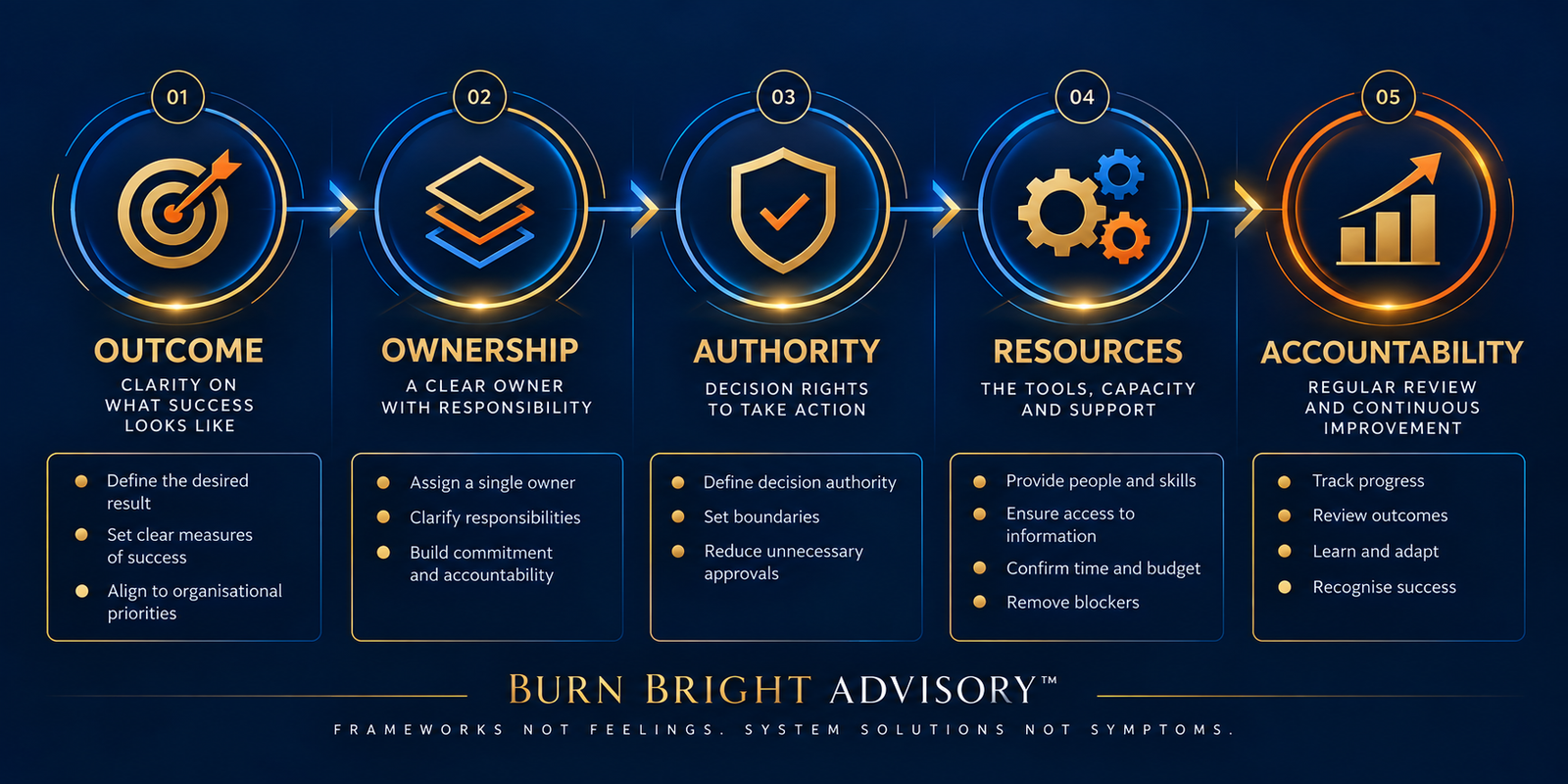
Each stage addresses a different source of delegation failure. Together, they establish the conditions employees need to take meaningful responsibility without creating additional management work.
Featured Snippet
Why Do Delegation Conversations Fail?
Most unsuccessful delegation conversations begin with an apparently reasonable instruction.
“Can you take responsibility for this?”
The employee agrees. The manager assumes the responsibility has transferred. Unfortunately, neither person has established what responsibility actually means.
- Does the employee have authority to make decisions?
- Can they change existing processes?
- Are they expected to consult colleagues?
- What happens when competing priorities emerge?
When these questions remain unanswered, delegation becomes structurally incomplete. The employee has received additional work without necessarily receiving the authority required to complete it.
The Hidden Problem of Unclear Ownership
Consider a school leader who delegates responsibility for improving departmental assessment procedures. The department head accepts the responsibility.
However, every proposed change requires senior leadership approval. Every disagreement between colleagues returns to the original leader. Every resource request becomes another management decision.
The task has moved.
The decision-making burden has not.
This is one reason delegation can increase rather than reduce management workload.
Research supports the importance of examining decision structures. McKinsey’s research on organisational decision-making found that:
- More than half of surveyed respondents spent over 30% of their working time making decisions.
- Among C-suite respondents, 14% reported spending more than 70% of their time on decisions.
- 61% of respondents believed that most of their decision-making time was ineffective.
These findings demonstrate the substantial management capacity consumed by poorly designed decision processes. Source: McKinsey, Decision Making in the Age of Urgency.
Three Common Delegation Failures
These problems cannot be solved through more enthusiastic communication. They require better delegation architecture.
For leaders already experiencing excessive workload, understanding the relationship between delegation and organisational capacity is essential.
How Should Leaders Structure Delegation Conversations?
Effective delegation conversations require a consistent framework. Without one, managers tend to rely on personal communication preferences, informal assumptions and inconsistent expectations.
Some provide excessive instructions.
Others provide insufficient information.
Neither approach creates reliable organisational accountability.
I recommend structuring delegation conversations around five essential questions.
Stage 1 What outcome are we trying to achieve?
Begin with the result. Explain why the responsibility matters, what successful completion looks like and how the outcome contributes to wider organisational priorities. Avoid immediately explaining how every step should be completed.
For example: “I would like you to lead the redesign of our departmental reporting process. The objective is to reduce unnecessary administration while maintaining accurate performance information.”
This establishes purpose without prescribing every action.
Stage 2 Who owns the responsibility?
Ownership must be explicit. Establish whether the employee is responsible for completing the work, coordinating others or making final operational decisions. Where several departments are involved, clarify their respective responsibilities. The RACI framework provides a useful structure:
- Responsible: Who completes the work?
- Accountable: Who is ultimately answerable for the outcome?
- Consulted: Whose input is required?
- Informed: Who needs progress updates?
RACI is particularly valuable when delegation involves several teams or overlapping management responsibilities.
Stage 3 What authority is being transferred?
This is frequently the missing conversation. Identify which decisions the employee can make independently. Specify which decisions require consultation and which must remain with senior leadership.
Authority should be proportionate to the employee’s responsibilities, competence and organisational risk.
Stage 4 What resources are available?
Discuss time, staffing, information, training and competing priorities. An employee who lacks sufficient capacity cannot take sustainable ownership of additional work.
Where necessary, agree which existing responsibilities will be reduced or removed.
Stage 5 How will accountability operate?
Establish milestones, reporting arrangements and escalation thresholds. Agree when the manager should become involved. Avoid requiring approval for decisions that have already been delegated.
The purpose of accountability is to maintain appropriate oversight without recreating the original management bottleneck.
How Do Delegation Conversations Reduce Leadership Burnout?
Delegation conversations influence more than operational efficiency. They shape how leadership responsibilities are distributed throughout an organisation.
When delegation fails, managers retain excessive decision-making responsibilities while simultaneously managing the work they supposedly transferred. This creates a cycle of overload.
The manager works longer hours.
Employees become increasingly dependent.
Decision-making slows.
Strategic leadership disappears beneath operational administration.
What the Research Tells Us
The World Health Organization identifies burnout as an occupational phenomenon associated with chronic workplace stress that has not been successfully managed. Its definition includes exhaustion, increased mental distance from work and reduced professional effectiveness.
These characteristics make organisational workload design directly relevant to burnout prevention. Source: World Health Organization, Burn-out an Occupational Phenomenon.
Gallup’s 2026 State of the Global Workplace report provides further context. Global manager engagement declined from 31% in 2022 to 22% in 2025 — a nine-percentage-point reduction. Across the wider global workforce, engagement stood at just 20% in 2025.
These figures measure engagement rather than burnout. They nevertheless demonstrate the importance of examining the conditions under which managers and employees work.
The Structural Relationship
Poor delegation creates three significant pressures:
- Managers become responsible for an excessive number of operational decisions.
- Employees experience reduced autonomy because they must repeatedly seek approval.
- Organisations become dependent on individual leaders rather than reliable management systems.
Effective delegation addresses these pressures by distributing appropriate authority. However, delegation alone cannot compensate for an organisation with fundamentally excessive workloads.
The solution must include workload assessment, prioritisation and resource allocation.
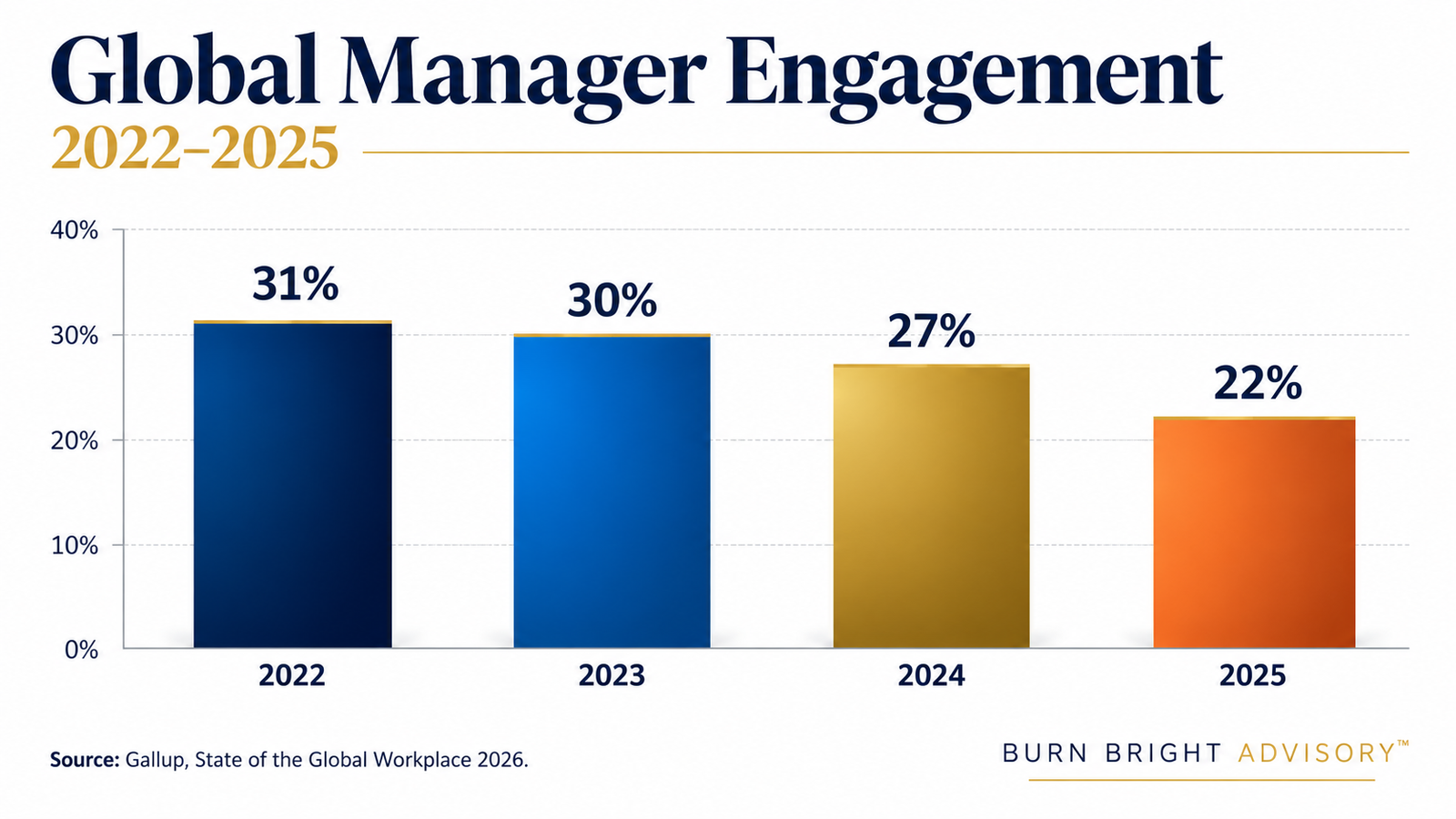
The decline in manager engagement reinforces the need to examine management roles and organisational support. It does not establish that poor delegation caused the decline.
This distinction matters. Evidence should inform structural diagnosis rather than become a convenient explanation for every organisational problem.
Effective delegation is one component of sustainable leadership. It must operate alongside realistic Workload Architecture™, appropriate Decision Authority™ and protected recovery.
What Should Leaders Say During Difficult Delegation Conversations?
Delegation becomes more complicated when employees question their capacity, resist additional responsibility or lack confidence in their decision-making authority. These situations require clarity rather than pressure.
The objective is not to persuade employees to accept unlimited work. It is to establish whether a responsibility can be transferred successfully and sustainably.
When an employee says they are already overloaded
Begin by examining existing commitments. Ask which responsibilities currently consume their time and whether any can be removed, delayed or redistributed. Avoid assuming that reluctance reflects poor motivation — an employee may be identifying a genuine capacity problem. For example: “Before we transfer this responsibility, let’s examine your current workload. Which existing activities would need to change to make this manageable?” This transforms the conversation from a personal disagreement into a workload-design discussion.
When an employee repeatedly seeks approval
Investigate whether decision authority was properly established. Employees often return decisions upwards because they fear making mistakes or receiving criticism. Clarify which decisions they can make independently, and establish boundaries around financial expenditure, organisational risk and stakeholder communication. Then respect those boundaries. Repeatedly overriding delegated decisions teaches employees that ownership is conditional.
When performance falls below expectations
Avoid immediately reclaiming responsibility. First, identify the cause. Was the outcome unclear? Did the employee lack sufficient information? Were resources inadequate? Did circumstances change? Or does the employee require additional development? Each situation demands a different response. Taking the work back may solve an immediate problem while creating a longer-term dependency.
When the manager struggles to release control
Managers must also examine their own behaviour. Perfectionism can make delegation unnecessarily difficult. If every task must be completed according to the manager’s personal preferences, genuine ownership becomes impossible. Distinguish essential standards from preferred methods. Maintain appropriate oversight of quality, safeguarding, legal obligations and organisational risk. Allow flexibility elsewhere.
Effective delegation conversations are not about abandoning responsibility. They establish the conditions under which responsibility can be exercised effectively.
How Can Organisations Make Delegation Conversations Sustainable?
Individual delegation skills matter. However, organisations should not depend entirely on individual managers remembering to delegate effectively. The objective should be to establish consistent management systems.
This is where the Burn Bright Not Out Framework™ becomes particularly relevant. Its four structural pillars are Workload Architecture™, Decision Authority™, Recovery Rhythms™ and Management Frameworks. Delegation operates primarily through the first two pillars, supported by the remaining two.
Pillar 1
Workload Architecture™
Every delegation decision should consider organisational capacity. When responsibilities move between employees, the organisation must understand what work is being added, removed or redistributed.
A delegation register can help. Record the responsibility, expected outcome, owner, available resources and agreed completion date. Review the register alongside existing workloads. This prevents responsibilities from accumulating invisibly.
Pillar 2
Decision Authority™
Establish clear decision rights across management levels. Routine operational decisions should not automatically require senior leadership involvement. Create documented escalation thresholds for financial, operational and reputational risks.
Employees should know when independent decisions are appropriate. Managers should know when intervention is necessary.
Pillar 3
Recovery Rhythms™
Delegation should create genuine capacity rather than additional administrative demands. Review whether managers are spending less time on unnecessary operational decisions. Examine whether employees have sufficient time to complete their expanded responsibilities. Protect periods for focused work and strategic thinking.
Pillar 4
Management Frameworks
Introduce consistent delegation practices across departments. Use RACI where responsibilities overlap. Establish proportionate progress reviews. Develop managers’ capability to hold effective delegation conversations.
Most importantly, measure whether the system works. If managers continue making every significant decision, delegation has not achieved its structural purpose.
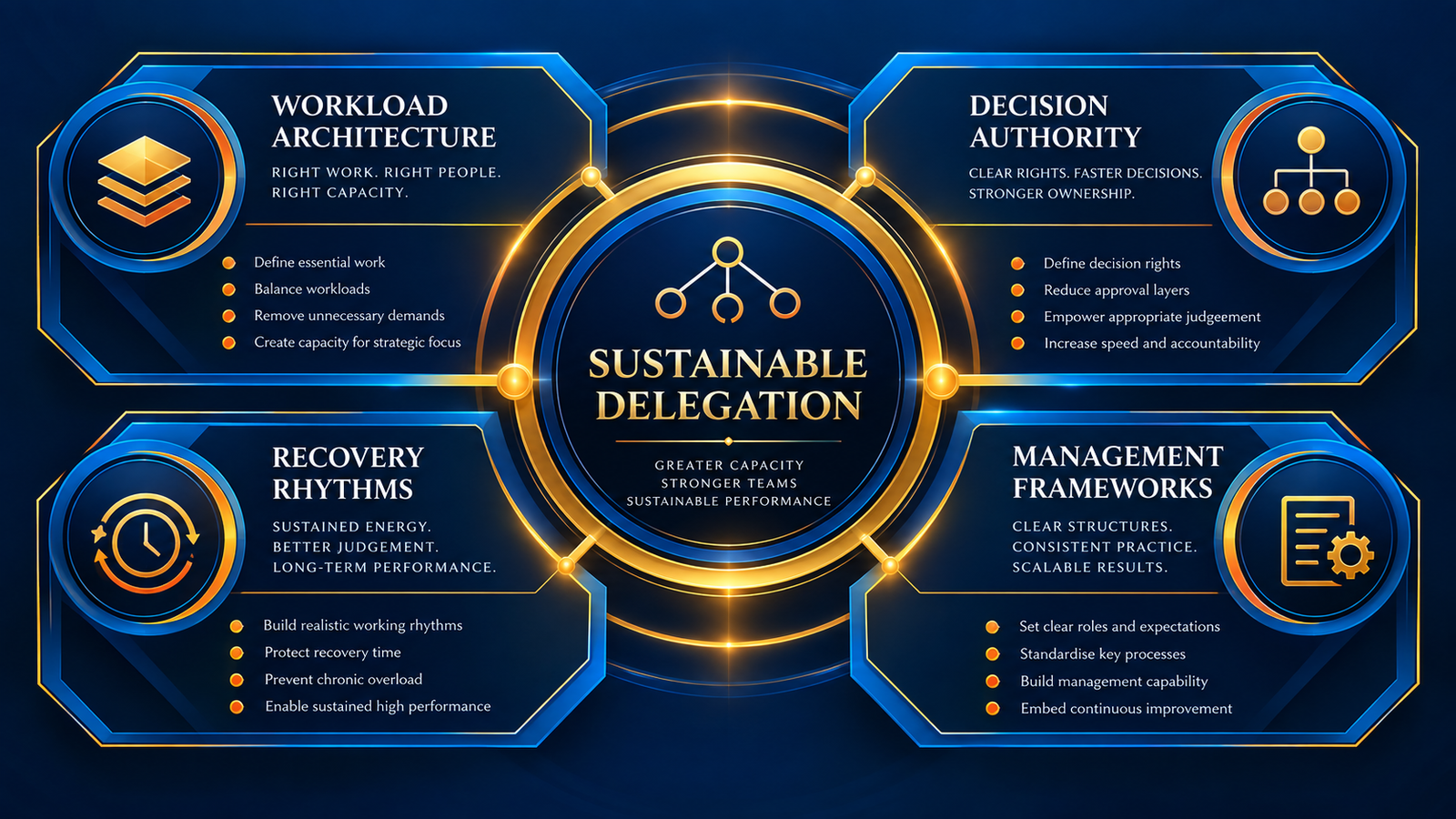
A sustainable delegation system distributes work and authority while preserving clear accountability. It should reduce organisational dependency on individual managers.
Traditional Delegation vs Sustainable Delegation
| Traditional Delegation | Sustainable Delegation |
|---|---|
| Assigns tasks | Establishes outcomes |
| Focuses on instructions | Clarifies ownership |
| Retains decisions with managers | Transfers appropriate authority |
| Assumes employees have capacity | Reviews workload before assigning work |
| Relies on constant supervision | Establishes agreed accountability |
| Measures task completion | Measures outcomes and organisational capability |
| Creates individual dependency | Builds reliable management systems |
| Responds to overload reactively | Addresses workload structurally |
The distinction is not whether managers remain involved. Effective leadership always requires appropriate oversight. The distinction is whether that involvement adds value or simply recreates unnecessary operational dependency.
Sustainable delegation creates clarity.
Poor delegation creates additional work disguised as management development.
Frequently Asked Questions
What is an effective delegation conversation?
An effective delegation conversation establishes the expected outcome, responsibility, decision-making authority, resources and accountability arrangements before work begins. Both parties should understand what success looks like, which decisions can be made independently and when management support is required. The objective is meaningful ownership rather than simply transferring additional tasks.
How can managers delegate without losing control?
Managers maintain appropriate control by establishing clear outcomes, decision boundaries, reporting arrangements and escalation thresholds. They should distinguish between decisions requiring leadership involvement and those employees can make independently. Effective oversight focuses on significant risks and outcomes rather than controlling every operational detail.
What should a manager do when an employee refuses additional responsibility?
Begin by understanding the reason. Examine existing workload, available resources, capability and competing priorities. Resistance may indicate insufficient capacity or unclear expectations. Where additional responsibility is appropriate, agree what existing work will change and what support will be provided.
How often should managers review delegated responsibilities?
Review frequency should reflect complexity, risk and employee experience. High-risk responsibilities may require frequent checkpoints, while established routine activities may need occasional progress reviews. Agree the review schedule during the original delegation conversation and adjust it as employee capability and confidence develop.
Can effective delegation prevent leadership burnout?
Effective delegation can reduce unnecessary management workload, decision overload and operational dependency. However, it cannot independently prevent burnout when organisational demands exceed available resources. Sustainable prevention requires realistic workloads, clear decision authority, appropriate staffing and sufficient recovery opportunities.
What is the biggest mistake leaders make when delegating?
A common mistake is transferring responsibility without sufficient decision-making authority. Employees become accountable for outcomes but must repeatedly seek management approval. This creates frustration, delays and additional work. Effective delegation requires responsibility, authority and accountability to be established together.
Conclusion: Better Delegation Conversations Build Better Systems
Delegation conversations should never be treated as simple administrative exchanges. They are fundamental components of organisational design.
Every conversation determines how responsibility is distributed, where decisions are made and how effectively an organisation uses its available leadership capacity.
When these conversations lack structure, managers become overwhelmed and employees become dependent. When they are designed properly, organisations develop clearer accountability, stronger employee ownership and more sustainable management arrangements.
The solution is not simply telling leaders to delegate more. It is helping them delegate differently.
Establish outcomes.
Clarify ownership.
Transfer appropriate authority.
Provide sufficient resources.
Agree accountability.
Then create organisational systems that make these practices consistent.
Because leaders cannot outwork broken systems. And delegation cannot succeed when the underlying management structure continues to concentrate every important decision at the top.
Need the full picture? The Burn Bright Full Diagnostic™ maps where decisions and workload concentrate in your leadership system — £144.
Your Next Step: Assess Your Leadership Workload
If your working day is dominated by decisions, interruptions and responsibilities that should sit elsewhere, begin by identifying where your leadership system is creating unnecessary pressure.
Free Leadership Intelligence
Get Weekly Leadership Insights
Join thousands of leaders receiving practical strategies on burnout prevention, workload design, and sustainable performance every week.