Quick Answer
Key Takeaways
- Leadership effectiveness increasingly depends on an organisation’s ability to learn, interpret complexity and develop shared understanding — not only on the knowledge a single leader possesses.
- Constructivism proposes that people actively develop understanding by interpreting experience, examining existing knowledge and interacting with others.
- Constructivist leaders remain accountable for decisions, but they also create environments in which knowledge can be developed, questioned, shared and applied.
- Five interconnected dimensions translate the theory into practice: experience, reflection, dialogue, knowledge construction and collective intelligence.
- Within the Leadership Intelligence Compass™, Constructivism Intelligence™ connects with Reflective Practice Intelligence™ and Knowledge Development Intelligence™ in service of Leadership Performance Intelligence™.
- Collaborative inquiry is not appropriate for every decision — sustainable constructivist leadership requires clear boundaries, decision rights and accountability.
Constructivism in Leadership: How Leaders Build Collective Intelligence Through Shared Learning
Introduction: Leadership Is No Longer Exclusively About Having the Answers
Organisations increasingly operate in environments characterised by technological change, competing stakeholder expectations, professional specialisation and complex operational challenges.
Under these conditions, the assumption that organisational knowledge should flow primarily from senior leadership towards employees deserves reconsideration.
No individual leader possesses every perspective necessary to understand a complex organisational problem.
- A hospital executive may understand strategic priorities without possessing the detailed operational knowledge of frontline clinical teams.
- A school principal may understand educational policy while remaining dependent on teachers’ professional experience to understand how those policies affect classroom practice.
- A business executive may establish commercial objectives but require specialist knowledge from employees to understand emerging customer expectations or operational risks.
These examples reveal an important distinction between individual expertise and collective organisational intelligence.
Individual expertise remains essential. However, organisational performance also depends on how effectively different forms of expertise interact.
Constructivism provides a useful theoretical perspective for understanding this relationship. Rather than treating knowledge exclusively as information transmitted from one person to another, constructivist approaches emphasise the active development of understanding through experience, interpretation and interaction.
For leaders, this creates an opportunity to reconsider how knowledge is generated within their organisations.
This is the central concern of Constructivism Intelligence™ within Burn Bright Advisory’s Leadership Intelligence Compass™.

Is your leadership load carried by one person — or by the system? Find out where you stand in minutes.
What Is Constructivism in Leadership?
Featured Snippet
Constructivist leadership therefore emphasises the creation of conditions that support learning and shared knowledge development.
Importantly, constructivism does not suggest that every interpretation is equally accurate or that leaders should abandon professional expertise. Evidence, established standards, ethical responsibilities and organisational accountability remain essential.
Instead, constructivism encourages leaders to recognise that understanding develops through an active process of interpretation and critical examination.
The Theoretical Foundations
Constructivist approaches to learning are associated with several influential thinkers:
- Jean Piaget examined how individuals develop knowledge through interactions between existing cognitive structures and new experiences.
- Lev Vygotsky emphasised the social and cultural dimensions of learning, including the importance of interaction and guidance in developing understanding.
- John Dewey’s work on experience, inquiry and reflective thinking also provides important foundations for understanding learning through practical engagement.
Although these thinkers developed distinct theoretical perspectives, their contributions help explain why experience, interaction and reflection matter to organisational learning.
For leadership practice, the implications are significant. A leader who communicates information may increase employees’ awareness of a particular issue. A leader who creates opportunities to investigate that information, question assumptions and apply new understanding may also contribute to deeper organisational learning.
The distinction is particularly important when organisations face problems without established solutions.
Constructivist Leadership Versus Traditional Knowledge Transfer
Traditional knowledge-transfer approaches generally begin with the assumption that relevant knowledge already exists and must be communicated effectively. This is appropriate when established procedures, technical instructions or regulatory requirements must be understood and implemented consistently.
Constructivist leadership becomes particularly relevant when knowledge is incomplete, distributed or dependent on context.
Consider an organisation experiencing declining employee engagement. A conventional response might involve senior management selecting an intervention and communicating implementation instructions.
A constructivist approach would begin by examining how different groups understand the problem. Leaders might investigate employee experiences, compare departmental perspectives and facilitate structured discussions about potential causes. These activities would inform the development of possible interventions.
The resulting decisions would still require leadership accountability, evidence and evaluation. However, the process would incorporate knowledge that might otherwise remain inaccessible to senior management.
| Dimension | Traditional Knowledge Transfer | Constructivist Leadership |
|---|---|---|
| Starting assumption | Relevant knowledge already exists and must be communicated effectively | Knowledge may be incomplete, distributed or dependent on context |
| Best suited to | Established procedures, technical instructions, regulatory requirements | Complex problems without established solutions |
| Response to declining engagement | Senior management selects an intervention and communicates instructions | Leaders examine how different groups understand the problem before designing interventions |
| Accountability | Leadership accountability, evidence and evaluation | Leadership accountability, evidence and evaluation — informed by wider organisational knowledge |
Why Constructivism Matters for Leadership Performance
Organisational performance depends on more than the capabilities of individual leaders. It also depends on the quality of organisational learning, communication, decision-making and adaptation.
These capabilities become especially important when established practices no longer produce the intended results. Constructivist leadership offers a way to examine three interconnected organisational challenges.
This difference is not necessarily evidence of poor communication. It reflects the reality that professional experience produces different forms of understanding.
Constructivist leadership recognises the importance of connecting these perspectives. Rather than assuming that seniority determines the value of knowledge, leaders establish processes through which relevant expertise can contribute to organisational decisions.
Reflective dialogue creates opportunities to examine whether established interpretations remain appropriate.
For example, an organisation might assume that declining productivity reflects insufficient employee motivation. Structured investigation could reveal that unclear responsibilities, fragmented technology systems or competing organisational priorities are contributing factors.
The value of constructivist leadership lies partly in creating opportunities to examine these competing explanations before selecting interventions.
Leaders influence these conditions. Constructivist leadership can support collective intelligence by encouraging individuals to contribute relevant knowledge, examine alternative interpretations and develop shared understanding.
However, participation alone is insufficient. Leaders must also establish decision-making responsibilities, maintain professional standards and evaluate whether collaborative processes improve organisational outcomes.
This distinction prevents collective learning from becoming an activity disconnected from performance.
The Five Dimensions of Constructivist Leadership
Burn Bright Advisory proposes a five-stage conceptual framework for translating constructivist principles into leadership practice.
The framework is a practical organising model rather than a separately validated scientific assessment. Its purpose is to help leaders examine how knowledge develops within their organisations and identify opportunities to strengthen collective learning.
The five interconnected dimensions are experience, reflection, dialogue, knowledge construction and collective intelligence.
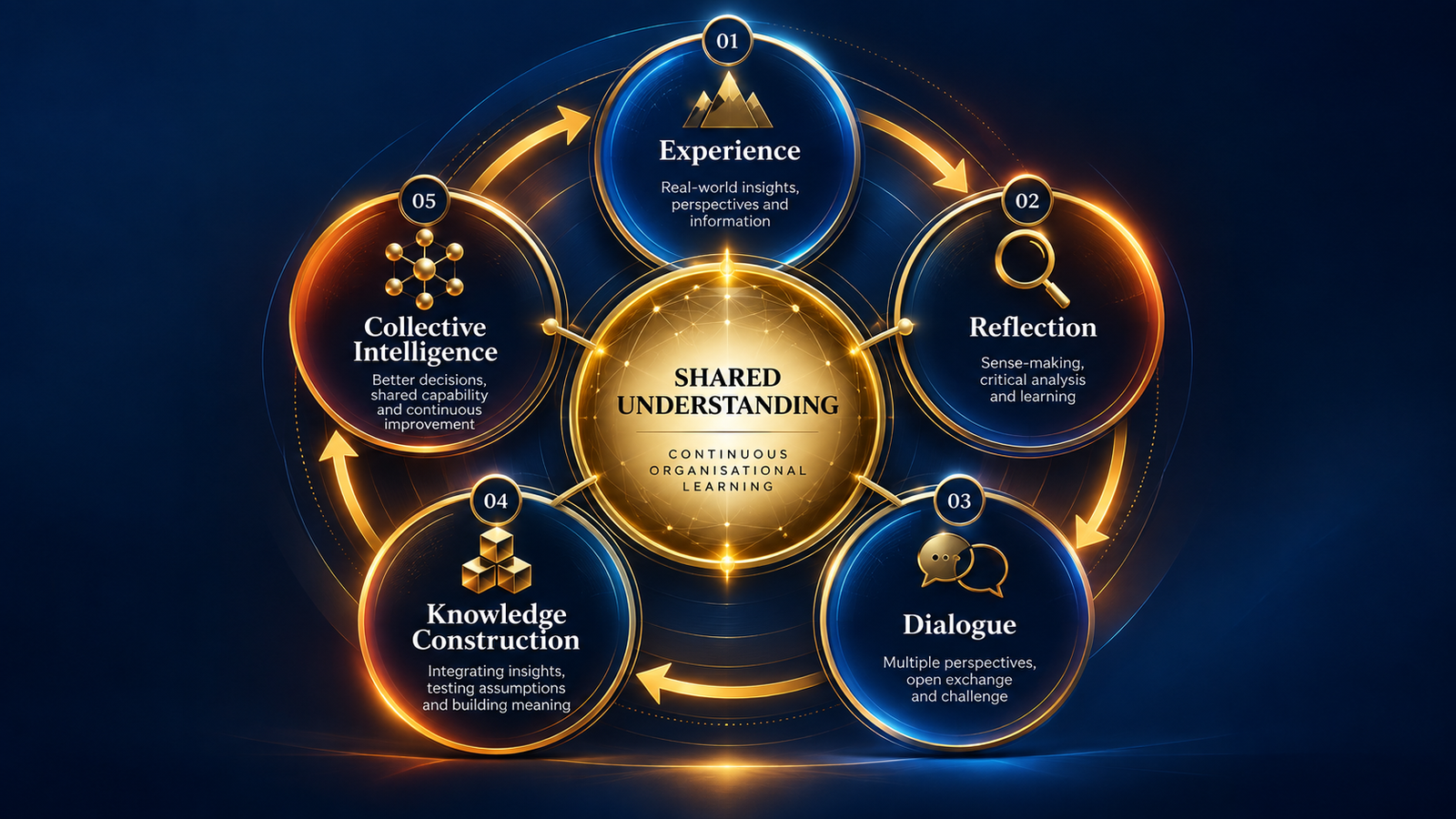
Dimension 1 Experience — Recognising Knowledge Within Practice
Professional experience provides an important source of organisational knowledge. Employees develop understanding through repeated interactions with operational systems, professional responsibilities and organisational stakeholders.
However, experience does not automatically produce accurate understanding. Individuals may interpret similar events differently or develop assumptions that require further examination.
Constructivist leaders therefore treat experience as a starting point for inquiry. They create opportunities for employees to describe practical challenges, identify recurring patterns and contribute observations that may not appear in formal performance reports.
A healthcare leader, for example, might use multidisciplinary case reviews to investigate how different professionals experienced the same operational challenge. The objective is not simply to collect opinions. It is to identify relevant knowledge that can be examined alongside available evidence.
Dimension 2 Reflection — Examining Assumptions and Interpretations
Experience becomes more valuable when individuals critically examine what happened and why. Reflective practice provides a structured process for investigating the relationship between actions, assumptions and outcomes.
Leaders can facilitate reflection by encouraging teams to distinguish observations from interpretations. They can also examine how professional backgrounds influence perceptions of organisational problems.
Consider a project that failed to achieve its intended objectives. An exclusively outcome-focused review might concentrate on identifying missed targets and assigning corrective responsibilities. A reflective review would additionally investigate the assumptions informing the original project design:
- Were stakeholder expectations understood correctly?
- Did the organisation underestimate operational constraints?
- Were important perspectives excluded during planning?
These questions help transform experience into opportunities for organisational learning.
Dimension 3 Dialogue — Connecting Different Perspectives
Reflection can occur individually, but organisational knowledge frequently develops through interaction. Dialogue enables individuals to compare interpretations, identify contradictions and explore alternative explanations.
Effective dialogue requires more than encouraging employees to speak. Leaders must establish conditions that support respectful disagreement, professional accountability and the examination of evidence. This is particularly important in hierarchical environments where employees may hesitate to challenge senior colleagues.
Constructivist leaders can support meaningful dialogue through structured questioning, multidisciplinary discussions and clearly defined opportunities for participation.
The objective is not to eliminate disagreement. It is to ensure that disagreement contributes constructively to understanding.
Dimension 4 Knowledge Construction — Developing Shared Understanding
Dialogue creates opportunities for different perspectives to interact. Knowledge construction occurs when those interactions contribute to new or revised understanding.
Teams may identify previously unrecognised relationships between organisational problems, develop alternative approaches or refine established practices.
However, shared understanding should not be confused with consensus. A team may reach agreement without adequately examining evidence.
Constructivist leaders must therefore ensure that emerging interpretations are evaluated against relevant professional knowledge, organisational objectives and practical constraints. The resulting understanding should be sufficiently clear to inform decisions and coordinated action.
Dimension 5 Collective Intelligence — Applying and Refining Shared Knowledge
The final dimension concerns the organisation’s capacity to apply developed knowledge. Collective intelligence becomes organisationally valuable when shared understanding improves the ability of teams to address relevant challenges.
This requires translating learning into decisions, practices and measurable outcomes. Leaders must establish how new understanding will be tested, implemented and evaluated.
They should also recognise that application generates further experience. New practices may reveal unexpected constraints or challenge the assumptions on which earlier decisions were based.
Consequently, collective intelligence should be understood as an evolving organisational capability rather than a permanent achievement.
The framework therefore returns to its starting point. Experience generates opportunities for reflection, dialogue and further knowledge construction. Through this continuing process, organisations can develop more sophisticated approaches to learning and performance.
Constructivism Intelligence™ and the Leadership Intelligence Compass™
Constructivism is particularly valuable when considered alongside the broader capabilities required for effective leadership.
Within Burn Bright Advisory’s Leadership Intelligence Compass™, Constructivism Intelligence™ concerns a leader’s capacity to facilitate learning, challenge established assumptions and support the collaborative development of understanding.
However, knowledge construction does not operate independently of other leadership capabilities. Its effectiveness depends partly on how leaders reflect on experience, develop professional knowledge, respond to alternative perspectives and translate learning into organisational practice.
Three relationships are particularly important.
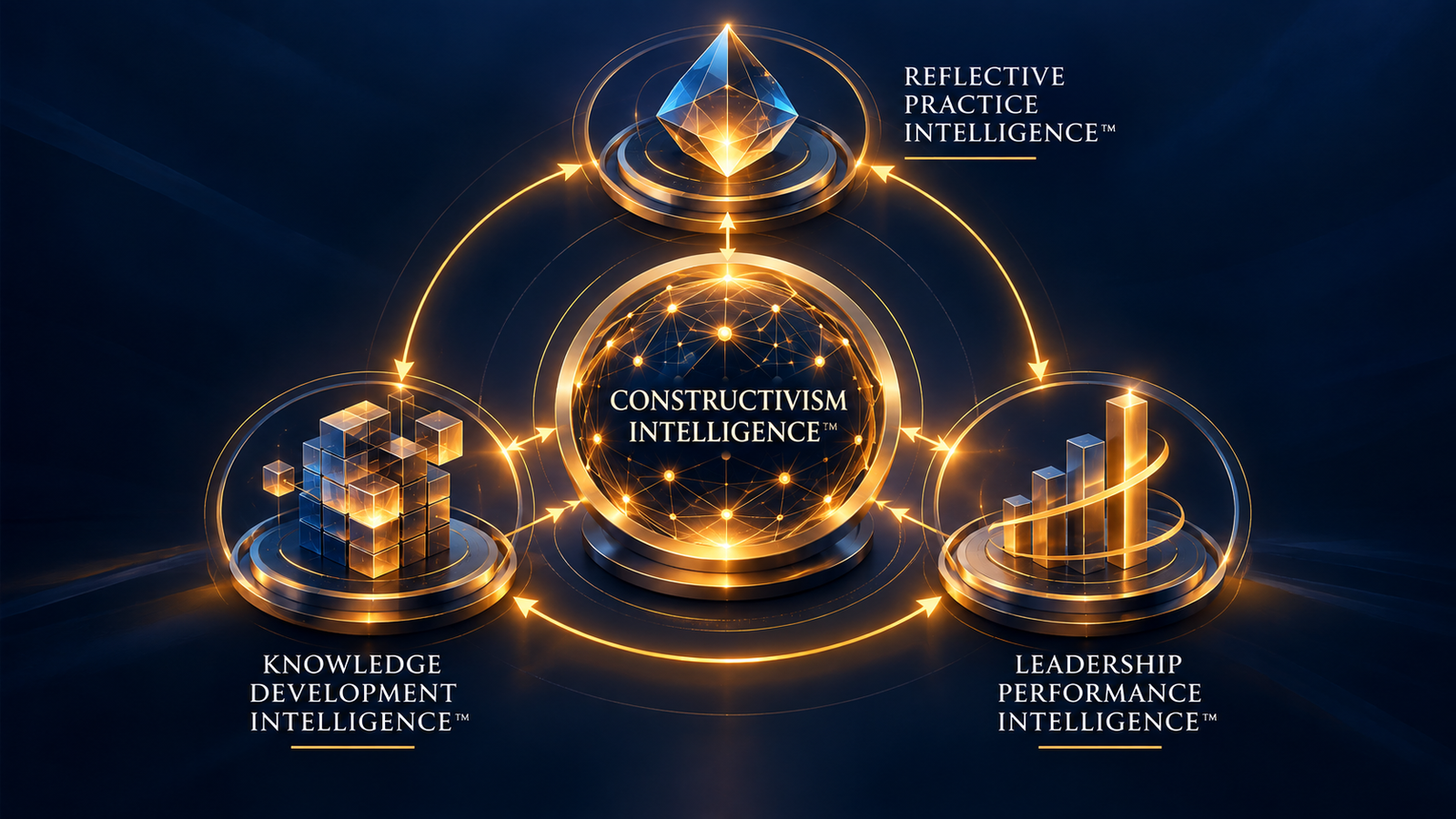
Relationship 1
Constructivism Intelligence™ and Reflective Practice Intelligence™
Reflective Practice Intelligence™ provides an important foundation for constructivist leadership. Leaders inevitably develop assumptions based on their professional experience, previous achievements and established understanding of organisational systems. Although these assumptions can support effective decision-making, they can also restrict learning when circumstances change.
Reflective practice enables leaders to examine the reasoning behind their decisions. Constructivism extends this process by incorporating the experiences and interpretations of others.
The relationship is reciprocal. Individual reflection can improve the quality of collaborative dialogue, while collaborative dialogue can expose assumptions that individuals might otherwise overlook. Leaders who integrate these capabilities create opportunities for both personal and organisational learning.
Relationship 2
Constructivism Intelligence™ and Knowledge Development Intelligence™
Knowledge Development Intelligence™ concerns how leaders acquire, develop, evaluate and apply knowledge. Constructivism contributes to this capability by emphasising the active processes through which understanding develops.
An organisation may possess extensive information without effectively translating that information into organisational knowledge. Similarly, employees may possess valuable professional expertise that remains isolated within departments or individual roles.
Constructivist leadership encourages interaction between these different sources of knowledge. Knowledge Development Intelligence™ provides a complementary focus on ensuring that emerging understanding is evaluated, organised and made accessible. Together, these capabilities support the transition from isolated professional expertise towards more coordinated organisational learning.
Relationship 3
Constructivism Intelligence™ and Leadership Performance Intelligence™
Leadership Performance Intelligence™ provides the wider context within which these capabilities contribute to leadership effectiveness. The development of shared understanding is valuable, but it should not become an objective disconnected from organisational responsibilities.
Leaders must also consider the quality of decisions, the effectiveness of implementation and the sustainability of organisational performance.
- Constructivism Intelligence™ supports these objectives by encouraging leaders to investigate problems before selecting solutions and to incorporate relevant expertise into decision-making.
- Reflective Practice Intelligence™ supports the examination of assumptions and outcomes.
- Knowledge Development Intelligence™ supports the development and application of organisational knowledge.
Constructivist Leadership Across Professional Sectors
The principles of constructivist leadership can be applied across different professional environments. However, their implementation must reflect the responsibilities, constraints and professional standards of each sector.
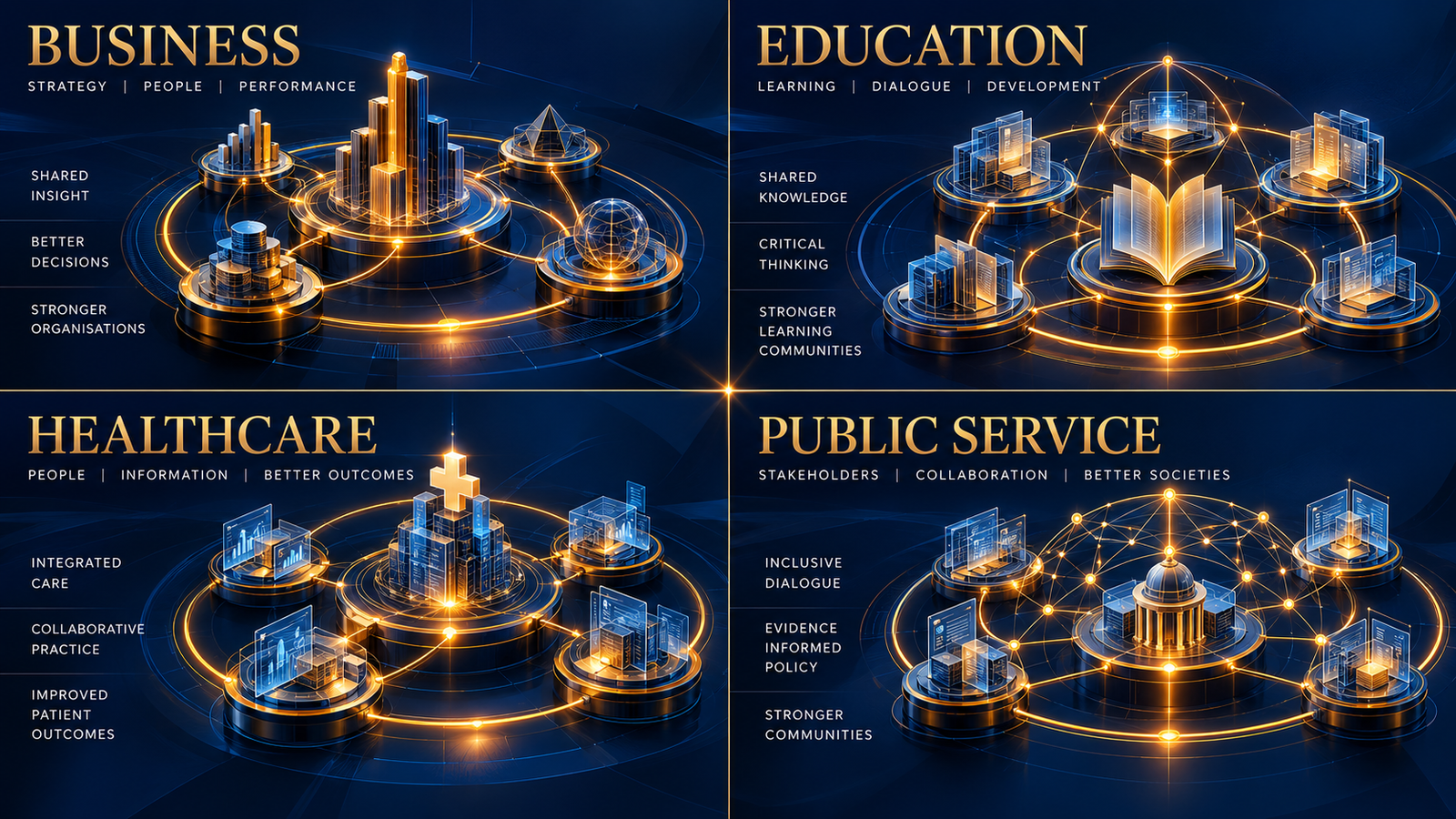
🏢 Business Leadership: Developing Strategic Understanding
Business leaders frequently operate with incomplete information and competing interpretations of market conditions. Constructivist leadership can help organisations bring together knowledge from employees, customers and specialist departments.
Consider a business experiencing declining customer retention. Rather than immediately implementing a management-selected solution, leaders could facilitate structured discussions involving customer service, operations, marketing and commercial teams. Each department would contribute its understanding of the problem, and these perspectives could then be evaluated alongside customer feedback and operational evidence.
The resulting process may reveal relationships that individual departments could not identify independently. This approach is particularly relevant to Business Growth Intelligence™, where strategic development depends on connecting organisational knowledge with changing commercial conditions.
🏫 School Leadership: Developing Collective Professional Knowledge
Educational environments provide a particularly relevant context for constructivist leadership. Teachers develop substantial professional knowledge through classroom experience — but this knowledge may remain fragmented when professional development relies primarily on instructions delivered by senior management.
Constructivist school leaders can facilitate collaborative inquiry through professional learning communities, peer observation and structured reflection. For example, a school seeking to improve student engagement could invite teachers to examine classroom evidence, compare instructional approaches and investigate differences between student groups.
Professional dialogue would support the development of shared understanding. Leaders would remain responsible for ensuring that emerging approaches align with educational evidence, safeguarding requirements and school improvement priorities. Within School Leadership Intelligence™, this approach connects professional learning with organisational development.
🏥 Healthcare Leadership: Integrating Multidisciplinary Expertise
Healthcare organisations depend on collaboration between professionals with different areas of expertise. Constructivist leadership can support multidisciplinary learning by creating structured opportunities to examine clinical and operational experiences.
For example, a hospital department reviewing patient discharge delays could bring together clinical, administrative and operational staff. Each professional group may identify different contributing factors, and structured dialogue could help the team develop a more comprehensive understanding of the discharge process.
However, collaborative knowledge construction must remain consistent with clinical governance, patient safety requirements and established professional responsibilities. Constructivism does not replace clinical expertise or evidence-based practice. Its contribution lies in improving how relevant expertise is integrated.
🏛️ Public Service Leadership: Understanding Complex Stakeholder Needs
Public service organisations frequently address problems involving multiple stakeholders, competing priorities and substantial institutional constraints. Constructivist leadership can support the examination of these challenges through structured consultation and collaborative inquiry.
For example, a public service organisation redesigning an administrative process could investigate the experiences of service users, frontline employees and operational managers. Comparing these perspectives may reveal practical barriers that are not apparent within existing performance reports.
Leaders can then use this understanding to inform the development and evaluation of alternative approaches. Public Service Leadership Intelligence™ connects these collaborative processes with accountability, ethical responsibility and effective public administration.
From Collective Learning to Sustainable Leadership Performance
Constructivist leadership also has implications for Leadership Sustainability™.
Organisations that depend excessively on individual leaders to interpret problems, generate solutions and retain institutional knowledge may create unnecessary leadership workload.
Developing collective learning capabilities offers an alternative. When employees have opportunities to contribute expertise, examine problems and develop shared understanding, organisational knowledge becomes less dependent on a single individual.
However, collaboration must be designed carefully. Unstructured participation can increase meeting demands, delay decisions and create uncertainty about accountability.
Sustainable constructivist leadership therefore requires appropriate boundaries. Leaders must determine when collaborative inquiry is necessary, which perspectives are relevant and how decisions will ultimately be made.
This relationship between shared learning, leadership capacity and organisational performance is an important consideration within Burn Bright Advisory’s wider Leadership Development System™.
Conclusion: Leadership as the Development of Collective Intelligence
Constructivism challenges the assumption that leadership effectiveness depends primarily on the knowledge possessed by individuals in positions of authority.
It offers an alternative perspective in which leaders contribute to organisational performance by facilitating the development of shared understanding.
Experience provides the foundation for inquiry.
Reflection enables assumptions to be examined.
Dialogue connects different perspectives.
Knowledge construction develops new understanding.
Collective intelligence emerges when organisations can apply and refine that understanding through coordinated action.
Within the Leadership Intelligence Compass™, Constructivism Intelligence™ connects these processes to the wider development of reflective practice, professional knowledge and leadership performance.
The implication for contemporary leaders is significant.
Organisations that develop this capability may become better equipped to address complexity, adapt to changing circumstances and sustain leadership performance over time.
Leadership Reflection: Are You Developing Collective Intelligence?
Constructivist leadership begins with an examination of how knowledge is developed within an organisation. Leaders should consider not only the quality of their decisions but also the processes through which organisational understanding emerges.
The following five questions provide a structured reflection framework.
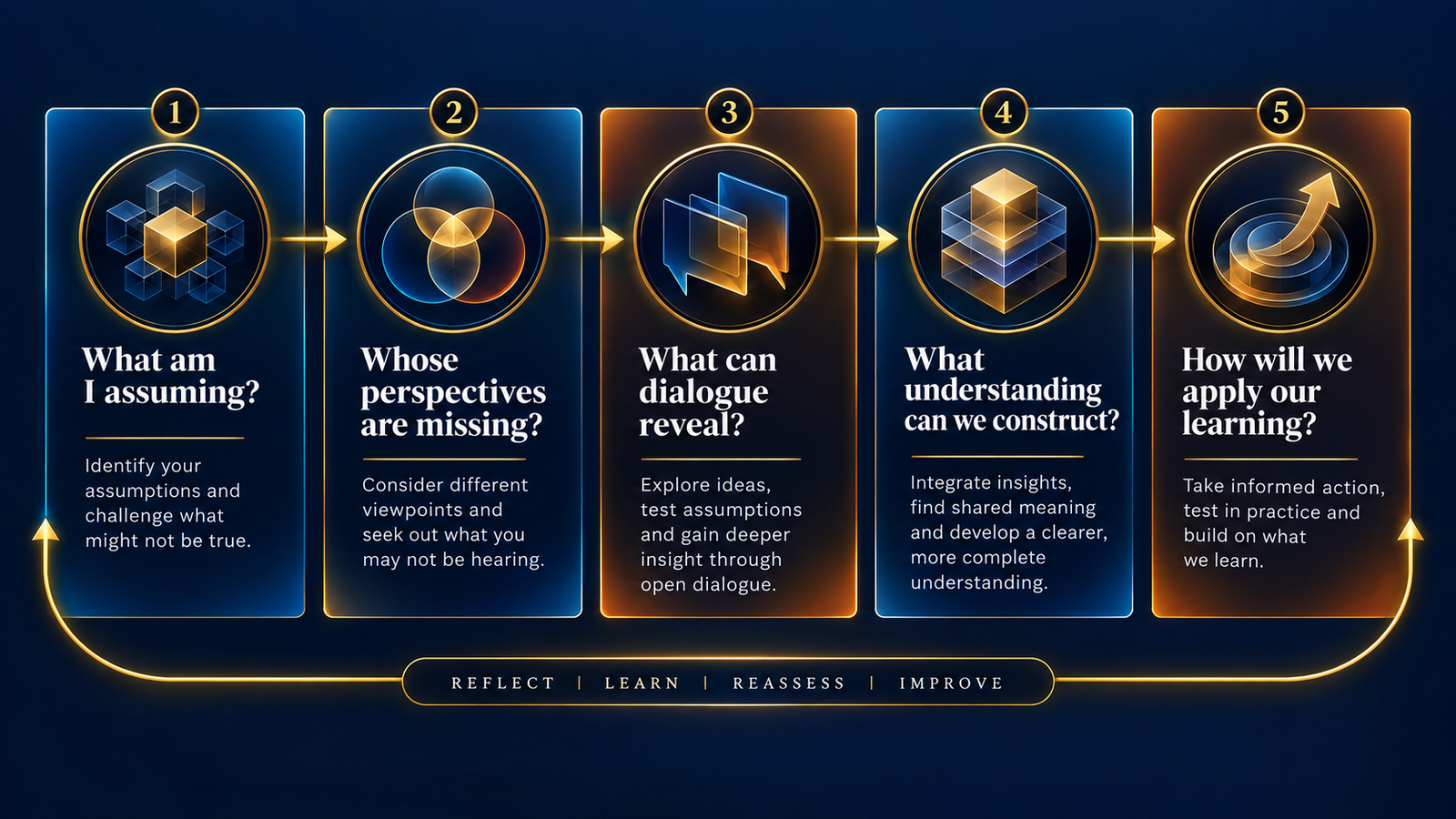
Leadership Reflection Questions
- What assumptions influence my leadership decisions? Examine a recent organisational decision. Which assumptions influenced your interpretation of the problem? Were those assumptions supported by evidence, professional experience or established organisational practices? Consider whether alternative interpretations were sufficiently explored.
- Whose perspectives are missing? Identify the individuals or professional groups whose knowledge may be relevant to an important organisational challenge. Are frontline employees, specialist professionals or affected stakeholders adequately represented? Consider whether existing organisational hierarchies unintentionally restrict the contribution of relevant knowledge.
- How effectively do I facilitate professional dialogue? Reflect on how disagreements are managed within your organisation. Do employees have appropriate opportunities to challenge assumptions, present evidence and offer alternative interpretations? Examine whether organisational discussions genuinely contribute to learning or primarily reinforce decisions already made.
- How does my organisation transform experience into shared understanding? Consider how your organisation learns from successful projects, operational difficulties and unexpected outcomes. Are lessons systematically examined, documented and shared? Does organisational learning influence subsequent decisions, or do teams repeatedly encounter similar problems?
- How do we translate collective learning into measurable improvements? Identify a recent example of collaborative problem-solving. What new understanding emerged? How was that understanding applied? What evidence demonstrates whether the resulting decisions improved organisational outcomes?
These questions can be revisited during leadership development reviews, strategic planning sessions and structured team reflection.
Five Actions for Developing Constructivist Leadership
Understanding constructivist leadership is only the beginning. Its organisational value depends on how effectively leaders translate the underlying principles into everyday practice.
Action 1: Identify a Complex Organisational Challenge
Select an important problem that requires knowledge from several individuals or professional groups. Avoid beginning with a problem for which established procedures already provide a clear solution. Define the challenge carefully and identify the evidence currently available.
Practical output: A clearly articulated organisational problem suitable for collaborative investigation.
Action 2: Map Relevant Organisational Knowledge
Identify the people who possess knowledge relevant to the challenge. Consider professional expertise, operational experience, stakeholder perspectives and existing organisational information. Determine which perspectives are already represented and which may be missing.
Practical output: A knowledge map identifying the expertise required to understand the problem.
Action 3: Facilitate Structured Collaborative Inquiry
Organise a discussion in which participants can present observations, question assumptions and examine alternative explanations. Distinguish evidence from interpretation. Encourage constructive disagreement while maintaining clear professional standards.
Practical output: A documented analysis identifying relevant evidence, competing explanations and outstanding questions.
Action 4: Translate Shared Understanding Into Action
Use the knowledge developed through collaborative inquiry to identify possible interventions. Evaluate alternatives against organisational objectives, professional requirements and available resources. Establish decision-making responsibilities and implementation arrangements.
Practical output: An agreed action plan with defined responsibilities and evaluation criteria.
Action 5: Evaluate Outcomes and Repeat the Learning Process
Review the results of the intervention. Identify whether the organisation’s understanding of the original problem has changed. Document lessons and determine whether additional investigation is necessary.
Practical output: A structured organisational learning review.
These actions provide a starting point for developing Constructivism Intelligence™ within a wider Leadership Development System™.
Frequently Asked Questions
What is constructivism in leadership?
Constructivism in leadership is an approach in which leaders facilitate the development of shared understanding through experience, reflection, dialogue and collaborative problem-solving. Rather than relying exclusively on hierarchical knowledge transfer, constructivist leaders encourage individuals and teams to examine assumptions, exchange perspectives and develop knowledge collectively.
Why is constructivism important for leadership?
Constructivism is important because organisational knowledge is frequently distributed across different individuals, departments and professional disciplines. Constructivist leadership helps organisations connect this knowledge, investigate complex problems and develop shared understanding. It can support organisational learning, adaptability and more informed decision-making.
What is Constructivism Intelligence™?
Within Burn Bright Advisory’s Leadership Intelligence Compass™, Constructivism Intelligence™ concerns a leader’s capacity to facilitate learning, examine assumptions and support the collaborative development of organisational knowledge. It connects constructivist learning principles with practical leadership development.
How does constructivist leadership develop collective intelligence?
Constructivist leadership develops collective intelligence by creating opportunities for individuals to contribute relevant knowledge, compare interpretations and collaboratively investigate organisational challenges. Structured reflection and dialogue help teams develop shared understanding, which can subsequently inform coordinated decisions and organisational improvements.
What is the relationship between constructivism and reflective leadership?
Constructivism and reflective leadership are complementary. Reflective leadership encourages individuals to critically examine their experiences, assumptions and decisions. Constructivism extends this process by emphasising how understanding develops through interaction with other individuals and perspectives. Together, these approaches support individual and organisational learning.
How can constructivist leadership improve organisational learning?
Constructivist leadership can improve organisational learning by establishing processes through which professional experience is examined, shared and translated into organisational knowledge. Examples include multidisciplinary reviews, collaborative inquiry, professional learning communities and structured reflection. The effectiveness of these approaches depends on the quality of participation, available evidence and subsequent implementation.
Is constructivist leadership suitable for every organisational decision?
Constructivist leadership is particularly relevant when organisations face complex problems requiring knowledge from multiple sources. However, collaborative inquiry is not necessary or appropriate for every decision. Established procedures, urgent operational requirements and professional accountability may require more directive approaches. Effective leaders must determine when collaborative learning will improve decision-making.
How can leaders develop constructivist leadership capabilities?
Leaders can develop constructivist leadership capabilities by strengthening reflective practice, facilitating structured dialogue and creating opportunities for collaborative problem-solving. They should also examine how organisational knowledge is documented, evaluated and applied. Leadership development programmes can support these processes through guided reflection, practical exercises and structured organisational learning activities.
Go deeper than a self-check: a full diagnostic of your leadership capacity, workload and performance conditions — Burn Bright Full Diagnostic™, £144.
Is Your Organisation’s Knowledge Resting on One Person?
When every answer has to come from the top, the load lands on the leader. Take the free self-assessment to see how sustainable your current leadership load really is.
Free Leadership Intelligence
Get Weekly Leadership Insights
Join thousands of leaders receiving practical strategies on burnout prevention, workload design, and sustainable performance every week.