Quick Answer
Key Takeaways
- Meeting overload is often an organisational design problem, not a personal time-management problem.
- Every recurring meeting should justify its existence through a clear decision, coordination or problem-solving purpose.
- Information sharing should normally happen asynchronously rather than consuming collective calendar time.
- Leaders need protected focus and recovery space, not calendars running at 100% capacity.
- Reducing meeting overload works best when organisations redesign decision authority and communication architecture alongside the calendar.
Reducing Meeting Overload: A Leadership Framework
Reducing meeting overload has become a leadership issue, not simply a diary-management exercise.
Many senior leaders spend their working day moving from meeting to meeting, only beginning their own work when everybody else has finished theirs. Strategic thinking gets pushed into evenings. Important decisions compete with routine updates. Lunch becomes another available meeting slot. The calendar looks productive because every hour is occupied.
But activity is not the same as effectiveness.
Microsoft’s research found that 68% of people said they lacked enough uninterrupted focus time during the working day, while employees in its dataset spent more time communicating than creating. Inefficient meetings were also identified as the leading productivity disruptor.
More recent Microsoft data illustrates how fragmented work has become: employees were interrupted by meetings, emails or notifications approximately every two minutes, while 52% of leaders described their work as chaotic and fragmented.
That is not simply a productivity problem.
It is a structural problem.
And when the structure repeatedly prevents leaders from thinking, deciding, recovering and doing meaningful work, burnout becomes considerably easier to create.
This article explains how leaders can redesign that structure.
A Useful Way to Visualise the Problem

Meeting overload is rarely caused by one badly managed calendar. It is usually a reinforcing organisational cycle. Breaking that cycle requires changing the architecture around meetings, not simply becoming better at enduring them.
Featured Snippet
Is Your Calendar the Symptom or the System?
Find out whether meeting pressure is an isolated problem or part of a wider structural pattern affecting your leadership capacity.
Why Does Meeting Overload Contribute to Leadership Burnout?
A calendar can be full without a leader producing their highest-value work.
That distinction matters.
The World Health Organization defines burnout as an occupational phenomenon resulting from chronic workplace stress that has not been successfully managed. Its dimensions include exhaustion, increased mental distance or cynicism towards work, and reduced professional efficacy.
Meeting overload can contribute to precisely those conditions.
Imagine a senior leader with eight meetings spread across a ten-hour day.
There may technically be gaps between them. But a 20-minute gap is rarely enough for serious strategic work. The leader checks messages, prepares for the next conversation, answers an urgent email and joins the next call.
The day becomes fragmented.
This creates what I think of as calendar occupancy without leadership capacity.
The calendar measures whether time is available.
It does not measure whether the mind is available.
Research from Microsoft’s Human Factors Lab illustrates the problem. In an experimental study, back-to-back virtual meetings were associated with accumulating stress activity. Short breaks between meetings interrupted that build-up and were associated with better engagement.
The problem therefore goes beyond the hours consumed by meetings.
There is also a transition cost.
A difficult budget discussion does not disappear from your brain because the next meeting has started. A conflict conversation can follow you into a strategy review. A poorly structured meeting can leave frustration and unresolved questions occupying cognitive capacity afterwards.
Harvard Business Review has described this as a meeting hangover: negative effects from a meeting that can continue to affect engagement and productivity afterwards. Its 2025 coverage reported that more than one-quarter of workplace meetings can produce these lingering effects.
So reducing meeting overload is partly about quantity.
But it is also about cognitive architecture.
A sustainable calendar needs enough space for leaders to think before important conversations, recover after demanding ones and complete the work those conversations create.
Why Do Organisations End Up With Too Many Meetings?
Most organisations do not deliberately create meeting overload.
It accumulates.
A weekly meeting is established during a project crisis. The crisis ends. The meeting remains.
A new leadership team creates another reporting forum. Nobody removes the previous one.
A senior leader wants greater visibility, so another check-in is introduced.
A cross-functional project creates a steering committee, a working group and a leadership update.
Each decision appears reasonable in isolation.
Collectively, they create structural overload.
This is one of the recurring patterns behind leadership burnout: scope creep applied to the calendar.
The Burn Bright framework identifies meeting culture as one of five root causes of burnout because meetings can become the place where unclear accountability, communication chaos and decision overload converge.
There is another problem.
Meetings frequently compensate for weak decision architecture.
The meeting is not necessarily the original problem.
It is the visible symptom.
McKinsey found executives spend almost 40% of their time making decisions, while 60% reported that this time was poorly used. Its research also describes how a healthcare organisation removed 30% of decisions from an executive committee by assigning those decisions to appropriate individual roles instead.
That is a critical lesson.
Sometimes the fastest way to reduce meetings is not to redesign meetings.
Ask:
Who actually has the authority to make this decision?
If the answer is clear, you may not need twelve people in a room.
If the answer is unclear, improving the agenda will only treat the symptom.
Leaders who want to go deeper should connect meeting redesign with how leadership burnout develops and the broader structural pressures that create unsustainable work.
How Can Leaders Audit Meeting Overload?
Start with diagnosis.
Do not immediately declare Wednesday a meeting-free day or cancel half the calendar.
First understand what the current system is doing.
Conduct a Meeting Architecture Audit across four weeks.
For every recurring meeting, record five things:
- Purpose: Why does this meeting exist?
- Output: What tangible result should it produce?
- Authority: Who owns any decision?
- Attendance: Who genuinely needs to participate?
- Alternative: Could the outcome be achieved asynchronously?
Then classify each meeting. Use four categories:
Decide Collective input, single decision owner
A genuine decision needs collective input before an identified decision owner makes the call.
Create Working together on a problem
People need to work together on a problem, idea or deliverable.
Coordinate Live alignment on interdependent work
Interdependent work requires live alignment.
Inform Distributing information
The purpose is predominantly to distribute information.
The fourth category should immediately attract scrutiny.
Information does not automatically require a meeting.
A written update, dashboard, recorded briefing or project platform may communicate the same information while allowing 20 people to consume it when their workload permits.
What the Data Tells Us

Microsoft found that 68% of workers surveyed lacked sufficient uninterrupted focus time, while its more recent telemetry shows meetings concentrated in periods that are often valuable for focused work.
Next, calculate the true meeting cost.
A one-hour meeting with eight senior employees is not a one-hour meeting.
It consumes eight employee-hours before preparation and follow-up are considered.
Then add the opportunity cost.
What did those eight people not do?
This question changes the conversation.
A meeting may be useful and still not be valuable enough to justify the collective cost.
The audit should therefore ask not: Was this a good meeting?
Ask:
That is a much tougher standard.
And it should be.
For leaders already struggling with an unsustainable workload, the broader leadership burnout self-assessment can help distinguish isolated calendar pressure from a wider structural pattern.
What Should Replace Unnecessary Meetings?
Reducing meeting overload does not mean eliminating collaboration.
It means choosing the correct mechanism for the work.
This distinction is essential.
Organisations often use meetings as the default operating system. Need an update? Meeting. Need feedback? Meeting. Need approval? Meeting. Need to share a document? Meeting.
The alternative is a deliberate communication architecture.
Use synchronous meetings where real-time interaction creates additional value.
Use asynchronous systems where it does not.
For example:
- A weekly project status meeting may become a written dashboard.
- A 60-minute executive update may become a ten-minute pre-read followed by a 25-minute decision discussion.
- A large approval meeting may disappear entirely when decision authority is assigned to one accountable leader.
- A standing check-in may move from weekly to fortnightly.
- A meeting attended by 14 people may become a working session for four, with a concise written update sent to the others.
McKinsey recommends starting by asking whether a meeting is necessary at all and warns that recurring meetings are particularly vulnerable to drifting away from their original purpose.
That is why cancellation alone is insufficient.
If you remove a meeting without fixing the information or decision process underneath it, people will recreate the meeting.
Or they will replace it with 70 emails.
You have not reduced organisational load.
You have moved it.
- Replace synchronous reporting with dashboards.
- Replace collective approval with explicit decision rights.
- Replace attendance-as-awareness with written summaries.
- Replace open-ended discussion with prepared options.
- Replace calendar access with defined communication channels.
This is also why meeting overload sits alongside communication chaos and decision overload in the Burn Bright diagnosis. These systems interact.
For leaders facing several of these patterns simultaneously, the Leadership Burnout Reset provides a broader structural approach to restoring capacity.
How Should Leaders Redesign Their Calendars?
Once unnecessary meetings have been removed, protect what the organisation normally consumes next: white space.
Most calendars are designed around availability.
Sustainable calendars need to be designed around capacity.
There is a difference.
A free hour does not automatically mean an available hour.
Leaders require time for thinking, preparation, difficult decisions, unplanned events and recovery between cognitively demanding tasks.
If every visible gap is treated as available meeting capacity, the system will eventually consume the entire calendar.
I recommend thinking in three layers.
Layer 1
Protect strategic capacity
Block meaningful periods for work that requires concentration. Not 20 minutes. Not the accidental gap created when somebody cancels. Real blocks.
This is where strategy gets developed, difficult problems are considered and complex decisions are prepared.
Layer 2
Create meeting buffers
Back-to-back scheduling creates cognitive carryover. Build 10 or 15 minutes between demanding conversations where possible.
Use that time to record decisions, reset and prepare.
Layer 3
Maintain contingency capacity
A leader operating at 100% planned capacity has no capacity for leadership. Problems will occur. People will need support. Customers will escalate. Plans will change.
If the calendar has no margin, every unexpected demand pushes work into evenings.
The Burn Bright Meeting Architecture
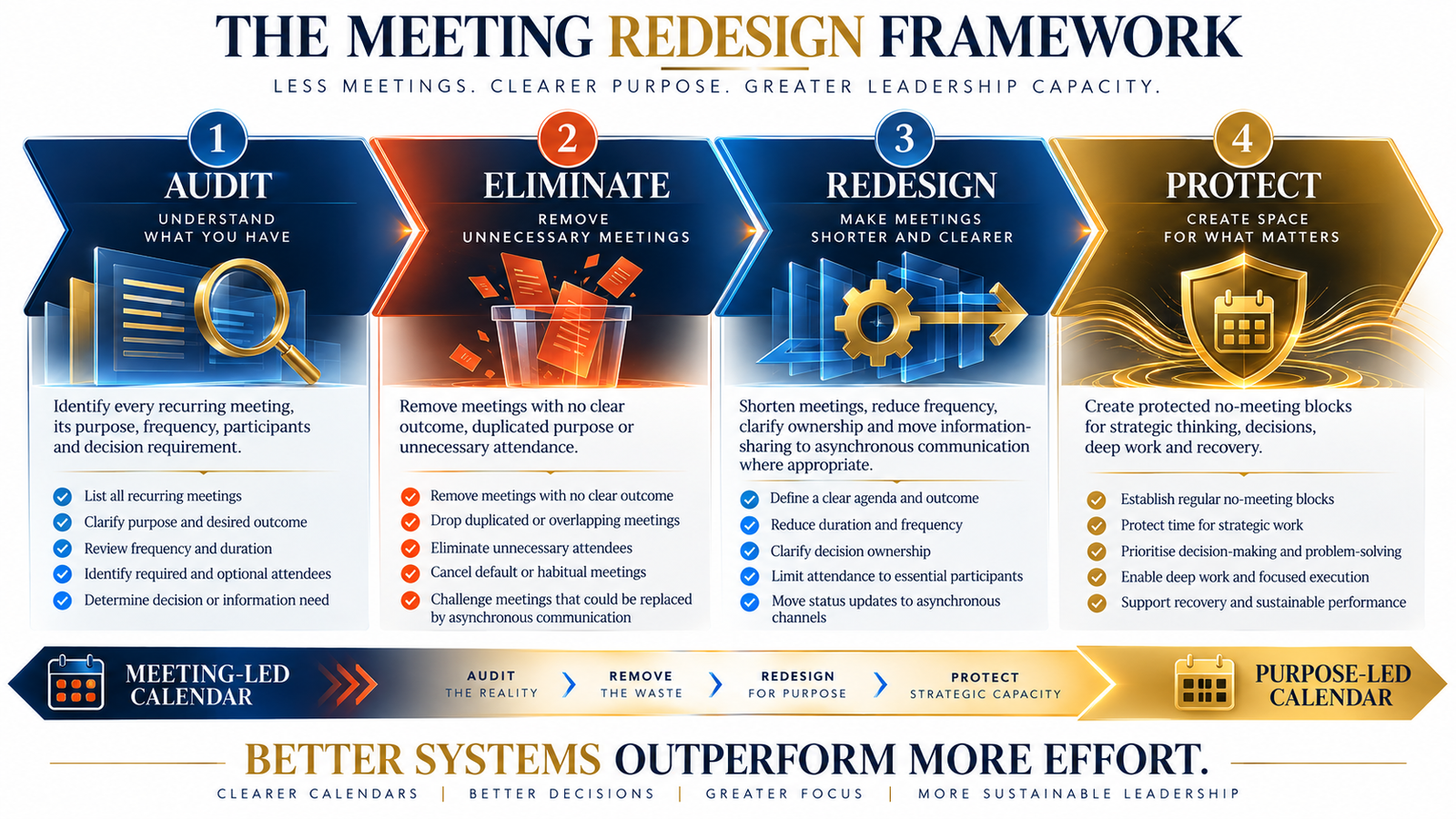
The goal is not an empty calendar. It is a deliberately designed calendar in which meetings compete for capacity rather than automatically receiving it.
Microsoft’s 2025 data found that half of meetings occurred within the 9–11 a.m. and 1–3 p.m. windows, while employees were simultaneously dealing with heavy communication traffic.
Leaders should therefore question the habit of giving prime cognitive hours automatically to meetings.
The same principle sits behind protecting leadership capacity from burnout: sustainable performance requires designing work around finite human capacity rather than pretending capacity is unlimited.
How Do You Stop Meeting Overload From Returning?
This is where many meeting-reduction initiatives fail.
The organisation holds a calendar clean-up.
People cancel meetings.
Everyone feels relieved.
Three months later, the calendar is full again.
Why?
Because the organisation removed meetings without changing the conditions that created them.
Sustainable change requires governance. Introduce several rules.
Every recurring meeting needs an owner
That person is responsible for its purpose, attendance, frequency and continued relevance.
Recurring meetings need expiry dates
A six-month project should not create a meeting that survives for six years.
Every decision meeting needs a named decision owner
Consultation can be broad. Accountability cannot.
Attendance should be based on contribution, not status
Do not invite people simply because they might want visibility. Give them visibility another way.
Cancel meetings when there is no agenda or decision
The existence of a calendar invitation is not sufficient justification for consuming collective capacity.
Audit the meeting architecture quarterly
Meeting culture is dynamic. It needs maintenance.
This matters because meetings are rarely isolated from wider organisational behaviour.
- A culture that rewards constant visibility will create meetings.
- A culture with unclear accountability will create meetings.
- A culture that distrusts delegation will create meetings.
- A culture where nobody wants to make a decision alone will create meetings.
So reducing meeting overload ultimately requires leaders to ask a deeper question:
That question moves the discussion from diary management to organisational design.
And that is where sustainable change begins.
| Traditional Meeting Culture | Sustainable Meeting Architecture |
|---|---|
| Meetings are the default | Meetings must justify synchronous time |
| Attendance creates visibility | Documentation creates visibility |
| Everyone joins decisions | Decision authority is explicit |
| Information is presented live | Information is shared asynchronously |
| Back-to-back calendars are normal | Buffers protect cognitive capacity |
| Free time means meeting availability | Focus time is protected capacity |
| Recurring meetings continue indefinitely | Recurring meetings expire or are reviewed |
| Leaders absorb coordination complexity | Systems carry coordination load |
| Busyness signals commitment | Outcomes signal effectiveness |
Frequently Asked Questions
What is meeting overload?
Meeting overload occurs when meetings consume disproportionate amounts of working time and cognitive capacity, leaving insufficient space for focused work, decision-making and recovery. It can result from too many meetings, excessive attendance, unclear purposes, weak decision rights or using meetings for information that could be communicated asynchronously.
How can leaders reduce meeting overload quickly?
Start with recurring meetings. Identify which ones exist mainly for updates, which lack clear outputs and which could be replaced with asynchronous communication. Then examine attendance. Removing one unnecessary recurring meeting can return dozens or hundreds of employee-hours over a year.
How many meetings are too many for a leader?
There is no universal number. The better measure is whether meetings leave sufficient capacity for the leader’s core responsibilities. If strategic thinking, preparation, important individual work or recovery routinely gets pushed into evenings because the working day is occupied by meetings, the architecture needs attention.
Should companies introduce no-meeting days?
They can help, but they are not a complete solution. A no-meeting day may simply compress the same volume into the remaining four days. Protected time works best when combined with meeting audits, clear decision authority and stronger asynchronous communication practices.
Can meetings actually contribute to burnout?
Meetings are not inherently a cause of burnout, but excessive or poorly designed meetings can contribute to chronic workplace stress by increasing workload, fragmenting attention and reducing control over working time. WHO identifies burnout as resulting from chronic workplace stress that has not been successfully managed.
What meetings should never be replaced by email?
Complex conversations requiring genuine dialogue may need synchronous interaction. Examples include sensitive performance conversations, high-stakes decisions, complex conflict resolution, creative problem-solving and discussions where rapid clarification materially improves the outcome. The principle is not “replace meetings with email”. It is match the communication method to the work.
Reducing Meeting Overload Requires Structural Change
Reducing meeting overload is not about becoming antisocial, refusing collaboration or turning every conversation into an email.
It is about recognising that leadership capacity is finite.
Every meeting consumes part of that capacity.
Some deserve it.
Others do not.
The problem begins when organisations stop distinguishing between the two.
A sustainable meeting culture starts with clear purpose. It assigns decision authority. It uses asynchronous communication intelligently. It protects focus time. It creates recovery space. And it regularly removes meetings that no longer produce enough value to justify their cost.
That is the wider Burn Bright principle.
A leader cannot productivity-hack their way out of a calendar that has been structurally designed to consume every available hour.
Better systems outperform more effort.
So before asking leaders to become more resilient, look at the architecture surrounding them.
Look at the meetings.
Look at the decisions.
Look at the interruptions.
Look at what happens to strategic work when the calendar fills.
Because the objective is not to help leaders tolerate overload more effectively.
It is to redesign the conditions creating the overload.
Go Deeper With the Burn Bright Full Diagnostic™
Map the meeting, decision and workload pressures across your leadership system and identify where structural redesign will return the most capacity.
Take the Leadership Burnout Self-Assessment
If meeting overload is only one part of a wider pattern of exhaustion, decision fatigue and disappearing strategic capacity, identify where the structural pressure is coming from.
Free Leadership Intelligence
Get Weekly Leadership Insights
Join thousands of leaders receiving practical strategies on burnout prevention, workload design, and sustainable performance every week.