Quick Answer
Key Takeaways
- The central challenge is not whether a leader can change, but whether they know what should change and what should not.
- The Adaptive Core™ separates a stable centre of purpose, ethics, values and professional standards from a flexible response of behaviour, priorities, processes, resources, communication and execution.
- Adapt the method before assuming you must compromise the standard.
- Every adaptive decision has four options: Maintain, Adjust, Redesign or Stop — and stopping is one of the most underused.
- Ethical drift rarely begins with a decision to be unethical; it begins with small exceptions that gradually become normal.
- When leaders absorb every new demand through personal effort, the system has not adapted — the individual has absorbed the failure to adapt.
- The Leadership Pressure Test™ — Pressure, Reality, Core, Response, Consequence — creates a deliberate pause between pressure and response.
How Can Leaders Adapt Under Pressure Without Compromising Their Standards?
Is pressure reshaping how you lead? Start with a free, confidential check-in.
Executive Summary
Leadership adaptability becomes most difficult when the pressure to change is greatest.
When performance declines, resources tighten, expectations conflict or uncertainty increases, leaders are frequently told to become more flexible. Yet flexibility without boundaries can become something very different from adaptability.
A leader can adjust so frequently that strategic direction disappears.
They can accommodate stakeholder pressure until expectations become unsustainable.
They can accelerate decisions until professional judgement deteriorates.
They can make pragmatic compromises that gradually weaken standards they previously considered non-negotiable.
The central challenge is therefore not simply whether a leader can change. It is whether they know what should change and what should not.
Within the Burn Bright Advisory™ Leadership Intelligence Compass™, Adaptability Intelligence™ describes the capacity to interpret changing conditions and make proportionate adjustments while maintaining alignment with purpose, values and strategic direction.
Under pressure, this requires what we call an Adaptive Core™: a stable foundation of purpose, ethics and professional standards surrounded by a leadership response capable of changing as circumstances require.
This distinction matters because adaptability should increase leadership effectiveness—not gradually redefine what the leader is willing to tolerate.
Mature adaptability therefore requires both flexibility and boundaries.
The response can change.
The standard does not automatically have to.
Introduction: Pressure Reveals the Boundaries of Adaptability
It is easy to describe yourself as adaptable when the stakes are low.
The more revealing test arrives when something important is under pressure.
A target is being missed.
A major customer is dissatisfied.
A project is behind schedule.
A team is exhausted.
Resources are reduced.
A stakeholder wants an immediate answer.
A senior executive demands faster results.
A competitor changes the market.
A new technology disrupts an established process.
Suddenly, the leadership question is no longer theoretical.
Most leadership discussions about adaptability concentrate on the importance of flexibility. Leaders are encouraged to remain open-minded, embrace change, respond quickly and avoid becoming attached to established ways of working.
Those are useful principles. But they are incomplete. Because not everything should become flexible simply because circumstances become difficult.
Sometimes pressure requires leaders to change their behaviour.
Sometimes it requires them to reconsider a process.
Sometimes priorities genuinely need to move.
Sometimes a strategy needs significant revision.
But sometimes the correct adaptive response is to refuse to move a boundary that should remain stable.
That distinction is central to Adaptability Intelligence™.
A leader who never changes becomes rigid.
A leader who changes everything becomes unpredictable.
A leader who changes the wrong things can become compromised.
The deeper leadership capability is knowing the difference.

What Is Leadership Adaptability Under Pressure?
Featured Snippet
The distinction between response and standard is fundamental.
A response might include:
- how a leader communicates;
- how resources are allocated;
- which priorities receive immediate attention;
- how a team is structured;
- how quickly a decision is made;
- which process is used;
- or how a strategic objective is pursued.
These things can often change.
A standard operates differently. It may concern honesty. Professional conduct. Safety. Fairness. Evidence. Accountability. Respect. Quality. Ethical boundaries. Or a commitment the organisation has deliberately chosen to protect.
Adaptive leadership requires leaders to know which category they are dealing with.
Consider a team facing an unexpected deadline. The leader may need to adapt.
Meetings can be reduced.
Decision rights can be temporarily changed.
Resources can be moved.
Reporting can be simplified.
Lower-priority work can be postponed.
Communication can become more frequent.
Those are adaptive responses.
But suppose the leader decides the deadline also justifies concealing problems, normalising excessive workloads, bypassing necessary safeguards or blaming employees for systemic constraints.
The leader is still changing their response. But it would be difficult to describe that change as mature adaptability.
Something else has happened. Pressure has started to alter the leadership standard.
That is the boundary this article examines.
The Adaptive Core™: What Changes and What Remains Stable
One of the most useful ways to think about adaptability is as a system with a stable centre and flexible outer layers. We call this the Adaptive Core™.
The Centre
Stable Core
The elements leadership should be especially cautious about changing merely because circumstances become difficult:
- Purpose.
- Ethics.
- Values.
- Professional standards.
The Middle Layer
Leadership Judgement
Around that core sits leadership judgement. This is where the leader interprets:
- context;
- evidence;
- risk;
- consequences;
- stakeholder needs;
- and competing responsibilities.
The Outer Layer
Adaptive Response
The elements most capable of adaptation:
- behaviour;
- priorities;
- processes;
- resources;
- communication;
- and execution.
The model can be expressed simply:

The framework does not mean that purpose, values or standards can never be reconsidered.
Organisations sometimes discover that a stated value is poorly defined. Professional standards evolve. Ethical understanding develops. An organisational purpose may legitimately be revisited.
The point is more precise: pressure alone should not be sufficient reason to abandon them.
Changing a principle after careful examination is different from quietly relaxing it because maintaining it has become inconvenient.
This distinction is especially important in senior leadership because pressure often arrives disguised as pragmatism.
- “We need to be realistic.”
- “We don’t have time.”
- “This is an exceptional situation.”
- “We can fix the process afterwards.”
- “Everyone understands what we’re trying to achieve.”
- “Let’s just get through this quarter.”
Any of these statements might be reasonable. They might also be the beginning of leadership drift.
Adaptability Intelligence™ requires leaders to determine which.
Why Pressure Changes Leadership Behaviour
Pressure does not merely change the environment around a leader. It can change the leader’s relationship with that environment.
Time appears shorter.
Options appear narrower.
Ambiguity becomes more uncomfortable.
Immediate consequences receive more attention.
Longer-term consequences can become psychologically distant.
- A leader who normally invites challenge may become impatient.
- A leader who usually delegates may become controlling.
- A leader committed to careful decision-making may suddenly treat speed as the dominant measure of effectiveness.
- A leader who values sustainable performance may begin relying on repeated exceptional effort from the team.
This matters because leaders can interpret these behavioural changes as evidence of adaptability. They may say: “I’m doing what the situation requires.”
Sometimes they are. Sometimes they are simply responding to pressure.
Adaptability Intelligence™ requires enough self-awareness to distinguish the two.
This is where Adaptability Intelligence™ begins to intersect with Emotional Intelligence™ and Reflective Practice Intelligence™. The leader must interpret not only the external environment but also their own response to it.
- What has genuinely changed?
- What am I assuming?
- What emotion is influencing my interpretation?
- Am I responding to evidence or discomfort?
- Am I changing because the existing approach is no longer appropriate—or because maintaining it has become difficult?
These are not abstract reflection questions. They influence real decisions.
Adaptability Is Not Accommodation
Another important distinction is the difference between adaptability and accommodation.
Adaptive leaders respond intelligently to changing conditions. Accommodating leaders can gradually become shaped by whoever or whatever applies the greatest pressure.
The difference can initially be difficult to detect.
Imagine a leader managing several stakeholders. One stakeholder continually requests exceptions. The leader wants to remain responsive.
The first exception appears reasonable.
The second is justified by unusual circumstances.
The third is granted because refusing it would create conflict.
Eventually, the exception has become the operating model.
Nothing dramatic happened. There was no single moment when the leader deliberately abandoned the original standard. Instead, the boundary moved incrementally.
This is one of the risks of adaptability under pressure.
It often presents itself as responsiveness. Pragmatism. Customer focus. Flexibility. Urgency. Relationship management. Or simply “getting things done.”
This does not mean leaders should become inflexible. It means adaptability needs an anchor.
Without one, the leader may become highly responsive while progressively losing consistency, credibility and strategic coherence.
The Difference Between a Flexible Method and a Flexible Standard
Consider the statement: “We need to become more flexible.”
The immediate question should be: flexible about what?
This is where many leadership conversations become imprecise.
An organisation may need greater flexibility in how work is completed. That does not necessarily require flexibility in the quality of the outcome.
- A school may need to adapt how learning is delivered. That does not mean expectations for student welfare should weaken.
- A healthcare organisation may need to redesign workflows. That does not mean clinical safeguards become optional.
- A business may need to change its commercial model. That does not mean misleading customers becomes acceptable.
- A public-service organisation may need to respond faster. That does not automatically remove obligations around accountability or fairness.
- An entrepreneur may need to change the product. That does not require abandoning the purpose the business exists to serve.
This distinction gives leaders a practical principle:
Sometimes the standard itself genuinely requires review. But that should be a deliberate leadership decision based on evidence, ethics and context—not the accidental consequence of sustained pressure.
Adaptability Intelligence™ and Ethics Intelligence™
This is where Adaptability Intelligence™ connects directly with another domain of the Leadership Intelligence Compass™: Ethics Intelligence™.
Adaptability asks: What needs to change?
Ethics asks: What should we be willing to change?
The two questions are related but not identical.
A highly adaptable leader without sufficient ethical judgement can become dangerously effective at rationalising whatever the immediate environment rewards.
They can adjust behaviour.
Read stakeholders.
Navigate systems.
Change messages.
Reallocate resources.
Find workarounds.
Achieve outcomes.
Yet leadership effectiveness cannot be judged only by whether the desired outcome was achieved.
- How it was achieved matters.
- What was protected matters.
- What was normalised matters.
- What the organisation learned from the leader’s behaviour matters.
Adaptability Intelligence™ therefore becomes stronger when it operates alongside Ethics Intelligence™.
One enables movement.
The other helps establish boundaries around that movement.
Adaptability Intelligence™ and Professionalism Intelligence™
There is a similar connection with Professionalism Intelligence™.
Professionalism becomes particularly visible when conditions make professional behaviour inconvenient. Standards are easy to maintain when there is sufficient time, adequate capacity and broad agreement. The harder test comes when maintaining those standards has a cost.
Pressure can tempt leaders to become inconsistent.
- Expectations applied to one employee may not be applied to another.
- Poor behaviour from a high performer may be tolerated because results are needed.
- Communication standards may deteriorate because everyone is busy.
- Preparation may decline because meetings are frequent.
- Commitments may become conditional on whether something more urgent appears.
Over time, these exceptions create information for the organisation. People learn which standards are genuine and which standards disappear under pressure.
This is why adaptability under pressure is closely connected to trust.
Employees do not need leaders to behave identically in every circumstance. They do need enough consistency to understand the principles governing leadership decisions.
Adaptability should make leadership more responsive.
It should not make leadership arbitrary.
The Question Is Not “Should We Change?”
Under pressure, leaders frequently frame decisions too narrowly.
- Should we change the plan?
- Should we change the target?
- Should we change the structure?
- Should we change the deadline?
A stronger adaptability question is:
This introduces proportionality.
Some changes in circumstances require monitoring.
Others justify minor adjustment.
Some require substantial redesign.
A smaller number require leaders to stop an existing approach entirely.
The objective is not to prove that the original plan was right. Nor is it to demonstrate agility by changing quickly. The objective is to produce a response proportionate to reality.
That is the point at which adaptability becomes leadership intelligence rather than leadership instinct.
And it leads to the practical decision framework at the centre of this article: Maintain. Adjust. Redesign. Stop.
The leadership challenge is deciding which response the evidence actually supports.
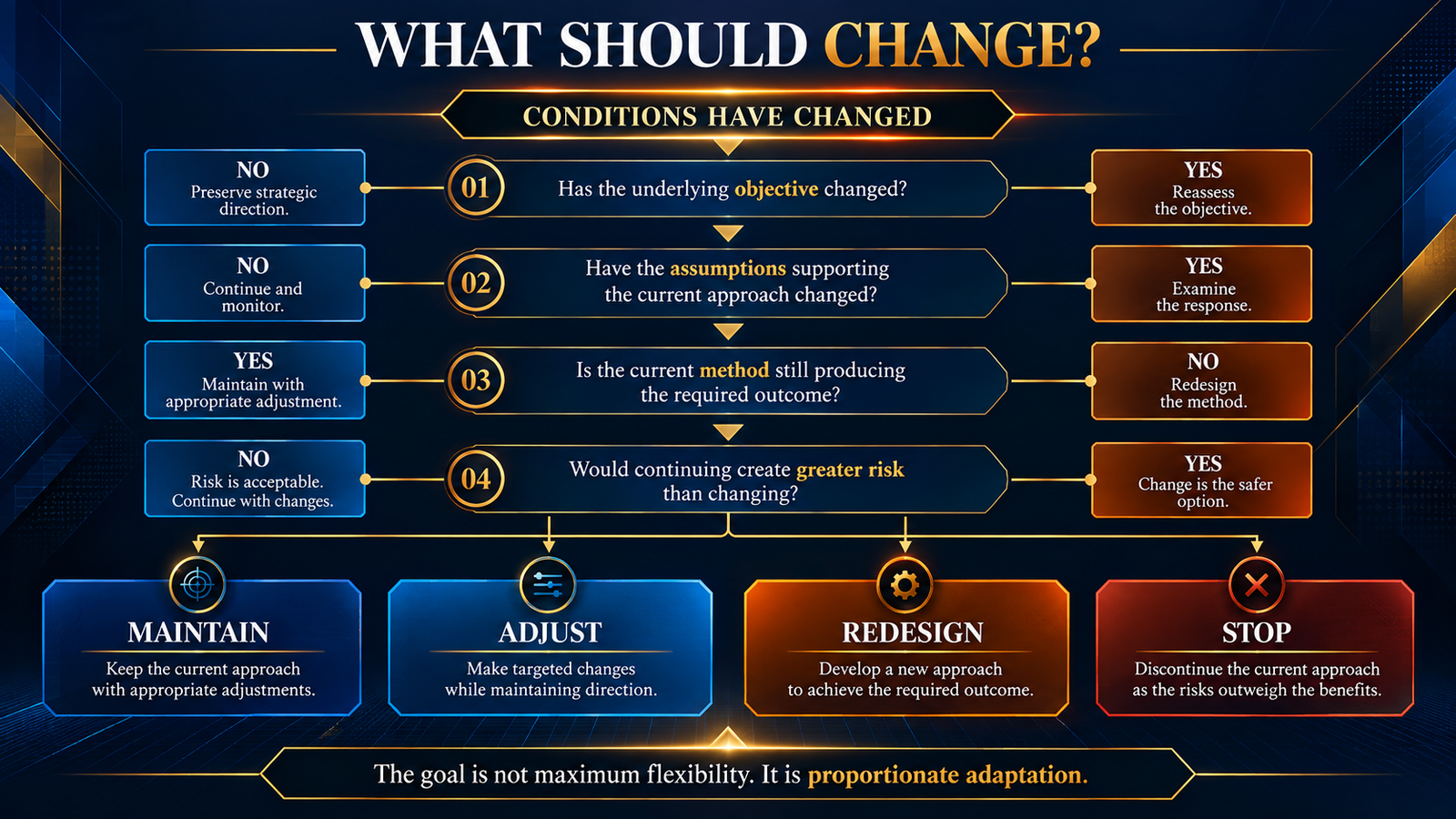
The Four Adaptive Responses: Maintain, Adjust, Redesign or Stop
When circumstances change, leaders often feel pressure to demonstrate action. But action is not automatically evidence of adaptability.
Sometimes the most intelligent response is to continue.
Sometimes a small adjustment is sufficient.
Sometimes the existing approach requires significant redesign.
And sometimes the evidence indicates that continuing would consume resources, increase risk or perpetuate a model that no longer fits reality.
Adaptability Intelligence™ therefore requires leaders to distinguish between four possible responses: Maintain. Adjust. Redesign. Stop.
The quality of leadership lies partly in determining which response the situation actually requires.
Response 1
Maintain
Not every change in the environment requires a change in direction. New information can be important without invalidating the existing approach.
A temporary decline in performance, an isolated complaint, a new competitor or an unexpected operational difficulty may justify attention without justifying strategic change.
Maintaining the existing approach can therefore be an adaptive decision when leaders have deliberately examined changing conditions and concluded that the underlying assumptions remain valid.
This is different from rigidity. Rigidity says: “We are continuing because this is what we have always done.” Adaptive maintenance says: “We have reviewed what has changed and the evidence still supports this direction.”
The behaviour may look identical. The quality of thinking behind it is not.
Response 2
Adjust
Many leadership situations require modification rather than transformation. The objective remains appropriate. The underlying strategy remains credible. But some aspect of execution needs to change.
- Resources might be redistributed.
- Communication may need strengthening.
- A timeline might require revision.
- A leader may need to change their behaviour.
- A team may need additional capability.
- A process may need simplifying.
Adjustment is often the least dramatic form of adaptability, but it may be the most frequently useful. Leaders do not need to redesign the organisation every time reality creates friction. Sometimes the intelligent response is simply to remove the friction.
Response 3
Redesign
Redesign becomes necessary when the objective remains valuable but the existing method no longer fits the environment.
This is a deeper form of adaptation. The leader is no longer making incremental improvements to an established approach. They are questioning its architecture.
- A service model may need redesigning.
- A leadership structure may need reconsideration.
- A workforce strategy may no longer match the skills required.
- A customer journey may have become outdated.
- A decision process may be too slow for the environment in which it now operates.
Redesign requires leaders to release attachment to the existing model while remaining clear about the outcome they are trying to protect. This is where the Adaptive Core™ becomes especially valuable. The method can change substantially because the core remains clear.
Response 4
Stop
Stopping is one of the most underused adaptive responses. Organisations frequently become better at adding than removing.
- A new priority emerges, so another initiative begins.
- A problem appears, so another process is introduced.
- A risk is identified, so another reporting requirement is created.
- A new technology arrives, but the old workflow remains alongside it.
Eventually, leadership becomes responsible for an accumulation of responses to conditions that may no longer exist.
Adaptability sometimes requires subtraction. An initiative may need to end. A meeting may no longer be useful. A reporting process may no longer justify the time it consumes. A product may need to be discontinued. A project may need to be closed. A leadership behaviour may need to stop.
This is not failure by definition. Continuing something that no longer creates sufficient value simply because resources have already been invested can create a larger failure.
Adaptive leaders therefore ask not only “What should we start doing?” They also ask: “What are we now prepared to stop?”
The Risk of Ethical Drift Under Pressure
The Maintain–Adjust–Redesign–Stop framework works well for methods, systems and strategies. But leadership becomes more complicated when pressure begins influencing standards.
Ethical drift rarely begins with a leader deciding to become unethical. It more often begins with a small exception that appears justified by circumstances.
A deadline is unusually demanding.
A customer is strategically important.
A target is under threat.
A high-performing employee is difficult to replace.
A stakeholder has considerable influence.
The leader makes an exception.
Then another.
Eventually, behaviour that once required justification becomes normal.
This is where adaptability can be misused.
- A leader may describe themselves as pragmatic when they are becoming inconsistent.
- They may describe an exception as necessary when the organisation has simply become dependent upon making exceptions.
- They may believe they are protecting performance while gradually weakening the standards that make performance sustainable.
The relevant question is therefore not: “Can we justify this once?”
That question changes the time horizon. It moves leadership attention away from immediate convenience and toward organisational precedent.
- What behaviour does this decision legitimise?
- What will employees reasonably conclude from it?
- Would we accept the same decision if another leader made it?
- Would we be comfortable explaining the reasoning openly?
- If this approach were repeated for twelve months, what would it do to the organisation?
These questions connect Adaptability Intelligence™ with Ethics Intelligence™ and Professionalism Intelligence™.
Adaptability determines how the response can move.
Ethics and professionalism help determine where the boundaries should sit.

The High Performer Exception
Consider a practical example.
A senior employee consistently produces exceptional commercial results. They also behave in ways that would normally trigger leadership intervention.
Colleagues complain about disrespectful communication.
Team members avoid challenging them.
Cross-functional relationships deteriorate.
The leader understands the problem but is under pressure to deliver demanding results. So the response becomes flexible.
- “Now isn’t the right time.”
- “We need the numbers.”
- “They’re under enormous pressure.”
- “We’ll address it after this quarter.”
This can be framed as adaptability. The leader is responding to commercial reality.
But what exactly is adapting? The performance strategy? Or the standard of behaviour?
The distinction matters.
An adaptive response might involve changing how the leader intervenes, providing more direct support, redesigning responsibilities or protecting critical commercial activity while addressing the behavioural problem.
A compromised response simply moves the standard because enforcing it has become inconvenient.
This illustrates a principle that applies far beyond performance management:
That is a much more sophisticated use of flexibility.
Leadership Workload™: When Adaptability Becomes Absorption
There is another danger hidden inside contemporary expectations of adaptability.
Leaders can become the mechanism through which organisations avoid addressing structural problems. Every time conditions change, the leader absorbs the difference.
- Demand increases. The leader works longer.
- Staffing decreases. The leader takes on additional responsibilities.
- A new strategic priority arrives. The leader adds it to the existing portfolio.
- A system fails. The leader creates a manual workaround.
- Another reporting requirement appears. The leader completes it outside normal working hours.
From the organisation’s perspective, adaptation appears successful. The work continues.
But the system has not necessarily adapted.
This distinction is fundamental to Leadership Workload™, Leadership Capacity™ and Leadership Sustainability™.
Burn Bright’s wider work on leadership burnout challenges leadership models that rely on leaders continually absorbing expanding demands rather than examining the systems creating those demands.
The same principle applies here. A leader’s willingness to work harder is not always evidence of adaptability. Sometimes it prevents the organisation from confronting a capacity problem.
Sustainable Adaptation Requires Substitution
A simple principle can help.
If nothing is removed, delayed, simplified or deprioritised, the organisation has not necessarily adapted. It may simply have accumulated more work.
This matters because repeated adaptation has a capacity cost.
Every new process needs attention.
Every additional priority competes for cognitive resources.
Every temporary workaround can become permanent.
Every exception creates another decision.
Eventually, leaders spend so much time maintaining accumulated adaptations that they have less capacity to interpret new changes intelligently.
This creates an important connection between Adaptability Intelligence™ and Leadership Sustainability™.
An adaptive response should not be judged only by whether it works today. Leaders should also ask: Can this response be sustained? If not, what must change before the temporary solution becomes the permanent operating model?
Adaptability Across Leadership Contexts
The boundary between flexible response and stable standards appears differently across sectors. The leadership intelligence remains transferable. The context changes. Explore our sector hubs for deeper, sector-specific guidance.
🏢 Business Growth Intelligence™: Protect the Customer Without Promising Everything
Commercial pressure creates powerful incentives for accommodation. A strategically important customer requests a highly customised solution. Sales wants to agree. Operations raises concerns. The opportunity is valuable, but delivering it could disrupt service for other customers.
A rigid organisation may simply refuse because the request falls outside the existing model. An overly accommodating organisation may agree without understanding the operational consequences.
Adaptability Intelligence™ creates a third option. Leaders examine what the customer genuinely needs, which elements of the current model can change, what capacity exists and which service standards must remain protected. The answer might be a modified solution rather than either complete refusal or unrestricted accommodation.
Adaptive commercial leadership therefore does not ask: “How do we say yes?” It asks: “What can we responsibly say yes to?” That distinction protects both growth and execution.
🏫 School Leadership Intelligence™: Adapt Provision Without Lowering Expectations
School leaders frequently balance competing demands from students, families, staff, policy requirements and resource constraints.
Adaptability may require different approaches for different circumstances. A student may need additional support. A teacher may require temporary workload adjustment. A curriculum implementation may need to proceed differently from the original plan.
The danger is assuming that adaptation necessarily means lowering expectations. It does not. A leader can change the route while protecting the intended outcome.
For example, providing additional support to help someone meet an appropriate standard is different from quietly removing the standard because achieving it has become difficult.
This is the Adaptive Core™ in practice. The method changes. The commitment remains.
🏥 Healthcare Leadership Intelligence™: Flexibility Within Safety Boundaries
Healthcare makes the relationship between adaptability and standards particularly visible. Demand can change rapidly. Capacity can become constrained. Technology can create new possibilities. Operational workflows may need significant adjustment.
Yet some boundaries exist precisely because the consequences of inconsistency can be serious.
Adaptive healthcare leadership therefore requires leaders to understand where flexibility is legitimate and where appropriate governance, evidence and professional safeguards must remain central.
The objective is not maximum procedural flexibility. It is safe adaptability.
Leaders may redesign the workflow. They may redistribute resources. They may introduce new technology. They may change communication patterns. But the need to adapt operationally does not automatically justify weakening the standards designed to protect patients, staff and professional accountability.
🏛️ Public Service Leadership Intelligence™: Responsiveness Without Arbitrary Decision-Making
Public-service organisations often experience pressure to respond quickly to changing public needs. Responsiveness matters.
But public leadership also carries obligations around consistency, accountability, transparency and fair treatment. This creates a distinctive adaptive challenge.
A leader may recognise that an established process is too slow or poorly suited to current conditions. The intelligent response is not necessarily to ignore the process. It may be to redesign it through the appropriate governance mechanisms.
Adaptability Intelligence™ therefore helps leaders distinguish between bureaucracy that can be improved and accountability that should be protected. The two are not the same.
👥 HR & People Leadership Intelligence™: Flexibility Without Unmanageable Exceptions
People leaders regularly encounter requests for flexibility. Many are entirely reasonable. Individual circumstances differ. Roles differ. Teams differ. Work can often be designed more intelligently when leaders move beyond unnecessary uniformity.
But flexibility can become difficult when individual exceptions accumulate without a coherent decision framework. Employees begin comparing arrangements. Managers become uncertain about boundaries. Decisions depend increasingly on who asks, which manager they have or how forcefully a request is made.
The problem is not flexibility itself. It is flexibility without intelligible principles.
Adaptive people leadership therefore requires leaders to explain the criteria governing flexibility. Consistency does not always mean treating everyone identically. It can mean applying consistent principles to different circumstances. That distinction allows adaptability and fairness to coexist.
🚀 Entrepreneur Performance Intelligence™: Pivot the Model, Not Every Principle
Entrepreneurs experience perhaps the strongest cultural pressure to pivot. Changing direction is frequently treated as evidence of entrepreneurial intelligence. Sometimes it is. But constant pivoting can also indicate insufficient strategic discipline.
A founder under financial pressure may begin accepting work that moves the business away from its intended market. Short-term revenue becomes attractive. The proposition broadens. The team becomes fragmented. Operational complexity increases. Eventually, the organisation is serving opportunities rather than executing a strategy.
Adaptability Intelligence™ asks the entrepreneur to distinguish between changing the business model because evidence demands it and abandoning strategic coherence because immediate pressure is uncomfortable.
The business may need to pivot. But the decision should be informed by evidence about what has changed—not simply by the emotional intensity of the moment.
The Leadership Pressure Test™
Before making a significant adaptive decision under pressure, leaders can use five questions.
1. PRESSURE — What is creating pressure to change our response?
Identify the source. Is it evidence? Urgency? Stakeholder expectations? Fear of conflict? Performance pressure? Resource scarcity? The source matters because pressure and evidence are not the same thing.
2. REALITY — What has genuinely changed?
Describe the change as objectively as possible. Separate what is known from what is assumed.
3. CORE — What must remain non-negotiable?
Identify the purpose, ethical boundaries, professional standards or commitments that should anchor the decision.
4. RESPONSE — What can legitimately change?
Consider behaviour, priorities, processes, resources, communication and execution. Look for flexibility around the core before moving the core itself.
5. CONSEQUENCE — What happens if we adapt, and what happens if we do not?
Consider both immediate and longer-term consequences. What precedent does the decision establish? What capacity does it require? What will employees learn from it? Could the response be sustained if the pressure continues?
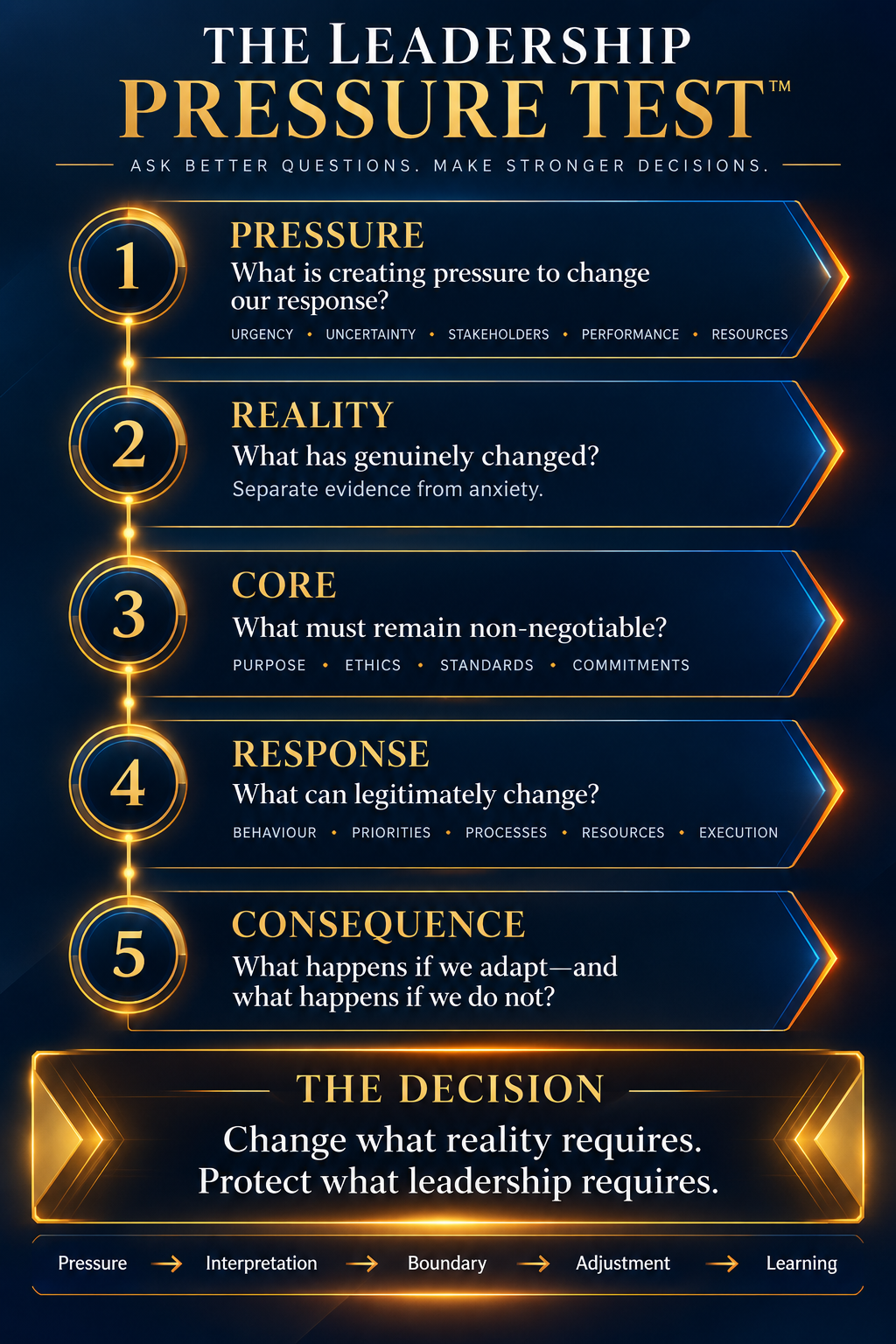
The five questions create a deliberate pause between pressure and response. That pause is important. Because leadership under pressure does not become more intelligent simply by becoming faster.
Sometimes the most adaptive thing a leader can do is create enough space to determine what reality actually requires before deciding what pressure appears to demand.
Adaptability Is a Boundary Capability
This leads to a deeper understanding of Adaptability Intelligence™.
Adaptability is not simply the capacity to move. It is the capacity to understand where movement is useful and where stability is necessary. That makes it a boundary capability.
The adaptive leader works continuously at the boundary between:
- flexibility and consistency;
- speed and judgement;
- responsiveness and accommodation;
- pragmatism and ethics;
- short-term necessity and long-term consequence;
- individual effort and sustainable capacity.
The strongest leaders are not those who always choose stability. Nor are they those who always choose change. They develop the intelligence to know which side of the boundary the situation requires.
And under pressure, that distinction becomes one of the clearest tests of leadership judgement.
| The Pressure-Driven Question | The Adaptive Leadership Question |
|---|---|
| Should we change? | What exactly has changed, and what scale of adjustment does that change justify? |
| Can we justify this once? | What would happen if this became normal? |
| How do we say yes? | What can we responsibly say yes to? |
| We are continuing because this is what we have always done. | We have reviewed what has changed and the evidence still supports this direction. |
| We need to become more flexible. | Flexible about what? |
| How adaptable are you? | When pressure increases, do you know what should change—and what should remain stable? |
Leadership Reflection Questions
Adaptability Intelligence™ becomes more useful when leaders examine not only whether they can change, but what happens to their judgement when pressure increases. Use these questions individually, with a leadership team or as part of a structured leadership review.
- What kinds of pressure are most likely to change how I lead?
- Which leadership standards do I consider genuinely non-negotiable?
- Where have temporary exceptions gradually become normal practice?
- Are we adapting our methods—or quietly lowering our standards?
- Where are we maintaining an established approach because changing it would require a difficult conversation?
- Where are we changing direction because pressure is uncomfortable rather than because evidence justifies the change?
- Which current leadership demands are being absorbed through additional individual effort rather than addressed through system redesign?
- When a new priority is introduced, what existing priority is reduced, removed or delayed?
- Would I be comfortable if the decision I am making under pressure became the organisation’s normal practice?
- What do people learn about our real values by observing the decisions we make when conditions become difficult?
Action Steps: Strengthening Adaptability Without Weakening Standards
Step 1 Define Your Adaptive Core™
Identify the elements that should provide stability when pressure increases. Document the purpose, ethical boundaries, professional standards and critical commitments that should not move casually.
Then identify the elements around that core that can legitimately adapt: behaviours, priorities, processes, resources, communication and execution.
The objective is not to make the core untouchable. It is to ensure that leaders recognise when they are changing it.
Step 2 Audit Your Exceptions
Review recurring exceptions across the organisation.
- Which were intended to be temporary?
- Which now occur regularly?
- Which exist because the underlying system no longer fits reality?
- Which are being granted primarily because enforcing the original standard has become difficult?
Repeated exceptions are information. They may indicate that a rule needs redesigning. They may also indicate that a valuable boundary is gradually disappearing. Leadership judgement is required to determine which.
Step 3 Apply the Maintain–Adjust–Redesign–Stop Test
For a current leadership challenge, deliberately consider all four options.
- Maintain: Does the evidence still support the existing approach?
- Adjust: Can a limited change restore effectiveness?
- Redesign: Has the environment changed enough that the existing method no longer fits?
- Stop: Are we maintaining something primarily because it already exists?
This reduces the tendency to treat every problem as requiring either complete persistence or complete transformation.
Step 4 Introduce the Substitution Question
Whenever a significant new priority is added, ask: What does this replace?
If the answer is “nothing,” examine the capacity implications. Repeatedly adding priorities without removing, reducing or delaying existing work can transform adaptability into overload.
This makes the substitution question an important bridge between Adaptability Intelligence™, Leadership Workload™ and Leadership Sustainability™.
Step 5 Use the Leadership Pressure Test™
Before a significant decision under pressure, work through five questions:
- Pressure: What is driving the demand for change?
- Reality: What has genuinely changed?
- Core: What must remain stable?
- Response: What can legitimately change?
- Consequence: What happens if we adapt—and if we do not?
The purpose is not to slow every decision. It is to prevent urgency from silently becoming the decision-making framework.
The Leadership Intelligence Connection
Adaptability under pressure demonstrates why leadership capabilities should not be developed in isolation.
Adaptability Intelligence™ enables movement when circumstances change. But adaptability alone cannot determine whether every available adjustment is appropriate. That requires connection with other domains of the Leadership Intelligence Compass™.
- Ethics Intelligence™ helps leaders determine which boundaries should remain intact even when compromising them appears expedient.
- Professionalism Intelligence™ protects standards of conduct, accountability and consistency when pressure makes maintaining them more difficult.
- Emotional Intelligence™ helps leaders recognise how stress, frustration, fear or urgency may be influencing interpretation and behaviour.
- Reflective Practice Intelligence™ creates the space to examine whether the current response is producing the intended consequences.
- Knowledge Development Intelligence™ helps leaders recognise when changing circumstances require new understanding rather than immediate action based on old assumptions.
- Visionary Leadership Intelligence™ provides strategic direction so that flexibility does not become drift.
- Leadership Sustainability™ tests whether the adaptive response can be maintained without continually consuming more leadership capacity than the system can provide.
Together, these capabilities contribute to Leadership Performance Intelligence™.
The aim is not to create leaders who possess a collection of disconnected competencies. It is to develop leaders who can recognise which forms of intelligence a situation requires and how those capabilities must interact.
Explore Adaptability Intelligence™ alongside the ethical, professional, emotional, reflective and sustainability capabilities that influence leadership performance through the Leadership Intelligence Assessment™, or continue into the Leadership Intelligence Library™ to identify where greater flexibility is required—and where stronger leadership boundaries may be equally important.
Conclusion: Change the Response. Protect the Standard.
Leadership adaptability is often presented as a simple virtue.
Be flexible.
Embrace change.
Respond quickly.
Stay open-minded.
But leadership under pressure reveals why adaptability is more demanding than these instructions suggest.
Leaders do not merely decide whether to change. They decide what is allowed to change. That distinction has consequences.
Mature Adaptability Intelligence™ avoids these extremes.
- It creates a stable core and a flexible response.
- It asks leaders to interpret the environment carefully enough to determine whether they should maintain, adjust, redesign or stop.
- It encourages responsiveness without surrendering judgement.
- It allows methods to evolve without assuming that standards must deteriorate.
- And it recognises that sustainable adaptation sometimes requires subtraction rather than another demand placed upon leaders and teams.
This creates a more useful question than: “How adaptable are you?”
That question reaches the centre of leadership judgement.
Because leadership credibility is not established only through what leaders protect when conditions are favourable. It is revealed through what they continue to protect when protecting it becomes difficult.
Adaptability should enable leaders to respond more intelligently to reality. It should not allow reality’s immediate pressures to define every aspect of leadership.
Change the response when the evidence requires it.
Redesign the method when the method no longer works.
Stop what no longer creates sufficient value.
But know which standards should not move simply because pressure is pushing against them.
That is adaptability with boundaries.
That is adaptability with judgement.
And within the Burn Bright Advisory™ leadership system, that is the work of Adaptability Intelligence™ as part of Leadership Performance Intelligence™.
Go Deeper Than a Snapshot
The Burn Bright Full Diagnostic™ gives you a comprehensive view of the workload, capacity and system pressures shaping your leadership — £144.
Frequently Asked Questions
What is adaptability leadership?
Adaptability leadership is the capacity to interpret changing circumstances and make proportionate adjustments to behaviour, priorities, decisions, resources or systems while maintaining appropriate alignment with purpose, values and strategic direction.
How can leaders adapt under pressure?
Leaders can adapt under pressure by first determining what has genuinely changed, then separating the elements that should remain stable from those that can legitimately change. The response should be proportionate to the evidence rather than driven solely by urgency or discomfort.
What is the Adaptive Core™?
The Adaptive Core™ is a Burn Bright Advisory™ framework that distinguishes between relatively stable leadership foundations—such as purpose, ethics, values and professional standards—and the more flexible leadership responses surrounding them, including behaviour, priorities, processes, resources, communication and execution.
What is the difference between adaptability and compromise?
Adaptability modifies the response to fit changing circumstances while protecting appropriate leadership boundaries. Compromise occurs when pressure causes leaders to weaken standards or principles that should remain stable without sufficient examination or justification.
Can a leader be too adaptable?
Yes. Flexibility without sufficient strategic or ethical boundaries can become reactivity, inconsistency or over-accommodation. Mature adaptability is not maximum flexibility; it is proportionate adjustment informed by evidence, judgement and clear boundaries.
How does adaptability relate to leadership ethics?
Adaptability asks what can or should change in response to circumstances. Ethics Intelligence™ helps leaders determine which possible adjustments remain appropriate. Together, they enable leaders to respond flexibly without treating immediate outcomes as the only measure of a good decision.
What are the four adaptive leadership responses?
The four responses are Maintain, Adjust, Redesign and Stop. Leaders can use these options to determine whether current conditions support continuation, limited modification, fundamental redesign or ending an existing approach.
How does leadership workload affect adaptability?
When organisations respond to every new demand by adding responsibilities without removing existing work, leaders may absorb organisational problems through additional effort. Sustainable adaptability therefore requires attention to Leadership Workload™, Leadership Capacity™ and what new priorities replace.
How can organisations develop Adaptability Intelligence™?
Organisations can strengthen Adaptability Intelligence™ by improving environmental sensing, testing assumptions, clarifying non-negotiable standards, creating safe mechanisms for challenge, reviewing exceptions, defining decision rights and systematically learning from previous adaptations.
How does Adaptability Intelligence™ connect with Leadership Performance Intelligence™?
Adaptability Intelligence™ is one domain contributing to the wider Leadership Performance Intelligence™ system. Its effectiveness depends partly on connected capabilities including Ethics Intelligence™, Professionalism Intelligence™, Emotional Intelligence™, Reflective Practice Intelligence™, Knowledge Development Intelligence™, Visionary Leadership Intelligence™ and Leadership Sustainability™.
How Adaptable Is Your Leadership Under Pressure?
Find out where pressure may be reshaping your leadership — and where the system, not you, needs to change.
Free Leadership Intelligence
Get Weekly Leadership Insights
Join thousands of leaders receiving practical strategies on burnout prevention, workload design, and sustainable performance every week.