Quick Answer
Key Takeaways
- Audit before cutting. Understand the purpose and value of meetings before changing the calendar.
- Measure the real cost. Include participant time, preparation, follow-up and lost concentration.
- Challenge recurring meetings. A regular calendar invitation is not evidence of ongoing value.
- Redesign decision-making. Clarify who needs to attend, who has authority and what outcome is required.
- Protect recovered capacity. Use reclaimed time for strategic leadership, focused work and recovery rather than filling it with more activity.
Meeting Audit Process: Reclaim Leadership Time
Introduction
A meeting audit process is one of the most practical ways to address a problem that quietly damages leadership effectiveness: the calendar that leaves no time to lead.
Many senior leaders begin their day with a full schedule and finish it with their most important work untouched.
They have attended operational updates, reviewed projects, responded to emerging issues and participated in discussions that produced few meaningful decisions.
Then the real work begins.
Strategic planning moves into the evening.
Difficult decisions are postponed.
Team development becomes something to fit between commitments.
The leader works longer, but the organisation does not necessarily perform better.
Across more than 30 years in leadership, I have seen how easily meetings become a substitute for clear authority, effective communication and disciplined management.
The problem is rarely one unnecessary meeting. It is the cumulative effect of a system that demands constant attendance without questioning the value created.
In this article, I will explain how to audit meetings, identify hidden costs, redesign meeting structures and recover leadership capacity without damaging communication or accountability.
Is your calendar leaving you no time to lead? Find out where the pressure is coming from.
The first step is understanding how meeting overload develops across an organisation.

When organisations fail to define how information and decisions should move, meetings become the default coordination mechanism. The calendar absorbs weaknesses that should be corrected through organisational design.
What Is a Meeting Audit Process?
Featured Snippet
Why Is a Meeting Audit Process Essential for Leaders?
Meeting overload is often treated as a personal time management problem.
It is usually an organisational architecture problem.
When leaders have no clear rules for meetings, every new initiative generates another invitation. Every uncertainty creates another discussion. Every decision requires another round of consultation.
The Hidden Cost of Constant Attendance
Microsoft’s 2023 Work Trend Index reported that 68% of surveyed workers lacked sufficient uninterrupted focus time during the working day. The same research identified inefficient meetings as the number one reported disruptor of productivity.
These findings matter because leadership effectiveness depends on more than being available.
Leaders need time to interpret information, assess risk, develop people and make difficult decisions. A calendar filled with meetings can prevent all four.
Microsoft’s 2025 Work Trend Index also described the rise of the infinite workday, with communication demands extending across conventional working hours. Its analysis reported an average of 117 emails and 153 Teams messages per day among the Microsoft 365 users studied.
The implication is straightforward. Meetings do not exist in isolation. They compete with an already fragmented working environment.
When Busyness Becomes the Performance Measure
Consider a fictional but typical operations director attending six hours of meetings daily.
The remaining two hours must accommodate emails, staff support, decisions, planning and unexpected problems. There is no realistic capacity for all these responsibilities.
The director starts working earlier and finishing later.
Management may interpret this as dedication. In reality, it is evidence of poor workload design.
The Burn Bright Leadership Burnout Course explores the wider structural causes behind these patterns.
The World Health Organization defines burnout as an occupational phenomenon resulting from chronic workplace stress that has not been successfully managed. Its three dimensions are:
- Exhaustion
- Increased mental distance or cynicism
- Reduced professional efficacy
Meeting overload can contribute to the chronic work pressures behind these experiences, particularly when leaders lack control over their calendars.
The solution is not simply to become better at enduring meetings. It is to redesign why those meetings exist.
How Do You Conduct a Meeting Audit Process?
A useful meeting audit process must move beyond counting hours.
A calendar can look efficient while still producing poor decisions, duplicated work and unnecessary interruptions.
I recommend a five-stage framework.
The Burn Bright Five-Stage Meeting Audit
- Inventory — Capture every recurring and significant ad hoc meeting.
- Evaluate — Assess purpose, cost, attendance and outcomes.
- Classify — Retain, redesign, combine, replace or eliminate.
- Rebuild — Create clear meeting and decision rules.
- Review — Measure the results after 30 days.
Stage 1: Inventory the calendar
Review four weeks of meetings. Record the meeting name, organiser, duration, frequency, attendees and stated purpose.
Include recurring meetings, project discussions, operational updates and informal decision sessions.
Do not rely on calendar titles alone. A meeting labelled strategic review may be little more than a status update.
Stage 2: Evaluate actual value
Ask five questions:
- What decision or outcome did this meeting produce?
- Could the information have been communicated without a meeting?
- Did every participant contribute something essential?
- Was the meeting the right length?
- Would removing it create a genuine operational risk?
A meeting that cannot demonstrate value should not automatically retain its place.
Stage 3: Classify each meeting
Assign each meeting one of five possible outcomes (see the table below).
| Outcome | When to Use It |
|---|---|
| Retain | Essential meetings with clear decisions and appropriate attendance |
| Redesign | Valuable meetings that need shorter agendas or fewer participants |
| Combine | Meetings that duplicate related discussions |
| Replace | Information-sharing meetings better handled through written updates |
| Eliminate | Meetings with no clear purpose or useful outcome |
Stage 4: Rebuild the meeting structure
Establish rules for agendas, attendance, decision ownership and follow-up.
Use the Burn Bright RACI Delegation Framework™ to clarify who is responsible, accountable, consulted and informed.
Not everyone who needs information needs to attend the decision.
Stage 5: Review the impact
After 30 days, assess whether the changes improved outcomes. Track meeting hours, decisions completed, strategic time protected and staff feedback.
Do not measure success by calendar reductions alone.
What Is the Real Cost of Meeting Overload?
The financial cost of meetings is often hidden because organisations rarely account for collective attendance time.
A one-hour meeting attended by eight people consumes eight working hours before preparation or follow-up.
That is not necessarily waste. It becomes waste when the meeting fails to produce sufficient value to justify the investment.
Calculate the Direct Cost
Use this formula:
Consider an illustrative organisation where eight managers attend a weekly 90-minute meeting. Assume a fully loaded employment cost of £60 per hour.
| Illustrative Assumption | Value |
|---|---|
| Attendees | 8 |
| Duration | 90 minutes |
| Hourly cost | £60 |
| Annual occurrences | 46 |
| Estimated annual staff-time cost | £33,120 |
Under these assumptions, that single meeting costs £33,120 annually in staff time. Substitute your own figures into the formula to estimate the direct staff-time cost of any recurring meeting. This is not an estimate of recoverable savings.
Removing half its duration would release 276 participant-hours over 46 weeks.
Those hours do not automatically translate into cash savings. Their value depends on whether the capacity is redirected towards more productive work.
The Indirect Cost Is Often Greater
Meeting overload also creates fragmented attention.
Leaders move from discussion to discussion without sufficient time to prepare, reflect or follow through.
Decisions become rushed.
Problems return because their causes were never addressed.
This creates what I describe in Burn Bright Not Out as part of the Culture Tax™: the ongoing cost organisations pay when inefficient structures generate exhaustion, disengagement and unnecessary work.
Research from Gallup’s State of the Global Workplace 2025 reported that global employee engagement fell from 23% to 21% in 2024, with manager engagement declining from 30% to 27%.
These figures do not establish that meetings caused the decline. They do reinforce the need to protect managerial capacity rather than treating it as unlimited.
The following visual illustrates how a recurring meeting accumulates costs over a working year.
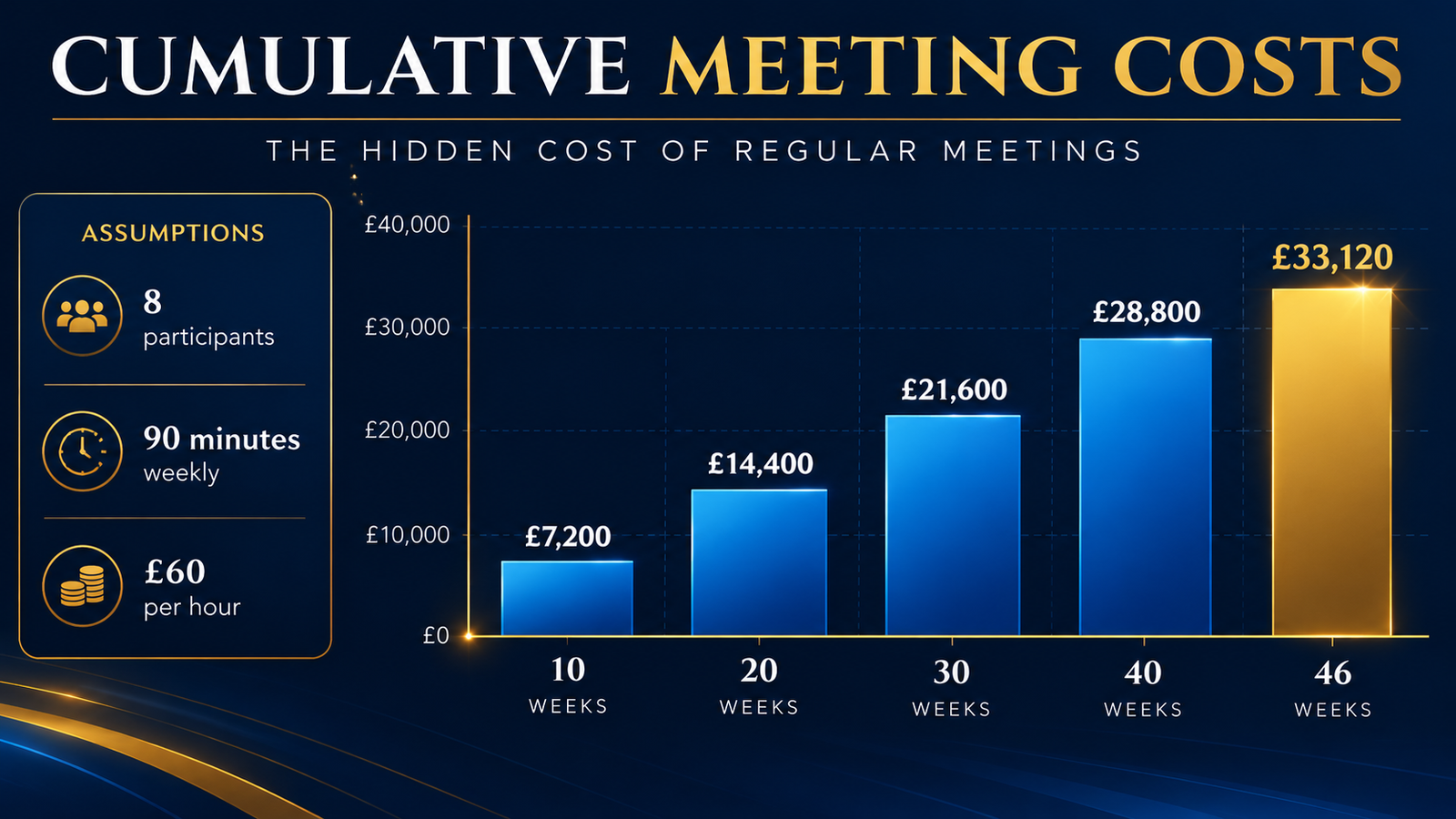
The key lesson is not that meetings are inherently expensive.
Which Meetings Should Leaders Eliminate or Redesign?
The purpose of a meeting audit process is not to create an organisation where nobody speaks to one another. It is to distinguish essential collaboration from unnecessary coordination.
Some meetings protect quality, safety and accountability. Others exist because nobody has questioned an old routine. The distinction matters.
The Five Meeting Categories
Category 1 Decision Meetings
These bring together people with the information and authority needed to make a specific decision. They should have a clear question, an identified decision owner and a recorded outcome.
Category 2 Problem-Solving Meetings
These address issues that require collaborative thinking. They work best when participants receive relevant evidence beforehand and understand the problem they are solving.
Category 3 Relationship and Development Meetings
One-to-one conversations, coaching and sensitive staff discussions often require direct interaction. Removing these simply to improve meeting statistics can damage leadership effectiveness.
Category 4 Information-Sharing Meetings
Routine updates may not require synchronous attendance. Written summaries, shared dashboards and recorded briefings can often communicate information more efficiently.
Category 5 Legacy Meetings
These continue because they have always existed. They may have no current owner, meaningful agenda or clear output. Legacy meetings are strong candidates for elimination.
Traditional Versus Sustainable Meeting Management
| Traditional Approach | Sustainable Approach |
|---|---|
| Every issue requires a meeting | Meetings are reserved for meaningful interaction |
| Attendance demonstrates commitment | Contribution determines attendance |
| Recurring meetings continue indefinitely | Recurring meetings have review dates |
| Information is shared verbally | Routine updates are shared asynchronously |
| Senior leaders approve routine decisions | Decision authority sits at the appropriate level |
| Success means a full calendar | Success means effective decisions and outcomes |
| Strategic work happens after hours | Strategic time is protected within working hours |
A Practical Example
🏫 Secondary School Leadership Team
Imagine a secondary school leadership team holding a 60-minute operational meeting every morning. Eight senior staff attend. Much of the time is spent reviewing information already available in the school’s management systems.
A meeting audit identifies that only two recurring items require collective decisions. The team redesigns the process: routine updates move into a shared dashboard, operational exceptions are handled through a 15-minute daily meeting, and complex decisions receive separate, focused discussions with relevant participants.
The change reduces unnecessary attendance without removing essential communication.
The same principle applies to hospitals, businesses, government departments and charities. Meeting design should reflect the decisions an organisation needs to make, not the habits it has inherited.
How Can Leaders Protect the Time Recovered from Meetings?
Removing unnecessary meetings creates an opportunity. It does not guarantee sustainable leadership.
Without new operating rules, recovered time quickly fills with additional requests, emails and urgent discussions.
This is why a meeting audit process must connect to wider Workload Architecture™.
Protect Strategic Thinking
Strategic leadership requires uninterrupted time. Leaders need space to evaluate performance, anticipate risks, develop capability and consider long-term consequences.
These responsibilities cannot be completed effectively through constant reactive communication.
- Start by protecting two 90-minute strategic blocks each week.
- Treat these blocks as legitimate leadership commitments rather than empty calendar space.
- Make the purpose visible to colleagues.
- Define genuine exceptions, particularly in safety-critical environments.
Clarify Decision Authority
Many organisations create unnecessary meetings because people are uncertain who can make decisions. The result is upward escalation.
Routine operational choices reach senior leaders who should be focused on more significant issues.
The Burn Bright four-pillar structural transformation framework addresses this through four pillars.
Pillar 1
Workload Architecture™
Designing responsibilities around realistic capacity.
Pillar 2
Decision Authority™
Placing decisions with appropriately empowered people.
Pillar 3
Recovery Rhythms™
Building sustainable patterns of work and restoration.
Pillar 4
Management Frameworks
Creating clear systems for coordination and accountability.
Meeting redesign should support all four pillars.
For example, reducing an executive’s operational meetings is ineffective if every operational decision still requires that executive’s approval.
Establish Meeting Standards
Create simple rules that apply across leadership teams.
- Every meeting should have a purpose, an owner and a defined outcome.
- Recurring meetings should have an expiry or review date.
- Attendance should reflect contribution rather than hierarchy.
- Information should be shared in advance where practical.
- Decisions should be documented once, in a location accessible to those who need them.
These standards reduce the need to repeatedly discuss matters that should already be clear.
Protect Recovery as Well as Productivity
The purpose of recovering time is not to squeeze more work into every available minute. That would reproduce the original problem.
Some capacity should be allocated to reflection, preparation, coaching and recovery.
In my book Burn Bright Not Out, I argue that sustainable leadership requires deliberate structures that preserve capacity over time.
The solution framework below connects meeting redesign to sustainable performance.
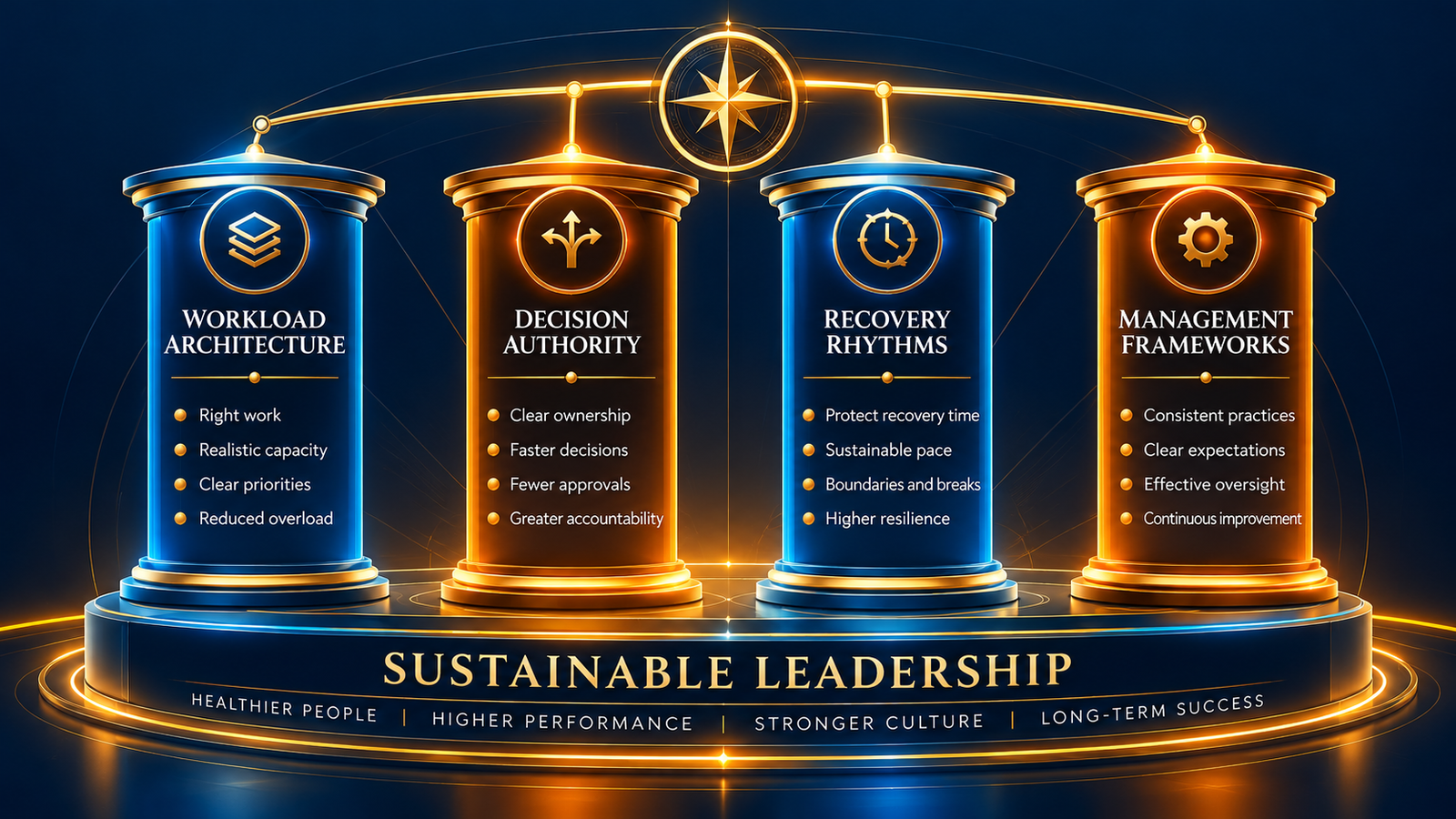
A successful audit does more than reduce attendance. It improves how the organisation distributes work, makes decisions and protects leadership capacity.
How Do You Measure Meeting Audit Success After 30 Days?
A meeting audit process should produce measurable organisational improvements. But the wrong measures can encourage the wrong behaviour.
If managers are rewarded only for reducing meeting hours, they may cancel valuable conversations and create new communication problems.
The objective is better organisational effectiveness.
Measure Four Outcomes
Measure 1 Meeting Capacity
Track total meeting hours, average duration, attendance and recurring commitments. Compare the results against the original four-week baseline.
Measure 2 Decision Effectiveness
Measure how quickly important decisions are made, how frequently they are reopened and whether ownership is clear. Fewer meetings are useful only when decisions remain effective.
Measure 3 Strategic Capacity
Measure protected time actually used for planning, improvement and leadership development. A calendar block that is repeatedly cancelled does not represent recovered capacity.
Measure 4 Leadership Sustainability™
Ask leaders whether they have sufficient time to complete core responsibilities during normal working hours. Track reported overload, after-hours work and perceived control over workload.
The Burn Bright leadership burnout reset addresses the broader challenge of restructuring unsustainable work patterns.
A 30-Day Implementation Plan
| Period | Action | Intended Result |
|---|---|---|
| Days 1–7 | Inventory meetings and calculate costs | Establish a reliable baseline |
| Days 8–14 | Evaluate and classify meetings | Identify changes and decision risks |
| Days 15–21 | Trial revised schedules and decision rules | Test whether communication remains effective |
| Days 22–30 | Measure outcomes and gather feedback | Confirm, adjust or reverse changes |
Avoid treating the first month as the final answer.
Some improvements will be immediate. Others will require changes to reporting lines, communication systems and decision authority.
A meeting that appears unnecessary may support a critical relationship or risk-management function. That is why judgement matters.
Make Meeting Audits Part of Management Practice
Repeat the review quarterly or when organisational responsibilities change significantly.
New projects, restructures and technology systems can all generate additional meetings. Without periodic review, meeting overload gradually returns.
Burn Bright Advisory’s advanced AI tools can support more structured leadership work. However, technology should support a clear operating model, not compensate for its absence.
A calendar is not simply a scheduling tool.
It is evidence of how an organisation distributes attention, responsibility and authority.
When the calendar is permanently overloaded, leaders should examine the system before asking individuals to become more efficient.
Frequently Asked Questions
What is the main purpose of a meeting audit process?
The main purpose is to determine whether meetings create enough organisational value to justify the time and resources they consume. A meeting audit identifies unnecessary attendance, duplicated discussions, unclear decision ownership and inefficient communication. The intended result is better decisions, stronger accountability and more sustainable workloads, not simply fewer meetings.
How often should organisations conduct a meeting audit?
Organisations should consider a comprehensive meeting audit every quarter, particularly where meeting demands change frequently. Additional reviews are useful after restructuring, major project launches or changes in leadership responsibilities. Individual recurring meetings should also have periodic review dates so that outdated commitments do not continue automatically.
How do you know whether a meeting is unnecessary?
A meeting may be unnecessary when it has no clear purpose, produces no decisions, duplicates another discussion or only communicates information that could be shared in writing. However, relationship-building, coaching and sensitive conversations may create value that is not immediately measurable. Evaluate the function before deciding to remove it.
Can reducing meetings help prevent leadership burnout?
Reducing unnecessary meetings can help lower workload pressure, protect concentration and improve control over the working day. However, meeting reductions alone will not prevent burnout if excessive demands, unclear authority and unrealistic expectations remain. Effective prevention requires wider structural changes to workload, decision-making, management systems and recovery opportunities.
What percentage of meetings should organisations eliminate?
There is no universal percentage that every organisation should target. The appropriate reduction depends on meeting purpose, operational risks and the organisation’s existing practices. Begin by identifying meetings with little demonstrated value, trial changes and measure their effects. A smaller reduction that improves decision quality is preferable to aggressive cuts that damage communication.
What is the difference between a meeting audit and calendar management?
Calendar management focuses on arranging an individual’s commitments. A meeting audit examines why those commitments exist and whether they support organisational performance. Calendar management may create more efficient scheduling. A meeting audit can reveal deeper structural problems, including duplicated reporting, unclear authority, unnecessary escalation and ineffective communication practices.
Conclusion: Better Meetings Begin with Better Systems
A meeting audit process provides leaders with something more valuable than an emptier calendar. It creates an opportunity to redesign how their organisation works.
When meetings multiply without scrutiny, they consume leadership capacity that should be directed towards decisions, strategy, staff development and organisational improvement.
The consequences extend beyond lost hours. Constant attendance fragments concentration, delays important work and reinforces a culture where visible busyness is mistaken for effectiveness.
But meeting overload is not inevitable.
Leaders can inventory commitments, evaluate their purpose, clarify decision authority and establish better communication standards. They can protect strategic time without abandoning accountability. They can create systems that allow people to collaborate effectively without requiring everyone to attend everything.
Most importantly, they can stop treating unsustainable workloads as evidence that individuals need to work harder.
Burnout is a system failure. Fix the system, not the person.
Better systems outperform more effort.
And sustainable leadership requires the discipline to question the structures that consume our time.
See the Full Picture
Move beyond a calendar review to a full, structured diagnostic of how workload, decision demands and meeting load are affecting your leadership capacity.
Take the Leadership Burnout Self-Assessment
If your calendar is permanently full, your strategic work happens after hours, or your leadership responsibilities feel increasingly unmanageable, begin by identifying the pressures driving that pattern.
Free Leadership Intelligence
Get Weekly Leadership Insights
Join thousands of leaders receiving practical strategies on burnout prevention, workload design, and sustainable performance every week.