Quick Answer
Key Takeaways
- Adaptability is a leadership intelligence capability, not merely a personality characteristic.
- Effective adaptation requires judgement about what to change and what to preserve.
- Organisational systems can either enable or restrict adaptive leadership.
- Adaptability must be balanced with ethics, reflection, professional standards and Leadership Sustainability™.
- Sustainable leadership performance depends on developing adaptability as a repeatable organisational capability rather than relying on individual improvisation.
Adaptability Intelligence™: Why Effective Leadership Requires More Than Responding to Change
The leadership capability that connects uncertainty, judgement, learning and sustainable performance.
Introduction: The Leadership Challenge Is No Longer Simply Change
Change has always been a feature of leadership.
Organisations evolve, markets shift, policies change, technologies advance and stakeholder expectations develop. Effective leaders have historically needed to adjust their decisions and approaches in response to these conditions.
What distinguishes the contemporary leadership environment is not simply the presence of change, but the interaction between its pace, complexity and consequences.
- A school leader implementing curriculum reform may simultaneously face staffing shortages, financial constraints and changing community expectations.
- A healthcare executive introducing new clinical technology must consider operational efficiency, patient safety, workforce confidence and regulatory responsibilities.
- A business leader responding to market disruption may need to revise commercial strategy while protecting organisational culture, employee capability and long-term investment.
These situations cannot be resolved through flexibility alone.
They require leaders to interpret competing signals, distinguish temporary disruption from structural change, assess risks and make decisions under conditions where information may be incomplete.
They also require something frequently overlooked in conventional leadership development: the ability to recognise when adapting too quickly can be as damaging as failing to adapt at all.
Is constant change quietly eroding your leadership capacity? Find out where you stand.
This is where Adaptability Intelligence™ becomes important.
Within the Leadership Intelligence Compass™, Adaptability Intelligence™ provides a way of understanding the relationship between changing circumstances, leadership judgement and effective organisational responses.
It shifts the leadership question from:
How quickly can we respond to change?
To a more consequential question:
This distinction matters because responsiveness and effectiveness are not synonymous.
A leader may react rapidly to every emerging problem yet create instability through inconsistent decisions. Another may maintain established practices with confidence, despite growing evidence that those practices are no longer appropriate.
Neither approach necessarily demonstrates effective adaptability.
The leadership challenge is to develop the intelligence required to distinguish between necessary adjustment, avoidable disruption and enduring organisational priorities.

What Is Adaptability Intelligence™?
Featured Snippet
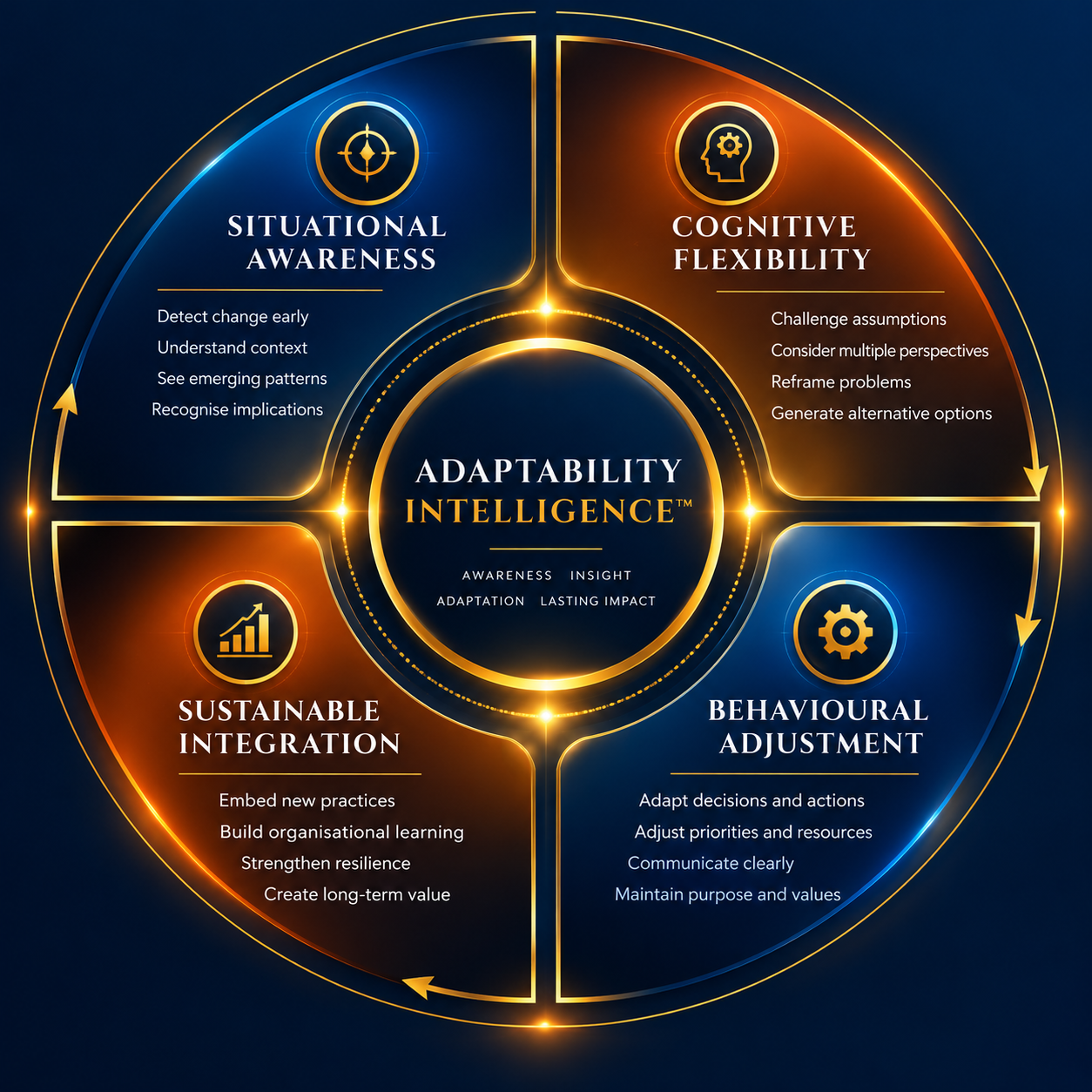
It involves more than reacting to external events. It requires the deliberate interaction of four leadership capabilities.
Capability 1
Situational Awareness
Leaders must recognise when the conditions surrounding their decisions have changed. This includes identifying emerging risks, changes in stakeholder expectations, operational pressures and evidence that existing approaches may be losing effectiveness.
Situational awareness is not simply the accumulation of information. It is the ability to distinguish meaningful signals from organisational noise.
Capability 2
Cognitive Flexibility
Effective leaders must be capable of reconsidering their interpretations without abandoning sound judgement. Experience provides valuable knowledge, but it can also create assumptions that become difficult to challenge.
Cognitive flexibility allows leaders to consider alternative explanations, incorporate new evidence and revise their thinking when circumstances warrant it.
Capability 3
Behavioural Adjustment
Recognising the need for change is insufficient unless leaders can translate that recognition into appropriate action. This may involve adjusting communication, redistributing authority, revising processes, modifying strategic priorities or changing how decisions are made.
Adaptability becomes visible through the quality and consequences of these adjustments.
Capability 4
Sustainable Integration
Adaptation must ultimately strengthen rather than continuously exhaust organisational capacity. A leadership response that achieves an immediate result while creating chronic workload pressure, confusion or declining trust may represent short-term responsiveness rather than effective adaptation.
Sustainable integration requires leaders to evaluate whether changes can be maintained, understood and supported by the people responsible for implementing them.
Together, these capabilities position adaptability as a form of leadership intelligence rather than an isolated behavioural preference.
Why Adaptability Must Be Understood as Intelligence
Traditional leadership discussions often describe adaptability as an individual attribute. Some leaders are considered naturally flexible, while others are characterised as resistant to change.
Although individual differences matter, this interpretation overlooks the role of judgement, learning and organisational conditions.
A leader can be personally comfortable with uncertainty yet make poor adaptive decisions. Similarly, a leader who prefers structure may demonstrate strong adaptability by systematically reviewing evidence, consulting stakeholders and modifying established practices when necessary.
The distinction lies in how adaptability is exercised. Intelligent adaptation requires leaders to answer several questions:
- What has actually changed?
- Which assumptions are no longer reliable?
- What evidence supports a different response?
- Which principles and commitments should remain unchanged?
- What consequences might follow from the proposed adjustment?
- How will we know whether the adaptation has been effective?
These questions transform adaptability from a general willingness to change into a disciplined process of leadership judgement.
They also expose an important limitation in conventional leadership development. Teaching leaders to embrace change does not necessarily equip them to evaluate it.
This distinction is especially important when leaders operate under pressure to demonstrate decisiveness. A rapid response may appear confident and capable. Yet speed can conceal inadequate consultation, weak evidence or insufficient consideration of downstream consequences.
Adaptability Intelligence™ therefore requires an appropriate balance between responsiveness and reflection. The objective is not to delay necessary action. It is to ensure that action is informed by the conditions, responsibilities and consequences of the leadership situation.
Research Foundation
Ronald Heifetz’s distinction between technical problems and adaptive challenges provides an established theoretical foundation for this argument. His work at Harvard Kennedy School emphasises that adaptive challenges cannot be solved by applying existing expertise; they require learning and changes to established practices.
The Burn Bright Advisory interpretation extends this discussion by explicitly connecting adaptability to Leadership Sustainability™, ethical judgement, reflective practice and organisational capacity.
Adaptability Intelligence™ Within the Leadership Intelligence Compass™
Adaptability does not operate independently of other leadership capabilities. A leader’s capacity to respond effectively to changing circumstances depends on the quality of their professional judgement, ethical reasoning, emotional awareness, reflective practice and ability to develop new knowledge.
This interdependence is central to Burn Bright Advisory’s Leadership Intelligence Compass™. The Compass positions leadership effectiveness as the interaction of multiple intelligence domains rather than the possession of isolated competencies.
Within this framework, Adaptability Intelligence™ performs an important integrating function. It enables leaders to translate their existing capabilities into appropriate responses when established assumptions, practices or operating conditions change.
Consider the relationship between adaptability and five other Compass domains.
Domain 1 Professionalism Intelligence™: Maintaining Standards During Change
Adaptability should never become an excuse for inconsistent professional standards. Leaders may need to modify processes, redistribute responsibilities or reconsider established methods. However, the expectations surrounding competence, accountability, reliability and professional conduct should remain clear.
Professionalism Intelligence™ provides the standards against which adaptive decisions can be evaluated. The essential question becomes: Are we changing how we work while maintaining the professional standards that make our work trustworthy?
Domain 2 Ethics Intelligence™: Recognising the Boundaries of Adaptation
Not every response to organisational pressure is ethically acceptable. A healthcare leader facing staffing shortages may need to redesign service delivery, but patient safety cannot simply become a negotiable variable. A business executive experiencing financial pressure may need to restructure operations, but the process must still consider fairness, transparency and legitimate employee interests.
Ethics Intelligence™ establishes the moral boundaries within which adaptation must occur. Without this connection, adaptability risks becoming organisational opportunism: changing direction whenever circumstances make established commitments inconvenient.
Domain 3 Reflective Practice Intelligence™: Learning Before Repeating
Leaders frequently encounter situations that resemble previous challenges. Experience can help them respond efficiently, but it can also encourage the uncritical repetition of familiar solutions.
Reflective Practice Intelligence™ allows leaders to examine the assumptions behind their decisions, recognise patterns in their responses and identify opportunities for improvement. Reflection therefore strengthens adaptability by transforming experience into usable leadership knowledge.
Domain 4 Knowledge Development Intelligence™: Updating What Leaders Know
Organisational environments change partly because the available knowledge changes. New evidence, technologies, professional standards and stakeholder insights may challenge previously accepted approaches.
Knowledge Development Intelligence™ supports the continuous renewal of leadership understanding. Adaptability Intelligence™ then enables leaders to translate that understanding into revised decisions and organisational practices.
Knowledge without adaptation risks becoming theoretical. Adaptation without knowledge risks becoming poorly informed experimentation.
Domain 5 Leadership Sustainability™: Protecting Future Performance
One of the most consequential relationships within the Compass is between adaptability and sustainability. Leaders may successfully navigate immediate disruption by extending working hours, absorbing additional responsibilities or repeatedly asking teams to deliver more with fewer resources.
These responses may produce temporary operational continuity. However, they can also reduce the capacity required to respond effectively to future challenges.
Leadership Sustainability™ requires adaptive decisions to be evaluated against their longer-term effects on workload, wellbeing, decision quality and organisational capability.
This relationship is fundamental to Leadership Performance Intelligence™.

The Hidden Danger of Reactive Leadership
One of the most persistent misconceptions about adaptability is that leaders who respond quickly are necessarily more adaptive.
Speed is sometimes essential. In emergencies, delayed decisions can create significant consequences. However, constant responsiveness is not the same as intelligent adaptation.
Reactive leadership emerges when decisions are driven primarily by immediate pressures rather than a considered understanding of the wider organisational situation. It often develops gradually.
- An executive responds to declining performance by introducing additional reporting requirements.
- A school leader addresses concerns about educational outcomes by adding new monitoring procedures.
- A healthcare manager responds to operational difficulties by increasing supervision and approval processes.
Each decision may appear reasonable when considered in isolation. Collectively, however, these adjustments can create administrative complexity, reduce professional autonomy and increase leadership workload.
The organisation becomes increasingly active.
It does not necessarily become more effective.
When Adaptation Becomes Organisational Instability
Three patterns deserve particular attention.
The resulting paradox is important.
This suggests that effective adaptability requires a deliberate distinction between three types of response:
| Leadership Response | Appropriate Purpose |
|---|---|
| Preserve | Maintain practices and commitments that remain effective |
| Adjust | Modify existing approaches where evidence indicates improvement is necessary |
| Transform | Fundamentally redesign approaches when established assumptions or systems are no longer adequate |
The ability to distinguish between these responses is a practical expression of Adaptability Intelligence™. It prevents leaders from treating every challenge as a reason for wholesale transformation.
Adaptability Intelligence™ Across Leadership Sectors
Although the underlying principles are transferable, adaptability takes different forms across organisational settings. The following illustrative scenarios demonstrate how leaders can apply Adaptability Intelligence™ while recognising the distinct responsibilities of their sectors.
🏢 Business Growth Intelligence™: Adapting Without Losing Strategic Direction
A medium-sized business experiences declining demand for a previously successful service. The leadership team initially responds by increasing marketing activity and introducing short-term sales incentives. These actions produce limited improvement.
An adaptability-informed response begins with a different question: Has customer demand temporarily weakened, or has the market changed in a more fundamental way? The executive team reviews customer feedback, examines emerging competitors and tests alternative service models. Rather than immediately abandoning its established strategy, the business identifies which elements remain valuable and which require adjustment.
Leadership lesson: adaptability requires evidence-informed choices, not simply greater commercial activity.
🎓 School Leadership Intelligence™: Balancing Innovation With Educational Stability
A school introduces a new digital learning platform intended to improve assessment and communication. Early implementation reveals uneven staff confidence, increased administrative demands and inconsistent use across departments.
A reactive response might involve additional compliance monitoring and mandatory reporting. An adaptability-informed school leader instead examines the relationship between implementation expectations, professional learning and available staff capacity. The school adjusts the rollout timetable, provides targeted support and removes duplicated administrative requirements.
Leadership lesson: the leader adapts the method without abandoning the educational purpose — demonstrating the relationship between Adaptability Intelligence™, Professionalism Intelligence™ and Leadership Sustainability™.
🏥 Healthcare Leadership Intelligence™: Adaptation Under Clinical Accountability
A healthcare department experiences increased patient demand alongside workforce shortages. Managers face pressure to improve throughput while maintaining clinical quality. Simply asking clinicians to work faster may temporarily increase activity but risks creating additional workload and safety concerns.
An adaptability-informed response examines patient pathways, staffing patterns, escalation procedures and the distribution of administrative tasks. Changes are evaluated not only against efficiency but also against clinical standards, workforce capacity and patient safety.
Leadership lesson: adaptability is valuable because it helps leaders redesign systems responsibly, not because it permits standards to be relaxed.
🏛️ Public Service Leadership Intelligence™: Responding to Changing Public Expectations
A public service organisation introduces a digital process to improve access and reduce administrative costs. Initial uptake is strong among some service users but limited among others who face accessibility, language or digital literacy barriers.
A narrowly operational response might judge the initiative successful because processing costs have declined. An adaptability-informed leader asks: Has the service become more efficient without becoming less accessible? The organisation reviews user experiences and adjusts delivery arrangements to retain appropriate alternative access routes.
Leadership lesson: effective adaptation considers not only operational improvement but also who benefits, who may be disadvantaged and what responsibilities the organisation must continue to uphold.
Explore sector-specific leadership resources in the Burn Bright Advisory Sector Hubs.
From Individual Flexibility to Organisational Adaptability
The examples reveal a broader leadership principle: adaptability cannot depend exclusively on the personal characteristics of individual leaders.
An executive may demonstrate considerable cognitive flexibility yet operate within an organisation that discourages dissent, restricts information sharing or penalises reasonable experimentation. Under these conditions, individual adaptability may have limited influence.
Organisational adaptability requires supporting systems. These include:
- Reliable feedback channels
- Clear decision authority
- Opportunities for professional learning
- Constructive challenge
- Mechanisms for evaluating the consequences of change
Leaders must also create conditions in which employees can identify emerging problems without fear that raising concerns will automatically be interpreted as resistance or incompetence.
This is particularly important in small teams. Where relationships are close and decision-making authority is concentrated, the behaviour of one leader can strongly influence whether people share concerns, challenge assumptions or contribute alternative solutions.
A team that remains silent in the presence of emerging problems may appear cooperative while becoming increasingly vulnerable. Conversely, a team that can question established approaches respectfully has greater opportunity to recognise when adaptation is necessary.
The objective is not unlimited experimentation. It is the development of an organisational environment where evidence can challenge assumptions, professional expertise is valued and changes can be evaluated without unnecessary defensiveness.
This moves leadership development beyond teaching individuals to become more comfortable with uncertainty. It requires organisations to examine whether their structures, expectations and decision processes enable intelligent adaptation.
The Adaptability Intelligence™ Decision Framework: From Uncertainty to Intelligent Action
Developing Adaptability Intelligence™ requires more than recognising the importance of change. Leaders need a disciplined method for translating uncertainty into proportionate, evidence-informed decisions.
Within Burn Bright Advisory’s Leadership Performance Intelligence™ approach, a practical five-stage decision framework can support this process. It connects situational awareness, reflective judgement, ethical responsibility, organisational capacity and continuous learning.
Its purpose is not to eliminate uncertainty, but to improve the quality of leadership decisions made within it.
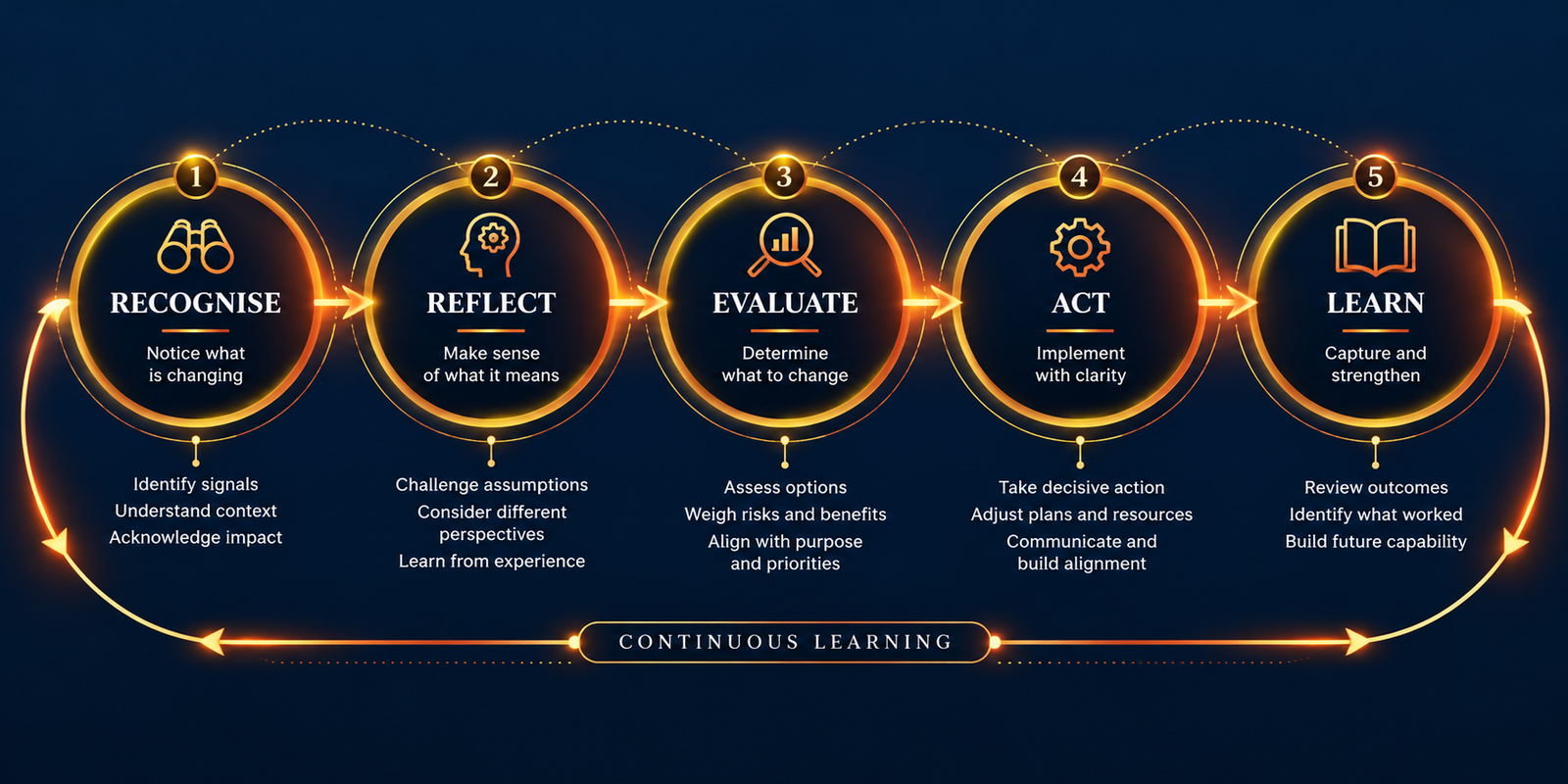
Stage 1: Recognise — What has changed?
Effective adaptation begins with an accurate interpretation of the situation. Leaders should distinguish observable changes from assumptions about their causes. Declining performance, for example, may reflect changing customer expectations, insufficient resources, ineffective processes or wider environmental pressures — and each explanation suggests a different leadership response. The priority is to identify the evidence that indicates a genuine need for adaptation.
Stage 2: Reflect — What assumptions need reconsideration?
Established practices often persist because they previously delivered successful outcomes. However, past effectiveness does not guarantee continued relevance. Reflective leaders examine whether their interpretations remain appropriate and whether alternative perspectives have been sufficiently considered. This stage connects Adaptability Intelligence™ directly to Reflective Practice Intelligence™ and Knowledge Development Intelligence™.
Stage 3: Evaluate — What should change, and what must remain?
Not every organisational practice requires modification. Leaders must distinguish between operational methods that can be adjusted and professional, ethical or strategic commitments that should be preserved. Evaluation should consider consequences for performance, stakeholders, workload and organisational trust. The objective is proportionate adaptation rather than change for its own sake.
Stage 4: Act — What response is appropriate and sustainable?
Once the necessary adjustment has been identified, leaders must establish clear responsibilities, realistic implementation expectations and appropriate support. Effective action requires communication about why the change is necessary, what success will look like and how concerns will be addressed. Leadership Capacity™ becomes particularly important here: an otherwise sensible change may fail when the organisation lacks sufficient time, capability or resources to implement it responsibly.
Stage 5: Learn — What does the outcome tell us?
Adaptability is incomplete without evaluation. Leaders should examine whether the response achieved its intended purpose, whether unintended consequences emerged and what should be retained or revised. This creates a continuous relationship between decision-making, organisational learning and future adaptability.
The framework is therefore cyclical rather than linear. Learning from one adaptation strengthens the quality of subsequent leadership decisions.
Leadership Capacity™: The Overlooked Constraint on Adaptability
One of the most significant barriers to organisational adaptability is insufficient leadership capacity.
Leaders are frequently expected to implement transformation while maintaining existing responsibilities, resolving operational difficulties and supporting employees through uncertainty.
Yet adaptation itself creates work.
New systems require learning.
Revised processes require communication.
Strategic changes require coordination.
Employees need time to understand expectations and develop confidence.
When organisations introduce additional demands without reconsidering existing workloads, they risk creating an implementation gap between strategic ambition and operational reality.
This is where Leadership Workload™ and Leadership Sustainability™ become essential to understanding Adaptability Intelligence™. A sustainable adaptive decision should consider three questions:
- Does the organisation have the capacity to implement the proposed change?
- What existing responsibilities must be reduced, redesigned or removed?
- Will the adjustment strengthen or diminish future leadership capability?
These questions shift responsibility away from individual endurance and towards organisational design.
A leader who repeatedly absorbs additional demands may appear highly adaptable. However, if this behaviour produces exhaustion, delayed decisions or dependence on personal intervention, it may actually weaken organisational resilience.
This principle is consistent with the systems-oriented approach developed in Burn Bright Not Out, which distinguishes sustainable workload management from simply asking leaders to become more efficient.
Diagnosing Adaptability Intelligence™ in Leadership Practice
Organisations cannot strengthen a capability they have not examined.
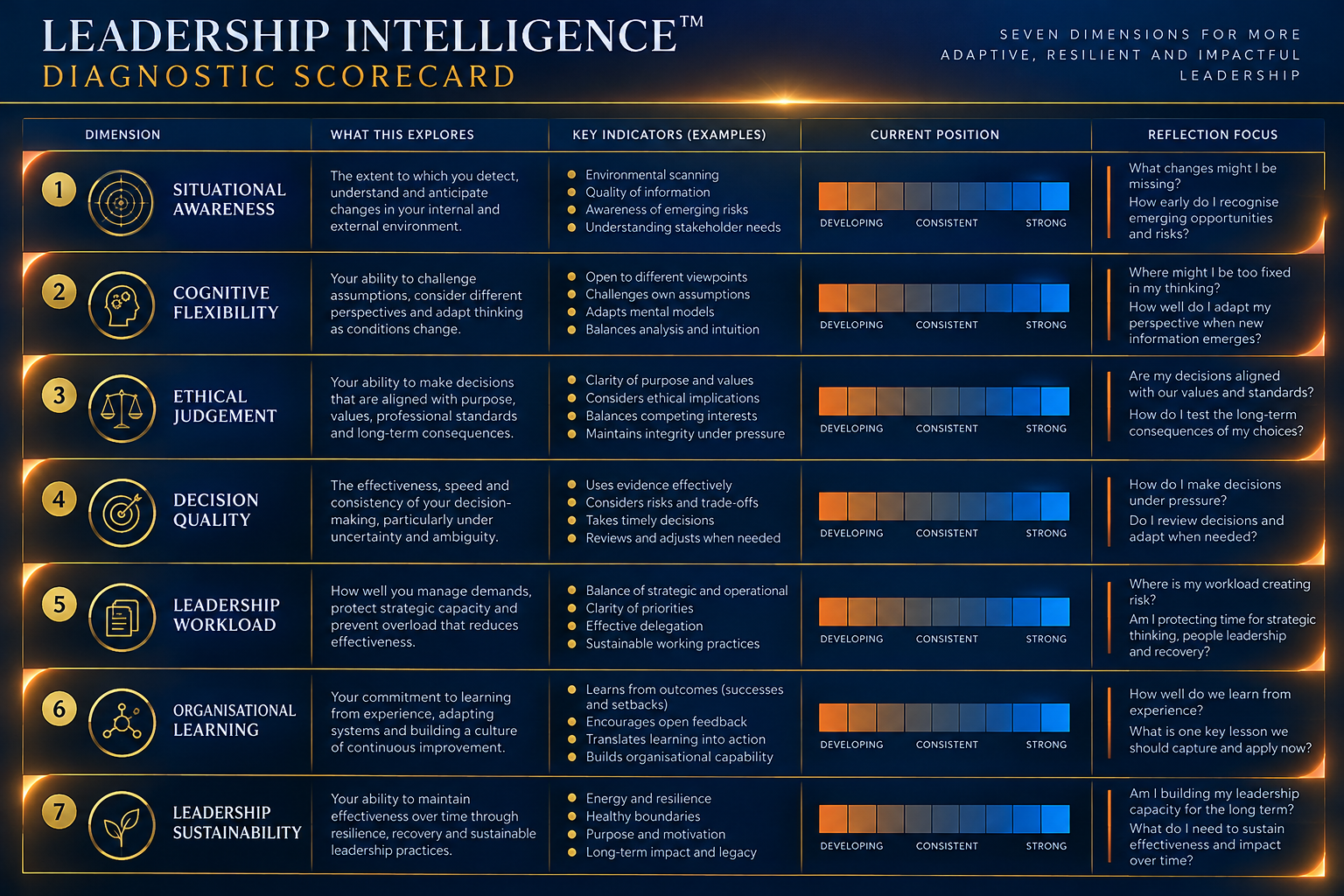
Leadership Benchmarking™ provides a useful development perspective by encouraging leaders to consider observable behaviours, decision processes and organisational conditions. The following diagnostic questions can support an initial leadership discussion.
| Diagnostic Dimension | Executive Reflection Question |
|---|---|
| Situational awareness | Do we recognise emerging changes before they become operational crises? |
| Cognitive flexibility | Can leaders revise established assumptions when credible evidence challenges them? |
| Ethical judgement | Are professional standards and stakeholder responsibilities protected during adaptation? |
| Decision quality | Do we distinguish necessary change from unnecessary organisational disruption? |
| Leadership workload | Do we assess implementation demands before introducing additional responsibilities? |
| Organisational learning | Do we systematically review what worked, what failed and why? |
| Leadership sustainability | Do our adaptive responses preserve the capacity required for future performance? |
These questions are intended for structured reflection, not as a validated psychometric assessment. They can inform leadership conversations, planning reviews and subsequent use of the Leadership Intelligence Assessment™.
From Diagnostic Insight to Leadership Development
The value of an adaptability diagnostic lies in what happens after reflection.
Leaders should identify a specific situation where an existing practice is becoming less effective, examine the evidence and determine whether preservation, adjustment or transformation is required. They should then establish an appropriate response, assign responsibility and agree on how the outcome will be evaluated.
This creates a practical connection between Leadership Reflection™, Leadership Benchmarking™ and the wider Leadership Development System™.
Practical Action Steps: A 30-Day Adaptability Intelligence™ Review
Week 1 — Identify an adaptive challenge
Select one significant leadership challenge where established practices may no longer be effective. Gather evidence and distinguish symptoms from underlying causes.
Week 2 — Examine assumptions and capacity
Consult relevant stakeholders, identify assumptions requiring reconsideration and assess whether sufficient resources exist to support change.
Week 3 — Implement a proportionate response
Determine whether to preserve, adjust or transform the current approach. Establish clear accountability, ethical safeguards and realistic expectations.
Week 4 — Review and learn
Evaluate early outcomes, identify unintended consequences and document insights that can strengthen future decision-making.
The purpose of this exercise is not to generate additional organisational activity. It is to improve the quality of adaptation through disciplined leadership reflection and evidence-informed action.
Leadership Reflection Questions
- When did I last reconsider a leadership assumption because new evidence challenged it?
- Does my organisation distinguish necessary adaptation from unnecessary change?
- Which established practices are being maintained primarily because they have worked previously?
- Are employees able to challenge existing approaches without fear of negative consequences?
- How effectively do we evaluate the workload implications of organisational change?
- Which professional and ethical commitments must remain stable during periods of uncertainty?
- Are our recent changes strengthening or diminishing long-term leadership capacity?
- What evidence would demonstrate that our adaptability has genuinely improved?
Conclusion: Adaptability as a Measure of Leadership Intelligence
The defining challenge of contemporary leadership is not simply the frequency of change, but the quality of the decisions leaders make in response to it.
Organisations do not become more effective merely because their leaders are flexible, responsive or willing to introduce new approaches. They become more capable when leaders can distinguish meaningful change from temporary disruption, reconsider established assumptions, protect essential standards and adjust organisational practices without compromising future performance.
This is the contribution of Adaptability Intelligence™.
Within Burn Bright Advisory’s Leadership Intelligence Compass™, adaptability connects reflective judgement, professional responsibility, ethical reasoning, knowledge development and Leadership Sustainability™. It enables leaders to move beyond reactive decision-making towards a more deliberate understanding of how leadership performance can be maintained under changing conditions.
For organisations, the implication is significant. Adaptability should not be treated as an individual characteristic to be encouraged during periods of disruption. It should be developed as an organisational capability supported by effective governance, realistic workloads, constructive challenge and continuous learning.
The ultimate test of adaptive leadership is therefore not how frequently leaders introduce change. It is whether their decisions improve organisational effectiveness, preserve stakeholder trust and strengthen the capacity to respond intelligently to future challenges.
Frequently Asked Questions
What is Adaptability Intelligence™ in leadership?
Adaptability Intelligence™ is the integrated leadership capability to recognise changing circumstances, reconsider assumptions, make appropriate adjustments and sustain responsible organisational performance. It combines situational awareness, cognitive flexibility, behavioural adjustment and sustainable integration.
Why is adaptability important for leadership performance?
Adaptability helps leaders respond to changing conditions without relying exclusively on established practices. It supports decision quality, organisational learning, resilience and the ability to maintain effectiveness when existing approaches become less appropriate.
How is Adaptability Intelligence™ different from flexibility?
Flexibility describes a willingness or ability to adjust. Adaptability Intelligence™ includes the judgement required to determine whether adjustment is necessary, which response is appropriate and how its consequences should be evaluated.
Can leaders develop Adaptability Intelligence™?
Yes. Leaders can strengthen adaptability through reflective practice, evidence-informed decision-making, constructive feedback, professional learning and structured evaluation of organisational change.
How does adaptability relate to emotional intelligence?
Emotional Intelligence™ helps leaders recognise and regulate emotional responses during uncertainty. Adaptability Intelligence™ uses this awareness alongside judgement, learning and action to support effective responses to changing circumstances.
What prevents organisations from becoming adaptable?
Common barriers include rigid decision structures, defensive leadership cultures, limited information sharing, excessive workloads, insufficient learning opportunities and resistance to questioning established assumptions.
How does adaptability support leadership sustainability?
Sustainable adaptability considers the workload, resource and wellbeing implications of change. It seeks to maintain performance while protecting the leadership capacity needed to respond to future demands.
How can organisations assess Adaptability Intelligence™?
Organisations can examine decision quality, responsiveness to evidence, learning practices, implementation capacity and the sustainability of adaptive responses. Structured reflection and relevant leadership assessments can support development, although formal benchmarking requires a clearly defined and validated measurement approach.
Go Deeper Than Reflection
Move beyond reflection questions to a full, structured diagnostic of how workload, decision demands and constant change are affecting your leadership capacity.
Is Change Costing You More Than It Should?
Constant adaptation without capacity is a system problem, not a personal failing. Take the free self-assessment to see where your leadership load stands today.
Free Leadership Intelligence
Get Weekly Leadership Insights
Join thousands of leaders receiving practical strategies on burnout prevention, workload design, and sustainable performance every week.