Quick Answer
Key Takeaways
- Adaptability is a leadership capability that can be examined, developed and strengthened, not simply a personality trait.
- Effective leaders do not adapt to everything. They determine what must change, what must remain stable and how to tell the difference.
- Five disciplines structure Adaptability Intelligence™: Recognize, Interpret, Evaluate, Respond and Learn.
- Poorly directed adaptation is a leadership risk: reactive, inconsistent, defensive and unsustainable patterns all create instability.
- Adaptation consumes Leadership Capacity™, so intelligent change asks what should stop as well as what should begin.
Adaptability Leadership: Building the Intelligence to Lead Through Uncertainty

Introduction: Why Adaptability Has Become a Leadership Performance Requirement
The ability to lead effectively has never depended solely on knowing what to do.
Leadership also requires knowing when an established approach is no longer appropriate.
A strategy that delivered strong results yesterday may become ineffective when customer expectations shift, technologies evolve, resources diminish or institutional priorities change. A leadership behaviour that once created stability may begin to restrict innovation. A decision-making process that worked in predictable conditions may become too slow or rigid when uncertainty increases.
These challenges expose a distinction between leadership experience and leadership intelligence.
Experience provides valuable knowledge of what has worked previously. Intelligence allows leaders to interpret whether that knowledge remains relevant to the circumstances they now face.
The distinction matters because experienced leaders can become attached to familiar methods. Their professional confidence, established routines and previous achievements may unintentionally discourage the reconsideration of assumptions.
In The Unguarded Leader, the relationship between leadership expertise, curiosity and openness to uncertainty is explored through the idea that previous success can sometimes constrain future judgement.
This is where adaptability leadership becomes essential.
Adaptability is not about abandoning direction whenever circumstances change. Nor does it require leaders to embrace every new initiative, management trend or technological development.
Instead, it requires the disciplined capacity to interpret change, assess its implications and respond without losing sight of organizational purpose.
For Burn Bright Advisory™, this capability sits within a broader understanding of Leadership Performance Intelligence™.
The central question is not whether a leader is comfortable with change.
It is whether the leader can respond to changing conditions in ways that preserve sound judgement, organizational trust, human capacity and sustainable performance.
Free Assessment
Is constant change consuming your leadership capacity? Find out where the pressure is coming from.
What Is Adaptability Leadership?
Featured Snippet
It involves four connected capabilities:
- Awareness: Recognizing meaningful changes in the operating environment.
- Interpretation: Understanding how those changes affect people, priorities and performance.
- Response: Selecting appropriate adjustments rather than reacting automatically.
- Learning: Evaluating outcomes and incorporating new understanding into future decisions.
These capabilities distinguish intelligent adaptation from reactive change.
A reactive leader may respond to uncertainty by increasing control, introducing new reporting requirements or repeatedly changing priorities.
An adaptive leader first examines the nature of the uncertainty.
Is the problem caused by inadequate information, outdated assumptions, changing stakeholder expectations or an organizational system that no longer functions effectively?
Different causes require different responses.
The ability to make that distinction is central to Adaptability Intelligence™.
Adaptability Is Not the Same as Constant Change
Organizations sometimes confuse adaptability with a continuous willingness to restructure, innovate or revise established practices.
However, frequent change does not necessarily indicate intelligent leadership.
A school principal who introduces a new improvement initiative every term may appear progressive while unintentionally increasing teacher workload and reducing implementation consistency.
A healthcare manager who repeatedly changes operational procedures may create uncertainty in an environment where reliable processes are essential to safety.
A business executive who constantly redirects strategic priorities may undermine employees’ confidence in the organization’s long-term direction.
In each example, the leader demonstrates activity rather than necessarily demonstrating adaptability.
Intelligent adaptation requires selectivity.
Some circumstances demand decisive change. Others require patience, consistency and protection of established practices.
The leadership challenge is determining which response is appropriate.
Why Adaptability Matters for Leadership Performance
Leadership performance is often assessed through results such as productivity, financial outcomes, service quality, employee retention or successful project delivery.
These measures are important, but they primarily describe what has already occurred.
Adaptability introduces a forward-looking dimension.
It asks whether the leader and organization can continue performing effectively as circumstances evolve.
A team may currently achieve its targets while relying on processes that are becoming increasingly fragile.
A department may appear efficient because experienced employees routinely compensate for poorly designed systems.
An organization may report strong short-term performance while depending on leadership workloads that cannot be sustained.
These conditions can remain hidden when performance assessment focuses exclusively on immediate outcomes.
Adaptability Intelligence™ encourages leaders to examine whether existing success is repeatable under changing conditions.
This creates an important connection with Leadership Sustainability™.
A leadership response that produces immediate results but exhausts the people responsible for delivering them may not represent effective adaptation.
Similarly, a rapid organizational restructuring that improves one performance indicator while damaging trust, capability or institutional knowledge may create longer-term vulnerabilities.
Effective adaptability must therefore consider both immediate performance and future organizational capacity.
The Relationship Between Adaptability and Leadership Capacity™
Leadership Capacity™ concerns the resources, capabilities and practical conditions available to sustain effective leadership.
These include time, attention, decision-making capability, team expertise, organizational support and the capacity to manage competing demands.
Adaptability places demands on these resources.
When leaders face continuous uncertainty, they must interpret new information, reconsider established decisions, communicate changing expectations and support employees through transitions.
Without sufficient capacity, adaptation can become another source of organizational strain.
This reflects an important argument developed in Burn Bright Not Out: leadership effectiveness cannot be separated from the systems, workloads and resources within which leaders operate.
Organizations cannot reasonably expect unlimited adaptability from leaders whose existing responsibilities already exceed sustainable capacity.
Developing adaptability therefore requires more than encouraging flexible thinking.

Understanding Adaptability Intelligence™ Within the Leadership Intelligence Compass™
Adaptability does not operate independently of other leadership capabilities.
A leader may recognize the need for change but lack the emotional intelligence to manage its human consequences. Another may demonstrate considerable flexibility while compromising ethical standards. A third may embrace innovation without adequately reflecting on previous decisions.
These examples reveal an important limitation in conventional approaches to leadership development: individual competencies are frequently assessed in isolation, despite operating as interconnected capabilities in practice.
The Burn Bright Advisory™ Leadership Intelligence Compass™ provides a broader conceptual structure for examining these relationships.
Within this framework, Adaptability Intelligence™ connects particularly closely with Reflective Practice Intelligence™, Emotional Intelligence™, Ethics Intelligence™, Constructivism Intelligence™ and Leadership Sustainability™.
Each contributes to the quality of adaptive leadership.
Domain Reflective Practice Intelligence™: Learning Before Adjusting
Adaptability requires leaders to distinguish between changing circumstances and inadequate assumptions. Reflective Practice Intelligence™ supports this distinction by encouraging systematic examination of decisions, experiences and underlying beliefs.
Consider a department experiencing declining performance. A reactive leader may immediately introduce tighter supervision or additional reporting requirements. A reflective leader begins by examining whether existing performance expectations remain realistic, whether employees possess the necessary resources and whether management practices contribute to the problem.
The difference lies in the quality of diagnosis. Reflection creates the opportunity to identify the underlying issue before selecting an intervention. Without reflection, leaders risk repeatedly adjusting visible symptoms while leaving structural problems unresolved.
Domain Emotional Intelligence™: Managing the Human Experience of Change
Organizational change is not experienced solely as a rational process. Employees interpret change through their professional identities, relationships, expectations and perceptions of security.
A restructuring that appears operationally straightforward to senior management may create significant uncertainty for employees whose responsibilities, relationships or career prospects are affected.
Emotional Intelligence™ helps leaders recognize these experiences without allowing emotional reactions to determine every organizational decision. Effective leaders acknowledge uncertainty, communicate honestly and create opportunities for meaningful dialogue.
This does not require universal agreement. It requires an understanding that the success of adaptation depends partly on how people experience and interpret the process.
Domain Ethics Intelligence™: Establishing the Boundaries of Adaptation
Not every possible adjustment is appropriate. Organizations may encounter pressure to reduce costs, accelerate delivery or achieve demanding performance targets. Under these conditions, leaders can be tempted to compromise established standards in pursuit of immediate results.
Ethics Intelligence™ provides an essential boundary. It encourages leaders to consider whether proposed changes are consistent with professional responsibilities, organizational values and obligations to stakeholders.
A healthcare leader cannot reasonably justify weakening patient safety procedures simply because operational conditions have become more demanding. A school leader cannot disregard equitable treatment because accountability pressures have intensified. An adaptive response must remain ethically defensible.
Domain Constructivism Intelligence™: Creating Better Understanding Through Collaboration
Complex leadership challenges rarely have a single interpretation. Employees, customers, service users and professional colleagues may understand the same situation differently because they possess different experiences and information.
Constructivism Intelligence™ recognizes the value of developing understanding through dialogue, shared inquiry and the examination of multiple perspectives. For adaptive leaders, this means avoiding the assumption that seniority automatically provides the most accurate interpretation of a problem.
- A frontline employee may identify an emerging operational weakness before it becomes visible in executive performance reports.
- A teacher may recognize why a new instructional initiative is failing before the problem appears in formal evaluation data.
- A nurse may identify an unsafe workflow that senior management considers efficient.
These perspectives are not automatically correct, but they represent valuable evidence. Leaders strengthen adaptability when they create processes through which different interpretations can be examined constructively.
The Adaptability Intelligence™ Leadership Framework
For practical application, Burn Bright Advisory™ can organize adaptive leadership around five connected disciplines.
This proposed framework translates the Compass domain into a repeatable leadership decision process.
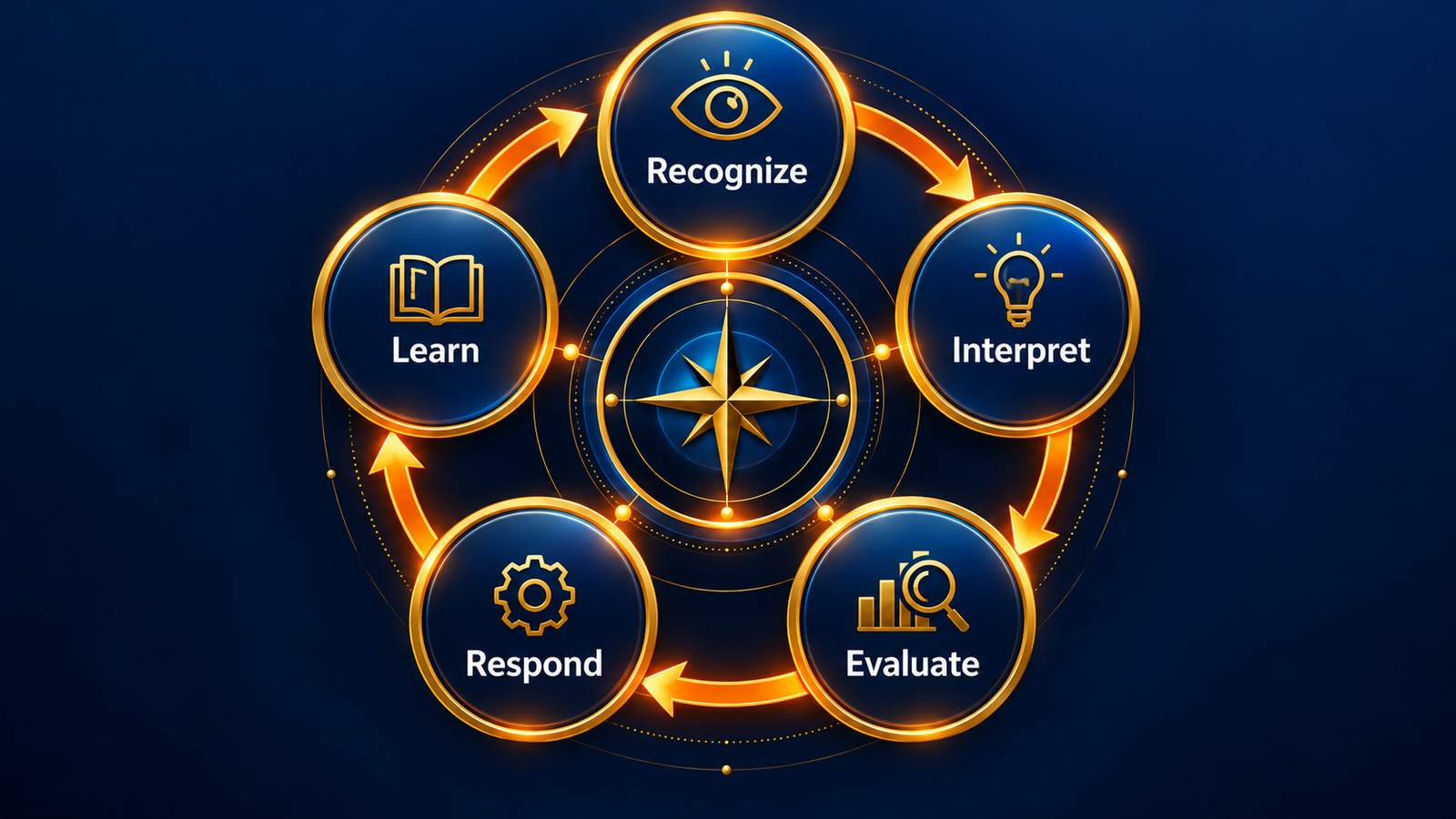
Discipline 1
Recognize Meaningful Change
The first requirement is identifying signals that established approaches may no longer be appropriate. These signals may include changing stakeholder expectations, declining performance, emerging technologies, increased employee turnover or persistent operational difficulties.
However, not every variation represents a structural change. Leaders must distinguish temporary disruption from developments that require strategic reconsideration.
Discipline 2
Interpret the Underlying Conditions
Recognition alone does not explain what is happening. Leaders need to examine causes, relationships and consequences. This requires evidence, consultation and the willingness to question familiar explanations.
The central question becomes: What has changed, why does it matter and which assumptions require reconsideration?
Discipline 3
Evaluate Available Responses
Once the problem is understood, leaders must assess possible adjustments. Evaluation should consider effectiveness, ethical implications, implementation capacity and potential unintended consequences.
A solution that appears strategically attractive may prove impractical if employees lack the necessary time, expertise or resources.
Discipline 4
Respond Proportionately
Intelligent adaptation does not always require comprehensive transformation. Sometimes the appropriate response is a limited operational adjustment, a revised communication process or a carefully designed pilot. Other circumstances demand substantial strategic change.
The scale of the response should reflect the significance of the problem and the quality of available evidence.
Discipline 5
Learn From Outcomes
Adaptability becomes a sustained capability when leaders evaluate what happened after a decision was implemented.
- Did the intervention address the underlying problem?
- What unexpected consequences emerged?
- Which assumptions proved accurate, and which require revision?
These questions turn individual decisions into opportunities for organizational learning.
The five disciplines are best understood as an iterative process rather than a rigid sequence. New evidence may require leaders to revisit an earlier interpretation or reconsider an intervention already underway.
Adaptability Leadership Across Different Sectors

The principles of adaptability are broadly applicable, but their practical expression varies according to organizational context. Explore the full sector leadership hubs for more.
💼 Business Growth Intelligence™: Adapting Without Losing Strategic Direction
A growing business may experience changing customer expectations, technological disruption and increasing operational complexity. Its leaders must decide when to revise established practices and when to protect the capabilities responsible for previous success.
Consider a hypothetical professional services firm introducing artificial intelligence into its operations. An ineffective response might involve adopting multiple technologies simultaneously without evaluating their effects on service quality, professional judgement or employee workload.
An adaptive approach would identify appropriate applications, establish safeguards, test implementation and evaluate results before expanding adoption. The objective is not technological change itself. It is improved organizational capability.
🎓 School Leadership Intelligence™: Balancing Innovation and Stability
Educational leaders face changing curriculum expectations, accountability requirements, workforce pressures and diverse student needs. Adaptability is essential, but constant institutional change can undermine implementation quality.
A principal introducing a new assessment approach should consider teacher readiness, professional development requirements, workload implications and the continuity of student learning. The most intelligent response may involve phased implementation rather than immediate whole-school transformation.
In this context, adaptability means maintaining educational purpose while adjusting the systems through which that purpose is achieved.
🏥 Healthcare Leadership Intelligence™: Responding Without Compromising Safety
Healthcare leadership requires responsiveness within environments where professional standards and reliable processes are critical.
Consider a clinical department experiencing unexpected increases in patient demand. An adaptive leader must assess staffing capacity, patient risk, workflow constraints and available support. The response may require temporary redistribution of responsibilities, escalation of resource requirements or modification of non-critical administrative processes.
However, adaptation cannot justify abandoning essential clinical safeguards. The distinction between flexible operations and non-negotiable professional standards becomes especially important.
🏛️ Public Service Leadership Intelligence™: Adapting Within Accountability Structures
Public service leaders operate within statutory obligations, political priorities, resource constraints and expectations of transparency. Their capacity to adapt may be limited by formal procedures, yet their responsibility to respond to changing community needs remains.
Effective adaptation requires understanding which processes can be improved, which decisions require authorization and which obligations must remain unchanged.
When Adaptability Becomes a Leadership Risk
Adaptability is generally presented as a desirable leadership characteristic. However, excessive or poorly directed adaptation can create significant organizational difficulties.
Leaders who continually adjust priorities may unintentionally weaken strategic clarity. Those who respond to every emerging concern may create unnecessary operational instability. Others may interpret adaptability as an expectation that employees should accommodate increasing workloads without additional support.
These patterns reveal an important distinction between adaptive leadership and maladaptive leadership.
Adaptive leadership responds intelligently to changing conditions. Maladaptive leadership creates additional uncertainty through poorly considered responses.
Within Leadership Performance Intelligence™, the quality of adaptation must therefore be evaluated against its consequences for decision-making, organizational trust, operational effectiveness and long-term sustainability.
Four Common Forms of Maladaptive Leadership
These risks demonstrate why adaptability must be connected to reflective practice, ethical judgement and sustainable leadership systems.
The Relationship Between Adaptability Intelligence™ and Leadership Sustainability™

Leadership Sustainability™ concerns the conditions that allow leaders and organizations to maintain effective performance over time without depending on continuous personal sacrifice or the depletion of essential resources.
Adaptability Intelligence™ contributes to sustainability by helping leaders recognize when existing systems, expectations or behaviours are becoming ineffective.
However, adaptability itself also consumes leadership capacity.
Every significant adjustment requires attention, interpretation, communication, implementation and evaluation.
When organizations demand continuous adaptation without allocating sufficient resources, they risk creating the very instability they are attempting to overcome.
This relationship can be understood through three interconnected dimensions.
Dimension Leadership Workload™
Adaptation often introduces additional responsibilities. Leaders must manage existing operations while developing new processes, supporting employees and monitoring implementation.
Unless some responsibilities are reduced, redistributed or discontinued, change can increase workload beyond sustainable limits. Intelligent adaptation therefore requires leaders to examine not only what must begin but also what should stop.
Dimension Leadership Capacity™
The effectiveness of adaptation depends partly on whether leaders and teams possess the time, knowledge, authority and resources required to implement change.
A strategically sound decision may fail because the organization lacks implementation capacity. Leadership Capacity™ should therefore be considered before substantial changes are introduced.
Dimension Leadership Reflection™
Reflection enables leaders to evaluate whether an adjustment has improved performance or merely transferred pressure elsewhere.
For example, reducing administrative demands on one department may create additional responsibilities for another. Without systematic reflection, such consequences can remain invisible.
The connection between these three dimensions reinforces a central principle of Burn Bright Advisory’s approach:
How Can Organizations Assess Adaptability Intelligence™?
Traditional leadership assessments may examine openness to change, resilience or behavioural flexibility.
These characteristics provide useful information, but they do not necessarily establish whether a leader adapts effectively.
An individual may report considerable confidence in managing change while repeatedly making decisions that create unnecessary disruption.
A more comprehensive approach examines observable leadership behaviours and their consequences.
Within the Leadership Intelligence Compass™, Adaptability Intelligence™ can be explored through five diagnostic dimensions.
| Diagnostic dimension | Key leadership question |
|---|---|
| Environmental awareness | Does the leader recognize meaningful changes before problems escalate? |
| Interpretive judgement | Does the leader investigate underlying causes rather than respond to symptoms? |
| Decision flexibility | Can the leader reconsider established approaches when evidence changes? |
| Implementation discipline | Are adjustments proportionate, communicated and supported? |
| Reflective learning | Does the leader evaluate outcomes and incorporate lessons into future decisions? |
These dimensions provide a proposed structure for leadership reflection and diagnostic development. They should not be interpreted as a validated psychometric assessment or an established benchmark without appropriate testing.
From Self-Assessment to Leadership Benchmarking™
Self-assessment can help leaders identify their perceptions of adaptability, but it should not be the only source of evidence.
A leader’s confidence may differ considerably from the experiences of colleagues and employees.
Leadership Benchmarking™ can strengthen understanding by comparing leadership behaviours against clearly defined expectations and examining patterns over time.
Relevant evidence may include decision reviews, employee feedback, implementation outcomes, recurring operational problems and the consistency of strategic priorities.
The objective is not to assign a simplistic adaptability score.
It is to develop a more accurate understanding of how leadership behaviour influences organizational performance.
Developing Adaptability Through the Leadership Development System™
Adaptability should be developed through repeated cycles of learning, application and evaluation rather than treated as a one-time training objective.
The Burn Bright Advisory™ Leadership Development System™ provides a conceptual pathway for connecting leadership insight with deliberate development.
For Adaptability Intelligence™, this can involve three stages.
Stage 1: Establish Leadership Awareness
Leaders begin by examining how they currently respond to uncertainty. They consider whether they seek sufficient evidence, invite alternative perspectives, recognize emotional responses and distinguish urgent problems from important strategic developments.
This stage connects naturally with the Leadership Intelligence Assessment™ and Leadership Reflection™.
Stage 2: Strengthen Adaptive Decision-Making
Leaders then apply structured decision processes to genuine organizational challenges. Rather than immediately introducing large-scale change, they examine alternatives, evaluate constraints and identify proportionate responses.
Leadership workshops and planning tools can support this process by creating opportunities to test assumptions and consider implementation risks.
Stage 3: Evaluate and Embed Learning
Finally, leaders review the consequences of their decisions. They examine what improved, what remained unresolved and what new difficulties emerged. The findings inform future decisions and contribute to organizational learning.
Through repeated application, adaptability becomes less dependent on individual instinct and more closely connected to established leadership practices.
A Practical Example: When the Right Response Is Not More Change
Consider an illustrative school leadership team experiencing declining staff confidence following several years of organizational reform.
The principal initially interprets the problem as resistance to change.
A conventional response might involve additional professional development, more frequent monitoring or a renewed communication campaign.
However, a structured Adaptability Intelligence™ review reveals a different explanation.
Teachers are not necessarily opposed to improvement. They are struggling with competing initiatives, unclear priorities and insufficient time to embed previous changes.
The leadership team therefore adjusts its approach.
Instead of introducing another improvement programme, it consolidates existing priorities, removes unnecessary reporting requirements and establishes a more realistic implementation timetable.
Staff are invited to contribute evidence about which practices are producing meaningful improvements.
The leadership team also introduces scheduled reviews to determine whether the revised approach is reducing unnecessary workload while maintaining educational standards.
This example illustrates an important feature of intelligent adaptation.
Sometimes the most effective response to changing conditions is not to accelerate transformation.
The same principle applies to healthcare departments managing competing improvement programmes, businesses introducing new technologies and public service organizations operating under resource constraints.
Adaptability is demonstrated through the quality of judgement rather than the visibility of change.
Executive Reflection Questions
The following questions can be used during individual Leadership Reflection™, executive coaching, leadership team reviews or organizational development workshops.
- When circumstances change, do I investigate underlying causes before introducing new actions?
- Which established leadership assumptions have I continued to rely upon despite evidence that conditions have changed?
- How effectively do I distinguish between changes requiring immediate action and those requiring further observation?
- Do employees experience my leadership adjustments as purposeful and consistent, or unpredictable and reactive?
- How do I incorporate alternative perspectives into decisions that challenge my existing expertise?
- Have recent organizational changes increased leadership workload without removing previous responsibilities?
- Which professional, ethical or organizational standards should remain non-negotiable during periods of uncertainty?
- How systematically do I evaluate whether leadership adjustments produce sustainable improvements?
These questions are intended to stimulate structured reflection, not to produce a validated assessment score.
Practical Action Steps: A 30-Day Adaptability Intelligence™ Review
Week 1: Recognize
Identify one emerging challenge and document its effects on performance.
Week 2: Interpret
Consult affected stakeholders and test at least two explanations.
Week 3: Respond
Select one proportionate adjustment, defining ownership and safeguards.
Week 4: Learn
Review early evidence, workload implications and necessary refinements.
The 30-day review is a development exercise, not a guarantee that an organizational change will demonstrate measurable results within four weeks. Complex interventions may require longer evaluation periods.
Frequently Asked Questions
What is adaptability leadership?
Adaptability leadership is the ability to adjust decisions, behaviours and organizational approaches in response to changing circumstances while maintaining accountability, ethical standards and strategic direction. It combines awareness, judgement, action and learning.
Why is adaptability important in leadership?
Adaptability helps leaders respond to changing stakeholder expectations, technologies, operating conditions and organizational challenges. It supports decision-making when established practices no longer produce the intended outcomes.
What is Adaptability Intelligence™?
Adaptability Intelligence™ is a leadership capability within Burn Bright Advisory’s Leadership Intelligence Compass™. It concerns the capacity to recognize meaningful change, interpret its implications, evaluate possible responses and learn from implementation.
What is the difference between adaptability and resilience?
Adaptability concerns adjusting approaches when circumstances change. Resilience concerns maintaining or recovering functioning when experiencing adversity or disruption. The capabilities are related but distinct: leaders may demonstrate resilience without sufficiently adapting outdated practices.
Can adaptability leadership be developed?
Yes. Leaders can strengthen adaptability through reflective practice, exposure to alternative perspectives, structured decision-making, feedback and systematic evaluation of outcomes. Development should be supported by organizational conditions that permit learning.
How does adaptability affect organizational performance?
Adaptability may support organizational performance by helping leaders identify ineffective practices, respond to emerging risks and improve alignment between strategy and operating conditions. Outcomes depend on implementation quality, resources and context.
Can leaders become too adaptable?
Yes. Repeatedly changing priorities or procedures without sufficient justification can undermine stability, trust and operational effectiveness. Intelligent adaptability requires distinguishing necessary adjustments from unnecessary disruption.
How can organizations assess leadership adaptability?
Organizations can examine environmental awareness, interpretive judgement, decision flexibility, implementation discipline and reflective learning. Multiple sources of evidence are preferable to self-report alone, and formal assessment claims require validated measures.
How does adaptability connect with Leadership Sustainability™?
Sustainable adaptability considers whether changes can be implemented without exhausting leadership capacity, creating unreasonable workloads or compromising future performance. Effective adaptation should preserve the resources required for continued leadership effectiveness.
Conclusion: Adaptability Is a Measure of Leadership Intelligence, Not Simply Flexibility
The challenge facing contemporary leaders is not merely the increasing frequency of change. It is the growing complexity of determining which changes require action, which require further investigation and which should be resisted.
Leadership adaptability cannot be measured by enthusiasm for innovation, willingness to restructure or the speed with which new initiatives are introduced.
Its value lies in the quality of judgement underpinning those decisions.
Effective leaders recognize changing conditions without becoming controlled by them. They reconsider established assumptions without abandoning valuable experience. They introduce adjustments without unnecessarily destabilizing the people and systems responsible for organizational performance.
This requires more than individual flexibility.
It requires the integration of reflective practice, ethical judgement, emotional intelligence, collaborative learning and sustainable leadership capacity.
Within the Burn Bright Advisory™ Leadership Intelligence Compass™, Adaptability Intelligence™ provides an important connection between understanding changing circumstances and responding through deliberate leadership action.
Its development should therefore form part of a broader Leadership Development System™ rather than remain an isolated competency.
Organizations seeking stronger adaptive leadership must also examine the conditions within which adaptation occurs.
Leaders cannot continuously absorb additional responsibilities without consequences.
Teams cannot implement unlimited change without sufficient resources.
Organizations cannot build sustainable performance through repeated disruption alone.
The objective is not to create leaders who change constantly.
It is to develop leaders who understand when change is necessary, how it should be implemented and what must remain stable.
That is the distinction between reacting to uncertainty and leading intelligently through it.
Explore the Leadership Intelligence Compass™ and Leadership Intelligence Library™ at burnbrightadvisory.com to examine how adaptability connects with reflective practice, ethical judgement, leadership capacity and sustainable performance.
Go Deeper
Burn Bright Full Diagnostic™ — £144. A complete structural picture of the pressures on your leadership capacity.
Are You Adapting Intelligently, or Absorbing More Change?
When change keeps adding to your workload without removing anything, capacity erodes quietly. Identify the pressures shaping your leadership before they become burnout.
Free Leadership Intelligence
Get Weekly Leadership Insights
Join thousands of leaders receiving practical strategies on burnout prevention, workload design, and sustainable performance every week.