Quick Answer
Key Takeaways
- Audit before cutting. Identify meetings that create decisions, solve problems or deliver genuine value.
- Challenge recurring meetings. A permanent calendar invitation is not proof that a meeting remains necessary.
- Replace updates with better communication. Written dashboards and decision logs can eliminate routine status meetings.
- Clarify decision authority. Give people permission to make appropriate decisions without convening a committee.
- Measure outcomes, not attendance. Judge meeting reform by decision quality, workload, focus time and team effectiveness.
How to Reduce Unnecessary Meetings at Work
Introduction
How to reduce unnecessary meetings is no longer a minor productivity question. It is a leadership design challenge.
Across organisations, calendars have become crowded with meetings that exist because nobody has questioned whether they should continue.
Senior leaders move between strategy sessions, operational updates, project reviews and stakeholder conversations. By late afternoon, they have attended six or seven meetings but made little progress on the work they are personally accountable for delivering.
The work has not disappeared. It has simply moved into the evening.
The problem is rarely one particularly bad meeting. It is the cumulative effect of fragmented attention, unclear decision rights, unnecessary attendance and organisational habits that treat visibility as evidence of contribution.
After more than 30 years in leadership across education, business and the public sector, I have seen how easily meetings become substitutes for clear management systems.
The answer is not to become more disciplined about accepting invitations.
It is to redesign the architecture of collaboration.
This article explains how to identify unnecessary meetings, remove them without damaging coordination, establish better decision processes and protect the strategic capacity that sustainable leadership requires.
Free Assessment
Is your calendar consuming your leadership capacity? Find out where the pressure is coming from.
The first step is to understand where meeting overload sits within the wider leadership system.
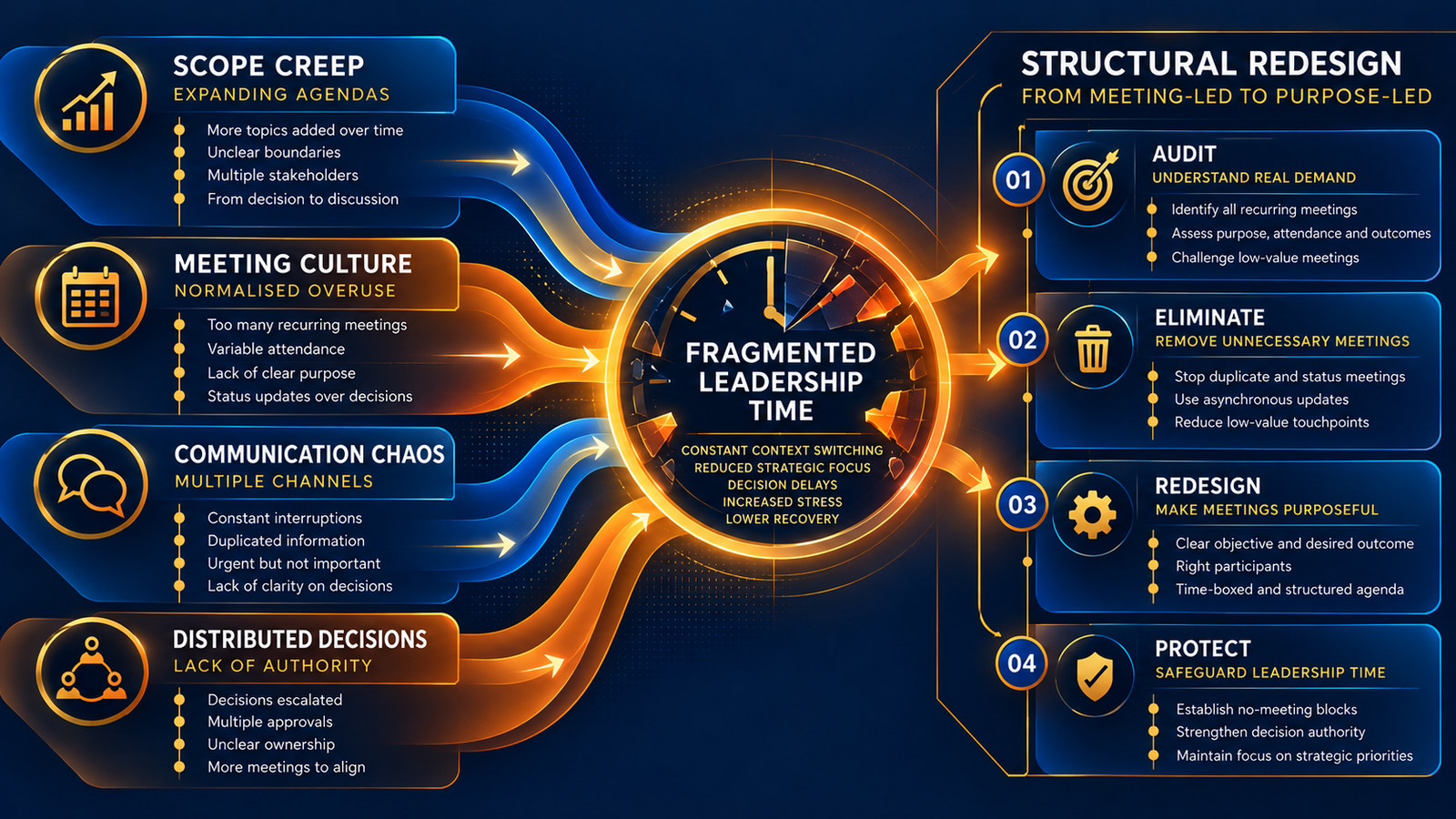
The diagram illustrates why cancelling isolated meetings is insufficient. Unless priorities, decision rights and communication expectations change, unnecessary meetings will return.
Definition: Unnecessary Meetings
Why Do Organisations Have So Many Unnecessary Meetings?
Most unnecessary meetings begin with a reasonable intention.
A manager wants better communication. A director wants stronger oversight. A project team wants everyone aligned.
A meeting is scheduled.
Initially, it may be useful. Decisions are made, information is exchanged and problems are resolved.
Then the meeting becomes permanent.
The original problem disappears, but the calendar invitation remains.
This is how meeting culture develops without deliberate design.
Meetings become organisational habits
Consider a leadership team that holds a weekly operational review.
The meeting was introduced during a difficult period when projects were falling behind. At that point, bringing everyone together helped restore control.
Two years later, the organisation has better reporting systems and clearer processes.
Yet the meeting continues.
Eight senior managers attend for 90 minutes every Monday.
Nobody has asked whether the meeting still solves the problem it was created to address.
Visibility becomes confused with accountability
Another cause is the belief that leaders must attend everything to remain informed.
This creates a dangerous equation:
Attendance = involvement = leadership.
But presence is not the same as contribution.
A leader who attends every operational discussion may actually weaken accountability by making teams dependent on their approval.
Meetings can become a way of avoiding delegation.
Instead of giving someone the authority to make a decision, the organisation invites everyone to discuss it.
Poor systems generate additional meetings
The Burn Bright Not Out Framework™ identifies five root causes of burnout: scope creep, meeting culture, communication chaos, decision overload and perfectionism culture.
These causes reinforce one another.
When communication is fragmented, organisations schedule alignment meetings.
When decision authority is unclear, they schedule approval meetings.
When priorities conflict, they schedule coordination meetings.
The calendar becomes a visible symptom of structural weakness.
The solution is not simply to improve meeting etiquette. It is to address the underlying management system.
This is why structural leadership burnout training must look beyond personal productivity and examine how work is organised.
How Do Unnecessary Meetings Contribute to Leadership Burnout?
Meetings do not automatically cause burnout.
Poorly designed meeting systems can, however, contribute to the chronic workplace stress that makes burnout more likely.
The World Health Organization describes burnout as an occupational phenomenon resulting from chronic workplace stress that has not been successfully managed.
It identifies three dimensions: exhaustion, increased mental distance or cynicism towards work, and reduced professional efficacy.
Meeting overload can contribute to all three.
Meetings consume more than calendar time
A 60-minute meeting rarely costs only 60 minutes.
There is preparation, context switching, follow-up communication and the cognitive effort of returning to interrupted work.
For senior leaders, these transitions matter.
Strategic thinking requires sustained attention. Complex decisions require the ability to examine information, challenge assumptions and consider consequences.
A calendar divided into 30-minute fragments makes that difficult.
Microsoft’s 2023 Work Trend Index reported that 68% of surveyed people said they lacked enough uninterrupted focus time during the workday.
The finding matters because it connects meeting and communication demands with the capacity to complete meaningful work. It does not prove that meetings alone caused the problem.
The hidden cost of meeting culture
Consider a straightforward calculation.
| Illustrative meeting cost | Value |
|---|---|
| Attendees | 8 |
| Weekly meeting duration | 90 minutes |
| Person-hours annually | 624 |
| Illustrative annual labour cost | £37,440 |
Assumes 52 meetings annually and £60 per person-hour. This is a planning illustration, not a measured organisational result.
The financial cost is only one part of the problem.
Those 624 hours could have supported coaching, strategic planning, process improvement or direct delivery.
There is also the work that gets pushed into evenings because the normal working day is already occupied.
The leadership ripple effect
Gallup’s 2024 State of the Global Workplace report estimated that managers account for 70% of the variance in team engagement across business units.
This does not mean managers control every outcome. It demonstrates how strongly the quality of management relates to the employee experience.
When leaders are permanently occupied, their availability for meaningful coaching and decision-making decreases.
Teams wait longer for answers.
Problems remain unresolved.
More meetings are scheduled to compensate.
A structural cycle emerges.
How Can Leaders Identify Which Meetings to Eliminate?
The most effective starting point is a structured meeting audit.
Not an informal conversation about which meetings people dislike.
A proper audit examines purpose, attendance, frequency, outcomes and decision authority.
In the Burn Bright approach, this connects directly to Time Architecture™ and the IMPACT Matrix™: using evidence to distinguish valuable leadership activity from work that consumes capacity without producing sufficient benefit.
Step 1: Collect four weeks of meeting data
Review every recurring meeting and record:
- Purpose and original reason for creation.
- Number of attendees and meeting duration.
- Decisions or outputs produced.
- Whether the same information exists elsewhere.
- Whether real-time discussion is necessary.
Avoid judging meetings by how enjoyable they are. Some difficult meetings are essential. Some comfortable meetings are unnecessary. The question is whether the meeting creates value that cannot be delivered more effectively through another process.
Step 2: Apply the four-outcome test
Place every recurring meeting into one of four outcomes: eliminate, shorten, replace or retain.

| Outcome | When it applies |
|---|---|
| Eliminate | No clear purpose, output or continuing need |
| Shorten | Useful outcome but excessive duration or attendance |
| Replace | Information sharing suited to written updates |
| Retain | Genuine collaboration, decisions or complex problem-solving |
The important distinction is between reducing meeting numbers and improving the coordination system.
A meeting that supports a difficult safeguarding decision, for example, may be essential even if it takes considerable time.
A weekly meeting where twelve people read aloud information already available on a dashboard is a different matter.
Step 3: Calculate the capacity released
Use a simple formula: Hours recovered = Duration × Attendees × Frequency.
For example, removing a 45-minute weekly meeting attended by ten people releases 7.5 person-hours each week. Across 48 working weeks, that is 360 person-hours.
Those hours only create value if the organisation also prevents the time from being immediately filled with more low-value activity.
Step 4: Review the consequences
Run a four-week trial. Track whether decisions become slower, communication deteriorates or unresolved problems increase.
If nothing important is lost, the meeting was probably not necessary. If coordination suffers, identify what information or authority is missing and design a lighter replacement.
What Should Replace Unnecessary Meetings?
Removing meetings without replacing their useful functions creates confusion.
The objective is not silence.
It is a communication architecture in which information, decisions and accountability flow through the right channels.
Use asynchronous updates for routine reporting
Status updates rarely require every participant to be present simultaneously.
A simple weekly written report can include:
- Progress against agreed priorities.
- Current risks or blockers.
- Decisions required.
- Named owners and deadlines.
Leaders can review the information before deciding whether a discussion is necessary.
This reduces the number of people required to sit through information that is not relevant to their responsibilities.
Create explicit decision rights
Many meetings exist because nobody knows who has authority to act.
Framework RACI Delegation Framework™
The RACI Delegation Framework™ helps clarify who is Responsible, Accountable, Consulted and Informed.
- People who need to be informed do not necessarily need to attend the decision meeting.
- People who should be consulted can often contribute before a decision is made.
- Only those genuinely required for real-time judgement need to participate.
Match the communication method to the work
| Traditional meeting culture | Sustainable meeting architecture |
|---|---|
| Weekly status meeting by default | Written status dashboard |
| Everyone attends for visibility | Only essential decision-makers attend |
| One-hour standard duration | Duration based on required outcome |
| Decisions deferred to committees | Clear decision owner and authority |
| Meetings continue indefinitely | Review or expiry date |
| Success measured by attendance | Success measured by outcomes |
| Strategic work fitted around meetings | Strategic time protected first |
Protect the meetings that matter
Not every meeting should disappear.
Complex decisions, sensitive conversations, conflict resolution, coaching and genuine collaboration often benefit from direct human interaction.
A difficult performance conversation should not be replaced by a dashboard.
A team facing a serious operational risk may need immediate collective discussion.
The aim is to reserve synchronous collaboration for work that genuinely requires it.
Microsoft’s 2023 Work Trend Index also found that 57% of Microsoft 365 users’ time was spent communicating, compared with 43% creating, using an aggregate analysis of digital work activity.
This is not a universal measure of every worker’s day. It does, however, illustrate how communication can dominate the digital working environment.
Leaders should examine whether their own communication systems support delivery or continually interrupt it.
Advanced AI tools for leadership workflows can support meeting summaries, action tracking and routine reporting, provided sensitive information and human oversight are handled appropriately.
How Can Leaders Make Meeting Reductions Permanent?
The greatest risk in meeting reform is that the calendar gradually fills again.
A leader removes five recurring meetings in October. By December, six new ones have appeared.
This happens when meeting reduction is treated as a one-off exercise rather than a change to organisational rules.
Introduce meeting design standards
Every new recurring meeting should have four requirements:
- A clear purpose.
- An identified decision or output.
- An accountable owner.
- A review or expiry date.
A meeting that cannot satisfy these requirements should not automatically enter the calendar.
Leaders should also challenge default durations.
Thirty minutes may be sufficient for a focused decision. Fifteen minutes may be enough for a short operational discussion.
Complex discussions may need longer.
Protect strategic capacity
Within the Burn Bright four-pillar structural transformation framework, meeting redesign supports Workload Architecture™ and Recovery Rhythms™.
Leaders need uninterrupted time to think, prepare, reflect and recover between demanding interactions.
This should be designed into the working week.
For example, a senior leadership team might protect two 90-minute blocks each week for strategic work.
These blocks should not become spare capacity available for routine meetings.
They are part of the leadership operating model.
Use a 30-60-90 day implementation plan

Days 1–30: Diagnose
Audit recurring meetings, calculate person-hours, identify duplicate reporting and establish baseline measures.
Days 31–60: Redesign
Eliminate low-value meetings, clarify RACI decision rights, introduce written updates and protect focus blocks.
Days 61–90: Embed
Review decision speed, team feedback, meeting hours and strategic capacity. Adjust rules and assign ongoing ownership.
The first month establishes evidence.
The second changes the system.
The third tests whether those changes improve performance.
Organisations should measure meeting hours per person, protected focus time, decision turnaround and employee feedback. They should also monitor whether people experience additional workload because communication has moved into written channels.
The goal is not to replace meeting overload with message overload.
A successful redesign reduces the total coordination burden.
That is the difference between cosmetic calendar management and structural transformation.
Frequently Asked Questions
What is the best way to reduce unnecessary meetings?
Start with a four-week audit of recurring meetings. Record their purpose, attendance, duration and outputs. Eliminate meetings without a continuing purpose, shorten those with excessive attendance or duration, and replace routine updates with written communication. Protect meetings that genuinely require collective judgement. Review the results after 30 days to ensure decisions and coordination remain effective.
How do you tell your manager a meeting is unnecessary?
Focus on outcomes rather than personal preference. Explain what the meeting currently achieves, identify an alternative way to deliver the same outcome and suggest a short trial. For example, propose replacing a weekly status meeting with a written dashboard for four weeks. Offer to monitor whether decisions, communication or accountability suffer.
Can reducing meetings improve employee productivity?
Yes, when the meetings removed are genuinely low-value and the released time supports meaningful work. Fewer interruptions can create longer periods for analysis, delivery and problem-solving. However, cutting essential coordination can harm productivity. The right measure is not the number of meetings removed but whether work progresses more effectively with less unnecessary effort.
How many meetings should a leader attend each week?
There is no universal ideal number. The appropriate meeting load depends on the role, operational risks, team maturity and decisions required. Leaders should assess whether their calendar leaves enough time for strategic thinking, coaching, preparation and direct responsibilities. A calendar filled entirely with meetings is a warning that the leadership role may need redesign.
Should all recurring meetings be eliminated?
No. Recurring meetings can provide essential continuity for safeguarding, governance, risk management, coaching and complex operational coordination. The issue is not recurrence itself. It is whether the meeting continues to serve a clear purpose. Every recurring meeting should have an owner, defined output and periodic review to confirm that its value justifies the time invested.
How does meeting overload contribute to burnout?
Meeting overload can increase cognitive demands, interrupt important work and extend the working day. When leaders have little control over their schedules, chronic pressure can accumulate. Reducing unnecessary meetings is one part of prevention, alongside realistic workloads, clear decision authority, adequate resources and protected recovery. Meeting reform alone cannot correct every source of burnout.
Conclusion: Fix the Meeting System, Not the Calendar
Learning how to reduce unnecessary meetings is ultimately about changing how leadership works.
Organisations do not become more effective simply because their calendars contain fewer appointments.
They become more effective when decisions are made by the right people, information moves through appropriate channels and leaders have the capacity to focus on work that genuinely matters.
That requires structural discipline.
Audit the meetings.
Challenge inherited routines.
Clarify authority.
Replace unnecessary discussion with reliable reporting.
Protect the time required for strategic judgement and recovery.
Most importantly, resist the temptation to treat every coordination problem as a reason to schedule another meeting.
Meeting overload is rarely an isolated calendar issue. It often reflects deeper problems with workload design, accountability and communication.
The aim is not a perfectly empty calendar. It is a leadership system that produces clarity, accountability and sustainable performance.
Go Deeper
Burn Bright Full Diagnostic™ — £144. A complete structural picture of the pressures on your leadership capacity.
Take the Leadership Burnout Self-Assessment
If your working week is dominated by meetings, interruptions and unfinished priorities, understanding the wider pattern is a useful first step. The assessment helps you reflect on the demands affecting your leadership capacity and identify where structural changes may be needed.
Free Leadership Intelligence
Get Weekly Leadership Insights
Join thousands of leaders receiving practical strategies on burnout prevention, workload design, and sustainable performance every week.