Quick Answer
Key Takeaways
- Effective adaptability requires more than flexibility — it demands the capacity to distinguish meaningful change from temporary disruption.
- Adaptability is not the same as reactivity: reactive leadership responds to the visible symptoms of change, while adaptive leadership seeks to understand the conditions producing them.
- Adaptability Intelligence™ is an observable and developable leadership capability, not simply a personality characteristic.
- The five-stage framework moves from Environmental Awareness to Reflective Evaluation, Strategic Judgement, Behavioural Adjustment and Sustainable Integration.
- Organisational change is an activity. Adaptability Intelligence™ is a leadership capability.
- Adaptability is not unlimited — sustainable adaptation should strengthen organisational capacity rather than depend indefinitely on personal sacrifice.
Adaptability Leadership: Why Adaptability Intelligence™ Is Essential for Sustainable Leadership Performance
Introduction: The Leadership Challenge Is No Longer Simply Managing Change
For decades, leadership development has emphasised the importance of managing change.
Leaders have been encouraged to communicate new strategies, overcome resistance, implement organisational initiatives and guide employees through periods of transition.
These capabilities remain important. However, they increasingly describe only part of the contemporary leadership challenge.
The more fundamental question is whether leaders themselves possess the capacity to adapt.
An organisation may introduce new technologies, restructure its operations, redefine its strategic priorities or respond to external disruption. Yet none of these changes automatically demonstrates leadership adaptability.
A leader can implement organisational change while remaining intellectually rigid.
A management team can introduce innovative systems while preserving outdated assumptions.
An executive can promote transformation while continuing to make decisions through established habits that no longer reflect operational reality.
This creates an important distinction between managing change and demonstrating adaptive leadership capability.
Managing change focuses primarily on the processes through which organisations transition from one operating condition to another.
Adaptability leadership focuses on the quality of leadership thinking, judgement and behaviour when established conditions become uncertain.
The distinction is significant because organisations do not simply require leaders who can implement predetermined changes. They increasingly require leaders who can recognise when their own understanding of a situation needs to change.
Within Burn Bright Advisory’s Leadership Intelligence Compass™, this capability is examined through Adaptability Intelligence™.
Adaptability Intelligence™ connects leadership awareness, learning, judgement and behavioural adjustment with the wider objective of sustainable organisational performance.
It also raises a challenging question:
The answer begins with a more precise understanding of adaptability itself.

What Is Adaptability Leadership?
Featured Snippet
It is not synonymous with constant change.
Nor does it require leaders to abandon established expertise whenever new information becomes available.
Instead, adaptability involves exercising judgement about three interconnected considerations:
- What has changed in the operating environment?
- Which assumptions, decisions or behaviours now require reconsideration?
- What must remain stable to protect organisational purpose, ethical standards and long-term performance?
These questions reveal why adaptability cannot be reduced to personal flexibility.
A leader who agrees with every new proposal may appear adaptable but lack strategic consistency.
A leader who frequently changes organisational priorities may demonstrate responsiveness while creating confusion.
Conversely, a leader who maintains an established strategy despite emerging evidence may appear decisive while exposing the organisation to avoidable risk.
Effective adaptability therefore requires a balance between responsiveness and stability.
It is the capacity to recognise when change is necessary, determine the appropriate extent of that change and implement adjustments without undermining organisational coherence.
How Sustainable Is Your Leadership Right Now?
Constant adaptation draws on finite leadership capacity. Take the free self-assessment to see where workload and burnout pressures may be building.
Adaptability Is Not the Same as Reactivity
One of the most consequential misunderstandings in leadership practice is the assumption that rapid responses demonstrate adaptive capability.
Speed can be valuable, particularly when circumstances require immediate intervention.
However, speed alone does not establish the quality of a leadership decision.
Consider an organisation experiencing declining employee retention.
A reactive leader might immediately introduce additional financial incentives, revise performance targets or launch a new engagement programme.
An adaptive leader would first investigate whether the underlying problem concerns compensation, workload, management behaviour, professional development or organisational culture.
The distinction is not necessarily the amount of time spent deciding.
It is the quality of the reasoning used to determine what action is appropriate.
This difference becomes particularly important when organisations face multiple pressures simultaneously.
Why Adaptability Intelligence™ Matters
Leadership performance is shaped not only by what leaders know, but also by how effectively they revise their knowledge when circumstances change.
Experience can strengthen judgement. It can also reinforce assumptions that become increasingly difficult to question.
Established expertise provides leaders with valuable mental models for interpreting problems and selecting appropriate responses.
However, these models are developed within particular organisational, professional and historical conditions.
When those conditions change, previously successful approaches may become less effective.
The challenge is not that leadership experience loses its value.
It is that experience must remain open to examination.
Adaptability Intelligence™ addresses this challenge by connecting leadership learning with the capacity for critical reassessment.
Rather than treating adaptability as a desirable personal attribute, it encourages leaders to examine how they process new information, respond to contradictory evidence and translate revised understanding into decisions.
The Relationship Between Adaptability and Leadership Performance Intelligence™
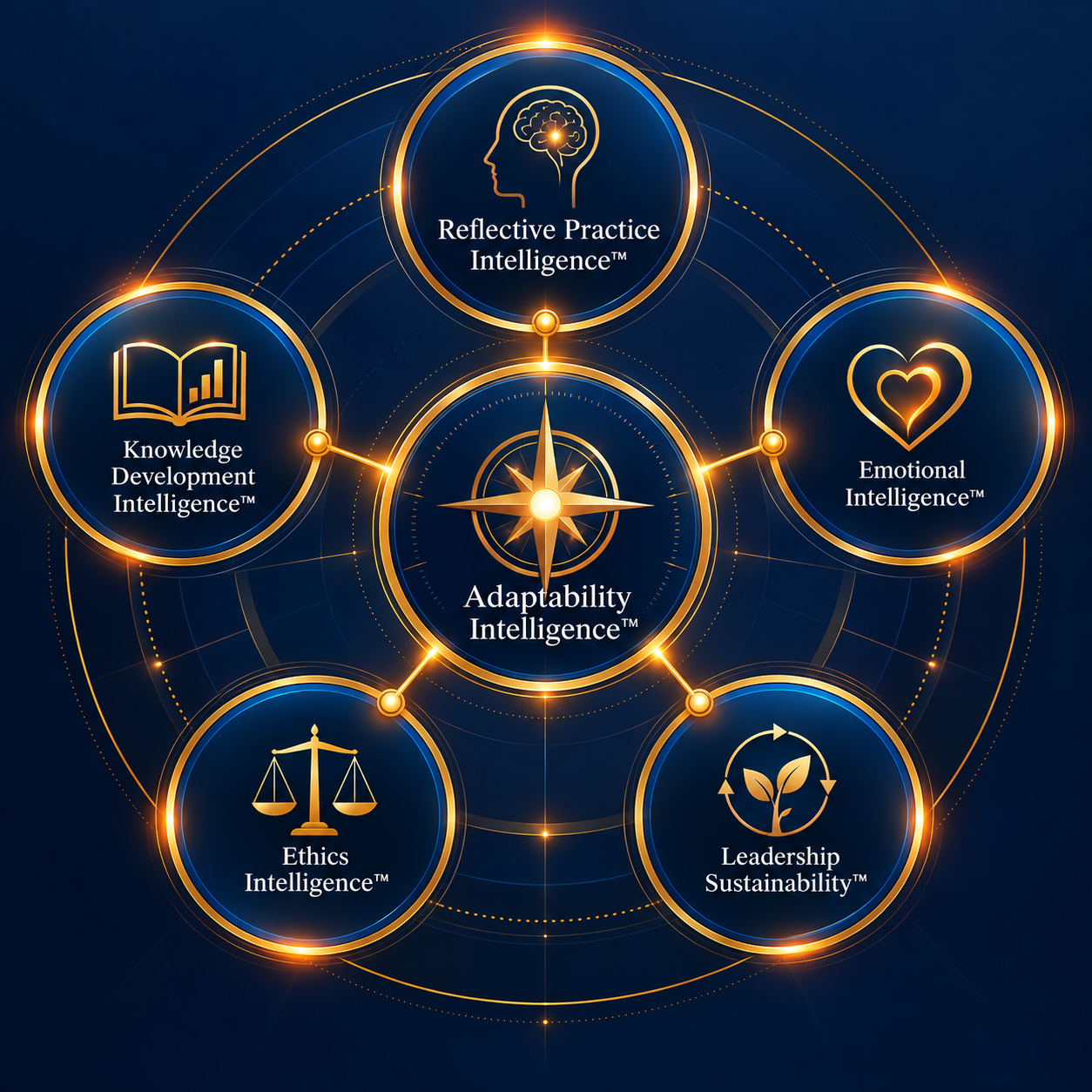
Burn Bright Advisory’s Leadership Performance Intelligence™ provides the wider context for understanding leadership effectiveness across interconnected capabilities.
Within this approach, Adaptability Intelligence™ does not operate independently.
It interacts with other dimensions of the Leadership Intelligence Compass™. For example:
- Reflective Practice Intelligence™ supports the examination of established assumptions and previous decisions.
- Knowledge Development Intelligence™ enables leaders to identify, interpret and integrate emerging information.
- Emotional Intelligence™ contributes to the management of uncertainty, interpersonal tension and the emotional consequences of change.
- Ethics Intelligence™ helps leaders evaluate whether proposed adaptations remain consistent with professional responsibilities and organisational values.
- Leadership Sustainability™ examines whether the pace and consequences of adaptation can be maintained without progressively exhausting individuals or teams.
Together, these capabilities provide a more comprehensive explanation of effective adaptability.
A leader may recognise the need for change but lack the emotional capacity to manage the resulting uncertainty.
Another may understand emerging evidence but fail to translate that understanding into revised organisational practice.
A third may demonstrate considerable flexibility while neglecting the ethical implications of changing established procedures.
Adaptability Intelligence™ therefore contributes to leadership effectiveness through its relationship with other leadership capabilities, rather than through isolated behavioural flexibility.
Why Adaptability Must Be Sustainable
An organisation cannot treat continuous adaptation as an unlimited demand on leadership capacity.
Every significant change requires attention, decision-making, communication, coordination and often emotional effort.
When organisational change accumulates without adequate prioritisation, leaders may experience increasing workload while teams struggle to consolidate new practices.
This creates a paradox.
The solution is not to resist necessary change.
It is to distinguish valuable adaptation from unnecessary organisational activity.
Sustainable adaptability requires leaders to consider the cumulative consequences of their decisions, including the demands placed on people responsible for implementation.
This principle connects directly with Burn Bright Advisory’s wider emphasis on Leadership Workload™, Leadership Capacity™ and Leadership Sustainability™.
Leadership adaptability should ultimately strengthen the organisation’s ability to perform over time, rather than produce short-term responsiveness at the expense of future capability.
The Adaptability Intelligence™ Framework: From Awareness to Sustainable Action
Understanding the importance of adaptability is only the beginning. The more demanding leadership challenge is translating adaptability into a consistent, observable and developable capability.
Many organisations encourage leaders to become more adaptable without clearly defining what effective adaptation looks like.
As a result, adaptability may be evaluated through subjective impressions rather than meaningful evidence.
A leader who embraces organisational restructuring may be described as adaptable. Another who questions the proposed changes may be labelled resistant.
Yet questioning change can represent sophisticated leadership judgement, particularly when the proposed direction is poorly supported by evidence.
Similarly, embracing change does not automatically demonstrate adaptive intelligence.
The quality of adaptability depends on how leaders interpret circumstances, evaluate alternatives and determine appropriate responses.
Within Burn Bright Advisory’s Leadership Performance Intelligence™ approach, the following five-stage framework provides a practical way to examine this capability. It is a proposed developmental framework, not a psychometrically validated assessment scale.
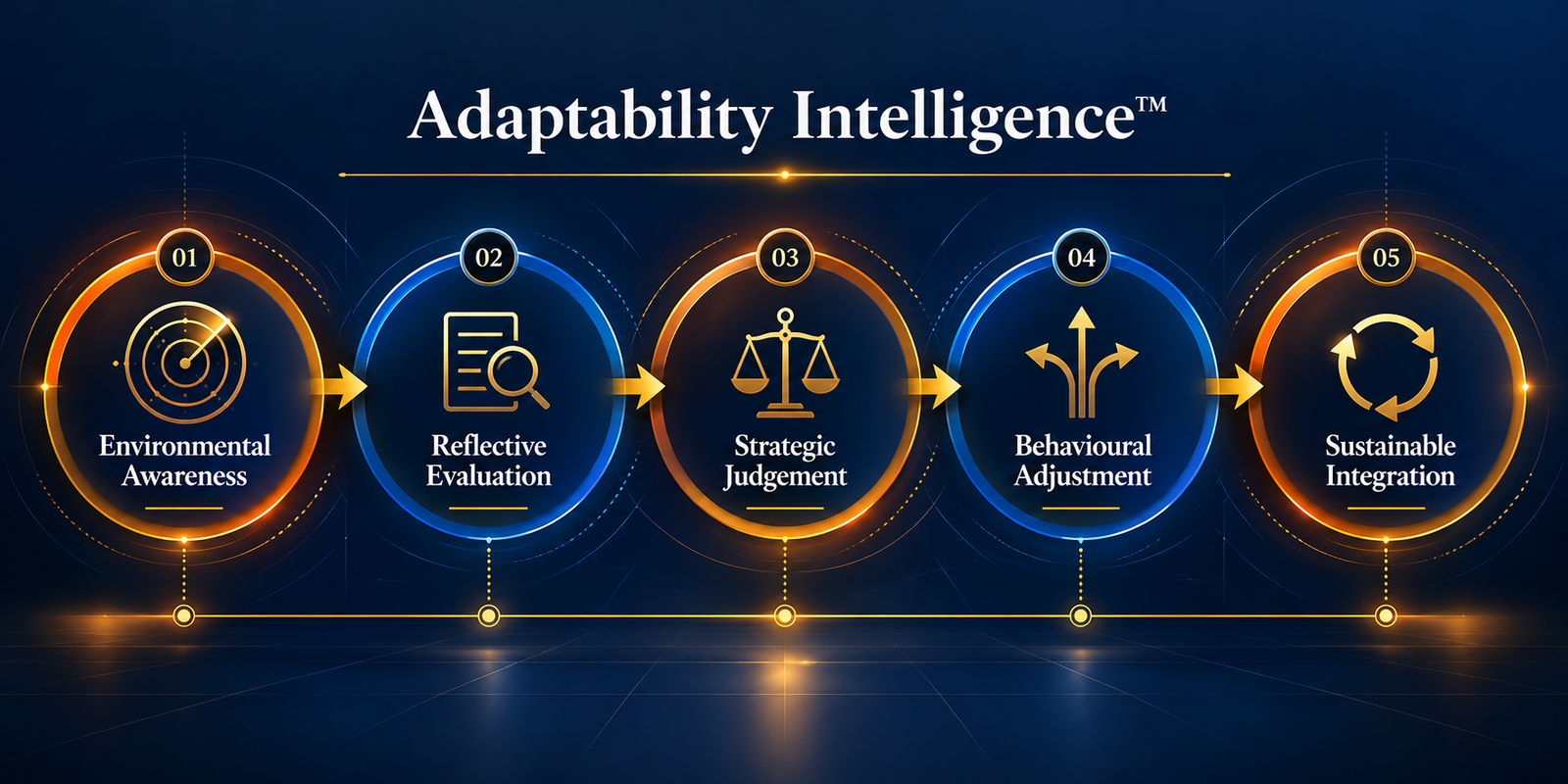
Stage 1 Environmental Awareness — Recognising What Is Changing
Effective adaptability begins with the capacity to recognise meaningful changes within the leadership environment.
These changes may involve technology, workforce expectations, regulatory requirements, stakeholder relationships, organisational performance or emerging operational risks.
However, environmental awareness requires more than collecting information. Leaders must distinguish between signals that warrant strategic attention and developments that have limited relevance to organisational priorities.
This requires curiosity, contextual understanding and the willingness to consider perspectives that challenge established expectations.
For example, a healthcare leader observing increased staff turnover should examine whether the pattern reflects compensation concerns, workload intensity, management relationships or broader workforce conditions.
The first responsibility is not immediate intervention. It is accurate interpretation.
Stage 2 Reflective Evaluation — Challenging Established Assumptions
Once a significant change has been identified, leaders must examine the assumptions influencing their interpretation.
Experience provides valuable reference points, but it can also encourage leaders to apply familiar solutions to unfamiliar problems. Reflective evaluation asks whether established approaches remain appropriate.
A school principal, for example, may interpret declining staff engagement as a problem of professional motivation. However, a more reflective examination might reveal increasing administrative demands, insufficient planning time or inconsistent organisational communication.
The initial interpretation shapes the intervention. When the interpretation is incomplete, even well-intentioned leadership action may fail to address the underlying problem.
This stage connects Adaptability Intelligence™ with Reflective Practice Intelligence™ and Knowledge Development Intelligence™. It encourages leaders to treat previous experience as evidence to examine rather than authority that cannot be questioned.
Stage 3 Strategic Judgement — Determining What Should Change
Not every emerging challenge requires organisational transformation. Some circumstances demand substantial redesign. Others require targeted adjustments or the deliberate preservation of existing practices.
Strategic judgement involves evaluating available options against organisational purpose, operational constraints, ethical responsibilities and long-term consequences.
The central question becomes: What degree of adaptation is justified by the evidence?
This protects organisations from two opposing risks:
- Strategic rigidity, where leaders preserve ineffective practices despite evidence that circumstances have changed.
- Unnecessary instability, where leaders repeatedly alter priorities without establishing whether those changes will improve outcomes.
Adaptability Intelligence™ requires leaders to navigate between these extremes.
Stage 4 Behavioural Adjustment — Translating Insight Into Leadership Practice
Recognising the need for change does not guarantee that leaders will modify their behaviour.
A leader may intellectually accept the importance of delegation while continuing to control every significant decision. Another may advocate collaborative leadership while responding defensively to disagreement.
Behavioural adjustment therefore represents a critical test of adaptability. It requires leaders to translate revised understanding into observable changes in communication, decision-making, delegation, professional relationships and operational practice.
Importantly, behavioural adjustment should be proportionate to the circumstances. The objective is not constant reinvention of leadership identity. It is the deliberate modification of practices that no longer support effective performance.
Stage 5 Sustainable Integration — Embedding Learning Without Creating Instability
The final stage concerns the integration of adaptive decisions into sustainable organisational practice.
A change that produces immediate improvement but creates excessive workload, confusion or dependency may not represent effective long-term adaptation.
Leaders must therefore evaluate both the outcomes and the consequences of their adjustments. This includes examining whether new practices strengthen organisational capability, improve decision quality and preserve the capacity required for future challenges.
Sustainable integration also requires learning. Leaders should examine which assumptions proved accurate, which decisions require further revision and what the organisation has learned about its ability to respond to uncertainty.
This stage connects adaptability directly with Leadership Sustainability™. Adaptation becomes a continuous learning capability rather than an endless sequence of organisational initiatives.
How Adaptability Intelligence™ Operates Across Leadership Sectors
The principles of adaptability apply across sectors, but their practical expression depends on the operating environment.
Business executives, school leaders, healthcare managers and public service professionals face different constraints, accountability structures and stakeholder expectations.
Consequently, effective adaptability cannot be reduced to a universal set of behaviours. The underlying capability remains consistent, while its application must reflect the responsibilities of each leadership context.

🏢 Business Growth Intelligence™: Adapting Without Losing Strategic Direction
Business leaders frequently operate under pressure to respond to competitive developments, technological disruption and changing customer expectations. However, organisational responsiveness can become counterproductive when every emerging trend produces a new strategic priority.
Consider a medium-sized professional services organisation experiencing increased competition from AI-enabled service providers. A reactive response might involve introducing multiple AI platforms, restructuring teams and accelerating automation without adequately examining client requirements or workforce capability.
An adaptive response would begin by identifying which services are genuinely changing, where technology can improve performance and which professional capabilities remain essential. The organisation could then introduce targeted changes while preserving service quality, professional accountability and strategic coherence.
The leadership challenge is not simply adopting technology. It is determining how technological change should influence the organisation’s operating model.
🎓 School Leadership Intelligence™: Adapting While Preserving Educational Purpose
Educational leaders must respond to changing curriculum expectations, student needs, workforce pressures and accountability requirements. Yet schools also depend on professional stability, relational trust and consistent educational expectations.
A principal who introduces numerous improvement initiatives without considering implementation capacity may unintentionally weaken the conditions required for sustained improvement. Adaptability Intelligence™ encourages school leaders to distinguish between changes that strengthen teaching and learning and initiatives that increase organisational activity without clear educational benefit.
For example, a school reviewing its assessment practices might begin by examining the quality of existing information, teacher workload and the decisions that assessment data actually informs. Rather than introducing another reporting system immediately, leadership may discover that simplifying existing procedures would improve both instructional focus and organisational effectiveness.
In this context, adaptability involves the disciplined adjustment of practice while preserving the school’s educational purpose.
🏥 Healthcare Leadership Intelligence™: Adapting Under Conditions of Professional Risk
Healthcare environments present a particularly demanding context for adaptability because leadership decisions may influence patient safety, clinical quality and workforce wellbeing. Healthcare leaders must respond to changing clinical evidence, workforce shortages, technological developments and operational pressures. However, adaptation must remain consistent with professional standards, regulatory requirements and appropriate clinical governance.
Consider a department experiencing increasing demand alongside constrained staffing. A reactive approach might involve repeatedly changing schedules, increasing overtime or redistributing responsibilities without examining the sustainability of those interventions.
An adaptive approach would evaluate demand patterns, clinical risk, workforce capability and available resources before determining appropriate operational adjustments. The objective would be to improve service responsiveness without normalising unsafe or unsustainable working conditions.
Here, Adaptability Intelligence™ operates alongside Ethics Intelligence™, Professionalism Intelligence™ and Leadership Sustainability™.
🏛️ Public Service Leadership Intelligence™: Balancing Responsiveness and Accountability
Public service leaders face changing policy priorities, resource limitations, community expectations and complex accountability requirements. Their adaptability is constrained not only by operational realities but also by legal, procedural and democratic responsibilities.
A public service leader cannot simply abandon established processes because a faster alternative appears attractive. Instead, effective adaptation requires determining where flexibility is appropriate and where consistency protects fairness, transparency and public trust.
For example, a department experiencing increasing service demand may explore digital delivery, revised workflows or alternative staffing arrangements. However, each proposed adjustment must be evaluated against accessibility, procedural fairness and the needs of service users.
In public service, adaptability is therefore inseparable from responsible governance. The most effective response is not necessarily the fastest organisational change, but the adjustment that improves public outcomes while maintaining institutional integrity.
The Adaptability Paradox: Why More Change Does Not Always Produce Better Leadership
A central challenge in contemporary leadership is the assumption that adaptability increases as the frequency of organisational change increases.
This assumption is misleading.
Organisations may experience substantial change while making limited progress in developing their underlying leadership capabilities.
New technologies may be introduced without improving decision quality.
Structures may be redesigned without resolving unclear accountability.
Professional development programmes may be expanded without changing established leadership behaviours.
These examples illustrate an important principle:
The distinction matters because activities can be counted more easily than capabilities can be evaluated.
Leaders may report the number of initiatives implemented, systems introduced or procedures revised. However, these measures provide limited evidence of whether the organisation has become more capable of responding effectively to future uncertainty.
A stronger evaluation considers whether leadership decisions have become more evidence-informed, whether teams can adjust without unnecessary disruption and whether organisational learning is retained.
Adaptability should therefore be examined through both immediate outcomes and the longer-term development of leadership capacity.
The ultimate objective is not an organisation that changes continuously. It is an organisation capable of changing intelligently when circumstances require it.
| Reactive Leadership | Adaptive Leadership |
|---|---|
| Responds to the visible symptoms of change | Seeks to understand the conditions producing those symptoms |
| Declining retention → immediately adds incentives, targets or a new engagement programme | Investigates whether the cause is compensation, workload, management behaviour, development or culture |
| AI competition → introduces multiple platforms, restructures teams, accelerates automation | Identifies which services are genuinely changing and where technology improves performance |
| Staffing pressure → repeatedly changes schedules and increases overtime | Evaluates demand patterns, clinical risk, capability and resources before adjusting |
| Absorbs added complexity through longer hours and personal involvement | Redesigns decision-making, improves delegation and removes low-value activity |
| Measures adaptability by the frequency of change | Measures adaptability by the quality of judgement when circumstances change |
Measuring Adaptability Intelligence™: From Leadership Perception to Performance Evidence
If adaptability is a critical leadership capability, organisations must move beyond simply encouraging it and begin examining how effectively it is demonstrated.
This presents an important challenge.
Adaptability is difficult to evaluate through conventional performance indicators because its value often becomes apparent during uncertainty, disruption or changing organisational conditions.
A leader may consistently achieve operational targets while relying on practices that are becoming increasingly ineffective.
Another may demonstrate strong adaptive judgement by questioning established procedures, identifying emerging risks or recommending a strategic adjustment that initially produces resistance.
Traditional performance evaluations may not adequately distinguish between these behaviours.
Within Burn Bright Advisory’s Leadership Performance Intelligence™ approach, adaptability should therefore be examined through evidence of leadership judgement, learning and behavioural adjustment.
The objective is not to assign leaders a simplistic adaptability label. It is to develop a clearer understanding of how they respond when established approaches become insufficient.
Five Dimensions of Adaptability Intelligence™ Assessment
The five-stage framework introduced earlier provides a practical foundation for evaluating adaptive leadership capability.
| Dimension | Evidence to Examine |
|---|---|
| Environmental Awareness | Recognition of relevant changes and emerging risks |
| Reflective Evaluation | Willingness to challenge assumptions and consider alternative interpretations |
| Strategic Judgement | Ability to distinguish necessary adaptation from unnecessary change |
| Behavioural Adjustment | Observable changes in decisions, communication and leadership practice |
| Sustainable Integration | Evidence that adjustments improve outcomes without creating excessive disruption |
These dimensions can inform structured reflection, development conversations and organisational review.
However, they should not be treated as a validated diagnostic instrument without appropriate assessment development, testing and evidence of reliability.
Moving Beyond Self-Reported Adaptability
Leadership self-assessment can provide useful insight, but it also has limitations.
Leaders may overestimate their willingness to change, particularly when adaptability is regarded as a desirable professional characteristic.
Others may underestimate their capability because they associate adaptability with constant innovation or rapid decision-making.
A more balanced approach combines several forms of evidence. These may include reflective accounts of significant decisions, feedback from colleagues, documented changes in leadership behaviour and the outcomes of organisational adjustments.
For example, a leader might describe a situation in which new evidence challenged an established operational assumption.
The assessment should explore not only whether the leader recognised that evidence, but also how they evaluated it, what they changed and what they subsequently learned.
This approach moves adaptability assessment closer to actual leadership performance.
Leadership Benchmarking™: Establishing a Meaningful Basis for Development
Leadership Benchmarking™ provides a structured way to examine capability against defined expectations, relevant responsibilities and evidence of performance.
In the context of Adaptability Intelligence™, benchmarking should not be understood as a competition to identify which leader changes direction most frequently.
Instead, it should examine whether leaders demonstrate the adaptive capabilities required by their particular roles.
A healthcare executive responsible for clinical governance operates within different constraints from an entrepreneur developing a new business model.
Both require adaptability, but the appropriate expression of that capability differs. Meaningful benchmarking must therefore account for leadership context.
What Should Organisations Benchmark?
Three considerations are particularly important.
- Capability expectations. Organisations should define what effective adaptive judgement looks like at different leadership levels.
- Behavioural evidence. Assessment should consider how leaders respond to uncertainty, contradictory information and changing stakeholder requirements.
- Developmental progress. Benchmarking should identify whether leadership capability improves over time rather than relying exclusively on a single assessment.
Within the Leadership Intelligence Compass™, these considerations can contribute to a more integrated understanding of leadership development.
For instance, limited adaptability may reflect weaknesses in reflective practice, knowledge development or emotional regulation rather than an isolated inability to manage change.
Recognising these relationships allows organisations to design more relevant development interventions.
The Role of the Leadership Intelligence Assessment™
The Leadership Intelligence Assessment™ can be positioned within Burn Bright Advisory’s wider Leadership Development System™ as a means of supporting structured conversations about leadership capability.
For Adaptability Intelligence™, relevant assessment questions might examine how leaders interpret emerging information, reconsider established decisions and balance responsiveness with organisational stability.
Any numerical scoring, comparative benchmarks or proficiency classifications would require a defined and appropriately validated assessment methodology.
The developmental value lies in connecting assessment findings with practical reflection, observable behavioural change and subsequent review.

Leadership Reflection™: The Foundation of Adaptive Development
Adaptability cannot develop effectively without reflection.
Leaders who continually respond to emerging demands without examining their decisions may become increasingly experienced in managing pressure without necessarily improving their judgement.
Leadership Reflection™ creates the opportunity to examine the relationship between assumptions, actions and outcomes.
It encourages leaders to consider not only whether a decision succeeded, but also why it was made and whether the reasoning remains appropriate.
This is particularly important in environments where immediate operational demands leave limited space for critical examination.
A structured reflective process can help leaders distinguish between genuine learning and repeated reliance on familiar responses.
A Practical Adaptability Reflection Cycle
The following cycle can support leadership development.
1. Identify a significant leadership decision
Select a situation involving uncertainty, competing priorities or changing circumstances.
2. Examine the assumptions
Consider which beliefs, experiences and expectations influenced the original interpretation.
3. Evaluate alternative perspectives
Identify information that may have been overlooked or insufficiently considered.
4. Review the response
Examine whether the decision represented appropriate adaptation, unnecessary reaction or excessive resistance.
5. Determine future adjustments
Identify specific changes in leadership practice and establish how their effectiveness will be reviewed.
The value of this process depends on the quality of reflection rather than the volume of reflective activity.
Reflection should lead to clearer understanding, more informed decisions and observable development.
It should not become another administrative requirement that increases leadership workload without improving performance.
Developing Adaptability Intelligence™ Through Leadership Practice
Adaptability develops through the interaction of experience, reflection, feedback and deliberate behavioural adjustment.
Formal leadership education can introduce useful concepts, but knowledge alone does not establish adaptive capability.
Leaders must have opportunities to apply their understanding within authentic organisational circumstances.
A practical development approach should therefore connect learning directly with leadership responsibilities.
For example, a senior manager who struggles to reconsider established decisions might undertake a structured review of a current strategic challenge.
Rather than immediately selecting a preferred solution, the manager could invite alternative interpretations, examine contradictory evidence and document the reasoning behind the final decision.
Subsequent reflection would explore whether this approach improved decision quality and whether similar practices should be incorporated into future leadership activity.
Integrating Adaptability Into the Leadership Development System™
Burn Bright Advisory’s Leadership Development System™ provides a wider developmental context for connecting leadership insight with sustained capability improvement.
Within this approach, Adaptability Intelligence™ can be developed through a sequence of assessment, reflection, targeted learning, practical application and review.
The Leadership Intelligence Library™ can support conceptual understanding and provide relevant leadership resources.
Planning tools can help translate insights into specific development priorities.
Workshops can create opportunities to examine complex scenarios, challenge assumptions and practise adaptive decision-making.
Where appropriately designed, certification pathways can recognise demonstrated understanding and application against defined standards.
The Sustainability Risk: When Adaptability Becomes an Additional Leadership Burden
Adaptability is essential, but it is not unlimited.
Leaders operate within finite cognitive, emotional and organisational capacity.
When every emerging challenge is treated as requiring immediate adjustment, adaptability can become another source of pressure.
This risk is particularly significant when organisations introduce new initiatives without removing outdated responsibilities.
Leaders may be expected to maintain existing performance standards while simultaneously implementing new technologies, responding to workforce changes and managing evolving stakeholder expectations.
Over time, these demands can reduce the capacity available for strategic thinking and informed judgement.
The resulting problem is not necessarily a lack of adaptability. It may be an imbalance between the demands of adaptation and the resources available to support it.
Connecting Adaptability With Leadership Sustainability™
Leadership Sustainability™ examines whether leadership performance can be maintained over time without progressively undermining the capacity required to deliver it.
Within this perspective, effective adaptability must account for the human and organisational consequences of change.
Leaders should consider whether proposed adjustments create additional workload, require capabilities that have not yet been developed or introduce uncertainty that exceeds the organisation’s capacity to manage.
This does not mean avoiding difficult decisions. It means recognising that sustainable performance requires disciplined prioritisation.
An organisation that continuously adds responsibilities without reconsidering existing commitments may eventually weaken the leadership capability on which its success depends.
Leadership Capacity™ and Leadership Workload™
Leadership Capacity™ concerns the resources and capabilities available to meet leadership responsibilities.
Leadership Workload™ concerns the demands placed upon those resources.
Adaptability Intelligence™ connects these concepts by influencing how leaders interpret changing demands and determine appropriate responses.
For example, a leader facing increased operational complexity may initially attempt to compensate through longer working hours and greater personal involvement.
However, a more adaptive response might involve redesigning decision-making responsibilities, improving delegation or removing activities that no longer contribute sufficient value.
The difference is significant. One approach attempts to absorb additional complexity through individual effort. The other examines whether the operating system itself requires adjustment.
The Leadership Performance Question: Are We Developing Adaptability or Simply Demanding More Flexibility?
Organisations frequently communicate the importance of adaptability through leadership expectations, competency frameworks and professional development programmes.
However, these expectations can become problematic when leaders are encouraged to demonstrate greater flexibility without receiving the authority, information or resources required to make meaningful adjustments.
In these circumstances, adaptability cannot be understood exclusively as an individual leadership responsibility.
Organisational systems influence whether adaptive capability can be exercised effectively.
The development of Adaptability Intelligence™ must therefore be accompanied by an examination of the conditions that enable or restrict adaptive leadership.
This includes decision-making authority, access to reliable information, professional trust, organisational learning and realistic workload expectations.
Ultimately, adaptability leadership is not demonstrated by an individual’s willingness to accommodate unlimited demands.
It is demonstrated through the quality of judgement used to determine what should change, what should remain stable and how sustainable performance can be protected.
This provides the foundation for translating Adaptability Intelligence™ into practical leadership development priorities.
Conclusion: Adaptability Is a Measure of Leadership Judgement, Not the Frequency of Change
The future of leadership will not be determined simply by how quickly organisations respond to disruption.
It will depend on whether leaders possess the intelligence, judgement and organisational awareness required to distinguish necessary adaptation from unnecessary change.
Adaptability leadership is therefore not a demand for permanent flexibility. It is a disciplined capability that enables leaders to reconsider assumptions, interpret emerging evidence and modify established practices without losing strategic direction.
Within Burn Bright Advisory’s Leadership Performance Intelligence™ approach, Adaptability Intelligence™ contributes to a more comprehensive understanding of leadership effectiveness.
It connects environmental awareness with reflective practice, strategic judgement with behavioural adjustment, and organisational responsiveness with sustainable performance.
Importantly, adaptability cannot be separated from the conditions in which leadership operates.
Leaders require sufficient capacity, reliable information, appropriate authority and opportunities for reflection if they are to respond intelligently to changing circumstances.
Organisations that demand constant adaptation without addressing these conditions risk confusing leadership development with increasing organisational pressure.
The central leadership challenge is therefore not to become more comfortable with change at any cost.
It is to become more capable of determining when change is necessary, what form it should take and how its consequences should be managed.
Through the Leadership Intelligence Compass™, Burn Bright Advisory™ positions adaptability as one interconnected dimension of a wider leadership capability system.
When supported by Reflective Practice Intelligence™, Knowledge Development Intelligence™, Ethics Intelligence™ and Leadership Sustainability™, adaptability becomes more than a response to uncertainty.
It becomes a foundation for informed decision-making, organisational learning and sustained leadership performance.
Leadership Reflection Questions
- Environmental awareness: How effectively do I distinguish significant organisational changes from temporary pressures or distractions?
- Assumptions: Which established beliefs about leadership or organisational performance have I not questioned recently?
- Strategic judgement: When circumstances change, do I evaluate alternatives before committing to a response?
- Behavioural adaptability: Can I identify a recent situation in which new evidence caused me to modify my leadership behaviour?
- Professional identity: Am I willing to reconsider approaches that previously contributed to my success?
- Organisational culture: Do colleagues feel able to challenge established assumptions without experiencing negative consequences?
- Leadership workload: Are adaptation demands increasing faster than the resources available to manage them?
- Sustainability: Do the changes I introduce strengthen long-term organisational capacity or create additional dependency on individual effort?
These questions are designed to support individual reflection, executive coaching, leadership team discussions and professional development, and can form part of Leadership Reflection™ activities within the Leadership Intelligence Library™.
Practical Leadership Action Steps
The following 30-day development sequence translates the article’s principles into practical leadership activity.
Week 1
Examine a recent decision
Select a significant leadership decision made under uncertainty. Document the information available, assumptions made and alternatives considered.
Week 2
Gather alternative perspectives
Invite feedback from colleagues or stakeholders who may interpret the situation differently. Identify evidence that challenges your initial understanding.
Week 3
Implement one deliberate adjustment
Select a leadership behaviour, decision-making practice or operational process that requires modification. Define the intended outcome and the evidence that would indicate improvement.
Week 4
Evaluate impact and sustainability
Review the adjustment’s effectiveness, including consequences for workload, organisational clarity and team capacity. Record what should be retained, revised or discontinued.
This sequence is a development exercise rather than a validated intervention. Its purpose is to establish a repeatable connection between leadership reflection, adaptive judgement and observable practice.
Frequently Asked Questions
What is adaptability leadership?
Adaptability leadership is the ability to modify leadership thinking, decisions and behaviours in response to changing circumstances while maintaining strategic direction, professional standards and organisational purpose. It requires leaders to interpret uncertainty, reconsider assumptions and make proportionate adjustments rather than simply reacting to every emerging demand.
What is Adaptability Intelligence™?
Adaptability Intelligence™ is a leadership capability domain within Burn Bright Advisory’s Leadership Intelligence Compass™. It examines how leaders recognise changing conditions, evaluate new information, adjust established practices and integrate learning into sustainable leadership performance.
Why is adaptability important in leadership?
Adaptability enables leaders to respond effectively when existing approaches become insufficient. It supports informed decision-making, organisational learning and responsiveness to emerging risks. Without adaptability, leaders may continue applying familiar solutions even when circumstances require different approaches.
How can leaders develop adaptability?
Leaders can develop adaptability through structured reflection, exposure to alternative perspectives, critical examination of assumptions and deliberate behavioural adjustment. Development is strengthened when leaders receive feedback, apply learning in authentic situations and review the consequences of their decisions.
What is the difference between adaptability and resilience?
Adaptability concerns the capacity to adjust thinking, behaviour and decisions when circumstances change. Resilience concerns the capacity to withstand, recover from or function through adversity. The capabilities are related but distinct: resilience can support continued functioning, while adaptability may require changing the approach itself.
How can organisations measure leadership adaptability?
Organisations can examine evidence of environmental awareness, reflective evaluation, strategic judgement, behavioural adjustment and sustainable integration. Assessment may combine self-reflection, colleague feedback, decision reviews and observable performance evidence. Formal scoring requires appropriately designed and validated measurement methods.
Can too much adaptability undermine leadership performance?
Yes. Excessive or poorly prioritised change can create uncertainty, increase workload and weaken organisational consistency. Effective adaptability requires leaders to distinguish necessary adjustments from unnecessary disruption and consider the cumulative consequences of change.
How does Adaptability Intelligence™ connect with the Leadership Intelligence Compass™?
Adaptability Intelligence™ interacts with Reflective Practice Intelligence™, Knowledge Development Intelligence™, Emotional Intelligence™, Ethics Intelligence™ and Leadership Sustainability™. These relationships help explain how leaders recognise change, evaluate alternatives, manage uncertainty and sustain effective performance.
Go Deeper With the Burn Bright Full Diagnostic™
For a structured, in-depth view of the capacity, workload and sustainability factors shaping your leadership performance.
Develop Your Adaptability Intelligence™
Effective leadership requires more than responding to change. It requires the capacity to interpret uncertainty, challenge established assumptions and make informed decisions that protect long-term performance.
Free Leadership Intelligence
Get Weekly Leadership Insights
Join thousands of leaders receiving practical strategies on burnout prevention, workload design, and sustainable performance every week.