Quick Answer
Key Takeaways
- Audit your calendar for strategic value, not simply meeting attendance.
- Remove recurring meetings that no longer justify their cost.
- Protect strategic thinking and decision-making time as essential leadership work.
- Delegate decision authority rather than merely declining invitations.
- Build recovery rhythms into your calendar to prevent overload returning.
Calendar Bankruptcy: A Leadership Reset
Introduction: When Your Calendar Becomes the Problem
Calendar bankruptcy leadership is becoming a serious challenge for executives whose working weeks are consumed by meetings, decisions and constant demands on their attention.
You open your calendar on Monday morning.
Every available hour is occupied. There are operational updates, performance reviews, stakeholder discussions, project meetings and urgent conversations.
Your day appears organised.
But there is a problem.
You have no time left to lead.
Strategic decisions are postponed. Important conversations are squeezed between meetings. Your most demanding thinking happens early in the morning or late in the evening.
And the work that genuinely requires your leadership keeps accumulating.
Across more than 30 years of leadership experience in education, business and the public sector, I have seen how easily a full calendar becomes mistaken for effective leadership.
The underlying problem is rarely a lack of personal discipline.
It is the way organisations allocate attention, distribute decisions and measure leadership contribution.
Calendar bankruptcy is the point at which those structures stop working.
In this article, we will examine why it happens, how to recognise it, what research tells us about meeting overload and how to redesign your leadership week using a practical structural framework.
The first step is understanding the system behind the overload.
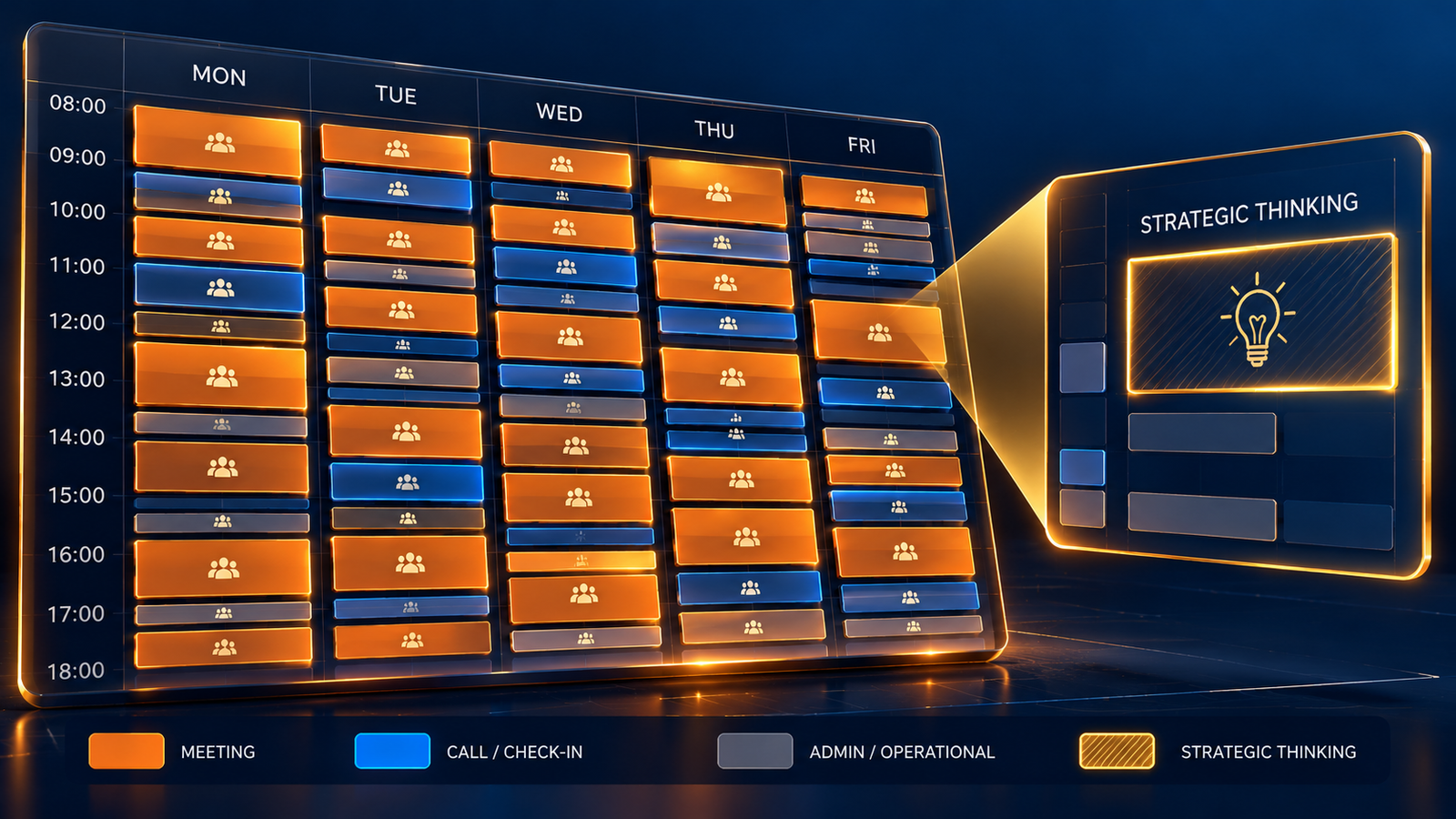
A full calendar is not necessarily a productive calendar. The critical question is whether the time committed produces the outcomes the organisation actually needs.
What Is Calendar Bankruptcy in Leadership?
Featured Snippet
It is not an official clinical diagnosis or a formal accounting term. It is a practical description of a leadership system that has lost control of its time commitments.
The distinction matters.
A busy calendar may reflect a demanding but manageable period. Calendar bankruptcy describes a more persistent problem: the leader cannot fulfil existing obligations without sacrificing strategic work, recovery or personal time.
The hidden mathematics of overload
Consider a senior leader working a nominal 40-hour week. Their calendar contains:
- 24 hours of scheduled meetings.
- 6 hours of operational interruptions.
- 5 hours of email and communication.
- 4 hours of administrative responsibilities.
That leaves one hour for strategy, preparation, coaching, reflection and unexpected decisions.
The organisation may still expect the leader to deliver all these responsibilities.
The leader compensates by extending the working day.
Initially, this appears effective. Deadlines are met. Problems are resolved. Stakeholders receive responses.
But the system is borrowing capacity from evenings, weekends and recovery.
Eventually, that borrowing becomes unsustainable.
Is Your Calendar Borrowing From Your Recovery?
Take the free self-assessment to see where workload, meeting pressure and burnout risk may be building in your leadership week.
Why calendar bankruptcy is a structural problem
In Burn Bright Not Out, I identify five recurring root causes of leadership burnout:
- Scope creep.
- Meeting culture.
- Communication chaos.
- Decision overload.
- Perfectionism culture.
Calendar bankruptcy sits at the intersection of all five.
Scope creep adds responsibilities. Meeting culture turns every issue into another discussion. Communication chaos fragments the remaining time. Decision overload concentrates authority at the top. Perfectionism makes leaders reluctant to step away.
The result is predictable.
A leader becomes the organisation’s default problem-solving mechanism.
This is not evidence of exceptional leadership. It is evidence of an organisational design problem.
For leaders already recognising persistent exhaustion or declining effectiveness, understanding the early signs of leadership burnout provides useful context.
Why Do Leadership Calendars Become Overloaded?
Leadership calendars rarely become unmanageable overnight.
They deteriorate through hundreds of individually reasonable decisions.
A new project requires a weekly meeting. A temporary crisis introduces a daily update. A stakeholder asks for additional visibility. A senior manager requests another reporting conversation.
Each addition appears manageable.
Very few commitments are subsequently removed.
The accumulation problem
Imagine an executive who accepts one additional 30-minute recurring meeting every fortnight.
That may appear insignificant.
But over a year, it creates approximately 13 hours of direct meeting time, excluding preparation, follow-up and context switching.
Multiply that pattern across several projects and departments.
The cost becomes substantial.
The problem is not necessarily the duration of individual meetings. It is the absence of a system for reviewing whether those meetings should continue.
The three forces behind calendar overload
The calendar gradually becomes a record of past organisational problems rather than a deliberate plan for current priorities.
What the research tells us
Microsoft’s 2023 Work Trend Index reported that 68% of surveyed people said they did not have enough uninterrupted focus time during the working day.
That finding is particularly relevant to leaders.
Strategic thinking requires more than a few available minutes between conversations. It requires sustained attention.
The same Microsoft research reported that inefficient meetings were identified as the leading productivity disruptor among surveyed respondents.
Although these findings are not specific to executives, they highlight the wider conditions in which leadership calendar overload develops.
The structural question is straightforward:
Until that contradiction is addressed, calendar optimisation will deliver limited results.
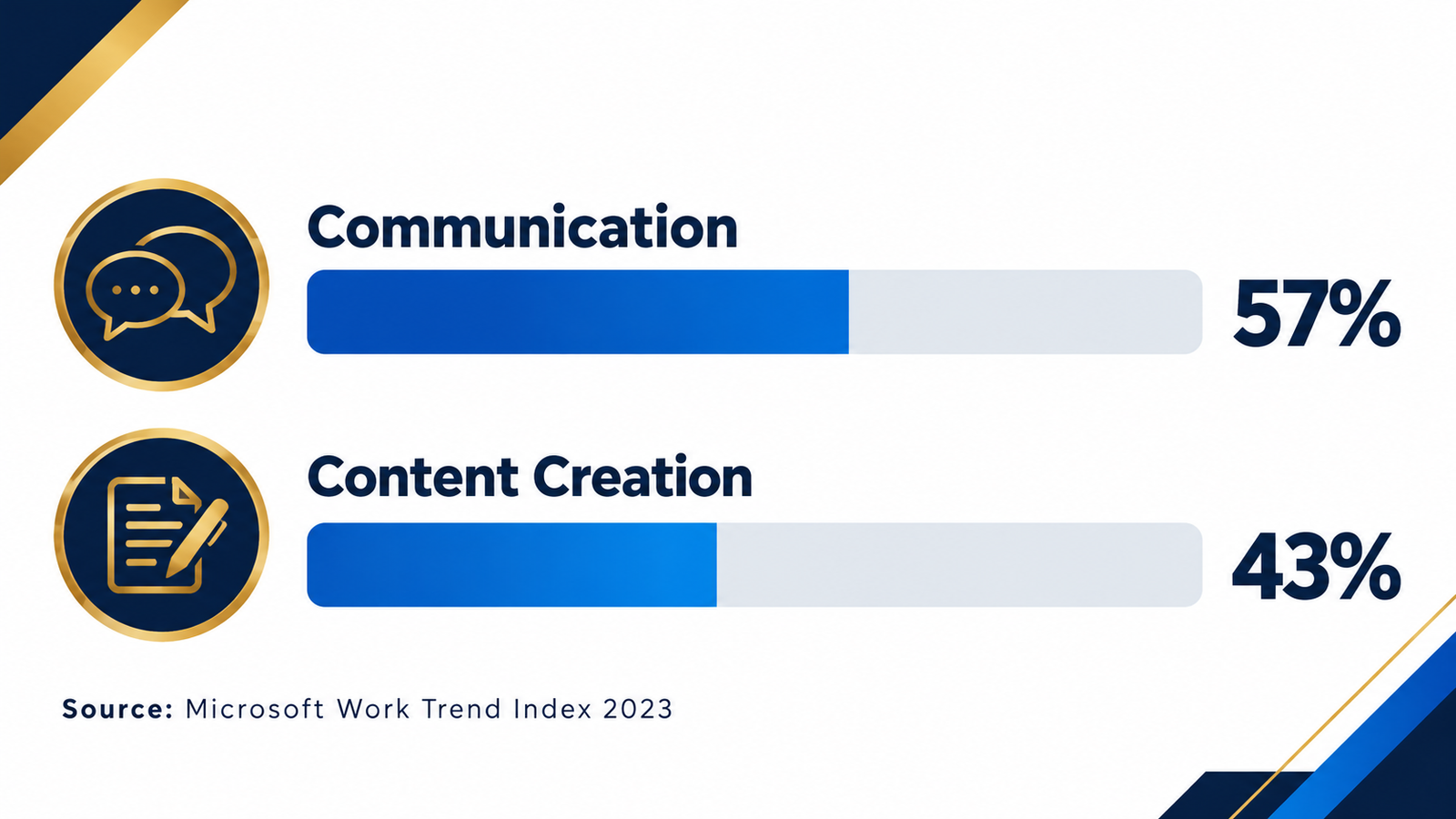
The lesson is not that communication is unproductive. Leadership depends on communication. The problem begins when communication absorbs the capacity needed to make decisions, develop people and improve the organisation.
How Does Calendar Bankruptcy Affect Leadership Performance?
The consequences of calendar bankruptcy extend beyond personal exhaustion.
They affect the quality of leadership itself.
When a leader’s attention is fragmented throughout the day, the organisation loses access to one of its most valuable resources: the leader’s capacity to think clearly about complex problems.
Strategic thinking becomes an after-hours activity
Senior leaders are employed to make decisions that shape the future.
Yet many spend their working days responding to immediate operational demands.
Long-term planning becomes something they intend to address when the calendar becomes quieter.
It rarely does.
Strategy is pushed into evenings, weekends or annual planning events.
This creates a dangerous imbalance.
The organisation becomes increasingly effective at responding to immediate problems while becoming less capable of preventing future ones.
Decision quality comes under pressure
Leadership decisions often require balancing incomplete information, competing interests and uncertain consequences.
Those decisions benefit from preparation and reflection.
A calendar filled with consecutive meetings provides little opportunity for either.
Leaders may become more reactive, defer difficult choices or rely too heavily on familiar solutions.
The problem is not necessarily a decline in competence.
It is a decline in the conditions required to exercise that competence.
For a deeper examination of this relationship, see how burnout affects leadership decision-making.
The effect spreads through the organisation
Gallup’s 2026 State of the Global Workplace report found that global manager engagement fell from 31% in 2022 to 22% in 2025.
Gallup also reported that manager engagement declined by five percentage points between 2024 and 2025 alone.
These figures do not prove that meetings caused the decline.
They do, however, show that managers are operating under considerable pressure.
Gallup identifies changing organisational structures, increasing spans of control and competing demands as important considerations.
A manager whose calendar leaves little time for coaching, feedback or problem-solving cannot provide the same quality of support as one with sufficient capacity.
The organisational cost
The World Health Organization estimates that depression and anxiety contribute to approximately 12 billion lost working days globally each year, with an estimated US$1 trillion in lost productivity.
These figures concern mental health at work broadly. They are not estimates of the financial cost of calendar bankruptcy.
But the WHO identifies excessive workloads and low job control as workplace risks.
Calendar design influences both.
That is why redesigning leadership time should be treated as an organisational effectiveness issue, not merely a personal productivity exercise.
What Is the Difference Between Calendar Management and Calendar Architecture?
Traditional calendar management focuses on fitting commitments into available time.
Calendar architecture asks whether those commitments should exist in the first place.
That is a fundamental difference.
A leader can become highly skilled at organising an unsustainable workload.
They can colour-code meetings, automate reminders, reduce meeting lengths and create sophisticated scheduling rules.
But none of these improvements solves the problem if the underlying volume of commitments remains excessive.
Traditional versus sustainable leadership calendars
| Traditional Calendar Management | Sustainable Calendar Architecture |
|---|---|
| Fit more meetings into the week | Reduce unnecessary commitments |
| Measure productivity through activity | Measure outcomes and decisions |
| Attend meetings to maintain visibility | Attend only where contribution is essential |
| Accept recurring meetings indefinitely | Require periodic renewal |
| Protect focus time when possible | Reserve strategic time by design |
| Escalate decisions to senior leaders | Distribute authority appropriately |
| Use evenings to catch up | Match workload to realistic capacity |
| Treat recovery as optional | Establish recovery rhythms |
The four pillars of structural transformation
My Burn Bright Not Out Framework™ identifies four pillars for building sustainable leadership systems.
Pillar 1
Workload Architecture™
Identify the work that genuinely needs to be done, the capacity available and the responsibilities that should be removed, redesigned or redistributed.
Pillar 2
Decision Authority™
Clarify who can make which decisions without escalating every issue.
Pillar 3
Recovery Rhythms™
Design the working week to allow periods of concentrated effort and appropriate recovery.
Pillar 4
Management Frameworks
Use consistent operating systems that reduce unnecessary meetings, duplicated reporting and avoidable uncertainty.
These pillars work together.
Removing meetings without changing decision authority may simply produce more emails and messages.
Delegating decisions without clear accountability may create confusion.
Protecting focus time without reviewing workload may move the pressure elsewhere.
Sustainable calendar architecture addresses the complete system.
The objective is not an empty diary. It is a deliberate allocation of leadership capacity.
How Can Leaders Recover From Calendar Bankruptcy?
Recovering from calendar bankruptcy requires more than cancelling a few meetings.
It requires a controlled reset of the commitments, decision pathways and expectations that created the overload.
I recommend a five-stage approach.
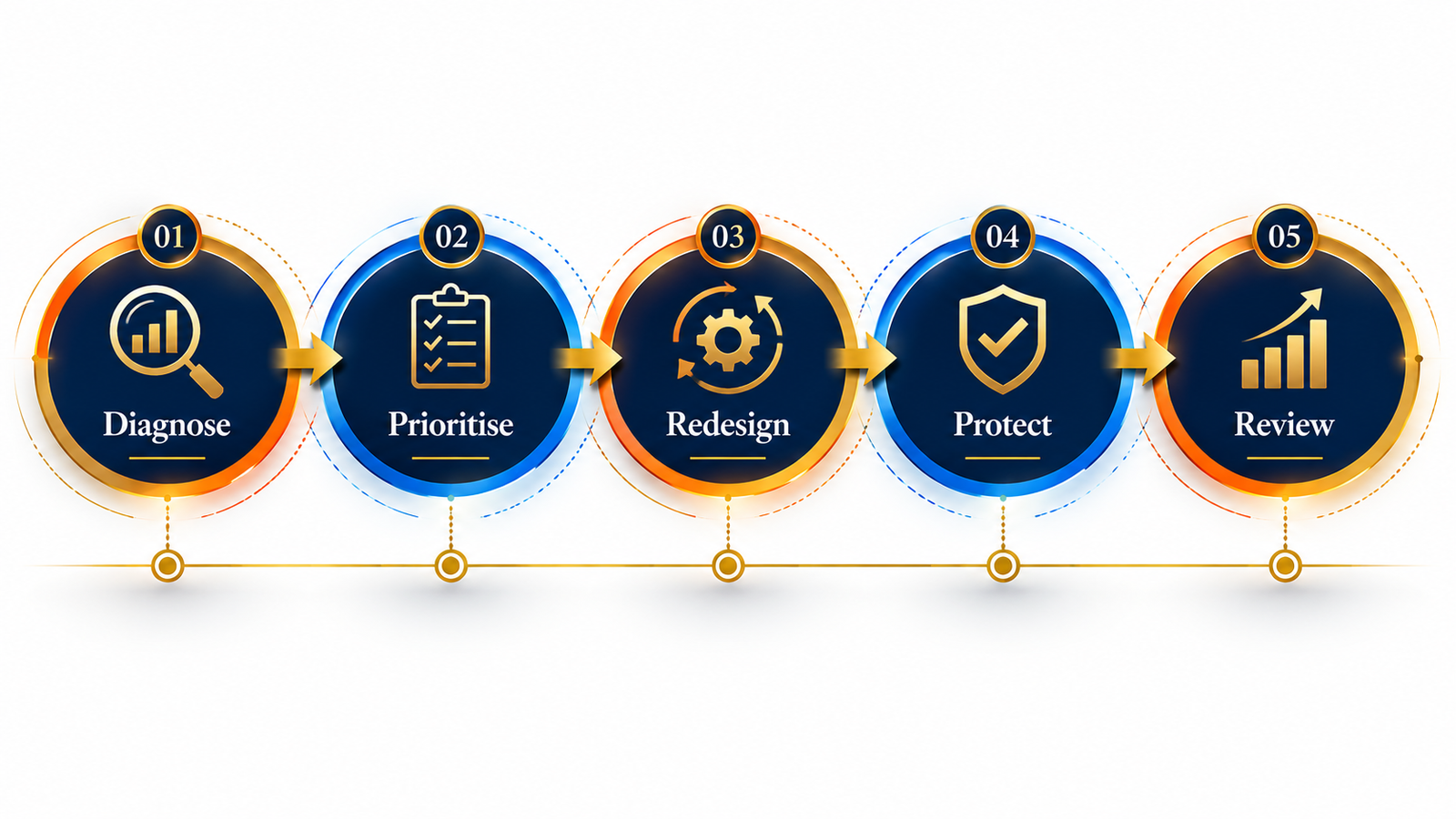
Stage 1 Diagnose the existing calendar
Review the previous four working weeks. Record the time spent on recurring meetings, operational discussions, strategic work, individual coaching, administrative activity and recovery.
For each commitment, ask:
- What outcome did this activity produce?
- Did my participation materially improve that outcome?
- Could the work happen without a meeting?
- Could another person make the required decision?
- Would the organisation suffer if this activity stopped?
Do not begin by reorganising the calendar. Begin by understanding it.
Stage 2 Apply the IMPACT Matrix™
The Burn Bright IMPACT Matrix™ provides a way to examine commitments through the lens of organisational contribution. For a calendar audit, apply these practical questions:
Does the activity influence an important outcome? Does it require my authority? Is it essential now? Does its value justify the time invested?
Sort commitments into four action categories:
- Retain: Essential work that genuinely requires your involvement.
- Redesign: Necessary work that can be completed more efficiently.
- Delegate: Work that belongs with another appropriately authorised person.
- Eliminate: Activities that no longer produce sufficient value.
The purpose is to move from automatic attendance to deliberate participation.
Stage 3 Reset recurring meetings
Start with recurring commitments because their cost compounds over time.
Ask every meeting owner to provide a clear purpose, expected output, required participants and review date.
Where a meeting exists only to distribute information, consider an asynchronous update. Where a decision is required, identify the decision-maker before scheduling. Where a discussion has no defined output, question whether it needs to happen.
For example, replacing a weekly one-hour status meeting involving eight people with a concise written update could release up to eight participant-hours per week, before accounting for preparation.
That is a calculation of potential capacity, not a guaranteed productivity gain.
Stage 4 Protect strategic leadership time
Reserve meaningful blocks for planning, difficult decisions, team development and improvement work.
For many senior leaders, two 90-minute strategic sessions per week provide a practical starting point.
These sessions should have an identified purpose. Protected time without a defined outcome can quickly be reclaimed by operational demands.
Stage 5 Establish a review rhythm
Calendar bankruptcy returns when old habits remain unchanged.
- Review recurring commitments monthly.
- Review strategic time weekly.
- Reassess decision authority whenever responsibilities change.
Most importantly, establish a rule: a new recurring commitment should trigger a review of existing commitments.
This prevents the calendar from becoming an unlimited container for organisational demands.
The sequence matters. Protecting time before removing structural causes may create temporary relief. Redesigning the system creates a better chance of lasting improvement.
How Do You Prevent Calendar Bankruptcy From Returning?
The most difficult part of calendar recovery is not removing commitments.
It is preventing the organisation from rebuilding the same overload.
Without clear rules, freed capacity attracts new demands.
An empty hour becomes an invitation for another meeting.
A cancelled committee becomes a new reporting requirement.
A delegated decision returns to the senior leader because the team is uncertain about its authority.
This is why calendar sustainability requires governance.
Establish a meeting admission standard
Every recurring meeting should meet a minimum standard. It needs a defined purpose, an accountable owner, an appropriate participant list and a clear reason for synchronous discussion. Meetings that do not meet this standard should be redesigned or removed. Urgent operational meetings may require exceptions. The objective is not rigidity but deliberate control.
Redesign decision rights
One of the strongest ways to reduce meeting demand is to remove unnecessary escalation. Use a RACI framework to clarify who is Responsible, Accountable, Consulted and Informed. Then distinguish decisions that genuinely require executive approval from those that can be made within agreed boundaries. A capable team should not need a senior leader present for every routine decision. When authority is clear, fewer meetings are needed to secure permission.
Introduce recovery by design
The WHO recognises excessive workloads and limited control as risks to mental health at work. Organisations should therefore consider how working patterns affect capacity, not just whether tasks are completed. Build reasonable transitions between demanding meetings. Avoid treating lunch breaks as spare capacity. Create clear expectations around out-of-hours communication. Ensure genuinely urgent matters have an agreed escalation route.
Measure outcomes rather than occupancy
The final change is cultural. Stop treating a full diary as evidence of commitment. Instead, examine whether leadership time is producing better decisions, stronger teams, improved service, reduced operational friction and progress against strategic priorities.
A leader who attends fewer meetings but improves organisational effectiveness is not contributing less.
They may be contributing more.
This requires senior leadership support. A manager cannot sustainably redesign their calendar if the organisation continues to reward constant availability and attendance.
For related approaches, explore leadership workload redesign and the Burn Bright leadership burnout course.
Frequently Asked Questions
What does calendar bankruptcy mean in leadership?
Calendar bankruptcy describes a situation where a leader’s scheduled commitments exceed their realistic working capacity. Meetings, interruptions and operational demands leave insufficient time for strategy, decision-making and recovery. It is a structural problem that requires reviewing commitments, decision authority and organisational expectations rather than simply improving personal scheduling habits.
How do I know if my leadership calendar is overloaded?
Common indicators include consecutive meetings throughout the day, routinely working after hours, postponing strategic priorities, missing preparation time and feeling unable to decline invitations. A useful test is whether your calendar provides enough time to fulfil your core leadership responsibilities without relying on evenings and weekends.
Should senior leaders cancel all recurring meetings?
No. Some recurring meetings provide essential coordination, accountability and support. The aim is to remove or redesign those that no longer justify their cost. Every recurring meeting should have a clear purpose, required participants, an expected output and a review point. Necessary meetings should remain.
How much strategic thinking time should a leader protect?
There is no universal requirement. The right amount depends on the role, operational demands and level of responsibility. Two 90-minute sessions each week can be a useful starting experiment. Leaders should then assess whether the protected time supports meaningful planning, decision-making and organisational improvement.
Can too many meetings cause leadership burnout?
Excessive meetings can contribute to conditions associated with burnout, particularly high workload, limited control and inadequate recovery. However, meeting volume alone does not establish burnout. The wider organisational context matters, including decision demands, staffing, autonomy and support. Reducing unnecessary meetings can form part of a broader prevention strategy.
How can I reduce meetings without appearing disengaged?
Explain the change in terms of organisational outcomes. Identify where your presence is essential and where another person can represent the function or make decisions. Offer clear reporting arrangements and escalation criteria. The objective is not to withdraw from responsibility but to focus leadership attention where it creates the greatest value.
Conclusion: Reclaim the Capacity to Lead
Calendar bankruptcy leadership is not fundamentally a scheduling problem.
It is a warning that the organisation’s demands on leadership time have exceeded the capacity available to meet them sustainably.
The response cannot simply be another productivity technique.
Leaders need to examine how work is allocated, why decisions are escalated, which meetings produce value and whether the organisation protects time for strategic thinking.
A sustainable calendar reflects deliberate choices.
It reserves capacity for the work that genuinely requires leadership. It removes commitments that no longer serve a purpose. It distributes authority rather than concentrating every decision at the top.
And it recognises that recovery supports performance.
The objective is not to become less accessible or less accountable. It is to become more effective.
If your working week leaves no space to think, develop people or improve the systems you are responsible for, the answer is not necessarily to work longer.
It is to redesign the work.
Go Deeper With the Burn Bright Full Diagnostic™
For a structured, in-depth view of the workload, decision and recovery factors shaping your leadership capacity.
Your Calendar May Be a Symptom
Your calendar may be showing symptoms of a wider leadership workload problem. The Burn Bright Leadership Burnout Self-Assessment helps you reflect on the demands, patterns and pressures affecting your leadership capacity.
Free Leadership Intelligence
Get Weekly Leadership Insights
Join thousands of leaders receiving practical strategies on burnout prevention, workload design, and sustainable performance every week.