Quick Answer
Key Takeaways
- Audit digital demand: Measure interruptions, communication channels and time spent responding rather than leading.
- Define communication rules: Establish which channels serve urgent, routine and non-urgent work.
- Protect cognitive capacity: Create uninterrupted periods for strategic thinking and complex decisions.
- Distribute decision authority: Stop routing every question and approval through senior leadership.
- Measure outcomes, not availability: Reward clarity, quality and results instead of instant responses.
Digital Overload for Leaders: How to Fix It
Why Digital Overload Is Exhausting Leaders
Digital overload for leaders has become one of the least recognised causes of leadership exhaustion.
A senior leader can spend an entire working day responding to emails, attending video meetings, answering Teams messages and reviewing dashboards, yet finish with little meaningful progress on the work that matters most.
The calendar is full.
The inbox never stops.
Every notification appears to demand attention.
And the strategic work gets pushed into the evening.
This is not simply a time-management problem. It is a structural problem in how modern organisations communicate, allocate responsibility and define responsiveness.
Technology was supposed to reduce administrative friction. Instead, many organisations have added new communication channels without removing old ones. They have increased access to leaders without defining limits on that access.
The result is a leadership role that can become permanently reactive.
After more than 30 years working across education, business and public-sector leadership, I have learned that availability and effectiveness are not the same thing.
In this article, I explain why digital overload develops, how it affects leadership performance and what organisations can do to redesign the systems creating it.
Take the Free Self-Assessment →
What Is Digital Overload in Leadership?
Featured Snippet
The following framework shows how the problem develops.
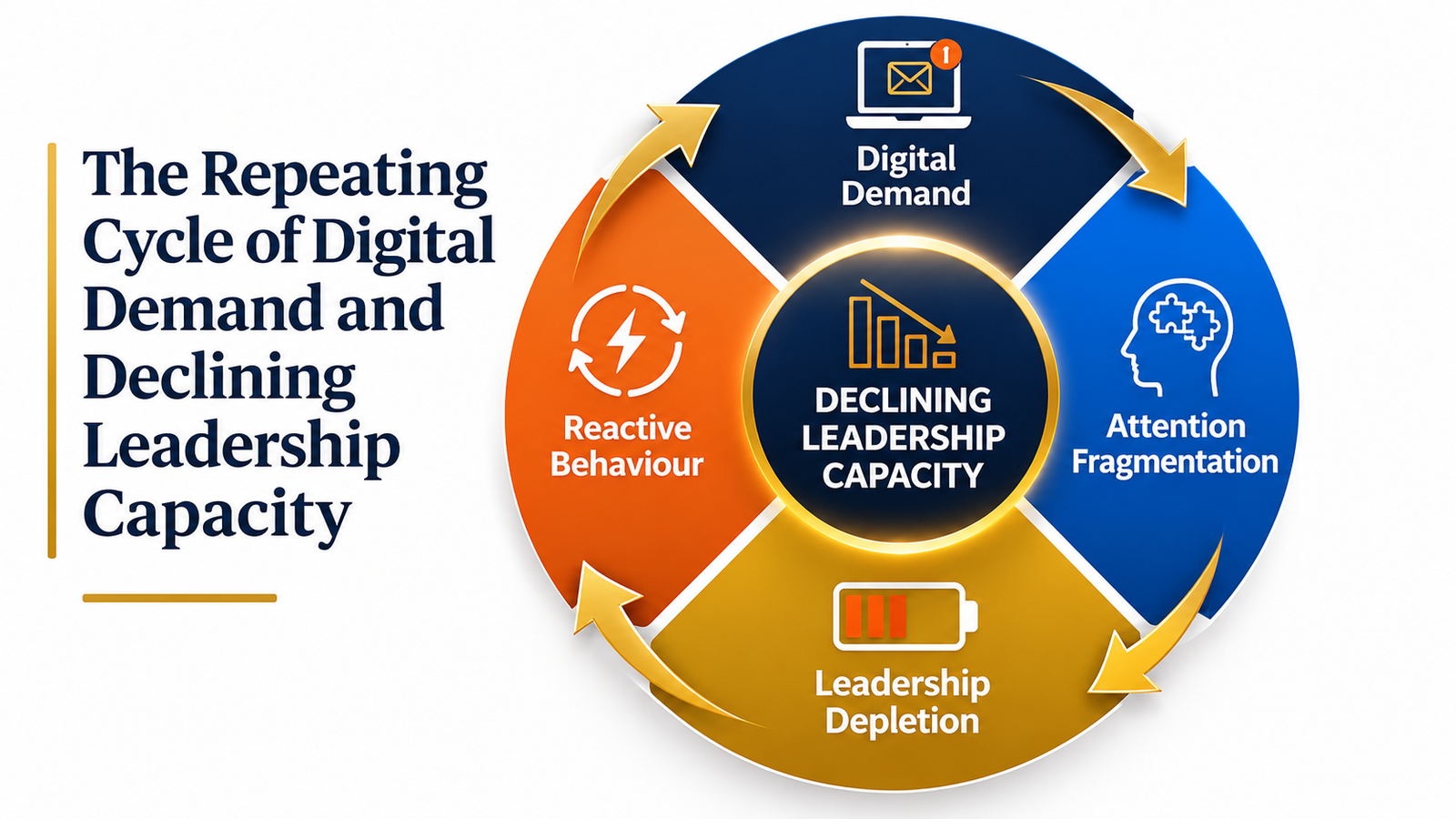
Stage 01 Digital demand
Emails, meetings and alerts compete for the leader’s attention.
Stage 02 Attention fragmentation
Constant interruptions and task switching break concentration.
Stage 03 Leadership depletion
Clarity and capacity decline.
Stage 04 Reactive behaviour
More checking and escalation, which generates further digital demand.
Why Is Digital Overload for Leaders Increasing?
The problem begins with a fundamental change in the design of work.
Twenty years ago, many leadership roles operated through relatively defined communication channels. Meetings, telephone calls, written reports and face-to-face conversations had recognisable boundaries.
Today, communication arrives continuously.
An executive may receive requests through email, Microsoft Teams, Slack, WhatsApp, project management platforms, shared documents and automated reporting systems. Each platform creates another entry point into the leader’s attention.
The multiplication of digital channels
Consider a school leader managing staff communication, parent enquiries, safeguarding systems, government reporting, operational dashboards and external stakeholder correspondence.
Each system may have a legitimate purpose. But if every system expects rapid attention, the combined workload becomes unsustainable.
The same pattern exists in healthcare, corporate management and public administration.
In its 2023 Work Trend Index, Microsoft’s research on digital work reported that 68% of surveyed people said they did not have enough uninterrupted focus time during the working day.
This matters because leadership requires more than processing information. It requires interpreting uncertainty, resolving competing priorities and making consequential decisions. Those activities demand sustained attention.
The false efficiency of constant connectivity
Digital communication often creates the appearance of efficiency. Messages are answered quickly. Dashboards update instantly. Meetings can be scheduled within seconds.
But speed of communication is not the same as quality of organisational performance.
A leader responding to 150 messages may appear productive while making little progress on strategic priorities. Worse, instant responses can train colleagues to escalate increasingly routine matters.
The leader becomes the organisation’s default decision point.
Over time, this creates a dependency system in which employees wait for approval rather than exercising judgement.
The organisation gains connectivity.
But it loses autonomy.
This is one of the five root causes identified in my Burn Bright Not Out framework: communication chaos.
The solution begins by examining the structure of communication, not blaming individuals for checking their phones.
How Does Digital Overload Affect Leadership Performance?
Digital overload affects leadership through three connected mechanisms: cognitive fragmentation, decision fatigue and reduced recovery.
These effects are often difficult to recognise because the leader may remain visibly busy and outwardly productive.
The problem is not simply the number of decisions. It is the absence of a framework determining who should make them.
This is why the Burn Bright approach places Decision Authority™ alongside Workload Architecture™, Recovery Rhythms™ and Management Frameworks.
The World Health Organization defines burnout as an occupational phenomenon associated with chronic workplace stress that has not been successfully managed. Its three dimensions are exhaustion, increased mental distance or cynicism, and reduced professional efficacy. See the WHO definition of burnout.
Digital overload is not identical to burnout. However, when it contributes to chronic, unmanaged workplace stress, it can become part of the conditions in which burnout develops.
Leaders should therefore treat persistent digital exhaustion as a signal to examine work design, not simply as evidence that they need another productivity application.
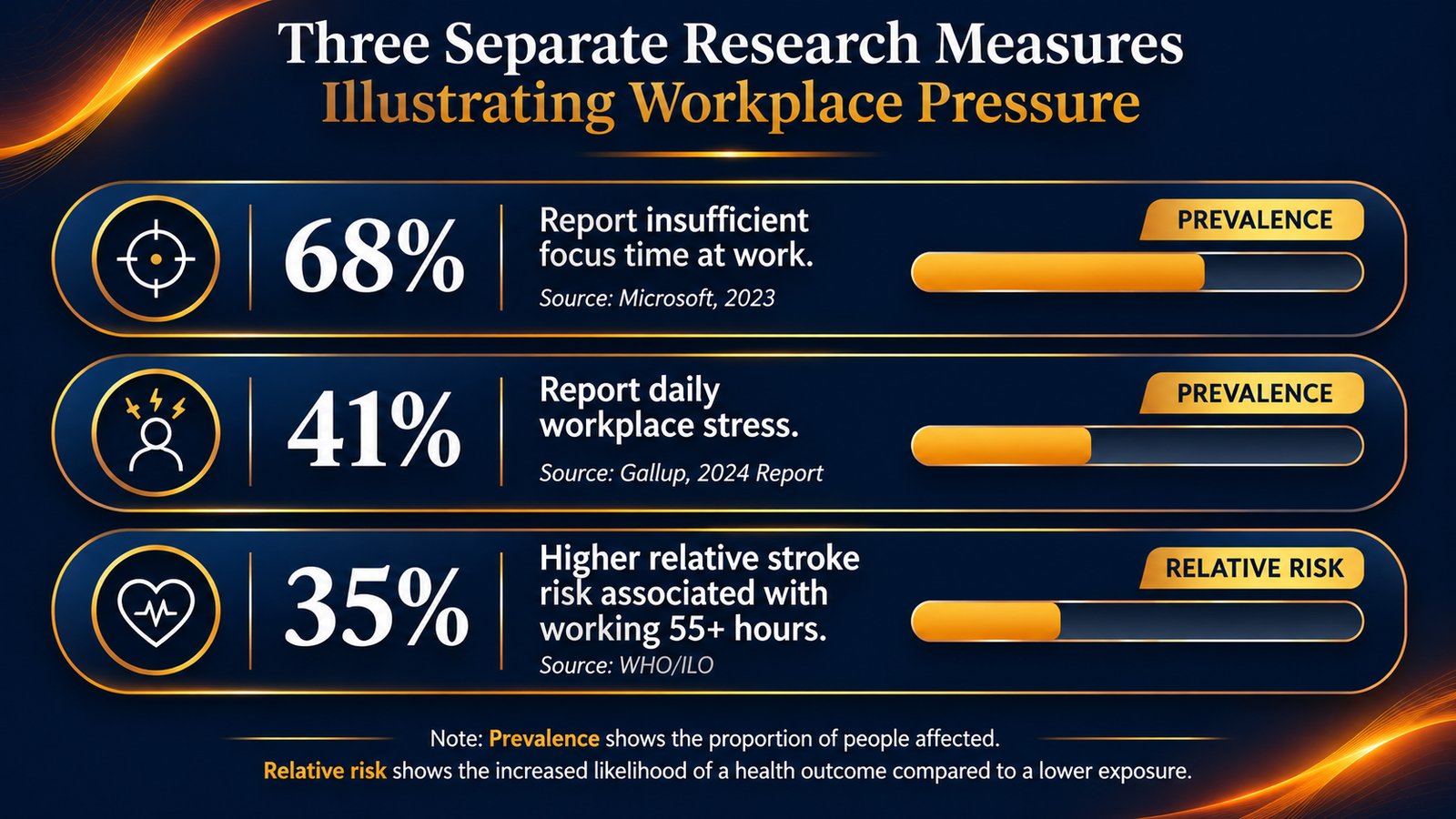
| Indicator | Figure | Source |
|---|---|---|
| Insufficient uninterrupted focus time | 68% | Microsoft Work Trend Index, 2023 |
| Employees experiencing substantial stress the previous day | 41% | Gallup State of the Global Workplace, 2024 |
| Higher stroke risk when working 55+ hours per week | 35% | WHO/ILO estimate, compared with 35–40 hours |
Gallup’s 2024 State of the Global Workplace report found that 41% of employees globally experienced substantial stress the previous day. This is a broader workplace stress measure, not a digital overload statistic, but it reinforces the need to examine how work is organised.
The WHO and International Labour Organization also estimated that working 55 hours or more per week was associated with a 35% higher risk of stroke compared with working 35–40 hours. This is a relative risk increase, not a prevalence figure.
What Are the Warning Signs of Digital Overload in Leaders?
Digital overload often develops gradually.
A leader may initially respond to messages outside working hours to help colleagues.
That becomes an expectation.
The expectation becomes a cultural norm.
Eventually, the leader feels unable to disconnect without risking operational failure.
The early warning signs are therefore both behavioural and structural.
Behavioural warning signs
- Checking email during meetings
- Responding to routine messages late at night
- Struggling to complete complex work without interruption
- Repeatedly postponing strategic priorities
- Growing irritation with ordinary requests
- Reduced patience, difficulty concentrating or an inability to mentally disengage after work
A question that previously required a straightforward answer begins to feel like another demand on an already exhausted mind.
These signs warrant attention, although they are not sufficient on their own to diagnose burnout or another health condition.
Structural warning signs
The more revealing indicators often sit inside the organisation. Ask:
- Do routine decisions require senior approval?
- Do employees understand which communication channels to use?
- Are urgent requests clearly distinguished from routine information?
- Do meetings generate decisions, or simply create more meetings?
- Does the organisation reward immediate responsiveness while claiming to value strategic thinking?
These contradictions are particularly damaging.
For example, a leadership team may announce that managers should protect two hours each week for strategic planning. But if the same organisation expects instant responses to all messages, the protected time becomes meaningless.
The seven-day digital demand audit
A useful starting point is to measure the problem. For one working week, record:
- The number of meetings attended
- Estimated interruptions
- Communication channels used
- Decisions escalated unnecessarily
- Minutes spent on genuinely strategic work
- How frequently work communication extends into personal time
Do not use the audit to judge individual commitment. Use it to identify recurring patterns.
If the same interruptions happen every day, they are not isolated emergencies.
They are evidence of a process that needs redesign.
This diagnostic approach is consistent with the principles in the Burn Bright leadership burnout course. The objective is to move from vague exhaustion to measurable structural causes.
How Can Leaders Reduce Digital Overload Without Losing Control?
The most effective response is to redesign communication architecture.
Communication architecture defines how information moves, who receives it, when responses are expected and where decisions belong. Without this structure, organisations rely on personal habits and informal expectations.
That is not a sustainable management system.
Establish channel purpose
Every communication platform should have a clear function. Urgent operational incidents may require a designated escalation channel. Routine updates may belong in a shared project system. Strategic decisions may require scheduled discussion with supporting documentation. The precise channels will vary. What matters is eliminating ambiguity: employees should not have to guess whether an email, chat message or telephone call is the correct method.
Introduce response-time agreements
Not every message deserves an immediate answer. Critical incidents may require immediate attention. Routine requests might be handled within an agreed working-day window. General updates may not require any acknowledgement. These are design choices, not universal rules: healthcare, safeguarding and emergency services will need different escalation arrangements from many office-based teams.
Reduce unnecessary approvals
Review decisions that routinely reach senior leadership. Some will genuinely require executive authority. Others may be escalated because accountability is unclear, confidence is low or previous management behaviour has discouraged independent judgement. Use a RACI framework to clarify who is responsible, accountable, consulted and informed, then define decision limits that allow capable colleagues to act without unnecessary approval. This reduces digital traffic and develops leadership capacity throughout the organisation.
Protect strategic work
Protected focus time must be supported by the system. Blocking two hours in a calendar achieves little if the leader remains expected to monitor six communication channels. Teams need explicit arrangements for interruptions, emergency cover and delegated decisions.
For a deeper structural approach, the Leadership Burnout Reset framework examines how workload and management systems can be redesigned.
The aim is not digital silence.
It is controlled, purposeful communication that supports performance rather than consuming it.
What Does a Sustainable Digital Leadership System Look Like?
A sustainable digital leadership system has four essential characteristics: clear workload design, distributed authority, protected recovery and consistent management rules. These correspond to the four structural pillars of the Burn Bright Not Out framework.
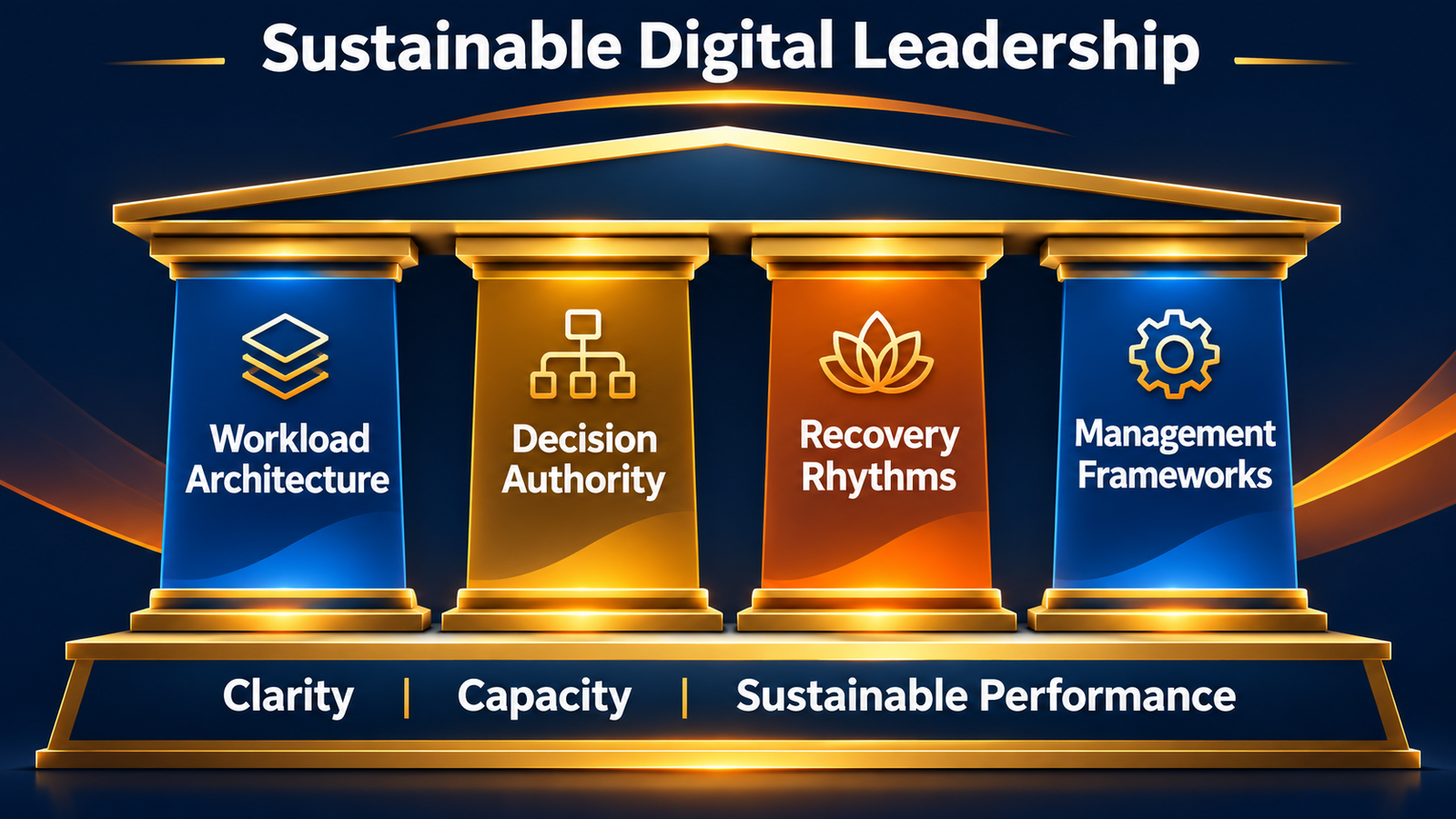
Pillar 01
Workload Architecture™: Remove low-value digital demand
Removes unnecessary digital work. This may involve consolidating reporting systems, eliminating duplicate updates or reducing meetings that exist only to share information.
Pillar 02
Decision Authority™: Put decisions at the right level
Ensures that leaders are not unnecessarily involved in every operational choice.
Pillar 03
Recovery Rhythms™: Protect attention and disconnection
Protects the time needed for sustained thinking and genuine disconnection.
Pillar 04
Management Frameworks: Set clear communication rules
Creates predictable rules that reduce confusion and repeated escalation.
A practical 30-60-90 day implementation plan
Days 1–30 — Diagnose the current communication system
Identify the highest-volume channels, repeated interruptions, unnecessary meetings and approval bottlenecks.
Days 31–60 — Test new arrangements with one leadership team
Introduce communication standards, protected focus periods and clearer decision authority.
Days 61–90 — Evaluate the results
Measure interruption frequency, meeting hours, decisions escalated, strategic work completed and staff feedback. Adjust the system where necessary.
Do not declare success simply because fewer messages were sent. The real test is whether the organisation makes better decisions, protects leadership capacity and maintains service quality.
This is also where technology, including carefully governed AI tools, can help. Used appropriately, automation can reduce routine information processing. But introducing another platform without removing existing demands may make the problem worse.
The objective is not maximum automation.
It is better organisational design.
Traditional vs Sustainable Digital Leadership
| Traditional Digital Leadership | Sustainable Digital Leadership |
|---|---|
| Immediate responses are expected | Response times reflect actual urgency |
| Leaders monitor every channel | Channels have defined purposes |
| Routine decisions move upwards | Authority is distributed appropriately |
| Full calendars signal commitment | Strategic outcomes demonstrate value |
| Notifications determine priorities | Agreed priorities determine attention |
| Digital availability extends into evenings | Clear escalation and recovery boundaries |
| Individuals manage the overload | Organisations redesign its causes |
The distinction is significant.
Traditional approaches ask leaders to become better at absorbing demand.
Sustainable approaches ask whether that demand needs to exist in the first place.
Frequently Asked Questions
What causes digital overload in leaders?
Digital overload develops when communication demands exceed available attention. Common causes include excessive meetings, unclear decision authority, multiple messaging platforms and expectations of constant availability. Individual habits can contribute, but organisational rules often determine how much interruption a leader experiences. Sustainable improvement requires changes to communication systems, workload and escalation procedures.
Can digital overload cause leadership burnout?
Digital overload can contribute to burnout when constant interruptions, excessive workload and insufficient recovery create chronic workplace stress. However, digital overload and burnout are not interchangeable. Burnout involves exhaustion, mental distance from work and reduced professional efficacy. Reducing digital demands can address one important organisational risk factor.
How can executives reduce digital distractions?
Executives should begin by auditing their communication channels, meetings and decision requests. They can then introduce agreed response times, delegate routine decisions, consolidate platforms and establish protected focus periods. These changes work best when supported by team-wide rules rather than relying entirely on individual notification settings.
Should leaders stop responding to messages outside working hours?
Organisations should establish clear expectations for communication outside normal working hours, including genuine emergency arrangements. The appropriate rules depend on operational responsibilities. Leaders should not have to monitor routine messages continuously to demonstrate commitment. Explicit escalation procedures allow critical matters to receive attention while protecting recovery time.
What is the difference between digital overload and information overload?
Information overload occurs when the amount or complexity of information exceeds someone’s ability to process it effectively. Digital overload is broader. It includes information volume alongside notifications, meetings, communication expectations, platform switching and digital availability. Both can interfere with judgement, but digital overload requires attention to the systems through which work is coordinated.
How long does it take to reduce digital overload?
Some improvements can occur within days, particularly when teams eliminate unnecessary notifications or clarify communication channels. More substantial structural changes may require several months. A 30-60-90 day approach allows leaders to diagnose demand, test redesigned processes and evaluate whether interruptions have declined without damaging operational effectiveness.
Conclusion: Digital Overload Is a Design Problem
Digital overload for leaders is not an unavoidable consequence of modern technology. It is often the result of organisations introducing new ways to communicate without establishing clear rules for how those systems should operate.
Every additional platform creates potential demand.
Every unnecessary approval consumes leadership attention.
Every expectation of instant availability reduces the space available for thoughtful decisions.
The solution is not to demand greater discipline from already exhausted leaders. It is to examine the architecture of work.
Start by identifying where digital demand originates. Clarify which communications genuinely require immediate attention. Distribute decisions appropriately. Protect strategic thinking time. Establish recovery arrangements that reflect operational reality.
Most importantly, measure leadership effectiveness through outcomes rather than responsiveness.
A leader who answers every message immediately may appear committed. A leader who builds systems that prevent unnecessary messages is creating something more valuable: sustainable leadership.
The question is whether your current systems support that objective.
Go Beyond the Symptoms
Digital overload is often one symptom of a wider structural problem. The Burn Bright Full Diagnostic™ examines workload, decision authority and recovery in depth — £144.
Identify Your Leadership Burnout Risk
Discover where workload, decision pressure and communication demands may be affecting your leadership capacity.
Free Leadership Intelligence
Get Weekly Leadership Insights
Join thousands of leaders receiving practical strategies on burnout prevention, workload design, and sustainable performance every week.