Quick Answer
Key Takeaways
- Most organisations don’t lack ambition. What holds them back is the gap between the future leaders imagine and the capabilities the organisation actually has.
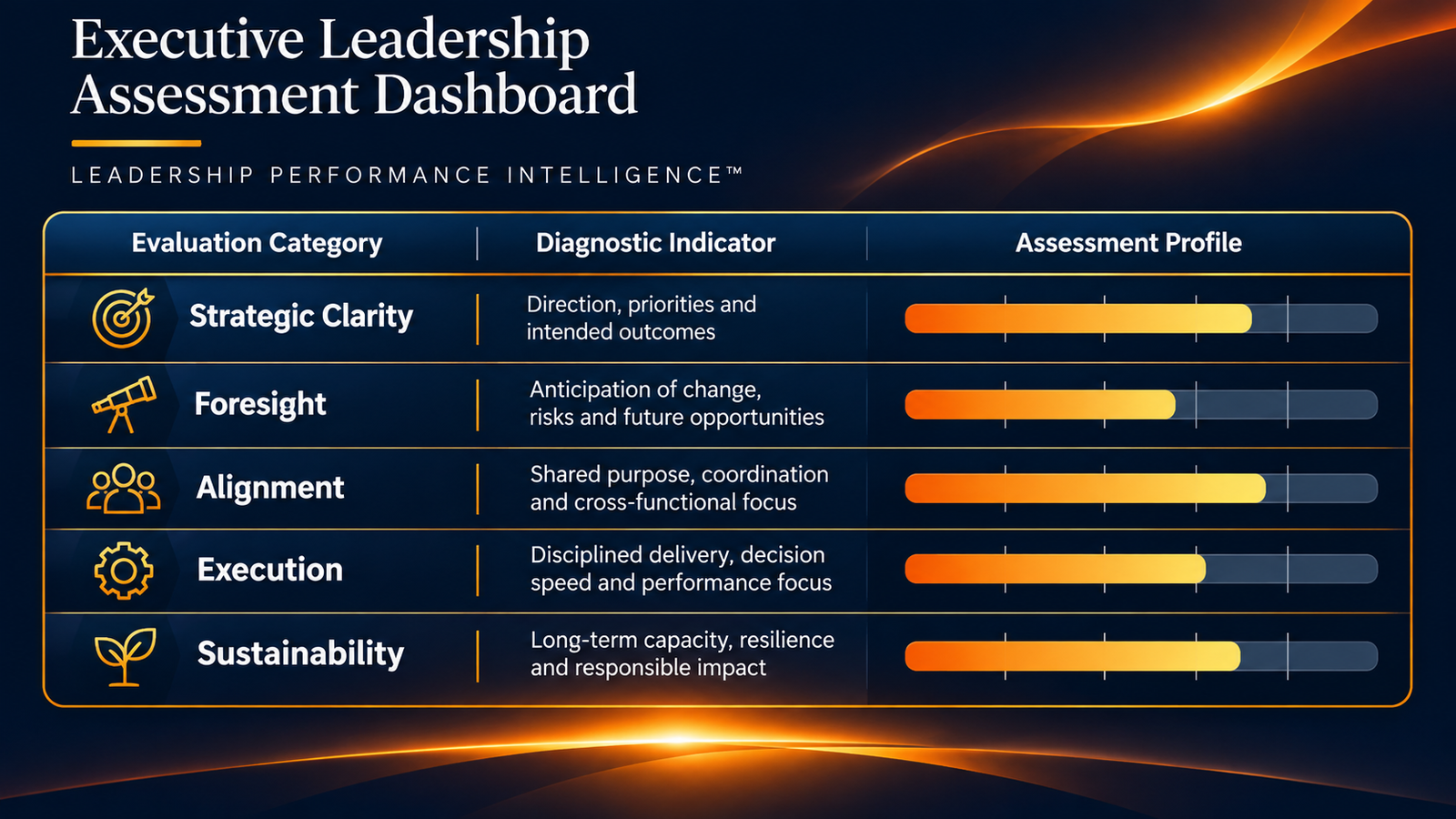
- Visionary Leadership Intelligence™ brings together five responsibilities: strategic foresight, directional clarity, collective alignment, execution capability and leadership sustainability.
- Vision provides direction, strategy sets priorities, and Leadership Performance Intelligence™ connects those priorities to the capabilities needed to deliver them.
- Good results today can hide a decline in future capacity. The future should not be financed through the continuous depletion of the people responsible for creating it.
- Visionary leadership turns into a performance risk through four traps: charisma, innovation, capacity and certainty.
- Visionary leadership should be judged by the organisation’s growing capacity to create the future, not by how convincingly a leader describes it.
Visionary Leadership Intelligence™: Why the Future of Leadership Depends on Turning Vision into Sustainable Performance
The Difference Between Seeing the Future and Building It
Most organisations do not suffer from a shortage of ambition.
Their strategic plans describe transformation. Their leadership presentations promise innovation. Their corporate statements articulate growth, resilience, excellence and long-term success.
Yet many struggle to translate these ambitions into meaningful organisational change.
A compelling vision may secure attention, but attention does not guarantee alignment. Strategic ambition may generate enthusiasm, but enthusiasm does not automatically create the systems, resources or professional capability required for execution.
This distinction is central to understanding visionary leadership.
Visionary leadership is not simply the ability to anticipate what might happen next. It is the capacity to establish a credible direction, mobilise collective intelligence, make disciplined strategic choices and create the organisational conditions necessary to achieve sustainable outcomes.
Within Burn Bright Advisory™’s Leadership Performance Intelligence™ approach, this capability is explored through Visionary Leadership Intelligence™, a domain of the Leadership Intelligence Compass™.
It recognises that the effectiveness of leadership depends on more than the quality of an individual’s thinking. Leadership performance emerges through the relationship between judgement, behaviour, organisational conditions, available capacity and the consequences of decisions.
The fundamental question therefore changes. Instead of asking whether a leader has an inspiring vision, organisations should ask:
Take the Free Self-Assessment →
What Is Visionary Leadership Intelligence™?
Featured Snippet
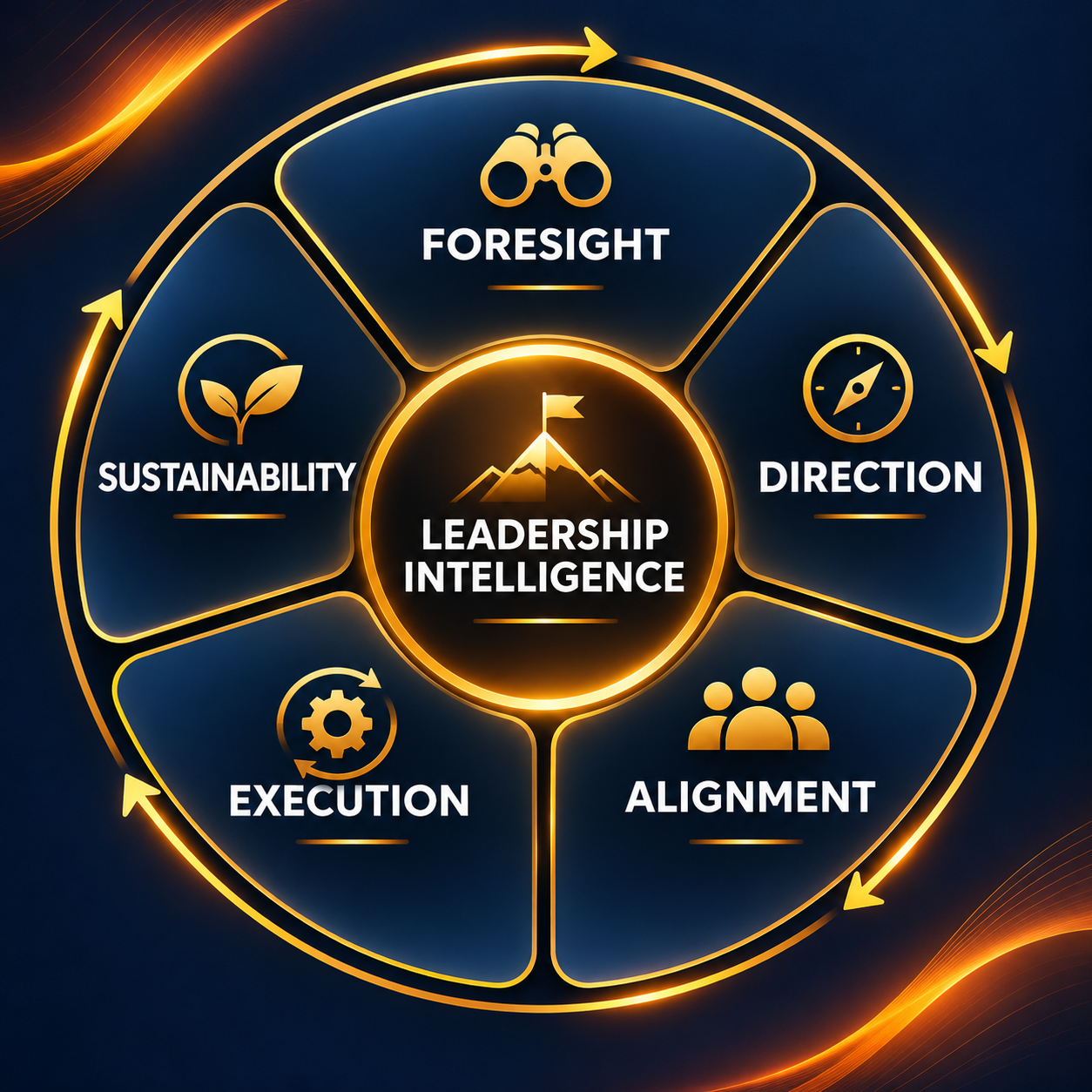
It integrates five essential leadership responsibilities:
- Strategic foresight: Recognising emerging developments, uncertainties, risks and opportunities.
- Directional clarity: Establishing an understandable and credible future ambition.
- Collective alignment: Connecting individuals, teams and stakeholders to shared priorities.
- Execution capability: Translating strategic intentions into decisions, resources and measurable progress.
- Leadership sustainability: Protecting the human and organisational capacity required to deliver results over time.
These responsibilities are interdependent.
Foresight without direction creates uncertainty.
Direction without alignment produces fragmented effort.
Alignment without execution becomes organisational optimism.
Execution without sustainability risks exhausting the very people responsible for delivering change.
Visionary Leadership Intelligence™ therefore moves beyond conventional descriptions of charismatic or transformational leadership. It examines whether leaders possess the judgement and organisational awareness to convert future possibilities into responsible performance.
Vision Is Not the Same as Strategy
A vision describes a desirable future.
A strategy explains the choices required to pursue it.
Leadership capability determines whether those choices can be implemented.
Consider a healthcare organisation seeking to become a regional leader in digitally enabled patient care.
Its vision may be clear and attractive. However, delivering that ambition requires investment decisions, clinical engagement, technology integration, workforce development, patient safeguards and measurable quality standards. Without these elements, the vision remains aspirational.
The same principle applies to schools pursuing educational transformation, businesses expanding into new markets and public institutions modernising essential services.
Why Visionary Leadership Matters in Complex Organisations
Modern leaders operate within environments characterised by interconnected risks, accelerating technological developments, changing workforce expectations and increasingly complex stakeholder relationships.
Under these conditions, leadership based exclusively on past experience becomes insufficient. Historical performance can provide useful evidence, but it cannot guarantee future relevance.
Leaders must distinguish between established knowledge, emerging signals and assumptions that require further examination. This is where strategic foresight becomes important.
Foresight does not mean accurately predicting every future development. It means considering plausible changes, examining their implications and preparing an organisation to respond intelligently.
- A leader who anticipates workforce capability gaps can begin developing talent before those gaps become critical.
- A school leader who recognises changing learning needs can strengthen professional development before educational outcomes deteriorate.
- A healthcare executive who anticipates increased service demand can examine workforce models, operational resilience and patient pathways before capacity becomes severely constrained.
The Risk of Leadership Built Around Immediate Results
Organisations frequently reward leaders for short-term achievements.
Quarterly performance, immediate efficiency, visible project delivery and rapid problem resolution are often easier to measure than long-term organisational capability. These measures matter, but they provide an incomplete picture.
- A leader may achieve an ambitious financial target while weakening workforce retention.
- A principal may deliver a successful improvement initiative while increasing unsustainable demands on teachers.
- A department head may improve operational output by personally absorbing excessive responsibilities.
In each case, immediate performance may conceal a deterioration in future capacity.
This concern is consistent with the systems-oriented argument developed in Burn Bright’s Burn Bright Not Out: sustainable leadership requires more than individual effort, personal efficiency or better time management. It requires intentional organisational design.
Visionary Leadership Intelligence™ extends that principle into strategic decision-making.
The Five Dimensions of Visionary Leadership Performance
Burn Bright’s five-dimension model provides a practical way to examine the relationship between strategic ambition and organisational execution.
Dimension 1
Foresight: Understanding What May Change
Strategic foresight begins with disciplined curiosity. Leaders examine technological developments, economic conditions, workforce expectations, stakeholder needs, policy changes and emerging organisational risks. Importantly, they also challenge assumptions that have become embedded in existing strategies.
A useful foresight discussion asks three questions:
- What developments could materially affect our organisation?
- Which assumptions underpin our current strategy?
- What would we need to change if those assumptions proved incorrect?
This approach prevents strategic planning from becoming an exercise in extending current performance targets into the future. It encourages leaders to consider alternative possibilities before circumstances force reactive decisions.
Dimension 2
Direction: Establishing Meaningful Strategic Priorities
Foresight becomes valuable when it informs choices. Effective leaders cannot pursue every emerging opportunity. They must identify which possibilities align with organisational purpose, available resources, stakeholder obligations and long-term value.
Directional clarity requires leaders to explain not only what the organisation intends to achieve, but also what it will deliberately avoid.
Strategic discipline involves recognising opportunity costs. Every new initiative requires attention, funding, expertise and organisational capacity.
Dimension 3
Alignment: Creating Shared Understanding
A vision communicated from the executive level does not automatically become a shared organisational commitment. Employees interpret strategic messages through their responsibilities, professional experiences, incentives and immediate working conditions.
A leadership team may describe digital transformation as an opportunity for innovation. Frontline employees may interpret the same initiative as additional administrative work, increased monitoring or uncertainty about their future roles.
Both perspectives matter.
Visionary leaders create structured opportunities to explore these differences. They explain the rationale for change, invite informed challenge, clarify responsibilities and examine whether operational realities support strategic intentions.
Alignment is not achieved when everyone repeats the same message.
It is achieved when people understand the direction, recognise their contribution and can identify legitimate concerns before those concerns undermine implementation.
Dimension 4
Execution: Converting Intentions into Measurable Progress
A credible vision requires operational architecture. Leaders must establish decision rights, resource commitments, milestones, accountability arrangements and feedback mechanisms. Without these structures, strategy becomes dependent on individual enthusiasm and informal coordination.
Effective execution also requires distinguishing activity from progress.
An organisation may conduct numerous workshops, launch several initiatives and generate extensive reports without producing meaningful improvement.
Visionary leaders therefore ask whether actions are changing the outcomes that matter. They examine indicators such as capability development, service quality, decision effectiveness, stakeholder value and organisational resilience.
Dimension 5
Sustainability: Preserving Future Leadership Capacity
The fifth dimension is frequently overlooked. Strategic change consumes organisational capacity. It requires cognitive attention, emotional effort, professional learning, operational adjustment and financial resources.
- If leaders repeatedly introduce initiatives without removing outdated responsibilities, workloads accumulate.
- If transformation depends on a small number of exceptional individuals, organisational vulnerability increases.
- If performance expectations rise without corresponding investment in capability, exhaustion can become normalised.
Leadership Sustainability™ addresses this relationship between performance demands and the capacity available to meet them. It asks whether the organisation can continue delivering its strategic priorities without undermining the people, systems and relationships on which future performance depends.
How the Leadership Intelligence Compass™ Strengthens Visionary Leadership
Visionary Leadership Intelligence™ does not operate independently of other leadership capabilities. Its effectiveness depends on how leaders integrate strategic thinking with ethical judgement, adaptability, emotional awareness, professional standards and reflective learning.
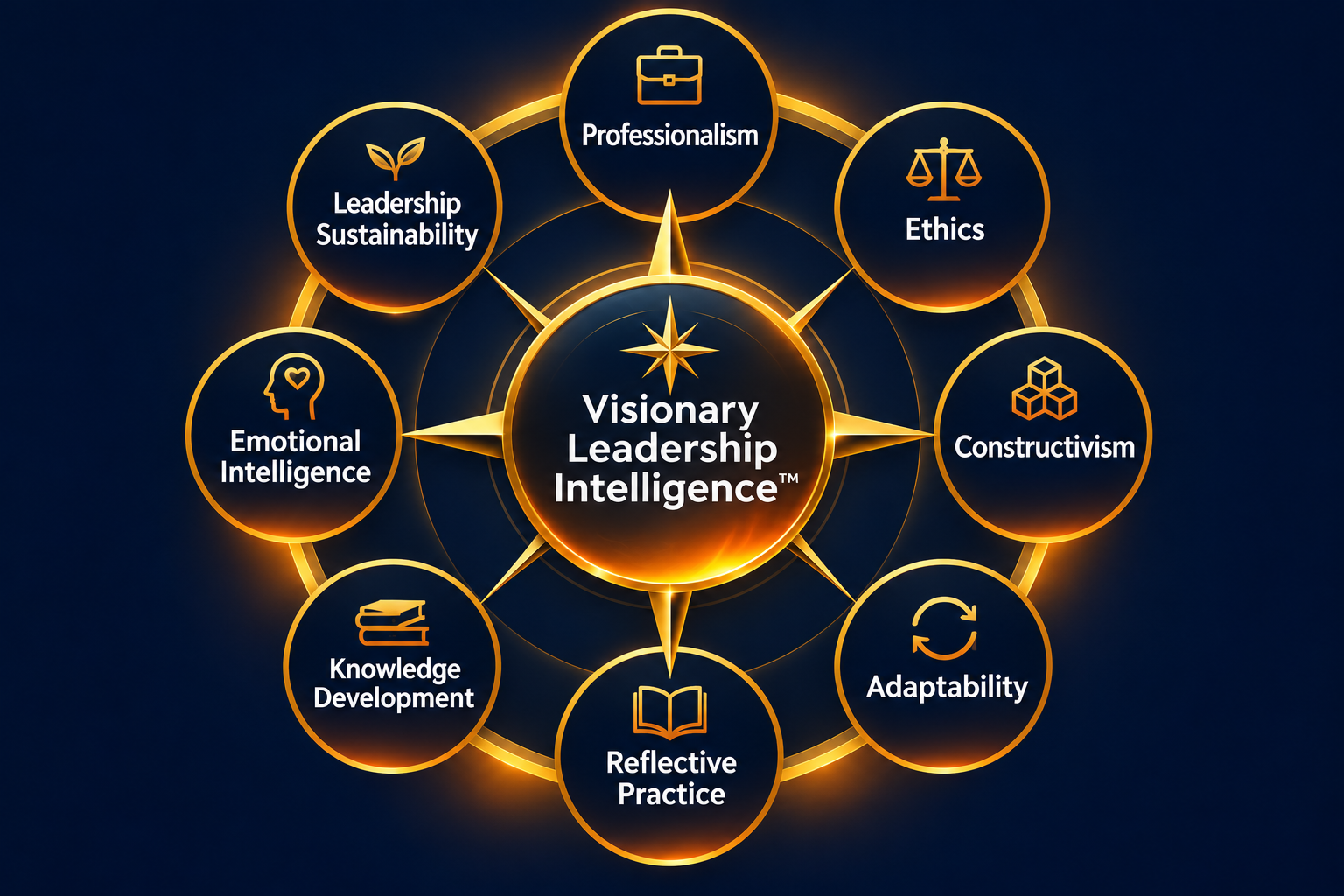
The Leadership Intelligence Compass™ provides a broader structure for understanding these relationships.
| Compass Domain | Contribution to Visionary Leadership |
|---|---|
| Professionalism Intelligence™ | Establishes standards of responsibility and execution |
| Ethics Intelligence™ | Evaluates the consequences and fairness of strategic choices |
| Constructivism Intelligence™ | Supports collective understanding and knowledge creation |
| Adaptability Intelligence™ | Enables strategic adjustment when conditions change |
| Reflective Practice Intelligence™ | Challenges assumptions and supports learning |
| Knowledge Development Intelligence™ | Builds capabilities needed for future performance |
| Emotional Intelligence™ | Supports trust, communication and stakeholder engagement |
| Leadership Sustainability™ | Protects long-term human and organisational capacity |
For example, a visionary leader may identify a promising technological opportunity.
- Adaptability Intelligence™ helps the organisation respond to changing requirements.
- Ethics Intelligence™ ensures the proposed transformation considers fairness, accountability and potential harm.
- Knowledge Development Intelligence™ identifies the capabilities employees will need.
- Emotional Intelligence™ supports communication and the management of uncertainty.
- Leadership Sustainability™ examines whether the pace and scale of implementation are realistic.
Together, these capabilities create a more complete understanding of strategic leadership effectiveness.
When Visionary Leadership Becomes a Performance Risk
Visionary leadership is not inherently effective. Like other leadership strengths, it can become counterproductive when applied without sufficient judgement or balance.
Burn Bright’s The Unguarded Leader explores how leadership strengths may become liabilities when overused or disconnected from situational needs. This insight is particularly relevant to visionary leadership.
Visionary Leadership Across Four Sectors
The principles of visionary leadership are broadly applicable, but their implementation differs according to organisational purpose, professional responsibilities and stakeholder expectations. The following are illustrative scenarios rather than documented case studies. Explore sector-specific guidance in our Leadership by Sector hubs.
🏢 Business Growth Intelligence™: Expanding Without Weakening the Organisation
Consider a medium-sized business planning international expansion. Its leadership team identifies attractive opportunities in several markets. However, existing operations already depend heavily on a small number of senior managers.
A conventional growth strategy might focus primarily on revenue projections and market entry timelines. A Leadership Performance Intelligence™ approach also examines management capacity, succession readiness, governance arrangements and operational resilience.
The executive team may decide to enter one market rather than three, while investing in leadership development and stronger management systems. This represents strategic discipline rather than diminished ambition. The organisation is building the capability to sustain future growth.
🏫 School Leadership Intelligence™: Connecting Educational Vision to Professional Capacity
A school principal establishes a vision for improving teaching quality and student outcomes. The proposed strategy includes professional learning, curriculum development and stronger assessment practices. Teachers support the ambition but already face substantial administrative demands.
An effective visionary leader examines what must change within the existing workload. Some reporting requirements may be simplified. Professional development may be integrated into collaborative planning. Implementation may be phased to allow meaningful evaluation.
The leadership challenge is not simply to persuade teachers that improvement matters. It is to create the conditions in which improvement can occur.
🏥 Healthcare Leadership Intelligence™: Balancing Innovation and Clinical Responsibility
A healthcare department plans to introduce AI-supported administrative and clinical workflows. Potential benefits include reduced documentation burden and improved access to relevant information. However, implementation also raises questions about professional oversight, data governance, clinical safety and staff capability.
Visionary leadership requires the organisation to assess these concerns before expanding deployment. Clinical professionals should contribute to system evaluation, responsibilities must remain clear, and patient safety must take precedence over technological enthusiasm.
The resulting strategy connects innovation with professional accountability.
🏛️ Public Service Leadership Intelligence™: Modernising Services Responsibly
A public service organisation seeks to improve citizen access through digital service delivery. Its vision emphasises efficiency, responsiveness and accessibility. Yet some service users face digital exclusion, while employees require training to operate new systems.
A visionary leader must consider the experience of both groups. Successful modernisation may involve digital services alongside accessible alternatives, phased implementation and continuous evaluation.
The objective is not digital transformation as an end in itself. It is improved public value.
From Strategic Ambition to Leadership Performance Intelligence™
A significant weakness in conventional strategic planning is the assumption that leadership capability will automatically expand to meet new expectations.
Organisations establish ambitious objectives, allocate projects and assign accountability. They may not examine whether leaders possess the time, authority, support and professional capability necessary to deliver.
Leadership Performance Intelligence™ introduces a more integrated perspective. It connects leadership expectations with observable capabilities, organisational conditions and sustainable outcomes. Within this approach, three questions become essential.
Question 1 What leadership capabilities does the strategy require?
A transformation programme may demand stronger adaptability, ethical judgement, cross-functional collaboration or strategic communication.
Question 2 What organisational conditions enable those capabilities?
Leaders may need clearer decision rights, improved information, stronger teams or reduced competing priorities.
Question 3 How will the organisation know whether capability is improving?
Performance evaluation should examine not only final outcomes but also the quality of decisions, learning, collaboration and execution.
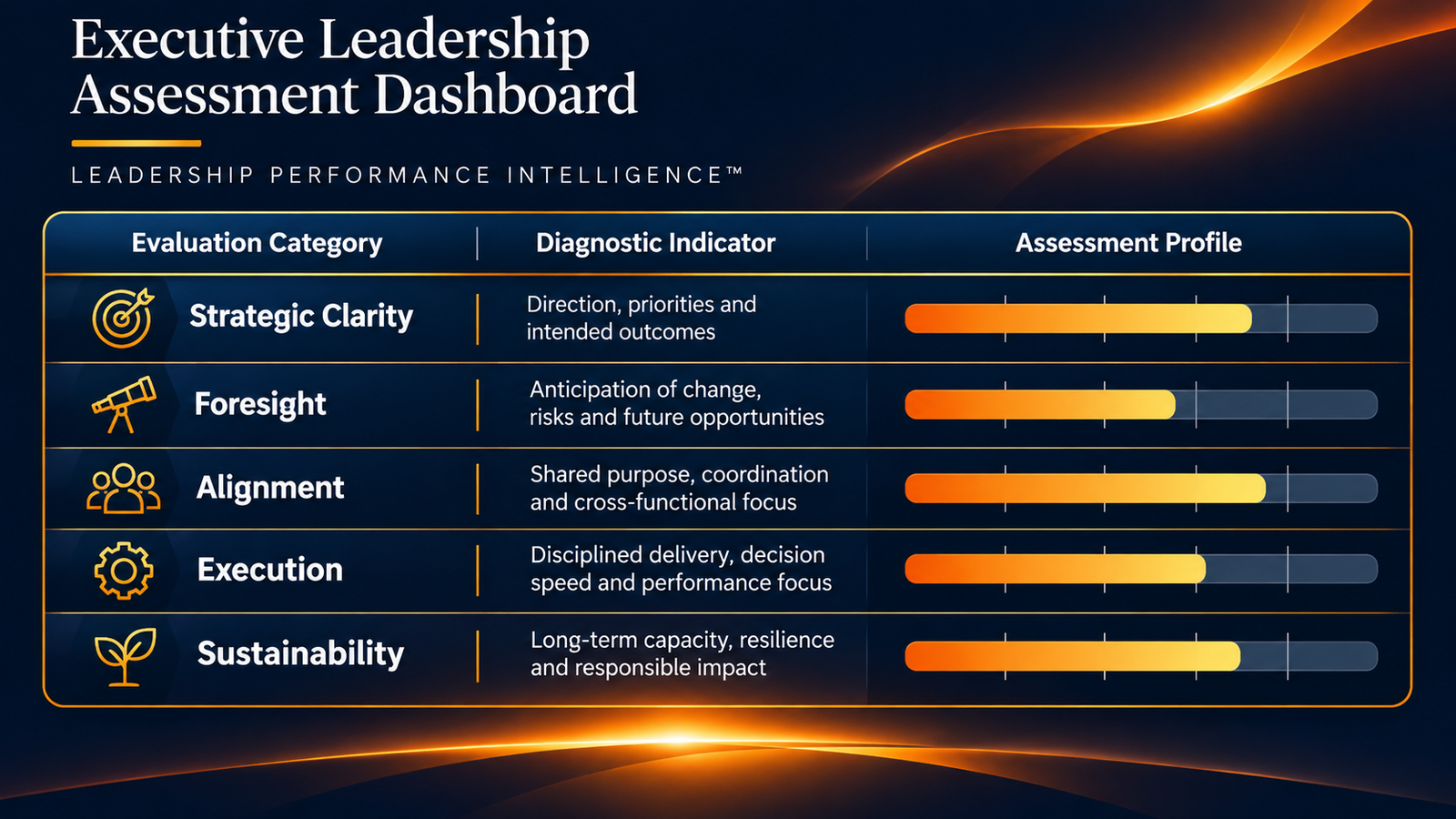
These questions can inform the Leadership Intelligence Assessment™, Leadership Benchmarking™ and relevant organisational diagnostics.
Assessment should not be treated as a substitute for judgement. Its purpose is to structure reflection, identify development priorities and support better-informed decisions.
A Practical Vision-to-Performance Framework
Burn Bright Advisory™ can translate these principles into a practical six-stage planning process.
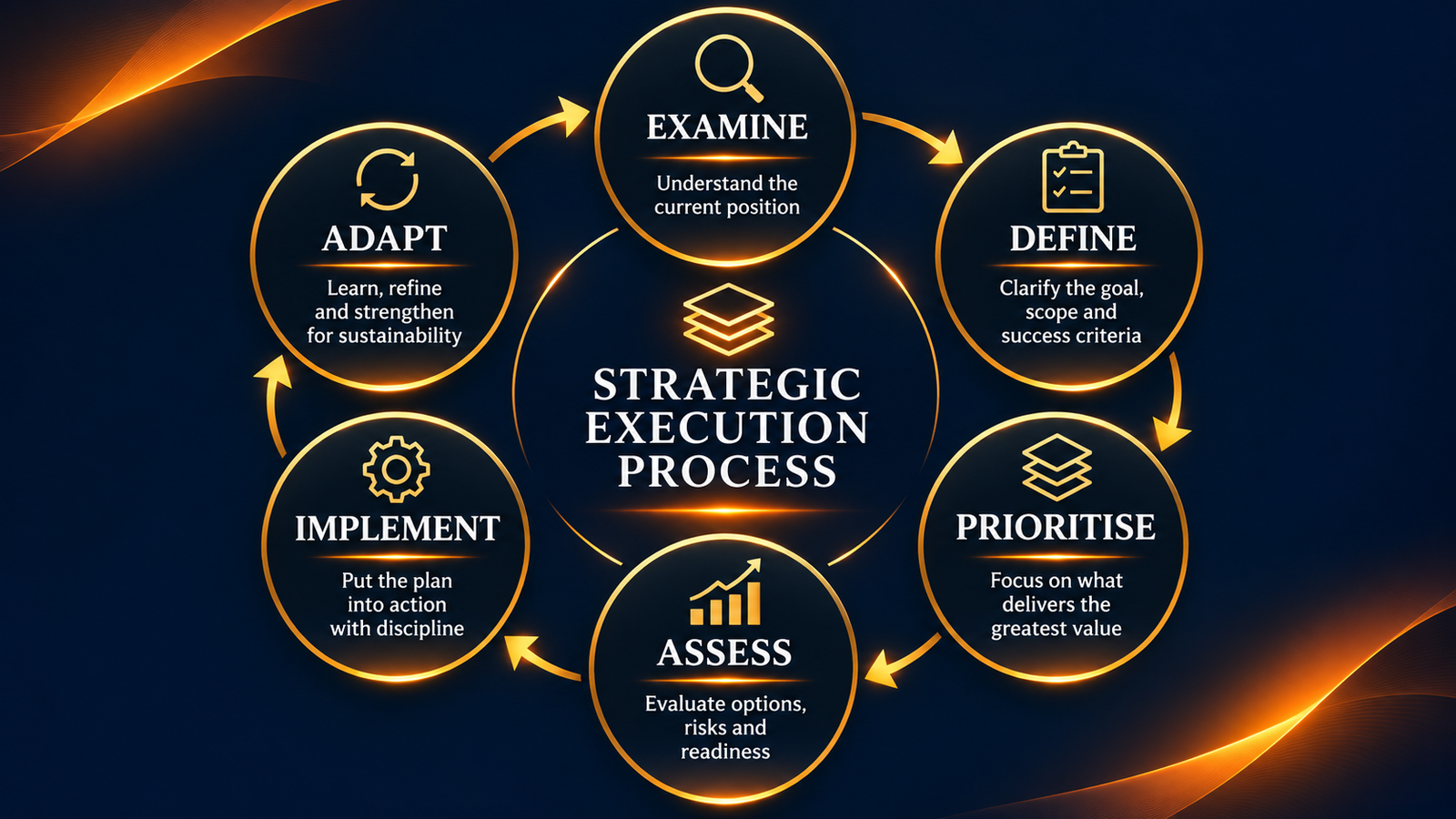
Stage 1 Examine the environment
Identify relevant trends, stakeholder expectations, risks and strategic uncertainties.
Stage 2 Define the desired future
Establish a credible ambition connected to organisational purpose and stakeholder value.
Stage 3 Make strategic choices
Select priorities, acknowledge trade-offs and discontinue activities that no longer support the direction.
Stage 4 Assess leadership capacity
Examine workforce capability, decision authority, workload, resources and organisational readiness.
Stage 5 Implement and measure
Establish milestones, accountabilities, leading indicators and mechanisms for feedback.
Stage 6 Reflect and adapt
Review results, test assumptions, strengthen capabilities and adjust strategic decisions.
This process is cyclical rather than linear.
Strategic foresight informs action.
Action generates evidence.
Evidence supports reflection.
Reflection improves future decisions.
The resulting leadership system is designed to learn rather than merely execute predetermined plans.
Measuring the Quality of Visionary Leadership
Organisations should avoid evaluating visionary leadership solely through employee enthusiasm or the perceived attractiveness of a strategic plan. More useful indicators examine the relationship between direction, capability and results. Potential measures include:
- Strategic priority clarity
- Decision turnaround times
- Capability development
- Implementation milestones
- Stakeholder confidence
- Workload sustainability
- The organisation’s ability to respond to emerging risks
No single indicator provides a complete assessment.
For example, rapid implementation may appear successful while concealing declining employee capacity. Conversely, slower implementation may represent responsible leadership when additional safeguards, professional learning or stakeholder consultation are necessary.
Leadership Benchmarking™ should therefore consider both performance outcomes and the conditions through which those outcomes are achieved. This distinction is particularly important when comparing organisations operating under different resource constraints.
The Future of Visionary Leadership
The next generation of visionary leadership will require greater sophistication than the ability to communicate an attractive future.
Leaders will increasingly need to interpret complex information, distinguish credible evidence from speculation and evaluate the implications of emerging technologies. They will also need to work across professional boundaries, involve diverse stakeholders and recognise the limits of individual expertise.
This places greater importance on collective intelligence.
The most capable visionary leader is not necessarily the person who generates the greatest number of ideas. It may be the leader who creates an environment in which people can challenge assumptions, contribute specialised knowledge and translate strategic possibilities into responsible decisions.
Such leadership requires both confidence and intellectual humility. It also requires an understanding that organisational transformation cannot depend indefinitely on personal sacrifice.
Leadership Reflection Questions
Leadership Reflection Questions
- How clearly can our people explain the future we are trying to create?
- Which assumptions underpin our current strategic direction?
- Are we prioritising long-term capability or immediate performance?
- What strategic initiatives are competing for the same organisational resources?
- How effectively do we involve employees in interpreting and implementing our vision?
- Which Leadership Intelligence Compass™ capabilities require development?
- Where are we relying on individual effort rather than sustainable systems?
- What evidence would cause us to reconsider our current strategy?
- How do we measure progress beyond activity and short-term financial outcomes?
- What decisions today will strengthen our organisation’s leadership capacity in three years?
Executive Action Steps: A 90-Day Plan
| Timeframe | Leadership Action | Intended Outcome |
|---|---|---|
| First 7 days | Review the strategic vision and its underlying assumptions | Greater strategic clarity |
| Days 8–14 | Identify competing priorities and resource constraints | Improved prioritisation |
| Days 15–21 | Evaluate leadership capabilities against strategic requirements | Capability gap identification |
| Days 22–30 | Establish a focused implementation scorecard | Measurable accountability |
| Days 31–60 | Review workload, decision rights and development needs | Improved execution capacity |
| Days 61–90 | Evaluate progress and adjust strategic assumptions | Sustainable strategic learning |
These are suggested planning intervals, not guaranteed transformation timelines.
Conclusion: Visionary Leadership Is a Responsibility to the Future
Visionary leadership should not be confused with optimism, charisma or the ability to communicate ambitious intentions. Its real value lies in the disciplined relationship between foresight, strategic judgement, collective capability and sustainable execution.
Organisations need leaders who can anticipate change without pretending to predict it perfectly.
They need leaders who can establish direction without suppressing constructive challenge.
They need leaders who can pursue ambitious outcomes without exhausting the workforce responsible for delivering them.
Through Visionary Leadership Intelligence™, Burn Bright Advisory™ positions future-focused leadership within a broader understanding of Leadership Performance Intelligence™.
The Leadership Intelligence Compass™ provides a way to consider the capabilities that support responsible strategic action, while the Leadership Intelligence Library™, assessments, diagnostics and development pathways can support ongoing learning.
Ultimately, visionary leadership is not demonstrated by how convincingly a leader describes tomorrow.
That is the difference between having a vision and building a future.
Frequently Asked Questions
What is visionary leadership?
Visionary leadership is the ability to establish a credible future direction and mobilise people, decisions and resources toward achieving it. Effective visionary leadership combines foresight, strategic judgement, organisational alignment and execution.
What is Visionary Leadership Intelligence™?
Visionary Leadership Intelligence™ is a domain within Burn Bright Advisory™’s Leadership Intelligence Compass™. It examines how leaders connect future-focused thinking with strategic decisions, collective capability and sustainable organisational performance.
Why is visionary leadership important?
Visionary leadership helps organisations prepare for emerging challenges, identify opportunities and coordinate decisions around meaningful long-term priorities. It reduces dependence on reactive management by encouraging strategic preparedness.
What is the difference between visionary and strategic leadership?
Visionary leadership establishes a meaningful future direction. Strategic leadership determines the choices, priorities and resources needed to pursue that direction. Effective organisational leadership integrates both.
Can visionary leadership become ineffective?
Yes. Visionary leadership may become counterproductive when ambition exceeds organisational capacity, leaders discourage challenge or transformation initiatives lack clear accountability.
How can organisations develop visionary leadership?
Development can combine strategic foresight exercises, leadership reflection, capability assessments, scenario planning, cross-functional collaboration and structured evaluation of strategic decisions.
How does visionary leadership relate to Leadership Sustainability™?
Leadership Sustainability™ examines whether performance demands are compatible with available human and organisational capacity. It helps ensure that strategic ambition does not depend on continuous overwork or unsustainable resource commitments.
How can visionary leadership be measured?
Relevant indicators include strategic clarity, implementation progress, decision quality, capability development, stakeholder alignment, adaptability and workforce sustainability. Measures should be interpreted together rather than in isolation.
Can Your Organisation Sustain the Future It’s Pursuing?
Go deeper than the headline. The Burn Bright Full Diagnostic™ examines workload, decision rights and leadership capacity in depth — £144.
Is Your Vision Being Built on Sustainable Capacity?
Strategic ambition depends on leaders who can sustain it. Take the free self-assessment to see where your leadership capacity stands today.
Free Leadership Intelligence
Get Weekly Leadership Insights
Join thousands of leaders receiving practical strategies on burnout prevention, workload design, and sustainable performance every week.