Quick Answer
Key Takeaways
- Having a vision is not the same as leading towards one — performance depends on converting a credible vision into decisions, capabilities and coordinated action.
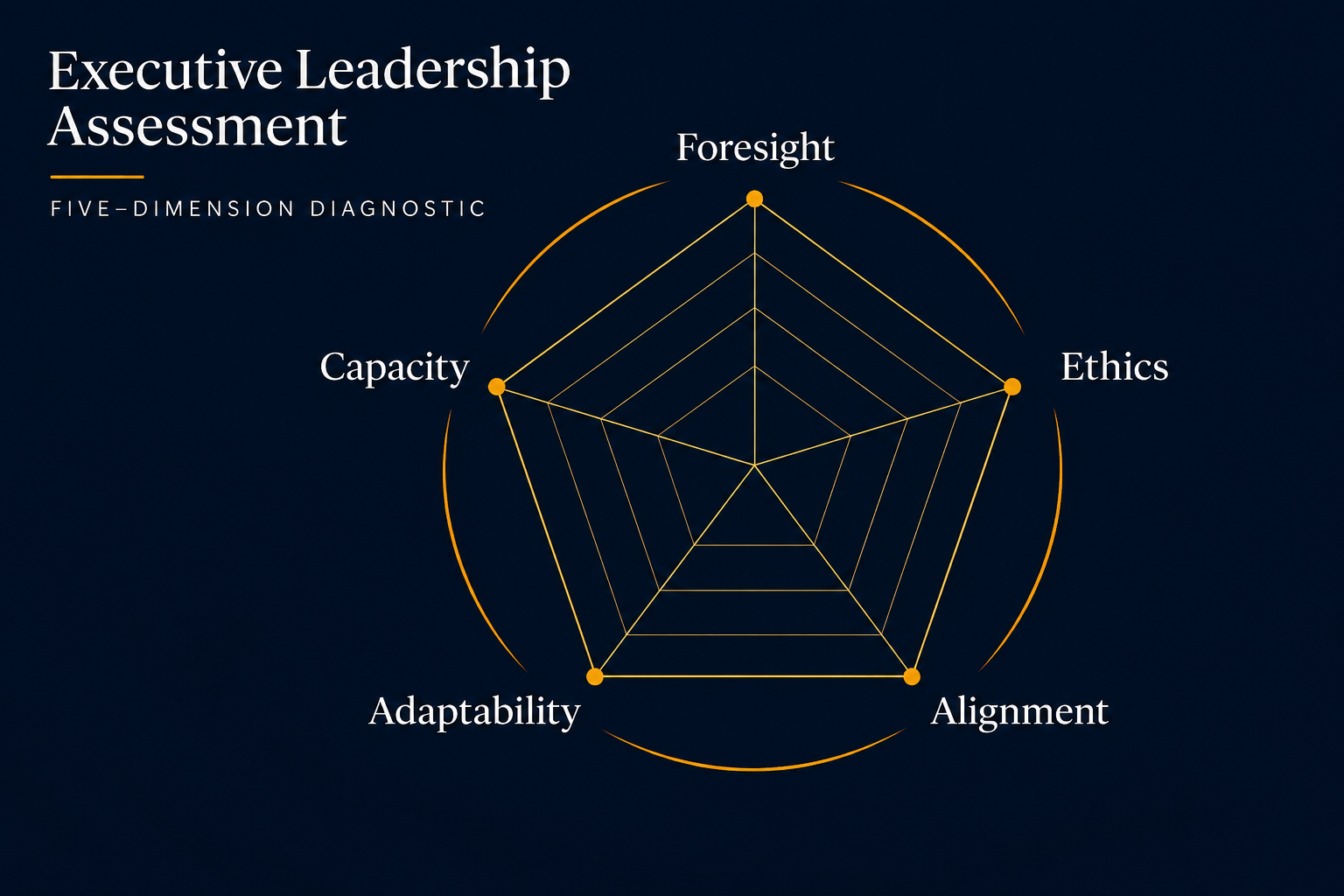
- Visionary Leadership Intelligence™ rests on five dimensions: strategic foresight, ethical direction, collective alignment, adaptive execution and sustainable capacity.
- Foresight is not prediction. It improves the quality of decisions made under uncertainty by exploring multiple plausible futures.
- A vision that adds responsibilities without reconsidering capacity can undermine the very performance it seeks to improve.
- The Vision-to-Performance Intelligence Framework — Scan, Define, Align, Adapt, Sustain — makes the link between ambition, execution and sustainability visible.
- Organisations can confuse commitment to a vision with the capacity to deliver it. When that happens, the leadership system needs redesign — not the people.
Visionary Leadership Intelligence™: How Leaders Turn Strategic Foresight into Sustainable Organisational Performance
The Difference Between Having a Vision and Leading Towards One
Most organisations have a vision. Far fewer possess the leadership capability required to realise it.
Strategic plans describe future ambitions. Executive presentations communicate transformation priorities. Mission statements articulate the organisation’s desired contribution to customers, communities or society.
Yet the existence of a vision does not establish whether an organisation is capable of achieving it.
A healthcare organisation may aspire to deliver integrated, patient-centred care while maintaining fragmented clinical systems. A school may commit to personalised learning while leaving teachers without the development time required to change classroom practice. A growing business may promise innovation while rewarding managers exclusively for short-term operational results.
The distinction matters because leaders increasingly operate in environments characterised by technological change, shifting stakeholder expectations, resource constraints and competing priorities. Under these conditions, strategic direction cannot remain a static declaration.
It must become an organisational intelligence capability. This is where Visionary Leadership Intelligence™ becomes relevant.
Rather than treating visionary leadership as an exceptional personal characteristic, Burn Bright Advisory™ positions it as a leadership capability that can be examined, developed and connected to measurable organisational outcomes.
The question is no longer whether a leader has a compelling vision. It is whether their leadership creates the conditions in which that vision can become sustainable performance.
Take the Free Self-Assessment →

What Is Visionary Leadership Intelligence™?
Featured Snippet
It combines five interdependent elements:
- Strategic foresight: Understanding emerging opportunities, risks and potential futures.
- Purposeful direction: Establishing a credible and ethically defensible destination.
- Collective alignment: Connecting people, decisions and resources to strategic priorities.
- Adaptive execution: Translating strategic intent into learning, experimentation and implementation.
- Leadership sustainability: Maintaining the human and organisational capacity required for sustained progress.
This definition moves beyond the traditional emphasis on inspiration.
A compelling narrative may help people understand why change matters. However, narrative alone cannot resolve resource shortages, conflicting incentives or inadequate organisational capabilities.
Visionary Leadership Intelligence™ therefore requires leaders to understand both the future they want to create and the present conditions that may prevent its achievement.
Visionary Leadership Within Leadership Performance Intelligence™
Leadership Performance Intelligence™ provides the broader conceptual foundation for examining how leadership capability translates into performance.
The Leadership Intelligence Compass™ organises interconnected domains of leadership intelligence, enabling leaders to consider their strengths, limitations and developmental priorities.
Within this system, visionary leadership is closely connected to:
- Ethics Intelligence™, ensuring that strategic ambition is balanced against responsibilities and consequences.
- Adaptability Intelligence™, enabling leaders to respond when assumptions change.
- Constructivism Intelligence™, supporting shared understanding and collective learning.
- Reflective Practice Intelligence™, encouraging examination of decisions and outcomes.
- Knowledge Development Intelligence™, strengthening the evidence base for future choices.
- Leadership Sustainability™, protecting the capacity needed to deliver long-term priorities.
These connections are essential.
An ambitious vision without ethical judgement can become reckless.
A credible strategy without adaptability can become obsolete.
A transformation programme without sustainable leadership capacity can exhaust the people responsible for delivering it.
Visionary Leadership Intelligence™ should therefore be understood as part of an integrated leadership development system, not as an isolated competency.
Why Visionary Leadership Matters in Complex Organisations
The traditional assumption that leaders can predict future conditions with sufficient accuracy to establish a fixed long-term plan is increasingly difficult to sustain. Organisations must now consider multiple plausible futures rather than depend on a single forecast.
The rise of artificial intelligence, for example, creates opportunities for productivity, service improvement and knowledge development. It also introduces questions about workforce capability, governance, professional judgement and accountability.
Similarly, changing demographic patterns may create new demand for healthcare, education and public services while simultaneously constraining the available workforce.
Leaders must interpret these developments without assuming that every emerging trend requires an immediate organisational response.
Foresight Is Not Prediction
Strategic foresight does not require leaders to know precisely what will happen. It requires them to examine what could happen, what the consequences might be and which capabilities would remain valuable across different scenarios.
Consider a regional healthcare provider planning its services over five years.
A prediction-led approach might assume that demand for existing services will increase at a consistent rate.
A foresight-led approach would explore several possibilities: greater demand from ageing populations, expanded digital care, workforce shortages, changes in funding and new clinical technologies.
The organisation could then identify investments that support multiple scenarios, such as workforce development, integrated information systems and adaptable service delivery models.
This approach does not eliminate uncertainty.
It improves the quality of decisions made under uncertainty.
Vision Creates Value Through Prioritisation
One of the most important functions of visionary leadership is determining what an organisation will not pursue.
Without strategic boundaries, an ambitious vision can encourage continuous expansion. New projects are introduced, additional targets established and existing responsibilities retained. The organisation becomes increasingly active without necessarily becoming more effective.
This problem is particularly relevant to leadership workload.
In Burn Bright Not Out, the distinction between individual time management and systemic workload management is central. Leaders cannot resolve structurally excessive demands simply by becoming more efficient.
The same principle applies to strategic transformation.
Visionary leadership must therefore connect future priorities with explicit decisions about resource allocation, discontinued activities and acceptable organisational trade-offs.
The Five Dimensions of Visionary Leadership Intelligence™

Dimension 1
Strategic Foresight: Interpreting the Future
Strategic foresight begins with disciplined observation. Leaders need mechanisms for identifying emerging developments across technology, regulation, stakeholder behaviour, workforce expectations and their operating environment.
However, collecting information is not sufficient. The intelligence lies in interpreting what that information means for the organisation. Three questions help structure this process:
- Which developments could materially change our operating environment?
- Which assumptions underpinning our current strategy may no longer hold?
- What capabilities should we develop before change becomes unavoidable?
Effective foresight also requires intellectual humility.
In The Unguarded Leader, the relationship between curiosity, vulnerability and leadership effectiveness challenges the assumption that authority depends on possessing all the answers.
This perspective is particularly important in strategic planning. Leaders who are unwilling to question established assumptions may interpret new information through outdated models of success.
A genuinely visionary leader creates conditions in which alternative interpretations can be examined without treating disagreement as disloyalty.
Dimension 2
Ethical Direction: Establishing a Responsible Future
Not every achievable future is desirable. A strategy may improve financial performance while creating unacceptable consequences for employees, customers or communities.
Visionary Leadership Intelligence™ must therefore incorporate ethical judgement. Leaders should consider whose interests are represented in the vision, who bears the costs of transformation and how potential benefits will be distributed.
For example, a public service organisation might pursue extensive automation to improve response times. An ethically informed vision would also consider accessibility, transparency, accountability and the needs of citizens who cannot easily use digital services.
Ethics Intelligence™ strengthens visionary leadership by ensuring that future-oriented decisions remain consistent with organisational responsibilities.
This connection is especially important when the benefits of strategic change are immediate for some stakeholders but the risks emerge later for others.
Dimension 3
Collective Alignment: Making Vision Operational
An organisational vision cannot depend solely on executive understanding. It must influence decisions throughout the organisation. This requires translation.
- Senior leaders may describe a strategic ambition such as becoming a more responsive, innovative or inclusive organisation.
- Middle leaders must understand what that ambition means for operational priorities, team responsibilities and performance expectations.
- Frontline professionals need to recognise how their everyday decisions contribute to the desired outcome.
Without this translation, vision remains abstract.
Collective alignment requires more than communicating the same message repeatedly. It requires meaningful opportunities for interpretation, questioning and feedback.
Constructivism Intelligence™ becomes particularly relevant because people develop understanding through experience, dialogue and participation. A leadership team that invites departments to examine the practical implications of a strategy is more likely to identify implementation barriers than one that simply distributes a completed plan.
Alignment should be assessed through behaviour, not agreement alone.
Dimension 4
Adaptive Execution: Learning While Implementing
Strategic execution is often presented as the process of following an agreed plan. In uncertain environments, this interpretation is incomplete.
Plans must provide direction while remaining responsive to evidence. Adaptive execution involves establishing clear outcomes, testing assumptions, monitoring progress and adjusting methods when circumstances change.
For example, a school introducing a new professional learning model might begin with a limited pilot. Leadership would examine teacher experience, implementation workload, instructional practice and student learning evidence before expanding the programme.
The vision remains stable: stronger professional learning and educational quality.
The implementation pathway evolves.
This distinction helps leaders avoid two opposing risks.
Adaptability Intelligence™ helps leaders maintain purposeful continuity while remaining responsive to new information.
Dimension 5
Sustainable Capacity: Protecting the Ability to Deliver
A strategy may be intellectually sound and operationally coherent yet still fail because the organisation lacks sufficient capacity.
Leadership capacity includes more than available working hours. It encompasses decision-making attention, emotional resources, professional expertise, workforce stability and the organisational systems required to support effective action.
Leadership Sustainability™ therefore represents a fundamental dimension of visionary leadership.
Leaders must examine whether strategic ambitions can be delivered without creating chronic overload. This requires attention to workload distribution, leadership succession, decision rights, recovery opportunities and the cumulative effects of organisational change.
A sustainable vision does not demand unlimited sacrifice.
It creates conditions in which people can contribute effectively over time.
The Vision-to-Performance Intelligence Framework
Burn Bright Advisory™ proposes a practical five-stage model for examining how strategic vision becomes organisational performance.

Stage 1 Scan
Interpret emerging conditions, risks and opportunities.
Stage 2 Define
Establish strategic direction, outcomes and ethical boundaries.
Stage 3 Align
Connect priorities, resources, responsibilities and capabilities.
Stage 4 Adapt
Test assumptions, learn and refine execution.
Stage 5 Sustain
Monitor outcomes, workload and long-term leadership capacity.
The stages should be treated as an interconnected cycle. Evidence from implementation may reveal that an original assumption was incorrect. Capacity constraints may require revised priorities. New developments may justify reconsidering strategic direction.
The framework supports structured reflection rather than promising a guaranteed transformation outcome. Its value lies in making the relationship between ambition, execution and sustainability more visible.
Visionary Leadership Across Different Sectors
The principles of visionary leadership apply across sectors, but their practical expression depends on organisational responsibilities. Explore sector-specific guidance in our Leadership by Sector hubs.

🏢 Business Growth Intelligence™
Consider a medium-sized company seeking to expand into international markets. A conventional growth strategy might emphasise revenue targets, new customers and geographic expansion.
A visionary leadership approach would also examine operational resilience, management capability, cultural understanding and the risks of expanding faster than the organisation can support. Growth would be evaluated not only by commercial results but also by the organisation’s capacity to maintain quality and develop future leaders.
🏫 School Leadership Intelligence™
A school leadership team may establish a vision for more inclusive and responsive learning. Implementation requires attention to curriculum, assessment, professional development, student needs and teacher workload.
The principal’s role is not merely to communicate the ambition. It is to create a coherent development system in which staff have sufficient knowledge, support and time to translate the vision into classroom practice.
🏥 Healthcare Leadership Intelligence™
A clinical organisation may aspire to improve continuity of care. Achieving this outcome could require changes to professional collaboration, patient information, referral processes and workforce development.
Visionary leadership must balance innovation with clinical safety, regulatory responsibilities and professional judgement. In this context, strategic ambition cannot be separated from the reliability of the systems through which care is delivered.
🏛️ Public Service Leadership Intelligence™
Public service leaders must consider long-term community outcomes while operating within governance, funding and accountability requirements. A vision for improved public access should therefore address not only service efficiency but also equity, transparency and institutional trust.
The quality of visionary leadership is reflected in how effectively future ambitions are reconciled with public responsibilities.
👥 HR & People Leadership Intelligence™
People leaders play a critical role in translating strategy into workforce capability. A transformation agenda may require new skills, different leadership behaviours and redesigned roles.
Without deliberate workforce planning, the organisation may discover that its strategic ambitions exceed its available capabilities. HR leaders can strengthen visionary leadership through succession planning, leadership benchmarking, development pathways and workforce capacity analysis.
An Illustrative Case: When Vision Outpaces Capacity
Consider a hypothetical organisation employing 450 people across several service locations.
Its executive team announces an ambitious three-year transformation involving digital systems, improved customer experience and expanded services. Each initiative is individually defensible.
However, department managers are expected to implement the changes while maintaining existing performance targets. No significant responsibilities are removed. Training is scheduled around normal duties. Decision-making authority remains concentrated at senior levels.
Within the first year, implementation delays increase and managers report conflicting priorities. The executive team initially interprets the situation as resistance to change.
A Leadership Performance Intelligence™ perspective would suggest a different diagnosis: the organisation has not adequately connected strategic ambition with operational capacity.
A more effective response would involve reviewing the combined transformation workload, sequencing initiatives, clarifying decision rights and establishing meaningful indicators of implementation readiness. The organisation might also suspend lower-value projects to release capacity.
The important distinction is that the vision itself may remain valuable.
The leadership system supporting it requires redesign.
Measuring Visionary Leadership Effectiveness
Visionary leadership should not be assessed exclusively through employee enthusiasm or the quality of strategic communication. A more comprehensive approach examines several categories of evidence.
| Measurement Dimension | Illustrative Indicator |
|---|---|
| Strategic clarity | Understanding of priorities and trade-offs |
| Organisational alignment | Consistency between decisions and strategic goals |
| Adaptive capability | Evidence that learning changes implementation |
| Leadership capacity | Workload sustainability and succession readiness |
| Performance outcomes | Progress against relevant organisational objectives |
| Ethical integrity | Quality of stakeholder consideration and governance |
These measures should be interpreted together. Strong short-term performance may conceal unsustainable workloads. High strategic agreement may coexist with poor implementation. Extensive innovation activity may produce limited organisational value.
Leadership Benchmarking™ can help identify patterns across teams, roles and organisational contexts, provided that measures are appropriate, consistently applied and interpreted with care.
The Leadership Intelligence Assessment™ can contribute to a broader developmental conversation by examining leadership capabilities and identifying areas for further reflection.
Neither assessment nor benchmarking should substitute for evidence of actual organisational performance.
The Risks of Visionary Leadership Without Intelligence
Visionary leadership can become counterproductive when ambition is disconnected from judgement.
These risks are particularly significant when leaders discourage challenge.
The themes explored in The Unguarded Leader reinforce the importance of curiosity, openness and the willingness to reconsider established assumptions. Similarly, How to Overcome Toxic Leadership in Small Teams highlights how controlling leadership behaviours can undermine trust and participation, particularly where teams have limited alternatives or formal support structures.
Visionary leadership must therefore be accountable, open to challenge and grounded in operational reality.
Leadership Reflection Questions
Leadership Reflection Questions
- How clearly does our current vision respond to emerging opportunities and risks?
- Which assumptions about our future operating environment have we not challenged?
- Can employees explain how our vision influences their daily decisions?
- Which current activities are consuming resources without contributing meaningfully to strategic priorities?
- How effectively do we balance long-term ambition with ethical responsibilities?
- What evidence demonstrates that our organisation can adapt when circumstances change?
- Are our leadership teams equipped with the knowledge and authority required to implement the vision?
- Does our transformation agenda strengthen or deplete leadership capacity?
- How do we distinguish genuine strategic progress from increased organisational activity?
- What would need to change for our vision to remain achievable and sustainable over the next three years?
Practical Action Steps: A 30-Day Visionary Leadership Review
An illustrative leadership development sequence:
Week 1 — Examine strategic assumptions
Review the organisational vision, identify external changes and document critical uncertainties.
Week 2 — Assess organisational alignment
Consult team leaders, examine conflicting priorities and identify gaps between strategy and operational decisions.
Week 3 — Evaluate leadership capacity
Review workload, decision rights, implementation resources and capability development requirements.
Week 4 — Agree improvement priorities
Identify three strategic adjustments, assign accountability and establish indicators for ongoing review.
The purpose is not to complete strategic transformation within 30 days. It is to establish a more credible evidence base for subsequent leadership decisions.
Conclusion: Vision Is a Leadership Responsibility, Not a Leadership Performance
The value of visionary leadership is not established by the scale of a leader’s ambition or the persuasiveness of their communication.
It is established through the organisation’s ability to make better decisions, develop relevant capabilities, adapt responsibly and achieve meaningful outcomes over time.
Visionary Leadership Intelligence™ provides a way to connect strategic foresight with the broader requirements of effective leadership.
Through the Leadership Intelligence Compass™, leaders can examine how visionary capability interacts with ethics, adaptability, reflection, knowledge development and sustainability. Through Leadership Performance Intelligence™, organisations can consider whether their leadership practices are producing the conditions necessary for sustainable performance.
The most important question for leaders is therefore not simply, “Where do we want to go?”
That is the distinction between possessing a vision and exercising visionary leadership.
Frequently Asked Questions
What is visionary leadership?
Visionary leadership is the ability to establish meaningful future direction and mobilise people, resources and organisational capabilities towards its achievement. Effective visionary leadership combines strategic foresight, clear priorities, collective alignment and adaptive implementation.
What is Visionary Leadership Intelligence™?
Visionary Leadership Intelligence™ is Burn Bright Advisory’s approach to examining how leaders interpret future conditions, establish responsible strategic direction and develop the organisational capability required for sustainable performance.
Why is visionary leadership important?
Visionary leadership helps organisations navigate uncertainty, coordinate decisions and invest in capabilities that support future performance. It provides a basis for prioritisation while helping teams understand how their contributions relate to longer-term objectives.
Can visionary leadership be developed?
Yes. Relevant capabilities can be strengthened through scenario analysis, strategic reflection, stakeholder engagement, decision reviews and structured leadership development. Progress should be assessed through both leadership behaviours and organisational outcomes.
How does visionary leadership differ from strategic management?
Strategic management focuses on establishing and implementing organisational priorities. Visionary leadership additionally emphasises interpreting future possibilities, creating shared direction and mobilising collective commitment. The two capabilities complement one another.
How does visionary leadership connect to emotional intelligence?
Emotional Intelligence™ supports visionary leadership by helping leaders understand stakeholder concerns, communicate change responsibly and recognise the human consequences of transformation. Strategic direction becomes more effective when leaders understand how people experience uncertainty.
What are the risks of visionary leadership?
Risks include unrealistic ambitions, excessive dependence on individual leaders, inadequate implementation capacity, resistance to feedback and neglect of ethical consequences. These risks increase when strategic vision is treated as unquestionable.
How can organisations measure visionary leadership?
Organisations can examine strategic clarity, decision alignment, adaptive capability, workforce readiness, ethical governance and progress against meaningful outcomes. Measures should be interpreted together rather than reduced to a single score.
How does visionary leadership support leadership sustainability?
It supports sustainability when leaders align ambition with realistic resources, manageable workloads, leadership development and succession planning. A vision that systematically exhausts the organisation is unlikely to remain effective over time.
What should leaders do first to improve visionary capability?
Begin by reviewing the assumptions underlying the current organisational vision. Compare these assumptions with emerging evidence, assess implementation capacity and identify where strategic ambitions are disconnected from operational reality.
Is Your Vision Outpacing Your Leadership Capacity?
Go beyond the headline. The Burn Bright Full Diagnostic™ examines workload, decision rights and leadership sustainability in depth — £144.
Can Your Leadership Sustain the Future You’re Building?
Ambitious strategy depends on sustainable leadership capacity. Take the free self-assessment to see where your capacity stands today.
Free Leadership Intelligence
Get Weekly Leadership Insights
Join thousands of leaders receiving practical strategies on burnout prevention, workload design, and sustainable performance every week.