Why High Performers Burn Out: The Hidden Leadership Trap
Quick Answer
Why high performers burn out is not because they are weak, fragile, or incapable. It is because the very traits that drive exceptional performance — responsibility, ambition, reliability, and commitment — often attract increasing demands without corresponding increases in support, authority, or recovery. Over time, this creates a structural mismatch between capacity and expectations, leading even the strongest leaders towards burnout.
Key Takeaways
- High performers are often rewarded with more work rather than better support.
- Burnout is frequently caused by structural overload, not personal weakness.
- Ambitious leaders often become victims of role expansion and invisible workload growth.
- Perfectionism and responsibility can accelerate depletion when systems are poorly designed.
- Sustainable leadership requires workload architecture, recovery rhythms, and decision boundaries.
Introduction
Why high performers burn out is one of the most misunderstood questions in leadership today.
Many organisations assume burnout affects struggling employees, disengaged workers, or people who lack resilience. The reality is often the opposite. The leaders most vulnerable to burnout are frequently the highest performers — the people everyone relies on, trusts, and promotes.
These leaders deliver results. They solve problems. They step into crises. They carry responsibility others avoid.
Then one day they hit a wall.
The issue is rarely motivation. It is rarely resilience. More often, it is the result of a system that continuously rewards capability with additional demand.
Burnout is not simply about working too hard. It is about working inside structures that steadily increase complexity, responsibility, and decision load without increasing recovery, support, or capacity.
This article explores why high performers burn out, the structural factors that drive leadership depletion, and how organisations can build sustainable performance instead of creating burnout factories.
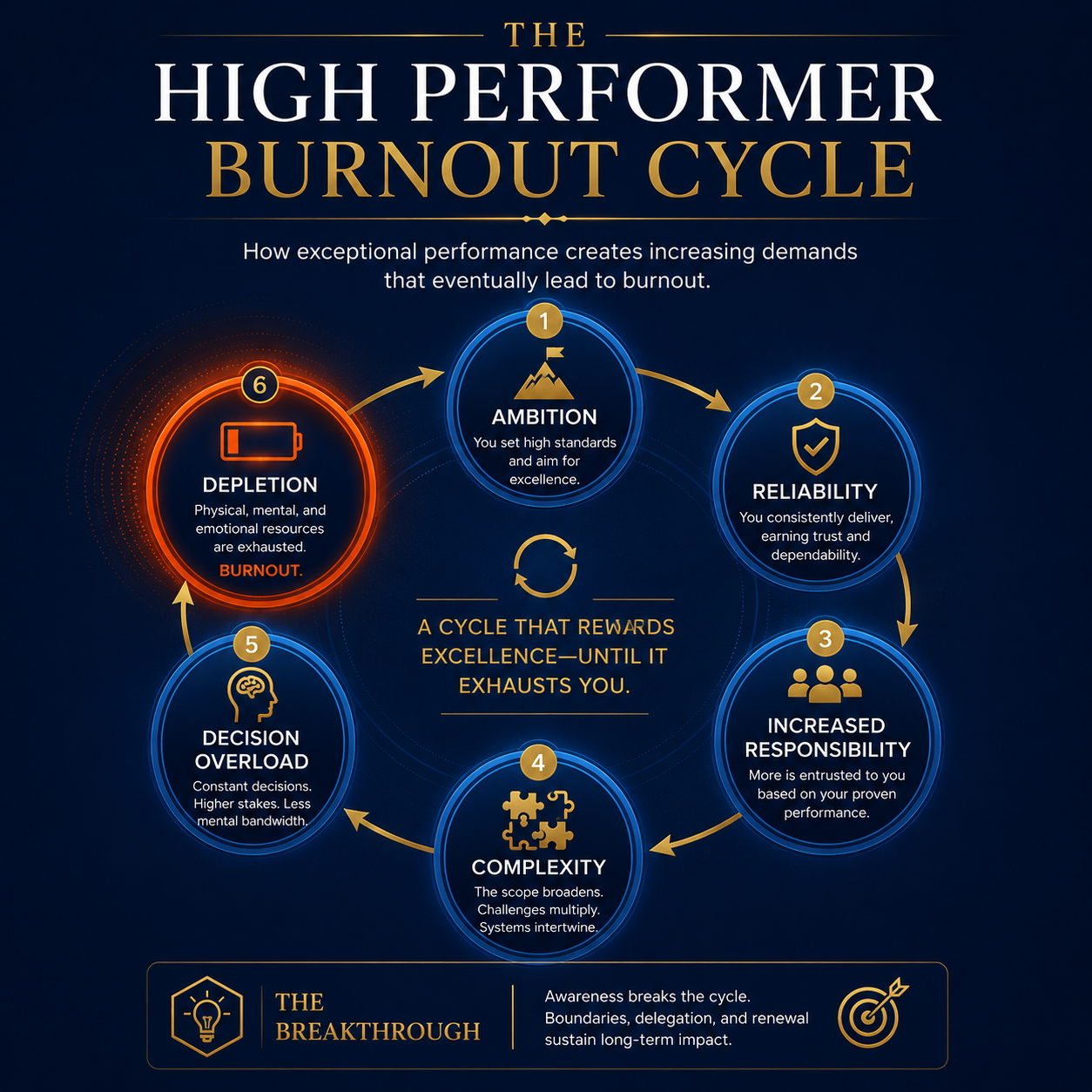
To understand the problem, we first need to understand how ambition becomes overload.
Definition
Why high performers burn out: High performers burn out because their competence, reliability, and ambition attract increasing demands, responsibilities, and expectations that eventually exceed sustainable human capacity without adequate support or recovery.
Why High Performers Burn Out More Often Than Average Employees
High performers often become organisational assets that everyone depends upon.
The problem is that success creates visibility. Visibility creates trust. Trust creates additional responsibilities. Eventually, responsibility becomes overload.
Research from Gallup consistently shows that managers and leaders experience significantly higher levels of workplace stress than individual contributors. The burden is not simply workload. It is accountability.
A high performer rarely receives more work because they have spare capacity. They receive more work because they are trusted to deliver.
This creates what Burn Bright Advisory describes as Scope Creep — one of the five root causes of burnout. Examples include:
None of these responsibilities appear dangerous in isolation. Combined over several years, they become unsustainable. The highest performers become victims of their own success.
Why High Performers Burn Out When Ambition Meets Structural Failure
Most burnout conversations focus on personal resilience. That is often the wrong place to start.
Research and practical leadership experience increasingly point towards a different conclusion: burnout is often a system failure. This principle sits at the centre of the Burn Bright philosophy.
The problem is not that leaders suddenly become less capable. The problem is that organisations continue increasing demands while maintaining the same structures.
Vincent Walters describes this as trying to run a modern workload using outdated support systems. Examples include more meetings, more communication channels, more reporting requirements, more stakeholders, more digital interruptions, and more compliance expectations — yet leaders are still expected to operate with the same working hours, same support staff, same decision authority, and same recovery opportunities.
Ambition accelerates burnout because ambitious leaders often absorb these additional demands voluntarily. They see every challenge as an opportunity. Until capacity breaks.
| Traditional Leadership | Sustainable Leadership |
|---|---|
| More effort | Better systems |
| Heroic problem solving | Structural problem solving |
| Constant availability | Protected recovery |
| Personal sacrifice | Sustainable performance |
| Individual responsibility | Shared accountability |
Why High Performers Burn Out Through Decision Overload
One of the least visible burnout drivers is decision fatigue.
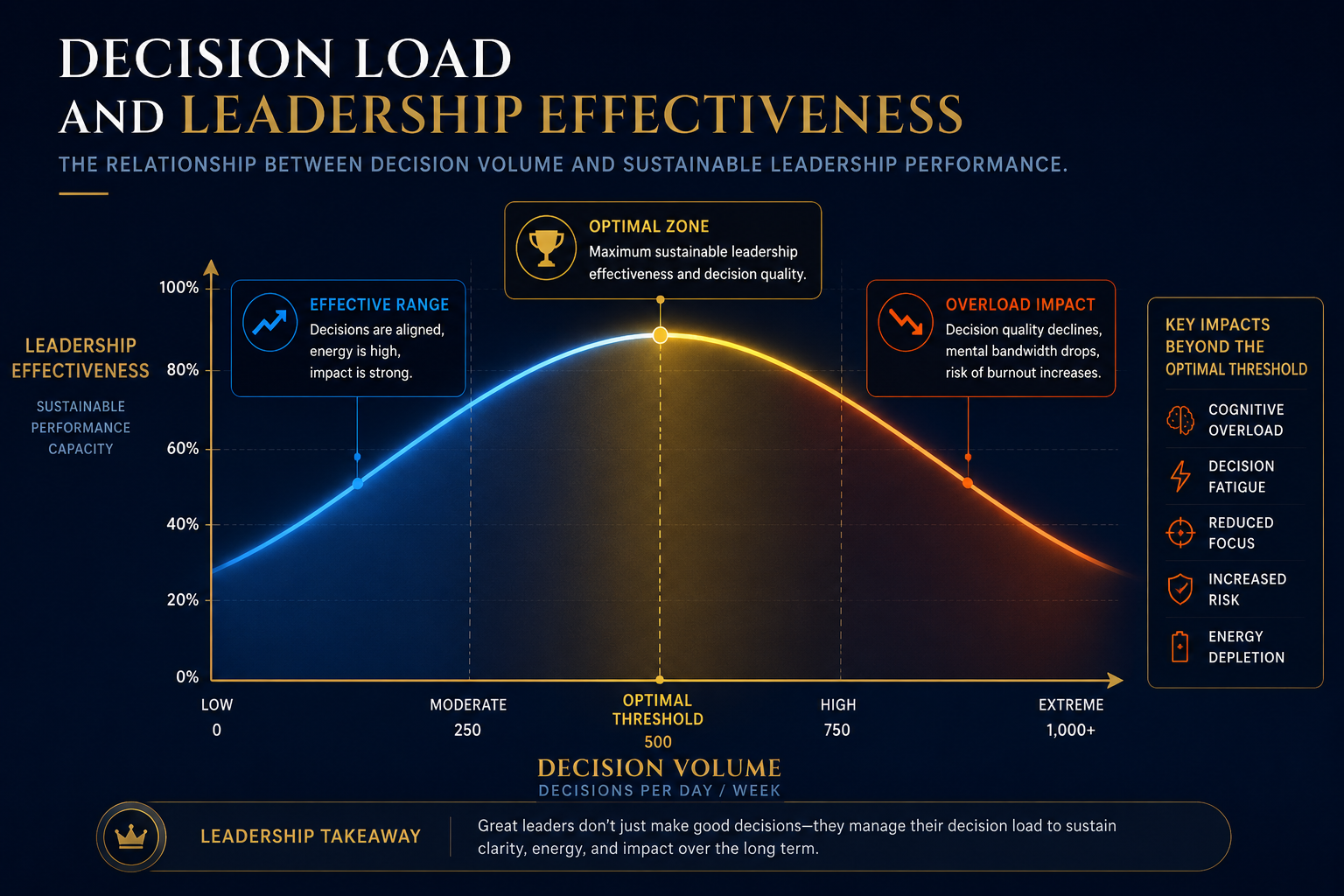
High-performing leaders make hundreds of decisions every week. Some are small. Others carry significant organisational consequences. The Burn Bright Not Out Framework identifies Decision Overload as a major burnout driver.
Every decision consumes cognitive energy. Examples include hiring decisions, budget approvals, performance management, strategic priorities, stakeholder management, and risk assessment.
As workloads increase, leaders experience what researchers describe as cognitive depletion. Symptoms include slower decision-making, reduced creativity, increased procrastination, risk avoidance, and mental exhaustion.
The very leaders organisations rely upon become less effective because the system demands too many decisions. Not because they lack capability. Because they lack capacity.
Why High Performers Burn Out Despite Being Resilient
Many leaders believe resilience protects against burnout. Evidence suggests otherwise. Resilience often delays burnout. It does not eliminate it.
This explains why resilient leaders frequently experience some of the most severe burnout episodes. They continue functioning long after warning signs appear. They compensate. Adapt. Push harder. Carry more. From the outside they appear successful. Internally they are depleting reserves.
High performers often possess strong work ethic, high emotional intelligence, commitment to excellence, personal accountability, and professional pride. These traits are strengths. But in poorly designed systems they become risk factors.
Resilience becomes a mechanism for tolerating dysfunction rather than solving it. The leader survives longer. The system remains broken. Eventually the bill arrives.
Why High Performers Burn Out in Cultures That Reward Perfectionism
Perfectionism is frequently mistaken for excellence. They are not the same thing. Excellence seeks impact. Perfectionism seeks flawlessness.
The Burn Bright framework identifies Perfectionism Culture as one of the five root causes of burnout. In high-performing organisations, perfectionism often hides behind high standards, attention to detail, accountability, and professionalism.
The danger emerges when leaders feel unable to delegate, prioritise, simplify, or accept good enough. Every task becomes critical. Every project becomes urgent. Every mistake feels unacceptable. This creates chronic stress and sustained cognitive overload.
For HR leaders, this is particularly important. Many top performers are not struggling because they lack skills. They are struggling because organisational culture rewards unsustainable behaviour.
How Organisations Can Stop High Performers Burning Out
Preventing burnout requires structural solutions. Not motivational slogans. Not resilience workshops. Not another wellbeing app.
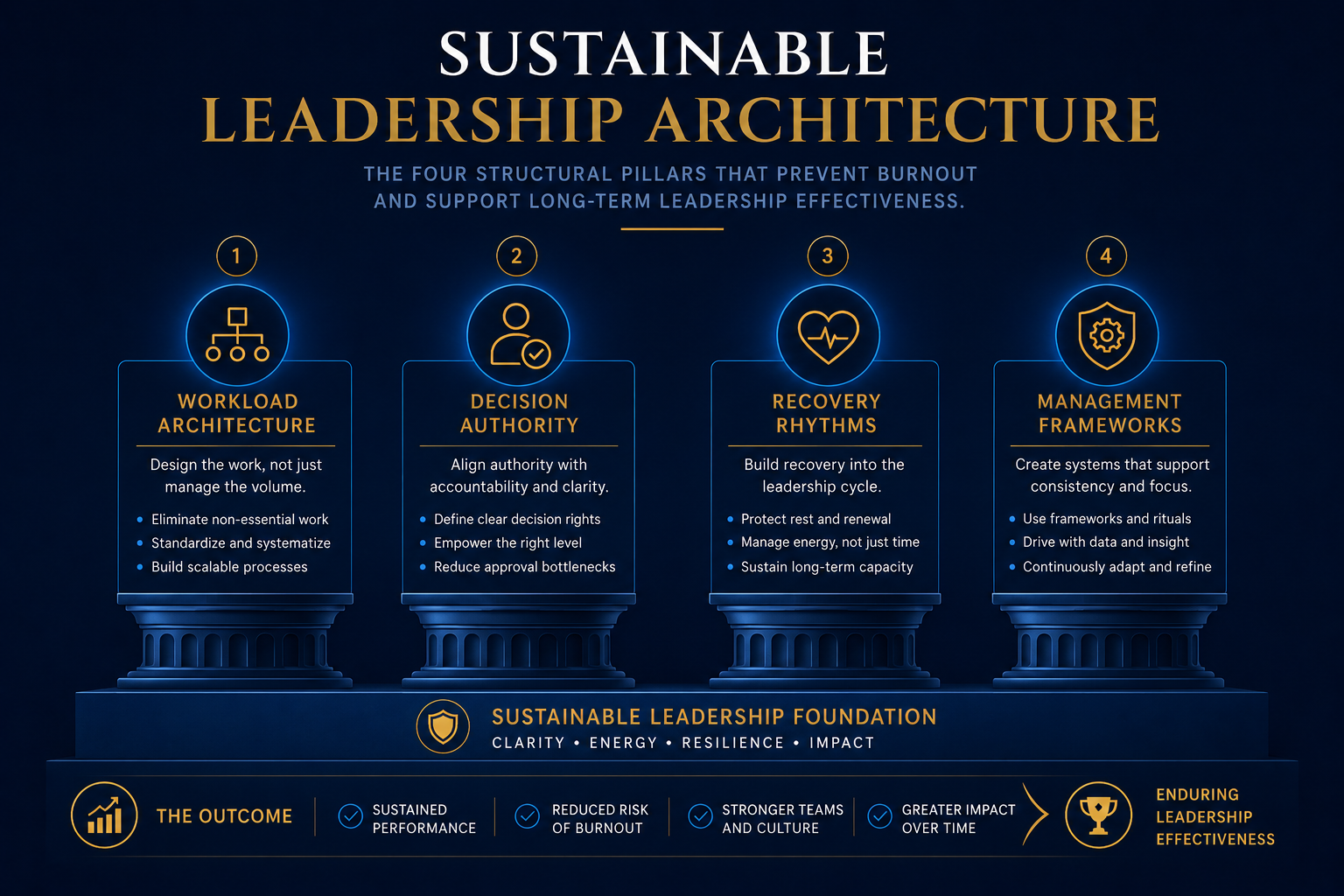
The Burn Bright Not Out Framework identifies four key pillars for sustainable leadership transformation:
Workload Architecture
Map visible and invisible workload. Remove low-value work. Reduce role creep. Clarify priorities.
Decision Authority
Push decisions closer to operational teams. Reduce unnecessary approval layers. Protect executive decision capacity.
Recovery Rhythms
Build recovery into leadership design. Recovery should be treated as a performance requirement, not a luxury.
Management Frameworks
Create systems that reduce dependency on heroic effort. Build repeatable structures. Reduce firefighting. Increase predictability.
Why High Performers Burn Out: The Cost to Organisations
The consequences extend far beyond individual leaders. Burnout creates significant organisational costs.
SENIOR LEADER REPLACEMENT
£500,000+
Cost of replacing a senior leader
MIDDLE MANAGER REPLACEMENT
£75,000
Cost of replacing a middle manager
PRODUCTIVITY LOSS
34%+
Productivity loss during leadership transitions
THE CULTURE TAX
The hidden cost organisations pay when treating burnout symptoms instead of fixing structural causes
The question is no longer whether organisations can afford to address burnout. The question is whether they can afford not to.
Frequently Asked Questions
Why do successful leaders burn out?
Successful leaders often accumulate responsibilities faster than support structures evolve. Their competence attracts additional demands, creating unsustainable workloads over time.
Can resilient people still burn out?
Yes. Resilience delays burnout but does not prevent it. Resilient leaders often tolerate unhealthy systems longer than others, increasing long-term risk.
Is burnout caused by working too many hours?
Not always. Burnout is often caused by a combination of workload, decision overload, lack of control, role ambiguity, and insufficient recovery.
Why are ambitious people vulnerable to burnout?
Ambitious people frequently volunteer for opportunities, responsibilities, and challenges. Without clear boundaries, ambition can create chronic overload.
How can organisations protect top performers?
Organisations should redesign workload structures, improve delegation systems, reduce decision overload, and build recovery into leadership expectations.
Is burnout a personal problem or an organisational problem?
Burnout can affect individuals, but in many cases it originates from organisational design, workload architecture, culture, and leadership systems.
Conclusion
Understanding why high performers burn out changes how we approach leadership, talent development, and organisational performance.
The highest-performing leaders are not usually lacking resilience, commitment, or capability. They are often carrying workloads that were never designed to be sustainable.
Ambition attracts responsibility. Responsibility attracts complexity. Complexity attracts depletion. Unless systems evolve alongside expectations, even exceptional leaders will eventually reach capacity.
Burnout is rarely solved by asking leaders to try harder. It is solved by redesigning the structures around them.
The organisations that thrive in the coming decade will not be those that demand the most from their leaders. They will be the organisations that build sustainable systems allowing leaders to perform at their best without sacrificing their health, effectiveness, or future capacity.
"As you look at your own situation today — are you leading from a place of clarity or a place of depletion?"
— Vincent Walters, Burn Bright Advisory
Take the Next Step
Explore the Leadership Burnout Reset
The 2 Module Fast Track to diagnose burnout risk, redesign workload structures, and build sustainable leadership performance before burnout takes hold.
Explore the Reset →