Why Leaders Hide Burnout: The Silent Leadership Crisis
Quick Answer
Why leaders hide burnout often comes down to fear, culture, and organisational expectations. Many senior leaders believe admitting burnout could damage credibility, limit career progression, reduce stakeholder confidence, or signal weakness. As a result, leaders frequently conceal burnout symptoms while continuing to perform publicly, creating a dangerous gap between appearance and reality.
Key Takeaways
- Leadership burnout is often hidden long before it becomes visible.
- Many executives believe admitting burnout threatens their credibility.
- Organisational cultures frequently reward endurance over sustainability.
- Leadership silence is often a rational response to structural pressures.
- Burnout becomes harder to address when leaders feel unable to speak openly.
Introduction
Why leaders hide burnout is one of the most important and least discussed questions in modern leadership.
Most burnout conversations focus on symptoms.
Far fewer examine silence.
Across organisations, senior leaders continue delivering presentations, leading meetings, managing teams, and reporting results while privately struggling with exhaustion, overwhelm, decision fatigue, and emotional depletion.
From the outside, everything appears fine.
The performance remains.
The confidence remains.
The authority remains.
Yet beneath the surface, many leaders are operating far beyond sustainable capacity.
This creates a dangerous leadership paradox.
The people responsible for protecting organisational health often feel unable to discuss their own.
The result is a culture where burnout becomes invisible until it becomes unavoidable.
The challenge is not simply personal.
It is cultural.
It is psychological.
And most importantly, it is structural.
This article explores why senior leaders conceal burnout, why leadership silence has become normalised, and why sustainable leadership depends on changing the systems that make openness feel risky.
The hidden reality of leadership burnout
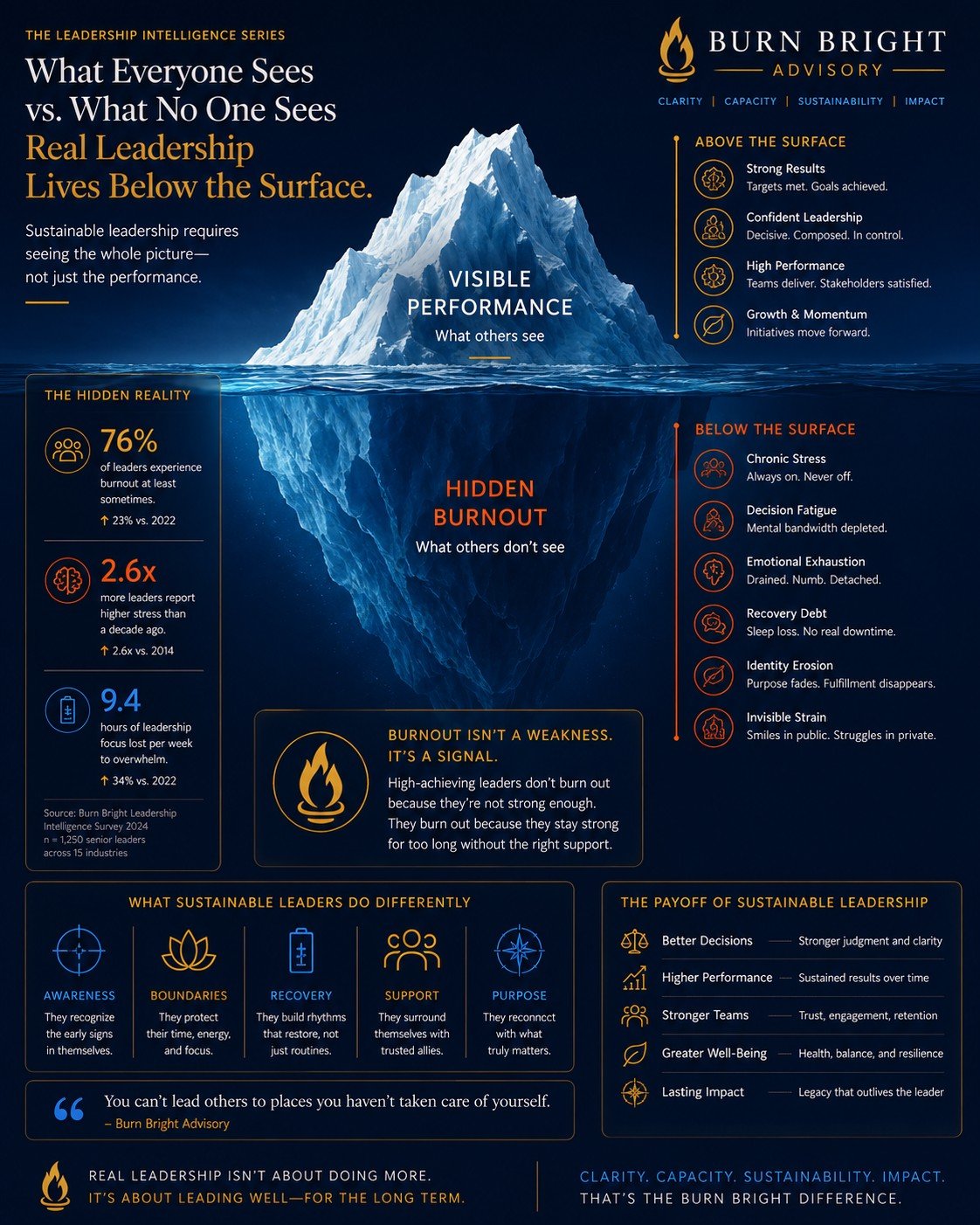
Caption: Many leaders maintain high performance externally while experiencing significant burnout internally.
Interpretation: Leadership burnout often remains invisible because performance can continue long after capacity has begun to decline.
Featured Snippet Definition
Why leaders hide burnout is typically driven by fears around credibility, career impact, organisational expectations, and cultural norms that equate leadership with constant strength and availability.
Why Burnout Is Easier to Hide at Senior Levels
One of the greatest misconceptions about burnout is that it is always obvious.
In reality, leadership burnout is often highly concealed.
Senior leaders possess skills that allow them to compensate for declining capacity longer than most employees.
They know how to:
- Manage perceptions
- Control communication
- Prioritise visible performance
- Hide vulnerability
- Continue functioning under pressure
This creates what might be called the leadership masking effect.
The leader appears capable.
The organisation sees results.
Meanwhile the cost is paid privately.
By the time symptoms become visible, burnout is often already advanced.
This explains why many executives seem to "suddenly" burn out.
The reality is usually very different.
Burnout has often been developing for months or years.
The organisation simply could not see it.
The Psychological Reason Leaders Hide Burnout
Leadership identity is deeply connected to competence.
Many executives have spent decades building reputations based on reliability, resilience, and performance.
Admitting burnout can feel like threatening that identity.
The Competence Trap
Many leaders unconsciously believe:
- Strong leaders cope.
- Strong leaders perform.
- Strong leaders handle pressure.
When burnout symptoms emerge, leaders often interpret them as personal failure rather than warning signals.
Instead of saying:
"The system is unsustainable."
They think:
"I should be handling this better."
Burn Bright's philosophy directly challenges this assumption.
Burnout is a system failure, not a personal failure. Yet many leaders continue carrying responsibility for structural problems they did not create.
Fear of Losing Status
Executives frequently worry that acknowledging burnout could:
- Reduce credibility
- Damage authority
- Affect promotion opportunities
- Create doubts among stakeholders
- Influence board confidence
Whether these fears are justified or not is almost irrelevant.
The perception alone often keeps leaders silent.
The Cultural Reason Leaders Hide Burnout
Many organisations unintentionally create cultures where silence feels safer than honesty.
The message may never be stated directly.
But leaders quickly learn what behaviours receive recognition.
Endurance Is Rewarded
In many organisations, leaders are praised for:
- Long hours
- Constant availability
- Crisis management
- Sacrifice
- Exceptional workload tolerance
Over time, endurance becomes a leadership requirement.
The problem is that endurance and sustainability are not the same thing.
A leader can endure unsustainable conditions for years.
Eventually, capacity runs out.
The Hero Leadership Model
Many organisations still operate according to a heroic leadership model.
This model assumes great leaders:
- Solve everything
- Handle everything
- Carry everything
The consequence is predictable.
Leaders become reluctant to acknowledge limits.
Burn Bright advocates an alternative:
Sustainable leadership beats heroic leadership.
The most effective leaders are not those who absorb unlimited pressure.
They are those who build systems that prevent overload from occurring.
The Structural Reason Leaders Hide Burnout
Silence is often a rational response to organisational reality.
Many leaders understand that acknowledging burnout does not necessarily reduce workload.
It simply creates another problem to manage.
This is where structure matters.
The Five Structural Drivers
Burn Bright identifies five common structural causes of leadership burnout:
- Scope creep
- Meeting culture
- Communication chaos
- Decision overload
- Perfectionism culture
Leaders operating inside these systems often feel trapped.
They know the workload is unsustainable.
They also know the system expects them to continue.
The Leadership Bottleneck Problem
Many executives become central decision-making hubs.
Every issue flows upward.
Every decision requires approval.
Every problem requires attention.
Eventually leaders reach a point where admitting burnout appears less practical than continuing to cope.
This creates a cycle:
- Workload increases.
- Capacity declines.
- Silence increases.
- Burnout worsens.
Why silence becomes self-reinforcing
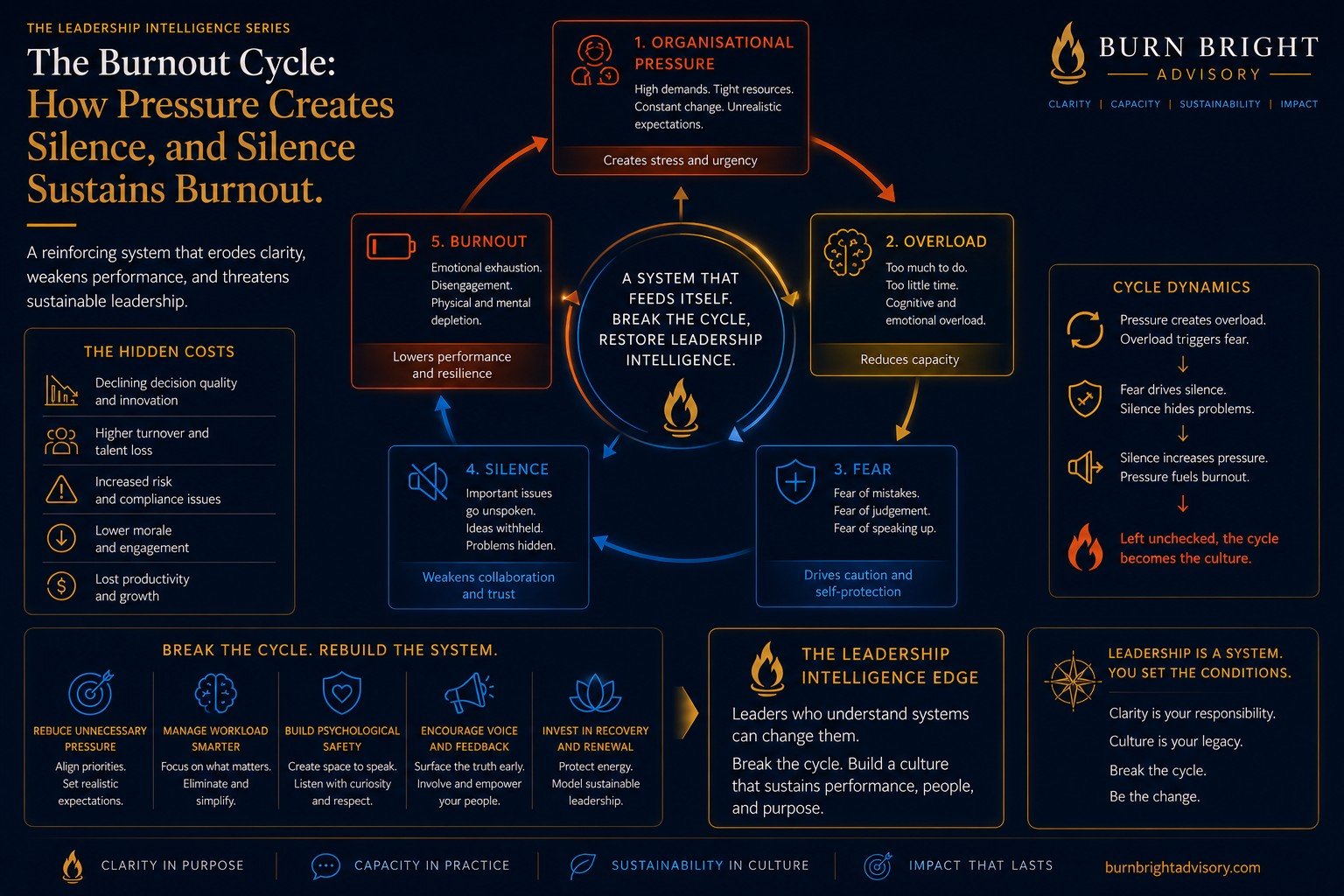
Caption: The longer burnout remains hidden, the more difficult it becomes to discuss openly.
Interpretation: Leadership silence often strengthens itself through fear, expectation, and organisational pressure.
Why High Performers Are Most Likely to Hide Burnout
Perhaps the greatest irony is that the leaders most likely to hide burnout are often the highest performers.
High performers are conditioned to solve problems.
When burnout appears, they treat it as another challenge.
They work harder.
They optimise further.
They sacrifice more recovery time.
Initially, this appears effective.
Performance continues.
Results remain strong.
But the underlying depletion continues growing.
Research consistently shows that high-achieving professionals often delay seeking support because they believe they should be capable of solving the problem independently.
Unfortunately, burnout is rarely solved through greater effort.
It usually requires structural intervention.
What Leaders Fear Will Happen If They Speak Up
When executives conceal burnout, they are often protecting themselves from perceived consequences.
Common fears include:
"People Will Think I Cannot Cope"
Leadership positions are often associated with strength and composure.
Many executives worry vulnerability will be interpreted as incapability.
"My Team Will Lose Confidence"
Leaders frequently fear openness could undermine morale.
In reality, carefully communicated vulnerability often increases trust.
"My Career Will Suffer"
This remains one of the most powerful concerns.
Many leaders believe future opportunities depend on projecting constant capability.
"Nothing Will Change Anyway"
This fear is particularly significant.
If leaders believe speaking up will not result in meaningful change, silence becomes understandable.
The issue becomes not trust but perceived futility.
The Cost of Leadership Silence
Burnout does not remain personal for long.
Eventually, it affects the organisation.
Reduced Decision Quality
Burnout impairs strategic thinking.
Leaders become increasingly reactive.
Emotional Contagion
Teams absorb leadership behaviour.
When exhaustion becomes normalised, it spreads.
Reduced Innovation
Burned-out leaders focus on immediate problems.
Long-term thinking declines.
Leadership Turnover
Burn Bright estimates leadership replacement costs can range from £75,000 for middle managers to more than £500,000 for senior leaders. Leadership transitions can also create productivity losses exceeding 34%.
The cost of silence is often far greater than the cost of early intervention.
What Organisations Get Wrong About Burnout
Many organisations approach burnout as an individual wellbeing issue.
This misses the root cause.
Common responses include:
- Resilience training
- Wellness programmes
- Time management workshops
- Mindfulness initiatives
These interventions can be helpful.
But they do not fix structural overload.
As Vincent Walters argues throughout the Burn Bright framework:
Fix the system, not the person.
If workload architecture remains unchanged, burnout eventually returns.
This is why leadership burnout should be viewed as an organisational design issue rather than a personal coping issue.
How Organisations Create Psychological Safety Around Burnout
The solution begins with culture.
Leaders must know that discussing capacity will not damage credibility.
Practical actions include:
Normalising Capacity Conversations
Leaders should be able to discuss workload without fear of judgement.
Measuring Sustainability
Performance metrics should include sustainability indicators, not just output indicators.
Rewarding Boundaries
Healthy boundaries should be viewed as leadership competence, not weakness.
Redesigning Workload Systems
Burn Bright's structural transformation framework focuses on:
- Workload Architecture
- Decision Authority
- Recovery Rhythms
- Management Frameworks
These changes address causes rather than symptoms.
Leadership Burnout vs Leadership Silence
| Leadership Burnout | Leadership Silence |
| Physical exhaustion | Emotional concealment |
| Cognitive overload | Fear of disclosure |
| Reduced capacity | Maintained appearance |
| Internal struggle | External performance |
| Personal impact | Organisational risk |
The most dangerous situation occurs when both exist simultaneously.
Burnout grows.
Silence continues.
The organisation remains unaware.
Building a sustainable leadership culture
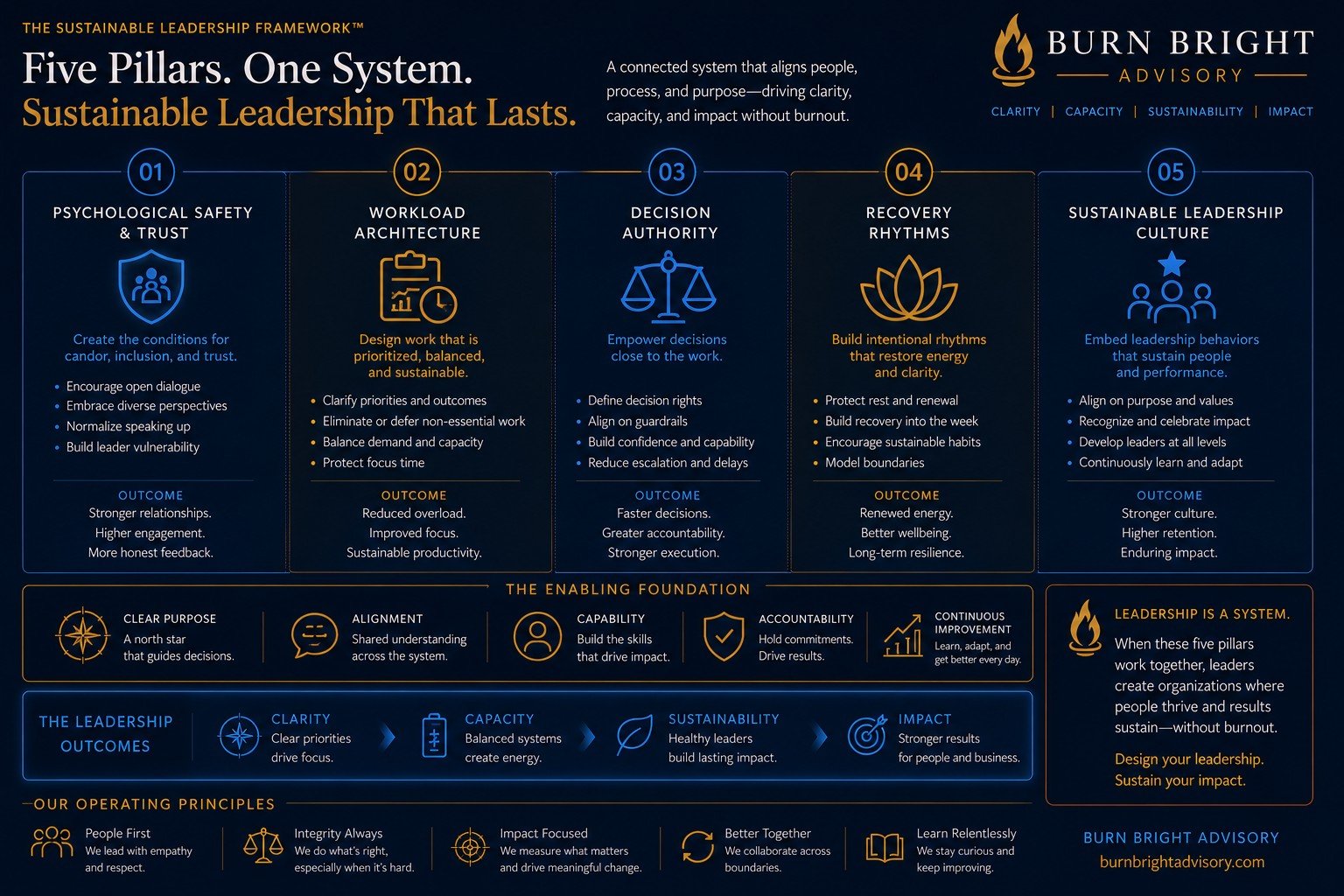
Caption: Sustainable leadership cultures encourage openness, capacity management, and structural redesign.
Interpretation: Long-term leadership performance depends on systems that support human sustainability.
Frequently Asked Questions
Why do leaders hide burnout?
Leaders often fear losing credibility, authority, career opportunities, or stakeholder confidence if they acknowledge burnout.
Is hiding burnout common among executives?
Yes. Senior leaders frequently continue performing publicly while privately experiencing significant burnout symptoms.
Does leadership culture contribute to burnout silence?
Absolutely. Many organisations reward endurance and constant availability, making openness feel risky.
Are high performers more likely to conceal burnout?
Often yes. High performers tend to compensate for overload longer and are more likely to believe they should solve burnout independently.
Can organisations reduce burnout stigma?
Yes. Organisations can normalise workload conversations, reward sustainable performance, and redesign systems that create overload.
Is burnout a personal weakness?
No. Burnout is usually linked to organisational structures, workload design, decision overload, and cultural expectations rather than individual weakness.
Conclusion
Understanding why leaders hide burnout requires looking beyond individual psychology.
Silence rarely occurs because leaders are unwilling to speak.
More often, it exists because leadership cultures reward endurance, organisational structures create overload, and executives fear the consequences of being honest about capacity.
The tragedy is that many leaders continue performing long after their systems have begun to fail.
They appear successful.
They appear capable.
They appear resilient.
Meanwhile exhaustion grows beneath the surface.
The solution is not encouraging leaders to become tougher.
The solution is creating organisations where sustainability is valued as highly as performance.
Burnout thrives in silence.
Sustainable leadership depends on visibility.
Because leaders cannot outwork broken systems.
And organisations cannot solve problems they refuse to see.
As you look at your own situation today — are you leading from a place of clarity or a place of depletion?
CTA
Take the Free Leadership Burnout Self-Assessment and gain a clearer picture of your current leadership sustainability before burnout becomes harder to recognise:
Related Articles
- What Is Leadership Burnout?
- Early Signs of Leadership Burnout
- Leadership Burnout Myths