Quick Answer
What is leadership burnout? Leadership burnout is a state of chronic physical, emotional, and cognitive exhaustion caused by prolonged exposure to excessive leadership demands without sufficient recovery, resources, authority, or support. Contrary to popular belief, leadership burnout is rarely a personal weakness. It is most often the result of poorly designed systems, unrealistic expectations, and unsustainable organisational structures.
Key Takeaways
- Leadership burnout is not simply stress or tiredness.
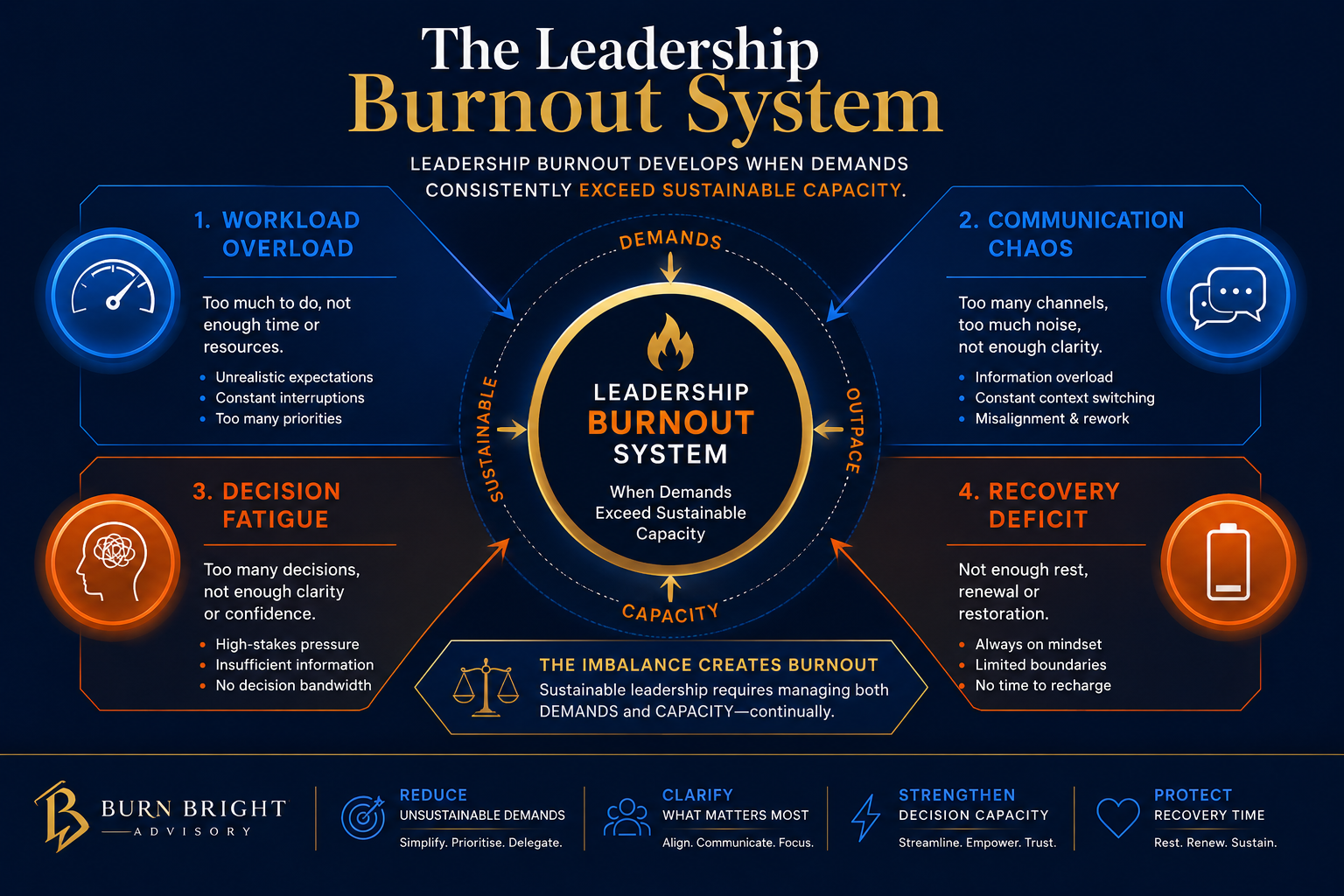
- Burnout develops when leadership demands exceed sustainable capacity for extended periods.
- Most burnout is driven by system failures rather than individual shortcomings.
- Scope creep, decision overload, communication chaos, and poor organisational design are common root causes.
- Sustainable leadership requires structural solutions, not motivational fixes.
Introduction
What is leadership burnout? It is one of the most important questions facing organisations today.
Across businesses, healthcare systems, schools, government departments, and charities, leaders are reporting unprecedented levels of exhaustion. Gallup research has found that more than half of managers report experiencing burnout symptoms, while organisations continue to struggle with rising leadership turnover and declining engagement.
For many senior managers and executives, burnout appears personal. They assume they are not resilient enough, disciplined enough, or organised enough.
The evidence suggests otherwise.
Burnout is often a predictable outcome of systems that demand more than any individual can sustainably deliver. Leaders are expected to manage increasing complexity, constant communication, expanding responsibilities, and growing accountability while resources remain static.
This article explains what leadership burnout is, what it is not, why it happens, and why the most effective solution starts with organisational design rather than individual coping strategies.
Before we explore the causes, it helps to understand the bigger picture.
Definition
Leadership burnout is a state of physical, emotional, and mental exhaustion caused by prolonged leadership pressures, excessive workload, limited control, and inadequate recovery. It is most often the result of organisational and systemic factors rather than personal weakness.
What Is Leadership Burnout Really?
Many people confuse burnout with stress. They are not the same thing.
Stress is typically temporary. It increases energy and focus during periods of challenge. Burnout is different. Burnout occurs when sustained pressure exceeds recovery capacity for so long that physical, emotional, and cognitive resources become depleted.
The World Health Organization describes burnout as an occupational phenomenon characterised by energy depletion, increased mental distance from work, and reduced professional effectiveness.
For leaders, burnout often appears through:
One of the most dangerous aspects of leadership burnout is that many leaders continue functioning long after their performance has begun to decline. From the outside they appear successful. Internally they are operating in survival mode.
Research and leadership case studies consistently show that burnout develops gradually through months or years of accumulated overload rather than a single event.
Why Is Leadership Burnout Increasing?
Leadership roles have changed dramatically. Technology promised efficiency. Instead, many organisations created greater complexity.
Leaders now manage multiple communication platforms, hybrid teams, constant digital interruptions, increased reporting requirements, more stakeholders, and greater accountability. At the same time, expectations continue to rise.
Many organisations are effectively attempting to run a 2026 workload using support structures designed for a much simpler workplace environment.
Research highlighted in Burn Bright's work shows leaders increasingly face scope creep, meeting overload, communication chaos, decision fatigue, and perfectionism-driven cultures. These five factors form the foundation of many burnout cases.
More work. More complexity. More responsibility. The same amount of time. Eventually, the system breaks.
Why Leadership Burnout Is a System Failure, Not a Personal Failure
This is the distinction most organisations miss. Traditional thinking treats burnout as an individual problem. The assumption is simple: if leaders are struggling, they need more resilience, better time management, or greater wellbeing support.
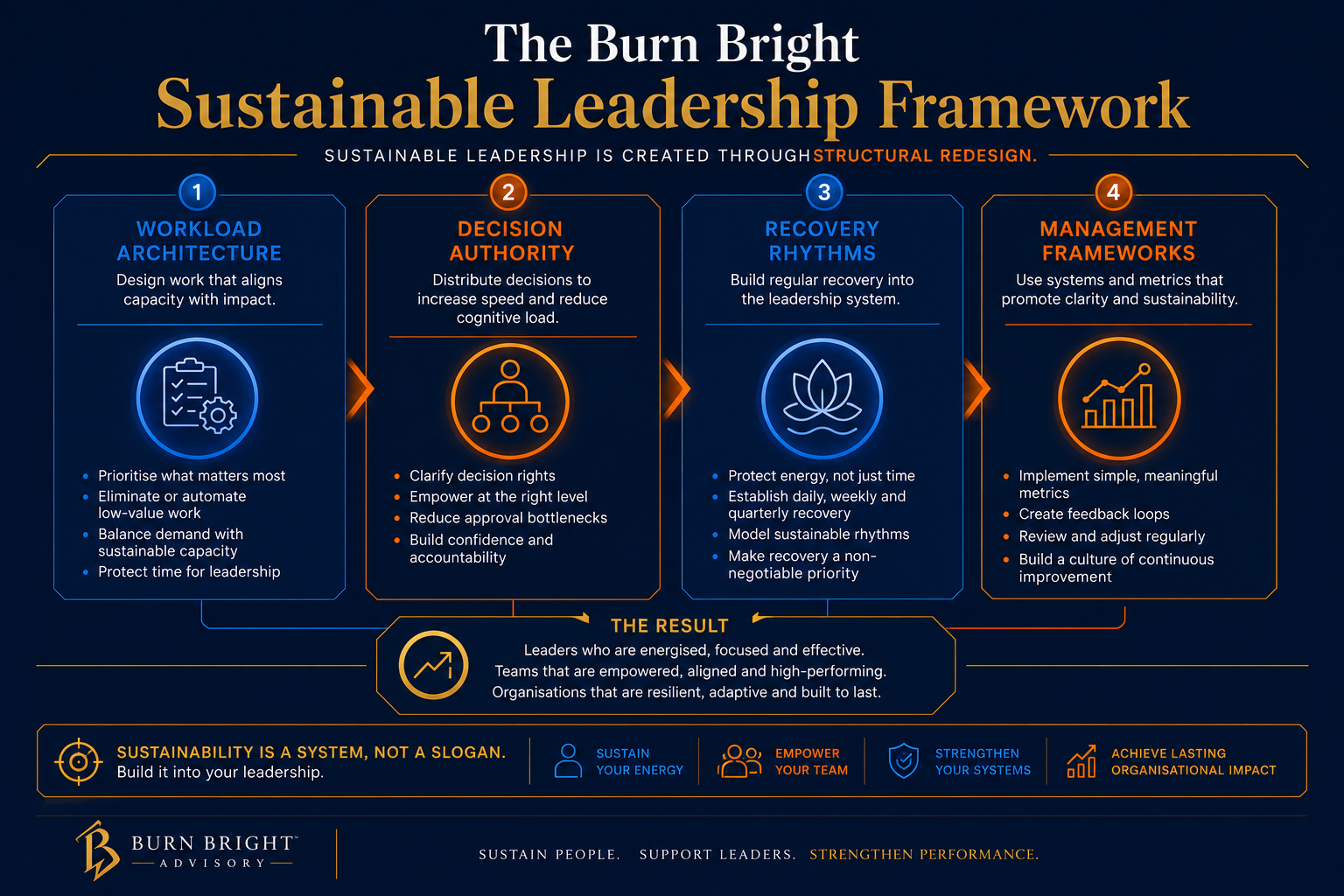
While these interventions may provide temporary relief, they rarely solve the underlying issue. The Burn Bright framework argues that burnout should be viewed primarily as a structural problem.
Consider the evidence: if one leader burns out, it may be personal. If dozens of leaders burn out within the same organisation, the system deserves investigation.
Common Organisational Drivers
What Leadership Burnout Is Not
Misunderstanding burnout often delays intervention. Leadership burnout is not:
Laziness
Burned-out leaders are often among the hardest-working people in the organisation.
Weakness
Many burnout cases occur among high performers with strong track records.
Poor Time Management
No productivity system can compensate for fundamentally unsustainable workloads.
Lack of Commitment
Most burned-out leaders care deeply about their organisations and teams.
Temporary Tiredness
A holiday may relieve fatigue. Burnout requires deeper structural recovery and redesign.
How Does Leadership Burnout Affect Organisations?
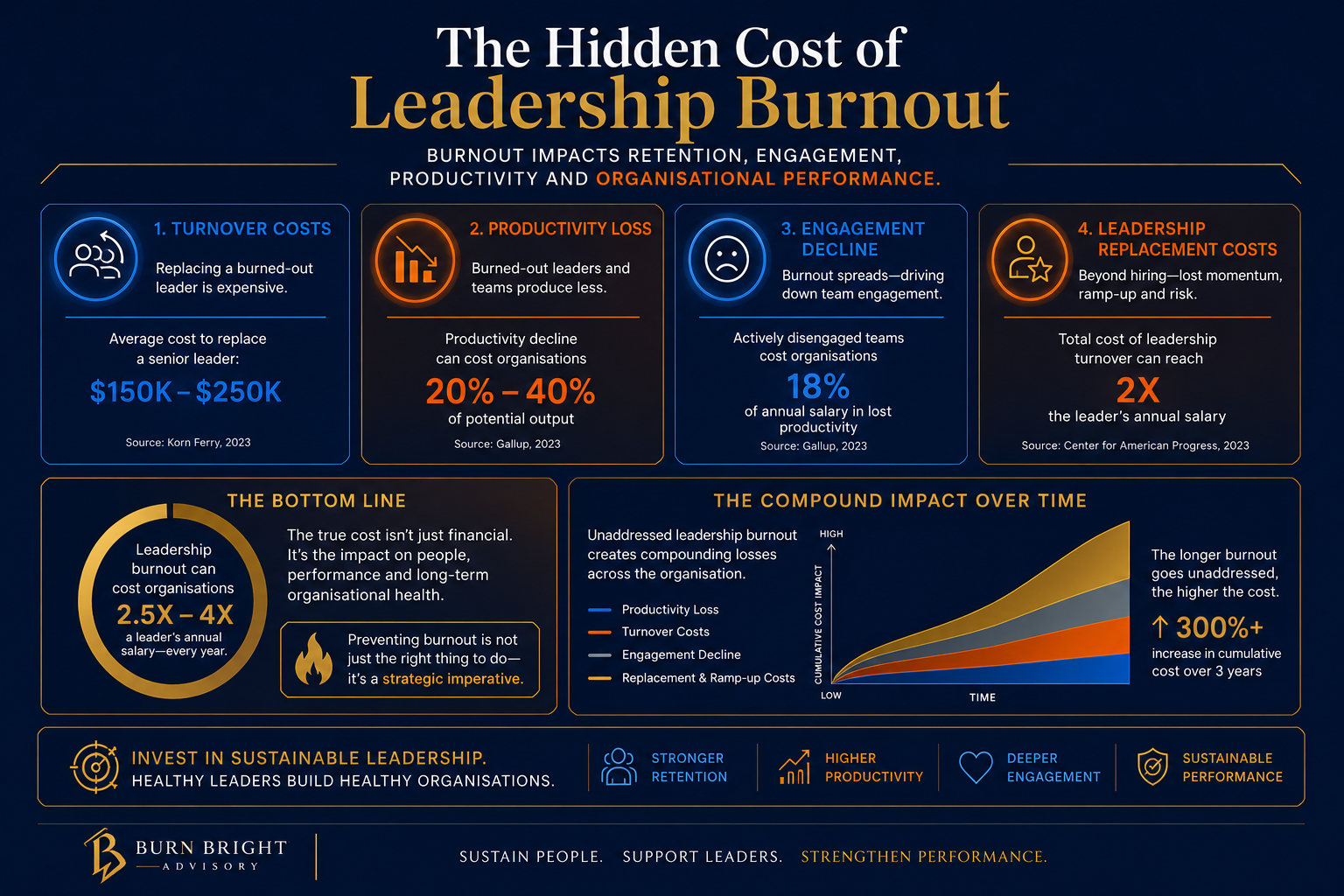
Burnout rarely remains isolated. It spreads. When leaders burn out, teams often follow.
Research and organisational case studies show that burned-out leaders are more likely to delay decisions, avoid difficult conversations, communicate less effectively, become reactive rather than strategic, and withdraw from team development.
SENIOR LEADER REPLACEMENT
£500,000+
Cost of replacing a senior leader
MIDDLE MANAGER REPLACEMENT
£75,000
Cost of replacing a middle manager
PRODUCTIVITY LOSS
30%+
Productivity loss during leadership transitions
What Causes Leadership Burnout?
While every situation is unique, most leadership burnout can be traced to recurring structural patterns.
| Personal Failure View | System Failure View |
|---|---|
| Leader lacks resilience | Workload exceeds capacity |
| Poor time management | Excessive demands |
| Needs wellbeing training | Needs workload redesign |
| Individual responsibility | Shared organisational responsibility |
| Fix the leader | Fix the system |
| Short-term intervention | Structural transformation |
How Can Organisations Prevent Leadership Burnout?
Preventing burnout requires moving beyond wellbeing initiatives. It requires structural redesign. The Burn Bright framework identifies four pillars of sustainable leadership:
Frequently Asked Questions
What is leadership burnout in simple terms?
Leadership burnout is a state of chronic exhaustion caused by prolonged leadership pressures, excessive workload, and insufficient recovery. It affects physical energy, emotional wellbeing, and decision-making ability.
Is leadership burnout the same as stress?
No. Stress is usually temporary and can improve with recovery. Burnout is longer lasting and often requires structural changes to workload, responsibilities, or organisational systems.
Can high-performing leaders experience burnout?
Yes. In fact, many burnout cases occur among high achievers who take on increasing responsibilities and continue performing despite mounting exhaustion.
What causes leadership burnout?
Common causes include workload overload, decision fatigue, communication overload, excessive meetings, unclear priorities, and organisational design failures.
Why do leaders hide burnout?
Many leaders fear appearing weak, damaging their credibility, or affecting career progression. This often delays support and allows burnout to worsen.
Is burnout an individual problem or an organisational problem?
Both can contribute, but organisational factors frequently play the dominant role. Research increasingly shows burnout emerges from mismatches between demands, resources, authority, and recovery opportunities.
Conclusion
When asking what is leadership burnout, the most important insight is this: burnout is rarely a failure of character. It is usually a failure of design.
Leaders today operate in environments characterised by expanding responsibilities, communication overload, decision fatigue, and constant pressure. When those demands exceed sustainable capacity for long enough, burnout becomes a predictable outcome.
The solution is not simply more resilience training, better productivity apps, or another wellbeing initiative. The solution is structural. Burnout is a system failure. Leaders cannot outwork broken systems.
Organisations that want healthier leaders, stronger cultures, and better performance must move beyond treating symptoms and begin redesigning the conditions that create burnout in the first place.
"As you look at your own situation today — are you leading from a place of clarity or a place of depletion?"
— Vincent Walters, Burn Bright Advisory
Free Resource
Take the Free Leadership Burnout Self-Assessment
Find out which of the five root causes is most active in your leadership right now. Free. Instant results.
Take the Free Assessment →