Quick Answer
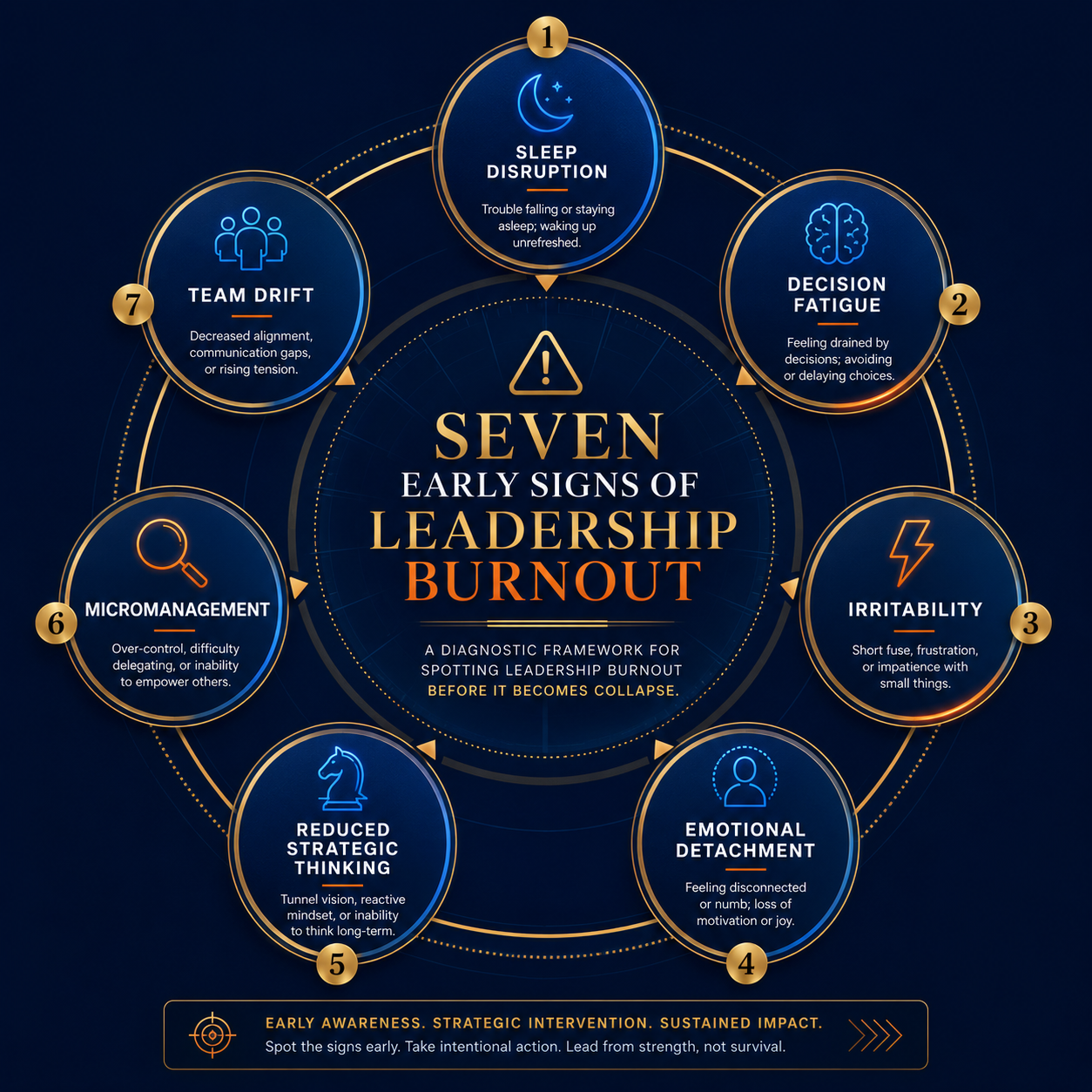
The early signs of leadership burnout include disrupted sleep, decision fatigue, irritability, emotional detachment, reduced strategic thinking, micromanagement, and visible team performance decline. These signals are often dismissed as normal executive pressure, but they usually indicate a deeper system problem: excessive demand, unclear boundaries, decision overload, and insufficient recovery.
Key Takeaways
- Burnout rarely appears suddenly. It builds through repeated depletion.
- The earliest signs are often physical: sleep disruption, fatigue, headaches, and illness.
- Cognitive warning signs include slower decisions, forgetfulness, and reduced creativity.
- Emotional detachment is a serious leadership risk, not a personality flaw.
- Sustainable leadership requires system redesign, not more personal effort.
Introduction
Early signs of leadership burnout are easy to miss because many executives are rewarded for hiding them. Long hours, constant availability, emotional control, and rapid decision-making are often treated as signs of strength.
But there is a difference between pressure and depletion.
The World Health Organization defines burnout as an occupational phenomenon caused by chronic workplace stress that has not been successfully managed. It is marked by exhaustion, mental distance or cynicism, and reduced professional efficacy.
For leaders, burnout is rarely just personal. The Burn Bright Not Out framework identifies structural causes such as scope creep, meeting culture, communication chaos, decision overload, and perfectionism culture.
This article explains the seven warning signals every executive should know, how to distinguish stress from burnout, and what to do before performance, health, and team trust begin to deteriorate.
Definition
Early signs of leadership burnout are the first physical, emotional, cognitive, behavioural, and team-performance signals that a leader’s workload, authority, recovery, and support systems are no longer sustainable.
Why Are the Early Signs of Leadership Burnout So Easy to Miss?
Executives are trained to keep functioning. They answer messages late at night. They absorb pressure from above. They shield their teams. They make decisions with incomplete information. Over time, this can make depletion feel normal.
Early leadership burnout is a pattern that unfolds over months, often dismissed as temporary stress or a busy season. Warning signs include increased work hours without increased productivity, difficulty concentrating, irritability, and avoidance of difficult conversations.
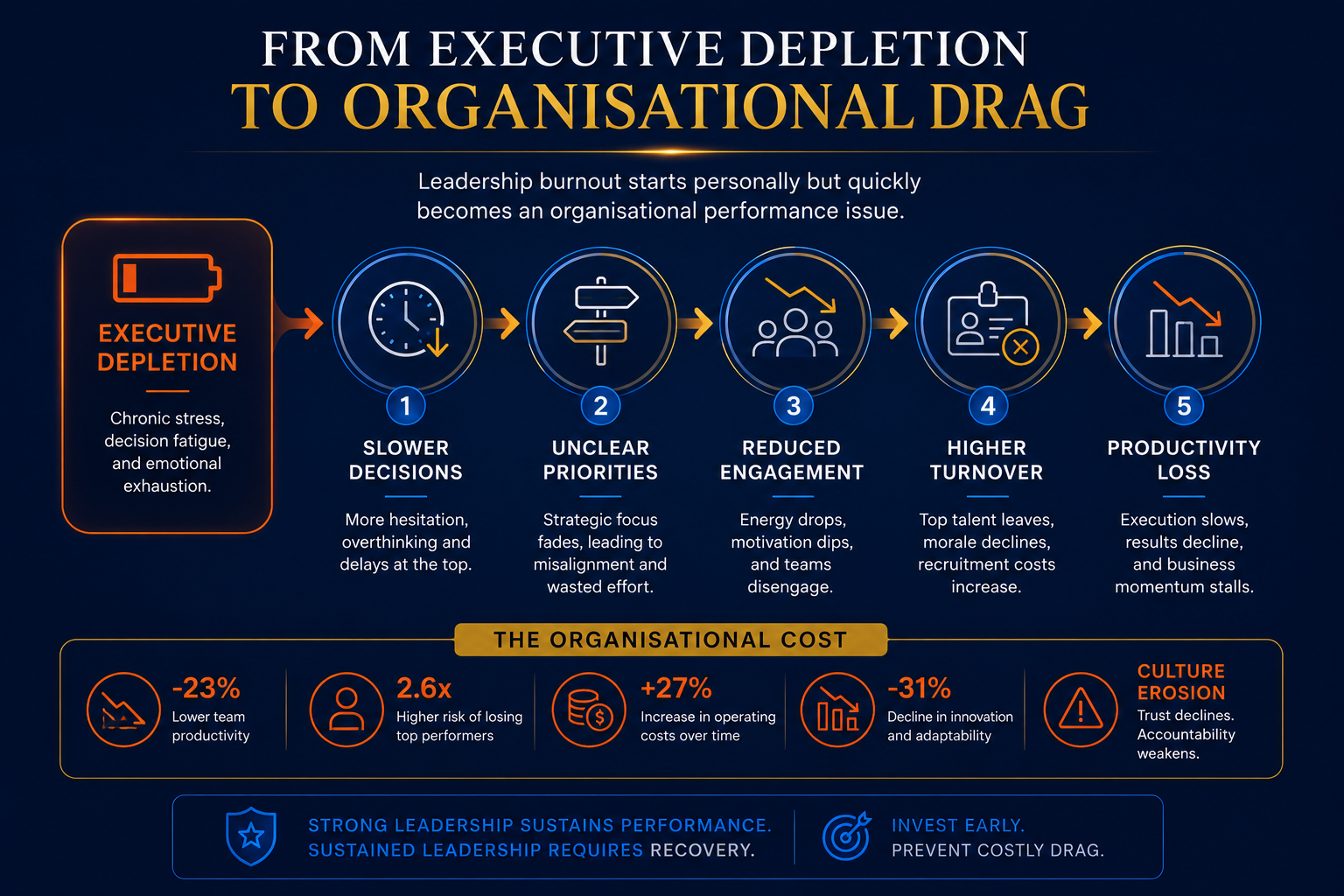
That matters because burnout damages more than personal wellbeing. Gallup’s 2026 workplace report found global engagement fell to 20% in 2025, with low engagement costing the world economy an estimated $10 trillion in lost productivity.
McKinsey also reports that burnout is strongly linked to workplace conditions, with employees reporting symptoms such as exhaustion, mental distance, cognitive impairment, and emotional impairment.
The executive risk is this: leaders often diagnose burnout too late. They wait until the collapse is visible. But sustainable leadership depends on earlier diagnosis.
Early Signs of Leadership Burnout: The 7 Warning Signals
Sleep Disruption That Does Not Reset
A poor night of sleep is normal. A repeated pattern is not. One of the clearest early signs of leadership burnout is disrupted sleep: waking between 2am and 4am, mentally rehearsing decisions, or feeling unrested after a full night in bed. Executives often rationalise this as responsibility. But when sleep becomes an extension of the working day, the system is already overloaded.
Decision Fatigue Earlier in the Day
Decision fatigue is not just tiredness. It is the point where routine choices start feeling heavier than they should. In leadership burnout, decision fatigue often appears as:
- Postponing simple decisions
- Second-guessing completed decisions
- Avoiding trade-offs
- Asking for more data when enough is already available
- Feeling mentally exhausted before midday
This is not weakness. It is cognitive capacity under strain.
Irritability Over Routine Questions
A useful test: are you reacting to the question, or to the load behind the question? Executives approaching burnout often become impatient with ordinary requests. They snap at people they respect. They feel interrupted by issues that are genuinely part of their role. This matters because irritation travels quickly through a team — people stop bringing problems early, delay escalation, and edit the truth. That creates more risk for the leader later.
Emotional Detachment From Work That Once Mattered
Another early sign of leadership burnout is emotional flatness. The project lands, but there is no satisfaction. The team succeeds, but it feels like another box ticked. The strategy works, but the leader feels nothing. The WHO includes increased mental distance from one’s job and feelings of negativism or cynicism as core dimensions of burnout. For executives, emotional detachment can look polished from the outside — calm, controlled, professional — while inside it feels like disconnection.
Reduced Strategic Thinking
Burnout narrows the mind. A leader who once thought in systems begins thinking only in tasks. The calendar becomes reactive. The inbox becomes the operating model. Strategy gets postponed because the day is consumed by urgent fragments. This is where burnout becomes an organisational risk. When leaders lose strategic bandwidth, the organisation loses foresight. Gallup data shows that a quarter of leaders felt burned out often or always, and two-thirds felt burned out at least sometimes — and that level of depletion changes decision quality.
Micromanagement After Previously Delegating Well
When leaders lose confidence in the system, they often reclaim work. They ask to be copied in. They review every detail. They take back decisions they had already delegated. This behavioural regression under stress can feel responsible — but it is usually a warning sign. Micromanagement increases decision load, slows the team, and confirms the leader’s belief that everything depends on them. That belief is dangerous.
Team Performance Starts to Drift
Leadership burnout shows up in the team before the leader admits it. Watch for:
- More confusion about priorities
- Slower decisions and missed deadlines from reliable people
- Reduced initiative and less innovation
- More conflict over small issues
- Higher turnover risk
The team is not always the problem. Sometimes the team is reflecting the leader’s depletion.
Stress vs Burnout: What Is the Difference?
Stress can be intense and still be healthy. Burnout is different. Healthy stress usually has a clear endpoint — a launch, a board deadline, an inspection, a funding round. The leader may feel stretched, but recovery restores capacity. Burnout does not reset properly. A weekend does not help. A holiday gives brief relief, then the same exhaustion returns.
| Pressure Signal | Healthy Stress | Leadership Burnout |
|---|---|---|
| Energy | Temporarily stretched | Chronically depleted |
| Recovery | Rest restores capacity | Rest does not fully reset |
| Emotion | Still connected to purpose | Cynical, numb, detached |
| Decisions | Hard but possible | Slower, avoidant, reactive |
| Team impact | Short-term intensity | Ongoing confusion and drag |
| Root cause | Temporary demand spike | Structural overload |
The distinction matters. If the problem is stress, recovery may be enough. If the problem is burnout, the system needs redesign.
What Causes Early Signs of Leadership Burnout?
The cause is rarely one bad week. Burnout usually emerges from repeated mismatch between demands and capacity. McKinsey found that on average one in four employees surveyed reported experiencing burnout symptoms, and linked burnout to workplace conditions rather than simply individual resilience.
For executives, five structural causes are especially common:
| Root Cause | What It Looks Like | Burnout Effect |
|---|---|---|
| Scope creep | More responsibility without removing old work | Infinite workload |
| Meeting culture | Calendar filled with low-value meetings | No strategic space |
| Communication chaos | Constant pings, emails, and escalation | Fragmented attention |
| Decision overload | Too many decisions sit with one person | Cognitive depletion |
| Perfectionism culture | Everything must be excellent, urgent, and visible | No recovery margin |
These are not character flaws. They are design flaws. Fix the system, not the person.
— Vincent Walters, Burn Bright Advisory
What Should Executives Do When Warning Signals Appear?
The first move is not to push harder. The first move is diagnosis. Use a simple four-part leadership burnout scan:
How is your sleep, energy, health, and recovery?
Are decisions slower, harder, or more avoidant?
Are you becoming detached, cynical, or unusually reactive?
What part of the role has become structurally unsustainable?
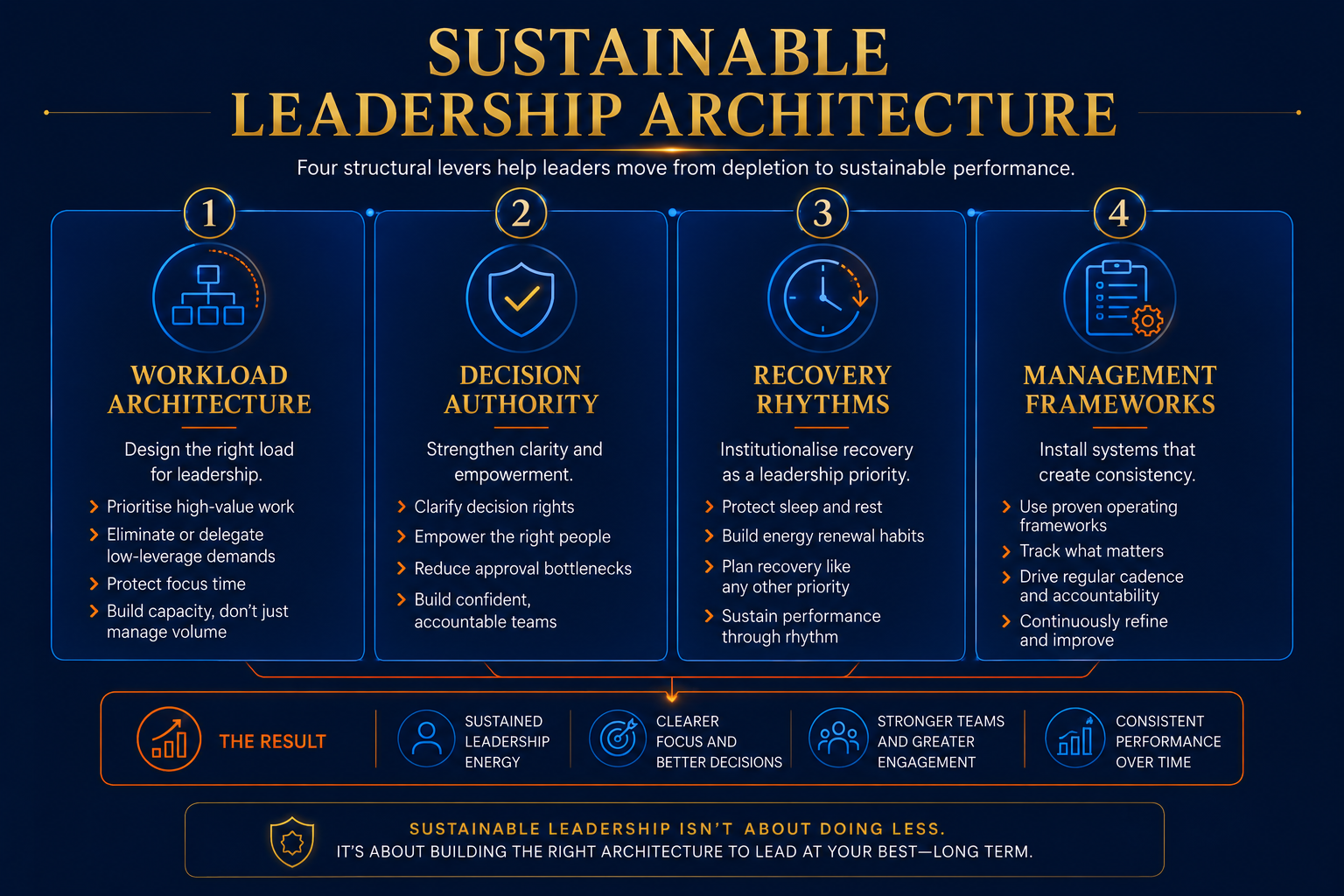
CIPD’s 2025 Health and Wellbeing at Work report found that 64% of organisations are taking steps to identify or reduce workplace stress, but only 50% believe their efforts are effective. A wellbeing initiative will not fix a broken workload architecture. Executives need structural moves:
Frequently Asked Questions
What are the first early signs of leadership burnout?
The first signs are often physical and cognitive: disrupted sleep, fatigue, headaches, difficulty concentrating, and slower decisions. Executives may also notice irritability, reduced patience, emotional detachment, or a growing sense that everything depends on them.
How do I know if I am stressed or burned out?
Stress usually improves after rest and has a clear endpoint. Burnout persists even after rest. If you feel exhausted, cynical, detached, and less effective for several weeks, the issue is likely deeper than normal pressure.
Can leadership burnout affect team performance?
Yes. Burned-out leaders often communicate less clearly, delay decisions, avoid difficult conversations, and become more reactive. Teams may respond with confusion, lower engagement, more conflict, and reduced initiative.
Why do executives hide burnout?
Many executives hide burnout because they believe visibility of strain will damage confidence in their leadership. Senior roles often reward control, endurance, and availability, which makes early admission feel risky.
What is the best first step if I notice burnout signs?
Start with a workload and decision audit. Identify what has expanded, what decisions are unnecessarily centralised, what meetings drain capacity, and where recovery has disappeared. Then redesign the system before relying on personal resilience.
Conclusion
The early signs of leadership burnout are not signs that an executive is weak. They are signals that the current leadership system is extracting more capacity than it restores.
Sleep disruption, decision fatigue, irritability, emotional detachment, reduced strategic thinking, micromanagement, and team drift all deserve attention before they become crisis points.
Burnout is a system failure. Leaders cannot outwork broken systems indefinitely. Better architecture beats more effort. Sustainable leadership means designing roles, rhythms, decisions, and boundaries that protect long-term effectiveness.
“As you look at your own situation today — are you leading from a place of clarity or a place of depletion?”
— Vincent Walters, Burn Bright Advisory
Free Resource
Take the Free Leadership Burnout Self-Assessment
Identify your current burnout risk level and find out which of the five root causes is most active in your leadership right now. Free. Instant results.