Quick Answer
How burnout affects decision making is simple but serious: it reduces cognitive capacity, increases decision fatigue, weakens judgement, slows processing speed, and increases the likelihood of poor choices. Burned-out leaders often become reactive rather than strategic, avoid difficult decisions, and rely on short-term fixes instead of long-term thinking. Burnout does not simply affect wellbeing — it directly affects leadership effectiveness.
Key Takeaways
- Burnout reduces judgement quality and strategic thinking.
- Decision fatigue causes leaders to avoid, delay, or rush decisions.
- Cognitive overload increases errors and reactive behaviour.
- Burnout impacts entire teams through poorer leadership choices.
- Sustainable leadership systems protect decision quality over time.
Introduction
How burnout affects decision making is one of the least discussed but most damaging consequences of leadership overload.
Most leaders recognise burnout when it shows up as exhaustion, stress, or emotional detachment. Fewer recognise what happens to their thinking.
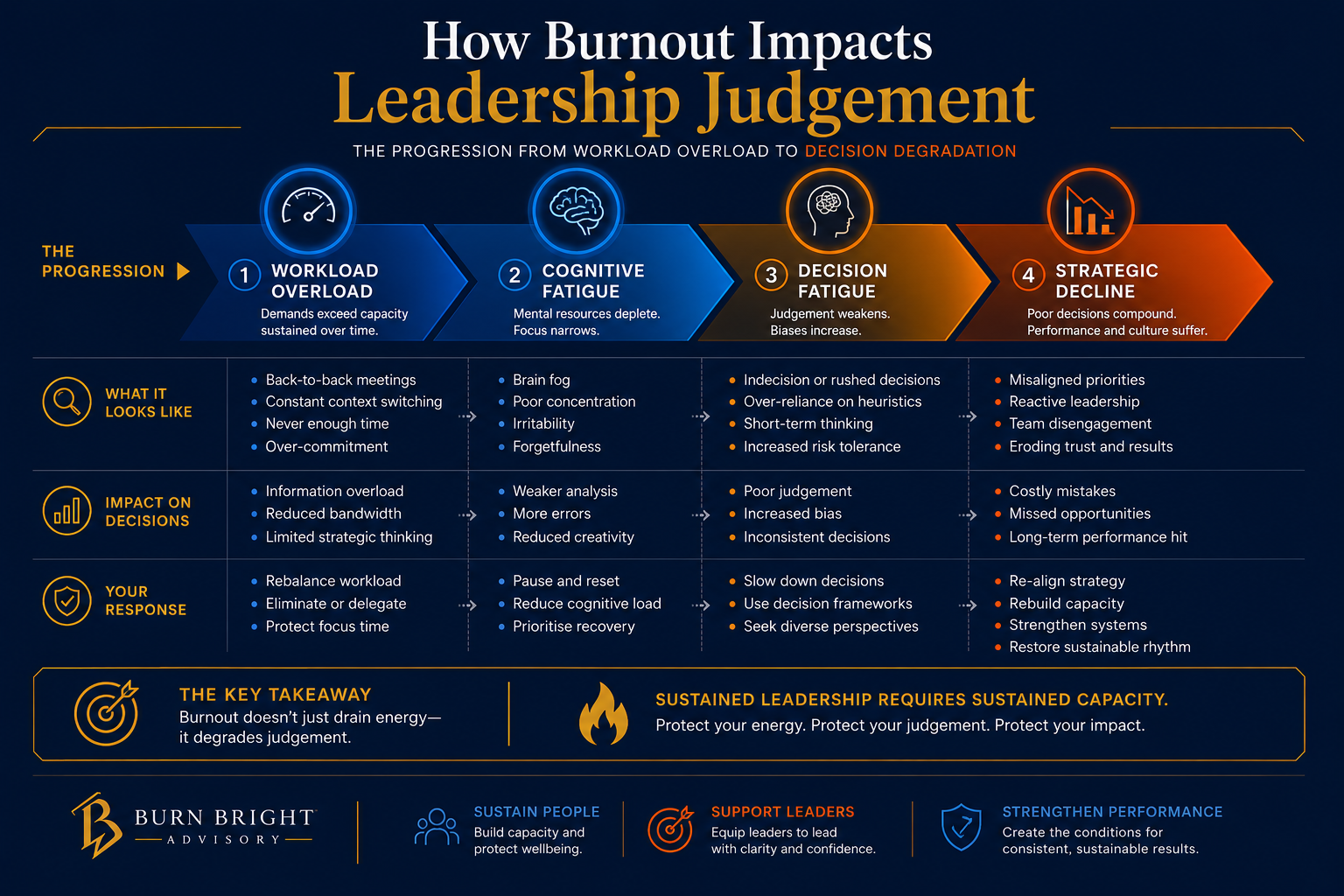
The reality is that burnout attacks the very capabilities leaders rely on most: judgement, prioritisation, problem-solving, emotional regulation, and strategic decision-making.
When leaders operate in a constant state of depletion, decision quality declines. Meetings take longer. Priorities become blurred. Small issues become crises. Strategic thinking disappears beneath operational firefighting.
This is why burnout should never be viewed as a personal resilience problem. It is often a structural problem created by workload architecture, decision overload, communication chaos, and role expansion.
Before we examine solutions, we need to understand what burnout does to the leadership brain.
Definition
How burnout affects decision making: Burnout reduces mental capacity, increases decision fatigue, weakens judgement, and makes leaders more likely to avoid, delay, or mishandle important decisions.
Why Does Burnout Damage Decision Quality?
Leadership is fundamentally a decision-making role. Every day leaders decide what matters most, where resources go, which risks to take, how to respond to challenges, and what gets prioritised.
Decision-making consumes cognitive energy. Research on decision fatigue shows that repeated decisions gradually reduce mental performance and self-control. As cognitive resources become depleted, judgement quality declines.
Burnout accelerates this process. Instead of making decisions from a position of clarity, leaders make them from a position of exhaustion.
This often leads to
The problem is not intelligence. The problem is cognitive capacity. Burnout reduces the availability of the mental resources leaders need to think effectively.
How Burnout Affects Decision Making During Daily Leadership
The effects often appear long before leaders recognise burnout.
Decision Avoidance
Important decisions are postponed. Leaders tell themselves they need more information when the real issue is mental exhaustion.
Reactive Decision-Making
Rather than setting priorities proactively, leaders spend their days responding to whatever appears most urgent.
Analysis Paralysis
Every option feels risky. Simple choices become unnecessarily complex.
Decision Reversal
Leaders constantly revisit decisions because confidence has deteriorated.
Cognitive Narrowing
Burnout reduces the ability to see the bigger picture. Leaders focus on immediate problems while missing systemic issues.
How Burnout Affects Decision Making at a Strategic Level
The most expensive consequences occur at the strategic level. Burned-out leaders often stop leading strategically and start managing tactically.
Instead of asking what system created this problem, what should we stop doing, or what capability should we build — they ask how do we survive this week, how do we get through today, and how do we handle the next crisis.
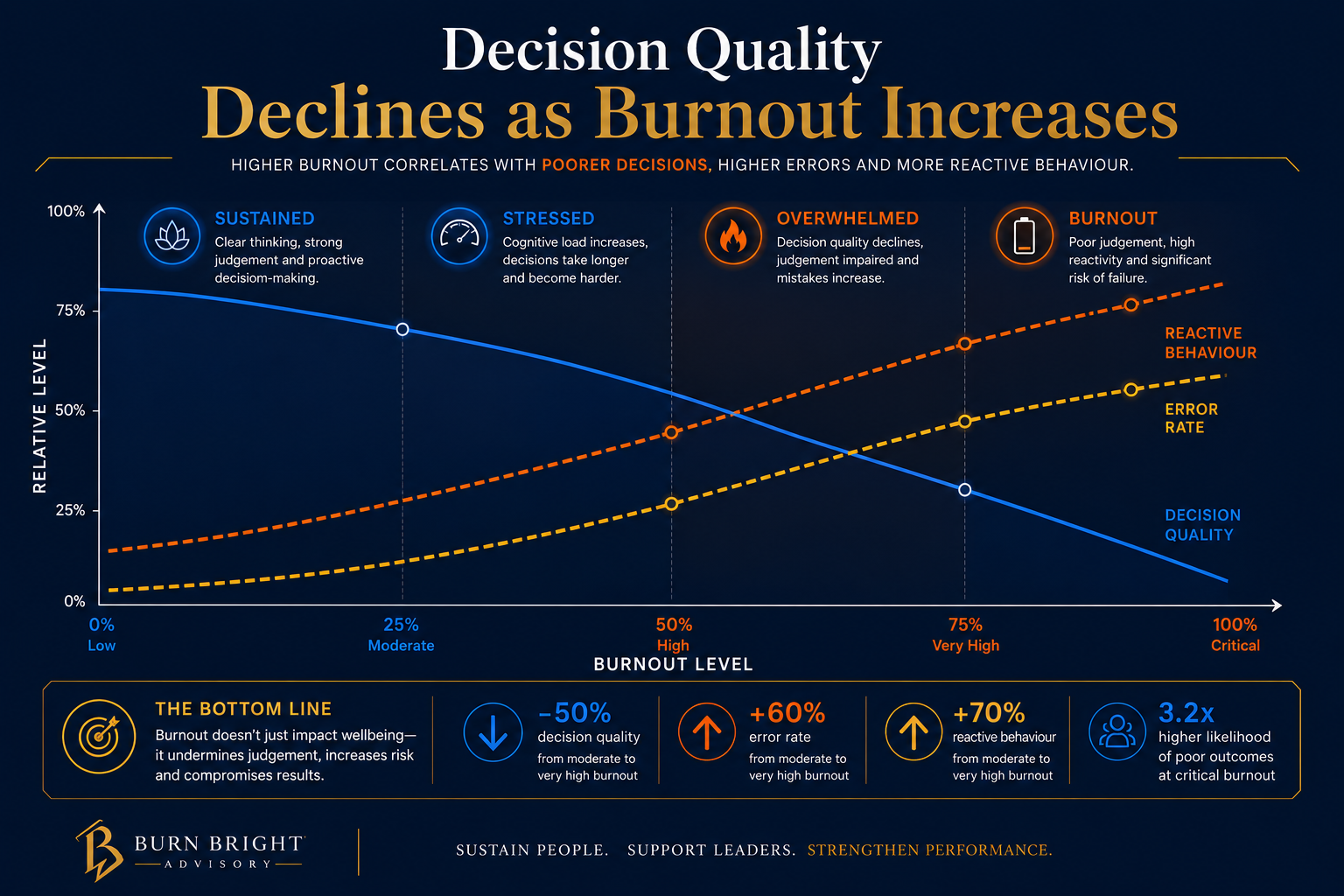
This shift creates a dangerous cycle. Poor decisions create additional problems. Additional problems increase workload. Increased workload accelerates burnout.
The result is structural leadership depletion. Burnout becomes self-reinforcing because the decisions needed to fix the system require the very cognitive capacity burnout has already eroded.
— Vincent Walters, Burn Bright Advisory
The Hidden Link Between Burnout and Decision Fatigue
Most leaders underestimate the number of decisions they make each day. Research suggests people make thousands of decisions daily, creating cumulative mental strain. Decision fatigue occurs when repeated decision-making reduces the quality of subsequent decisions.
Burnout magnifies this effect. Leaders already facing scope creep, meeting overload, communication chaos, decision overload, and perfectionism cultures — the five root causes identified in the Burn Bright Not Out framework — experience significantly greater cognitive depletion.
Signs of Decision Fatigue
Many leaders assume these are performance issues. Often they are structural symptoms.
| Traditional Leadership | Sustainable Leadership |
|---|---|
| Heroic decision-making | Distributed decision-making |
| Constant availability | Protected thinking time |
| Reactive workload | Structured workload architecture |
| Individual responsibility | Shared accountability |
| Short-term focus | Long-term effectiveness |
| More effort | Better systems |
How Leaders Can Protect Decision Quality
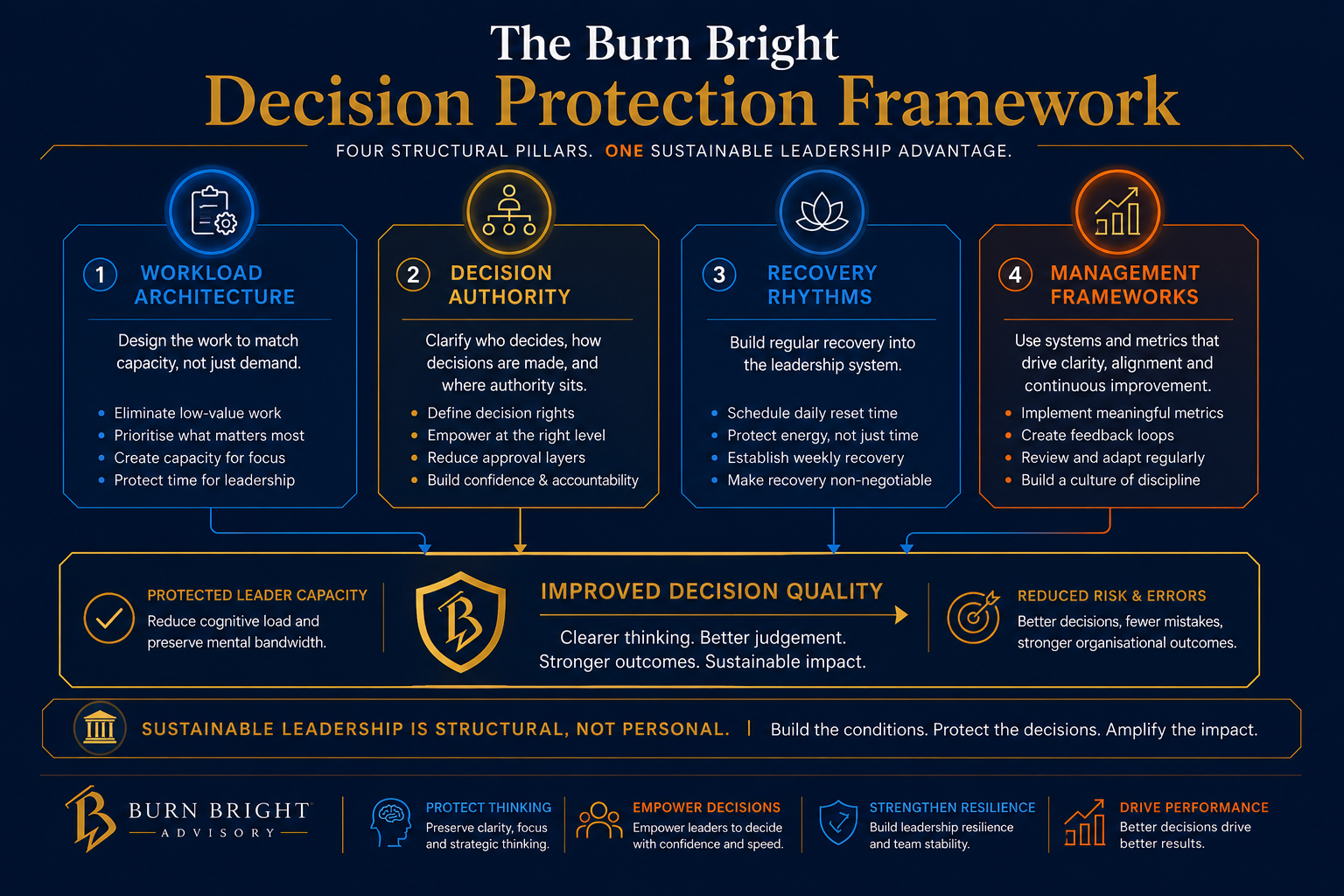
If burnout affects thinking, the solution is not simply resilience training. The solution is structural redesign.
Reduce Decision Volume
Not every decision requires leadership involvement. Use delegation frameworks such as RACI to move routine decisions closer to the work.
Protect Strategic Thinking Time
Create calendar blocks where interruptions are prohibited. Constant digital interruptions undermine autonomy and cognitive performance.
Simplify Communication Systems
Communication chaos is one of the fastest routes to cognitive overload. Reduce unnecessary channels, meetings, and approvals.
Create Recovery Rhythms
Recovery is not optional. Recovery is part of leadership architecture. Leaders who never disengage never fully restore cognitive capacity.
Fix Structural Causes
Burnout is rarely solved through motivation alone. It requires redesigning workload architecture, decision authority, and organisational systems.
What the Research Tells Us
27%
of managers reported being engaged at work in 2024 — Gallup
50%+
of managers report experiencing burnout symptoms — Gallup Workplace Research
Burnout and chronic fatigue contribute to poorer judgement, reduced self-control, and lower decision quality. Organisations experiencing leadership burnout often see declining engagement, productivity, and retention.
The evidence points in one direction. Leadership effectiveness depends on leadership sustainability.
Frequently Asked Questions
Does burnout affect decision making?
Yes. Burnout reduces cognitive capacity, increases decision fatigue, and makes leaders more likely to avoid, delay, or mishandle important decisions.
Can burnout make leaders indecisive?
Absolutely. Burnout often creates analysis paralysis, causing leaders to seek excessive information or postpone decisions unnecessarily.
Why do burned-out leaders become reactive?
Exhaustion reduces strategic thinking capacity. Leaders become focused on immediate problems rather than long-term outcomes.
Is decision fatigue the same as burnout?
No. Decision fatigue is one symptom of burnout. Burnout is a broader state of chronic emotional, cognitive, and physical exhaustion.
Can leadership burnout be prevented?
Yes. Sustainable workload design, clear decision authority, recovery rhythms, and structural redesign significantly reduce burnout risk.
Conclusion
Understanding how burnout affects decision making changes the conversation about leadership performance.
Poor decisions are not always caused by poor leaders. Often they are the predictable outcome of depleted leaders operating inside unsustainable systems.
When workload architecture, communication systems, meeting culture, and decision authority are poorly designed, leaders lose the cognitive capacity required for effective judgement. Burnout becomes a leadership risk, an organisational risk, and ultimately a performance risk.
Burnout is a system failure. Fix the system, not the person. The leaders who sustain high performance over time are not those who work harder. They are those who build structures that protect their ability to think clearly when it matters most.
“As you look at your own situation today — are you leading from a place of clarity or a place of depletion?”
— Vincent Walters, Burn Bright Advisory
Free Resource
Take the Free Leadership Burnout Self-Assessment
Assess your current level of leadership risk and find out which of the five root causes is most active in your leadership right now.