Quick Answer
How to detect hidden burnout starts with looking beyond workload and performance metrics. Hidden burnout often appears as decision fatigue, emotional detachment, declining creativity, reduced strategic thinking, increased irritability, and chronic exhaustion that leaders conceal behind continued productivity. The earlier organisations identify these signals, the easier it becomes to redesign workload, decision-making, and recovery systems before burnout becomes a crisis.
Key Takeaways
- Hidden burnout often exists long before performance visibly declines.
- Decision fatigue is one of the strongest early warning signs.
- Burnout is usually a system failure, not a personal failure.
- Teams often notice leadership fatigue before leaders recognise it themselves.
- Structural redesign is more effective than individual coping strategies.
Introduction
How to detect hidden burnout has become one of the most important leadership challenges facing organisations today.
Many leaders continue delivering results while quietly operating with depleted emotional, cognitive, and physical capacity. They attend meetings, meet deadlines, and maintain appearances. From the outside everything looks fine.
Inside, however, something is changing.
Strategic thinking becomes reactive. Decision-making slows. Patience disappears. Recovery never fully happens.
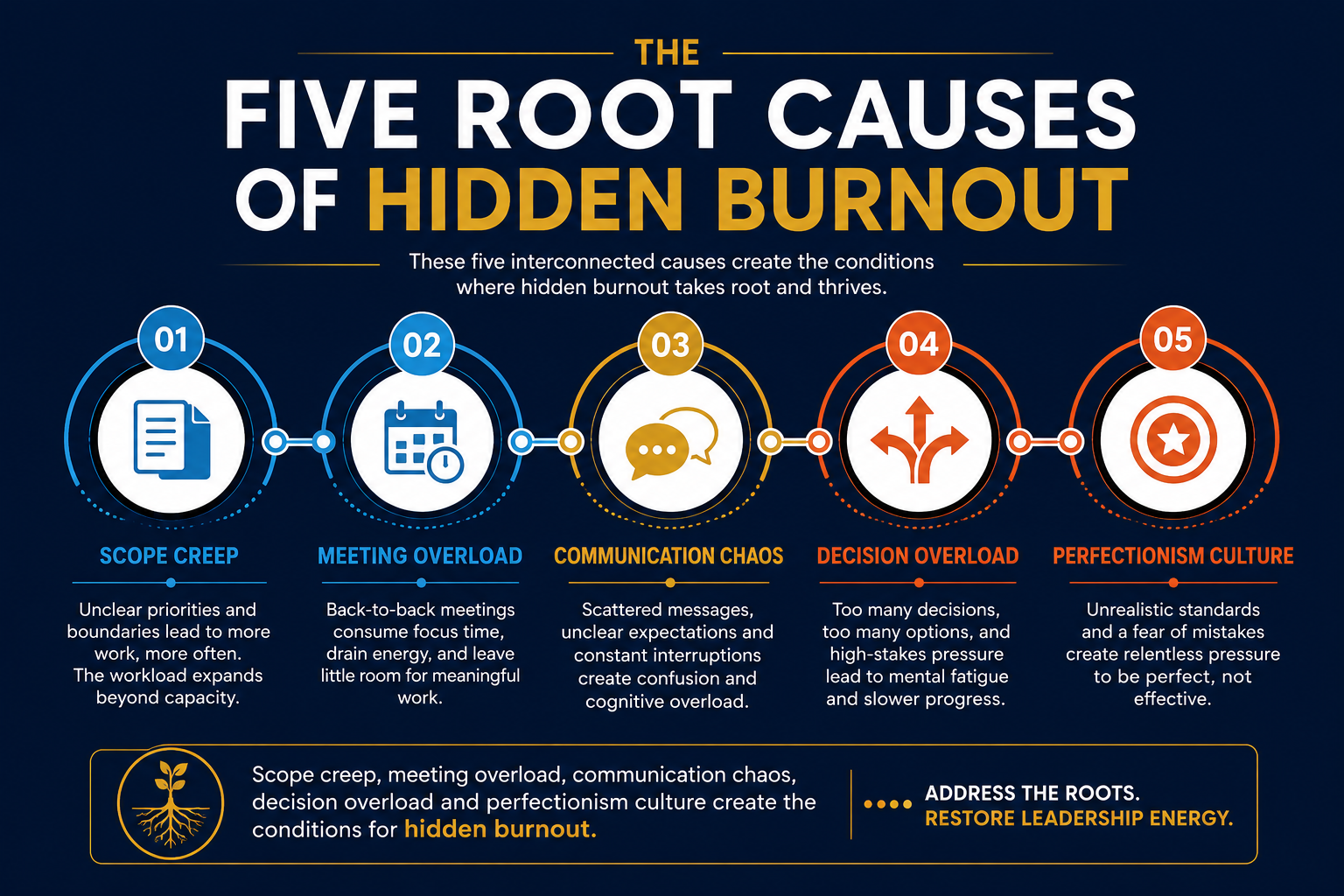
The danger is that hidden burnout rarely announces itself. It develops gradually through workload overload, communication chaos, decision fatigue, and expanding leadership responsibilities. These patterns align closely with the leadership burnout crisis described throughout the Burn Bright framework, where leaders are expected to manage increasing complexity without corresponding increases in support or resources.
This article explains how hidden burnout develops, the warning signs most leaders miss, how organisations can identify it early, and what sustainable leaders do differently.
Definition
Hidden burnout is a state of chronic emotional, cognitive, and physical exhaustion that remains largely invisible because the individual continues functioning and performing despite significant depletion.
Before exploring the warning signs, it helps to understand the structural drivers behind hidden burnout.
What Makes Hidden Burnout Different From Obvious Burnout?
Traditional burnout is easier to recognise. The leader becomes visibly exhausted. Performance drops. Absence increases. The warning signs are obvious.
Hidden burnout is different. The individual continues functioning. They still attend meetings. They still answer emails. They still deliver projects.
The problem is that performance becomes increasingly expensive. Every decision requires more energy. Every conversation feels harder. Every interruption creates disproportionate frustration.
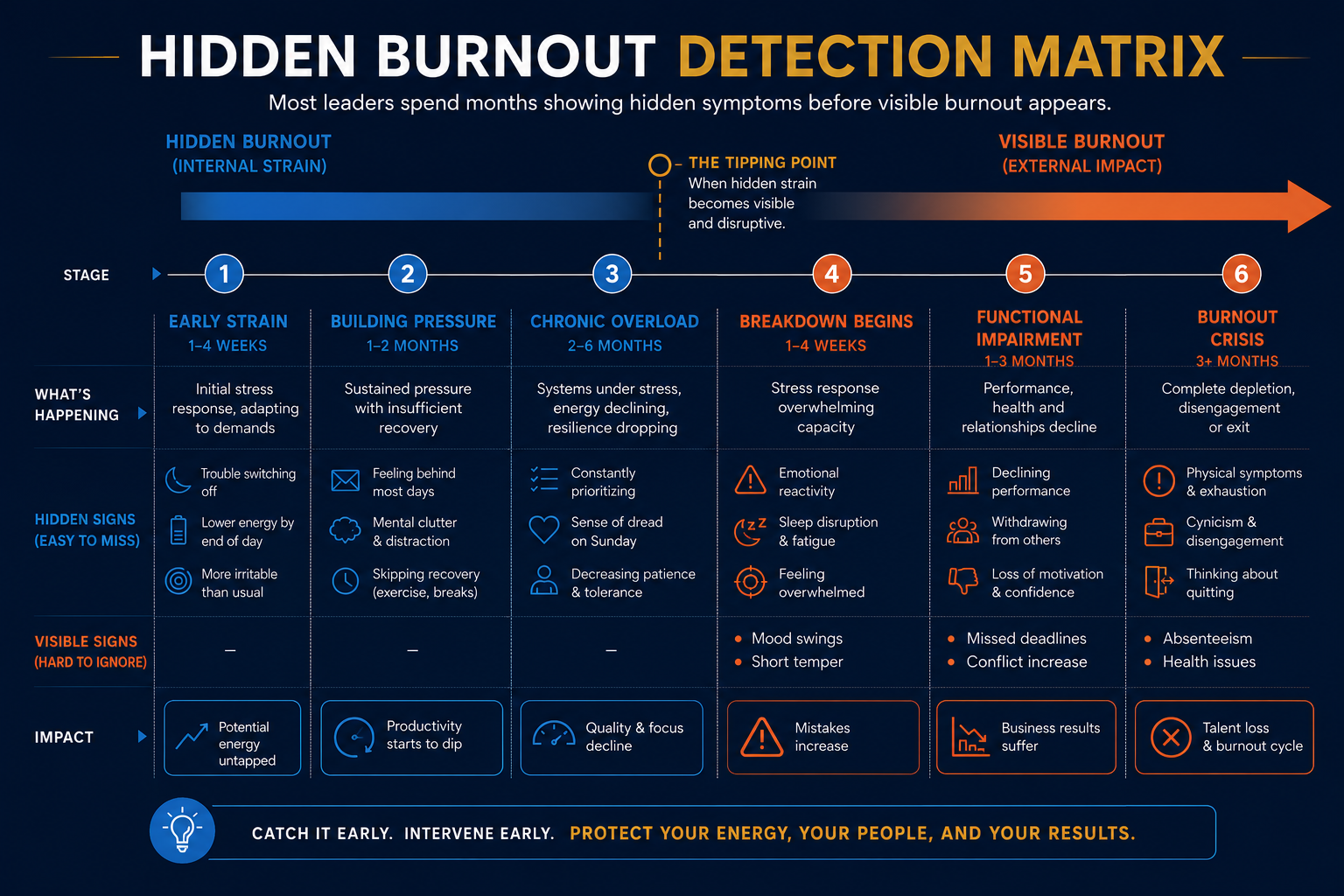
Burnout develops progressively rather than suddenly. Leaders often move through months of increasing effort before recognising that recovery is no longer happening.
A Dangerous Illusion
The hidden cost appears in reduced innovation, poorer judgement, declining engagement, and weakened leadership effectiveness long before visible collapse occurs.
Burnout is not the moment someone breaks. Burnout is the long period beforehand.
What Are the Earliest Signs of Hidden Burnout?
Most leaders expect burnout to feel like exhaustion. Often it starts elsewhere. The earliest indicators are usually cognitive.
Decision Fatigue
Simple decisions begin consuming disproportionate energy. Leaders delay choices they would previously make quickly. Routine decisions feel overwhelming.
Reduced Strategic Thinking
Attention narrows. Leaders become consumed by immediate problems. Long-term planning disappears.
Emotional Detachment
People become problems to manage rather than individuals to support. Empathy declines. Patience becomes harder to sustain.
Increased Irritability
Minor issues create major reactions. Questions feel intrusive. Interruptions feel intolerable.
Recovery Stops Working
Weekends no longer restore energy. Annual leave provides temporary relief but exhaustion quickly returns.
These warning signs frequently appear before productivity drops, making them especially important for leaders and organisations to monitor.
One of the clearest ways to identify hidden burnout is by tracking behavioural changes rather than workload alone.
Why Do High-Performing Leaders Hide Burnout?
High performers are often the most vulnerable. Not because they lack resilience. Because their competence masks risk.
Strong leaders frequently respond to increasing demands by working harder. They compensate. They absorb. They carry more. Eventually the system begins depending on that behaviour.
This creates what Burn Bright describes as a structural failure rather than an individual weakness. When organisations continually increase demands without redesigning support structures, burnout becomes inevitable.
Why Leaders Stay Silent
As a result, burnout remains hidden. The leader becomes increasingly depleted while continuing to present an image of competence. This is why burnout detection must never rely solely on self-reporting. Organisations must actively look for patterns.
How Does Hidden Burnout Affect Teams?
Leadership burnout rarely stays contained. It spreads. Research consistently shows that leader behaviour shapes team behaviour.
When leaders become exhausted:
The team may not know the leader is burned out. They simply experience the consequences. Projects slow down. Approvals take longer. Meetings become less productive. People feel uncertain about priorities.
These effects align with what Burn Bright calls the “culture tax” — the hidden organisational cost of turnover, disengagement, and burnout that accumulates when structural problems remain unresolved.
| Traditional Approach | Sustainable Approach |
|---|---|
| Wait for performance decline | Monitor early behavioural signals |
| Focus on individual resilience | Examine structural workload factors |
| Measure output only | Measure capacity and recovery |
| Treat symptoms | Address root causes |
| React after crisis | Prevent burnout proactively |
How Can Organisations Detect Hidden Burnout Systematically?
The best organisations do not wait for burnout cases. They monitor leadership sustainability. A practical framework includes four questions.
1. Is Workload Increasing Faster Than Capacity?
Hidden burnout often begins with workload architecture problems. Work expands faster than resources. Responsibilities accumulate without removal of existing responsibilities.
2. Is Decision Load Becoming Unsustainable?
Decision overload is one of the five major burnout drivers identified in the Burn Bright framework. Track decision volume, approval requirements, escalations, and complexity.
3. Are Recovery Rhythms Present?
Sustainable leaders recover deliberately. Without recovery, performance becomes extraction, not sustainability.
4. Are Communication Systems Creating Chaos?
Many leaders now manage fragmented communication streams across email, Teams, Slack, messaging apps, and meetings simultaneously — creating continuous shallow work that prevents recovery and deep thinking.
These structural indicators reveal hidden burnout earlier than wellbeing surveys alone.
What Should Leaders Do When They Identify Hidden Burnout?
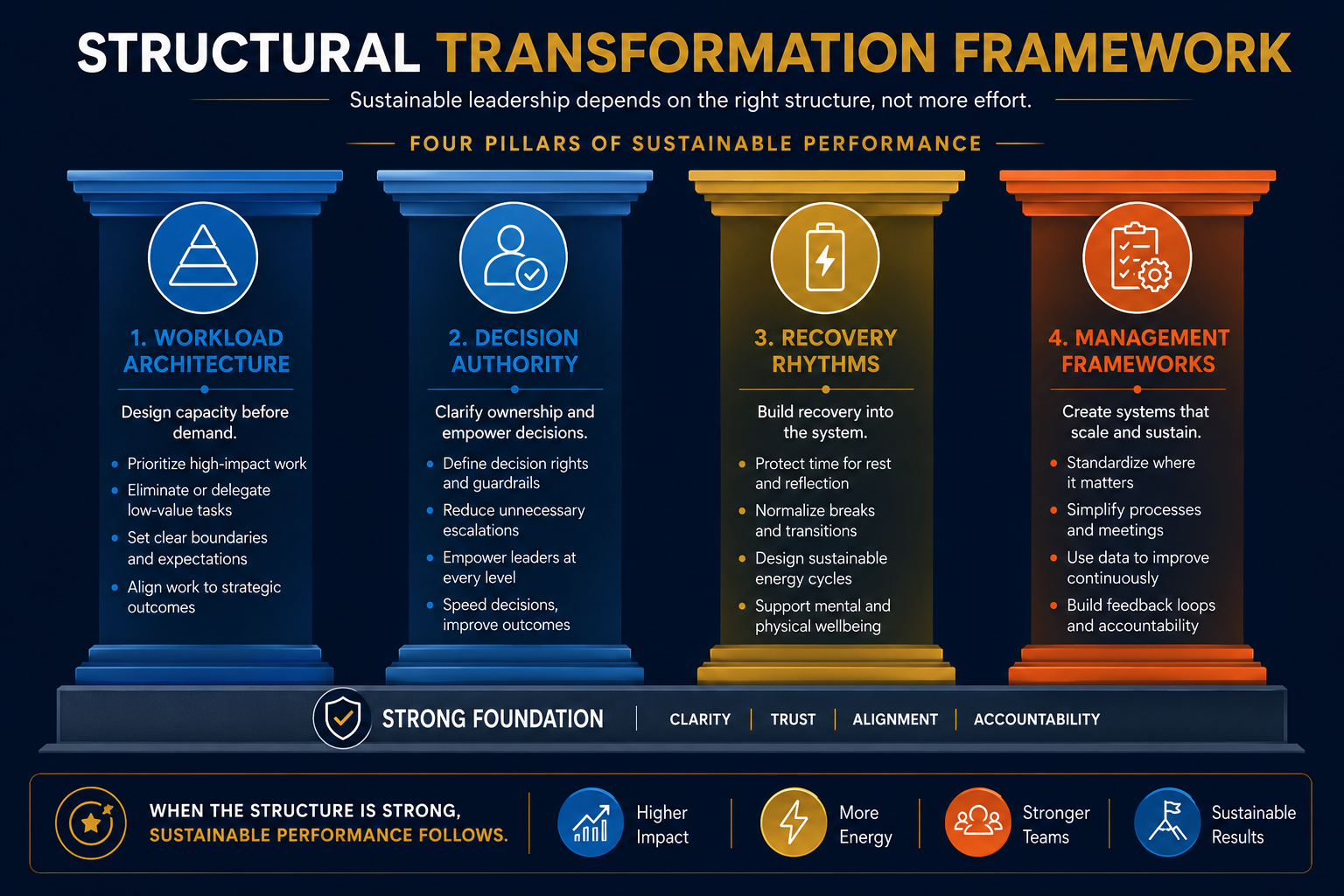
The wrong response is trying harder. The right response is redesigning the system. The Burn Bright framework identifies four structural transformation pillars:
Leaders should begin by identifying which pillar has broken down. For example: excessive workload requires workload redesign, constant approvals require delegated authority, chronic exhaustion requires protected recovery, and operational chaos requires management systems.
The goal is not better coping. The goal is better design. Because leaders cannot outwork broken systems.
Two-thirds of the way through any burnout cycle, intervention remains possible if structural changes happen quickly.
Frequently Asked Questions
How do you know if burnout is hidden?
Hidden burnout exists when a person continues performing while experiencing chronic exhaustion, decision fatigue, emotional detachment, and reduced recovery capacity. The symptoms are present even though outward performance may still appear strong.
What is the biggest early warning sign of hidden burnout?
Decision fatigue is often the earliest indicator. Leaders begin delaying decisions, avoiding choices, and feeling mentally exhausted by routine responsibilities.
Can high performers experience hidden burnout?
Yes. High performers frequently hide burnout longer because they compensate through increased effort. Their competence often delays recognition until symptoms become severe.
How is hidden burnout different from stress?
Stress is usually temporary and improves with recovery. Burnout is chronic and persists despite rest, holidays, or reduced short-term pressure.
Can organisations prevent hidden burnout?
Yes. Organisations that redesign workload architecture, reduce decision overload, create recovery rhythms, and improve management systems can significantly reduce burnout risk.
Conclusion
How to detect hidden burnout is ultimately about recognising depletion before collapse. The most dangerous burnout is not the burnout everyone can see. It is the burnout that remains hidden behind competence, commitment, and continued performance.
Leaders often believe they need more resilience. In reality, they frequently need better systems.
Burnout is a system failure, not a personal failure. When organisations learn to identify early warning signs, monitor workload architecture, reduce decision overload, and protect recovery, leadership becomes sustainable rather than extractive.
The question is no longer whether burnout exists. The question is whether you can detect it before it spreads.
Free Resource
Take the Free Leadership Burnout Self-Assessment
If you suspect hidden burnout may already be affecting your leadership effectiveness, complete the assessment and identify the structural drivers before they become a crisis.
Free Leadership Intelligence
Get Weekly Leadership Insights
Join thousands of leaders receiving practical strategies on burnout prevention, workload design, and sustainable performance every week.