Quick Answer
Burnout and emotional detachment occurs when prolonged stress causes leaders to disconnect emotionally from their work, colleagues, and purpose. It is one of the most damaging symptoms of leadership burnout because it reduces empathy, weakens decision-making, damages team trust, and creates a cycle of declining performance. The solution is not greater resilience. It is structural redesign of workload, decision-making, recovery, and organisational systems.
Key Takeaways
- Emotional detachment is a warning sign of advanced leadership burnout.
- Burnout is a system failure, not a personal failure.
- Leaders often mistake detachment for professionalism or resilience.
- Team engagement typically declines when emotionally detached leaders remain in role.
- Sustainable recovery requires structural changes, not motivational fixes.
Introduction
Burnout emotional detachment is one of the least recognised and most dangerous consequences of leadership burnout.
Most leaders expect exhaustion. They expect long hours, difficult decisions, and pressure. What they do not expect is waking up one day and feeling disconnected from the very work they once cared deeply about.
The problem is increasingly common. Across sectors, leaders report feeling emotionally numb, disengaged, and disconnected despite continuing to perform at a high level. They attend meetings. They make decisions. They manage teams. Yet internally something has changed.
This is not a motivation problem. It is often the result of prolonged overload, decision fatigue, communication chaos, and relentless pressure that gradually depletes emotional capacity. Burnout develops when leaders attempt to manage modern workloads using outdated organisational structures.
In this article, you’ll learn what emotional detachment is, why it happens, how it affects leadership performance, and what organisations can do to reverse it.
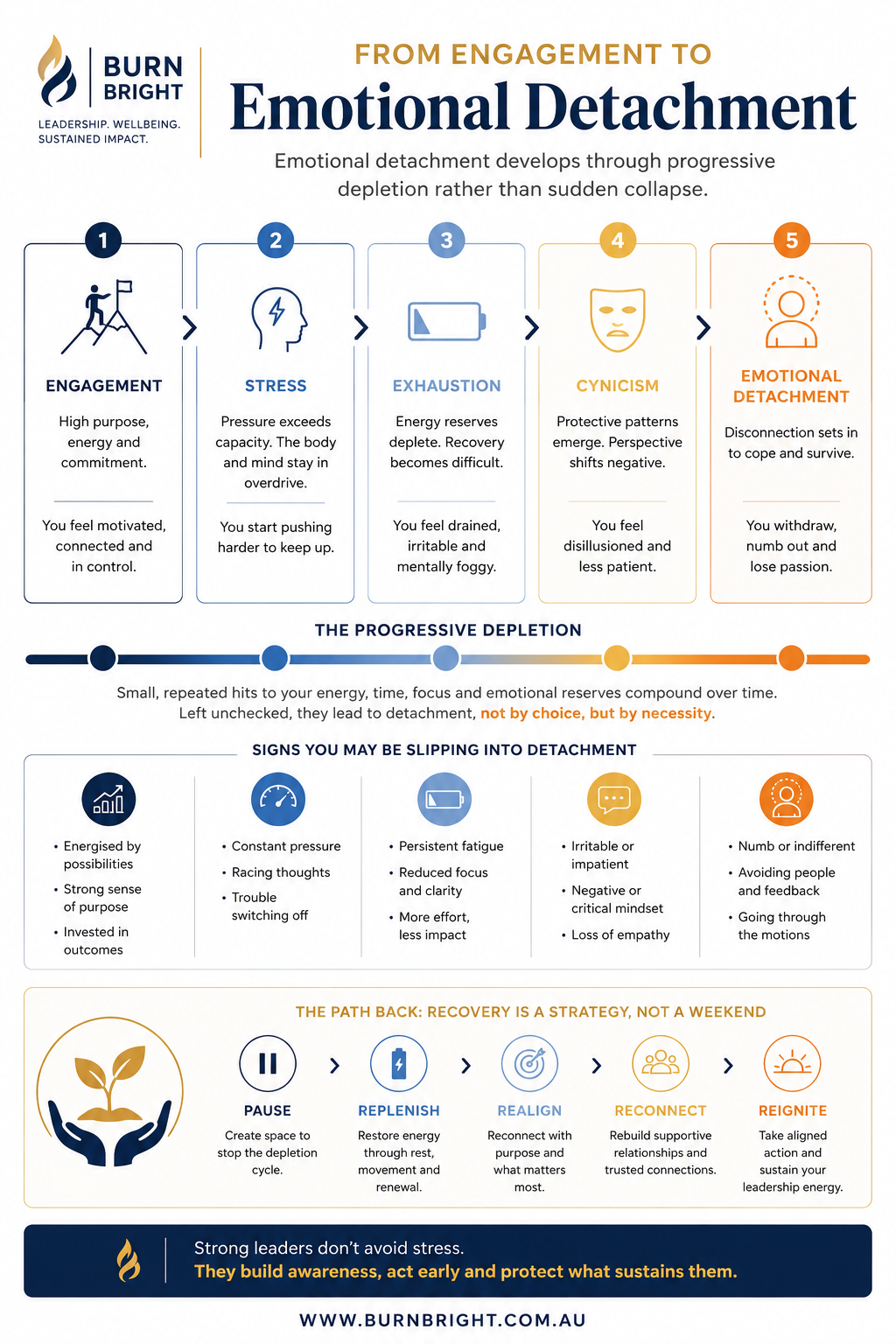
Leaders often experience emotional detachment gradually rather than suddenly.
Definition
Burnout emotional detachment is a psychological response to prolonged workplace stress where leaders become emotionally disconnected from their work, colleagues, and responsibilities as a protective coping mechanism against ongoing overload.
What Is Burnout Emotional Detachment?
Emotional detachment is often the third stage of burnout. Initially leaders experience stress. Then exhaustion. Eventually emotional withdrawal.
At this point many leaders stop feeling connected to outcomes. Tasks become transactional. Conversations become functional. Work becomes something to survive rather than something to lead.
Research consistently identifies emotional exhaustion and depersonalisation as key dimensions of burnout. Leaders begin viewing people as problems to solve rather than individuals to support.
Common Signs
This often creates confusion because externally the leader may still appear effective. Internally they are running on depletion.
When workload architecture breaks down, emotional withdrawal becomes a survival mechanism — not an individual weakness.
Why Do Leaders Become Emotionally Detached?
The answer is surprisingly simple. Human emotional capacity is not unlimited.
Modern leadership roles have expanded dramatically over the past decade. Leaders now manage more stakeholders, more communication channels, more meetings, more reporting requirements, and more decisions than ever before.
The Burn Bright framework identifies five primary drivers of burnout:
These factors gradually drain emotional resources until detachment becomes a protective response. A leader who spends eight hours in meetings, manages hundreds of emails, handles multiple crises, and remains available after hours cannot maintain unlimited emotional engagement.
Eventually the brain begins conserving energy. The result is emotional distance.
Not because the leader no longer cares. Because the system has demanded more than the individual can sustainably provide.
How Does Emotional Detachment Affect Leadership Performance?
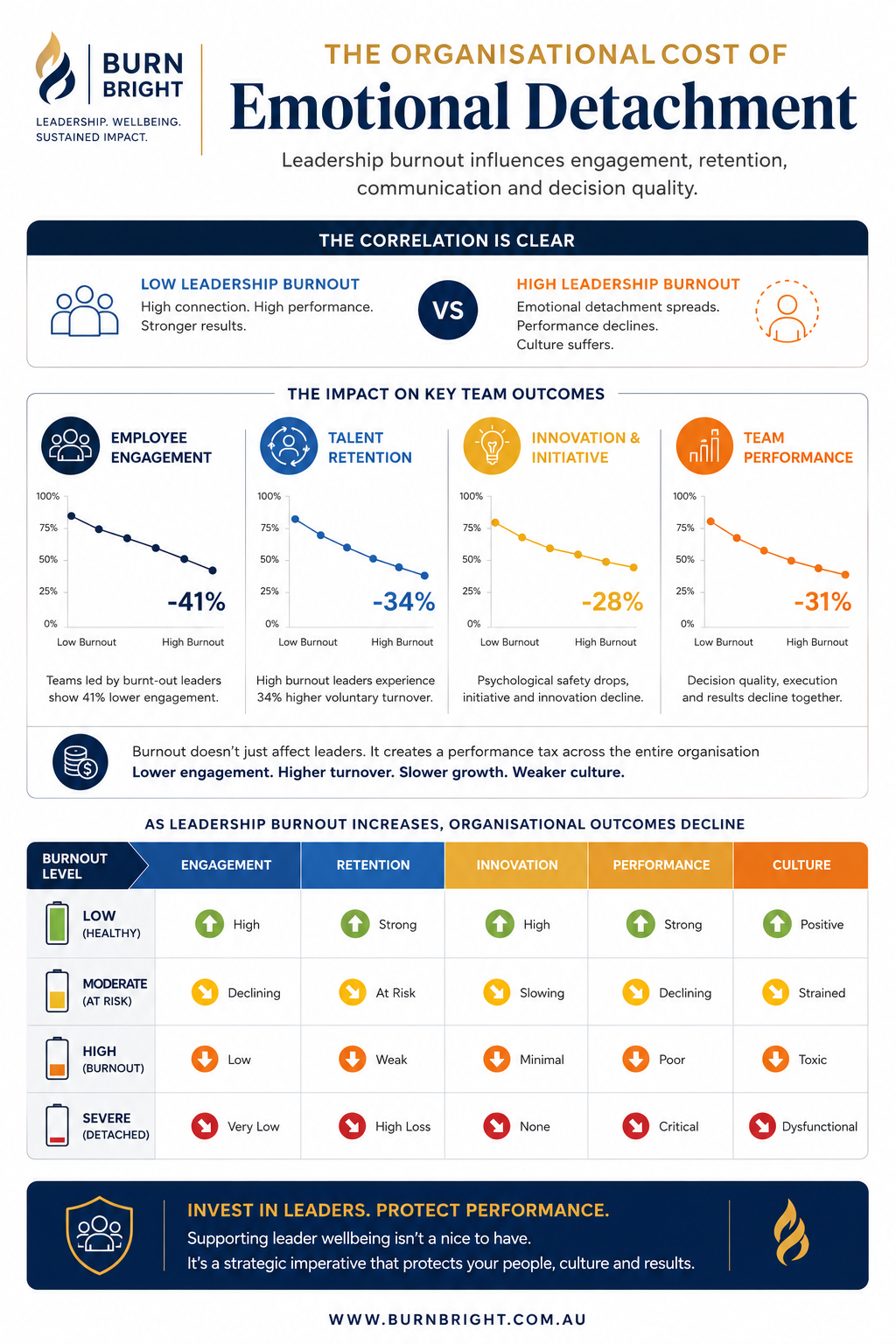
Many leaders believe emotional detachment protects performance. The evidence suggests the opposite.
Leadership effectiveness depends heavily on trust, communication, influence, judgement, and relationship quality. All of these decline when emotional engagement disappears.
Manager wellbeing directly influences team engagement and performance. Burned-out leaders create burned-out teams.
Common Performance Impacts
Reduced Decision Quality
Decision fatigue increases. Leaders become slower, more reactive, and more risk-averse.
Lower Team Trust
Employees quickly detect emotional withdrawal. Communication becomes less authentic. Engagement falls.
Loss of Strategic Thinking
Overloaded leaders focus on immediate problems rather than long-term priorities.
Increased Turnover
Teams often leave managers before they leave organisations. Replacement costs can exceed £75,000 for middle managers and over £500,000 for senior leaders.
Emotional detachment creates measurable organisational consequences.
Is Emotional Detachment a Personal Failure or a System Failure?
This is where most burnout conversations go wrong. Many organisations treat emotional detachment as a resilience issue. The leader is encouraged to take a course, improve time management, build resilience, or practise mindfulness.
While these interventions can help temporarily, they rarely address the underlying cause.
Burnout is a system failure, not a personal failure.
When leaders experience emotional detachment, organisations should ask whether workload is realistic, whether decision rights are clear, whether meeting culture is sustainable, whether communication expectations are reasonable, and whether recovery rhythms are protected.
Fixing the person without fixing the structure is like treating symptoms while ignoring the diagnosis.
| Traditional View | Sustainable Leadership View |
|---|---|
| Leader lacks resilience | System exceeds human capacity |
| Focus on individual coping | Focus on structural redesign |
| More productivity training | Better workload architecture |
| Manage stress better | Remove unnecessary stressors |
| Work harder | Work differently |
| Recovery is optional | Recovery is a leadership discipline |
What Does Recovery from Emotional Detachment Look Like?
Recovery is rarely immediate. The first step is recognising that emotional detachment is feedback. It signals a mismatch between workload demands and human capacity.
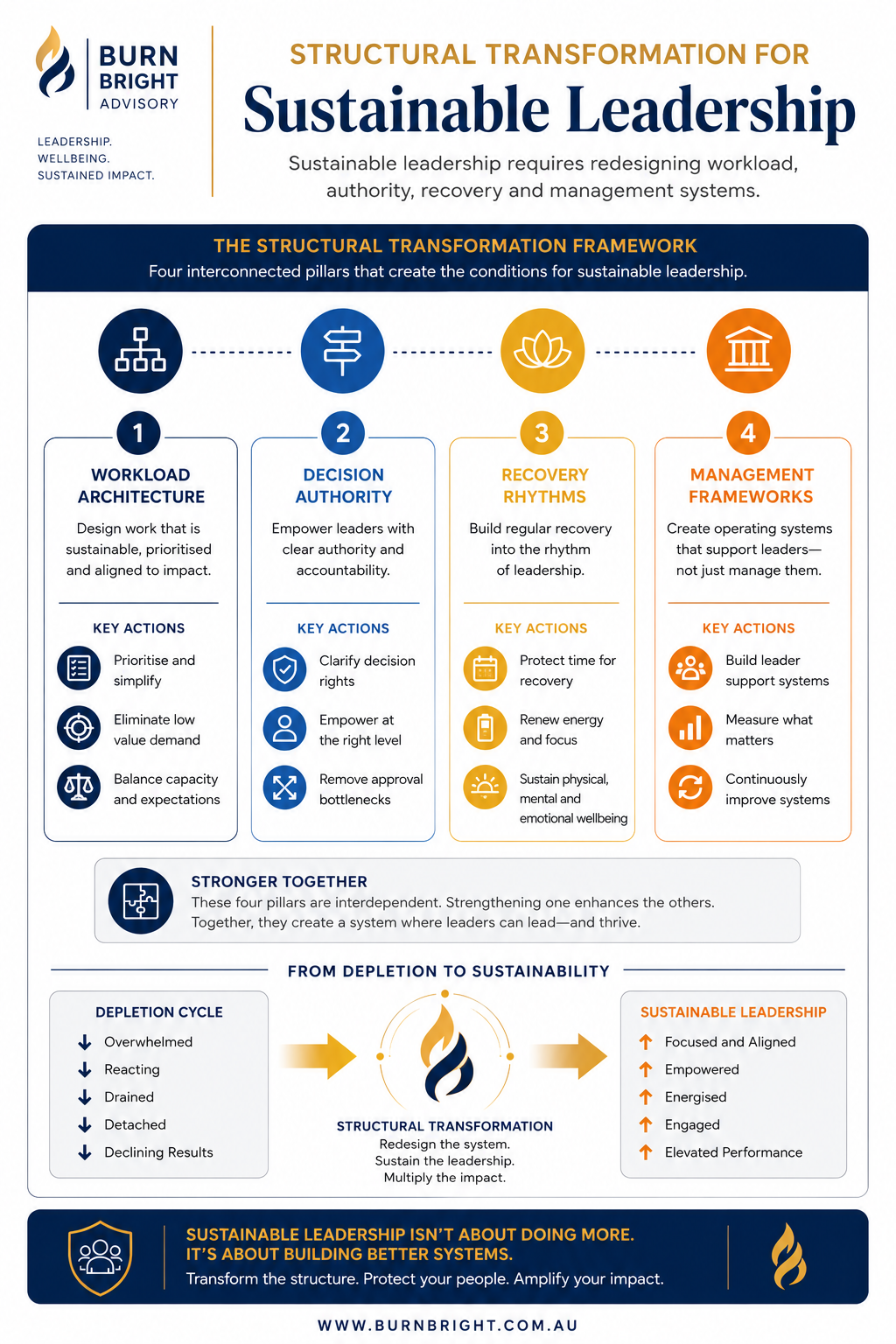
The Burn Bright Structural Transformation Framework focuses on four pillars:
1. Workload Architecture
Reduce unnecessary complexity. Clarify priorities. Eliminate low-value work.
2. Decision Authority
Reduce decision bottlenecks. Clarify ownership. Strengthen delegation.
3. Recovery Rhythms
Protect recovery as a business process. Not a reward.
4. Management Frameworks
Replace heroic leadership with sustainable systems.
Leaders often report emotional connection returning only after workload pressure decreases and recovery capacity improves. The goal is not simply feeling better. The goal is rebuilding sustainable effectiveness.
How Can Organisations Prevent Burnout Emotional Detachment?
Prevention requires organisational commitment. The strongest organisations recognise that sustainable leadership creates sustainable performance.
Audit Workload Regularly
Measure actual workload rather than assumed capacity.
Reduce Communication Noise
Limit unnecessary meetings. Create clear communication protocols.
Protect Strategic Time
Deep work cannot survive constant interruption.
Improve Delegation Systems
Use structured delegation frameworks rather than informal task dumping.
Normalise Recovery
Recovery should be built into leadership design rather than treated as weakness.
Organisations achieving sustainable performance focus on systems, not heroics.
Leaders recover when systems support sustainable performance.
Frequently Asked Questions
What is emotional detachment in burnout?
Emotional detachment occurs when prolonged stress causes leaders to disconnect emotionally from work, people, and outcomes. It is often a protective response to chronic overload.
Is emotional detachment a sign of severe burnout?
Yes. Emotional detachment typically appears after extended periods of stress and exhaustion and is often considered an advanced burnout indicator.
Can leaders recover from emotional detachment?
Yes. Recovery is possible when workload, decision pressure, recovery opportunities, and organisational systems are redesigned to support sustainable performance.
Why do high-performing leaders become emotionally detached?
High performers often absorb increasing responsibilities without corresponding resources. Over time this creates exhaustion and emotional withdrawal.
Does emotional detachment affect team performance?
Absolutely. Teams led by emotionally detached managers often experience lower trust, reduced engagement, weaker communication, and higher turnover.
Conclusion
Burnout emotional detachment is not laziness. It is not weakness. It is not a lack of commitment.
It is often the predictable outcome of prolonged overload operating inside systems that were never designed for sustainable leadership. The warning signs are clear: reduced empathy, emotional withdrawal, decision fatigue, cynicism, and loss of connection to purpose.
Leaders cannot outwork broken systems. Burnout is a system failure. When organisations address the root causes, emotional connection returns and leadership effectiveness improves.
The question is not whether leaders care enough. The question is whether the system allows them to continue caring without depletion.
Free Resource
Discover Your Burnout Risk
Take the free Leadership Burnout Self-Assessment and identify the structural factors contributing to burnout before they become a leadership crisis.
Free Leadership Intelligence
Get Weekly Leadership Insights
Join thousands of leaders receiving practical strategies on burnout prevention, workload design, and sustainable performance every week.