Quick Answer
Burnout and leadership confidence loss occurs when prolonged overload, decision fatigue, and cognitive depletion undermine a leader’s ability to trust their judgement. Most leaders assume they have a confidence problem. In reality, they often have a capacity problem. Confidence typically returns when workload architecture, decision systems, and recovery rhythms are redesigned to support sustainable performance.
Key Takeaways
- Burnout often destroys confidence before it destroys performance.
- Leadership confidence loss is usually a capacity issue rather than a competence issue.
- Decision fatigue reduces judgement quality and increases self-doubt.
- Sustainable leaders protect cognitive bandwidth as carefully as they protect time.
- Confidence is rebuilt through structural redesign, not motivational techniques.
Introduction
Burnout leadership confidence loss is one of the least discussed consequences of chronic overload.
Most leaders do not wake up one morning feeling incapable. Instead, confidence erodes slowly. Decisions become harder. Strategic thinking feels foggy. Conversations that once felt straightforward become emotionally draining. Leaders begin second-guessing themselves.
The common assumption is that confidence loss reflects weakness, poor resilience, or a lack of leadership capability. The evidence suggests otherwise.
Many highly capable leaders lose confidence because they have been operating beyond sustainable capacity for too long. The issue is not capability. The issue is overload.
Research consistently shows that burnout impairs cognitive performance, decision-making quality, emotional regulation, and strategic thinking. When those leadership capabilities deteriorate, confidence naturally follows.
This article explores why burnout damages confidence, how to recognise the warning signs, and what leaders can do to rebuild sustainable confidence through better system design.
To understand your current risk level, complete the Leadership Burnout Self-Assessment.
Before examining solutions, it is important to understand the hidden relationship between burnout and confidence.
Definition
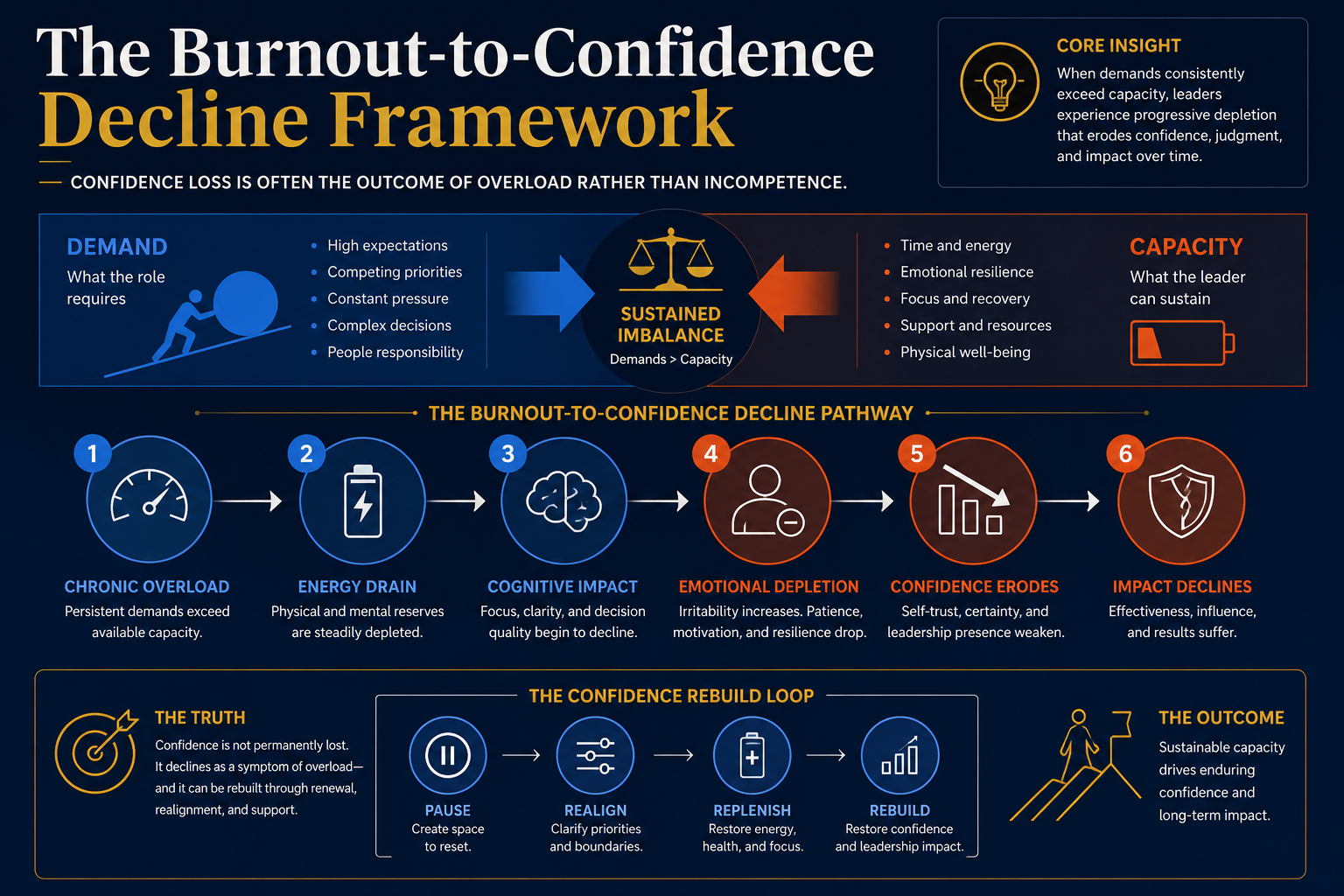
Burnout leadership confidence loss is the decline in a leader’s trust in their judgement, decisions, and abilities caused by sustained overload, cognitive fatigue, and emotional exhaustion rather than a lack of competence.
Why Does Burnout Destroy Leadership Confidence?
Confidence depends on evidence. Leaders build confidence through effective decisions, successful outcomes, and repeated demonstrations of competence.
Burnout interrupts this cycle. When leaders become overloaded, several changes occur simultaneously:
The result is predictable. Leaders begin making more mistakes. Not because they have become less capable. Because their operating system is overloaded.
Gallup research found that over half of managers report burnout symptoms. Burned-out leaders consistently demonstrate slower decision-making, reduced engagement, and lower team effectiveness.
The Burn Bright Not Out framework describes this as a demand-versus-capacity mismatch. When demand exceeds capacity long enough, system performance deteriorates. Confidence becomes collateral damage.
Burnout is not a confidence problem. It is a system failure.
What Are the Early Warning Signs of Confidence Loss?
Leadership confidence rarely disappears suddenly. It follows a predictable pattern.
Stage 1: Increased Hesitation
Leaders begin spending longer on routine decisions. Choices that once took minutes now take hours.
Stage 2: Growing Self-Doubt
Internal questions become more frequent: Am I making the right decision? Am I still capable of doing this role? Why does everyone else seem to cope better?
Stage 3: Avoidance Behaviour
Difficult conversations get postponed. Strategic decisions are delayed. Leaders become reactive instead of proactive.
Stage 4: Identity Erosion
The leader no longer trusts their judgement. This is often where confidence loss becomes visible to others.
The challenge is that many organisations misdiagnose this stage as a leadership capability issue when the root cause is usually chronic overload.
How Does Decision Fatigue Accelerate Confidence Loss?
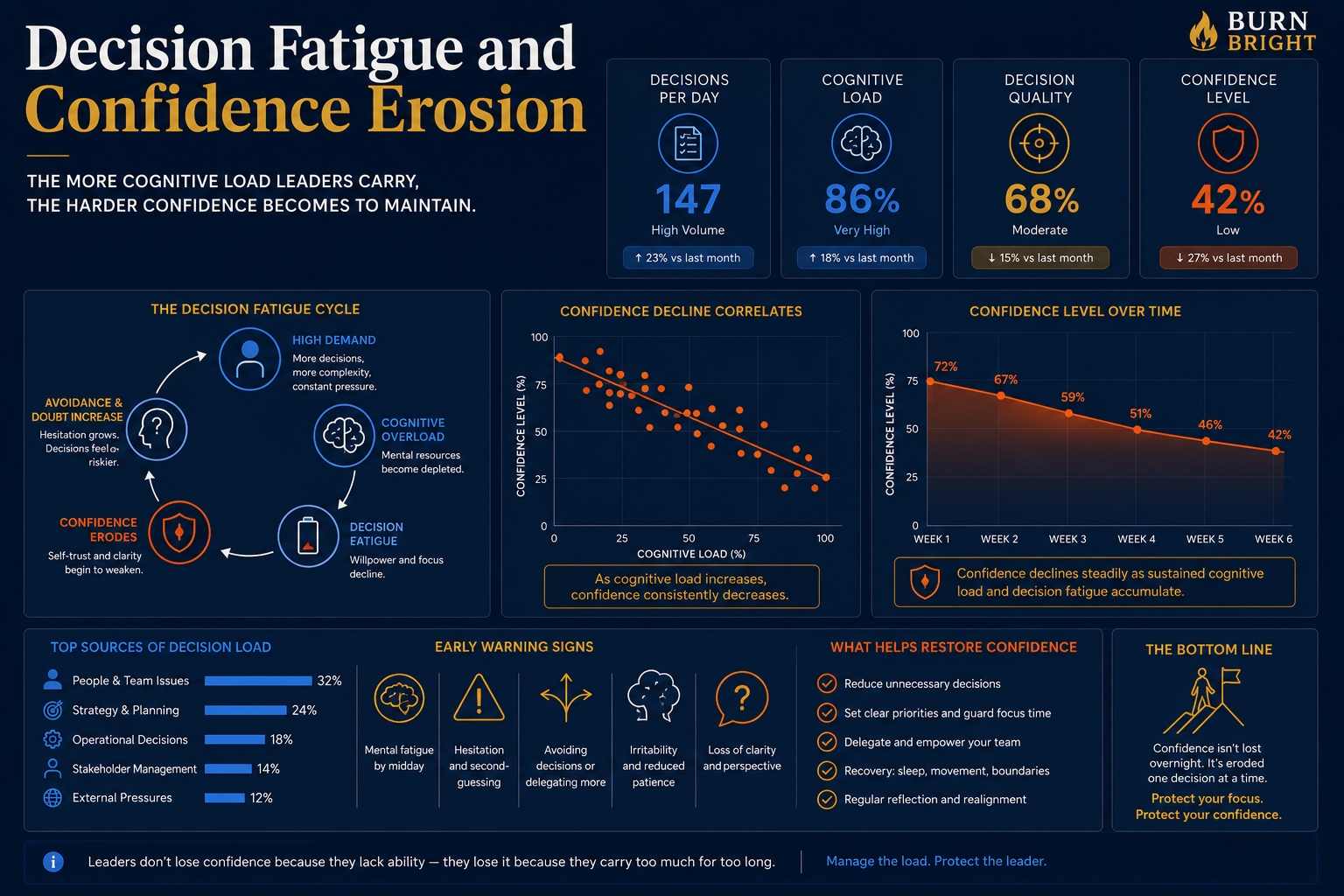
Decision fatigue is one of the strongest predictors of confidence decline.
Every day leaders make hundreds of decisions. Some are strategic. Many are operational. Others should never have reached the leader in the first place.
The Burn Bright Not Out framework identifies decision overload as one of the five root causes of burnout. As decision volume increases:
Mental energy decreases.
Judgement becomes inconsistent.
Leaders rely on shortcuts.
Confidence falls.
Research from multiple sectors shows that leaders experiencing burnout often become slower, more reactive, and less decisive.
This creates a dangerous feedback loop. Poor decisions reduce confidence. Reduced confidence increases hesitation. Hesitation increases workload. Workload creates more burnout. The cycle continues.
The solution is not becoming more resilient. The solution is redesigning decision architecture.
Why Confidence Training Often Fails
Many leadership development programmes attempt to solve confidence loss through mindset work. Positive thinking. Affirmations. Executive coaching focused solely on self-belief.
These approaches may provide temporary improvements. However, they rarely solve the root problem.
Imagine asking a leader operating at 180% capacity to simply become more confident. The workload remains unchanged. The meetings remain unchanged. The decision overload remains unchanged. The communication chaos remains unchanged. Nothing structural improves.
Burn Bright Advisory describes this as treating symptoms rather than systems. Fixing the person while ignoring the architecture rarely produces sustainable outcomes.
Confidence returns when leaders experience evidence that their systems work again. That requires structural change.
How Do Leaders Rebuild Confidence Sustainably?
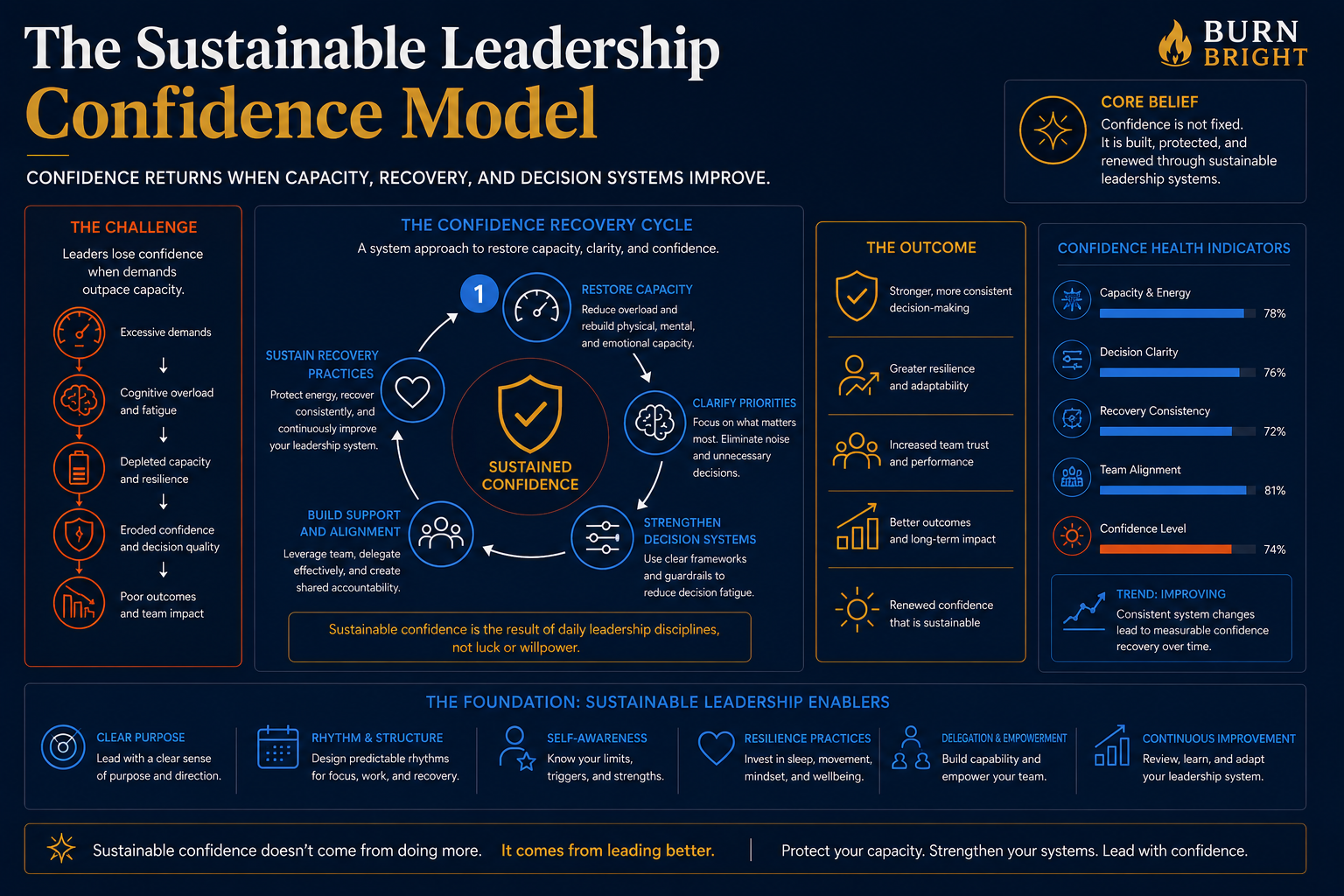
The Burn Bright Not Out Framework recommends four structural interventions.
1. Redesign Workload Architecture
Audit current responsibilities. Remove low-value commitments. Delegate operational work. Eliminate unnecessary complexity.
2. Clarify Decision Authority
Reduce decisions requiring senior approval. Push authority closer to the work. Remove decision bottlenecks.
3. Establish Recovery Rhythms
Protect strategic thinking time. Create recovery protocols. Prevent cognitive depletion from becoming chronic.
4. Implement Leadership Frameworks
Use repeatable systems. Reduce reliance on constant judgement calls. Build clarity into execution.
Confidence grows when leaders repeatedly experience successful execution within sustainable systems.
| Personal Failure Thinking | System Failure Thinking |
|---|---|
| I need more confidence | My system is overloaded |
| I need to work harder | Demand exceeds capacity |
| I need more resilience | I need better workload design |
| I need more motivation | I need better decision architecture |
| I need to push through | I need sustainable systems |
The difference matters. One approach blames the leader. The other fixes the conditions creating the problem.
Frequently Asked Questions
Can burnout cause loss of confidence?
Yes. Burnout affects decision-making, concentration, emotional regulation, and cognitive performance. As those capabilities decline, leaders often lose trust in their judgement.
Is confidence loss always burnout?
No. Confidence loss can result from many factors. However, persistent confidence decline combined with fatigue, overload, and decision difficulties often indicates burnout.
Why do successful leaders suddenly lose confidence?
Many successful leaders are promoted into roles where demand exceeds sustainable capacity. Confidence declines because overload impairs performance, not because capability disappears.
Can confidence return after burnout?
Yes. Most leaders regain confidence when workload, decision structures, and recovery systems are redesigned appropriately.
How long does it take to rebuild leadership confidence?
Recovery varies. Many leaders notice improvements within weeks after reducing overload and restoring cognitive capacity. Sustainable confidence rebuilding typically occurs over several months.
Conclusion
Burnout leadership confidence loss is rarely about confidence. It is usually about capacity.
When leaders spend months or years operating beyond sustainable limits, cognitive performance deteriorates. Decisions become harder. Strategic thinking narrows. Confidence fades.
The mistake is assuming the leader is broken. The real problem is usually structural.
Burnout is a system failure, not a personal failure. The solution is not motivational. It is architectural.
Leaders who redesign workload, decision authority, recovery rhythms, and operating systems often discover something surprising. Their confidence was never lost. It was buried beneath overload.
As you look at your own situation today — are you leading from a place of clarity or a place of depletion?
— Vincent Walters
Free Resource
Take the Free Leadership Burnout Self-Assessment
If you’re questioning your confidence, start by understanding your burnout risk.
Free Leadership Intelligence
Get Weekly Leadership Insights
Join thousands of leaders receiving practical strategies on burnout prevention, workload design, and sustainable performance every week.