Quick Answer
Why burnout keeps returning is surprisingly simple. Most people recover from exhaustion without fixing the conditions that caused it. A holiday, reduced workload or wellbeing programme may restore energy temporarily, but unless workload, decision-making, communication and organisational expectations change, burnout becomes a repeating cycle rather than a one-time event. Sustainable recovery requires structural redesign, not temporary relief.
Key Takeaways
- Burnout returns because the system that created it usually remains unchanged.
- Recovery without structural change only treats symptoms.
- Leadership burnout is driven by workload architecture rather than resilience.
- Sustainable organisations redesign work instead of expecting people to cope harder.
- Lasting recovery requires leaders to fix systems, not themselves.
Introduction
Why burnout keeps returning has become one of the biggest leadership questions of the past decade. Many leaders recover, return to work full of good intentions, and within months find themselves exhausted again.
That pattern is not a failure of motivation. It is a failure of design.
Across organisations, leaders are encouraged to take annual leave, attend wellbeing workshops or practise mindfulness. These approaches may reduce stress temporarily, but they rarely change the structural conditions that created burnout in the first place.
Research consistently shows that burnout develops when workload, control, support and organisational expectations become misaligned. Recovery that ignores these conditions simply resets the clock.
At Burn Bright Advisory, we describe burnout as a system failure rather than a personal failure. The goal is not to build people who can tolerate unhealthy workloads. The goal is to build organisations that no longer depend on unhealthy workloads.
This article explains why burnout keeps returning, why traditional recovery often fails and how leaders can build systems that prevent burnout from coming back.
Understanding the Burnout Cycle
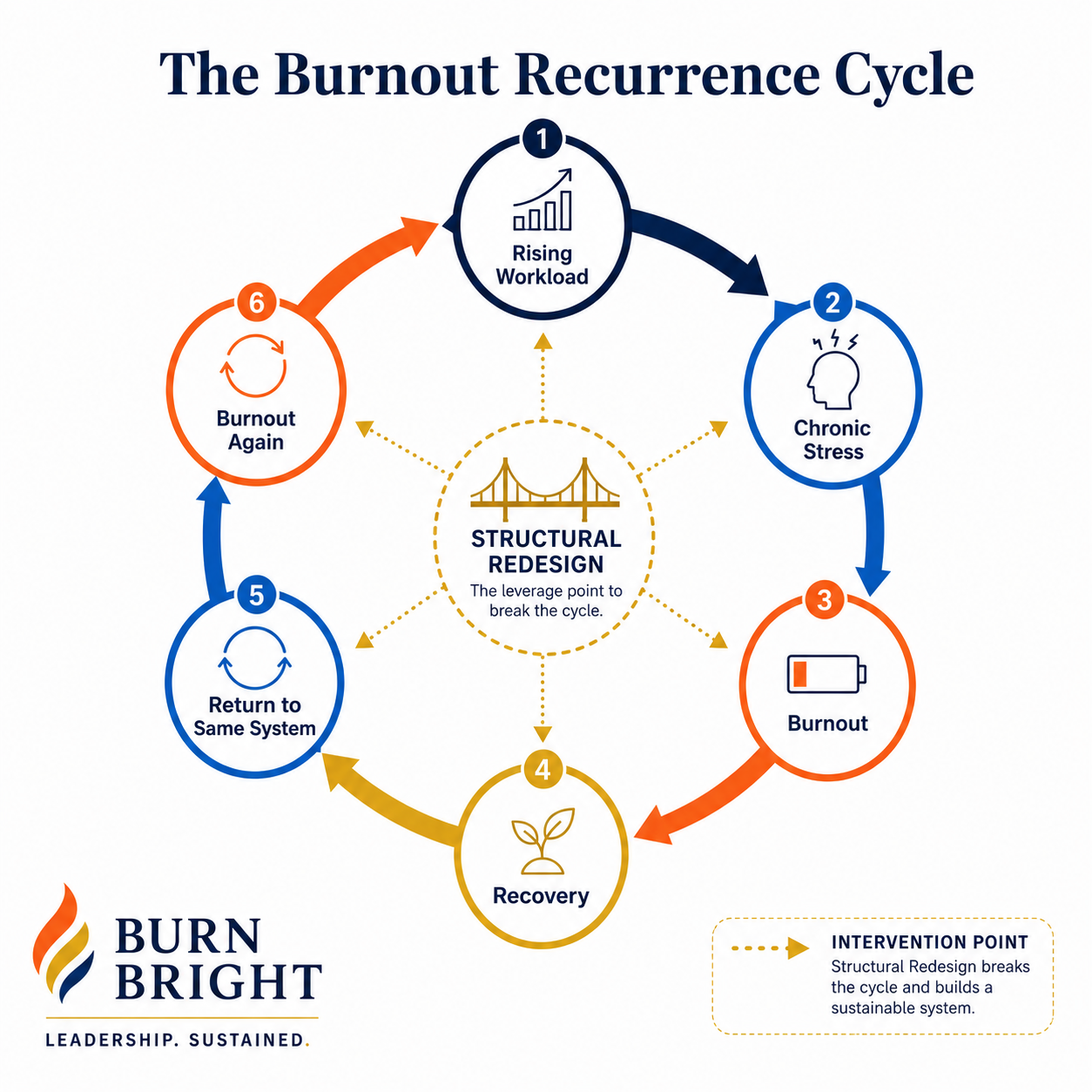
The first step towards permanent recovery is understanding that burnout is rarely a single event. It is usually a repeating organisational pattern.
Definition
Why burnout keeps returning is the result of recovering from exhaustion without changing the workload, systems, expectations and organisational structures that caused burnout in the first place. Sustainable recovery requires structural redesign rather than temporary stress relief.
Why Does Burnout Keep Returning?
Most burnout recovery plans concentrate on symptoms. People are encouraged to sleep more. Take annual leave. Exercise. Meditate. Improve work-life balance.
All of these help. None of them remove the cause.
Imagine placing a bucket underneath a leaking roof. The bucket solves today’s problem but the roof still leaks. Burnout works exactly the same way.
Research from the World Health Organization defines burnout as an occupational phenomenon resulting from chronic workplace stress that has not been successfully managed. That definition deliberately focuses on the workplace rather than the individual.
Gallup research similarly found that workload, lack of role clarity, unfair treatment, poor communication and unreasonable time pressure are major drivers of burnout — not personality traits.
When organisations fail to address these structural causes, leaders recover only enough to begin carrying the same unsustainable workload again. Eventually the exhaustion returns. The cycle becomes predictable.
Why Holidays Don’t Solve Burnout
One of the most common misconceptions is that burnout simply requires rest.
Rest is essential. It is not sufficient.
Consider what happens after a two-week holiday. During the break:
Then work resumes. The overflowing inbox remains. The unnecessary meetings return. Decision overload starts immediately. Communication chaos resumes. Scope creep continues.
Within weeks many leaders are operating exactly as they were before taking leave.
The holiday wasn’t ineffective. It simply never addressed the underlying architecture of work. This explains why so many executives return from annual leave feeling refreshed for only a short period before exhaustion rapidly returns.
Burn Bright describes this as symptom recovery without structural recovery.
Burnout Isn’t About Working Hard
Hard work rarely creates burnout on its own. Poorly designed work does.
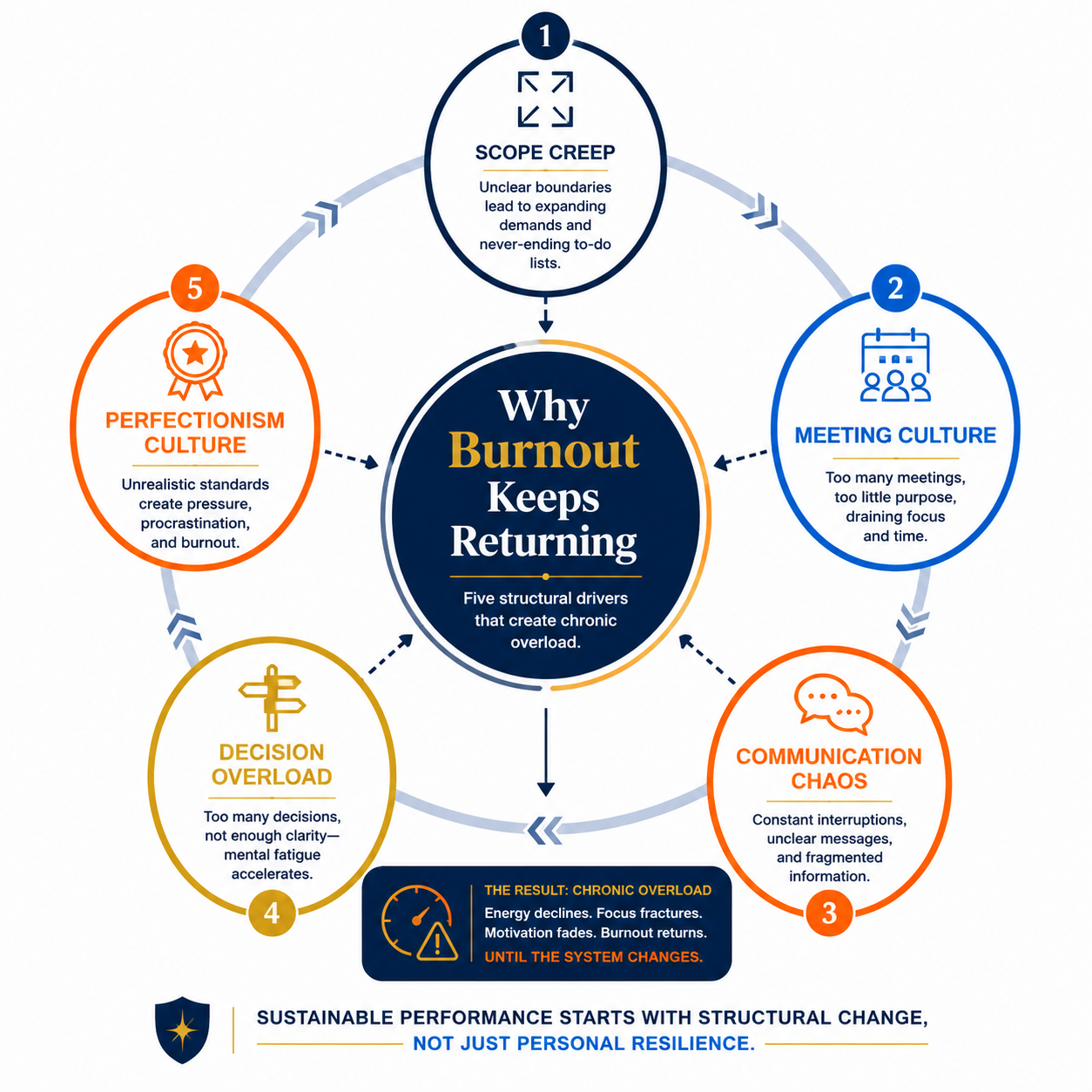
The Burn Bright framework identifies five recurring structural drivers of burnout:
These five forces quietly expand every leadership role until the workload exceeds sustainable capacity. Once that threshold is crossed, even highly capable leaders begin showing signs of burnout.
Why Resilience Alone Cannot Stop Burnout
Many organisations invest heavily in resilience training. Resilience is valuable. But resilience should never become a substitute for organisational redesign.
If a bridge continually collapses, engineers strengthen the bridge. They do not simply train drivers to tolerate the collapse.
Leadership should be treated the same way.
Leaders cannot outwork broken systems. They cannot out-resilience impossible workloads. They cannot meditate away structural overload.
Lasting recovery begins when organisations redesign work rather than expecting people to continually recover from unhealthy work. That shift — from individual responsibility to structural responsibility — is where sustainable leadership begins.
Why Does Structural Recovery Prevent Burnout?
The difference between temporary recovery and sustainable recovery lies in one word: structure.
Most organisations ask people to become more efficient. Burn Bright asks organisations to become better designed. That distinction changes everything.
Structural recovery means redesigning how work enters the organisation, how decisions are made, how meetings are managed and how leaders recover before exhaustion develops. Rather than treating burnout as an individual weakness, it treats burnout as feedback that the operating system has exceeded human capacity.
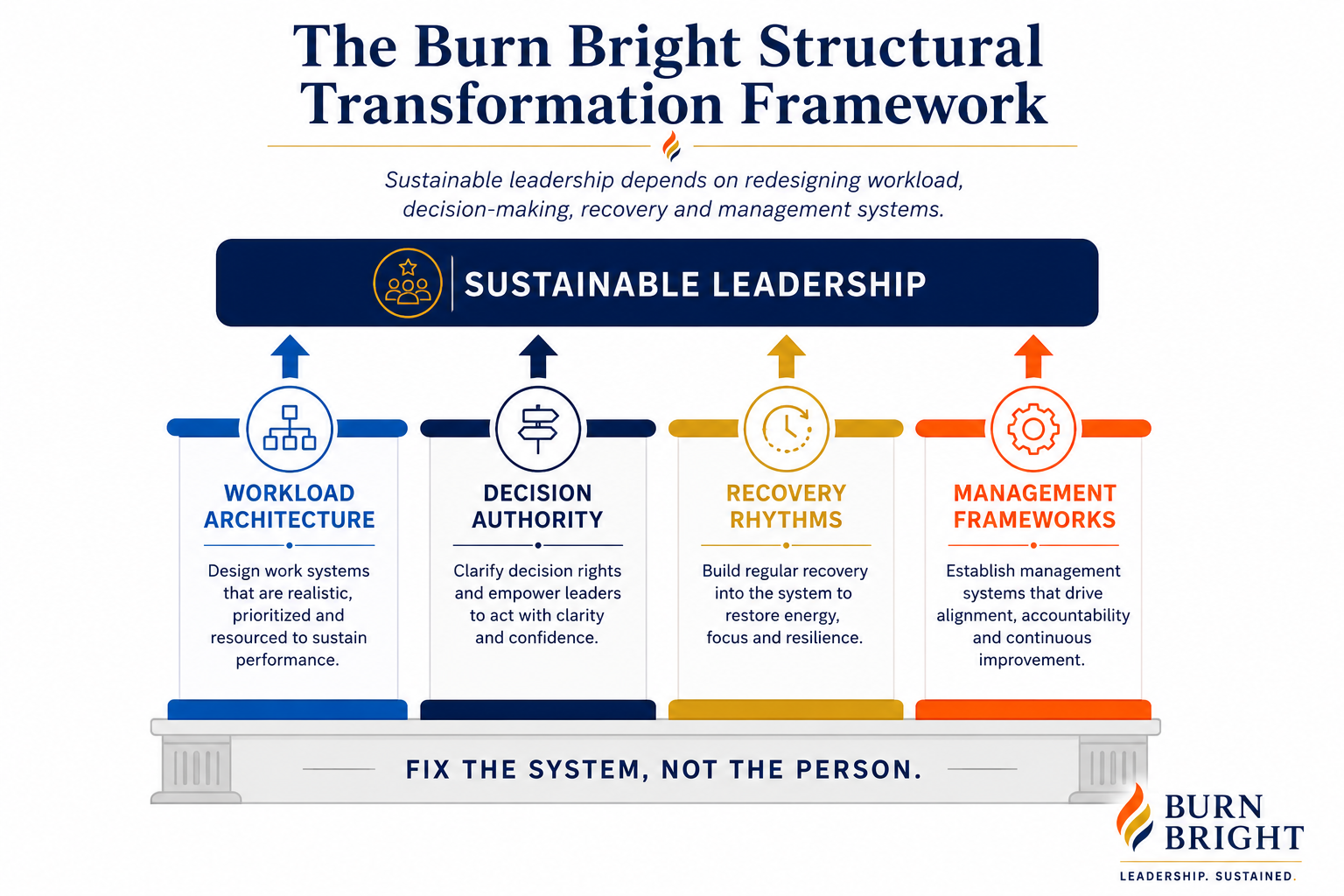
The Burn Bright Framework identifies four structural pillars that create sustainable leadership:
1. Workload Architecture
Every task competes for finite capacity. Instead of continually adding responsibilities, leaders should redesign how work flows through teams. This includes workload triage, removing duplicated processes, reducing unnecessary reporting and clarifying ownership.
The question changes from “Can people do more?” to “Should this work exist at all?”
2. Decision Authority
Decision overload quietly drains cognitive capacity. Many leaders become the default decision-maker because nobody has clearly defined decision ownership. Using frameworks such as RACI and decision matrices reduces interruptions while increasing accountability throughout the organisation.
3. Recovery Rhythms
Recovery should never depend on annual leave alone. Sustainable organisations deliberately build recovery into the working week through protected thinking time, meeting-free blocks, realistic workloads and genuine permission to disconnect. Recovery becomes part of work — not something leaders try to squeeze in afterwards.
4. Management Frameworks
Frameworks reduce decision fatigue. Clear operating systems remove unnecessary complexity by standardising routine decisions, communication expectations and delegation processes. Consistency reduces cognitive load. Clarity replaces chaos.
These four structural pillars form the foundation of sustainable leadership because they remove unnecessary pressure before burnout develops.
Traditional Recovery vs Structural Recovery
| Traditional Recovery | Structural Recovery |
|---|---|
| Treats symptoms | Treats root causes |
| Focuses on resilience | Focuses on redesign |
| Encourages coping | Reduces overload |
| Relies on holidays | Builds continuous recovery |
| Individual responsibility | Shared organisational responsibility |
| Burnout often returns | Sustainable performance improves |
The difference is profound. Traditional recovery asks leaders to return stronger. Structural recovery ensures they never need to recover to the same extent again.
What Should Leaders Do Differently?
If burnout keeps returning, the answer is rarely another wellbeing initiative.
Instead, leaders should begin with diagnosis. Ask:
These questions reveal structural friction. Removing friction creates capacity. Capacity creates sustainability. Sustainability creates better leadership.
The objective is not simply reducing workload. It is improving organisational design.
This reflects the Burn Bright philosophy: Fix the system, not the person.
Frequently Asked Questions
Why does burnout keep returning after a holiday?
Because holidays restore energy but rarely change workload, communication patterns or organisational expectations. Returning to the same environment often recreates exactly the same conditions that caused burnout.
Can resilience stop burnout from returning?
Resilience helps leaders cope with pressure, but it cannot compensate for permanently excessive workloads or poorly designed systems. Sustainable leadership combines personal capability with structural change.
Is burnout always caused by working too many hours?
No. Burnout is often driven by fragmented work, decision overload, unclear priorities, constant interruptions and lack of control rather than simply the number of hours worked.
How long does burnout recovery take?
Recovery varies considerably. Mild burnout may improve over several weeks, while severe burnout can require many months. Long-term recovery depends on changing the conditions that caused burnout rather than simply resting.
What is the biggest mistake organisations make?
Treating burnout as an individual wellbeing issue rather than an organisational design problem. Without changing systems, burnout frequently returns.
Conclusion
Understanding why burnout keeps returning changes how leaders approach recovery.
Burnout is rarely caused by a lack of resilience. It is usually the predictable outcome of systems that demand more than people can sustainably deliver.
When organisations respond only with wellbeing initiatives, they relieve symptoms without removing the causes. When they redesign workload, decision-making, communication and recovery, burnout becomes far less likely to return.
The most sustainable leaders do not simply become better at coping. They build environments where constant coping is no longer required.
That is the difference between temporary recovery and lasting organisational performance.
Burnout is a system failure. Fix the system, and sustainable leadership becomes possible.
Ready to Break the Burnout Cycle?
Take the Free Leadership Burnout Self-Assessment
Identify the structural causes of burnout in your leadership role and discover where workload, decision-making and organisational design are creating unnecessary pressure — and where to focus first.
Free Leadership Intelligence
Get Weekly Leadership Insights
Join thousands of leaders receiving practical strategies on burnout prevention, workload design, and sustainable performance every week.