Quick Answer
Key Takeaways
- Burnout in school leaders is primarily driven by structural workload, not personal capability.
- Expanding responsibilities have outpaced available time, resources and support.
- Early intervention prevents declining school performance, staff turnover and poor decision-making.
- Sustainable leadership requires redesigned systems rather than individual heroics.
- Better organisational architecture produces healthier leaders and stronger schools.
Burnout in School Leaders
Burnout school leaders has become one of the defining leadership challenges facing education.
Across schools worldwide, headteachers, principals and senior leaders are being asked to lead larger teams, manage increasing accountability, navigate safeguarding concerns, oversee wellbeing initiatives, respond to parents, analyse growing volumes of performance data and implement continuous policy change—all while maintaining high educational standards.
The problem is not that today’s school leaders are less capable.
The problem is that leadership roles have changed dramatically while the systems supporting those roles have remained largely unchanged.
This mismatch creates a leadership environment where exhaustion becomes normalised and overload becomes expected. Research consistently shows that leadership burnout contributes to higher turnover, poorer decision-making and declining organisational performance. When school leaders burn out, the consequences extend far beyond the individual leader and affect teachers, pupils, parents and the wider community.
Throughout Burn Bright Not Out, Vincent Walters argues that leaders cannot outwork broken systems. Instead of asking leaders to become endlessly resilient, organisations must redesign the structures creating unsustainable workloads. This article explores why burnout in school leaders continues to rise and how sustainable leadership offers a better path forward.
Framework Overview
Understanding burnout begins by looking beyond individual behaviour and examining the systems surrounding leadership.
Featured Snippet
Why Is Burnout Increasing Among School Leaders?
Many discussions about burnout begin with resilience.
They should begin with workload.
School leadership has changed beyond recognition over the past decade. Responsibilities that once focused primarily on teaching, learning and staff development have expanded into safeguarding, compliance, technology implementation, financial management, wellbeing strategies, crisis response, community engagement and increasingly complex accountability frameworks.
Every additional responsibility may be reasonable in isolation.
Together they become structurally unsustainable.
This phenomenon is described throughout Burn Bright Not Out as scope creep—the gradual expansion of leadership responsibility without corresponding increases in capacity or resources. Scope creep represents one of the five root causes of burnout identified within the Burn Bright framework alongside meeting culture, communication chaos, decision overload and perfectionism culture.
The result is predictable. School leaders find themselves working longer hours without becoming more effective.
Instead of leading strategically, they spend increasing amounts of time responding to operational demands, urgent emails, safeguarding incidents, staffing shortages and administrative compliance. Many report feeling permanently reactive.
Research supports this experience. Gallup has consistently found managers experience significantly higher levels of burnout than non-managers, while educational leadership studies continue to identify principal retention as a growing challenge across multiple countries.
The cost extends well beyond individual wellbeing. Leadership fatigue reduces strategic thinking, slows decision-making, weakens communication and makes innovation increasingly difficult. Eventually schools become trapped in a cycle where exhausted leaders create exhausted organisations.
Burnout therefore becomes contagious.
Not because stress spreads.
Because organisational systems reproduce the same unsustainable conditions across every level of leadership.
How Has the School Leadership Role Changed?
Few professions have experienced role expansion as rapidly as educational leadership.
Today’s school leaders are expected to be instructional experts, financial managers, safeguarding specialists, HR professionals, mental health advocates, facilities managers, technology leaders, community representatives and strategic planners simultaneously.
Each role demands specialist knowledge.
Yet one individual is expected to coordinate them all.
The opening chapters of Burn Bright Not Out describe this as the modern manager’s dilemma: leadership roles have expanded horizontally across new responsibilities while simultaneously expanding vertically into greater accountability.
Consider a typical school day. A headteacher may begin with staffing issues before responding to safeguarding concerns, meeting parents, reviewing attendance data, approving budgets, supporting distressed staff, dealing with unexpected operational problems, attending trust meetings and preparing reports for governors.
Very little of this work appears on the calendar.
It simply arrives.
Meanwhile strategic leadership—the activity that genuinely improves schools—is repeatedly interrupted by operational firefighting.
Technology has amplified this challenge rather than solving it. Email, messaging platforms and digital reporting systems have increased communication volume while fragmenting attention. Instead of creating efficiency, many schools have created permanent accessibility.
The consequence is continuous partial attention. Leaders remain connected all day without finding uninterrupted time for strategic thinking.
Research discussed throughout the Burn Bright materials highlights that organisations are attempting to manage modern workloads using outdated support structures. Complexity has increased dramatically, yet leadership capacity has remained largely static.
This explains why many highly capable school leaders still experience burnout.
The issue is not competence.
It is architecture.
Better systems outperform greater effort.
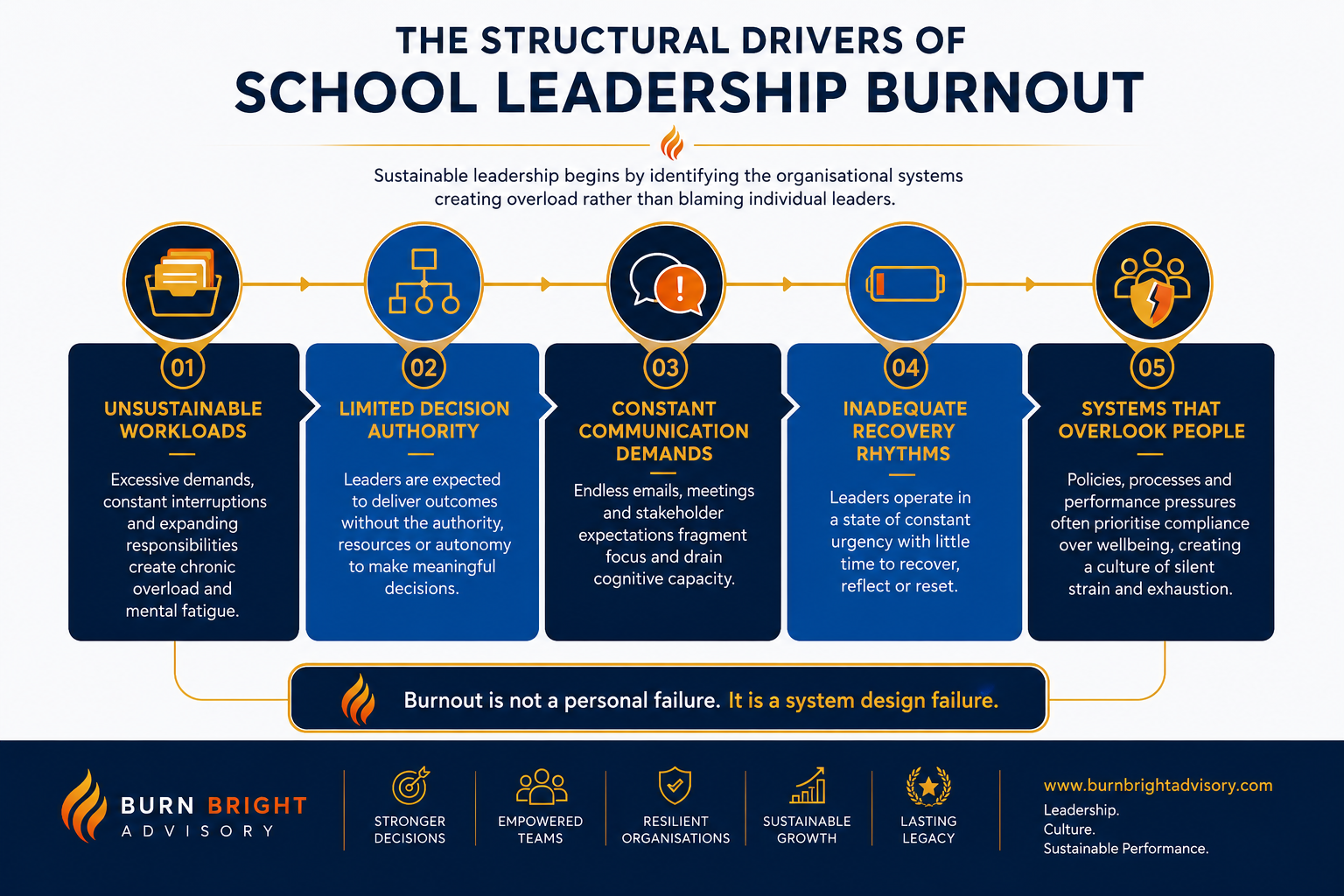
What Are the Structural Causes of Burnout in School Leaders?
Burnout is rarely caused by a single difficult week. It develops when organisational structures repeatedly demand more than leaders can sustainably deliver.
The Burn Bright framework identifies five structural drivers that consistently appear across organisations. Although every school is different, these root causes are remarkably consistent.
The challenge is not commitment.
The challenge is believing that commitment requires constant sacrifice.
Burn Bright argues that organisations should redesign these five structural pressures before asking leaders to become more resilient. Structural transformation always outperforms motivational interventions.
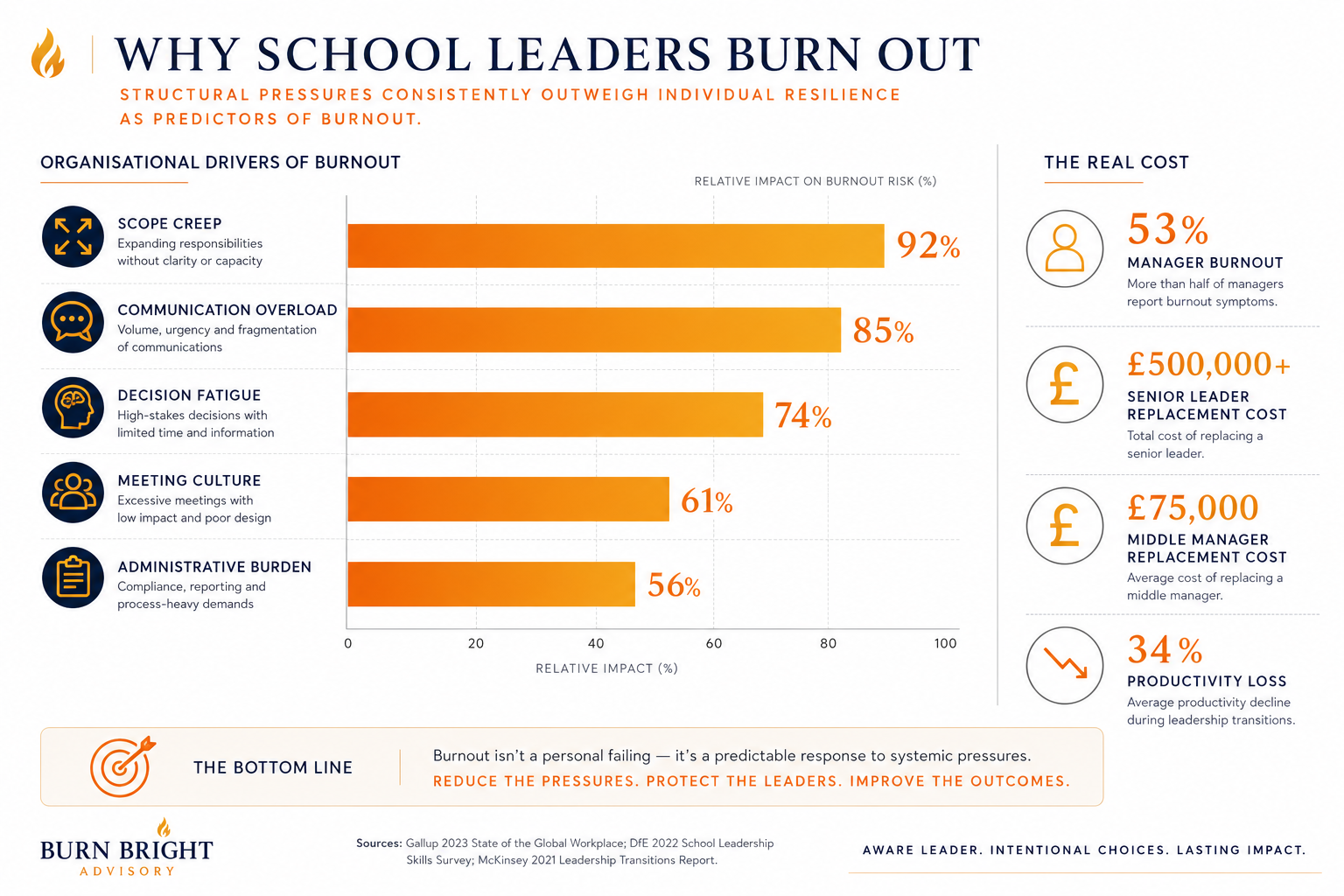
Data Insight
The evidence increasingly shows that burnout follows workload architecture rather than individual personality.
Traditional Leadership vs Sustainable Leadership
| Traditional Leadership | Sustainable Leadership |
|---|---|
| Work longer | Design better systems |
| Be available constantly | Protect strategic time |
| Solve every problem personally | Build team capability |
| Reward heroic effort | Reward sustainable performance |
| Measure busyness | Measure organisational impact |
| React to crises | Prevent recurring problems |
| Focus on resilience | Focus on organisational architecture |
The distinction matters. Traditional leadership often celebrates exhaustion as commitment. Sustainable leadership recognises exhaustion as evidence that the system requires redesign.
This shift represents one of the central ideas throughout Burn Bright Not Out. Sustainable leaders protect both organisational performance and leadership capacity because the two are inseparable.
What Happens When School Leaders Burn Out?
Burnout affects far more than the individual leader. Its impact spreads throughout the entire school.
Teachers receive less coaching.
Parents experience slower communication.
Strategic improvement stalls.
Decision-making becomes reactive.
Innovation declines.
Research consistently demonstrates that leaders experiencing burnout communicate less effectively, delay important decisions and become increasingly focused on immediate operational issues rather than long-term improvement.
Schools then enter a vicious cycle.
Operational problems increase.
Workload grows further.
Leadership capacity continues to decline.
Eventually staff wellbeing begins to mirror leadership wellbeing. Gallup research has repeatedly demonstrated that managers account for a substantial proportion of team engagement, highlighting the influence leaders have on organisational culture.
Educational studies similarly show that schools with stable leadership teams experience stronger staff retention, improved collaboration and more consistent pupil outcomes.
This is why leadership burnout should never be viewed as a personal issue. It is an organisational performance issue.
The Burn Bright framework introduces the concept of the Culture Tax—the hidden financial and operational cost organisations pay every year through turnover, disengagement, reduced productivity and recruitment costs when they fail to address structural causes of burnout.
Replacing experienced leaders is expensive. Beyond recruitment costs, schools lose institutional knowledge, strategic continuity, trusted relationships and momentum. According to the Burn Bright framework, replacing a senior leader can exceed £500,000 when organisational disruption is fully considered, while leadership transitions commonly reduce productivity by 34%.
Why Resilience Alone Will Never Solve Leadership Burnout
Professional development often focuses on resilience — build coping skills, improve time management, practise mindfulness. While each has value, none addresses structural overload.
Teaching a headteacher to manage time more efficiently cannot solve a calendar that contains more work than available hours. Likewise, encouraging better wellbeing habits does little if leaders remain permanently accessible, responsible for expanding workloads and expected to solve every operational challenge.
This is why Vincent Walters argues that burnout is fundamentally a systems problem rather than a motivation problem. Leaders cannot outwork broken systems.
Instead of asking: “How can leaders cope better?”
Schools should ask: “Why have we designed leadership roles that require coping at this level?”
That single question changes everything. It shifts attention away from fixing individuals and towards redesigning organisational architecture. It replaces heroic leadership with sustainable leadership — and it creates schools where both leaders and teachers have the capacity to perform at their best over the long term.
How Can School Leaders Prevent Burnout?
Preventing burnout requires more than reducing workload. It requires redesigning how leadership work is organised.
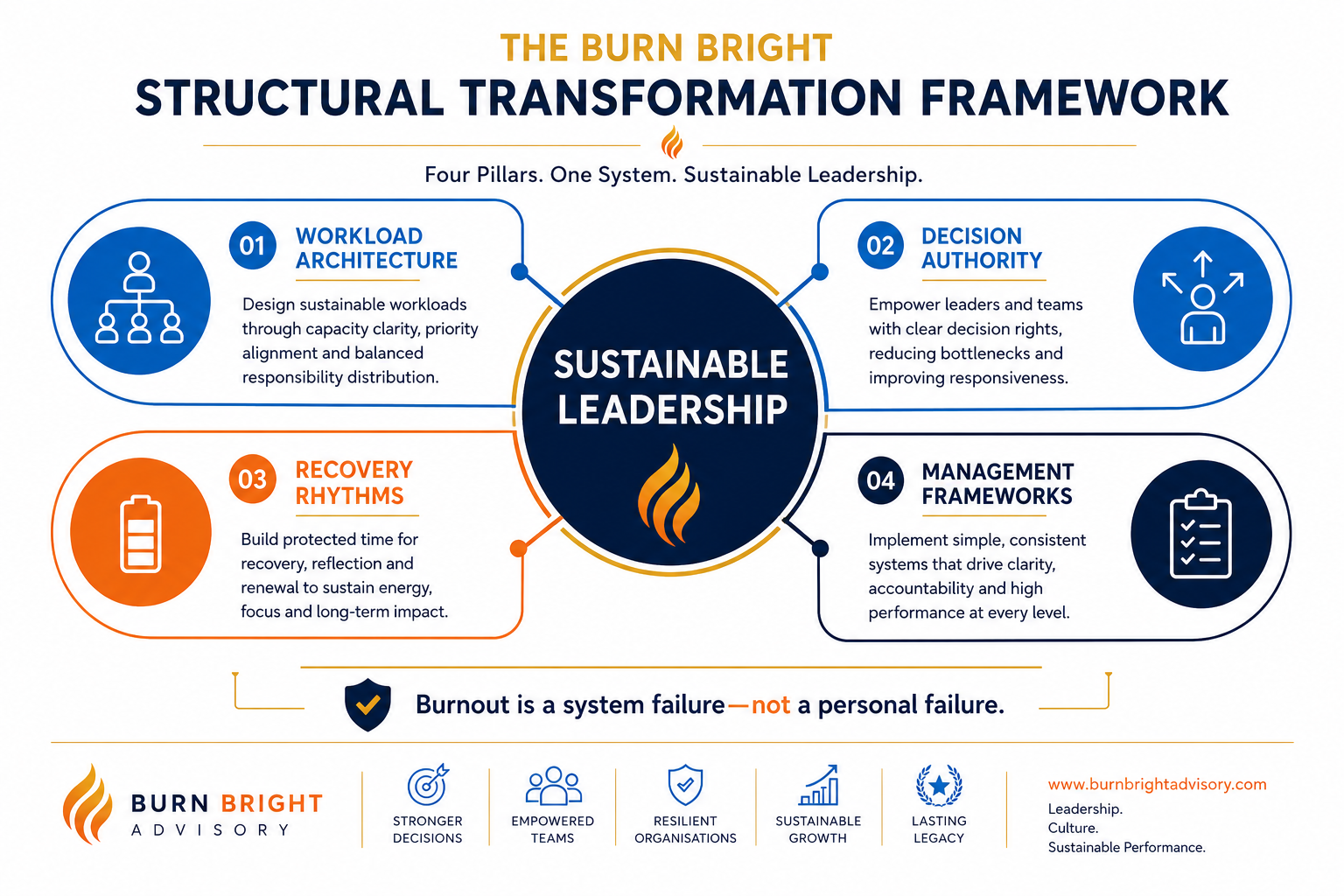
The Burn Bright Framework identifies four structural pillars that create sustainable leadership. Rather than relying on individual resilience, these pillars reshape the systems that generate overload in the first place.
Pillar 1
Workload Architecture
Every responsibility should have a clear purpose, owner and outcome. Regular workload audits help identify activities that can be eliminated, delegated or simplified.
The question should never be “Can we fit one more initiative into the calendar?” Instead ask: “What must stop before something new begins?”
Pillar 2
Decision Authority
Many school leaders become decision bottlenecks. Empowering middle leaders with clear decision-making authority reduces cognitive overload while developing future leadership capacity. Delegation is not abdication — it is intentional leadership design.
Frameworks such as the RACI model and the Burn Bright IMPACT Matrix provide structured approaches to distributing responsibility without sacrificing accountability.
Pillar 3
Recovery Rhythms
Recovery should be designed into leadership rather than treated as an occasional reward.
- Protected strategic thinking time
- No-meeting periods
- Digital boundaries
- Annual workload reviews
Pillar 4
Management Frameworks
Great leaders reduce uncertainty by creating repeatable systems — clear meeting protocols, decision filters, communication standards and escalation pathways. These reduce unnecessary cognitive effort and free leaders to focus on what matters most: improving teaching, learning and organisational culture.
Sustainable Leadership Framework
Small structural improvements compound over time to produce healthier leaders and stronger schools.
What causes burnout in school leaders?
Burnout is usually caused by sustained organisational overload rather than individual weakness. Expanding responsibilities, constant interruptions, excessive decision-making and limited recovery combine to create leadership roles that become structurally unsustainable.
Can resilient leaders still experience burnout?
Yes. Many of the most resilient leaders eventually burn out because resilience cannot compensate indefinitely for poorly designed systems. Strong people often stay in failing systems longer, making burnout more likely rather than less likely.
What are the first warning signs?
Common early indicators include constant fatigue, declining concentration, slower decision-making, emotional detachment, increasing cynicism and feeling permanently behind despite working longer hours.
Does leadership burnout affect teachers?
Absolutely. School culture reflects leadership culture. When leaders become exhausted, communication declines, decision-making slows and staff support weakens. Teacher engagement, morale and retention are all influenced by leadership wellbeing.
How can schools reduce leadership burnout?
Schools reduce burnout by redesigning workload, simplifying communication, improving delegation, protecting strategic time and removing unnecessary administrative complexity. Sustainable systems consistently outperform individual coping strategies.
Conclusion
Burnout school leaders is no longer an isolated wellbeing issue. It is one of the defining organisational challenges facing modern education.
As expectations continue to grow, schools cannot expect individual leaders to absorb unlimited complexity through greater effort alone.
Burnout is not evidence of weak leadership.
It is evidence that leadership systems require redesign.
Schools that continue rewarding heroic overwork will struggle to retain experienced leaders, develop future talent and maintain long-term organisational performance.
The alternative is sustainable leadership. By redesigning workload architecture, clarifying decision authority, protecting recovery and implementing consistent management frameworks, schools create environments where leaders can think strategically, support their teams and sustain high performance over many years.
Take the Free Leadership Burnout Self-Assessment
If this article reflects your current experience, discover where your own leadership system is under pressure — and the practical actions that can help you move from depletion to sustainable leadership.
Free Leadership Intelligence
Get Weekly Leadership Insights
Join thousands of leaders receiving practical strategies on burnout prevention, workload design, and sustainable performance every week.