Quick Answer
Key Takeaways
- Leadership begins with strong foundations rather than position or authority.
- Sustainable leadership depends on developing Leadership Performance Intelligence™.
- Leadership capability grows through reflection, learning and intentional practice.
- High-performing organisations invest in leadership systems, not individual heroics.
- Strong leadership foundations improve organisational performance across every sector.
Foundations of Leadership: Building Leadership Performance Intelligence™ for Sustainable Success
Introduction
Leadership has never existed in a vacuum, but today’s leaders operate in an environment unlike any before. Economic uncertainty, technological acceleration, workforce transformation, increasing stakeholder expectations and continuous organisational change have fundamentally altered what effective leadership requires.
For decades, leadership development concentrated on competencies, personality traits or management techniques. Organisations invested heavily in communication workshops, strategic planning programmes and performance management systems, believing that improving isolated skills would naturally produce better leaders. While these approaches remain valuable, they often overlook a more fundamental question:
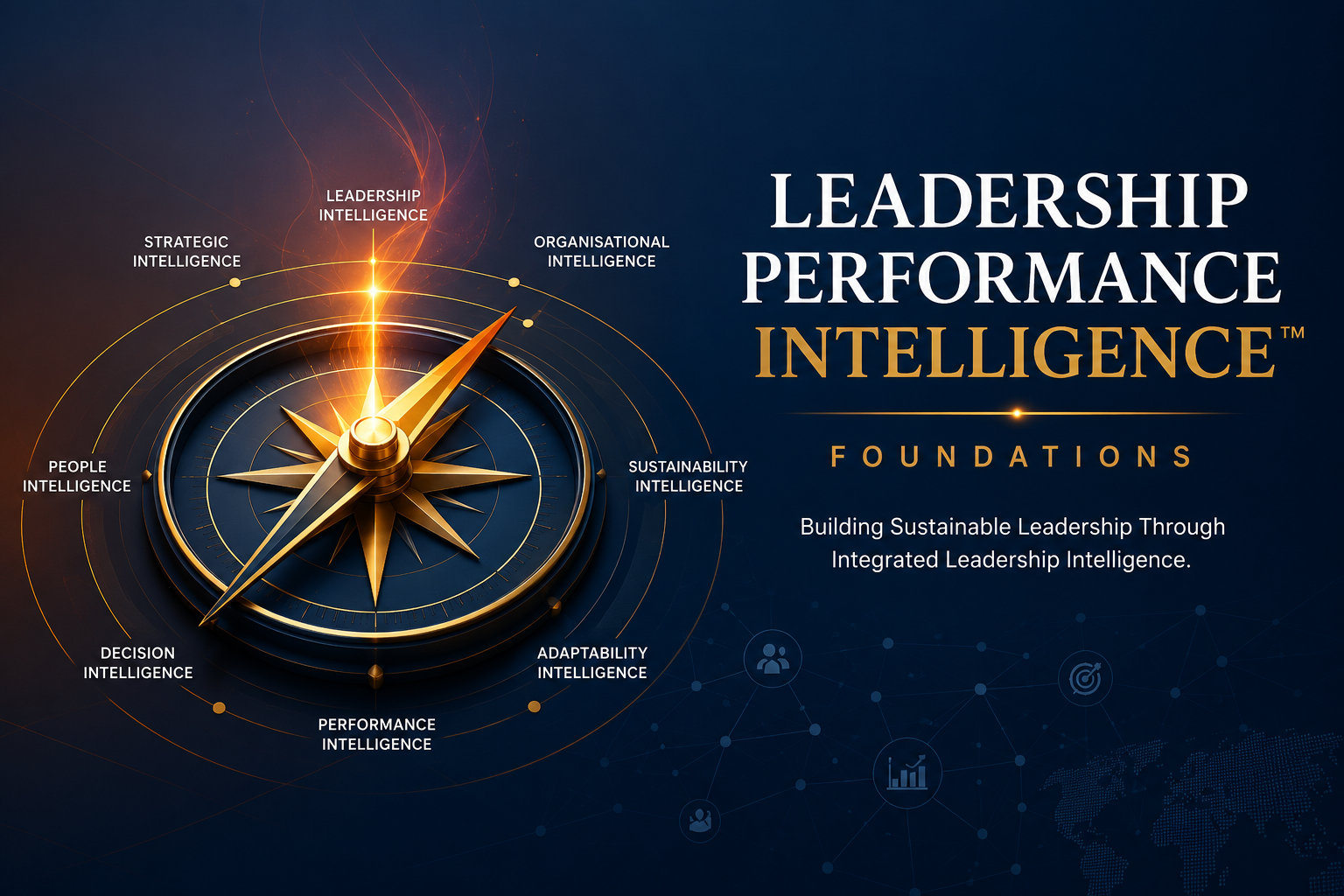
Leadership excellence is not built through occasional moments of inspiration. It is developed through an integrated set of capabilities that shape how leaders think, learn, decide, influence and sustain performance throughout their careers. This is the central philosophy behind Leadership Performance Intelligence™.
Rather than viewing leadership as a collection of independent skills, Leadership Performance Intelligence™ recognises leadership as an interconnected system of cognitive, behavioural, emotional and ethical capabilities. Every decision a leader makes influences organisational culture, employee wellbeing, innovation, stakeholder confidence and long-term organisational sustainability.
When these capabilities develop together, leadership becomes increasingly resilient.
When they develop unevenly, organisations often experience inconsistent decision-making, declining engagement, ethical failures and leadership burnout.
Strong foundations therefore become the difference between leaders who merely manage complexity and those who consistently create value within it.
Featured Snippet
Why Leadership Foundations Matter More Than Ever
The pace of organisational change continues to increase.
Artificial intelligence is transforming decision-making.
Hybrid working has altered communication.
Economic uncertainty has increased organisational pressure.
Employees increasingly seek purpose, psychological safety and authentic leadership rather than positional authority. At the same time, leaders are expected to produce better results using fewer resources while responding to continual disruption.
These demands expose an important reality: leadership capability cannot rely solely on technical expertise. Many outstanding professionals are promoted because they excel within their specialist discipline. Yet leadership quickly requires entirely different capabilities. Success depends upon:
- Judgement rather than knowledge alone
- Influence rather than authority
- Reflection rather than reaction
- Adaptability rather than certainty
- Ethical reasoning rather than procedural compliance
- Sustainable performance rather than continual sacrifice
Without these foundations, leadership becomes increasingly reactive.
With them, leaders create organisations capable of thriving despite uncertainty.
Leadership Performance Intelligence™: A Foundation Rather Than a Framework
Traditional leadership models often separate technical skills, emotional intelligence and strategic thinking into independent development programmes. Leadership Performance Intelligence™ integrates these capabilities into one coherent leadership system.
This integrated approach recognises that leadership decisions are rarely isolated events. Every significant leadership decision simultaneously involves:
- Ethical judgement
- Emotional regulation
- Strategic thinking
- Stakeholder awareness
- Organisational learning
- Professional standards
- Adaptability
- Long-term sustainability
Improving only one capability rarely transforms leadership performance.
Developing them collectively does.
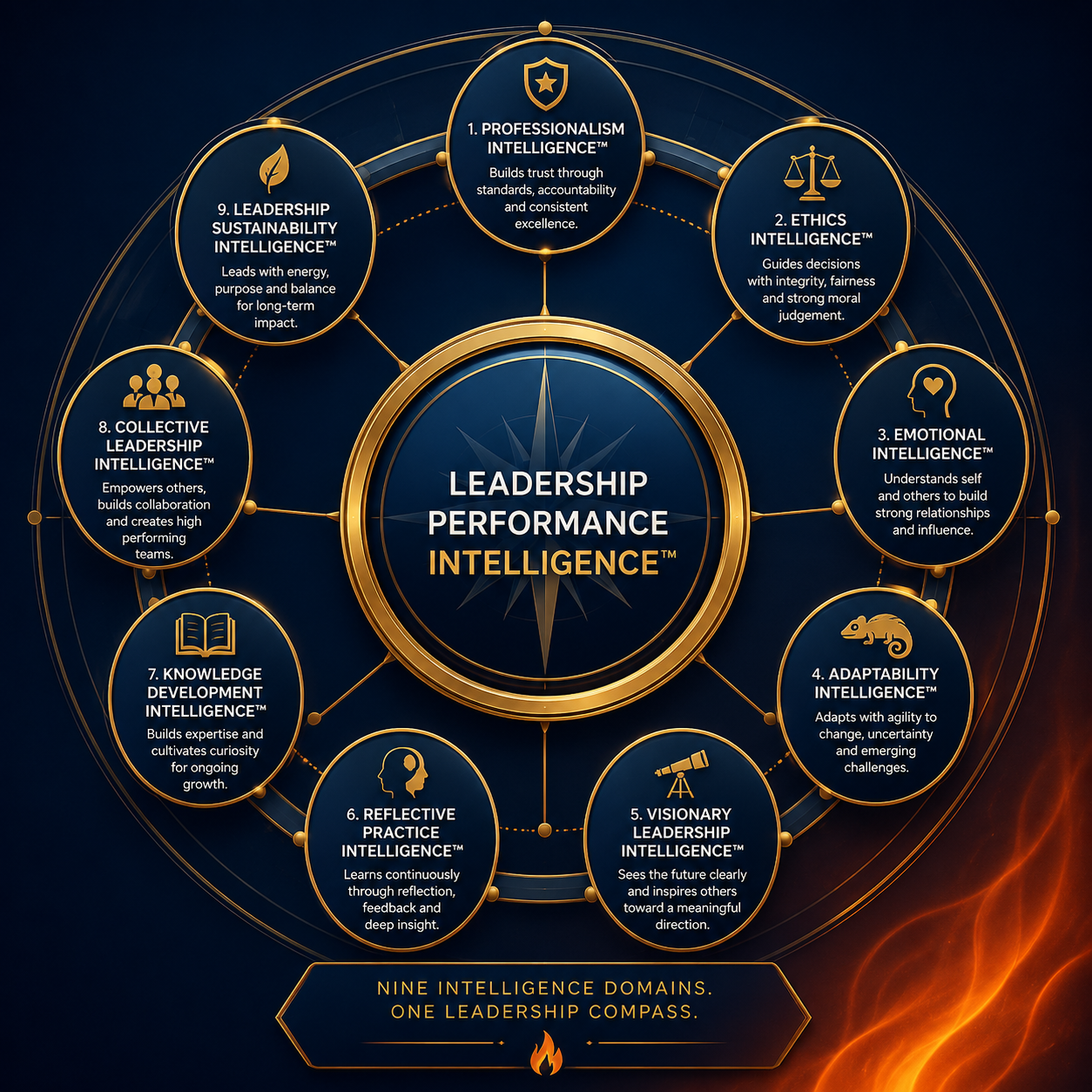
The Leadership Intelligence Compass™
Burn Bright Advisory™ brings these interconnected capabilities together through the Leadership Intelligence Compass™, a practical way of understanding leadership development as an ongoing process rather than a destination. Its core domains include:
Domain 1
Professionalism Intelligence™
Professional leaders establish credibility through consistency, accountability and disciplined execution. Professionalism creates trust because stakeholders know what they can expect. Without it, leadership influence quickly becomes unstable.
Domain 2
Ethics Intelligence™
Every leadership decision contains ethical consequences. Ethics Intelligence™ supports transparent decision-making, fairness, integrity and responsible organisational governance, building higher levels of employee trust and long-term stakeholder confidence.
Domain 3
Constructivism Intelligence™
Modern leadership is less about providing answers and more about helping organisations create new knowledge together. This domain encourages collaboration, shared learning and adaptive problem-solving, so that solutions emerge collectively rather than being directed.
Domain 4
Adaptability Intelligence™
The future cannot be managed using yesterday’s assumptions. Adaptability Intelligence™ enables leaders to respond confidently to uncertainty and disruption without sacrificing strategic direction, keeping organisations resilient through continuous learning.
Domain 5
Visionary Leadership Intelligence™
Vision provides meaning; strategy provides direction. Visionary leaders connect today’s decisions with tomorrow’s possibilities, helping people understand why their work matters within a broader organisational purpose.
Domain 6
Reflective Practice Intelligence™
Reflection transforms experience into learning. Without it, leaders simply accumulate experiences; with it, experience becomes a source of wisdom, judgement and improved future performance.
Domain 7
Knowledge Development Intelligence™
Leadership depends upon continual learning. This domain encourages curiosity and evidence-informed decision-making, preparing leaders to navigate emerging challenges rather than relying solely on past success.
Domain 8
Emotional Intelligence™
Leadership is fundamentally relational. Emotional Intelligence™ strengthens communication, empathy, conflict resolution and psychological safety, creating cultures where people feel valued and capable of performing at their highest level.
Domain 9
Leadership Sustainability™
Sustainable leadership recognises that organisational performance cannot exceed leadership capacity indefinitely. This domain balances ambition with resilience, ensuring leaders maintain the energy and judgement necessary for long-term effectiveness.
Leadership Is a System, Not a Collection of Skills
One of the greatest misconceptions in leadership development is the belief that leaders simply need to improve individual competencies. Real organisations rarely operate this way.
Decision-making influences organisational culture.
Culture shapes engagement.
Engagement affects innovation.
Innovation determines organisational performance.
Performance influences wellbeing.
Wellbeing affects future leadership capacity.
Every element is interconnected. Leadership Performance Intelligence™ therefore encourages systems thinking. Instead of asking “How can I become a better communicator?” leaders begin asking “How does communication influence trust, culture, decision quality and long-term organisational performance?”
Foundations Before Performance
Many organisations attempt to improve organisational performance without first strengthening leadership foundations. This often produces short-term improvement followed by gradual decline.
Strong leadership foundations create sustainable performance because they improve the quality of every subsequent leadership decision. Leadership development therefore becomes an investment rather than an intervention.
Leadership foundations are therefore not the beginning of leadership. They are the conditions that allow leadership excellence to continue throughout an entire career.
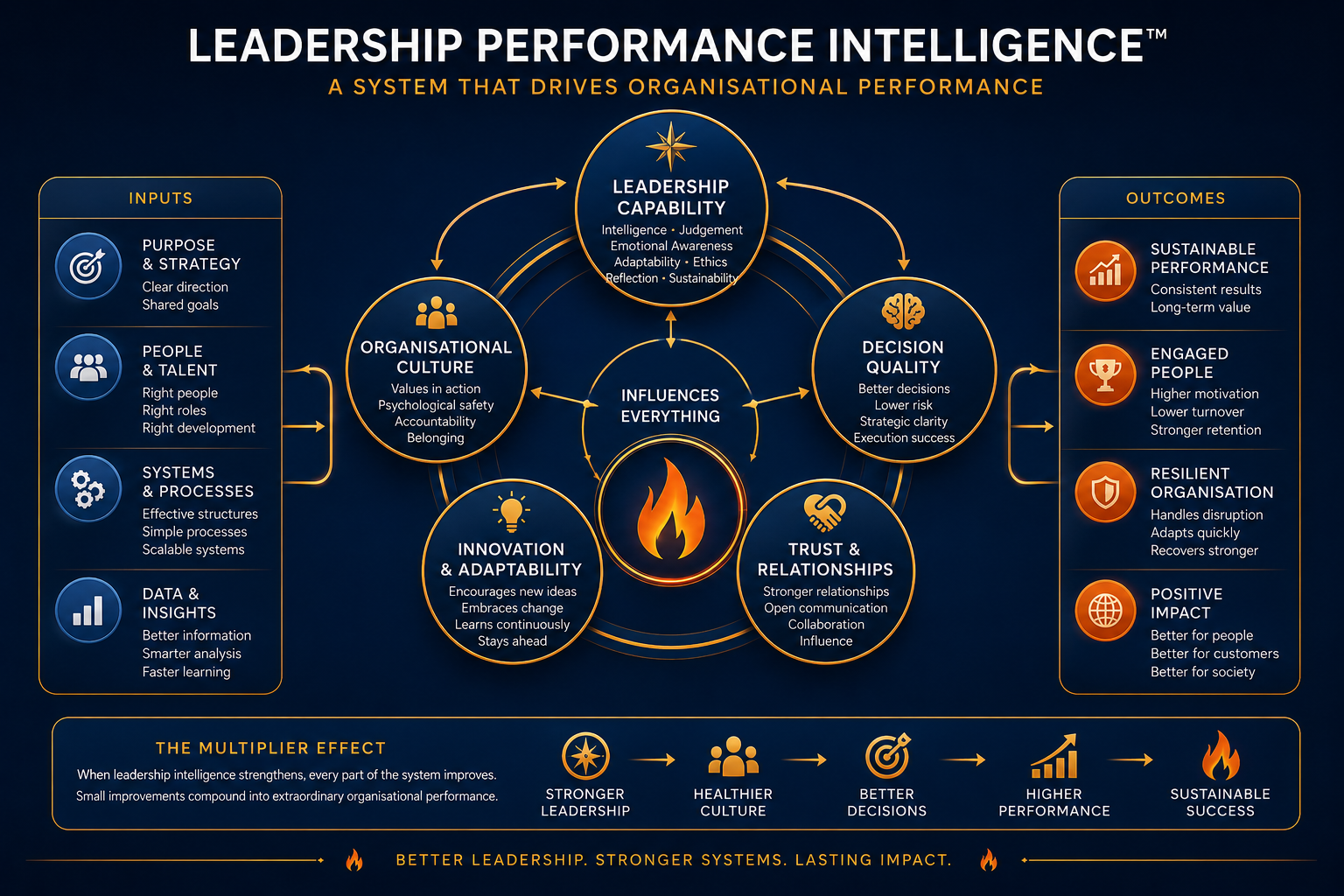
Building Leadership Capacity Through Integrated Intelligence
Leadership capability is often measured by visible outcomes — financial performance, employee engagement, organisational growth or strategic delivery. While these outcomes matter, they are ultimately lagging indicators of something much deeper: leadership capacity.
Leadership capacity represents a leader’s ability to think clearly under pressure, adapt to changing circumstances, make sound ethical decisions, develop others and sustain high performance over time. Within Leadership Performance Intelligence™, capacity is not fixed — it can be deliberately strengthened through continuous learning, structured reflection and purposeful development across all domains of the Leadership Intelligence Compass™.
Leaders with high leadership capacity consistently demonstrate several characteristics:
- They remain composed during uncertainty.
- They make decisions using evidence rather than emotion alone.
- They balance short-term operational demands with long-term strategic priorities.
- They encourage learning rather than blame.
- They continuously invest in developing themselves and others.
The Relationship Between Leadership Capacity and Organisational Performance
Organisations often attempt to improve performance through structural change, new technology or revised processes. While these initiatives can create value, they rarely achieve their full potential without corresponding improvements in leadership capability. Leadership acts as the multiplier. Leadership Performance Intelligence™ identifies five organisational outcomes that consistently improve when leadership foundations are strengthened.
Outcome 1 Better Decision-Making
Leaders equipped with multiple forms of intelligence consider wider perspectives before making decisions, integrating evidence, ethics, stakeholder needs and strategic implications. This produces decisions that are faster and significantly more sustainable.
Outcome 2 Higher Trust
Trust develops when leaders consistently demonstrate integrity, competence and transparency. Professionalism Intelligence™ and Ethics Intelligence™ reduce unnecessary bureaucracy and enable faster collaboration across teams.
Outcome 3 Greater Innovation
Innovation rarely emerges within cultures dominated by fear. Constructivism Intelligence™, Emotional Intelligence™ and Reflective Practice Intelligence™ create psychologically safe environments where people are encouraged to experiment and learn from failure.
Outcome 4 Stronger Adaptability
Organisations that respond effectively to disruption usually possess leaders who embrace learning rather than certainty, helping people navigate transitions with confidence rather than resisting change.
Outcome 5 Sustainable Performance
Instead of continually demanding more from leaders until burnout occurs, sustainable organisations deliberately protect leadership capacity, strengthening succession planning and long-term performance.
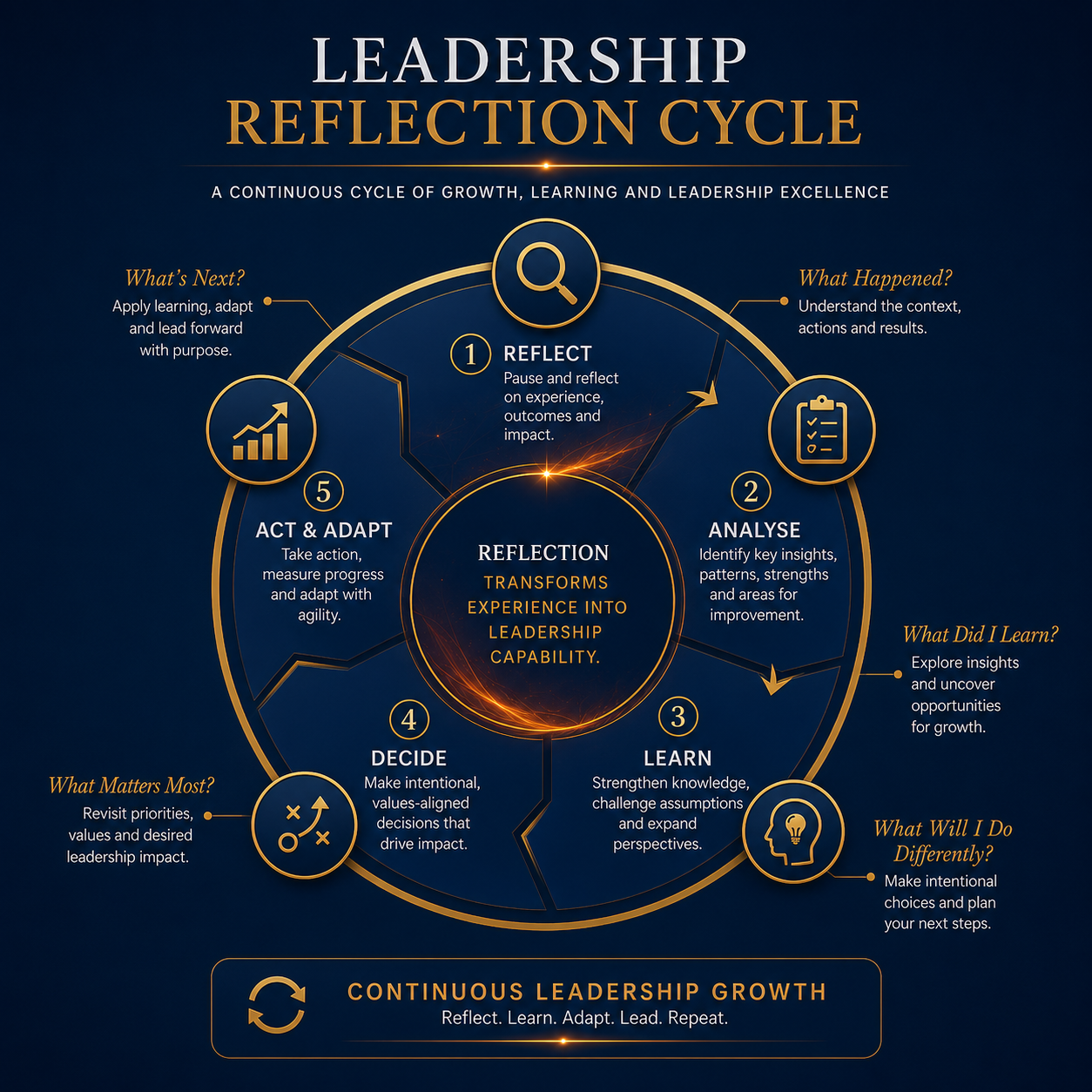
Leadership Reflection: The Foundation of Continuous Improvement
Reflection transforms experience into capability.
Without structured reflection, leaders simply accumulate years of experience.
With reflective practice, every experience becomes an opportunity to improve judgement, communication and decision-making.
Leadership Reflection™ encourages leaders to ask questions such as:
- What assumptions influenced today’s decisions?
- Which conversations created the greatest value?
- Where did bias influence judgement?
- What evidence supported my decision?
- How did my behaviour influence the team?
- What should I continue, improve or stop doing?
Leadership Sustainability™: Redefining High Performance
Traditional leadership often celebrates endurance.
Long hours.
Constant availability.
Sacrificing wellbeing for organisational success.
Leadership Performance Intelligence™ challenges this assumption. Sustainable leadership recognises that exhausted leaders eventually make poorer decisions — fatigue narrows thinking, stress reduces emotional regulation, and burnout weakens judgement. Over time, these factors undermine organisational performance far more than temporary reductions in workload ever could.
Sustainable leaders intentionally manage:
- Cognitive workload
- Emotional energy
- Decision fatigue
- Recovery
- Professional development
- Delegation
- Succession planning
They understand that resilience is created through intelligent systems rather than personal sacrifice.
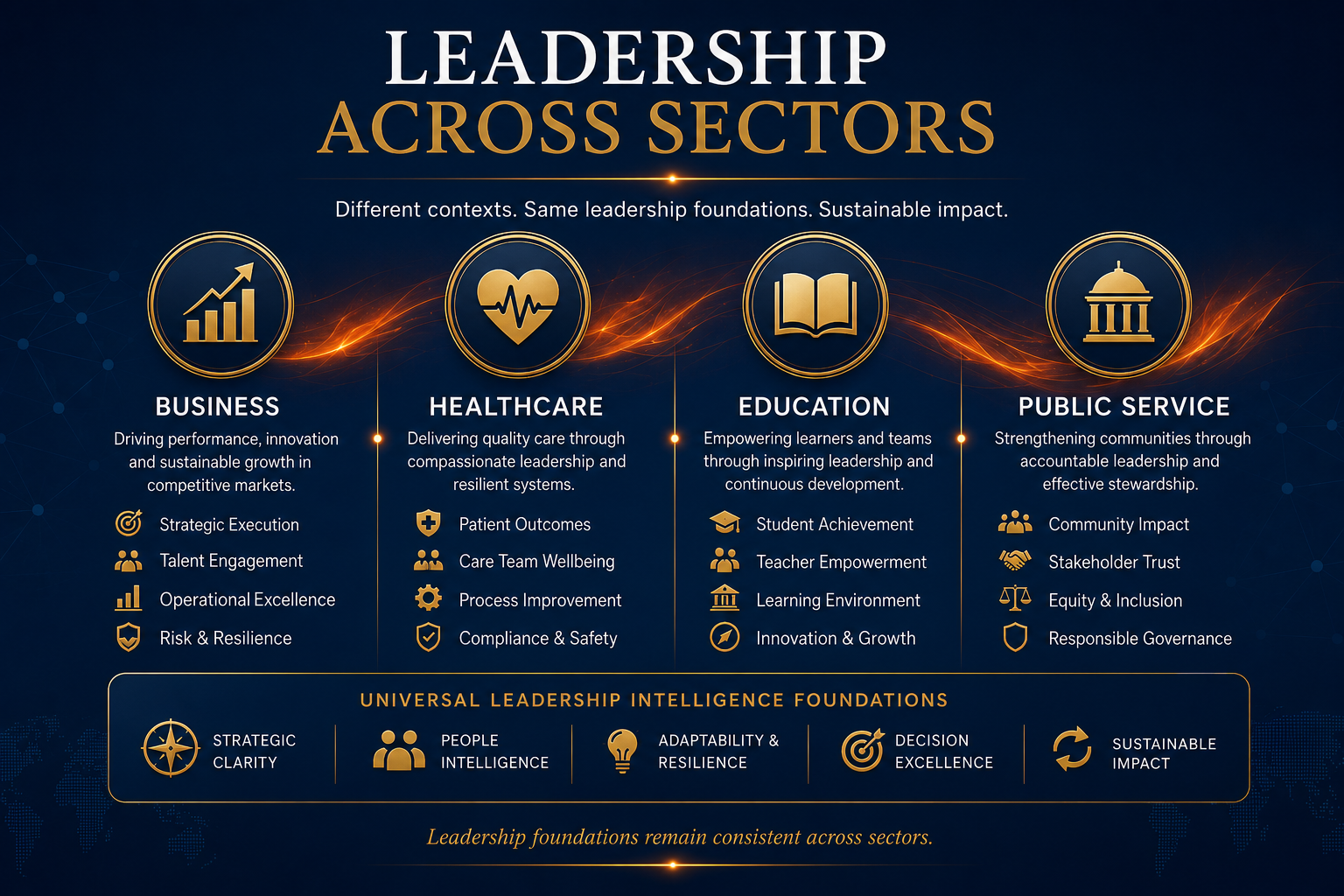
Sector Applications of Leadership Foundations
Although every organisation is unique, the principles of Leadership Performance Intelligence™ apply consistently across sectors.
Business
Commercial leaders must balance profitability with innovation, customer expectations and employee engagement. Strong leadership foundations improve strategic thinking, organisational agility and sustainable growth.
Education
Educational leaders influence learning cultures that extend well beyond classrooms. Leadership foundations strengthen collaboration, professional learning communities and organisational improvement.
Healthcare
Healthcare leadership requires exceptional judgement under pressure. Leadership Performance Intelligence™ supports ethical decision-making, multidisciplinary collaboration and workforce wellbeing.
Public Service
Public sector leaders operate within environments of high accountability and competing stakeholder expectations. Leadership foundations strengthen transparency, public trust and long-term policy implementation.
Human Resources and People Leadership
HR leaders increasingly shape organisational culture rather than simply managing employment processes. Leadership Intelligence strengthens capability development, succession planning and organisational sustainability.
Entrepreneurship
Entrepreneurs often face rapid growth, uncertainty and limited resources. Leadership foundations provide the stability required to scale organisations while preserving culture, purpose and long-term resilience.
Leadership Foundations Are Built Daily
Leadership development is rarely transformed through one course, one conference or one inspirational speech. It is developed through thousands of daily decisions.
Every conversation.
Every difficult decision.
Every moment of reflection.
Every opportunity to develop another person.
Leadership Performance Intelligence™ provides a practical framework for ensuring these daily moments contribute towards stronger leadership capability rather than simply greater experience. These foundations ultimately determine not only how leaders perform today, but the legacy they create for the people and organisations they serve.
Conclusion
Leadership has always been about influence, but the nature of that influence continues to evolve. Organisations no longer require leaders who simply direct activity or manage processes. They require leaders who can think systemically, adapt continuously, act ethically and sustain high performance in environments characterised by complexity and change.
These capabilities do not emerge by chance. They are built upon strong leadership foundations. Leadership Performance Intelligence™ provides a comprehensive approach to developing these foundations by recognising that effective leadership depends upon the integration of multiple forms of intelligence rather than isolated competencies.
For organisations, investment in leadership foundations strengthens organisational resilience, improves culture, increases innovation and develops future leadership capacity. For individual leaders, leadership becomes less about maintaining control and more about creating conditions in which people, teams and organisations flourish together.
Ultimately, the strongest organisations are not those with the most charismatic leaders. They are those that deliberately cultivate Leadership Performance Intelligence™ throughout every level of leadership.
Reflection Questions
- Which leadership strengths consistently support my effectiveness?
- Which Leadership Intelligence Compass™ domains require the greatest development?
- How well do my daily leadership behaviours reflect my organisational values?
- When making decisions, do I balance evidence, ethics and long-term organisational impact?
- How effectively do I create psychological safety for my team?
- What habits contribute most to my Leadership Sustainability™?
- Where am I relying on past experience rather than continuous learning?
- How intentionally do I develop leadership capability in others?
- What leadership behaviours do I consistently model for my organisation?
- If my team copied my leadership habits exactly, would the organisation become stronger?
Action Steps
Strengthening leadership foundations requires deliberate, consistent action.
This Week
Identify one Leadership Intelligence Compass™ domain for focused development. Schedule thirty minutes for structured leadership reflection. Seek constructive feedback from a trusted colleague or mentor. Review one recent leadership decision using ethical, strategic and organisational perspectives.
This Month
Complete a comprehensive Leadership Intelligence Assessment™. Develop a personal leadership development plan. Introduce regular reflective conversations within your team. Identify opportunities to delegate responsibility that supports leadership growth in others.
This Quarter
Benchmark leadership capability across your team. Review organisational culture through the lens of Leadership Performance Intelligence™. Evaluate leadership sustainability, workload and decision-making capacity. Align leadership development initiatives with long-term organisational strategy.
What are leadership foundations?
Leadership foundations are the core capabilities, behaviours and principles that enable leaders to make effective decisions, build trust, develop people and sustain organisational performance over time.
What is Leadership Performance Intelligence™?
Leadership Performance Intelligence™ is Burn Bright Advisory’s integrated framework for developing leadership capability through interconnected domains including professionalism, ethics, adaptability, emotional intelligence, reflective practice and leadership sustainability.
Why are leadership foundations important?
Strong leadership foundations improve decision-making, organisational culture, employee engagement, innovation and long-term organisational resilience.
How is Leadership Performance Intelligence™ different from traditional leadership models?
Traditional models often focus on individual competencies. Leadership Performance Intelligence™ integrates multiple leadership intelligences into one comprehensive system that supports sustainable organisational performance.
Can leadership capability be developed?
Yes. Leadership capability develops through structured learning, reflective practice, experience, coaching and continuous professional development.
Which sectors benefit from Leadership Performance Intelligence™?
The framework applies across business, education, healthcare, public service, human resources, entrepreneurship and not-for-profit organisations because its principles are based on sustainable leadership capability rather than sector-specific management practices.
What role does reflection play in leadership?
Reflection enables leaders to convert experience into learning, improve judgement, recognise bias and continually strengthen decision-making.
Why is Leadership Sustainability™ important?
Leadership Sustainability™ ensures leaders maintain the physical, emotional and cognitive capacity required for long-term effectiveness while reducing the risk of burnout and declining organisational performance.
Where Do Your Leadership Foundations Stand?
Discover which Leadership Intelligence Compass™ domains need the greatest development and build a personal plan for sustainable leadership performance.
Free Leadership Intelligence
Get Weekly Leadership Insights
Join thousands of leaders receiving practical strategies on burnout prevention, workload design, and sustainable performance every week.